I was at supper at his house, and he was not inclined to let me leave him at my usual time. 'If you go,' he said, 'there will be nothing for it but I must go to bed and dream of the chrysalis.' 'You might be worse off,' said I. 'I do not think it,' he said, and he shook himself like a man who is displeased with the connexion of his thoughts. 'I only meant,' said I, 'that a chrysalis is an innocent thing.' 'This one is not,' he said, 'and I do not care to think of it.'
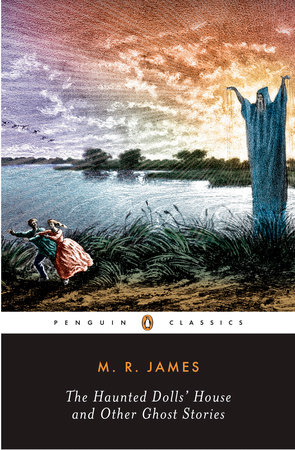
I read M. R. James' collection of ghost stories, Count Magnus, around last Halloween, and figured I might as well take this Halloween as an opportunity to read its companion collection, The Haunted Dolls' House. These stories have the same hallmarks as the first collection: they're set among stuffy British country houses and boarding schools; their ghosts and ghouls are linked to ancient and medieval objects and lithographs and old folderol like that; yet the ghosts and ghouls themselves are quite creepy. The monsters of The Haunted Dolls' House begin to bear a tedious similarity to the ones in Count Magnus--James has a thing for monsters made of nothing but hair--but still they are in effective contrast to the stories' gentility. James has a real knack for breaking through a fussy Victorian scene with the briefest glimpse of a horrible vision, like the friend above who admits, without any prior context, "I must go to bed and dream of the chrysalis." The chrysalis.
My favorites in this collection all center on the British countryside. The countryside, in British literature, is picturesque and historical, a setting for wanderers and tourists like Wordsworth. "A View from a Hill," plays on both of those expectations: it centers on a pair of binoculars, constructed by a mad experimenter using a dead man's eyes, that allows the viewer to see the particular towns--and the gallow's pole--as they were hundreds of years ago. Another, "A Warning to the Curious," repurposes an old legend about Anglo-Saxon crowns buried on England's eastern shore, which have kept the island safe from invasion, and which are guarded by a relentless spirit. The best story, "A Neighbour's Landmark," is no more inventive than a spirit who haunts a certain grove of trees, but the story's protagonist learns about it first as an aside in a historical pamphlet.
James knew that monsters are scariest when they're at arm's length, not just in space, but in time. Ghosts are the past come back to haunt us, as it haunts, in a manner of speaking, the classicist and the historian. The stories pile veil upon veil; every single one is in some way a story reported by a friend about a friend of theirs, or some other kind of multi-layered contrivance. There's a metaphor in there for the process of historical understanding, which passes through so many generations of understanding that you're never quite sure if you've got your eyes set on something real. In James, the horribleness of the beasts slices through these layers of interpretation, too awful to be legendary, and too ridiculous to be real.
Showing posts with label M. R. James. Show all posts
Tuesday, November 6, 2018
Sunday, October 29, 2017
Count Magnus and Other Stories by M. R. James
So he put his hand into the well-known nook under the pillow: only, it did not get so far. What he touched was, according to his account, a mouth, with teeth, and with hair about it, and he declares, not the mouth of a human being.
M. R. James was a well-regarded Classical scholar who also happened to dabble in ghost stories. His stories are often described as "antiquarian," and they read exactly like the kind of story you might expect a Classical scholar to write. The ghosts, ghouls, and monsters are often relics of a past age, accessed through a spooky artifact like an illuminated manuscript. In one of the best stories, "The Mezzotint," the supernatural object is actually just a lithograph print depicting a country house, but the collector who acquires it notices that every time he looks at it a frightening shrouded figure has moved to a new spot in the picture, until he's made his way into the house and carried out an unsuspecting little boy. They also take place against the backdrop of the stuffy world of Oxbridge; another story, "Casting the Runes," is all about a devious alchemist who uses his black magic to seek revenge on the scholar who refused to publish his monograph. In another standout, "A School Story," a murdered man communicates with his murderer through his students' Latin exercises.
The best thing, I think, about James' stories, is how frightening and particular the various monsters are. There's the mouth under the pillow above, but I also liked the monster from "Canon Alberic's Scrap Book," which has "[p]ale, dusky skin, covering nothing but bones and tendons of appalling strength; coarse black hairs, longer than ever grew on a human hand; nails rising from the ends of the fingers and curving sharply down and forward, grey, horny and wrinkled." These disheveled ghouls are a perfect contrast to the gentility and decorum of James' professors and barristers and classicists.
My favorites are: "Number 13," in which the title hotel room appears at night and disappears during the day, housing a man who once made a deal with the devil to escape the hangman's noose, and the title story, "Count Magnus," about a medieval count who continues to hang out with demons long after his death. Count Magnus is hardly ever seen, but the story is a masterwork of suspense. Like most of the stories here, it's reported through several layers of hearsay, but that fails to dilute this image: "Also Anders Bjornsen was there, but he was dead. And I tell you this about Anders Bjornsen, that he was once a beautiful man, but now his face was not there, because the flesh of it was sucked away from his bones." Nice. Happy Halloween, everyone!
M. R. James was a well-regarded Classical scholar who also happened to dabble in ghost stories. His stories are often described as "antiquarian," and they read exactly like the kind of story you might expect a Classical scholar to write. The ghosts, ghouls, and monsters are often relics of a past age, accessed through a spooky artifact like an illuminated manuscript. In one of the best stories, "The Mezzotint," the supernatural object is actually just a lithograph print depicting a country house, but the collector who acquires it notices that every time he looks at it a frightening shrouded figure has moved to a new spot in the picture, until he's made his way into the house and carried out an unsuspecting little boy. They also take place against the backdrop of the stuffy world of Oxbridge; another story, "Casting the Runes," is all about a devious alchemist who uses his black magic to seek revenge on the scholar who refused to publish his monograph. In another standout, "A School Story," a murdered man communicates with his murderer through his students' Latin exercises.
The best thing, I think, about James' stories, is how frightening and particular the various monsters are. There's the mouth under the pillow above, but I also liked the monster from "Canon Alberic's Scrap Book," which has "[p]ale, dusky skin, covering nothing but bones and tendons of appalling strength; coarse black hairs, longer than ever grew on a human hand; nails rising from the ends of the fingers and curving sharply down and forward, grey, horny and wrinkled." These disheveled ghouls are a perfect contrast to the gentility and decorum of James' professors and barristers and classicists.
My favorites are: "Number 13," in which the title hotel room appears at night and disappears during the day, housing a man who once made a deal with the devil to escape the hangman's noose, and the title story, "Count Magnus," about a medieval count who continues to hang out with demons long after his death. Count Magnus is hardly ever seen, but the story is a masterwork of suspense. Like most of the stories here, it's reported through several layers of hearsay, but that fails to dilute this image: "Also Anders Bjornsen was there, but he was dead. And I tell you this about Anders Bjornsen, that he was once a beautiful man, but now his face was not there, because the flesh of it was sucked away from his bones." Nice. Happy Halloween, everyone!
Labels:
Count Magnus,
horror,
M. R. James,
short stories
Subscribe to:
Posts (Atom)
