Wednesday, February 1, 2023

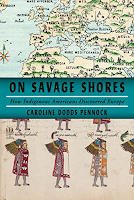
On Savage Shores: How Indigenous Americans Discovered Europe by Caroline Dodds Pennock

Once the first shocks of invasion were past, the Native men (and occasionally women) who crossed the Atlantic for political purposes were ordinarily not isolated pioneers striking out into the unknown. They were sophisticated diplomats, aware of the nuances of what we would all international law (the foundations of which were being laid in this period, often in response to the challenges of indigenous diplomacy), and able to draw on the experience and support of previous travellers, legal advocates and colonial officials.

I'm looking forward to when, in a couple weeks, my friends and I return to Ocracoke Island in North Carolina, where we've been going every February for over a decade. The island is already rich with history--it was the favorite haunt of Blackbeard--but when I go this time, I'll be thinking of a story Caroline Dodds Pennock tells in her history On Savage Shores: Manteo and Wanchese, two Croatan men who had traveled to England in the late 16th century to meet Sir Walter Raleigh and Queen Elizabeth I, were on their way home when, off the shore of Ocracoke, then called Wococon, their ship ran aground and begun to sink. "We can only imagine the feelings of Manteo and Wanchese," Pennock writes, "after nearly a year away, fearing that they would die only metres from the soil of their homeland."

Today, Manteo and Wanchese are the names of the two towns on Roanoke island: Manteo "nicer" and Wanchese, perhaps, more "rustic." There's something in that that matches the separate paths of their lives; Manteo stayed loyal to the English and their interests in the New World, whereas Wanchese turned against the English and fomented resistance among the Croatan. What must have Wanchese seen in England that turned him against his former friends? Was it, like a Powhatan man who accompanied Matoaka (Pocahontas) on her journey, that he was shocked by the abundance of corn and wheat among the English who putatively had arrived in North America looking for resources? Or, as many other Indigenous sources report on their sojourns, was he aghast at the rampant inequality among Europeans? Or was he simply feeling jealous of the greater prestige given to Manteo who--as I did not know, despite having learned all about Manteo and Wanchese as a kid in North Carolina--helped to create the first Algonquin alphabet while in England?

As Pennock shows, we often think about the arrival of Europeans in the New World as a one-way endeavor: they arrived, took root, did some rather dirty deeds, and stayed. Our historical narratives, too, tend to face from west to east, looking through the eyes of the Europeans at a strange world full of resources and plunder. Rarely do we think about how Indigenous people looked back at Europe, or what they saw when they traveled there. As they did, apparently, in numbers that might seem to us surprising. Pennock splits these narratives up into six categories: "Slavery," which tells the stories of those who were forcibly removed from North America and whose labor was exploited in Europe; "Go-Betweens," for those who, like Manteo and Wanchese, acted as interpreters and envoys for European colonizers; "Kith and Kin," for those Indigenous people who married into European families and their children, who inherited lineages from two hemispheres; "The Stuff of Life," about the many resources, including tomatoes, potatoes, and tobacco, that crossed the Atlantic during the Columbian exchange and those who supplied them; "Diplomacy"--rather self-explanatory--; and "Spectacle and Curiosity," which tells stories like the tale of the Inuk man who wowed crowds by fishing in the Thames with a spear.

Just to consider the chapter titles is to understand how diverse the experiences of Indigenous people in Europe were. Some arrived in chains, but others arrived in full regalia, and were treated--after some prodding--as the kings they were. On Savage Shores recently attracted some negative attention from the kind of people who are devoted to coloring-book notions of European colonialism. Too bad they didn't really read it, because if they had, they might have noted that several stories in Pennock's book resist easy lefty narratives about colonial violence. Many Indigenous people were quite happy to ally themselves to European power for assistance in conquering their local enemies; others were simply politically def. For example, the city of Tlaxcala was pretty Machiavellian in the way it used Cortes and the Spanish to bring down its rival, Tenochtitlan; the Inca ensured some measure of survival by doing what European powers did, marrying into Spanish families. Which is not to say Pennock is anything but clear about the horrors of colonialism; one of the book's great challenges is to tease out stories and voices that were intentionally elided from the historical record. While factually scrupulous, Pennock engages in a necessary amount of supposition--What must Manteo and Wanchese have seen? Of course, what the book's malcontents really object to is the inclusion of Indigenous voices at all.

Here's one specific thing I didn't appreciate until reading On Savage Shores: not only did the Spanish really get to the Americas before the English and French, their approach to the Indigenous people they found there was totally different. They weren't any less brutal, really, but Indigenous people were assimilated into Spanish society more readily than that of their northern rivals. Sometimes that meant forced enslavement--I was shocked to read about how many Indigenous slaves there were in Spain, and how often they sued for their freedom by arguing that their enslavement was illegal, not to mention how often they succeeded--and sometimes it meant intermarriage. That alone goes a long way in explaining the contemporary differences between American and Canadian relationship to Indigenous people and Mexican or Latin American ones. I had often wondered why Mexican culture values the idea of mestizaje--a shared Indigenous heritage--in a way that's totally foreign to us up here.

The best thing I can say about On Savage Shores is this: it's one of those history books that seems so obviously needed, you wonder why nobody's written it before. Its simple reframing--what did Europe look like through Indigenous eyes?--turns so much of what we think we know about history on its head.

Saturday, January 28, 2023

Ducks by Kate Beaton

I loved Kate Beaton's webcomic series, Hark! A Vagrant. It was erudite without being smug or obscure, consisting of rapid-fire riffs on literature and history, drawn in a charismatic pen-line style. It's funny to learn, from Beaton's graphic memoir Ducks, that the series began while she was toiling in the remote Alberta oil sands, a place where men--almost entirely men--come to pad their bank accounts by working under hard conditions, far away from home. For Beaton, the oil sands were a way to quickly pay down student debt, a brief but difficult experience meant to allow her to pursue her dream of being a cartoonist, as opposed, perhaps, to taking a job as a teacher or in a museum, where she might be more comfortable but never get out from under the debt, or follow her dreams.

For Beaton, the worst thing about the oil sands turns out not to be how remote they are, nor the spartan conditions of "camp" living, nor even the brutal physical ugliness of the tailing ponds. It's the men. The oil sands, like North Dakota's oil towns here in the U.S., are overwhelmingly masculine places, and they are difficult for women. Beaton immediately finds herself the object of unwanted attention: stares and leers, crude jokes, sexual propositions and harassment. Ducks shows well just how wearisome such a life can be, how it can wear one down. Each joke or crude suggestion in and of itself can be written off as men being men, or not a big deal, but they never stop, and they come from every man, even the "nice" ones. These crudities culminate in rape--twice. Writing such a thing into your own memoir, especially when you must actually draw it, and not just write about it, seems to me an act of remarkable authorial bravery. The rapes, we come to understand, are like the "safety pyramid" that illustrates how fatalities and injuries are the consequences of thousands of small negligences: they are inextricable from the larger culture of sexism and unaccountability that pervades the oil sands.

There's an interesting resonance, I thought, between Ducks and Alistair MacLeod's No Great Mischief, which I recently read. Both Beaton and MacLeod are Nova Scotians, Cape Bretoners, and both write about the way western resource extraction peels Atlantic Canadians, many of whom live in generational poverty, away from their homes. For MacLeod, it's the coal mines of western Ontario; as someone explains to Beaton in Ducks, those opportunities have all dried up and Nova Scotians and Newfoundlanders have had to move west, to the oil sands. But both depict the pain and uncertainty of leaving home, and the physically and mentally demanding conditions of this unlovely work. The ducks of the title are those who land in the oil sands' tailing ponds and become stuck in the oil, drowning and being poisoned. In a literal sense, the ducks awaken Beaton to a new understanding the environmental and social catastrophe that the oil sands represent--amplified by watching a local First Nations leader on YouTube--but in another sense, they are a symbol for the Canadians who are drawn to the oil sands' beguiling economic promise.

Beaton's style isn't much changed from the Hark! A Vagrant days: she still has a knack for creating charismatic expressions with a few simple lines only. The workers in the oil sands are cartoonish but wholly human. I liked especially how Beaton uses a simple three-by-three grid, reminiscent of the stacked "episodes" of the old webcomic, which every know and then opens up into a full page scene of massive scope: the Northern Lights over a frozen field, or a "photo" taken from a crane of all the workers at the camp. The oil sands are somehow both immense and confining, a vast landscape and a cramped cage.

Friday, January 27, 2023

Wings of Fire: The Dragonet Prophecy by Tui T. Sutherland

“No prophecy decides what happens to me. I‘m not letting a bunch of words or baby dragons choose when I die or what I bow to.”


Since we started this blog 15(!) years ago, a lot has changed. I’ve gotten married, moved from Indiana to South Carolina, bought a house, been through several pets and I have three kids. I don’t get much opportunity to talk about them here, since book blogging is serious business, but the oldest, ten, loves to read and burns through series like there’s no tomorrow. She’s currently working her way through everything Percy Jackson-adjacent, but a year ago she was just finishing up her first real literary obsession, Wings of Fire.

Wings of Fire is a little like Game of Thrones, pitched to preteens and starring (mostly) dragons. Humans--”scavengers”--pop up once in a while, usually as prey, but the dragons and their power struggle is the real draw here. The overarching narrative focuses on a power vacuum that’s been created between the seven dragon kingdoms: SkyWings, SandWings, NightWings, SeaWings, RainWings,  IceWings and the MudWings. A war has been raging for years, driven largely by a quartet of power hungry and sadistic dragon queens. The antagonist of the first arc is Queen Scarlet, of the SkyWings, and we’re introduced to her when she bites a scavenger’s head off and kidnaps five young dragons, called dragonets, who have been raised since egghood by a shadowy group called Talons of Peace, who ostensibly want them to fulfill a prophecy and end the war but whose actions raise questions about their real motives. The dragonets--Tsunami, Sunny, Starflight, Glory, and our protagonist, Clay--are taken to Queen Scarlet’s kingdom where they’re imprisoned and forced to fight in gladiatorial deathmatches with other prisoners for the amusement of Queen Scarlet and her subjects. Here they meet some other dragons, including the somewhat antiheroic Peril, initially Queen Scarlet’s champion fighter and enforcer, who befriends Clay and sets into motion a dragonet love triangle that actually works pretty well.

I was surprised by the intensity Sutherland brings to the story. If the summary above sounds violent, the books themselves are even moreso. While they eschew graphic descriptions, there are face-meltings, bone shatterings, disembowelments, decapitations, and, lest you think the Game of Thrones comparison above was a joke, abrupt and brutal deaths of important characters. The story both opens and closes with a murder atop a seaside cliff, the second of which also serves to cast the Talons of Peace in a sinister light. Other plot points caught me by surprise as well. For example, the dragonets were taken as eggs and raised by members of the Talons of Peace, and one of the running plots is Clay’s sense of aloneness and his desire to return to the MudWings and find his mother and father. Near the end of the book, he succeeds in doing so, only to have his mother treat him with disdain--she hurries along his story of how he got there so she can go back to sleep--and tells him that she doesn’t know who his father is because MudWings are conceived during a giant annual orgy. Really.

I don’t want to overstate the grittiness--this is a preteen series all the way language-wise--but it does deal with some complex themes rather forthrightly, and I was surprised and happy to learn that it also features several queer dragons/relationships. The plot is satisfying, the characters, especially Peril and Glory, are compelling and well fleshed-out, and there are, like, 15 of these. So I could conceivably be reading them until this blog turns 30.

Wednesday, January 25, 2023

Travels in Siberia by Ian Frazier

I was becoming numb to scenery. My stock of landscape adjectives was running low. On the road paralleling the Ingoda, the panoramas just kept  coming at us as if they were being brought to the windshield by a conveyor belt somebody had forgotten to turn off. The road was gravel and dusty, the sky blank and bright. From it a hawk flared suddenly right in front of us, its belly feathers white, and then was gone. In every direction the land rolled on--unfenced, untenanted, unvaried, still apparently unused. The idea of "scenery" implies a margin, a frame. What we were seeing had neither, and I couldn't exactly situate it in my mind.

Siberia is a big place. It contains almost 8% of the earth's land. Everyone knows two things about it: it's cold, and it's remote. That remoteness has a special importance: "Siberia" is the place in the restaurant, or classroom, that is farthest from the action, or perhaps closest to the bathroom. It's where the Tsars, and later, the Soviets, sent exiles. It's where no one wants to be. And yet despite that--or perhaps because of it--it has a certain allure. It is untouched, unknowable, and vast. It's these qualities that attract travel writer Ian Frazier, whose book Travels in Siberia covers a half dozen excursions into the Russian outback, some large and some small. On these excursions, Frazier sees firsthand the qualities that make Siberia so daunting, but also so attractive.

Frazier's dalliance with Siberia begins in western Russia, Moscow and St. Petersburg, where Frazier becomes enamored with Russia, and even begins to take courses in the nation's difficult language between excursions. It's from St. Petersburg, the "Window to the West," where he first begins to think about crossing into Siberia, turning his back on Europe and looking the other direction. His first trips to Siberia, however, are actually from the other direction: he enters western Russia from Alaska, hopping over to coastal outpost towns like Providenskaya, and even stopping to look at Russia from land on the tiny island of Little Diomede, a few short miles from Russia's Big Diomede. But it's not until he decides that he must cross Siberia by car that the journey really begins.

The crossing of the Siberian road, or Trakt, is the heart of the book: a seven-week journey over rough roads and difficult conditions. Frazier is ferried by a pair of guides, Sergei and Volodya, who are by turns ingenious and careless, affable and irascible, and as you might expect of strangers thrust together under such stress for nearly two months without ceasing, they begin to hate each other. The van, provided by Sergei, is a piece of junk that breaks down every couple of days, but the guide manages to hold it together, quite literally with wire and tape. They are bedeviled by thick clouds of mosquitoes, and everywhere in Russia seems to be littered with trash. But among the rewards are Siberia's beautiful yet remote cities, like Tobolsk and Irkutsk, and the wonder of Lake Baikal.

One of the nice things about Travels in Siberia is that it's a history book as well: Frazier devotes long sections to the conquest of the Mongols and the Golden Horde, to Russian exploration of the Far East, and to the fate of the unlucky Decembrists, a group of dashing sophisticates who, if they were not put to death, were exiled to Siberia after being foiled in their attempts to assassinate the Tsar. These sections elevate the book above a mere travelogue, and allow us to see, as Frazier does, history unfolding along the Trakt, memorialized in small dusty museums and grand statues all out of proportion with the towns they gaze down on. Siberia, as Frazier sees it, is beautiful and ugly, a testament to human daring and human cruelty. Sergei bristles at Frazier's constant desire to hunt down Soviet-era prisons, and a tense photo stop at an operating prison makes it clear that such places have not completely disappeared. The prisons, and the many bribes needed for safe passage, make Siberia out to be a place of danger. In an unexpected, and ironic, twist, Frazier and his guides arrive at their final stop in Vladivostok on September 11, 2001--real danger, it seems, having struck at home.

A few years later, Frazier makes a final journey to Siberia because he wants to see it in winter. In this final section of the book he visits the Siberian city of Yakutsk, the only major city in the world built on permafrost, and the coldest. He drives on the ice the entire length of frozen Lake Baikal; he visits a traditional village of Even natives. (How many Americans understand that Russia, like North America, has its own indigenous groups? Or that, like the ones here, they have managed to establish long communities in conditions most of us would find absurd?) Frazier feels he hasn't really seen Siberia until he's seen it in the cold, and it's hard not to agree: this final trip, which trades mosquitoes and trash for snow and sable martens, has the bulk of the book's charm.

I enjoyed Frazier's style, which is knowledgeable but loose. He seemed of a type, to me, with Paul Theroux, both aging white guys who come off a little befuddled and out of place on their grand excursions, but not so much that you find yourself wondering, Who let this doofus travel the world and not me? I could do without the constant rib-jabs about how beautiful Siberia's women are, but the contentious relationship between Frazier and his guides provide a humor that makes the book feel human and--especially important, for a book about such a cold place--warm.

Monday, January 23, 2023

Black Hole by Charles Burns

It's the bad place I always come back to in my dreams.

A strange disease, one that afflicts only teenagers and is spread by primarily sexual activity, arrives in a small town somewhere. The symptoms, strange and inexplicable mutations, vary from person to person--some kids end up with horribly deformed faces, lumps of tissue on their necks, strange orifices in places they shouldn’t be. For some teens, the mutations are severe enough that they leave town and join an outsider community in the woods nearby. No adults ever visit--there are very few adults in the book at all, and the ones that do show up seem curiously unconcerned with the disease, whatever it is.

A sense of surrealism suffuses the whole work, created over a decade by cartoonist Charles Burns. Lynchian is such an easy, overused descriptor, but how else to quickly evoke the atmosphere of a graphic novel where teenagers shed their (entire) skin, grow lizard-like tails, and participate in a strange and sometimes violent community in the woods, while the world around them goes on as if nothing is happening?

We spend most of our time with four teenagers: Chris, a model student who contracts the virus after a liaison in the woods and consequently begins periodically shedding her entire skin, kinda like a snake; Rob, the other participant in said liason, whose mutation exhibits as a tiny mouth in his neck that can’t stop saying disturbing things at the wrong time; Eliza, who has a lizard-like tail that breaks off periodically and regrows; and Keith, who contracts the virus from Eliza, and whose infection causes vivid hallucinations. The relationship between the four and the group of mutated exiles who live in the woods form the book’s narrative backbone and drive the murder mystery that propels the plot, such as it is.

The specifics of the storyline are as strange as you might expect from the premise, but much of that strangeness comes not from the twists and turns of the story itself, most of which are about what you’d expect--there’s a love triangle and plenty of teenage angst, sex, and drug use--but from Burns’ artwork, built out of thick black lines and monochrome inks. There are no colors or shades of gray here, literally. Whether this is a thematic comment on the ways teenagers tend to see the world, one can only speculate. But it’s quite striking and the detail and composition of almost every page is breathtakingly intricate, extremely creepy, and filled with recurrent visual motifs. as in the spread below:

This is a story about the body--the way it changes, the way it wrests control away especially in the teenage years, about the alienation that comes from being different/other and everything that comes with it. Interestingly, reading up on the book after I finished it, I learned that this collected edition doesn’t include various in-story letters and yearbook entries that the individual issues contained, extra content which includes something crucial to interpreting the story, and one that makes it bleaker than it appears on first read--that after some time, the virus runs its course and most of the infected return to normal. In light of the paths taken by the teenagers here, many of which end up homeless, messed up, or dead, it would’ve been nice to have included that information here.

That said, I did find a few things frustrating. The characters can be difficult to distinguish, particularly Rob and Keith, and there’s little humor or tonal variation here. As a whole, it works--it even has an ambiguously hopeful ending--but I had to take it in pieces and flip back and forth a few times to figure out who was doing what, especially in the last book when all the plotlines are playing out together.

There were a few plot developments I never really did understand, but perhaps that’s a feature in a world like this one, where the characters live their whole lives without ever understanding what’s happening to them. The obscurity of what’s given to the reader mirrors the confusion of the kids involved without using that as an excuse to be fully inscrutable--a neat trick that most books like this don’t pull off. It’s hard to know what to make of Black Hole as a total work, but that seems fine. It’s not like anyone living it is able to put it all together either.

Saturday, January 21, 2023

The Years by Annie Ernaux

The year 2000 was on the horizon. We could not believe our luck in being there to see it alive. What a shame, we thought, when someone died in the weeks before. There were rumors of a Y2K computer bug, a planetary malfunction, some kind of black hole portending the end of the world and a return to the savagery of instinct. The twentieth century closed behind us in a pitiless succession of end-of-millennium reviews. Everything was listed, classified, and assessed, from works of art and literature to wars and ideologies, as if the twenty-first century could only be entered with our memories wiped clean. It was a solemn and accusatory time (we had everything to answer for). It hung darkly overhead and removed personal memories of what for us had never been an entity called "the century" but only a slipping-by of years that stood out (or didn't) depending on the changes they had brought to our lives. In the coming century, parents, grandparents, and people we'd known in childhood would be dead for good.

The Nobel Prize Committee, in awarding its 2022 prize to French writer Annie Ernaux, described "the courage and clinical acuity with which she uncovers the roots, estrangements and collective restraints of personal memory." The Years is a book that highlights the tension between the "collective" and "personal" aspects of that sentence: it's a memoir, ostensibly, of Ernaux's life, but one in which the personal is subsumed in the collective. It begins in the post-war boom of France in the late 1940's and ends after the arrival of the new millennium and, shortly after, September 11th. It covers these seven-odd decades, vacillating between two modes. The first is a first person collective "we" that is a kind of memoir of an entire generation ("The speeches said we represented the future"). The second is an estranged third person linked to photos of Ernaux herself, minutely described and imagined ("The raked-back hair, drooping shoulders, and shapeless dress, in spite of her smile, indicate fatigue and the absence of a desire to please").

The effect is one of estrangement, estrangement from one's self, estrangement from the specific, and a flight toward notions of a collective experience. This experience, the collective experience of Ernaux's generation, is defined by political attitudes and rituals of consumption; Ernaux compiles lists of novels, magazines, television shows, films, cosmetics and consumables; these things have as much weight as the protests of 1968 or an increasing disillusionment toward Mitterand. History, such as it's defined, barely touches them; events in Algeria or Vietnam have no reality, or as little reality as anything else. And all of these things, once they become memory, are at risk of total loss: "Everything will be lost in a second," Ernaux writes at the memoir's beginning. As the memoir goes on, details pile up, but so does an increasing awareness of those details' ephemeral nature. What will be left, Ernaux wonders, when the person is gone, and their memory gone with them?

I think The Years might have been more effective for me if I had been French, and had a better idea of what the cultural touchstones of the memoir are. I have a passing familiarity with Charlie Hebdo and "ye-ye" music, but I don't know who Coluche is, or les Guignols. Still, I was fascinated by the general arc of social history The Years presents, beginning with the affluence of the post-war years, moving through the furor of the 1960's, into a late 20th century in which attitudes become soured and ripe for the kind of reactionary politics of Le Pen. The "we" of The Years acts as a reminder, at times, that one is never entirely apart from society's churning; it doesn't matter much whether the Ernaux of the photographs is taken in by Le Pen or not, if her generation is. I got the sense, reading The Years, of history as a kind of ocean that carries one along on its tides

Tuesday, January 17, 2023

No Great Mischief by Alistair MacLeod

I think of my grandparents a great deal, and, as in the manner of the remembered Gaelic songs, I do not do so consciously. I do not awake in the morning and say, as soon as my feet hit the floor, "Today I must remember Grandma and Grandpa. I will devote ten whole minutes to their memory" -- as if I were anticipating isometric exercises or a self-imposed number of push-ups to be done on the floor beside my bed. It does not work that way at all. But they drift into my mind in the midst of the quiet affluence of my office, where there is never supposed to be any pain but only the creation of a hopeful beauty. And they drift into the quiet affluence of my home, with its sunken living room and its luxuriously understated furniture. And they are there too on Grand Cayman or in Montego Bay or Sarasota or Tenerife or any of those other places to which we go, trying to pretend that, for us, there really is no winter. They drift in like the fine snow in the old Calum Ruaidh house in which my brothers used to live; sifting in and around the window casings or under the doors, driven by the insistent and unseen wind, so that in spite of primitive weather stripping or the stuffing with old rags, it continued to persist, forming lines of quiet whiteness to be greeted with surprise.

A man drives from Halifax to Toronto to visit his older brother, and buy him a couple cases of the liquor he can no longer do without. Nearly three hundred years earlier, a Scotsman of the clan MacDonald sets out for the New World, having buried one wife already and burying another while at sea. The point of land in Cape Breton where he lands will bear his name forever: Calum Ruaidh Point. Between these two lifetimes stretches a long history of poor but hardy Highlanders who scraped a living out of the Cape Breton landscape, as fishermen and lighthouse keepers, parted from their ancestral homeland. To some extent they live as aliens in Canada, visitors from a country most of them have never seen, but their attachment to Cape Breton, somehow, only seems to become clear when they, the clan MacDonald, dissipate into a further diaspora across Canada and the United States.

The dentist who drives to Toronto is Alexander MacDonald, the narrator. His life, told as a kind of thread that is woven with the lives of parents, grandparents, siblings, and cousins, is punctuated by several significant deaths. The first is the death of his parents, who disappear into a hole in the ice on a winter's day and are never found. "I went to my grandparents' for the night," he describes, "and I never left." It is impossible to imagine him living with his three older brothers, who share their ancestral house in a kind of primeval masculine state, using a bucket for a toilet and sleeping in their clothes. From an early age, it's understood that Alexander--typically identified as gille bhig ruaidh, the little red boy--will be different; he will go to school, become a dentist. But when his cousin, also named Alexander MacDonald, is killed in a mining accident alongside the same brothers in Ontario, the narrator is conscripted to make up the number, and spends a formative summer in the mines himself:

I was also aware of a certain guilt concerning the death of the red-haired Alexander MacDonald, though I was not sure if the guilt really was or should have been mine. But there was a vague uneasiness associated with the circumstances and the timing of it all. I told myself that he had gone into the mine after high school because he was not academically inclined. But I knew also that he had done so, at least in part, to help the members of his family who had been haunted, through no fault of their own, by the echoes of a kind of regional, generational poverty which whispered and sighed with the insistence of the unseen wind. I realized that Alexander MacDonald had partially paid for the car which ferried me home from my splendid graduation, and I realized that the opportunity to thank him and make amends was now no longer there. I had often recreated the scene in which he had called me "lucky" because my parents had lost their lives, and the feeling of the callouses on his small, determined, hard-working hands seemed permanently bonded to the rising hair on the back of my neck. The touch of his small hands, it seemed, would now and forever be mine, although I told myself that his passing had affected others much more profoundly, and I had best not consider myself so precious.

The men of the mines are proud Highlanders, doubly estranged from home, and locked in enmity with their French Canadian counterparts. Among his brothers in the mines, narrator Alexander reflects on the way that history, the story of the generations, comes to bear on men, and how its burdens can lead to strange violence. In a turn both grim and funny, a third Alexander MacDonald appears: an American cousin fleeing the Vietnam War who wears that history lightly, and whose flippant ignorance of it leads to another, final murder. Two Alexander MacDonalds, I'd wager, is symbolic enough, but three begins to look downright silly, and yet the wistful plainspokenness of MacLeod's language, like a Maritime Willa Cather, makes it work.

One small thing I appreciated about No Great Mischief is the way the narrator, as he drives across Ontario, watches the itinerant farmers, from Mexico and Guatemala and other places, at work in Canadian fields. He imagines their lives, their hard work, the refuge of a nightly beer or two, the boredom of their children. The point, as I read it, is that the story of the clann Calum Ruaidh is one repeated the world over by people making a home far from home. Without MacLeod's light touch it might seem heavy handed, but here it's perfect and subtle. Like his story collection Island, No Great Mischief evokes the rocky, hardscrabble environment of Nova Scotia in a way few novels have ever really been able to evoke a place, but it also manages to find something universal about family, about history, about what is owed to our ancestors--and their descendants.

Sunday, January 15, 2023

White Horse by Erika T. Wurth

Until now, I'd never thought about the other world except as something on the silver screen or the page, though I had to admit, horror had always been my favorite, which had to say something. I didn't believe in an afterlife, had never let Aunt Sandy drag me to church, even when I was a little girl. Though Jesus she'd tried, hard. And though some of my best friends growing up were more tradish Natives, from NAC to old school Dine lifeways, I wasn't interested in their stuff either. Whenever we'd be walking off in the woods, trying to find a place to get high, and a coyote would cross our paths and they'd shudder, tell me we had to turn around, I'd tell them to go right ahead. I was going to move forward and get baked.

Kari James is an "urban Indian," an Apache living in Denver. She spends her days haunting bars, especially her beloved White Horse, but she in turn is haunted by twin tragedies: the car crash that has destroyed her father's brain, and the overdose death of her teenage friend Jaime. Another tragedy, the mysterious death of her mother, has had little conscious impact on her, because Kari barely remembers her. But when her friend Debby discovers a copper bracelet that her mother used to own, Kari finds herself literally haunted: by touching it, she seems to have unloosed her mother's ghost, who follows Kari with blood pouring out of her mouth. Her mother, it seems, wants her to solve the mystery of her death, which has something to do with both a vicious Apache monster named the Lofa and Kari's own never-before-met grandparents.

Native horror is having sort of a moment. It makes a lot of sense, as a genre, as it often emerges from an inversion of well-worn horror tropes. As Kari notes on a tour of Colorado's Stanley Hotel, which inspired Stephen King's The Shining, and provided the setting for the movie, "it's all Indian burial grounds." Horror has mined vague apprehensions about Native spirituality for hundreds of years, and Native writers like Stephen Graham Jones and Cherie Dimaline, and Wurth, have upended it by seizing the perspective for themselves.

But man, I just don't think this genre--written by Native authors or otherwise--is for me. I've read all three of those authors and not one has worked for me. I think one of the central problems is that modern horror novels tend to draw not from the long tradition of Gothic literature, but from movies. It's why Kari ends up in the Stanley Hotel in the first place, driven by her mother's spirit, and though she claims to be a King superfan, it's easy to tell that it's the movie that provides most of this section's touchstones. Like the Jones and Dimaline books, White Horse has no idea of how supernatural images, or even moments of intense fear, might be expressed stylistically: each time Kari's mom shows up, it's written in the same bland prose as the moment before it, where Kari is sitting at a bar drinking or shopping in a record store. Which is OK for a movie script, but you need someone who knows how to put on the fisheye lens or add in the special effects.

White Horse makes a few feints toward a larger story about Indigenous issues: Kari begins to suspect that her mother was targeted because she was active in the American Indian Movement, of which she knows little. When Kari touches the bracelet, or other items associated with her mother, she's transported into her mother's consciousness, watching Russell Means speak or attending a protest; a similar thing happens when she takes hold of an Apache "war club" and briefly occupies the mind of Geronimo. But the newfound information that gets dumped into Kari's mind in these moments sits awkwardly in the narrative, and Wurth is never really able to connect them to anything else. You could read White Horse and not really know anything about what Means was trying to accomplish, or who exactly Geronimo was fighting, and where or when. There is a general gesture toward a deeper engagement with the urban Indian community, as with the AIM center that Kari discovers her mom frequented, and suspicious types are always discouraging Kari from doing so. But these things are treated quite superficially: the life choice that is really meant to represent Kari's growth is the choice to buy and manage the bar herself.

Saturday, January 14, 2023

All the Answers by Michael Kupperman

When you avoid talking about one conspicuous thing in a family, soon you stop talking about any conspicuous things in the family. It’s like a form of rot. My father’s early stardom became a piece of trivia. An odd fact that didn’t really mean anything, even as it influenced every aspect of our lives.


All the Answers opens in June 2015, with Michael Kupperman alone, staring out the window of his parents’ house, where his wife has dropped him off so he can do some work. Kupperman is a cartoonist, researching for his newest project, a memoir about his father, the once-famous Joel Kupperman--the Quiz Kid.

Quiz Kids, in case you don’t know--I didn’t--was a wildly popular radio and television program that ran from roughly 1940 -1956. It was, as the name indicates, a quiz show populated by children, albeit unusually intelligent ones, who answered trivia questions sent in by the listening (and later viewing) audience. Of the contestants, the most famous by far was Joel Kupperman, a six-year-old math prodigy who’s adorable lisp and precocious intelligence turned him, overnight, into a national sensation. There were books, poems, cameo appearances, and even a movie, and Joel met with many of the biggest stars of the era--he was everywhere. But like most child stars, Joel’s draw eventually waned, as he stayed on the show well past the normal 15 year old cut off, and, as Kupperman puts it he was “a contestant on a never-ending game show with no prizes. And he was overstaying his welcome.”

Finally, Joel left Quiz Kids, no one knows quite why or when, and found that, as a teenager known for being smart and compliant, he’d become a laughingstock among his peer group. Bullying and ostracism followed until he finally left the country, returned (narrowly avoiding disgrace amid the $64,000 Pyramid scandal, and reinvented himself as a philosopher, and a well-regarded one--dozens of his books are still in print and active use.

Alongside the history of Quiz Kids and Joel himself, Kupperman is examining a second, more pressing subject, the impact of his father’s history on his own life. Joel refused to speak about those years at all for most of Kupperman’s life, and it’s only when Kupperman is reestablishing his relationship with Joel, who is now falling into dementia, that he begins to piece together the puzzle of his father’s disconnection and how it relates to his exploitation as one of the original child stars.

The conversations between Kupperman and his father are the real backbone of the book, as interesting as the history is, providing answers that Kupperman manages to assemble into something coherent but which Joel, in spite of his quiz kid acumen,can’t quite put together himself. Kupperman, in the end, recognizes the irony that must have inspired the title--there is no secret chest where all the answers can be found, unless that chest is found in excavating ourselves and moving forward. Kupperman has this realization on the subway, just before entering a dark tunnel, having released the hope of finding answers and speeding, willingly or not, into the darkness to see what’s next.

With these graphic novels I’ve reviewed, I’ve spent little time on the art, not because I don’t think it’s important or meaningful, but because I feel like I lack the ability to really analyze the visuals the way they deserve. However, I’ve been a fan of Kupperman’s comics for a while, and the art here is a masterclass in adapting a style that looks simple on the surface to the situation. The conversations between Kupperman and Joel are rendered starkly, mostly tight drawings of faces against empty backgrounds, while the Quiz Kid years are busy, full of detail and historical color. But even in these years, Joel himself is often presented in small panels by himself, rarely with other faces present, emphasizing his isolation. All the Answers is rarely funny--most of Kupperman’s work is--but there’s a joy to the draftsmanship here in spite of the complex subject matter.

Kupperman has a Patreon, which I support, so I’m adding a link to that here as well. It’s a real treasure trove of his work, including a great piece about his years working for the New Yorker.

Friday, January 13, 2023

My Year of Rest and Relaxation by Ottessa Moshfegh

Seeing Reva in full-blown Reva mode both delighted and disgusted me. Her repression, her transparent denial, her futile attempts to tap into the pain with me in the car, it all satisfied me somehow. Reva scratched at an itch that, on my own, I couldn’t reach. Watching her take what was deep and real and painful and ruin it by expressing it with such trite precision gave me reason to think Reva was an idiot, and therefore I could discount her pain, and with it, mine. Reva was like the pills I took. They turned everything, even hatred, even love, into fluff I could bat away. And that was exactly what I wanted.

Reviews of Moshfegh’s work tend to repeat the same notes. Her protagonists are gross, scatological, inside and outside. All the characters, especially the POV ones, are unlikable, borderline sociopaths. She has nothing to say, relying on shock value and bodily functions to mask a fundamental lack of content. And finally that she’s nihilistic, nasty, destructive, a Brett Easton Ellis for Millennials.

I’ve read three of Moshfegh’s books now--this one, McGlue, and Death in Her Hands. The first criticism is largely correct, if a bit flat: the widow of Death in Her Hands isn’t gross, even though the book itself sometimes is, but in McGlue and Year, the protagonists deal with (and deal out) plenty of real and metaphorical shit. And it’s true that from a certain angle, none of these people are especially likable. They range from annoyingly obtuse, like the widow, to cold and cruel, like the unnamed narrator of Year. But Moshfegh isn’t empty, and she’s the furthest thing from nihilistic--in their ways, I think all her books are about transcendence and the difficulty, maybe the impossibility, of finding it in this world that’s full of piss, shit, and people.

The unnamed author of Year spends most of her time in a drug induced haze, when she isn’t in a drug induced sleep. Entire paragraphs enumerate the drugs she’s on, acquired mostly from her quackish psychiatrist, Dr Tuttle, and their effects. She spends most of her waking hours in the first half watching VHS tapes of movies starring Whoopi Goldberg and Harrison Ford, drowsy marathons often interrupted by Reva, her overly-sincere best/only friend, who she often seems to hate. She’s well-off, thanks to the inheritance she received after both her parents died in close succession, lives in a nice apartment on the East Side, and pines, occasionally, for her only serious boyfriend, a jackass named Trevor that’s easily the slimiest character in this grimy book. Oh, and she looks like a supermodel--everyone wants her, praises her, tries to get into her good graces, but she studiously pushes them away, all but Reva who, through sheer force of neediness, sticks around even as her mother slowly dies of cancer. Oh, and this is all very funny most of the time.

Yes, there’s gross stuff in this book. Plenty of bodily fluids, anatomical anomalies, dead animals and people, weird sex. And I understand why people don’t like the narrator: she’s painfully self-absorbed and cruel, very cruel, to Reva, though as the story progresses we see that she’s perpetuating patterns begun by her parents and Trevor, a walking reddit age gap horror show. To say this is a trauma book is reductive, but certainly generational pain and severe depression are major themes, and they form the primary obstacles in a story that, in the end, is structured something like a Goethian or Hesse-ian bildungsroman. In the third act, the narrator’s defenses are slowly stripped away--Trevor, the drugs, her VCR, and finally, even Reva--and she emerges, like Siddhartha, as an enlightened being, or as enlightened as a 90s trust fund baby can be.

The final page of this book, which I knew nothing about going in, subtly reframes the book, as 9/11 occurs and the narrator has her final epiphany. What it means, exactly, is up to the reader--is it the moment she finally sluffs off the cloud of wilful unknown, or is it the most egregious example of making herself into the only person whose pain matters? Moshfegh doesn’t tell us, here or elsewhere, and it’s this ambiguity about whether the transcendence that all her novels seek actually exists that gives them their power and elevates them above their far more nihilistic forerunners.