Saturday, March 4, 2023

The Wright Brothers by David McCullough

It had taken four years. They had endured violent storms, accidents, one disappointment after another, public indifference or ridicule, and clouds of demon mosquitoes. To get to and from their remote sand dune testing ground they had made five round-trips from Dayton (counting Orville's return home to see about stronger propeller shafts), a total of seven thousand miles by train, all to fly little more than half a mile. No matter. They had done it.

Last year, on our way home from our annual trip to the Outer Banks, we stopped at the Wright Brothers National Memorial, where you can see a replica of the Flyer that made the first ever powered flight on December 3rd, 1902--and walk along the paths of its first flights. I really enjoyed the museum there, which made the achievement seem somehow even more impressive: did you know, for instance, that after arriving at Kitty Hawk, Orville and Wilbur discovered that all the data they were using, which had been collected by German aeronautist Otto Lilienthal, was basically garbage, and they had to start from scratch all on their own, using wind tunnels of their own design? So when we went back down this year, I took along historian David McCullough's The Wright Brothers, a biography of the two men and their achievement.

What I enjoyed most about The Wright Brothers is probably the historical sense it gives of Kitty Hawk in the early 1900's. The Outer Banks were barely inhabited at the time, save for "life-saving stations" that were stationed every six miles to save stranded or sinking boats. People lived with their families in the meagerest conditions, growing what they could in small garden plots of mostly sand. Wilbur and Orville stayed with a time with Kitty Hawk's postmaster, and the local life-saving crew provided critical support for the brothers during their stay on the remote beach, and were among the first people outside of the brothers themselves to witness human flight. Kitty Hawk today is all yogurt shops and escape rooms, but you really get a sense of that remoteness passing over some of the bridges further to the south; though many flight enthusiasts of the time were thought of as obsessives or cranks, you have to marvel at the commitment the brothers had toward the goal of flight. On his very first trip over, McCullough describes rough waters that nearly drowned poor Wilbur, who even had to reverse course and camp out for the night in a sheltered part of the sound.

Part of me wanted my experience reading The Wright Brothers to be more like my experience in the museum: to explain (or remind) the various technical achievements that made the Wrights the first to achieve human flight, while so many were making the same attempt. What was so genius about the wing-warping system the Wrights used? How did they perfect the propeller? But McCullough is a historian, not an engineer, and the book is written with an eye toward the human rather than the scientific.

What I really didn't know was what happened after the successful trials at Kitty Hawk. First, no one seems to have believed they'd done it. The first eyewitness account was written in a magazine called Gleanings in Bee Culture. The Wrights attempted over and over again to contact the U.S. government to sell them the Flyer, but the U.S gave them the cold shoulder every time, even after the Wrights had returned to Dayton and begun making regular flights at Huffman Prairie. But not every country was so dismissive--it was actually the French government that first expressed interest in the Wright's invention. France, as I did not know, seems to have been the real epicenter of research into human flight. It wasn't until Wilbur demonstrated the Flyer at Le Mans in 1908--five years after Kitty Hawk--that the momentousness of the achievement had really become clear. And it was the beginning of a period in which the brothers became European celebrities, which seems to have been bemusing and a bit troubling to them both, being rather American in the simplicity of their tastes and habits.

Though I liked the first part of the book best--the wind-swept dunes, the tireless tinkerers, all that stuff of legend was what I wanted to hear about again--but it was this second part, which told the part of the story I'd never heard, that was probably the most valuable.

Saturday, February 25, 2023

The Investigation by Stanislaw Lem

“Maybe even God only exists from time to time,” the Chief Inspector added quietly. He had leaned forward, and with his face averted was listening attentively to what Gregory was spewing forth with such difficulty from deep inside himself.

“Maybe,” Gregory replied indifferently, “But the gaps in his existence are very wide, as you know.”

Inspector Gregory is called upon by Scotland Yard to investigate a strange series of crimes--corpses are disappearing from their caskets, only to be found a short ways away, the twist being that a few of them have been spotted in transit. In short, is this a case of prankish grave robbery, or are they something stranger and more destabilizing: a sort of resurrection?

The summary makes The Investigation sound like a horror story, or perhaps an existential detective novel in the vein of New York Trilogy or Death in Her Hands. And it is, in some ways, both of those things. I don’t think it’s much of a spoiler to say that, like in those two novels, the “crimes” such as they are, are never solved and the investigators undergo an identity crisis. Nor can it really be surprising that some parts are very creepy: a reel to reel recording of a witness dying as he spends his last breaths describing a writhing corpse; Gregory’s dream of his landlord as a puppet master who contacts the dead through his manipulation of a pair of mannequins; an interview with Sciss, a police statistician(?) that devolves into a strange psychosexual encounter complete with mysterious negative depicting snuff films.

Spoilers follow, to the extent that this can be spoiled.

The climax, no less unsettling for its predictability, sees Gregory, whose entire life has slowly been consumed by the case and its myriad unprovable causes--a psychopath, a virus, alien technology, God--given a plausible explanation by his chief, an explanation that posits a trucker who’s been slowly driven mad by driving through the foggy winter nights. He protests, he points out the facts that don’t fit the explanation, he protests about the arbitrary nature of it all; ultimately though, he accepts it, because to not do so would upset the constructions that allow Scotland Yard, religion, government, human relationships, et al, and the premise that lies behind it all: that there is some concrete meaning in the world, and that we can discover and  comprehend it. That actions can be explained, crimes solved, and corpses safely assumed to be dead.

And yet, the book as a whole is somewhat inert, consisting largely of long conversations between various detectives, officers, scientists, and doctors. Entire chapters pass with no real action, and many of the characters outside of Gregory, Sciss, and the Landlord blur together so that much of the book reads more like a philosophical dialogue than a novel. Outside of Gregory’s increasingly emotive responses (he’s always angry, confused, certain), his descent into obsession lacks the texture than makes New York Stories work so well, and the pathos Moshfegh gives the widow in Death in Her Hands. In spite of its compelling big ideas and exciting final quarter, I found this, my first Lem, to be underwhelming--but I’m still looking forward to reading more.


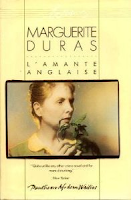
L'Amante Anglaise by Marguerite Duras

Do you know that murder doesn't happen all of a sudden? No. It creeps up slowly, like a tank. And then it stops. And there it is. A murder has just been committed in Vine. By Claire Lannes. There's no going back on it. Murder has descended on Viorne. It was hovering high in the air above, and it's there where Viorne is that it fell, in that house, in the kitchen of that house, and the one who did it--oh... the one who did it is Claire Lannes. She knew that the murder was there, and that only a thread kept it from falling on Viorne.

A policeman arrives at a bar in the French town of Viorne searching for information about a gruesome murder that has captivated the national press: a series of dismembered body parts, discovered on trains all around the country, which have been traced back to the rail junction at Viorne. As he discusses theories with the patrons there, a woman, Claire Lannes, comes up and confesses: she is the one who committed the murder. The victim is Marie-Therese, a deaf and mute woman who was Claire's cousin and housekeeper. L'Amante Anglaise tells this story as a series of interviews between an unnamed writer, who wants to write a book about Claire, and three figures: Robert, the bar owner; Pierre, Claire's husband; and Claire herself.

I think it's only when you read an author's second book that you really begin to understand who they are as a writer. L'Amante Anglaise shares with Duras' incredible book The Lover a sense that the real story is not being told, that it lies somewhere below the surface, inaccessible to both the reader and the characters themselves. Claire--whose section is by far the novel's most interesting--seems to have no idea why she killed her cousin. Murder, as she describes it, is a force that descends from outside, taking a place or a person as its vessel or host. And yet, she thinks that she might have answers for the writer, if only the writer would pose the right questions. But of course, she doesn't know the right questions any more than the writer does.

Truth, where it exists, is hidden; the novel's title, L'Amante Anglaise is written in French to retain the pun between la menthe anglaise, or English mint, Claire's favorite plant in her beloved garden, and l'amante en glaise, a "lover in sand" or "clay," which is her Freudian-slip pronunciation. Does Claire murder her cousin because of some inexpressible jealousy toward her dalliances with their friend Alfonso, or her sexual jealousy more broadly? What does it mean when the writer suggests that Claire has acted out not her own desire, but Pierre's, a desire to be free of both wife and housekeeper? Is Marie-Therese's still-missing head buried in the garden among the English mint?

I'm unsure what to think about L'Amante Anglaise. Its brief and oblique nature make it seem somehow incomplete--missing, like Marie-Therese, the identifying feature that will make it all make sense. Does L'Amante Anglaise conceal a buried secret, or does it only point toward the idea of secrets? Is there a truth at the heart of it, or only a gesture toward the possibility of truth? What's most interesting about it is, I think, the way it turns familiar stories of investigation and detective work on their head. The writer who seems so incisive with Robert and Pierre, working doggedly and shrewdly toward truth, seems suddenly stymied by Claire. So stymied, in fact, that the writer actually begins to lose interest in the conversation. It's a detective story that ends with a shrug.

Hostage by Guy Delisle

It was in the early morning hours of July 2 that I was kidnapped. I had been working for three months in the town of Nazran, in Ingushetia, a small Russian republic west of Chechnya. I was responsible for the  finances and administration of a medical N60 established in the North Caucasus. It was my first job in the humanitarian sector.

So begins the story of Christian Andre, a French humanitarian worker whisked away in the middle of the night by Chechen rebels, taken to an unknown location and chained to a radiator. Initially he assumes he’s been kidnapped because he’s the organization’s treasurer, the only person with a key to the safe in his house; as the days, weeks, and months go by, it becomes clear that they don’t know about the safe at all--he’s been held for ransom. As told to graphic journalist Guy Delisle, Hostage recounts his experience.

Graphic novels provide unique presentational opportunities. Anything goes and a cartoonist with some time can draw a story as large-scale as any blockbuster, be it a superhero apocalypse, a sprawling period piece, cosmic horror, whatever. But the elevator pitch for Hostage sounds like a poor fit. Most of it takes place in one room, with one character. There’s very little dialogue, since Christian can’t understand or communicate with his captors. Many of the panels recur over and over, as Christian studies his feet, tries to escape the handcuffs, sleeps in uncomfortable positions, counts the days, speculates on when and if he’ll be released. He’s moved to a few different locations, but none of them are much more visually complex. Aside from the ten or so pages where he entertains himself by replaying military history in his head, Hostage is a long, repetitious nightmare.

Thankfully, it all works perfectly. Comics excel at working with time, able to stretch a single second over pages and pages or elide years in the gutter between panels. They can also, crucially, communicate repetition with drawings instead of prose, which means that the reader who tires of being imprisoned with Christian can speed quickly through the book, but for me, I found the repetitive rhythms of the days drew me in, affecting a real sense of melancholy or hopelessness where a prose presentation might instead have brought boredom and irritation.

In the last 40 pages or so, the story picks up as Christian manages to escape(!) when his captors forget to lock his door when they leave. With the help of a family he reluctantly trusts, he eventually makes it back, safe and sound. And according to the afterword, he returned to continue his humanitarian work a year later. Hostage is an affecting work, a masterful use of the form, and I’m going to be seeking out more of Delisle’s work.

Sunday, February 19, 2023

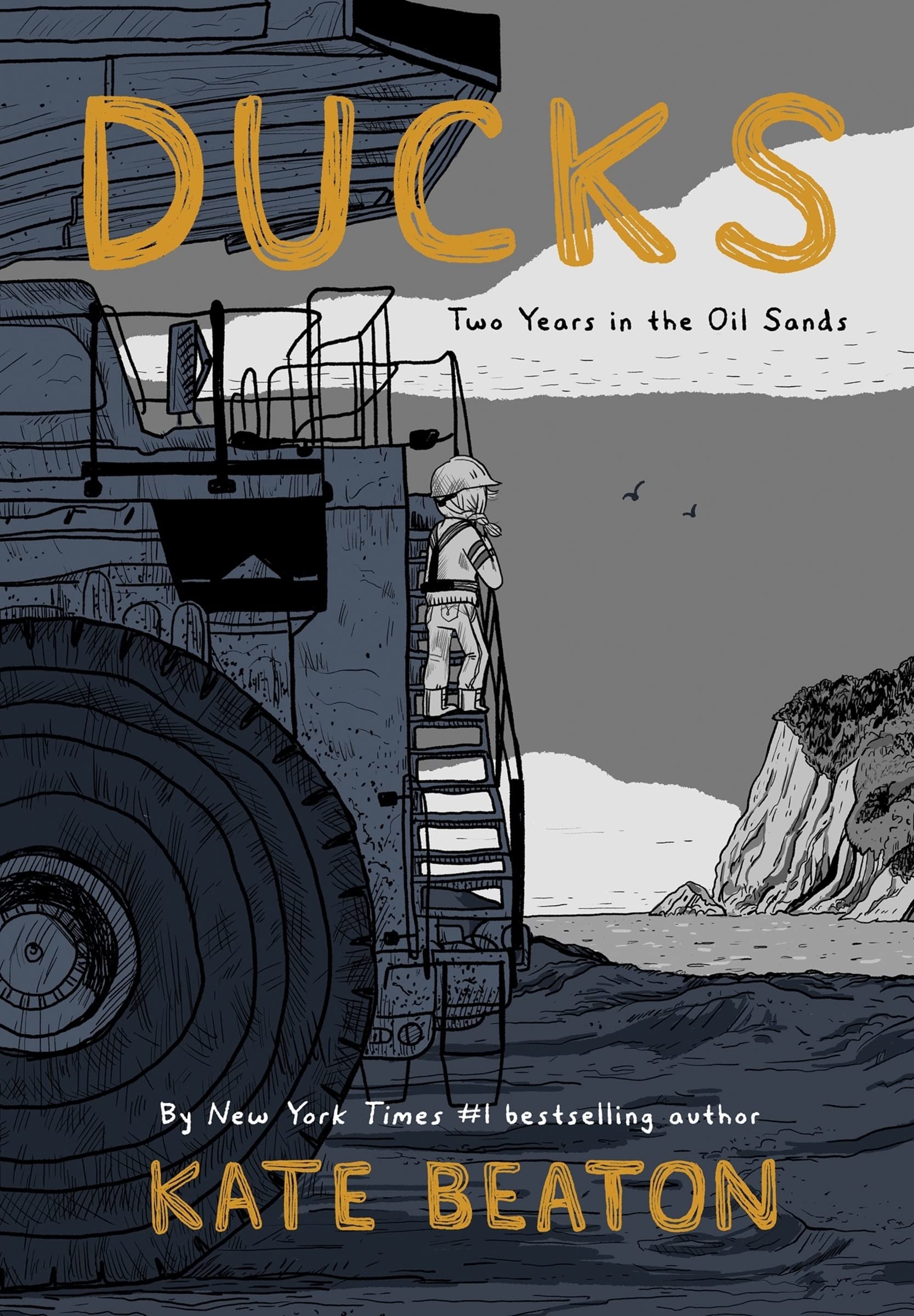
Ducks by Kate Beaton

I’ve waited too long to review Ducks, one of my favorite books of the year. I know this because I’ve already returned it to the library so I don’t have it on hand to consult. In my defense, Chris’s review is so good, I didn’t feel like I had much to add. But in the interest of reviewing everything this year, and not wanting to leave something that will likely make my year end list without a review, here goes.

Ducks is a graphic memoir, recounting the two years cartoonist and writer Kate Beaton spent working in the oil sands of Alberta, Canada. This is, I learned, a common rite of passage for young Canadians, and so, in spite of her family’s concerns, the book opens with Kate at the airport with her mother, about to leave her hometown of Cape Breton for the wild North.

The story is structured around the various camps at which Kate works plus one brief period at a museum in Victoria, and, within those sections, the story is broken up into a series of moments, interactions, and small scale events. The larger narrative emerges as the characters recur throughout various vignettes in different settings, as do the larger thematic concerns, most of which revolve around what it’s like to be one of the only women surrounded by hundreds of men who have largely been freed from the constraints of society.

And it must be said, the picture that emerges of the men here is not flattering. From her first moments in the sands, Kate finds herself being stared at, accosted, insulted, treated as inferior or, worse, as a prize, by seemingly every man she encounters. There are a few exceptions, characters whose names I can’t look up because I don’t have the book handy, and to Beaton’s credit, the portraits that emerge of the men are nuanced and complex--what are we to make of the men who are here working for their families, who gushingly share photos of wives and daughters and then make gross advances? Or of Kate’s boss who makes constant sexist remarks but also acts protectively? Or the hundreds of men with whom she never interacts, the silent majority, perhaps, who keep their heads down, make their money and go home? Beaton confronts this question head on, in a great conversation she has with her sister late in the narrative, but even there, no answers are forthcoming. Something about the isolation, the freedom from censure, the loneliness, the constant stress, causes breakdowns both internal and external, and, like the Safety Pyramid from the repetitive introductory seminars at each camp, these small disintegrations lead to larger disintegrations. Kate asks explicitly the question that the #NotAllMen contingent presumes the answer to: if our dad, our brother, our cousin were here, would they be any different?

The threat of sexual violence hangs heavy over the narrative; even before its explicitly mentioned we, the readers, can feel the looming threat, simply from the ratio of men to women. Later, it’s made more explicit, particularly when Kate visits a strip club with some of the men and learns about the practice of heating a quarter and tossing it at the dancer, with the intent that it hit and burn her genital area. Kate doesn’t know what to say to this; neither do I. But the darkest and boldest moment in the book comes when Kate, drunk at a party after being plied all night with drinks is taken to a back room and raped. And then, mere pages later, it happens again. The second time, Beaton illustrates her dissociation in a way that could exist only here, in the realm of graphic art, as she leaves her body, lets it happen, then tries to forget.

Beaton’s uncanny skill for capturing faces and expression with a few scratchy strokes pays big dividends as the cast grows. Her environments reflect the sameness and repetition of life on the sands, lulling the reading into the same cyclical rhythms without ever becoming visually boring. And the large illustrations, used sparingly, are both beautiful and imbued with meaning: the aurora borealis, the final group photo.

She leaves the sands only twice. Once to work at the aforementioned museum in Victoria, where we witness the birth of Beaton’s famous horse and, implicitly, Hark a Vagrant, her most famous work. And, at the end, when she returns from the sands and reunites with her family. In town, still with her family, she’s seen by a man she worked with on the sands, who says hello then tells her that, while she was stationed at his site, the men had a bet going about who would sleep with her first. She laughs it off, to the shock of her family, who ask why. And, like this book, she doesn’t offer them any answers.

Friday, February 17, 2023

Hiroshima by John Hersey

A year after the bomb was dropped, Miss Sasaki was a cripple; Mrs. Nakamura was destitute; Father Kleinsorge was back in the hospital; Dr. Sasaki was not capable of the work he could once do; Dr. Fujii had lost the thirty-room hospital it took him many years to acquire, and no prospects of rebuilding it; Mr. Tanimoto's church had been ruined and he no longer had his exceptional vitality. The lives of these six people, who were among the luckiest in Hiroshima, would never be the same.

John Hersey's Hiroshima tells the story of six ordinary Japanese citizens who lived through the bombing of Hiroshima. They are "among the luckiest," because those who were unlucky--nearly 100,000 of them--died in the blast, and many more died of radiation sickness shortly thereafter and were unable to be interviewed. But these "lucky" six had their lives transformed, physically, mentally, utterly, and Hersey's book traces their experiences from the moments of the blast to a year later; an added section provides updates totaling decades, and brings the book, if not the experience, to a close.

In his choice of subjects, Hersey provides an odd symmetry: two priests, two doctors, and two women. The subjects seem to be connected socially or professionally, and the choice of priests seems strange; it makes you wonder whether Hersey thought the Japanese Catholics would be more sympathetic to a Western audience, or whether they were the people who were easiest to talk to. One of the priests, Father Kleinsorge, is a German who loves the Japanese so much he ultimately takes Japanese citizenship and a Japanese name. The priests and the doctors, in the wake of the blast, find themselves in similar roles, compelled to the aid of the survivors in ways that exceed by many degrees their capacity for help. I was moved by the bitter irony of Dr. Sasaki, toiling away to bind the wounds of the patients in his hospital for days, not aware that the rest of the city, too, had been leveled. Dr. Fujii and the other priests make their way to Hiroshima's public garden with hundreds of thousands of others, and the sheer scope of the death and suffering they find there is even more shocking in Hersey's plain and unadorned language.

Hersey seems to make a point of keeping his voice simple, just the facts, bare of anger or despair. Images speak for themselves: "He reached down and took a woman by the hands, but her skin slipped off in huge, glovelike pieces." Another image: six nude, dead men, fallen in unison where they had been trying to push a boat into the water. Another: a group of air defense soldiers, huddled together in blind desperation because they had been looking up at the sky when the blast happened, melting their eyes. The details, Hersey knows, speak for themselves, and they tell a story of monstrous cruelty and human devastation that casts judgment better than judgment can. It was surprising, then, to read about how many of the Japanese survivors expressed indifference toward the ethics of the bomb, or who believed that their suffering was ennobled by their sacrifice for the Emperor. For a long time, the Japanese resisted commemoration or financial support for the hibakusha, the survivors, and resentment laid dormant until the American hydrogen bomb irradiated a Japanese fishing boat a decade later. For me, Hiroshima strengthened a conviction that those involved in the bombs' use should have been put in prison, or, since it's too late for that, hell.

Thursday, February 16, 2023

Mrs. Caliban by Rachel Ingalls

She came back into the kitchen fast, to make sure that she caught the toasting cheese in time. And she was halfway across the checked linoleum floor of her nice safe kitchen, when the screen door opened and a gigantic six-foot-seven-inch frog-like creature shouldered its way into the house and stood stock-still in front of her, crouching slightly, and staring straight at her face.

Dorothy is a housewife, the kind of housewife you read about in books. Her marriage to Fred has been a farce for years; they sleep in separate beds and are, as she tells her friend Estelle, too deeply unhappy to get a divorce. Fred clearly has a sidepiece, but who cares. Things look like they're going go on like that, forever, until a giant frog-faced monster shows up at her front door. His name is Larry, and he's escaped from a scientific facility, where he killed his captors to escape and is now on the lam. Dorothy hides him in her spare room (where Fred never even thinks to look) and soon Dorothy is in a full-flung sexual love affair with her amphibian lover.

It sounds so much like The Shape of Water I have to wonder whether the filmmakers were directly inspired by Ingalls' novel. But the flight to freedom that makes up the movie's climax isn't the kind of thing Mrs. Caliban is interested in (though it has its salacious and pulse-quickening moments). It's a domestic novel, a literally housebound novel: Dorothy lives her secret life with Larry while Fred is at work, though sometimes they go out driving at night, with Larry dressed up in a trenchcoat, hat, and gloves. Larry is a funny character, fluent in the English he learned at the lab--Larry is his own chosen name--but unfamiliar with the way that Dorothy's world works. His species approaches love and sex like most animals, without any special attachment to a single partner; there are no marriages, no childhood to speak of. As she teaches him the way of her world, she herself is, in a fashion, relearning it, reabsorbing youthful lessons about the possibility of real intimacy and family-making.

Unlike the fish-man in The Shape of Water, Larry seems to me essentially human. He's something like Mork from Mork and Mindy: a creature with a human's disposition but without knowledge or experience. Such characters bring perspective. And of course they are hated: the radio spreads panic and fear about Larry, with predictably violent results. Leave Larry alone! He just wants to eat avocados and have sex with his human mistress! In the end, of course, Larry and Dorothy cannot be together; the inescapable logic of bourgeois life arrives to smash their relationship. A surprisingly scandalous ending leads to violence and death, and though--spoiler alert--Dorothy is able to help Larry escape into the sea, the last image of the book is its most haunting: Dorothy coming back to the shore every day, hoping he'll return, which he never does.

Wednesday, February 15, 2023

Gender Trouble by Judith Butler

If the inner truth of gender is a fabrication and if a true gender is fantasy instituted and inscribed on the surface of bodies, then it seems that genders can be neither true nor false, but are only produced as the truth effects of a discourse of primary and stable identity.

A couple years ago, journalist Spencer Bokat-Lindell wrote a piece titled “Turducken is Performative” and received, to his surprise, a response from Judith Butler. First, they complimented his article, then very graciously cautioned him against associating “performative” with fake, clarifying that performance can emulate desired realities, and sometimes even bring them about. It’s funny, yes, that one of the most famous scholars in the world would fire off a note about a seemingly trivial misreading, but having read Gender Trouble, it makes sense: the entire work could be flippantly summarized by the famous Vonnegut quote, “We are what we pretend to be, so we must be careful what we pretend to be.”

Of course, it’s more complex than that. Much, much more complex. Gender Trouble is one of the most difficult texts I’ve ever completed, not due to Butler’s supposedly-impenetrable prose--I found it dense but generally quite lucid--but because it’s such a thorough investigation and dismantling of a number of theories of sex/gender, most notably Lacan and Freud but secondarily Levi-Strauss, Derrida, Foucault, Wittig, Irigaray, and structuralist theories of sex/gender as a whole. I won’t attempt to summarize their specific arguments, not that I could, except to say that they consistently tug at one particular thread: is there a pre-symbolic/pre-linguistic/ontological foundation to sex/gender, or are they entire constructed through performance of both socially acceptable and culturally heterogeneous acts?

The structuralists and their immediate predecessors--especially Lacan and Freud--say yes. As I understand it, the origin of both sexuality and language can be found in, uh, incest, the original and strongest taboo. Sexuality is a discursive effect of the repression of the Oedipal desire; because they cannot have sex with the parent, their sexual desires are projected outward toward other members of the opposite sex who can temper but not slake the original desire. Language, on the other hand, grows from the pre-verbal cries of desire, transforming, as the child gains distance from the parent, into other symbols and signifiers, and so on.

Even a cursory reading of the above makes clear the foundational binary at play; there are heterosexual men and women who have heterosexual desires, there are heterosexual men and women who have homosexual desires (caused by the much rarer Reverse Oedipus, really). Ultimately all these desires must either be subsumed in (ersatz?) heterosexual acts or suppressed entirely, because the only alternative is literally madness.

Yeah.

While this may look regressive, the binary is equally strong even in some radical feminist approaches to gender. Wittig, the mother of political lesbianism, makes great headway at dismantling the necessity of heterosexuality but only imagines a wholesale rejection of opposite-sex acts as a response, finally serving only to further establish rejection of heterosexuality as the basis of a new binary, and starting the cycle again. Even Foucault, the thinker Butler seems most in sync with, envisions sex/gender primarily as the abolishment of all sexual identity, resulting in some sort of post-gender paradise, perhaps a nice idea but not one that seems coherent with the way people are.

Butler, on the other hand, thinks bigger. Her ideas are perhaps not as shocking as they once were--though who can say, as we live through Gay Panic 2.0--but it’s still bracing, in 2023, to read about the radical deconstruction and reconstruction of sexual and gender identity in such stark (such as it is) language. A section about how sex is as socially constructed as gender, supported by Foucault’s ideas of gender as a construct of social control, was especially thought-provoking, as it posits that splitting humanity into a binary based on sexual anatomy is just as arbitrary (and no less non-binary) than divisions based on hair color, skeletal structure, or whether one has an innie or an outie--that is, unless the primary purpose of your society is to reproduce the family structure as a means of consolidating power. Then it makes perfect sense to keep the women pregnant in the kitchen while the men go out hunting and gathering and waging war.

A sense of “there is no there there” pervades the last section of the work, in which performativity is presented in its full (at the time) academic form. As I understand it (and as Butler helpfully summarized in her Turducken letter), performance can be oppressive, mandated one’s place in the cultural hierarchy. But they can also be liberative, joyful, constructive, as in a drag show where the absurdities and disjunctions of sex and gender identity are banged together until they break (I understand why drag shows scare conservatives so much now). But even performance is circumscribed by cultural laws and expectations, as Butler discusses below:

The subject is not determined by the rules because signification is not a founding act, but rather a regulated process of repetition that both concerns itself and endorses its rules precisely through the production of substantializing effects. In a sense, all signification takes place within the orbit of the compulsion to repeat; agency then is to be located within the possibility of a variation on that repetition. If the rules governing signification not only restrict but enable the assertion of alternative domains of cultural intelligibility, then it is only within the practices of repetitive signifying that a subversion of identity becomes possible.

The above was like a light at the end of the tunnel after two hundred pages of theories that presented sex and gender as either immutable, posited a post-patriarchal society that still used the binary as a load-bearing wall, or critiques that identified problems but seemingly offered no way forward. The answer, Butler seems to say, is to do what we can, to make small changes in the acts of repetition that, after all, form us and the society we live in, until finally we can look around and see that things have changed in meaningful, liberating ways.

On a personal level, a few years ago, I thought my kids would be growing up in a world where aggressive queerphobia was verboten; seeing it make a comeback has been dispiriting in a way I can't describe. In a time when conservatives at home and abroad are targeting sexual minorities, where trans high schoolers are being stabbed to death, where men kill trans women after sex, Gender Trouble is necessary, a dense, difficult work that still sounds like the future. May the future get here soon.

Monday, February 13, 2023

Houseboy by Ferdinand Oyono

The new Commandant needs a boy. Father Vandermayer told me to report to the Residence tomorrow. I am glad because I have not been able to bear life at the Mission since Father Gilbert died. Of course it is a good riddance for Father Vandermayer as well.

I shall be the Chief European's boy. The dog of the King is the King of dogs.

A Cameroonian is summoned to the bedside of a fellow countryman, dying in Equatorial Guinea. "What are we blackmen," the dying man says to the other, "who call ourselves French?" When he dies, the man reads his notebook journals, which tell the whole of his tragic story: the dead man, Toundi, fled his parents to become the servant to a white priest, believing in the superiority of French culture and religion. When the priest died suddenly, he became servant to the Commandant, who treated him with contempt and suspicion.

Toundi's story is a familiar colonial one: the way racism becomes internalized, and the disillusionment that follows on the heels of colonizer cruelty. Toundi is a good servant, conscientious and discreet, but it doesn't matter, because it is in the nature of the Commandant to be cruel. He doesn't want a good servant, actually: he wants a servant he can beat and upbraid, and if Toundi refuses to be that servant, he will beat him and upbraid him all the same. Toundi falls in love with the Commandant's wife when she arrives at the compound, but she turns out to be even worse. She carries on an affair with one of the Commandant's underlings, and treats Toundi poorly though a single word from him would betray their secret. Of course, when the Commandant does discover the affair, he punished Toundi for the imagined offense of being a go-between.

Houseboy is, like Toundi, a rather passive figure: Toundi is so obedient that the book has little narrative energy. The Commandant is cruel; his wife is cruel; Toundi cultivates a mindset that lives beyond and apart from their hatred toward him, or even their need of him. He becomes disillusioned, but circumstances will not allow him to act on disillusionment, though what one really desires is for him to "misplace" one of M. Moreau's letters to the Commandant's wife one day. Instead, he becomes even more the victim, accused by the French police of abetting a woman who has run away with her master's money. In another life, Toundi and the woman Sophie might have been lovers, but in this one she is repulsed by his obeisance, and his obeisance prevents him from becoming her accomplice--though that hardly matters to the police. They torture him until he makes an escape, limping off to Spanish Guinea where, as we know, he shortly dies.

Houseboy is wry, mocking, but at its heart is an essential bitterness: if Toundi had been a little wiser, had played his masters a little more artfully, he might have been better off. But European colonialism requires a subject to be disciplined, and it always begins, we learn, with the close at hand. The Commandant and his wife share every vice, from adultery to malice to greed, but by projecting these evils onto their houseboy, they are able at last to put aside their differences.

Sunday, February 12, 2023

Kick the Latch by Kathryn Scanlan

A lot of my friends have gotten killed. A lot of them have steel rods down their spines. One guy lot his leg. He was a jockey who lost his leg, but he'd still gallop horses and pony them to the gate. Sometimes his fake leg would fall off when he was riding and someone had to run out and pick it up for him.

There's a lot of pain and pill abuse. You learn some of them are drunks. They show up to hot walk and they're drunk. When they say they're hungry, you don't give them money. You take them to get a bite instead.

Kathryn Scanlan's Kick the Latch is the story of a horse trainer named Sonia. Sonia grows up with a love for horses and wants to be a jockey, but she's too tall; as a child, she stacks books on her head to keep her from growing. She becomes a successful trainer, working mostly at low-rent tracks, which are worlds away from the mint juleps and fancy hats of the Kentucky Derby. It's a hard life: back-breaking and highly physical. The "backside" of the tracks are little universes of their own, places where people spend all their time because of the grueling nature of the job, and they have their own small and large human dramas. It's a tough place for women, and Sonia is belittled and doubted, and once, raped. But she's good at what she does.

Kick the Latch is based, the afterword notes, on a series of interviews with the real "Sonia," but the result is a fictional version of the real person's life. If there are seams between reality and fiction, they don't show: Scanlan captures the earthy and reflective voice of Sonia; each vignette sounds like what it is, a story told over the phone. As a result, Kick the Latch has a powerful verisimilitude. You're convinced by the specificity of the detail, the truth of the language: the Bowie Clay and leg paint, the doping, the untrustworthy jockeys who shock their horses with electrical devices to give them an edge, the horrible accidents that leave some jockeys and trainers wrecked or paralyzed. It's a convincing portrait of a person in an unglamorous profession; sometimes there's nothing more captivating than a portrait of a person who is utterly devoted to some niche and invisible task.

Sonia's life is long and varied. Her successes are bringing horses that no one believed in into the winner's circles. The challenges are tough--the physical labor, the instability of track life--and she ends up getting seriously injured and going into a coma. When she emerges, she has to give up the life she's loved. For a while she takes a position as a groomer with more expensive, Derby-bound stables, but the rigidity and absurdity of the high-stakes world is distasteful. She leaves horses entirely and takes a job as a prison warden, which is, as you might expect, no easier for women. The parallels between the two jobs--the hard hours, the detailed care required toward captive creatures, the way those creatures are devalued and abused, the sexism--are there, but never overdone; Sonia's life never becomes a metaphor or an allegory. She is only what she is: dedicated, strong, even in a small way, heroic.