Showing posts with label Cameroon. Show all posts

Monday, February 13, 2023

Houseboy by Ferdinand Oyono

The new Commandant needs a boy. Father Vandermayer told me to report to the Residence tomorrow. I am glad because I have not been able to bear life at the Mission since Father Gilbert died. Of course it is a good riddance for Father Vandermayer as well.

I shall be the Chief European's boy. The dog of the King is the King of dogs.

A Cameroonian is summoned to the bedside of a fellow countryman, dying in Equatorial Guinea. "What are we blackmen," the dying man says to the other, "who call ourselves French?" When he dies, the man reads his notebook journals, which tell the whole of his tragic story: the dead man, Toundi, fled his parents to become the servant to a white priest, believing in the superiority of French culture and religion. When the priest died suddenly, he became servant to the Commandant, who treated him with contempt and suspicion.

Toundi's story is a familiar colonial one: the way racism becomes internalized, and the disillusionment that follows on the heels of colonizer cruelty. Toundi is a good servant, conscientious and discreet, but it doesn't matter, because it is in the nature of the Commandant to be cruel. He doesn't want a good servant, actually: he wants a servant he can beat and upbraid, and if Toundi refuses to be that servant, he will beat him and upbraid him all the same. Toundi falls in love with the Commandant's wife when she arrives at the compound, but she turns out to be even worse. She carries on an affair with one of the Commandant's underlings, and treats Toundi poorly though a single word from him would betray their secret. Of course, when the Commandant does discover the affair, he punished Toundi for the imagined offense of being a go-between.

Houseboy is, like Toundi, a rather passive figure: Toundi is so obedient that the book has little narrative energy. The Commandant is cruel; his wife is cruel; Toundi cultivates a mindset that lives beyond and apart from their hatred toward him, or even their need of him. He becomes disillusioned, but circumstances will not allow him to act on disillusionment, though what one really desires is for him to "misplace" one of M. Moreau's letters to the Commandant's wife one day. Instead, he becomes even more the victim, accused by the French police of abetting a woman who has run away with her master's money. In another life, Toundi and the woman Sophie might have been lovers, but in this one she is repulsed by his obeisance, and his obeisance prevents him from becoming her accomplice--though that hardly matters to the police. They torture him until he makes an escape, limping off to Spanish Guinea where, as we know, he shortly dies.

Houseboy is wry, mocking, but at its heart is an essential bitterness: if Toundi had been a little wiser, had played his masters a little more artfully, he might have been better off. But European colonialism requires a subject to be disciplined, and it always begins, we learn, with the close at hand. The Commandant and his wife share every vice, from adultery to malice to greed, but by projecting these evils onto their houseboy, they are able at last to put aside their differences.

Saturday, October 30, 2021

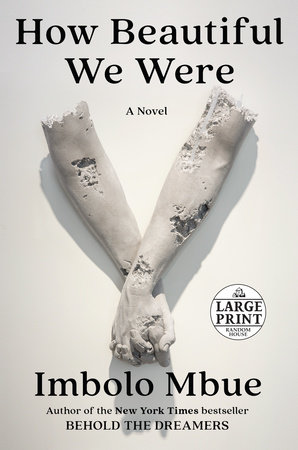
How Beautiful We Were by Imbolo Mbue

We should have known the end was near. How could we not have known? When the sky began to pour acid and rivers began to turn green, we should have known our land would soon be dead. Then again, how could we have known when they didn't want us to know? When we began to wobble and stagger, tumbling and snapping the feeble little branches, they told us it would soon be over, that we would all be well in no time. They asked us to come to village meetings, to talk about it. They told us we had to trust them.

In the small village of Kosawa, in an unnamed African nation that presumably resembles author Imbolo Mbue's native Cameroon, the water and soil have been poisoned by an oil company called Pexton. The children of the village are becoming gravely ill, and often dying; pleas to the company to clean up the land fall on deaf ears, and the village chief is in the pocket of the oil barons. It's the town madman who pushes the village to finally take matters into his own hands: during a visit from Pexton's ambassadors, he nicks the key to their truck, knowing that for ritual reasons no one will dare touch him. Suddenly the town leaders find themselves having kidnapped three of the company's employees, a situation which presents both great opportunity and great danger.

This scenario, which I really liked, makes up the first third of the novel, and turns out to be rather inconclusive, as all kinds of real-world activism really are. The immediacy and intensity of the hostage scenario gives way to what I thought was a much weaker novel about the education of Thula, a young girl when the hostages are taken, who goes to America and comes back to Africa as a firebrand intent on bringing political change to her country. The bulk of How Beautiful We Were was, I thought, marred by bad literary choices, beginning with the novel's structure, which is composed of several first-person sections written by villagers. Their own stories can be detailed and engaging, but they felt to me ultimately a distraction from what's clearly meant to the main narrative, which happens at a bird's-eye view that robs it of specificity and detail.

Several of these sections are written from the perspective of "The Children," a collective of Thula's "age-mates." I really loved this at first, but over the course of the novel it forces Mbue into authorial positions that just don't work: she uses a series of ham-fisted letters from Thula to the Children in order to inform us of the progress of her education, for example. Later, when the Children splinter, having argued about the morality and efficacy of the violent methods the employ to supplement Thula's political activism, the internal logic of these sections breaks down almost completely.

I didn't think this book worked, honestly. But when it's at its best, it presents complex and interesting questions about how oppressed peoples in the Third World can and should fight back. During the hostage scenario, a team of envoys travels to the nation's capital to convince an American journalist to write about them; the outrage in the U.S. over the village's plight leads to an arrangement with the oil company and an NGO called the "Restoration Movement" that brings a measure of progress. But Thula returns understanding that only political change will make a difference; her non-violent campaigns are contrasted with the gun-happy "Children," in a way that seemed a little jejune to me but not without knowledge or understanding.

I have an ongoing project to read a book from every country. How Beautiful We Were falls in sort of a gray area: though born in Cameroon, Mbue lives in and wrote the book in America. But perhaps this is offset by the African setting of the novel, so I'm counting this for Cameroon, which puts me at 50 countries.