Monday, October 20, 2008

Sounds of the River by Da Chen

Colors of the mountain will never leave our door
Sounds of the river will linger forever in our ears.

-- a couplet painted on the door of the old Chen house

I read Colors of the Mountain late last year. I liked it so much that I gave the book to my brother for Christmas, knowing that he too would enjoy it. I told him that the book was great but also informed him that when he came to the end, he would feel like the story was not over. (I ended my review of the book by stating much the same thing.) However, my brother is much smarter than I am. After he finished the book, he looked to see if Da Chen wrote another.

Sounds of the River literally picks up right where Colors of the Mountain left off. Da is getting ready to leave Yellow Stone to go to college in Beijing. This a dream come to for Da and his family. Little does he know that corrupt teachers, suicidal roommates, and poor living conditions await his arrival in Beijing. But the same dogged determination that got Da into college helps him to survive and even prevail. He become a voracious student of the English language, going from the bottom of his class to the very top. His knowledge of English lands him a sidejob as an interpreter for the Sports Ministry. A couple of chapters are devoted to the time Da spent as a translator and guide to a group of NBA stars touring China. Da's dealing with the NBA stars is hilarious, especially his interactions with Kareem Abdul Jabbar.

With Sounds of the River, Da Chen strikes the same balance as he did with his first book. He candidly describes his time in Beijing, with both poignance and humor. Da grapples with love, death, and religion, causing this book to strike a more mature tone than Colors of the Mountain. Sounds of the River ends with Da preparing to go to America, leaving me feeling much the same way that I did when I finished the first book. This time I checked, but unfortunately there is no third book. Hopefully Da is working on it.

Friday, October 17, 2008

The Yiddish Policemen's Union by Michael Chabon

I recall that once my favorite English teacher from high school noticed that I was reading Tom Wolfe's A Man in Full, a book he admitted to having read but didn't seem to care for. "Well," he said, "I'll say this--the man knows how to spin a good yarn." It wasn't really a compliment, but I think that his sarcasm betrayed a certain notion that plot is somehow subordinate to Big Ideas. Is that notion misguided or justified? I'm not certain--but surely to dismiss Wolfe's plot-making ability as little more than quality weaving is to slight a literary skill too rare in modern literature.

Such is the recorded opinion of Michael Chabon, who admits to missing the "ripping yarns" of the genre fiction of yore. It's in that vein that he delivers The Yiddish Policemen's Union, a hulking Frankenstein's monster cobbled from bits of alternative history, Philip Marlowe novels, and Rothian postmodernism. Though YPU provides enough material philosophical and spiritual for the reader to ruminate upon, it is first and foremost a novel of things happening, meant to be marveled at. Though it may be a fruitless task, I will attempt to synopsize:

The divergence point of Chabon's alt-history is the 1948 death by car crash of Anthony Dimond, representative of the territory of Alaska to Washington. Apparently in our world it was Dimond who squashed Harold Ickes' proposal to create a protected Federal district for the temporary residence of Jews in Sitka, Alaska. In Chabon's world, the proposal passes with Dimond out of the way, and soon millions of Jews are seeking refuge in the Sitka District: The "Frozen Chosen."

Fast forward to 2008, the 60-year anniversary of the settlement, and the expiration date of the agreement, which means that "Reversion" is imminent for the Jewish district and soon most of Alaska's three million Jews will be refugees once again. If that wasn't story enough for you, Chabon layers on top of this the story of Meyer Landsman, a detective investigating a gunshot homicide perpetrated in his own building that seems to have ties to the Verbovers, a powerful and mafia-like Orthodox sect of Jews that live on a nearby island.

If that isn't enough for you, wait! I haven't even mentioned that Landsman's partner is also his cousin and half Tlingit Indian, or that his father was a chess prodigy and his uncle a former police chief disgraced by accusations of embezzlement, or that Landsman left his ex-wife because he couldn't bear dealing with the pain of having convinced her to have an abortion, or that the homicide victim is reputed to have been the Tzaddik Ha-Dor, the once-in-a-generation would-be Messiah, or that the victim's death is somehow related to Landsman's sister's death in a plane crash, or that all of this seems to be tied into a shadowy conspiracy cooked up between Alaskan Hasidim and the evangelical United States president to return Israel to Jewish control. Whew. Breathe.

Clearly, The Big Sleep, this is not--Raymond Chandler's tight and careful plotting produced books under 200 pages; Chabon doubles that but stuffs in enough that it would have felt more comfortable at twice that again. But while Chabon hasn't quite got the noir genre's laconicness down pat, he does a good job with Landsman, into whom he funnels as much of Philip Marlowe's personality as is possible. The genius of this lies in the dialogue--I had never made the connection between the kind of rapid-fire quips that characterize noir and the brusque recursiveness of Jewish humor, but there it is. I am reminded of Mastrionotti and Deutsch* from the Coen Brothers' Barton Fink; it is no surprise that it is the Coens who are slated to begin filming YPU early next year.

But back to the book. Reading it feels like traveling through the legendary and labyrinthine Warsaw tunnels which run beneath Sitka, but when you emerge on the other side, what are you left with? For one, you are left with a mess. It's hard not to feel that YPU has a few ideas too many, and some of them could have been left on the cutting-room floor. For another, you are left with the unfortunate conclusion that while you weep for the fate of the Jews, for whom the Disapora comes with a countdown this time around, it is much more difficult to feel pity for the individual characters of this novel, who are drawn a little too broadly and rely a little too heavily on their archetypes.

Thirdly, you may be left with the opinion of Richard Johnson of the New York Post, who titles his Page Six piece "Novelist's Ugly Views of Jews." This is, of course, the Post, which could sensationalize a ham sandwich, but I wish to briefly unpack the criticism here: Mainly Johnson takes issue with the fact that YPU "depicts Jews as constantly in conflict with one another, and its villains are a ruthless, ultra-Orthodox sect that resembles the Lubavitchers." What exactly is Johnson's understanding of Judaism today, that its various sects are friendly in a way that the splinter denominations of Islam and Christianity have failed to be since their inception? In fact, I think that Chabon's depiction of internecine conflict among the Sitka Jews is one of the novel's great successes; in a population of three million Jews with no Palestinians to brush against (though the native Indians serve this position to some extent), isn't it natural that such issues would arise along sectarian and secular lines? Johnson's criticism is pure silliness, and I have not seen it repeated by any respectable source.

And yet, let me bring up something that Johnson does not: One of the most poisonous and absurd claims made about Jews today is that they have extensive control over world institutions like the media and the United States Government. This idea is particularly pervasive in Islamic communities and the controversial specter of it taints even serious academic work, like Mearsheimer and Walt's claims about the undue influence of the Israel Lobby. By presenting a "ripping yarn" in which a cabal of Orthodox Jews plot to undermine the stability of world events, isn't Chabon playing into the hands of such absurdity? And even if the Post is too dim to pick up on it, doesn't that in a way back up their claims that YPU reinforces an ugly stereotype?

That question is more rhetorical than it sounds; I bring up the issue only to bring it up and would probably argue against it in the end. But I do think that it contributes to one aspect that did leave a bad taste in my mouth: YPU, for all its concern with religious issues, seems at times to have a rather uncomplex attitude toward religion in general. Though we might argue about the significance of it, the villains of the novel are conspiratorial Jews--and its heroes are humorous, self-effacing, Woody Allen-like ones--and what's more, they're aided by an amoral and evangelical president who wants to bring on the End Times. Though I understand this is the perception many have of our sitting president, it seems to me to evidence a certain lack of nuance on Chabon's part. There is no worth, I believe, in fiction that does not subvert our expectations, and while Chabon distracts us with the aurora borealis of conceit and plot, the cast lacks the capability to surprise us.

Don't think that I'm not recommending the book, I am--sometimes a good story is good enough. Let us not forget that one of the most powerful people in Jewish Sitka is Itzak Zimbalist, the boundary maven. It is against Jewish law to carry anything across boundaries on the Sabbath, a law circumvented by creating makeshift boundaries with rope, cable or wire around entire communities, and it is the boundary maven who is in charge of keeping this border, the eruv, intact. So do not doubt the power of string, the effectiveness of a "good yarn."

Sunday, October 12, 2008

The Magus by John Fowles

If The Magus has any "real significance," it is no more than that of the Rorschach test in psychology. Its meaning is whatever reaction it provokes in the reader, and so far as I am concerned there is no given "right" reaction.
--John Fowles

Whew. That's a relief. Because I can tell you now, I have as little idea of what The Magus means as when I started. But you know, I don't really mind, because even if I'm a little fuzzy on the concepts, there is no book like The Magus. I cannot remember the last time a piece of literature had me so on edge--it is a book that thrives on suspense, and not just the "erotic adventures" and "terrifying violence" promised by the jacket.

The protagonist of the book is Nicholas Urfe, a young Londoner just out of college who takes a job as an English teacher on the remote Greek isle of Phraxos in order to escape a messy and ruined relationship with an Australian girl named Alison. (Okay, so, besides the school being in Greece, does that sound like anyone you know?) Before he leaves he is warned by his predecessor not to fraternize with a particular man, a foreign millionaire who owns a mansion on the island's west side and is widely believed to have helped the Nazis during their occupation of Greece.

But of course, Nicholas' interest is piqued and he ends up visiting the man, whose name is Maurice Conchis, at Bourani, his massive estate. Conchis begins to tell him the story of his life, and asks Nicholas to return and stay with him each weekend. But after a while strange things begin to happen--mysterious figures appear, seeming illustrations of the stories that Conchis tells. No sooner does Conchis tell him about his childhood sweetheart who died decades ago than Nicholas, lulled out of the guestroom at night by the sound of music, comes downstairs to find Conchis playing piano accompanied by a young girl on recorder, the spitting image of his long-dead lover. It is all a game, of course, but the underlying lesson is always just out of Nicholas' grasp. It is as if he is trapped in a grotesque performance, a masque, and it can be truly bizarre. Here he is walking down on the beach with the girl, whose name is Lily, and looking back toward the house:

A figure appeared on the terrace, not fifty feet away, facing and above me. It was Lily. It couldn't be her, but it was her. The same hair blew about in the wind; the dress, the sunshade, the figure, the face, everything was the same. She was staring out to sea, over my head, totally ignoring me.

It was a wild, dislocating, disactualizing shock. Yet I knew within the first few seconds that although I was obviously meant to believe that this was the same girl as the one I had just left down on the beach, it was not. But it was so like her that it could be only one thing--a twin sister. There were two Lilies in the field. I had no time to think. Another figure appeared beside the Lily on the terrace.

It was a man, much too tall to be Conchis... I couldn't see, becasue the figure was in all black, shrouded in the sun, and wearing the most sinister mask I had ever seen: the head of an enormous black jackal, with a long muzzle and high pointed ears. They stood there, the possessor and the possessed, looming death and the frail maiden.


There are twin sisters; Nicholas sees through that ruse instantly. But what he cannot see through is the next layer of the ruse, and when he does, he is met instantly with the next. Conchis' explanations shift, he readily drops one explanation for another while intimating something completely different; he is playing three or four hands at a time. This is what makes The Magus so fascinating; the game is labyrinthine, circular, impenetrable. So many books and films play with this conceit--one man trapped in the mind-games of another--but their games are so simple and flimsy. But there is no opportunity for Nicholas to gain any sort of understanding of what lies behind the masks; behind the doors there are only more doors. He falls in love with Lily, but which explanation of her identity can he trust? Is she a ghost? An actress? A psychological patient? Or perhaps a psychologist herself? Or maybe, like Conchis, simply a pure sadist?

And truly there must be sadism here. There is no other way to explain just how vicious the game becomes. Nicholas' amusement fades to abject desperation and terror; while the players in the game never pretend that it is anything but, the stakes begin to look increasingly serious. Mental abuse morphs into physical abuse, and Conchis plays one trick that is so savage, so heartbreaking, that it makes the book's final chapters difficult to read. I had to stop myself from writing that the masque "spins out of control," because as dark as it becomes, every move seems preordained by Conchis, and culminates in a surreal tableau that reminds me of Heironymous Bosch, or perhaps the end of The Man Who Was Thursday viewed in negative.

Ultimately, perhaps it was foolish of me to expect such an unwieldy trick to tie itself neatly at the end, and moreover I expect that if Conchis' motivations could be explained away in a pithy sentence, the masque would hardly have been worth it. But the book is so heavily decked in concept, in philosophy and ideas, that I feel as if I, like Nicholas, have come out the other end of the ordeal with very little to show for it. What is it he--and I--are meant to understand? While in a way I am relieved by Fowles' quote above, I consider it also a bit of a copout.

I recall a blog post by my friend Helen that suggested that there can be no humility without humiliation. I wonder if that isn't part of it--Conchis games are, ultimately, quite cruel--but Nicholas in many ways is a puffed-up little shit and treats Alison quite cruelly himself. Nicholas comes out of the ordeal a different person, a better person; he has been broken and remade. But what of his anger, which is surely justified? Once the anger is gone, as is true in so many cases, there is only sadness, and it is that sadness which is transformative; he cannot be remade if he is not broken and there is no way to break a dish gently.

The greatest flaw of this book is that it succeeds on account of its terrific plot when it wishes to succeed on account of its ideas. But that's hardly damning, isn't it?

The Giver by Lois Lowry

Somehow I never got around to reading The Giver in middle school, which is a shame, because I think it might have given my impressionable little mind quite a bit to think about. It is, essentially, 1984 for the tween set, a slim dystopian novel written from the perspective of a teenager.

The protagonist, Jonas, is about to enter into the Ceremony of Twelve, in which he will be assigned the career which has been chosen for him. The village of The Giver thrives because these assignments are well-made; the council who decides them observes the children painstakingly so that they might make the best decision possible. The society in which Jonas lives is peaceful and self-sufficient, lacking in physical and emotional pain but, as we come to learn later, lacks also the pleasures that come with taking risk--that is to say, concepts such as love, adventure, and even sex.

But there is one man in the village still familiar with these things: The Giver. His job is the most secretive, and in many ways the most powerful in the village. He has collected all the collective memories which might endanger the stability of the society, memories that include not only exquisite happiness but terrible pain. Jonas' assignment--to the surprise of everyone--is that of Receiver, or the Giver-in-training to whom the Giver must bequeath all his memories before he dies. Throughout the process, Jonas becomes privy to not only what society can be, if risk is not eliminated, but also to the darker side of his own society that ensures its survival. The Giver reveals to Jonas that the village is built on a system of euthanasia which eliminates the elderly as well as undesired children.

I can think of few young adult books that can boast of as many strong and affective scenes as The Giver. One of my favorites comes when Jonas, having experienced love through the Givers' memories, asks his parents--two people to whom he has been assigned, and have been assigned to each other--if they love him. They chide him for his "imprecise language," saying that they desire his success, and enjoy his company, but love--what is that, exactly? Love is messy, and has necessarily been eradicated.

And yet, I have the same for The Giver that I do for many dystopian novels. I feel that the strongest dystopian novels are terrifying because it is easy to see that society might one way inexorably dissolve into the world depicted, but so many set up philosophical straw men in that they depict societies that have no redeeming features whatsoever. The best dystopias are seductive, and Lowry seems to establish the positive attributes of hers, but who really would ever argue that such an anesthetized, numb society would really be preferable to our own? I understand that the village, as in all dystopias, is meant as symbol, the reductio ad absurdum of dangerous ideas, but I am not sure what real ideas Lowry means to counteract.

I think the truth must lie in the fact that this is a young adult book, and those ideas which Lowry wishes to repel are ideas that foster in the minds of the young. It is a strongly didactic book, and seems to boil down to the simple truism that great happiness is impossible without great pain. I find great similarities between this and Tuck Everlasting--which I noted can be reduced to the idea that life necessitates death--but I reiterate that this is a lesson no serious adult needs. Am I wrong? I may be. But still I think that both books lack the sophistication that some of the best juvenile fiction possesses, and which enables them to be read and enjoyed by both children and adults.

Wednesday, October 8, 2008

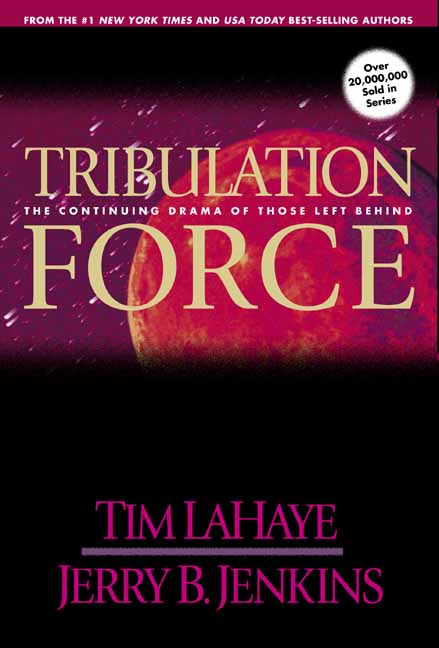
Tribulation Force by Tim LaHaye and Jerry Jenkins

"The Red Horse of the Apocalypse was on the rampage."

This is a horribly boring book. It made me feel as if I had brain rot. The first 400 pages are a complete reiteration of the first book, Left Behind. Because the first book and the first 400 of this one as well, are about what happens in the first few weeks after the tribulation, there is very little plot and it moves along at less than a snail's pace.

All of the characters are incredibly shallow. They don't evoke any emotion or concern for themselves, the lost world around them, or the tragic events that rip their lives apart. No main character in the story resists God or salvation, and Buck, yeah, Buck has long hair that he blow dries.

OK, so what do the authors take 450 pages to tell us? Buck gets to meet the wall wailers and moves to NY to be a publisher of the Anti-Christ's newspaper, Rayford becomes the pilot for the Anti-Christ and inexplicably gets married, a leading Rabbi gets saved and announces on TV that Jesus is the Messiah, Bruce dies, Chloe finally marries the world renown and virgin journalist Buck and last but not least the treaty signaling the beginning if the tribulation is signed in Jerusalem. All of which would easily have fit on the back of this massive volume. It might also be worth noting that both marriages including Rayford and Amanda's entire relationship and Bruce's death all happen in the last 50 pages, and yes, the wedding IS a double ceremony.

Friday, October 3, 2008

Paper Money by Ken Follett

Characters: Tony Cox, Mrs. Cox, Tim Fitzpeterson, Dizi Disney, Felix Laski, Arthur Cole, Kevin Hart, Derek and Ellen Hamilton, Deaf Willie, and Billy.

So, the book starts in the middle of the story, with politician Tim Fitzpeterson being set up to have an affair with Dizi Disney. He takes the bate, and the next morning Tony Cox comes to his door, and blackmails him in order to find out which company will be granted a licence to drill oil.

Every chapter until the midpoint of the book introduces a new character, and unfolds a little more of what is going on. Basically, some time back, these two losers, Tony and Felix, met up in a casino. They both boasted about being guys who could get any info they wanted, Tony through sex and Felix through money. So, they wanted to see which was more effective. Tony has to find out which company will be licenced to drill and Felix has to find out the route of an armored truck carrying over a million in cash.

They both get the info they are looking for, and when they exchange this information, Tony robs the truck and Felix buys the failing company, who's shares will sky rocket once the licence is released. Of course some mishaps happen along the way.

The newspaper is also having trouble getting a story, I guess nothing is happening today. But, everyone who is involved with this drama keeps calling the paper with a potential story, which they are unable to use until they verify it. Arthur Cole is the editor of the paper and Kevin Hart is the reporter. Kevin figures out what is going on, but he never gets proof enough to publish.

Mrs. Hamilton is having an affair with Felix. The thought of sleeping with her husband repulses her, but she wants to love him. So, she gives each man an ultimatum, Derek can sell the company and they will live happily ever after, or Felix can step it up and marry her and she will leave Derek.

During the robbery, Deaf Willie gets shot in the face. His handicapped son hears that Tony Cox did it. So, Billy walks to Tony's house to kill him. Tony isn't home, so Billy stabs his dog and mother to death instead.

In the end, it is Felix who buys Derek's company, because it is the one that gets the licence. He also purposes to Ellen, but since her husband sold the company, she decides to stay with him. The thing is, Felix doesn't actually have the money. But, he is inadvertently bailed out when Tony brings the million he stole to the bank Felix owns for safe keeping. Using the stolen funds, the men are able to pull off their scheme nicely, losing only the women in their lives.

This was a very crappy book.

Thursday, October 2, 2008

The Bride of Stone by Thomas Williams

The Bride of Stone is the third book in the Seven Kingdoms Chronicles. However, it is a prequel to the first two. They are fantasy books about seven kingdoms on an island, and their struggles to serve the Master of the Universe. The book(s) is interesting and keeps you turning the pages. It has an interesting way of presenting truth. It isn't fabulous, but it is fun.

All of the books deal with the Crown of Eden, a crown that has jewels from the Garden of Eden. The crown exaggerates the deepest desire of whoever wears it, even giving them physical characteristics that resemble heir desire.

Morgultha is the "bad guy", she is probably a million years old, and in one of the books she mates with the Devil so she can have an evil child to help her take over the seven kingdoms. This woman is desperate. In this latest book, Morgultha attacks the seven kingdoms with an army she has created by reanimating the bodies of dead people and animals. She is defeated by the general, Percival, who unties the seven kingdoms into one army. After the battle, Percival is named high king of all seven kingdoms.

He rules justly for a few years, until he is tempted by some bad guys to wear the crown. The crown causes him to be overcome with pride. He fills all of his halls with filthy art that doesn't display the true beauty of the Master of the Universe, cheats on his wife, promises his daughter to a king she doesn't want to marry, and alienates his son by forcing him to be a warrior when he doesn't have the physical ability to do so.

All of this leads to his wife's death, his daughter falling in love with some other guy, who Percival kills after scaring his daughter's face for life with hot oil, and his son hating him and the rest of the family and being a general trouble maker. Soon, the proud king decides that he really needs the 500ft mountain that can be seen from all seven kingdoms carved into a statue of his naked self.

Now, there is a sculptor who is better than any other sculptor that ever has been or will be, and he is only seven. So, his dad sends him to get some special lessons from a sculptor who only makes art that glorifies the Master of the Universe, and the boy learns to make this kind of art as well. When, I think his name is Damien?, gets older, he falls for this barmaid and makes a sculpture of her. When she steals all of his money and breaks his heart he swears to hate all women forever and won't sculpt and females.

Of course, Damien and his mentor are soon commissioned to make two figures, Adam and Eve. Damien refuses to work on Eve, but makes an exceptional Adam. However, after Adam falls on his mentor and kills him, Damien is forced make Eve after all. He makes the most beautiful woman that ever has been or will be, and falls in love with her.

So, the night he finishes both statues, the kirk (like a priest) comes to destroy them and kill Damien for making them because he is one of the guys who hates art and beauty. One of the monks hears of this and warns Damien. They both escape with the two statues. They sell Adam and after being commissioned by the king to carve the mountain nude of the king, they pack up and take Eve with them.

As Damien works for the king, he passes this wall every day and hears this girl singing the saddest songs in the world. So, he starts to talk to her and makes friends. The girl is the princess, hidden away by her father so that no one will see her awful scar.

Now, Morgultha is still at work. She convinces some ancient spirits to sell her the incantation for animating sculptures. They let her animate one, and whatever sculptures that one touches, they are animated too, but if the first one is destroyed it destroys all of them. So, she animates Eve, who becomes a live person that Damien loves, and she has Eve animate a little model of Percival that Damien had made as a model for the mountain statue. Then, she has the Percival statue make 1000 more just like itself, and leaves Eve with Damien, just as the ancient evil spirits told her to do.

The things about Eve though, is that she mirrors all of Damien's thoughts and desires, so she has no personality of her own at all. Anyway, there is a war. Percival goes to meet the army of statues that look just like him and is killed. One of the statues comes to kill the rest of the royal family. The prince escapes, but the princess is trapped and Damien has to come and save her. The statue starts to choke her, so Damien runs home and destroys Eve, destroying all the other statues as well. When he strikes Eve, he goes blind, but somehow makes it back to the castle.

Then they escape. In the night an angel comes to the princess and asks her lets her chose to have her own beauty back or Damien's eyesight. She gets Damien's sight back and he thinks she is gorgeous even with her scar. So they live happily ever after as peasants, and the wicked prince rules in his father's place until he is overthrown and the seven kingdoms are once again split into the seven.

Sunday, September 28, 2008

Copper Sun by Sharon M. Draper


"I got a bad feelin' 'bout this. We all gonna hang 'fore nightfall! Lawd, Lawd, Lawd. What we gonna do? We done fell out the trouble tree and hit every branch on the way down!"

Set in the 1730s, Copper Sun is a historical young adult fiction novel that follows our main character, Amari, from Africa to the Carolina Colony where she becomes the birthday present for a cruel slave master's even crueler sixteen-year-old son Clay. After seeing her family slaughtered and her village plundered, Amari struggles to keep her spirit alive while surviving the horrors of the slave ship, trying to maintain her dignity while being raped on a daily basis, and pushing on through countless other nightmarish atrocities. Once she gets to the plantation a quarter into the novel, she shares the narrative with Polly, an indentured servant that shares her quarters and her duties in the kitchen under Teenie, the plantation cook. Throughout the rest of the book, we see how the two girls struggle to assimilate to the culture around them and to maintain their identities as much as possible without getting themselves killed. During this time, Clay takes a special liking to Amari that goes beyond the physical relationship that he forces on her, sending her gifts and verbally professing affection. He treats her more the way that a free woman would be treated than like a slave would be treated--but given the time period women were not exactly seen as equals either, obviously. After a subplot dealing with the mistress of the house throws a killer plot twist into the novel at the climax, Polly, Amari, and Teenie's son are sent away from the plantation and they decide to make their escape. The last quarter of the novel deals with running and whether or not they make it to Fort Mose, Florida where there are supposidely streets of gold and people of every color living together as though slavery did not exist.

I appreciated this novel quite a bit. I remember reading novels like Heart of Darkness and Things Fall Apart in school when I was maybe a bit too young to wrap my head around them as well as would be necessary to take in everything those books were intended to convey. While I sometimes groaned about having too much history in my English classrooms, I could understand that it was important that it be there. Reading about slavery in a history textbook is one thing. You know names and dates and basic information. Reading historical fiction about slavery and what the Europeans did when they went into Africa to take slaves from their homeland really drives in how truely terrible those things were. I feel like Copper Sun could serve the same kind of purpose that those aforementioned books usually serve in a classroom and be more accessible to students. Beyond that, the main characters are both fifteen when the story begins putting them at the same age a sophomore in high school would be... making it a lot easier for students to potentially become more invested in and interested in the characters. I'm not saying that the classics aren't important, I just think that they should be introduced when it's appropriate.

Sharon Draper did an incredible job on the research that she put into writing Copper Sun. She traveled to Africa and went to the "slave castles" and crawled through the Door Of No Return as the slaves did. She saw the place on the beach where they were branded before being put on the ship to America. Then she spent ten years doing research. In the back of the book and on her website she has extensive lists of links for slave narratives and things of that nature as well as suggested texts. I could tell that she was trying in her writing to give dignity and respect to those people who had those things stripped from them and that is why I think so highly of this book as both an artistic endeavor and a scholastic undertaking on her part.

Thursday, September 25, 2008

"Everybody has itches and everybody's looking for fingers to scratch them..."

"...and for me, I have found that I can't find a finger in the world and I have to make my own." So Jonathan Safran Foer tells us, about how he just chanced upon his writing career with a little help from Joyce Carol Oates.

Monday, September 22, 2008

Empress of the World by Sara Ryan


"I am sitting cross-legged on an uncomfortable seat, waiting for a speech to start. It has been approximately forty-five minutes since Mom and Dad left me here. I am going to be here for the whole summer, and I do not know a single person. I open the big new journal Mom gave me last week. So far all it has is a title page which says “Field Notes” in block letters. I turn to the first blank page and write:
hypothesis: taking an actual class in archaeology will serve to confirm nicola lancaster in her lifelong dream of becoming an archaeologist.

I scratch out “lifelong dream,” because it doesn’t sound scientific enough, and write “proposed vocation,” but that sounds pompous, so I write “lifelong dream” again, and then above it, in larger letters, “ignore: this is dumb.” Then I write: “speech notes” just in case I actually take any."

Empress of the World is another book that I read for my Young Adult Literature class. I should start off the review by telling you that it is not a book that I would teach in a class room given some of its content and that it's LGBT fiction. That's not to say that I wouldn't teach a novel with a gay character in it, but I would be more prone to teach something like M.E. Kerr's book Deliver Us From Evie. While Empress of the World was not terribly explicit or anything like that, I felt like it pushed the boundaries just enough to potentially make a lot of students and parents angry. I would save my battles for a book that I felt was more significant. However, if I had a student that was in the process of coming out I might gift it to them for reading on her own time.

The novel is focused on Nicola, a bright girl interested in archaeology sent to study at the Siegal Institute Summer Program for Gifted Youth. Back at home Nic is virtually friendless but at her orientation to Siegal she stumbles into a group of various social outcasts (computer geek, preacher's daughter, music nerd) that instantly accepts her. The reader follows Nic through her eight weeks of class where she manages to come to terms with the fact that she isn't straight, enters into her first relationship (with the preacher's daughter, no less), suffers through a breakup, and deals with other adolescent milestones like going to her first dance and finally sticking up for herself when classmates bully her.

The name of the novel comes from Carmina Burana, which ties in to the book because of Nic's interest in music. When she's sulking over losing Battle (who she nicknames Empress of the World) , you can usually find her playing her viola.

Ryan has written one another novel, a follow up to Empress, called The Rules for Hearts. Beyond that, she creates comics with her husband Steve Lieber.