Sunday, August 25, 2013

"Mr. Salinger instructed his estate to publish at least five additional books — some of them entirely new, some extending past work — in a sequence that he intended to begin as early as 2015..."

One collection, to be called “The Family Glass,” would add five new stories to an assembly of previously published stories about the fictional Glass family, which figured in Mr. Salinger’s “Franny and Zooey” and elsewhere, according to the claims, which surfaced in interviews and previews of the documentary and book last week.
Another would include a retooled version of a publicly known but unpublished tale, “The Last and Best of the Peter Pans,” which is to be collected with new stories and existing work about the fictional Caulfields, including “Catcher in the Rye.”

Monday, August 19, 2013

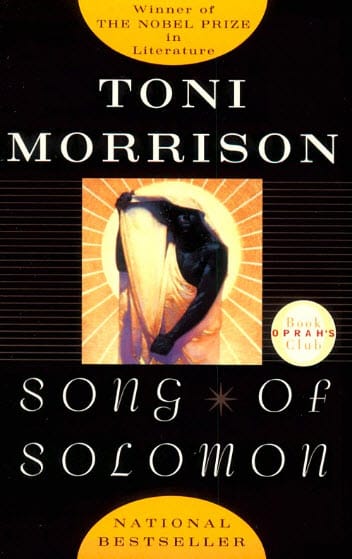
Song of Solomon by Toni Morrison

As Milkman watched the children, he began to feel uncomfortable.  Hating his parents, his sisters, seemed silly now.  And the skim of shame that he had rinsed away in the bathwater after having stolen from Pilate returned.  But now it was as thick and tight as a caul.  How could he have broken into that house--the only one he knew that achieved comfort without one article of comfort in it.  No soft worn-down chair, not a cushion or a pillow.  No light switch, no water running free and clear after a turn of a tap handle.  No napkins, no tablecloth.  No fluted plates or flowered cups, no circle of blue flame burning in a stove eye.  But peace was there, energy, singing, and now his own remembrances.


Toni Morrison's Song of Solomon opens with this very crytpic sentence: "The North Carolina Mutual Life Insurance agent promised to fly from Mercy to the other side of Lake Superior at three o'clock."  To the story, the agent is nobody, a non-character, but his attempted flight--you can guess how it turns out--provides the guiding symbol for the rest of the novel: a man, alone, making a leap that, no matter how it ends, will take him away from his town, his home, and his family.  There are other flights in the novel, too: The protagonist, Milkman Dead, learns that his great-grandfather was reputed to be part of a legendary tribe of "flying" slaves in the antebellum South; at the end, Milkman too leaps into the air, his flight perhaps the most ambiguous of them all.

It's not hard to believe that someone in the world of Song of Solomon might able to fly.  Morrison crowds her plot with a number of details borrowed from Magical Realism: Milkman's Aunt Pilate, for instance, born just after her mother's death, has no navel.  Another character seems to be immortal.  Morrison's story bumps right up to the edge of realism, and when it's not fantastical, it's consistently weird.  But at the same time, it's one of Morrison's most straightforward works.  She explains in the (really great) foreword that, for Solomon, she abandoned the more complex experiments with time that characterize some of her other books because the traditional progression seemed more fitting for the male protagonist.  That's something I never would have thought of.

At its heart, Song of Solomon is a conventional novel; a bildungsroman about Milkman that follows him from his birth to his moment of "flight."  Morrison carefully details not only Milkman himself but his family--his greedy, callous father Macon, his abused mother Ruth, his sisters Lena and Corinthians, his otherworldly aunt Pilate, her granddaughter Hagar, whom he loves then abandons.  Each of these characters gets a really intricate, detailed plotline; to Morrison's credit, nothing among them seems extraneous and unnecessary.  In the second part of the novel, Milkman retraces Pilate's life history in Pennsylvania and Virginia searching for a sack of gold she described to him.  The gold, reliably, is a MacGuffin--what he really discovers is the story of his family, of flying Solomon, and the rest of his great-grandparents.  And just as reliably, he comes out of the experience a better person--regretful for the way he has treated Hagar, loving toward his parents, etc., etc.

That sounds hokey and cliched, but man, it works.  I think part of the genius of Song of Solomon is that Morrison finds the perfect balance between this well-worn structure and the accumulated strangeness of Milkman's family.  I don't think that my description of it has been really sufficient, but the book's greatness relies in its many intricate details, and I don't think reciting them here would really provide an understanding of how well they work together.

Sunday, August 18, 2013

All Quiet on the Western Front by Erich Maria Remarque

To no man does the earth mean so much as to the soldier.  When he presses himself down upon her long and powerfully, when he buries his face and his limbs deep in her from the fear of death by shell-fire, then she is his only friend, his brother, his mother; he stifles his terror and his cries in her silence and security; she shelters him and releases him for ten seconds to live, to run, ten seconds of life; receives him again and often for ever.

Earth!--Earth!--Earth!

There is a generally prevalent notion, among literary authors if not among historians, that World War I marks a sort of dividing line in history, a point of irreversible transformation.  The map of Europe was transformed, of course, but along with it came cultural and psychological transformations.  In a reductive sense, much of what defines modern literature--alienation, deracination, nihilism, existentialism, abstractism--has its origin in the that conflict.

Yet I know of very few good literary accounts of the war itself.  My favorite World War I book, Parade's End, provides a few good scenes of Christopher Tietjens being shelled in the trenches, but for the most part it's about what goes on at the fringes of the war, and back home in England.  For the French and Germans, there was no "back home" in that sense, and perhaps for that reason All Quiet on the Western Front could only have come from a continental writer like Remarque.

All Quiet is narrated by a young German soldier, Paul Bremer, who recounts the experiences of his tightly knit group of friends.  It is at times disturbingly graphic about the reality of war, as in one memorable scene in which Paul, unexpectedly finding himself occupying the same foxhole as a French soldier, stabs his enemy to death.  The fear of being murdered is one particular horror, and the murdering another, but it is worse still that Paul must spend the remainder of the skirmish with the man he has killed, looking into his open eyes.  The French soldier is relatively lucky; Remarque goes to great lengths to show us that there are much more gruesome deaths to be had on the front lines.

Even in the midst of the physical actuality of war, Paul and his friends are keenly aware of the way that the war has changed them.  Paul is granted a couple of weeks' leave, but at home he is uneasy and fails to fit in as he once did; home is not what it was because Paul is not what he was.  Remarque clearly spells out the break between the war generation and its predecessors:

For us lads of eighteen they ought to have been mediators and guides to the world of maturity, the world of work, of duty, of culture, of progress--to the future.  We often made fun of them and played jokes on them, but in our hearts we trusted them.  The idea of authority, which they represented, was associated in our minds with a greater insight and a more humane wisdom.  But the first death we saw shattered this belief.  We had to recognize that our generation was more to be trusted than theirs.  They surpassed us only in phrases and in cleverness.  The first bombardment showed us our mistake, and under it the world as they had taught it to us broke into pieces.

...We loved our country as much as they; we went courageously into every action; but also we distinguished the false from the true, we had suddenly learned to see.  And we saw that there was nothing of their world left.  We were all at once terribly alone; and alone we must see it through.

You might certainly read something similar by an Englishman or an American, but there's a special poignancy in that Remarque writes from the German perspective.  The knowledge that Germany will lose this war hangs over the novel, the knowledge that the atrocities come to nothing.  One might ask what the victors of World War I got for their troubles, too--but I think that only the losing side could produce a novel that really lays bare the pointlessness of the bloodshed.  There's a great scene in which Paul and his friends, stationed near the front lines in France, sneak out in the middle of the night to have sex with a group of French girls, whose brothers and cousins perhaps they may kill the very next day.  The scene with the French soldier in the foxhole says something similar about the two sides:

This dead man is bound up with my life, therefore I must do everything, promise everything in order to save myself; I swear blindly that I mean to live only for his sake and his family, with wet lips I try to placate him--and deep down in me lies the hope that I may buy myself off in this way and perhaps even get out of this; it is a little stratagem: if only I am allowed to escape, then I will see to it.  So I open the book and read slowly:--Gerard Duval, compositor.

With the dead man's pencil  write the address on an envelope, then swiftly thrust everything back into his tunic.

I have killed the printer, Gerard Duval.  I must be a printer, I think confusedly, be a printer, printer--

You can see why the Nazi regime banned All Quiet; Paul's experiences do not leave room for the kind of trenchant nationalism the Third Reich required.  But beyond that there is a tangle of guilt and victimhood that threatens the Nazi justification for war.  Is Paul morally responsible for the soldier's death in the way that he feels at this moment, or does that feeling conflict with the feeling of victimhood, of being pushed into war without understanding it, that pervades the rest of the novel?  I'm so fascinated by Paul's feverish need to "become" the man he has killed--partly to reanimate him, to retract the act of murder, partly out of a sense of justice, but also because to become the printer, Gerard Duval, is to relinquish the role of killer in exchange for the role of the killed.  Is it better to be the dead, or to go on living, as Paul must, with his conscience?

Bonus: Brent's review from 2010.

Friday, August 16, 2013

Kindred by Octavia E. Butler

"Dana, don't make me talk to you like that," he said wearily. "Just do what I tell you."

I added this book to my feminism Amazon wishlist when I saw it on a The Atlantic book list titled "21 Books Written By and About Women that Men Would Benefit From Reading," but seeing that Chris had read it made me pull the trigger and read it myself.

Ugh, I wish I hadn't.

The story was reasonably entertaining, but the messages were gross and unsettling.  The short review on The Atlantic promised social criticism, but as far as I could tell the only constructive social criticism in Kindred was, "slavery was pretty awful," which I kind of figured beforehand.  In addition to this insight, we also had flagrant rape apology and a vivid, but uncondemned, depiction of domestic abuse.

The story revolved around Dana, a black woman from 1976 who keeps being transported back in time to save the life of her distant ancestor, Rufus, a white son of a plantation owner who also owns an undetermined (but large number) of slaves.  Dana figures our pretty quickly that her forebear is the daughter of Rufus and a free (at least initially) black woman named Alice.  As a result, Dana consistently saves Rufus, who proves to be brutal and cruel when you remove Dana's rose colored view of him, and is complicit in his continued torture and rape of Alice.  Dana reluctantly tries to help Alice every now and then, but the message is clear: Dana will only help her to the extent that her own eventual existence is assured.  This makes sense in this context; obviously Dana wants her ancestors to be born.  However, it's also eerily reminiscent of the politicians claiming that babies born from rape are "gifts" and pro-life activists saying, "aren't you glad your mom didn't abort you?"  I think Butler just wanted to add some drama to her story, but the drama functionally excused the torment and continued rape of poor Alice.  It would be terrible to see the story through her eyes, especially if she realized this other woman was taking these measures to ensure her continued abuse.

Speaking of abuse, the relationship between Dana and Rufus is a textbook abusive domestic relationship.  Though there is no romantic relationship between the two, Rufus acts like a batterer throughout.  He has Dana beaten (and eventually beats her himself) or has other slaves beaten or sold to punish Dana, but always apologizes afterward, and Dana always lets him off the hook! He threatens suicide (in his story-specific way, a classic abuser tactic) and accuses Dana of "making him" do what he does.  And still she has a kind of affection for him!  His kindnesses are exaggerated (even when the kindness is that he wasn't as bad as he could have been) and his transgressions are minimized because he didn't mean it or he was a product of his upbringing or some other excuse.  This could have been a very sharp commentary on domestic abuse, but Butler only (spoiler alert; btw, thanks, Christopher, for putting the spoiler alert in your review, it saved me) sees fit to give Rufus his comeuppance when he tries to force himself on Dana sexually at the end.  This would feel like a real condemnation of his behavior (rather than a convenient way to end the story) if he hadn't already 1. brutally beaten and whipped her, 2. sold her friends into slavery and separated them from their familes, and 3. lied to her about contacting her husband to have him come rescue her.  What makes it different this time, other than it was convenient now that the ongoing rape of Alice had productively created Dana's ancestor and neatly wrapped up that storyline.  And Dana even gets punished for giving the monster what he deserves, somehow (Butler is a little light on the sci-fi explanation on this point) losing her arm above the elbow for her troubles. (disclaimer: those of you who know me/have read my reviews for other books know that I am staunchly for due process/against the death penalty, but for illustrative/allegorical purposes this asshat had to die).

I don't know why The Atlantic thought that men would benefit from reading this book, unless they want men to think that a. it's ok to rape someone because you kind of love them and they might have a kid, b. even pregnancies that result from rape should be carried to term because what about the feelings of the progeny that result? and c. domestic abuse isn't that bad as long as you don't really mean it and apologize for it later.

Gross.

p.s.
There also were a lot of complicated dynamics between Dana and the other slaves, who hated her for being "too white," by which they meant both well educated and seemingly allied with Rufus against the other slaves. I don't really know enough about this subject to intelligently comment on it, but it seemed like it was an important part of what Butler was trying to say, so if anyone has some insight I'm definitely interested.

p.p.s.
There was also some great male/white privilege from Dana's husband, a white man, who is brought with her on one of the trips back to the 1800s.  When they first arrive, Kevin figures it'll be fascinating to explore this world.  He assumes that because he will be with Dana and protect her, that it won't be that bad, not realizing how perilous it is for a black woman to be in the South in the antebellum period, no matter what his circumstances.  Y'all, it's important to recognize your privilege!

Wednesday, August 14, 2013

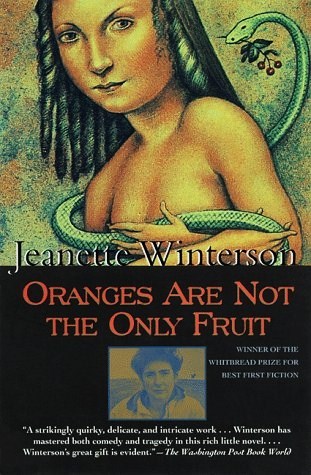
Oranges Are Not the Only Fruit by Jeanette Winterson

I miss God.  I miss the company of someone utterly loyal.  I still don't think of God as my betrayer.  The servants of God, yes, but servants by their nature betray.  I miss God who was my friend.  I don't even know if God exists, but I do know that if God is your emotional role model, very few human relationships will match up to it.  I have an idea that one day it might be possible, I thought once it had become possible, and that glimpse has set me wandering, trying to find the balance between earth and sky.

I read Jeanette Winterson's Sexing the Cherry for class a few years back, and really loathed it.  It probably remains, to this day, the least enjoyable book I have read since the Fifty Books Project began.  I'm not going to link to it because it's a pretty thoughtless review, and I don't do a very good job of laying out what I disliked about it.  But, if I recall correctly, I was bothered by the way the skeleton narrative was padded out with digressive passages of parable and fantasy that failed to illuminate anything about the main plot, thin though it was.  Sexing the Cherry struck me as a book of vignettes hastily cobbled together in the hopes that their multiplicity would mask their rather shallow observations about gender and sexuality.

You can imagine what I was thinking when I found out that Winterson's debut novel, Oranges Are Not the Only Fruit, had been made a mandatory text for one of the classes I'm teaching next year.  I picked it up with trepidation, to be sure--but, I am happy to say, I found Oranges to be a much better experience.  Perhaps some of that is because of ways I have changed in the past seven years.  But only some.

Unlike Sexing the Cherry, which has the intimacy and depth of a collection of fairy tales, Oranges Are Not the Only Fruit presents itself as semi-autobiographical, detailing Winterson's childhood in an extremely evangelical family and the conflict created by her attraction to women.  Winterson's mother is kooky, an obsessive who throws herself into evangelizing with abandon, but Winterson's own belief is presented as very real and very treasured.  The scene in which Jeanette and her young lover, Melanie, are exposed in front of the church, is tragic and real:

'I will read you the words of St Paul,' announced the pastor, and he did, and many more words besides about unnatural passions and the mark of the demon.

'To the pure all things are pure,' I yelled at him.  'It's you not us.'

He turned to Melanie.

'Do you promise to give up this sin and beg the Lord to forgive you?'

'Yes.'  She was trembling uncontrollably.  I hardly heard what she said.

'Then go into the vestry with Mrs White and the elders will come and pray for you.  It's not too late for those who truly repent.'

He turned to me.

'I love her.'

'Then you do not love the Lord.'

'Yes, I love both of them.'

'You cannot.'

It's not always so heavy; in fact, Winterson treats her story with just the right amount of irony and humor (which, if I recall correctly, were noticeably absent from Sexing the Cherry.)  There's a scene--Lord knows how much truth is in it--where Jeanette, exiled from her family because of her sexuality, has taken a job driving an ice cream truck.  Through an odd turn of events, she's forced to help cater a funeral for an older woman who she had been very close to, and where she must encounter her mother and her mother's friends.  Afterward, the guests line up for ice cream before she can get away, and her mother's crew huffs over Jeanette "making money off the dead"--which is a great image of the way the judgment of others has of twisting one's identity.  But it's the absurdity of the scene that sells it, that somehow works to balance the awful sadness of it.

Winterson devotes a large section of the last chapters to a fable about a princess named Winnet.  This story reaffirmed my feelings about Sexing the Cherry, which was basically a collection of similar fables.  I would not claim that the story of Winnet has nothing to say about Jeanette's experience--surely, there are many parallels that Winterson wants us to see.  But the whole thing is so unnecessary, a needless diversion in a novel that would work much better without it.

Sunday, August 4, 2013

The Bell Jar by Sylvia Plath

I thought the most beautiful thing in the world must be shadow, the million moving shapes and cul-de-sacs of shadow.  There was shadow in bureau drawers and closets and suitcases, and shadow under houses and trees and stones, and shadow at the back of people's eyes and smiles, and shadow, miles and miles of it, on the night side of the earth.

I totally forgot that I had read The Bell Jar.  Well, no, I didn't forget that I'd read it, I forgot to review it, and for whatever reason, as I went back over the books I needed to write about after I got back from my trip, it dropped out of my mental list.  That's a shame, because The Bell Jar is really fantastic.  I'm sorry, The Bell Jar.

As Meagan pointed out in her review from a couple years ago, The Bell Jar is almost an autobiographical work.  Its heroine, Esther Greenwood, is a stand-in for Plath herself, who also spent a time working for a magazine (Mademoiselle, in Plath's case) and who fretted over her career and romantic prospects, and then had a nervous breakdown and had to be briefly committed to an institution.  Keeping this in mind makes reading The Bell Jar a grim exercise, since shortly after it was published Plath committed suicide.  Such knowledge blunts the sharp humor of Esther's bungled attempts to kill herself, which seem as if they are detailed with the light touch of someone with a greater sense of distance from their previous feelings.

One of the really terrific things about The Bell Jar is the way in which Plath is able to blur the line between the everyday neuroticism of the first part, which seems very familiar to anyone trying to "make it" in academia, or the creative professions, or New York City, and the kind of mental illness that strikes Plath when she returns to her New England home in the second part.  In a famous passage from the first part, Esther compares her future to a fig tree:

From the tip of every branch, like a fat purple fig, a wonderful future beckoned and winked.  One fig was a husband and a happy home and children, and another fig was a famous poet and another fig was a brilliant professor, and another fig was Ee Gee, the amazing editor, and another fig was Europe and Africa and South America, and another fig was Constantin and Socrates and Attila and a pack of other lovers with queer names and offbeat professions, and another fig was an Olympic lady crew champion, and beyond and above these figs were many more figs I couldn't quite make out.

I saw myself sitting in the crotch of this fig tree, starving to death, just because I couldn't make up my mind which of the figs I would choose.  I wanted each and every one of them, but choosing one meant losing all the rest, and, as I sat there, unable to decide, the figs began to wrinkle and go black, and, one by one, they plopped to the ground at my feet.

I love this image, and it's easy to see the stamp of Plath's poetry on it.  I was impressed by the way that Plath manages to employ the distinct, stark imagery and detail of her poems without sacrificing a strong narrative voice.  The list of writers who are equally great poets and novelists is not very long, and I wouldn't hesitate to put her on it.  (Hardy, Lawrence, Plath... ?)  But look how easily the ennui and indecision of that passage transforms into a kind of paralysis:

The reason I hadn't washed my clothes or my hair was because it seemed so silly.

I saw the days of the year stretching ahead like a series of bright, white boxes, and separating one box from another was sleep, like black shade.  Only for me, the long perspective of shades that set off one box from the next had suddenly snapped up, and I could see day after day glaring ahead of me like a white, broad, infinitely desolate avenue.

It seemed silly to wash one day when I would only have to wash again the next.

It made me tired just to think of it.

I wanted to do everything once and for all and be through with it.

We read this passage with a sense of irony, thinking that the author recognizes the strange horror of these thoughts, shares an outsider's perspective with us.  And that may be true.  It may be true that Plath, like Esther sometimes can, can see these images with an outsider's perspective, and yet they doubtlessly became unbearable for Plath in the end.  What she left behind is a great, horribly frank and terrifying novel, perhaps the greatest record we have of mental illness.

Saturday, August 3, 2013

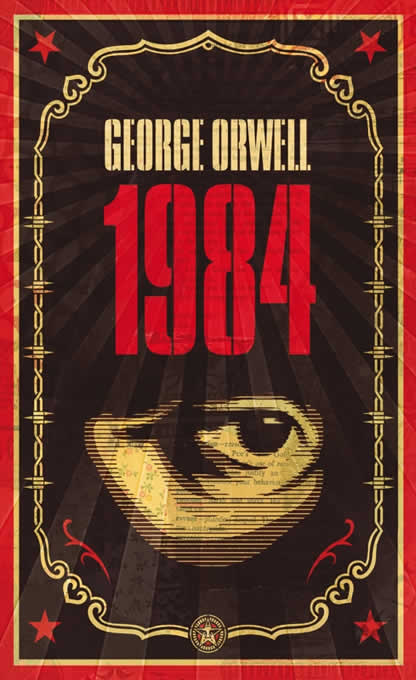
Nineteen Eighty-Four by George Orwell

He took a twenty-five cent piece out of his pocket.  There, too, in tiny clear lettering, the same slogans were inscribed, and on the other face of the coin the head of Big Brother.  Even from the coin the eyes pursued you.  On coins, on stamps, on the covers of books, on banners, on posters, and on the wrapping of a cigarette packet--everywhere.  Always the eyes watching you and the voice enveloping you.  Asleep or awake, working or eating, indoors or out of doors, in the bath or in the bed--no escape.  Nothing was your own except the few cubic centimeters inside your skull.

1984 is one of those books whose cultural influence completely outstrips its presence as a novel.  I mean that, even if you haven't read it, details and themes from it are so ingrained into the way we think about politics and society that you can't help but being familiar with it.  I have read it, and until I revisited it recently I have to admit that my mental conception of 1984 was still dominated by its pop culture distillations, which are often facile and shallow: Big Brother the television show, V for Vendetta and those stupid Guy Fawkes masks, the flaccid banality of most political protests in the post-Vietnam era.  Just this year I told a student who was reading 1984 to pick up Brave New World, because it was "much richer."

But you know what?  1984 is great.  It's much more subtle, more carefully wrought, and more terrifying than I had remembered.  First, I was struck by just how little happens in the novel.  (Spoilers commence, though if you haven't read it--what did you do in high school?)  There is the protagonist, Winston, an "Outer Party" member who secretly harbors unorthodox opinions and a skepticism about Big Brother and the Party establishment.  Winston allows himself small heresies at first--keeping a diary, for instance.  But then he becomes swept up in an affair with a young woman, Julia, who shares his antipathy.  They know that their affair, like all love and non-procreative sex, is a one-way ticket to the Ministry of Love, which enforces law and order in Airstrip One (the Party name for Britain--love that), and yet they go about it anyway.  They are recruited by a shadowy organization, the Brotherhood, and for a moment, it seems as if the novel is about to explode into espionage and action, but that is the very moment that the hammer drops and Winston and Julia are captured by the Party's Thought Police.

The Brotherhood turns out to be a ruse, of course, a tool of entrapment--an unnecessary one, since we learn that Winston has been under surveillance for his unorthodoxy for years and years.  I can't help but compare this to other dystopian works, all of which take after 1984 in a way: V for Vendetta is one, but also The Hunger Games.  These works are all about collective resistance, but 1984 remains more terrifying than these because resistance is clearly impossible, a foregone conclusion.  Winston knows from the moment he begins to write in his diary that he is a "dead person," and things go more or less exactly according to his fears.  In this way 1984 reminds me more of Never Let Me Go, another novel which explores the way that oppressive systems work to preclude even the idea of resistance.  There is no fighting back; the Party always wins; we know the famous last words of the novel which describe Winston's dissolution as an individual and complete subjugation to the state: "He loved Big Brother."

Second, I was struck by how philosophically rich the novel is.  It's easy to see 1984 as an allegory for the fascist and totalitarian movements that sprung up in Europe at the time of its writing, but Orwell's thoughts on power, history, and subjectivity deal in questions that have been around for thousands of years, including one of the most fundamental: "What is truth?"  The Party of 1984 operates by controlling the truth, falsifying facts and manipulating records so that history always seems to validate the Party's essential goodness.  The Party relies on a philosophy that negates any sense of "reality":

Only the disciplined mind can see reality, Winston.  You believe that reality is something objective, external, existing in its own right.  You also believe that the nature of reality is self-evident.  When you delude yourself into thinking that you see something, you assume that everyone else sees the same thing as you.  But I tell you, Winston, that reality is not external.  Reality exists in the human mind, and nowhere else.  Not in the individual mind, which can make mistakes, and in any case soon perishes; only in the mind of the Party, which is collective and immortal.  Whatever the Party holds to be truth is truth.  It is impossible to see reality except by looking through the eyes of the Party.  That is the fact that you have got to relearn, Winston.  It needs an act of self-destruction, an effort of the will.  You must humble yourself before you can become sane.

It strikes me that Orwell here is offering what we consider a very conservative philosophy, one that stresses the importance of an objective reality to political freedom and philosophical health.  One of the most interesting and useful ideas he offers is that of doublethink: a "Newspeak" word which means to hold two contrasting ideas in your head at a time, and to believe them both:

To know and not to know, to be conscious of complete truthfulness while telling carefully constructed lies, to hold simultaneously two opinions which cancelled out, knowing them to be contradictory and believing in both of them, to use logic against logic, to repudiate morality while laying claim to it, to believe that democracy was impossible and that the Party was the guardian of democracy, to forget whatever it was necessary to forget, then to draw it back into memory again at the moment when it was needed, and then promptly to forget it again, and above all, to apply the same process to the process itself--that was the ultimate subtlety: consciously to induce unconsciousness, and then, once again, to become unconscious of the act of hypnosis you had just performed.  Even to understand the word "doublethink" involved the use of doublethink.

I do not believe that the modern world is in danger of becoming the world of 1984.  One thing I think we are learning from the recent Snowden-NSA debacle is that one-way methods of surveillance are never truly one way, and that the better those in power get at watching us, the better we get at watching those in power.  But dystopian fictions are not really predictions, they are exaggerations, hyperbolic descriptions of attitudes and processes that already exist, and I see doublethink everywhere.  Our entire system of political discourse, with its rah-rah partisanship, is founded on doublethink, and the subjugation of truth to power.  We see it every time some Republican idea becomes cherished by Democrats and loathed by Republicans, or vice versa.

One of the scariest things about 1984 is the way that it shows how a really successful fascism doesn't merely pummel the opposition into non-existence.  ("If you want a picture of the future," Winston's interrogator tells him, "imagine a boot stamping on a human face--forever.")  It also enlists us in the oppression, and asks us to invest in power at the expense of truth.  If we really wanted to let Orwell be useful in the 21st century, we'd keep that in mind.

Thursday, August 1, 2013

The Witches by Roald Dahl

“It doesn't matter who you are or what you look like, so long as somebody loves you.”

When I searched for quotes from The Witches, the above was by far the most popular. I find this pretty amusing considering that most children who read Dahl’s creepy tale will probably remember the first half, where children are drowned, poisoned transformed and sometimes just vanished by a world-wide cabal of mostly unidentifiable witches. It’s certainly the part of the book that stuck with me the most. Dahl has a knack for crafting disturbing grotesqueries without being explicit, and he’s at his best in the first half of The Witches.

The story is simple: a young boy, never named, is told stories about witches by his grandmother. In Dahl’s mythology, witches have only one objective: destroy all children, by any means possible. Unfortunately for our nameless hero, the boy and his grandmother end up at a hotel that just happens to be hosting the annual gathering of all the witches in England. The boy ends up captured by the witches and used as a test case for the witches’ newest plan: turning all the children in the world into mice.

The story does two things at this point. First, up until the boy’s transformation, The Witches is mostly a creepy slow-burn; afterward, it becomes more of a traditional adventure story as the boy attempts, in mouse-form, to turn the witches’ mouse-making potion on them. Dahl is just fine at writing action, but it’s not his primary strength, and the last third of the book suffers as a result.

The second, and most notable, thing about the last section, however, is the way it inverts expectations about the boy’s eventual fate. Normally, in a story like this, the boy would be turned back into, well, a boy. Not so here. Instead, he is told by his grandmother that, as a human-mouse, he will likely live only nine more years. To which he responds, “Good! That’s great! That’s the best news I ever had!” Because he doesn’t want to live longer than his grandma, you see.

I guess the ending is triumphant--the implication is that mouse and grandma will soon eliminate every witch in the world--but it’s hard to feel super happy about the kid spending the rest of his abbreviated life as a rodent. Whatever.

Wednesday, July 31, 2013

Kindred by Octavia E. Butler

The trouble began long before June 9, 1976, when I became aware of it, but June 9 is the day I remember.  It was my twenty-sixth birthday.  It was also the day I met Rufus--the day he called me to him for the first time.

Dana Franklin passes out in 1976 and wakes up in early 19th century Maryland, just in time to save a young boy from drowning.  The episode lasts for maybe fifteen minutes, but when she returns, only a few seconds have passed.  When she's "called" again, it's 1819, and the boy is a little older, and about to accidentally burn his house down.  This time, Dana stays a little longer--and discovers, at the point of a gun, that she only returns to her own time when her life is in jeopardy.

Of course, death isn't the only frightening prospect for a black woman in the antebellum South.  Each time Dana is called to help Rufus--a man whom, she discovers, is her distant ancestor--she finds herself deep in Plantation life, not a slave exactly, not that those sort of technicalities matter.  Even when she manages to bring her husband, Kevin, along with her, they must disguise their marriage--Kevin is white--and pose as master and slave.  Each time she faces the possibility that she'll never return.

Kindred is a better thought experiment than a novel.  It has a very cinematic sense of plot--in fact, I'm surprised no one's tried to make a film out of it yet.  The nature of Dana's time traveling means that every chapter has to end with a cliffhanger.  The stakes are kept constantly high--when Kevin fails to reach Dana before she "disappears" back to the modern day, he is essentially trapped until Rufus calls her back, and spends five lonely years stuck in the 19th century.  Yet it seems to me Dana never coheres as a character rather than an archetype, Kevin, less so.  Furthermore, the novel's use of history often seems flatly encyclopedic.

The best thing about the novel is the relationship between Dana and her ancestor, Rufus.  Dana is cast into the role of protector for Rufus, and she saves him from certain death multiple times, but she's unable to help him grow into someone who leads a life contrary to his family and his society.  As a result, Rufus is alternately cruel and needy towards Dana--he can not live without her, but he doesn't have access to the kind of respect and gratitude that need requires.  He gives her gifts, then has her whipped, pleads with her not to leave him, then backs his pleas up at the point of a rifle.  Their relationship mirrors that between Rufus and Alice, the slave who will give birth to Dana's family line.  In the 20th century, Butler suggests, Rufus might have been able to pursue Alice romantically in the way that Kevin pursues Dana; in the antebellum South Alice's child will inevitably be a product of rape.

Butler does a good job, without excusing Rufus' cruelties, of showing the way in which he himself is limited and malformed by the "peculiar institution."  (Spoiler alert!)  When Dana is called for the last time, it is because Alice has hanged herself.  Rufus, distraught, turns his sexual advances on Dana, and though she has never confessed their kinship, the possibility of incest underlines the destructiveness of slavery on family relationships, a destructiveness which necessitates that Dana kill the man who she has toiled against her will to protect.

Tuesday, July 30, 2013

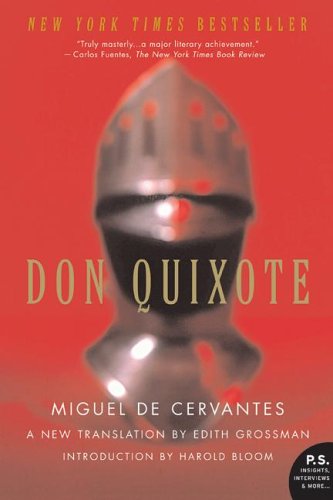
Don Quixote by Miguel de Cervantes

"Not mine," responded Sancho.  "I mean, there's nothing of the scoundrel in him; mine's as innocent as a baby; he doesn't know how to harm anybody, he can only do good to everybody, and there's no malice in him: a child could convince him it's night in the middle of the day, and because he's simple I love him with all my heart and couldn't leave him no matter how many crazy things he does."

I did it!  It took three weeks and a couple twelve-hour stretches in a rented car, but I finished Don Quixote.  I don't mean to make it sound like a slog; I probably would have finished it much more quickly if I hadn't been passing through some beautiful Montana scenery, because there's nothing really difficult or thorny about Don Quixote.  It's one of the most fun and readable "classics" I've ever read--though I'm sure part of that is Edith Grossman's recent translations, which really captures the spirit of Cervantes' up-to-date (for the time) Spanish.

Don Quixote, briefly, is a Spanish hidalgo, or nobleman, named Alonso Quijano who becomes obsessed with books of chivalry and knight errantry.  He reinvents himself as Don Quixote, the Knight of the Sorrowful Face (a name he takes on after he gets the crap beaten out of him), defender of the weak, champion of justice, devoted to the beautiful and peerless Dulcinea of Toboso--a fictional version of a peasant girl who lives in a nearby town.  Even if you're not familiar with Don Quixote, you probably know the famous image of him "tilting at windmills," that is, attacking a windmill imagining it to be a giant.  All 900 pages of the book are pretty much like that: Don Quixote imagines a commonplace person or thing is a giant or a witch or an enchantment, and tries to fight it, and ends up getting his ass kicked despite the protests of his loyal squire,  Sancho Panza.  Don Quixote's "madness" is a positive feedback loop, in which he dismisses any proof to the contrary as the work of enchanters:

"Well, Sancho, by the same oath you swore before, I swear to you," said Don Quixote, "that you have the dimmest wits that any squire in the world has or ever had.  Is it possible that in all the time you have traveled with me you have not yet noticed that all things having to do with knights errant appear to be chimerical, foolish, senseless, and turned inside out?  And not because they really are, but because hordes of enchanters always walk among us and alter and change everything and turn things into whatever they please, according to whether they wish to favor us or destroy us; and so, what seems to you to be a barber's basin seems to me the helmet of Mambrino, and will seem another thing to someone else."

Don Quixote is often praised not only as the first novel, but as anticipating most of the textual tools and tricks of modernist literature: First, Cervantes presents it as a translation of a Moorish author, Cide Hemete Benengeli.  Then, in the second part, published a decade or so after the first, Cervantes places Don Quixote and Sancho in a world where the first part of their adventures has become famous; the heroes, then, have to grapple with their own textuality.

To be sure, these aspects do a lot to make Don Quixote into a rich, fascinating text.  But Cervantes approaches the metafictional stuff with a very light touch; and in my opinion, it's not the most rewarding facet of the novel.  Don Quixote is really, great, I think, for two reason: First, the pervasive suggestion that Don Quixote is the one who is sane and everyone else who is insane.  I don't mean that Don Quixote is right that the windmills are giants or that the inn is a castle, of course, but rather that Cervantes is constantly forcing us to evaluate Don Quixote's philosophy against the attitudes of those around him.  He's frequently the butt of practical jokes invented by those who know about his "madness," from the priest and the barber of the first part to the duke and the duchess of the second; some are harmless, but many involve actual physical harm to Don Quixote.  Such cruelty and play-acting contrast sharply with Don Quixote's moral compulsion to protect those who need it.  Even when destroying a puppet show, Don Quixote seems to be the only one in the novel with a moral code:

"I shall not consent, in my lifetime and in my presence, to any such offense against an enamored knight so famous and bold as Don Gaiferos.  Halt, you lowborn rabble; do not follow and do not pursue him unless you wish to do battle with me!"

And speaking and taking action, he unsheathed his sword, leaped next to the stage, and with swift and never before seen fury began to rain down blows on the crowd of Moorish puppets, knocking down some, beheading others, ruining this one, destroying that one, and among many other blows, he delivered so power a downstroke that if Master Pedro had not stopped, crouched down, and hunched over, he would have cut off his head more easily than if it had been so much marzipan.

The second great thing about Don Quixote is the relationship between Don Quixote and his squire, Sancho Panza.  Sancho sometimes sees through his master's madness and sometimes does not; sometimes Don Quixote praises Sancho for his loyalty and sometimes he upbraids him for his cowardice and weakness, but ultimately Sancho's devotion to Don Quixote is one of the most convincing literary portraits of friendship I know of.

Don Quixote ends (spoiler?) with the Knight of the Sorrowful Face tricked into returning to his home and giving up knight errantry; once again becoming Alonso Quijano and promptly dying.  His friends and neighbors treat this as a great success, but there's an awful sadness to it.  Only the most cynical realist could think that the world is better off without Don Quixotes in it.