Showing posts with label Gay/lesbian. Show all posts

Wednesday, August 14, 2013

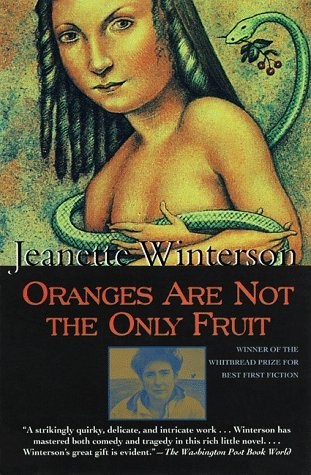
Oranges Are Not the Only Fruit by Jeanette Winterson

I miss God.  I miss the company of someone utterly loyal.  I still don't think of God as my betrayer.  The servants of God, yes, but servants by their nature betray.  I miss God who was my friend.  I don't even know if God exists, but I do know that if God is your emotional role model, very few human relationships will match up to it.  I have an idea that one day it might be possible, I thought once it had become possible, and that glimpse has set me wandering, trying to find the balance between earth and sky.

I read Jeanette Winterson's Sexing the Cherry for class a few years back, and really loathed it.  It probably remains, to this day, the least enjoyable book I have read since the Fifty Books Project began.  I'm not going to link to it because it's a pretty thoughtless review, and I don't do a very good job of laying out what I disliked about it.  But, if I recall correctly, I was bothered by the way the skeleton narrative was padded out with digressive passages of parable and fantasy that failed to illuminate anything about the main plot, thin though it was.  Sexing the Cherry struck me as a book of vignettes hastily cobbled together in the hopes that their multiplicity would mask their rather shallow observations about gender and sexuality.

You can imagine what I was thinking when I found out that Winterson's debut novel, Oranges Are Not the Only Fruit, had been made a mandatory text for one of the classes I'm teaching next year.  I picked it up with trepidation, to be sure--but, I am happy to say, I found Oranges to be a much better experience.  Perhaps some of that is because of ways I have changed in the past seven years.  But only some.

Unlike Sexing the Cherry, which has the intimacy and depth of a collection of fairy tales, Oranges Are Not the Only Fruit presents itself as semi-autobiographical, detailing Winterson's childhood in an extremely evangelical family and the conflict created by her attraction to women.  Winterson's mother is kooky, an obsessive who throws herself into evangelizing with abandon, but Winterson's own belief is presented as very real and very treasured.  The scene in which Jeanette and her young lover, Melanie, are exposed in front of the church, is tragic and real:

'I will read you the words of St Paul,' announced the pastor, and he did, and many more words besides about unnatural passions and the mark of the demon.

'To the pure all things are pure,' I yelled at him.  'It's you not us.'

He turned to Melanie.

'Do you promise to give up this sin and beg the Lord to forgive you?'

'Yes.'  She was trembling uncontrollably.  I hardly heard what she said.

'Then go into the vestry with Mrs White and the elders will come and pray for you.  It's not too late for those who truly repent.'

He turned to me.

'I love her.'

'Then you do not love the Lord.'

'Yes, I love both of them.'

'You cannot.'

It's not always so heavy; in fact, Winterson treats her story with just the right amount of irony and humor (which, if I recall correctly, were noticeably absent from Sexing the Cherry.)  There's a scene--Lord knows how much truth is in it--where Jeanette, exiled from her family because of her sexuality, has taken a job driving an ice cream truck.  Through an odd turn of events, she's forced to help cater a funeral for an older woman who she had been very close to, and where she must encounter her mother and her mother's friends.  Afterward, the guests line up for ice cream before she can get away, and her mother's crew huffs over Jeanette "making money off the dead"--which is a great image of the way the judgment of others has of twisting one's identity.  But it's the absurdity of the scene that sells it, that somehow works to balance the awful sadness of it.

Winterson devotes a large section of the last chapters to a fable about a princess named Winnet.  This story reaffirmed my feelings about Sexing the Cherry, which was basically a collection of similar fables.  I would not claim that the story of Winnet has nothing to say about Jeanette's experience--surely, there are many parallels that Winterson wants us to see.  But the whole thing is so unnecessary, a needless diversion in a novel that would work much better without it.

Wednesday, March 19, 2008

Coachella by Shelia Ortiz-Taylor

'Against his will he has plunged into mystery, somehow held captive in that temporal zone between the question and the answer. But if you could ask him what shape life ought to take, he would tell you this: that life should be like a map on which one could chart one's clear course. And those of others. Life should have a legend by which one could calculate distance, speed, points of intersection. Somewhere on the map it should say: YOU ARE HERE. By traveling at a certain speed, for a certain length of time, one should be able to estimate one's approximate time of arrival and probable outcome.' Shelia Ortiz-Taylor


"Ortiz-Taylor writes novels that help to illuminate the Mexican-American lesbian experience." -Tina Gianoulis


Need I say more? Doubtful, but I want to make sure you have a full picture.

Characters:

  • Casa Diva, (seemingly its own character) a spa house for gay men that is over-run with AIDS.

  • Marina Lomas, Victim of her abusive husband and recently turned lesbian.

  • Yolanda Ramirez, local phlebotomist and lesbian.

  • Crescencio, a man in love with with a dying, married woman.

  • Ella Townsend, the dying, married, before mentioned woman.

  • Mr. Townsend, Ella's abusive husband.

  • A few other Indians, Mexicans, and Gays. (Not that I am grouping them all together, but the author seemed the think those were the superior beings on earth.)

Plot:
The women of Coachella all believe they need extensive plastic surgery on the regular basis. This is not an idea put in their heads by their abusive husbands, but in fact a sad truth that they themselves can see as their boobs sag, bellies pooch, and faces age. However, all of their surgeries require extended hospital stays where they are eventually given blood transfusions.

All the Gay men living at the Casa Diva, most notably the owner, are getting nagging colds that refuse to go away and soon turn into pneumonia.

The phlebotomist, Yolanda, is seeing a surprising increase in the number of people with low white blood cell counts. She realizes that this is an indication of AIDS.

Yolanda thinks that AIDS may be a virus, and it may be carried in the blood. The blood bank might be contaminated. She takes her research to the doctor, after a brief discussion, they decide that they are more like business men than doctors. They hide the fact of the tainted blood so that they don't loose money on it.

Marina comes to town with her baby girl as she tries to escape her abusive husband, David. She starts working at the Casa Diva and meets Yolanda. The two women soon become lovers and move in together. When they hear that David is coming after Marina, they hide out with a friend. Yolanda's father, Crescencio stays at their trailer and shoots David to death.

That night there is an announcement on the News. Everyone is made aware of the tainted blood, but most of them will die anyway. We are not too sad, since Davis has been killed, Ella escaped her abusive husband by dying of AIDS herself, and all the good people of Coachella know that Yolanda was really the one who made the important discovery.

General Conclusions :

  • All straight men abuse women because their scarred emotions don't know any other way of asking for love.

  • Women understand women better, and men understand men better, so you should not attempt to have a romantic relationship with the opposite sex.

  • Mexican culture is far superior to American. If all the Mexican natives would throw off American bondage and be gay they would live much happier lives, but still die of AIDS.

  • If you are a lesbian, your books will get published without the content even being scanned.