
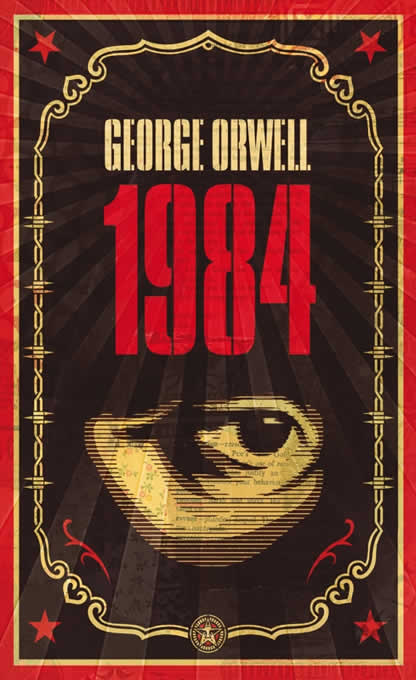
1984 is one of those books whose cultural influence completely outstrips its presence as a novel. I mean that, even if you haven't read it, details and themes from it are so ingrained into the way we think about politics and society that you can't help but being familiar with it. I have read it, and until I revisited it recently I have to admit that my mental conception of 1984 was still dominated by its pop culture distillations, which are often facile and shallow: Big Brother the television show, V for Vendetta and those stupid Guy Fawkes masks, the flaccid banality of most political protests in the post-Vietnam era. Just this year I told a student who was reading 1984 to pick up Brave New World, because it was "much richer."
But you know what? 1984 is great. It's much more subtle, more carefully wrought, and more terrifying than I had remembered. First, I was struck by just how little happens in the novel. (Spoilers commence, though if you haven't read it--what did you do in high school?) There is the protagonist, Winston, an "Outer Party" member who secretly harbors unorthodox opinions and a skepticism about Big Brother and the Party establishment. Winston allows himself small heresies at first--keeping a diary, for instance. But then he becomes swept up in an affair with a young woman, Julia, who shares his antipathy. They know that their affair, like all love and non-procreative sex, is a one-way ticket to the Ministry of Love, which enforces law and order in Airstrip One (the Party name for Britain--love that), and yet they go about it anyway. They are recruited by a shadowy organization, the Brotherhood, and for a moment, it seems as if the novel is about to explode into espionage and action, but that is the very moment that the hammer drops and Winston and Julia are captured by the Party's Thought Police.
The Brotherhood turns out to be a ruse, of course, a tool of entrapment--an unnecessary one, since we learn that Winston has been under surveillance for his unorthodoxy for years and years. I can't help but compare this to other dystopian works, all of which take after 1984 in a way: V for Vendetta is one, but also The Hunger Games. These works are all about collective resistance, but 1984 remains more terrifying than these because resistance is clearly impossible, a foregone conclusion. Winston knows from the moment he begins to write in his diary that he is a "dead person," and things go more or less exactly according to his fears. In this way 1984 reminds me more of Never Let Me Go, another novel which explores the way that oppressive systems work to preclude even the idea of resistance. There is no fighting back; the Party always wins; we know the famous last words of the novel which describe Winston's dissolution as an individual and complete subjugation to the state: "He loved Big Brother."
Second, I was struck by how philosophically rich the novel is. It's easy to see 1984 as an allegory for the fascist and totalitarian movements that sprung up in Europe at the time of its writing, but Orwell's thoughts on power, history, and subjectivity deal in questions that have been around for thousands of years, including one of the most fundamental: "What is truth?" The Party of 1984 operates by controlling the truth, falsifying facts and manipulating records so that history always seems to validate the Party's essential goodness. The Party relies on a philosophy that negates any sense of "reality":
Only the disciplined mind can see reality, Winston. You believe that reality is something objective, external, existing in its own right. You also believe that the nature of reality is self-evident. When you delude yourself into thinking that you see something, you assume that everyone else sees the same thing as you. But I tell you, Winston, that reality is not external. Reality exists in the human mind, and nowhere else. Not in the individual mind, which can make mistakes, and in any case soon perishes; only in the mind of the Party, which is collective and immortal. Whatever the Party holds to be truth is truth. It is impossible to see reality except by looking through the eyes of the Party. That is the fact that you have got to relearn, Winston. It needs an act of self-destruction, an effort of the will. You must humble yourself before you can become sane.
It strikes me that Orwell here is offering what we consider a very conservative philosophy, one that stresses the importance of an objective reality to political freedom and philosophical health. One of the most interesting and useful ideas he offers is that of doublethink: a "Newspeak" word which means to hold two contrasting ideas in your head at a time, and to believe them both:
To know and not to know, to be conscious of complete truthfulness while telling carefully constructed lies, to hold simultaneously two opinions which cancelled out, knowing them to be contradictory and believing in both of them, to use logic against logic, to repudiate morality while laying claim to it, to believe that democracy was impossible and that the Party was the guardian of democracy, to forget whatever it was necessary to forget, then to draw it back into memory again at the moment when it was needed, and then promptly to forget it again, and above all, to apply the same process to the process itself--that was the ultimate subtlety: consciously to induce unconsciousness, and then, once again, to become unconscious of the act of hypnosis you had just performed. Even to understand the word "doublethink" involved the use of doublethink.
I do not believe that the modern world is in danger of becoming the world of 1984. One thing I think we are learning from the recent Snowden-NSA debacle is that one-way methods of surveillance are never truly one way, and that the better those in power get at watching us, the better we get at watching those in power. But dystopian fictions are not really predictions, they are exaggerations, hyperbolic descriptions of attitudes and processes that already exist, and I see doublethink everywhere. Our entire system of political discourse, with its rah-rah partisanship, is founded on doublethink, and the subjugation of truth to power. We see it every time some Republican idea becomes cherished by Democrats and loathed by Republicans, or vice versa.
One of the scariest things about 1984 is the way that it shows how a really successful fascism doesn't merely pummel the opposition into non-existence. ("If you want a picture of the future," Winston's interrogator tells him, "imagine a boot stamping on a human face--forever.") It also enlists us in the oppression, and asks us to invest in power at the expense of truth. If we really wanted to let Orwell be useful in the 21st century, we'd keep that in mind.


