
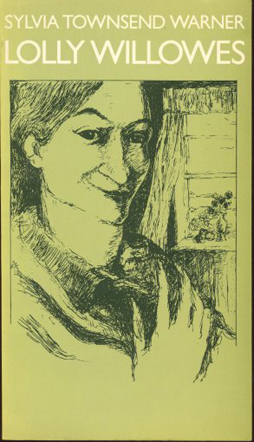
Sylvia Townsend Warner's Lolly Willowes moves in the same way as her novel Mr. Fortune's Maggot. It begins as a black comedy, a satire of conventional mores, this time a needling portrait of a woman who becomes a spinster. Then it becomes something else entirely, something more interesting and profound. In this case, it does that when the spinster becomes a witch.
Lolly--Laura--doesn't exactly chafe against the mores of society, but she is slightly estranged from them. After the death of her beloved father she moves in with her brother and his wife because no one has enough imagination--not Lolly, not her brother Henry, not her sister-in-law Caroline--to think she might do anything else. Lolly goes along, not marrying, submitting to the dead dullness of the everyday life of a woman at the turn of the century, until one day a realization comes upon her: she doesn't actually have to do any of that. She chooses a place in the English countryside, a town called Great Mop, out a guidebook, and moves there.
Lolly's choice to become a servant of the Devil seems hilariously sudden. After all, the book seems to operate in another mode entirely. But it's not totally out of the blue. After all, Warner tells us that Lolly's sense of alienation takes the form of an attraction to darkness and ruin:
Her mind was groping after something that eluded her experience, a something that was shadowy and menacing, and yet in some way congenial; a something that lurked in waste places, that was hinted at by the sound of water gurgling through deep channels and by the voices of birds of ill-omen.
The best part of the novel is its depiction of Satan, who Warner describes as a kind of genial huntsman, traveling through the English countryside looking for souls to snatch. In this way he's sort of an inversion of the image of Christ as "fisher of men," and Warner imbues her Satan with a kind of aloof fatherliness that seems to borrow from depictions of God. But Satan, unlike God, is uncoupled from the intricate network of oppressive conventionality that Lolly has run from: "Society, the Law, the Church, the History of Europe, the Old Testament, great-great aunt Salome and her prayer-book, the Bank of England, Prostitution, the Architect of Apsley Terrace, and half a dozen other useful props of civilization."
God and St. Paul, for Lolly, are "men's things, like politics, or mathematics." Warner, like many after her (and probably some before?) reclaims the archetype of the witch as a symbol of feminism. "When I think of witches," she tells Satan, "I seem to see all over England, all over Europe, women living and growing old, as common as blackberries, and as unregarded." Satan kindly reminds her that there are warlocks, too, but for Lolly and for Warner the decision to follow Satan has a special valence for women, because it represents a rejection of the everyday burden conventionality places on them. The radical gender politics of Lolly Willowes are cut by a mildness, a light satirical touch, that make it seem less radical than I suspect it really is.
In that way, the novel itself is a little like its depiction of Satan. The conversation between him and Lolly that forms the climax of the novel is its best part, and it's hard not to feel like he's introduced too late and rushed off too quickly. But as Lolly notes, Satan, unlike God, is pretty much done with a soul once he's gathered it. In "his satisfied but profoundly indifferent ownership" he won't bother her, making her servanthood look more than a little like true independence.

