Tuesday, January 24, 2017

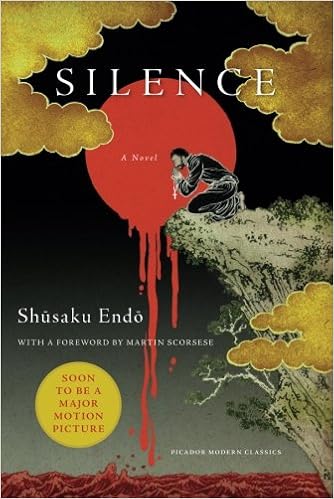
Book 4: Silence, by Shūsaku Endō

Having already read several reviews of Silence, including one on this site, I'm hesitant to launch into my own. This counts as my book set more than 5000 miles away from where I live for ye olde Reade Harder. Taking place during the early isolationist period of Japan's history, Silence follows a Portuguese priest, Sebastian Rodrigues, trying to track down a supposed apostate countryman as he tends to the faithful in Japan. Things go quickly awry thanks to a pathetic Judas figure, Kichijiro, who tries time and again to redeem himself, to no meaningful avail in Rodrigues' situation. Throughout his ordeals, Rodrigues is faced with the ineffable silence of God, despite his faith and his trials.

For many, the silence of God is basically equal to the problem of God. It's been quite a while - if ever - since people have been happy with the explanation given in Job, and Endo does a tremendous job of tracking someone's fall from total adherence to realizing, creepingly at first and with a torrent of doubt finally, that there may be a damned good reason for this silence. As many have, I found a good deal of my own struggles with God mirrored in Silence. Full disclosure, I attend Mass pretty much every week, and take my three and a half year old son along with me. Still, I find myself bristling during the homily many weeks, as the most recent manifestation of God's silence was, for me, heard on Election Day. It was probably the closest I've ever come to flat-out giving up on the faith, and yet I still found myself in the pews that Sunday. Is it because, like Rodrigues, I've been raised with the face of Christ my entire life? Because I can't deal with accepting the silence? Because I can almost hear something behind the silence? I don't know for sure, a frustrating but true answer. When I was 14, Marvel put out their Infinity War comics, a grand superhero battle with the trappings of philosophy and theology kind of slapped over top of them. Each issue of musclebound nonsense (boy, rereading comics from the early 90s is not an exercise for the faint of heart) opened with a quote that had no business being in such lunacy, and one that has always stuck with me is Tennyson's "There lives more faith in honest doubt, believe me, than in half the creeds." (I probably should've started this review with the information that I learned Tennyson and religious credos from comic books, and saved you all the time it took to read this.)

And, just because it didn't fit with the religion part of my rumination but it feels like a very vital part of this novel, I just wanted to say: Man, I don't think I've ever been presented with a view of Japan that is so ugly. When I think of the countryside of Japan, I think of Kurosawa films, woodprints, and the Maple Treeway from Mario Kart. Endo's rural Japan is mud, rain, and mudswamp. Obviously the mudswamp of Japan is one of the central themes of the book, but it was a major challenge to my preconceived notions (similar, I suppose, to the challenge of a 1950s consumer America that welcomed me in Lolita).

Book 6: We Should All Be Feminists, Chimamanda Ngozi Adichie

As I've mentioned, I teach AP Language and Composition at the high school I work at. For those unfamiliar, AP Lang is an all nonfiction, rhetoric-based class, as opposed to AP Literature, which is for the fancy readin' and theory learnin' to raise future English majors. I took Lit in high school because my very small rural middle-of-nowhere school didn't offer anything else, but I have a feeling Lang is the more useful of the classes (says the modest AP Lang teacher). Anyway, I focus on issues of social justice in my attempt to turn all of my students into screaming leftists, and for the most part I've been very happy with the results.

I've got race and class covered, but I've had a very hard time finding what I felt to be an accessible, intro-level text on feminism or gender rights in general. I've made a concentrated effort to address this in my reading the past year, but have run into several dead-ends. I think, however, Adichie's (very) slim volume is going to help me finally fill out this part of my curriculum. Adapted from a TED Talk that it's likely you've heard, We Should All Be Feminists is conversational, engaging, covers a wide variety of issues, and puts out a call that all can understand and take steps to answer. Adichie humorously traces her "labeling" of her feminism early on, going from a Happy Feminist to a Happy African Feminist to, eventually, a Happy African Feminist Who Does Not Hate Men And Who Likes to Wear Lip Gloss And High Heels For Herself And Not For Men. That paragraph alone opens avenues for all sorts of conversations about the perception of feminism in our culture. (I read this for the specific purpose of bringing it to a high school classroom, so much of my review will be written with that in mind.) While the African bit of the equation gives the feminist-resistant in the audience an easy out ("we're not Africa - we're a much more equal society!"), I feel like the Women's March this past weekend provides enough of a window into the mindset of America outside of the Brooklyn bubble. (To wit, Slate had the reaction of some Trump supporters who witnessed the March, and said things like, “I just don’t understand why they are marching. I don’t know what rights they are losing or what’s being threatened... The only thing I can see that might be threatened is abortion rights, a little bit. Most of this is not necessary at all.”)

Adichie ends with, "All of us, women and men, must do better." Since so much of, um, the conversation right now focuses on getting the conversation started, I feel like that is appropriate, useful, and, most importantly for my purposes, actionable. A lot of my kids realize that feminism is good, because they believe in equality, but they just don't know all the things that go into feminism. As one of the speakers at the March this weekend said, criminal justice is a woman's issue. Income inequality is a woman's issue. Healthcare is a woman's issue. Looking at society through that lens, I hope, will be an easy and useful leap for my kids (says the white, heterosexual, cisgender male who will be teaching his students about feminism). 

Book 5: Lolita, by Vladmir Nabokov

This is my "reread" for the Read Harder challenge. I originally read Lolita back my senior year of college, for my Cold War Fictions seminar, and while I remember liking it, I definitely don't remember it hitting me like the work of genius that it very clearly is. Probably this is because I had to burn through it to read another book for another class (but it could just also be stunning immaturity).

Lolita is famous enough that I don't really need to get into specifics, which is nice, as it will make for a quicker review. The stuff that Lolita is famous for, however - the relationship between Humbert Humbert and his underage stepdaughter - is really a small part of the novel. Lolita is really just a dizzying exercise in genre, I think - romance to travelogue to almost a noir fever dream in the final third. Throughout, the repellent wit of Nabokov's narrator and the scathing indictment of America's (at the time nascent) consumer culture are the glue that hold the entire thing together.

I couldn't help but think about the impact this book mu
st have had in 1955. A grown man opening lusting after and then dry humping a preteen girl? Constant droll David Sedaris-level sarcasm? Describing the great American highways as nothing more than connecting bumpkin-filled dots on an endlessly repetitive map? None of this fits the narrative I have of 1955 America, even peeling away the rose-colored tint that infects even some of the revisionist histories of the time. And when you consider this criticism comes from an immigrant who had left Soviet Russian and Europe as it was plunging into WWII, it is especially poignant.

(This said, the final third of the novel felt a bit much for me. Judging from a few conversations I've had with others, this isn't a unique opinion. My wife had read the book twice, and for the life of her, couldn't remember who it was that Humbert Humbert killed at the end. I couldn't, either. Honestly, after 200 pages in H.H.'s mind, I was ready to move on. But that's no doubt part of what Nabokov was doing - the charm of this sociopath inevitably has to wear off.)

As a final note, I made the active choice to be reading this book while my AP Language and Composition students were writing an essay in class on Friday - as Donald Trump was taking the oath of office. I found it very fitting to be reading the narrative of a narcissistic, truth-bending sexual predator, as Lolita provides more than a little warning about what could easily become (and what has become) Trump's America, 60 years before it happened. Time and time again, Humbert Humbert fools people who should know better, and even the people who suspect things wind up totally unable or unwilling to stop him. He provides just enough surface-level charm and convincingness to skate by, until finally he doesn't, and the consequences are disastrous for everyone involved. Oh, boy! America!

Sunday, January 22, 2017

The Brothers Vonnegut by Ginger Strand

Kurt had not realized that there were different kinds of ice crystals. Of course, Bernie was happy to explain. He told Kurt to imagine cannonballs stacked on a courthouse lawn. Just as the balls could be piled up into different shapes, ice crystals could stack up in different configurations. In fact, Bridgman had described a whole series of ice phase variants, ice-1 through ice-6. And who knew--there might be more to come. 

Kurt Vonnegut got his first full-time writing job writing copy for General Electric's PR department at a time where GE was revolutionizing everything from lightbulbs to fighter jets. His older brother, the much more successful Bernie, was a scientist at GE's Research Lab. As Kurt wrote robotic copy, Bernie was encouraged to chase down his dreams and find something "fun" to research. Strand's book follows the brothers' intertwined careers as well as the rise and fall of "The House of Magic," scientists' loving nickname for the Research Lab.

A cloud-seeding demonstration.
Bernie Vonnegut at center
Kurt is clearly the underdog here--his work is mindless, and he has to devote his nights and weekends to the fiction that sustains him. He is constantly striving for a nebulous, intellectual existence where his fiction writing supports him, his wife Jane, and their future family of seven children, and his work at GE does not fit into that vision. Bernie, on paper the more successful of the two, has struggles of his own. He is working on Project Cirrus, a Herculean attempt to control weather through cloud seeding--the process of impregnating clouds with various substances to prompt precipitation. He and his team are in it for pure scientific curiosity, and the joy they take from their early work is palpable in Strand's prose (as well the photographs included throughout, including the one to the right). But, as they become more successful, the project takes on political significance and Bernie struggles with the meaning and implications of their success.

By far my favorite aspect of this book were the parallels between the work being done at GE (by Bernie and by the other scientists the Vonneguts worked with) and Kurt's fiction. I haven't read all of Vonnegut's writing, but the ties to Cats Cradle (ice-9!), Slaughterhosue Five, and Sirens of Titan were especially clear. By layering Bernie's story on top of Kurt's, we get the excitement and potential of science along with the tinge of skepticism needed, but also a clear road map to Kurt's later work. Bernie haunts his pages just as much as his experience in the war. The debate over the atomic bomb and the ethical responsibilities of scientists runs throughout Strand's book as clearly as it does through Vonnegut's fiction, and the two brother's perspectives inform and enrich each other as their lives progress. 

Even without the context of Vonnegut's novels, this is a great read. The work being done at GE in the 40s and 50s is fascinating--almost bordering on science fiction all on its own--and Strand's writing draws you into the world the brothers inhabited. 


Saturday, January 21, 2017

Herzog by Saul Bellow

If I am out of my mind, it's all right with me, thought Moses Herzog.

Some people thought he was cracked and for a time he himself had doubted that he was all there.  But now, though he still behaved oddly, he felt confident, cheerful, clairvoyant, and strong.  He had fallen under a spell and was writing letters to everyone under the sun.  He was so stirred by these letters that from the end of June he moved from place to place with a valise full of papers.  He had carried this valise from New York to Martha's Vineyard, but returned from the Vineyard immediately; two days later he flew to Chicago, and from Chicago he went to a village in western Massachusetts.  Hidden in the country, he wrote endlessly, fanatically, to the newspapers, to people in public life, to friends and relatives and at last to the dead, his own obscure dead, and finally the famous dead.

Moses Herzog is in crisis.  His wife, cold, beautiful, and shrewd, has left him for his best friend, a boisterous, redheaded man with a wooden leg named Valentine Gersbach.  Together they have evicted him from his own house, and given his picture to the local police.  His lawyer advises him not to sue for custody of his daughter, June--the mother, he says, always wins.  So he bounces aimlessly around New York, Chicago, Western Massachusetts, writing letters to people, some to friends, some to family, some to people he's never met.

The letters Moses writes are frenetic, neurotic, and filled with the heady intellectual musing of an academic.  They are as dense as the book he's written on Romanticism, but they don't help:

All the while his heart is contemptibly aching.  He would like to give this heart a shaking, or put it out of his breast.  Evict it.  Moses hated the humiliating comedy of heartache.  But can thought wake you from the dream of existence?  Not if it becomes a second realm of confusion, another more complicated dream, the dream of intellect, the delusion of total explanations.

In some sense Herzog is a satire of intellectualism, which fails to address Herzog's traumas.  In its place Bellow advocates what he calls, in a tremendous turn of phrase, "potato love"--the sub-verbal kind of love which Herzog has for his daughter, June, and which his wife has denied him.  It's a simple idea, really, dressed up in the incendiary volleys of Bellow's prose.

Nobody writes with the vitality of Bellow.  Herzog is low on plot, but it absolutely bursts with energy.  But Bellow--one of the very best prose stylists in the history of the English language--is never out of control, and the high-octane style of the book never gets tedious.  It helps that Bellow populates the book with a cast of vivid characters, almost all of whom exist only to be vivid.  And Bellow's eye for detail is tremendous:

He remembered that late one afternoon she led him to the front-room window because he asked a question about the Bible: how Adam was created from the dust of the ground.  I was six or seven.  And she was about to give me the proof.  Her dress was brown and gray--thrush-colored.  Her hair was thick and black, the gray already streaming through it.  She had something to show me at the window.  The light came up from the snow in the street, otherwise the day was dark.  Each of the windows had colored borders--yellow, amber, red--and flows and whorls in the cold panes.  At the curbs were the thick brown poles of that time, many-barred at the top, with green glass insulators, and brown sparrows clustered on the crossbars that held up the iced, bowed wires.  Sarah Herzog opened her hand and said, "Look carefully, now, and you'll see what Adam was made of."  She rubbed the palm of her hand with a finger, rubbed until something dark appeared on the deep-lined skin, a particle of what certainly looked to him like earth.  "You see?  It's true."

What a lovely story, I think, but it really lives because of the specificity and particularity of the description of the windows, and the snow in the street, and the light poles.  It's the kind of thing that lesser writers try, and can never seem to do right; for Bellow it never seems extraneous.

Bellow makes Herzog's story a moving reflection on suffering, and on the necessity of love amid great pain.  But the best thing about it is just getting caught in the torrential music of Bellow's writing.

Monday, January 16, 2017

Another Brooklyn, Jacqueline Woodson

The year my mother started hearing voices from her dead brother Clyde, my father moved my own brother and me from our SweetGrove land in Tennessee to Brooklyn.  It was the summer of 1973 and I was eight years old, my younger brother four, his thumb newly moving to his mouth in the hot city, his eyes wide and frightened.

To say that Jacqueline Woodson’s novel Another Brooklyn is poetic is not simply a nod to the beauty of her language, but a realization that the novel is structured around short prose flashes – rarely even a full page long, often a single line.  These slowly construct a story about 4 girls growing up in the Bed Stuy of the 1970s, with a heavy emphasis on how friendship – especially among girls – was necessary for survival.

There are glimpses of life in Tennessee, of the aftermath of the Vietnam War and of the importance of the Nation of Islam to that community.  There are brief scenes that build a narrative, but only the narrator, August, becomes a full-fledged character.  Her father and mother appear intermittently, but more as images than characters, while her brother and her three friends, Sylvia, Angela and Gigi come across more as forces for good, sources of strength than as people.  Everyone is beautiful, even the junkies and rapists that appear regularly on the periphery of Auggie’s life.


There is a good deal of music.  The birth of rap makes a ripple in the lives of these girls, but they are more interested in r&b and at least Auggie slowly comes to love jazz.  Jazz becomes a symbol for the ability to improvise and survive and the novel's structure is meant to nod to jazz's structure.  That structure is careful and impressive – looking back over the opening pages made clear how neatly subsequent surprises had been built.  

While there is a good deal of tragedy here, ultimately this is a story of survival and I was compelled to keep reading to learn how Auggie survives; in fact, I was much more moved by her survival than by the tragedies that befall other characters.

Saturday, January 14, 2017

Randy's Best of, 2016 Edition!

This is the first year my book total dipped since I re-joined Fifty Books back in 2013. I'm not 100% sure what happened. I think part of it was that I was reading more challenging books, as compared to previous years, and that I was busy (I done got married, and what not). Also, I think I went after both challenging and long books. Thus, Notes from a Dead House, though a good book, also was sometimes quite slow. Roughing It, The Years of Lyndon Johnson, and The Count of Monte Cristo were all quite long. And then, both Reading for Plot and From the War on Poverty to the War on Crime were difficult reads.

But perhaps I am just making excuses.

Notes about my 2016 reading:

  • Not a great year for novels. I only read eight, but if you cut out the short story collections (The Lone Ranger, Roughing It) and the one that is a thinly veiled memoir (Notes from a Deadhouse), and the one I was re-reading (The Count of Monte Cristo), I only read four novels (The Familiar, Small Gods, A Lesson Before Dying, and The Bluest Eyes). Given that one of these was a sequel, The Familiar, I feel that I read far too few novels.
  • A good year for me and non-fiction: almost half of my books were nonfiction.
  • Also, a big year for me and biographies. Historically I've had very little interest in biography, but I find that, as an adult, I have become more interested in learning about how other people have found their way. I suspect my future holds more biographies, and certainly more volumes of Caro's Lyndon Johnson.
  • Ten reviews. Last year I did eighteen reviews; the previous year, seventeen.  So, a low year for me. Perhaps 2017 will be better.


With my mere twenty-four books, I think a top five is within the spirit of the best-of lists. So, without more dithering about, my Top Five:

#5: On Writing: a Memoir of Craft by Stephen King

My literary snobbishness went through a period where I turned my nose at King, despite having reading his novels extensively in my youth. However, I revisited King to finish off The Dark Tower series and was generally satisfied. After reading Reading for Plot, though, I have really come to appreciate King's remarkable skill for plot design. King's memoir was an unexpected delight. I expected to enjoy it and get some tips on writing along the way. What I actually got was an extremely thoughtful and engaging memoir, not just of King's writing life, but his life. I'd suggest it's worth reading for anyone interested in the craft of writing.

#4: On Violence by Hannah Arendt

Per usual, Arendt blew my mind. I continue to find great insight in her words, regardless of how old they are. I want, some day, to feel I understand her enough to apply it to understand our world today. I feel that I got closer, but I still have quite far to go.

#3: Small Gods by Terry Pratchett

Quotable at every turn, entertaining on every page, and interesting to top it off, my first experience with Pratchett was as good as promised. Small Gods in particular was recommended to me by a friend as a book that would especially resonate with me. I am excited to know of another author whose work I can turn to and enjoy.

#2:The Years of Lyndon Johnson

Like some other books I've read over the last couple of years, this appeared on my radar because of a Paris Review interview. Ninety percent of the time, I find these interviews boring and self-indulgent; however the good ones are so good to justify reading all of them. The interview with Caro motivated me to give the first volume about Johnson a try, and it was great. Caro described his project as attempting to write a biography of power, and how it comes to be. The first volume in his Johnson biography did exactly that. It was about Johnson, yes, but it was also about how a person can become powerful.

#1: From the War on Poverty to the War on Crime: The Making of Mass Incarceration in America by Elizabeth Hinton

I list this as my best read of the year because it is the most likely to have the longest-lasting impression on me. I will probably have Hinton's book in mind for years to come as I continue my quest to try to understand our criminal justice system. And, Hinton's book, I feel, has brought me quite far.

Homegoing by Yaa Gyasi

I first heard of Homegoing when my eyes were drawn it's brightly cover on the front page of The AV Club, a pop culture site I frequent even though it mostly sucks now, and which rarely reviews any books I would consider reading. I skimmed the review, and then forgot about it, but the book kept popping up in my newsfeed and on endcaps at the bookstore. When I saw it on sale at the end of the year for 3.99, I couldn't resist, especially since it played into my goal, this year, of reading more lit by women and POC.

And it turns out Homegoing was a great choice for that particular initiative, since it covers men, women, racial minorities, and LGBT persons and it does so over the backdrop of 400 years of history, starting around 1600, I think (the book doesn't give dates and I'm terrible with them) and moving straight through till now, with the sections of the book each following some member of the family of a pair of half-sisters, Effia and Esi, whose stories begin in colonial Africa. As the book progresses, so does the timeline, with chapters alternating, roughly, between Effia's side of the family, whose stories largely take place in Africa, and Esi's, who is sold into slavery and taken to Europe and, eventually, America.

To go deep into all the different stories in Homegoing would take forever, and diminish one of the primary pleasures (and pains) of the book--seeing the clever ways Gyasi connects to family members to their different times, and how each deals with the dual impacts of racism and the destruction of their culture. And the impacts are really the part of the book that have stuck with me the most. The structure here, which gives the whole story an epic, almost mythological feeling at times, is constantly undercut by the brutal realities faced by these people, trials Gyasi wisely ties in with the unique traits of each protagonist. Instead of being the victim of generic "racism", we see Quey forced to travel to America when his father learns that he's gay. We see Willie faced with the powerlessness, in early 19th century America, of a woman who isn't light-skinned enough to pass. And there are many more (the genealogy in the front lists about 17 people who get their own stories here). The scope and Gyasi's willingness to make her characters bleed, as well as her canny ability to inject a ray of hope just when it all gets too depressing, drive the story.

I know I haven't spoken much here about the actual themes of slavery and oppression woven into the heart of Homegoing, but they are there, and they are impactful. Sometimes it was hard to even pick the book back up, because it seems (and, for some of the characters, it's true) that there is not, nor will there ever be, a way for them to transcend their blackness, but the last section--which ties everything up too neatly by half but also makes this important point--took me to task for these thoughts, rightly, because blackness is not a thing that should be transcended. Rather, it has always been the small-minded, small-hearted, wicked heart of man that needs elevation. And the kaleidoscope of people that populate Homegoing make the point beautifully.

Also, Gyasi is only 25 years old and this is her first novel. Really excited to see what she does next.

Thursday, January 12, 2017

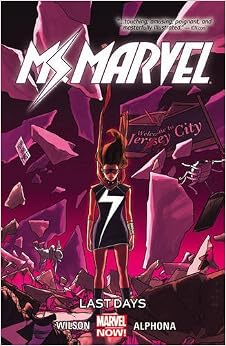
Comics 1-3, Ms Marvel volumes 4 and 5, Giant Days vol 2.

Read Harder orders a super-hero comic with a female lead, and also an all-ages comic. I was all too happy to oblige and knock a couple of the challenges out of the way early.

It broke through to the mainstream a few years back, but the current iteration of Ms Marvel is a Muslim Pakistani-immigrant teenage girl named Kamala Khan. Just typing all of that made me feel like Marvel was checking off a bunch of "let's get credit for making a bold choice" boxes, but I can say that the creative team does a fantastic job actually making Kamala all of those adjectives in their fullest sense. I read Volume 1 last year, and found it overall delightful, novel, and very interesting. It didn't do anything earth-shaking to the superhero genre, but it was obviously much, much more than a publicity stunt.

Volumes 2 and 3 weren't on the shelves of my local library, so I for no real reason picked up Volume 4, "Last Days." Some mysterious world-ending event is nigh. If you've seen a Marvel movie in the past four years, you are no doubt expecting a strange vortex forming in the sky above New York City. Marvel throws you a curve in this case; the danger is instead a strange planet approaching Earth in the sky above New York City. From that very unpromising start comes just a brilliant adventure. The world is ending, on a scale that Kamala simply cannot handle. Kamala Khan lives in Jersey City, and the town rallies to provide safe shelter for its residents as the end draws near. Kamala tries to save her her family and her friends, and is completely overwhelmed by the demands on her great powers, in the best Spider-man tradition.

In order to save her town, Kamala teams up with Captain Marvel, Carol Danvers, who is (understandably) her hero. I have not regularly read comics since the mid-90s, so I have no idea if Carol Danvers is a heavy hitter in the Marvel universe, but her presence gives Kamala the mentor figure she needs, facing her first world-ending threat as a superhero. Their interactions are well done and reminiscent of a college senior coming home from study abroad to discover that her annoying ten-year old sister has suddenly become capable and autonomous, and only needs a little direction.

The real pay-off of the book, however, comes in the last single issue collected in the volume, in which Kamala is out of costume for the entire issue. She bonds with her family, friends, and frenemies in a beautiful, all-hope-is-lost sequence. There is a sequence in which her mother tells her she knows her secret identity and "thank[s] God for having raised a righteous child." It is a lovely moment and a fantastic example of what comics can do right when they're firing on all cylinders. 

How excellent Ms Marvel is becomes even more clear when one reads the random Spider-man issues included in the collection after the main Ms Marvel story. I guess Dr. Ocotopus body-switched with Peter Parker? And there's a sexy Spider-lady? Besides being convoluted beyond all saving, the add-on story was just so tonally inconsistent with Kamala's adventures that it seems unfair to the Spider-man creative team to include it.

As excellent as Volume 4 is, Volume 5 is a mixed bag. There is a massive time skip that was very jarring. (The world-ending event was apparently part of a massive Marvel crossover, so Kamala's role was entirely in managing the Jersey City side of things. Also, evidently Kamala Khan has been invited to join the Avengers. I guess this is a really big deal.) There are some really good touches in this volume, such as Kamala's very religious brother marrying an African-American Muslim girl; an evil plot involving gentrification; Kamala's best friend and kind-of love interest dating a girl who purposefully does not embody the typical physique of a female in comics; and Kamala being stretched thin between super-heroing, helping with the wedding, and fulfilling the basic obligations of being in high school. That said, the gentrification plot veers into the overly cartoony (HYDRA has weaponized aerosol nanobots in order to reshape and take over... Jersey City?), and the answer to keeping up with the stresses of having to be in two places at once is to.. use the school's 3D printer and her best friend's physics genius to create an army of Kamala clones. Yeah  There are still some fantastic human touches in the story, but it's a definite downgrade from Volume 4. The change in artistic team doesn't help; in Volumes 1 and 4, the pencils were done by Adrian Alphona, who had a fairly realistic style and made sure to give Kamala Pakistani features. There's a rotating cast of artists in Volume 5 (including, I see, Alphona for some pages), but Kamala is much more of a manga-looking character for a lot of the book, which is not helpful.
Leon
Alphona

For my all-ages comic, I read John Allison's Giant Days 2. I've been a huge fan of Allison's since his original run of Scary-go-round in 2002, which was a huge inspiration for an online comic I used to draw. I've mostly gotten away from reading daily onlines, but I pick up some collected volumes from time to time. Giant Days features Esther, a character from Scary-go-round, now off at college! Or, rather, university, since this takes place in the UK. I don't have nearly as much to say about Giant Days as Ms Marvel - it's spritely, energetic, manic, and funny, but it's not capital I important like Ms Marvel is at its best. There is drama, misunderstanding, an evil city that's not really evil, and the interesting idea of one of Esther's roommates (or friends? I'm not really sure of the living situation) binging Friday Night Lights and bouncing between Coach and Tami Taylor personas to give various other characters pep talks. It's nice to know that even the Brits see the value in having clear eyes and full hearts!

Monday, January 9, 2017

#3 - An Ember in the Ashes by Sabaa Tahir


For the Book Riot Read Harder 2017 Challenge, I needed to read a fantasy book. Fantasy isn't a genre I normally pick up (I'm assuming the Game of Thrones books are the last fantasy books that I read), but I love a Hobbit as much as the next guy. An Ember in the Ashes, by Sabaa Tahir came out a few years ago and was evidently a Times bestseller, but I hadn't heard of the series until book 2 made someone's year-end list on the AV Club recently.

The story alternates perspectives between Laia, a slave girl of the Scholar people, and Elias, a gladiator-like warrior from the Martial empire. In the opening chapters, Laia's family is murdered, she finds the Resistance, and infiltrates Blackcliff, the military academy that Elias is about to graduate from. Elias, in the meantime, has a super-hot and super-awesome best friend gladiator-ess named Helene, attends Blackcliff, and is thinking of deserting the empire. (I wouldn't make a point of the super-hot, but it's brought up more than twice in the book.) Elias quickly finds himself involved in the Tri-wizard Tournament to see who gets to be the new Emperor, while Queen Cersei tries to rig the outcome to make sure he doesn't win.

That paragraph sounds much more negative than the book actually deserves. It's hard to establish a wholly creative and new fantasy word, and Tahir writes a gripping yarn that makes the 450 pages go really really quickly. Whether this is because of or in spite of the well-worn template that Ashes follows, it was definitely an interesting read. The first-person narration of a slave trying to just stay alive instead of purposefully overthrow an Empire was new; the first-person narration of Elias brings to mind the Kingslayer in some regards, but because he's also still essentially a college student, there is a nice amount of self-doubt and confusion that freshens things up. In the meantime, I wish Tahir had come up with better names for the Empire and its member ethnicities than "the Martials," "the Scholars," and "the Mariners," etc. That may sound like a small nit to pick, but world-building in fantasy novels is important, and an entire race being known as "the Scholars" is just, well, goofy. The AV Club article I mentioned earlier said that the series really gets going in book 2, where the characters get a lot more attention, and I do plan on reading A Torch Against the Night, because there was a lot to like in this book - probably why I'm so critical of what I feel needed another reworking.