Showing posts with label Saul Bellow. Show all posts

Thursday, October 18, 2018

Mr. Sammler's Planet by Saul Bellow

And soon everything must change.  Men would set their watches by other suns than this.  Or time would vanish.  We would need no personal names of the old sort in the sidereal future, nothing being fixed.  We would be designated by other nouns.  Days and nights would belong to the museums.  The earth a memorial park, a merry-go-round cemetery.  The seas powdering our bones line quartz, making sand, grinding our peace for us by the aeon. Well, that would be good--a melancholy good.

It's 1968 and man is on his way to the moon.  Artur Sammler is living on the Upper West Side, a Polish emigre.  His daughter, perhaps unwittingly, steals a manuscript by an Indian cosmologist named V. Govinda Lal in order to share it with Sammler, to use in a memoir he's writing about H. G. Wells.  They were once friends, Sammler and Wells, and Wells' optimism about humankind's ability to remake itself provides vital context for the novel.  Mr. Sammler's Planet is one of those talky, thinky Bellow novels like Herzog and Seize the Day, full of meditations on Max Weber and Julius Caesar and Freud and god knows what else, but the manuscript caper gives it a bit of the shaggy feeling of more plotty novels like Augie March.  While Sammler dreams about the moon, his daughter is hiding manuscripts in a locker in Grand Central Station.

At the same time, Sammler faces the impending death of his beloved nephew Elya, who has had a hemorrhage in his neck.  The moon landing, and the dream of the future, is contrasted with the finality of death.  As Sammler tells Elya's daughter, Angela, "But we don't have to decide whether the world is ending.  The point is that for your father it is the end."  Bellow beautifully captures one of the fundamental ironies about the tale of human progress: while mankind has a future, individual men and women can only partake in the smallest part of it.  Sammler envisions the future person, "a colossal figure, a beautiful green color, with a hand that had evolved into a kit of extraordinary instruments, tools strong and subtle, thumb and forefinger capable of exerting thousands of pounds of pressure."  But this future man (he sounds like the Jolly Green Giant) is no one you know.

Sammler knows about death.  He survived the Holocaust; his wife did not.  He dug her grave; he survived by hiding in a mausoleum.  He leapt out of the grave twice over.  He has faced death, and it provides him a kind of wisdom and moral authority that he is reluctant to use.  Sammler can only observe: again and again he sees a pickpocket on the Riverside Drive bus, but he rejects the possibility of action.  The whole world, he feels, is sliding into a kind of barbarism, into crime and sex.  The green men of the future may be different, but who's to make things better now?

Okay.  Now let's talk about this: the pickpocket, who is black, sees Sammler seeing him.  He chases Sammler into the lobby of his building, where he corners him and shows him his penis.  It's a show of masculine force, of course, an assertion of manhood meant to menace Sammler.  The pickpocket is nattily dressed in a violet suit and Dior sunglasses, but his penis is coded as animal, barbaric--and starkly black.  It's upsetting to see such a rankly racist symbol in the work of Bellow, who is often so perceptive.  The fear of a black man's dick is so shallow, so juvenile, so sadly familiar.  And of course, it's Sammler, the meticulous Jew, that gets to stand in for the forces of civilization.  The ugliness of the scene poisons the whole book.

Or maybe it just reveals a conservative paranoia at the heart of the novel.  It certainly makes me more suspicious of the way the novel deals with sex, which is always dangerous and always female.  Elya's daughter Angela is a free-love advocate in the 60's mold, and an abortive swing in Mexico has Elya livid.  When Sammler chastises her, are we supposed to read that as him finally recovering his moral voice?  And why is Sammler unable to look at her without thinking about sex, as if it's something that radiates from her body, like stink-lines?  "Smearing all," as he says, "with her female fluids."

I had a tough time with this novel.  At the level of the sentence, the word, there might not be a better prose stylist in the English language than Bellow.  He certainly knows how to describe a penis with flair.  But why does he have to do it at all?  Augie March calls himself a "Columbus of the near at hand," a man interested in exploring the depth of life all around him, but Sammler shrinks from it, fears it, and here at least so does Bellow.  Why is Bellow able to extend a sympathetic eye to the green giant of the future, but not the black New Yorker of the present?  The dream of the moon is the dream of a better human; but it's a dream of a better, kinder novel, too.

Saturday, January 21, 2017

Herzog by Saul Bellow

If I am out of my mind, it's all right with me, thought Moses Herzog.

Some people thought he was cracked and for a time he himself had doubted that he was all there.  But now, though he still behaved oddly, he felt confident, cheerful, clairvoyant, and strong.  He had fallen under a spell and was writing letters to everyone under the sun.  He was so stirred by these letters that from the end of June he moved from place to place with a valise full of papers.  He had carried this valise from New York to Martha's Vineyard, but returned from the Vineyard immediately; two days later he flew to Chicago, and from Chicago he went to a village in western Massachusetts.  Hidden in the country, he wrote endlessly, fanatically, to the newspapers, to people in public life, to friends and relatives and at last to the dead, his own obscure dead, and finally the famous dead.

Moses Herzog is in crisis.  His wife, cold, beautiful, and shrewd, has left him for his best friend, a boisterous, redheaded man with a wooden leg named Valentine Gersbach.  Together they have evicted him from his own house, and given his picture to the local police.  His lawyer advises him not to sue for custody of his daughter, June--the mother, he says, always wins.  So he bounces aimlessly around New York, Chicago, Western Massachusetts, writing letters to people, some to friends, some to family, some to people he's never met.

The letters Moses writes are frenetic, neurotic, and filled with the heady intellectual musing of an academic.  They are as dense as the book he's written on Romanticism, but they don't help:

All the while his heart is contemptibly aching.  He would like to give this heart a shaking, or put it out of his breast.  Evict it.  Moses hated the humiliating comedy of heartache.  But can thought wake you from the dream of existence?  Not if it becomes a second realm of confusion, another more complicated dream, the dream of intellect, the delusion of total explanations.

In some sense Herzog is a satire of intellectualism, which fails to address Herzog's traumas.  In its place Bellow advocates what he calls, in a tremendous turn of phrase, "potato love"--the sub-verbal kind of love which Herzog has for his daughter, June, and which his wife has denied him.  It's a simple idea, really, dressed up in the incendiary volleys of Bellow's prose.

Nobody writes with the vitality of Bellow.  Herzog is low on plot, but it absolutely bursts with energy.  But Bellow--one of the very best prose stylists in the history of the English language--is never out of control, and the high-octane style of the book never gets tedious.  It helps that Bellow populates the book with a cast of vivid characters, almost all of whom exist only to be vivid.  And Bellow's eye for detail is tremendous:

He remembered that late one afternoon she led him to the front-room window because he asked a question about the Bible: how Adam was created from the dust of the ground.  I was six or seven.  And she was about to give me the proof.  Her dress was brown and gray--thrush-colored.  Her hair was thick and black, the gray already streaming through it.  She had something to show me at the window.  The light came up from the snow in the street, otherwise the day was dark.  Each of the windows had colored borders--yellow, amber, red--and flows and whorls in the cold panes.  At the curbs were the thick brown poles of that time, many-barred at the top, with green glass insulators, and brown sparrows clustered on the crossbars that held up the iced, bowed wires.  Sarah Herzog opened her hand and said, "Look carefully, now, and you'll see what Adam was made of."  She rubbed the palm of her hand with a finger, rubbed until something dark appeared on the deep-lined skin, a particle of what certainly looked to him like earth.  "You see?  It's true."

What a lovely story, I think, but it really lives because of the specificity and particularity of the description of the windows, and the snow in the street, and the light poles.  It's the kind of thing that lesser writers try, and can never seem to do right; for Bellow it never seems extraneous.

Bellow makes Herzog's story a moving reflection on suffering, and on the necessity of love amid great pain.  But the best thing about it is just getting caught in the torrential music of Bellow's writing.

Sunday, July 27, 2014

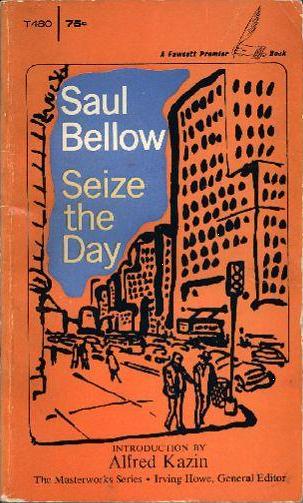
Seize the Day by Saul Bellow

Every other man spoke a language entirely his own, which he had figured out by private thinking; he had his own ideas and peculiar ways.  If you wanted to talk about a glass of water, you had to start back with God creating the heavens and earth; the apple; Abraham; Moses and Jesus; Rome; the Middle Ages; gunpowder; the Revolution; back to Newton; up to Einstein; then war and Lenin and Hitler.  After reviewing this and getting it all straight again you could proceed to talk about a  glass of water.  "I'm fainting, please get me a little water."  You were lucky even then to make yourself understood.  And this happened over and over with everyone you met.  You had to translate and translate, explain and explain, back and forth, and it was the punishment of hell itself not to understand or be understood, not to know the crazy from the sane, the wise from the fools, the young from the old or the sick from the well.  The fathers were no fathers and the sons no son.  You had to talk to yourself in daytime and reason with yourself at night.  Who else was there to talk to in a city like New York?

There's something telling about the lengths of books.  Beyond every other stylistic difference, there's something about, say, Muriel Spark's tendency to write short novels that differentiates her from someone like Tolstoy.  Augie March is a Tolstoyesque book, immense, meandering, insatiably devouring different scenes and locales.  What is the writer of Augie March trying to do in writing a book of only 100 pages, as in Seize the Day?  What accounts for the difference?

For one, Augie March was a story of several years; Seize the Day, as its name suggests, is the story of a single day in the life of New Yorker Tommy Wilhelm.  Tommy is a failed actor who has recently moved into the same building as his aging father, who is coldly dismissive of Tommy's many problems: his poverty, his strained relationship with his wife, who refuses to grant him a divorce.  Spurned for money and compassion by his father, Tommy comes under the influence of the suspicious Dr. Tamkin, who convinces him to make an ill-advised investment in the commodities market.

Tamkin is full of cryptic, new-agey advice about how Tommy should reinvigorate his unhappy, broken life.  But even the notion of success eludes Tommy:

But at the same time, since there were depths in Wilhelm not unsuspected by himself, he received a suggestion from some remote element in his thoughts that the business of life, the real business--to carry his peculiar burden, to feel shame and impotence, to taste these quelled tears--the only important business, the highest business was being done.  Maybe the making of mistakes expressed the very purpose of his life and the essence of his being here.  Maybe he was supposed to make them and suffer from them on this earth.

Perhaps, Tommy thinks, the "essence of his being here" is to suffer, but if that is so, why does his father fail to give him sympathy?  His father, of course, is old and preoccupied with his own death, which he accuses Tommy--rightly--of not sufficiently caring about.  Like his son, the father suffers acutely, but neither is able to work up the kind of regard for the other that would bring any kind of relief.

This particular day offers an intense crisis for Tommy, but nothing really happens to him over the course of it: the day is not seized; he exits the novel as feckless, confused, and frustrating as he enters it.  One aspect of the novel's brevity is that it precludes any kind of change in Tommy or his father.  It's difficult to imagine Tommy ever changing in any significant way, but over 300 pages that kind of stasis might have been maddening.  Instead, Bellow offers us a glimpse at a man who is lost and will remain lost, and lets us briefly experience or recognize that mode of suffering.

Seize the Day is one of those novels where I feel as if something got past me--I feel, uncomfortably, as uncertain as Tommy at the novel's end.  Is that by design, or is there really something in it that I'm missing?  I cannot say I really enjoyed reading it, as I did Augie March or Henderson the Rain KingTommy Wilhelm is a profoundly difficult protagonist, impossible to like and unpleasant to consider.  Bellow's prose is, as always, something to behold, but it wasn't enough for me this time.

Wednesday, February 16, 2011

"Imagination has been steadily losing prestige in American life, it seems to me, for a long time."

"I am speaking of the poetic imagination. Inferior kinds of imagination have prospered, but the poetic has less credit than ever before. Perhaps that is because there is less room than ever for the personal, spacious, unanxious and free, for the unprepared, unorganized, and spontaneous elements from which poetic imagination springs."

Saul Bellow, speaking to us from his time machine.

Sunday, February 13, 2011

The Adventures of Augie March by Saul Bellow

The Adventures of Augie March begins with America:

I am an American, Chicago born--Chicago, that somber city--and go at things as I have taught myself, freestyle, and will make the record in my own way: first to knock, first admitted; sometimes an innocent knock, sometimes a not so innocent.


And ends with it, too:

Look at me, going everywhere! Why, I am a sort of Columbus of those near-at-hand and believe you can come to them in this immediate terra incognita that spreads out in every gaze. I may well be a flop at this line of endeavor. Columbus too thought he was a flop, probably, when they sent him back in chains. Which didn't prove there was no America.


In his introduction, Christopher Hitchens identifies Augie's opening assertion as essentially radical. Augie, a Jew and the descendant of immigrants, claims an American birthright, unthinkable in the 1920's of the novel's opening and not much less so when it was written in 1953. We are inheritors of this assertion and will not find it strange; most of us will take it for granted that America is land of opportunity, an immigrant nation, where the ladders of social mobility can be scaled quicker.

Still, we can appreciate Augie's bold claim to exhibit a new conception of our national character. Augie is an American, that is to say, democratic. He tells us early on that the phrase "various jobs" is the "Rosetta stone" of his existence, and indeed his "adventures" can be summed as a series of tasks: He is a dog groomer, a union organizer, a petty thief, a sales clerk, a ship's pharmacist, an assistant to more than one millionaire. In one of the book's greatest sections, he spends a long period in Mexico training an eagle to hunt lizards. Some of these jobs are menial and low-class and others come with fancy wardrobes, but the overall line of progression is fluctuated, not upward as in some Horatio Alger story. When I say that Augie is democratic, this is what I mean--the dogged insistence that meaning and fulfillment, though not likely to be found, can be approached from all sides and all stations:

"How is your campaign after a worthwhile fate, Augie?" asked Clem, for he knew a lot about me, you see. Alas, why should he kid me so! I was only trying to do right, and I had broken my dome, lost teeth, got burned in the progress, a mighty slipshod campaigner. Lord, what a runner after things, servant of love, embarker on schemes, recruit of sublime ideas, and good-time Charlie! Why, it was a crying matter, no fooling, to anyone who might know which side was up, that here was I trying to refuse to lead a disappointed life.


Democratic, too, are Augie's attitudes toward people. On his ship during wartime he becomes a sort of confidant and advice-giver for his shipmates and tells us, "I advocated love, especially." Love is democratic because it regards social class, like all other concerns alien to mere personhood, as irrelevant. Augie's attitude reminds me of the King of France from King Lear, who remarks that "Love is not love / When it is mingled with regards that stand / Aloof from th'entire point." So it happens that, in my favorite section of the book, Augie risks estrangement from his heiress girlfriend, Lucy, in order to help a a friend obtain an illegal abortion. Lucy's parents believe he is mixed up with the girl sexually, not that it would matter if he weren't, and Augie mistakenly expects from Lucy the same kind of inconsiderate love that he gives freely:

Inside, on the turned-over heels of the yard shoes I hadn't remembered to change, I walked to the mirror to knot my black tie and saw backward, by the drape in the living room, the tense belly of Uncle Charlie, his sharp feet prepared, and sitting waiting in the oriental mix-up of brass, silk, wool, and all that gave the place so much power, Lucy, her mother, and Sam, observing me. I felt there was a big machine set against me. But I had come in order not to disappoint Lucy, toward whom, given their chance, my feelings could have shone and warmed again. I expected poisoned looks, against which I was coated and immune; at least, my greater trouble made such looks seem negligible; and I wasn't willing to be tagged for lascivious crime and false pretenses or whatever the coutns were that they thought they had against me. By no means nervous, therefore, I judged that I had only to do with Lucy, no fortune hunting now involved, for I could go any distance independent of brothers, relations, and all, provided that her impulse was a true one and she was, as she had always said, in love.


But love for others is not always the same as love for Augie, who has no conception of the love of money or the love of power. When he calls himself, at book's end, a "Columbus of those near-at-hand," he celebrates the love of people, the personal, individual life as opposed to the "big machine" which only has the power to oppose.

No wonder, then, that Bellow rejects the prose of Hemingway--who might be called typically American in that he exalts the stark, shorn pioneerism of Emerson and Thoreau--in favor of a looser, more exuberant style that is democratic in the sense that no word seems to excessive to leave out. Augie March is dense and allusive, delighting in its metaphors. The hem of a dress is "stiff as a line of Euclid." Elsewhere "the wheat looked like the glass of wheat." The human heart "circulates and warms, when it's piled at any bar or break, burns inward or out with typical embers or sores, and makes a track of fever or fire whose corresponding part is darkness and cold gaps." It is easy to lose the thread, and such long-windedness fails perhaps as often as it succeeds, but one comes to feel that, like Augie, such failures must be permitted.

Hitchens refuses to call it "The Great American Novel," though apparently Martin Amis does so freely. I myself categorically reject the existence of such a thing, but I will note that Augie March is obsessed with the reason that such a novel is impossible: America is too vast, too broad, too pluralistic to be pinned down. It is, in short, like Augie.