A line by John Gregory Dunne, chosen by author S. J. Rozan as his favorite opening line ever written. The Atlantic has a list, including choices by Margaret Atwood and Jonathan Franzen.
Most of them don't impress me much, though I like that one, and the Hemingway. But I guess that the success of a first line is tied pretty closely to what comes after. Mine is the opening line of The Good Soldier: "This is the saddest story I've ever heard." But if you haven't read the book, you can't fully grasp the sad irony of that line, can you?
What about you guys? What's your favorite opening line?

Monday, July 29, 2013

Sunday, July 28, 2013
Late Lights by Kara Weiss

The stories in Late Lights are harsh and jarring, often dealing with subjects that I knew little about, such as, the day-to-day experiences inside a juvenile detention center. Weiss' writing has a sense of urgency, as though she is pleading with her readers to understand her characters.
Late Lights was a very quick read. I would recommend it to anyone who enjoys short stories.
Zinsky the Obscure by Ilan Mochari
 "There are stories like Superman which require suspension of disbelief for maximum enjoyment. Then there are stories like mine -- real stories -- where for the most part, disbelief need not be suspended. There are no flying humans, no unfamiliar planets, and no optical illusions."
When he is thirty years old, Ariel Zinsky come to the conclusion that no one cares about his life story, so he decides to write it. He takes some paper from work and beings with his childhood. This is the premise of Zinsky the Obscure, Ilan Mochari's debut novel.
The quote about suspension of disbelief is a good indication of the tone of this novel. Zinsky is essentially the telling of the life of a young misanthropic man living in New York. It bares some resemblance to Confederacy of Dunces, but the story and writing lacks the absurdity that was so integral in making Toole's novel so enjoyable for me. Mochari's Arial Zinsky has all the angst of Ignatius J. Reilly but little of the bravado and ridiculousness that made him such a memorable character.
The unfolding of the story of Zinsky's adolescense is coupled with thirty-year-old Zinsky, from whose perspective the book is written, reconnecting with members of his family. Zinsky the Obscure is an angsty and emotionally raw novel, with nuggets of brilliant writing and storytelling buried in its pages. It's a strong debut novel for Ilan Mochari.
Friday, July 26, 2013
Hamlet by William Shakespeare

But if I don't blog about it, it doesn't count so: I haven't read Hamlet since high school, so I was surprised to find how familiar it was to me. It's so full of great moments, but I've re-encountered them recently in Bloom, or Ron Rosenbaum, or in other places, yet I found very little I liked that seemed new to me. In that sense, and only that sense, reading it was a little disappointing.
In every other sense, of course, it's amazing. Lear has a special place in my heart, but if you were to say that Hamlet is the best Shakespeare offers, I wouldn't argue. I think, besides merely being Shakespeare at the height of his literary powers, Hamlet is so revered because it manages to encapsulate what it means to be a modern human being. I'm thinking about what Hamlet says about thoughts and actions:
Who would fardels bear,
To grunt and sweat under a weary life,
But that dread of something after death,
The undiscovered country from whose bourn
No traveler returns, puzzles the will
And makes us rather bear those ills we have
Than fly to others that we know not of?
Thus conscience does make cowards of us all,
And thus the native hue of resolution
Is sicklied o'er with the pale cast of thought,
And enterprises of great pitch and moment
With this regard their currents turn awry
And lose the name of action.
The line on Hamlet, if I'm remembering correctly from high school, is that his "fatal flaw" is that he thinks too much; he dithers and plots and plans instead of getting right down to business. What a meager, shrunken vision that is of the Prince of Denmark. I see in this passage and the play as a whole the best expression of that strange feeling that there is no immediacy in actions, that the groundlessness and mystery of being calls the very importance and urgency of action into question, the feeling that the life of thought is so much more vital than the life "out there." Hamlet seems as if he laments the dissolution of "enterprises of great pitch and moment," but doesn't he simultaneously compel us to question the very worth of those enterprises? The "fatal flaw" perspective on the other hand is too dependent on Aristotelian ideas about tragedy that Hamlet annihilates completely. What does Hamlet have in common with Oedipus, for example, whose character is so completely circumscribed by his actions, by the things that he's done?
That feeling, of course, as Hamlet understands, is connected to the fundamental dilemma of death--if the living world seems burdensome, yet that burden is balanced or even overcome by the fear of "the undiscovered country." I think Hamlet shows us the way that we retreat into our own minds as a way of escaping these two poles.
Okay, there are some incoherent, rambling thoughts about Hamlet. Do you think I could get next year's sophomores to react to these ideas in the form of a diorama?
Tuesday, July 23, 2013
White Out by Michael W. Clune

White Out is a memoir about drug addiction, specifically heroin. In the first chapter, "Memory Disease," Clune describes the strong grip heroin had on him and its deleterious effects. But he does so through conversations, gritty characters, and grim scenes.
Throughout the book, it is rare that Clune's writing is overtly didactic. He chooses rather to rely on the reader to draw conclusions from the stories he presents. That's really what they are: stories. Because while White Out is a memoir, it reads like a novel. At numerous points, I was reminded of scenes from HBO's The Wire, which was also set in Baltimore. The people Clune introduces the reader to seem almost too tragic to be real: Henry who lost an arm after passing out on top of it in a heroin-induced sleep; the people trying to get clean that he meets at various clinics; and Clune himself, perhaps the most tragic.
Clune eventually gets clean. I imagine it would be impossible to write a publishable book while addicted to heroin. He credits his sobriety to "the machine"--to the habits he formed in the early days of his recovery. Habits like meditation, going to NA meetings, and making lists for himself. But besides making to-do lists each night for the following day, Clune says he does not think about the future. The future, in all of it whiteness.
Sunday, July 21, 2013
The Handmaid's Tale by Margaret Atwood
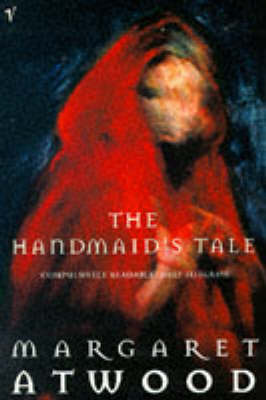
I avoid looking down at my body, not so much because it's shameful or immodest, but because I don't want to see it. I don't want to look at something that determines me so completely.
The Handmaid's Tale is a classic dystopian novel that provides a good reminder why it's so important to be a feminist. Like the best dystopian stories, part of what makes The Handmaid's Tale work is that it's not so hard to imagine the world Atwood creates. Written in 1985, the story is set in the near future in an America that is recovering from a theocratic revolution. After an attack by Islamic extremists that dispatches the president and much of congress, the Constitution is suspended and the totalitarian regime eventually takes over. There are still ongoing rebellions and wars, plus some nuclear wastelands, but the setting of our story is calm and firmly under control.
The regime focuses its energies on controlling women. Prior to the revolution (white) birthrate had dropped (thanks to the equally threatening specters of birth defects from nuclear/chemical waste and feminism) and a rigid hierarchy has been set up to address the problem. The powerful men, while married, also have a succession of handmaids granted to them. The handmaids, of which our narrator is one, live in the man's house and do some shopping, but mostly their role is to remain invisible...except for once a month when they have sex with the man in hopes to conceive. This is the handmaid's sole function: to bear a child. They get a few chances, but at some point they are considered failures (unwomen) and are sent off to the colonies to clean up nuclear waste or some other unpleasant task.
There are lots of standard dystopian tropes, like constant surveillance, but the themes that make The Handmaid's Tale stand out are those concerning the new society's treatment of women. There are so many insightful criticisms in this book that it's hard to hit them all. Among them:
- There's a terrible scene where, during the future handmaids' training program, one of the future handmaids confesses that when she was 14 she was gang raped. The rest of the future handmaids, provoked by their trainers, shout at her, telling her it was her fault, that she led them on, that she deserved it, that she was being taught a lesson. It's so horrible it's hard to believe...unless you read the news, where young girls are killing themselves because they are so shamed for being raped, or the first questions rape victims are asked are what they were wearing or whether they had been drinking.
- The handmaids are stripped of their names (we never learn our narrator's), and are instead assigned a name based on the man whose home they live in. Our narrator is Offred, literally of-Fred. Atwood makes explicit the way women are so often defined in relation to the men in their lives.
- One of the first changes implemented in the new society is to strip women of all property. The money in their bank accounts is transferred to their husbands or other male family members. Our narrator's reaction to this is understandable outrage, but her husband provides a great example of unexamined male privilege with his response. To him, it's not that big a deal; they share their finances anyway and it's not like he's going to abandon her or anything. He doesn't stop to consider how these changes affect women's sense of freedom, independence, and self. Because he isn't being stripped of his rights, he just assumes that because he's not a cruel asshole then there's nothing really wrong. Let that be a lesson to us, gentlemen...
- A pair of male security guards are caught having sex with each other and are executed for "gender treachery." This seems to me to be such a prominent undercurrent of the anti-gay movement: that homosexual relationships threaten rigid gender dynamics. If two men or two women get married, who has to do the housework!? Who "wears the pants" in the relationship!? If a homosexual couple can have a happy marriage and be good parents without one going to work and one staying home based solely on what's in their pants, what does it say about my relationship in which our roles have been determined solely on that basis?
- At one point, Atwood drops in a prescient line about men: "Men are sex machines...and not much more." So often men in a sexist society are treated like slobbering dogs, unable to control their impulses or act like adults. Women have to change how they dress, where and when they walk alone and men are just let off the hook. The Iowa Supreme Court just held that a dentist who had been sexually harassing his female employee was allowed to fire her because she was too attractive and that it was threatening his marriage (not because there was any danger of an illicit affair between them; she had expressed no interest). As convenient as that may be for men like me, I call bullshit. It's absurd that women should have to be punished for men's transgressions and lack of self-control.
Fundamentally, the society developed in The Handmaid's Tale is about controlling women. If their sole or primary interest was to replenish the (white) population, then there are much more efficient ways to accomplish that goal. Instead, the society elevates powerful men and subjugates women and places them under their control. Sadly, men instituting laws for ostensibly benign purposes that are actually aimed at controlling women and their bodies isn't just a figment of dystopian novels.
The Handmaid's Tale is well written and an important work that is unfortunately still relevant today.
Saturday, July 20, 2013
The Rainbow by D. H. Lawrence

The Rainbow details three successive generations of one English family, the Brangwens: Patriarch Tom, who marries a Polish woman, their daughter Anna who marries her brooding cousin, Tom, and Anna and Tom's daughter Ursula. At first the story of the Brangwens adheres so closely to Lawrence's favorite images and themes that The Rainbow hardly seems like a necessary book. Tom's formative years in a bleak English coal town might as well be Paul Morel's; Anna's sexual awakenings might be taken wholesale from Lady Chatterley's Lover. Even Lawrence's prose, which I really admire, started to feel worn to me--I started to become hyperaware of his favorite trick, which is to repeat a simple word in different grammatical constructions in a single passage. (Check out the word "colour" in the description of the rainbow above.)
But by the time that Lawrence gets around to Ursula, the last in the line, the novel manages to individuate itself. Part of Lawrence's purpose here is to examine human relationships across a span of historical time; Ursula, as the "modern" iteration and free from the traditional expectations of her grandparents, offers a more varied and engaging story. I especially liked the part in which Ursula, insisting on finding work for herself, becomes a schoolteacher. As a teacher myself, I've never read such a spot-on description of what it's like to teach at a dysfunctional school. Like Ursula, I've been squeezed on both sides by the expectations of administrators and students, and I can relate to the way it turns her into a person she cannot recognize:
But she had paid a price out of her own soul, to do this. It seemed as if a great flame had gone through her and burnt her sensitive tissue. She who shrank from the thought of physical suffering in any form, had been forced to fight and beat with a cane and rouse all her instincts to hurt. And afterwards she had been forced to endure the sound of their blubbering and desolation, when she had broken them to order.
Oh, and sometimes she felt as if she would go mad. What did it matter, what did it matter if their books were dirty, and they did not obey? She would rather, in reality, that they disobeyed the whole rules of the school, than that they should be beaten, broken, reduced to this crying, hopeless state. She would bear all their insults and insolences a thousand times than reduce herself and them to this. Bitterly she repented having got beside herself, and having tackled the boy she had beaten.
I enjoyed Ursula's story because there was space for something other than the spiritual-sexual problems that plague the two earlier generations, although Ursula has plenty of that too. (Including a lesbian love affair, which seems pretty bold for 1915.) I found myself wishing that the first two parts of the book were lopped off, though Lawrence clearly wants us to see that Ursula is deeply connected to those that came before her:
Here was peace and security. Here, from her grandmother's peaceful room, the door opened on to the greater space, the past, which was so big, that all it contained seemed tiny; loves and births and deaths, tiny units and features within a vast horizon. That was a great relief, to know the tiny importance of the individual, within the great past.
Friday, July 19, 2013
A Wizard of Earthsea by Ursula K. LeGuin

A young boy is sent to wizard school, where he learns to control his great natural skill at wizardry. In time, he becomes known as the most gifted wizard of them all--which is good, because he'll need all his talents to defeat an evil, shadowy force connected intimately to him for mysterious reasons.
Sound familiar? Yes, of course it does: It's Ursula K. LeGuin's A Wizard of Earthsea, which tells the story of Ged, who accidentally creates a rip between the land of the living and the dead, allowing a horrible "shadow creature" to enter the world. (How great can this guy be if he's the one that caused the problem in the first place, though?) The extent to which Ged's story of self-discovery mirrors another, later story reveals how well-worn some of these fantasy tropes are, I suppose.
What sets A Wizard of Earthsea apart? Not much, if you ask me--I find most fantasy pretty underwhelming, and Earthsea felt very much limited by the confines of its genre. A couple elements did stand out, though: First, the setting of Earthsea, a massive island chain, provided a unique bit of atmosphere. Second, magic in Earthsea operates in a very interesting way. To have power over something, a wizard must know its name in the original and natural "true language." Every animal, thing, place, and person has a "true name," many of which are kept hidden. What is so threatening about the shadow creature that Ged looses is that it lacks a name, and cannot be controlled or defended against, and so becomes a chilling image of the ineffability of death, which refuses to be sufficiently described in human language.
The last few chapters of Earthsea go far in elevating it above similar books. In them, Ged chases the shadow to the limits of Earthsea, an unknown part of the ocean that slowly thickens into land. The final meeting with the shadow creature is fairly cryptic for what is ostensibly a young adult book:
Aloud and clearly, breaking the old silence, Ged spoke the shadow's name and in the same moment the shadow spoke without lips or tongue, saying the same word: 'Ged." And the two voices were one voice.
Ged reached out his hands, dropping his staff, and took hold of his shadow, of the black self that reached out to him. Light and darkness met, and joined, and were one.
What's going on here? Is this an illustration of the reality principle, the need for man to confront his own death and comes to terms with it? Does LeGuin suggest that what we battle in our fear of death is not death itself, but us? That's pretty heady stuff, and a lot more interesting than the wizard-school and dragon-fighting that make up most of the book.
Thursday, July 18, 2013
The Executioner's Song by Norman Mailer

I had never read Mailer either, in spite of having a copy of The Naked and the Dead sitting on my bookshelf for a few years, but The Executioner’s Song caught my attention in the bookstore for two reasons--it was huge, and the premise--a man, Gary Gilmore, is given the death penalty and executed--didn’t seem like enough to support the length. Not to mention that it was a true story and I’d never heard of Gary Gilmore. So my interest was piqued.
In some ways, the single-sentence summary above does the book justice--it is single-minded in the sense that it keeps the execution front and center throughout--but, of course, further explication is necessary. Gilmore spent over half of his life behind bars, beginning as a juvenile. In 1976, he was paroled and sent to live with his cousin Brenda in Provo, Utah, the heart of Mormon country. During this time he struck up a tempestuous, intense relationship with a young single mother named Nicole Baker, and, after an unusually severe fight and breakup, killed two men, execution style, over a two night period. He was caught and sentenced to death, notable because, at the time, the U.S. was currently in the midst of a moratorium on the death penalty, imposed by Furman vs Georgia in 1972.
The death sentence happens less than halfway through the book. The rest is the story of Gilmore’s fight to be allowed to die and the media circus that surrounded him. Because of the moratorium, numerous civil rights groups, including the ACLU, were fighting Gilmore’s execution, even though he wished for his sentence to be carried out, because they feared, correctly, that if Gilmore was executed, many others would be executed in short order.
Normally, in a story like this, there are clearly defined heroes and villains, and, in true stories, if the facts don’t point to a clear dichotomy, the author usually chooses sides and, inadvertently or not, paints one side more sympathetically. Not so Mailer in The Executioner’s Song. As long as it is, the novel is a picture of restraint, with Mailer refusing to cast Gilmore as a misguided saint or his antagonists, such as they are, as anything other than complicated people with (generally) legitimate reasons for the things they do. It would have been far easier as a reader if I could have seen Gilmore as a monster or the ACLU lawyers as hypocrites, but Mailer’s thoroughness doesn’t really allow for such simplistic line-drawing. Even Gilmore’s motivations for the murders are in question: were they emotional responses to his problems with Nicole? Inevitable behaviors for a bad seed like Gary? Indicators of some deeper mental issue? Results of repressed pedophilic impulses? Deus Ex Machinas handed down from unfeeling gods? We’re never told, and the length of The Executioner’s Song serves as a challenge. Mailer seems to be saying, “Here’s all the information. Figure it out.”
There are moments in The Executioner’s Song that cut deep, like Mailer’s sensitive portraits of the two men Gilmore killed, but even here, he resists the urge to beatify, communicating the facts in flat, affectless prose that works even better than cloying melodrama. Gilmore’s letters to Nicole are the same way--of course, love letters from a man on death row are going to contain some pathos, but Mailer doesn’t edit, and their contents reveal Gilmore’s duality as well as his humanity, his intense longing beside his almost feral brutality. Finally, after Gilmore’s execution, the one spot where a little bit of punch-pulling might be in order, Mailer refuses look away from the grislier aspects of Gilmore’s death--including his autopsy, described in some detail--and the unresolved grief of his victims’ families and Nicole, who Mailer even dares to suggest may someday forget Gilmore, ostensibly her soulmate throughout his time on death row. At risk of hitting the point too many times, Mailer refuses to espouse one simple answer to the questions he raises. It’s what makes The Executioner’s Song worthwhile, what justifies its length, and it’s a good argument for why Mailer, great male narcissist or not, deserves to be part of the “great authors” conversation.
1The others being John Updike and Philip Roth, who we at 50B apparently love.
Monday, July 15, 2013
Dreams of Empire by Justin Richards
 Well, here it is, the second of the two Doctor Who 50th Anniversary novels
I’ll be reviewing for this site. If you’re not familiar with the good
Doctor, check out my summary on Beautiful Chaos; otherwise, here’s the
one sentence review for Dreams of Empire: it was
really--surprisingly--good.
Beautiful Chaos, while it did capture the feel of NuWho fairly well, was a pretty by the numbers affair. The plot was unsurprising, the prose was utilitarian, and the science was... unique, to say the least. That’s not to say it wasn’t enjoyable, but for someone who wasn’t a fan of the series, I don’t think it would hold much appeal.
Dreams of Empire, on the other hand, could have functioned, with a fairly minor rewrite and one large plot shift, as a solid science fiction story if the Doctor wasn’t involved at all. I’m no hardcore sci-fi nerd--I think I missed that boat by panning both Neuromancer and Snow Crash--but I am a fan of well-told, well-written stories. On that count, Dreams succeeded beautifully.
Set mostly on a space station on the outer reaches of the Republic of Haddron, an interstellar kingdom in decline, the story’s events are set into motion by a political intrigue, an interstellar civil war initiated by one Hans Kesar, one the nation’s top generals. His rebellion is put down within the first twenty pages by Milton Trayx, another general and one of Keser’s closest friend, and is moved to the aforementioned outpost to prevent his assassination, thus preventing his becoming a martyr and weakening the empire further. The Doctor and his companions arrive on the outpost just in time to welcome a military vessel that seems intent on finishing the job of killing Kesar, but there are more complex machinations afoot.
I don’t want to go too deeply into the plot, because there are a number of wonderful twists throughout the story, most of which I didn’t see coming, but even from the summary above, it’s clear that this, unlike Beautiful Chaos, isn’t a (sort of)man vs. alien story. In fact, more time is spent in back-alley skullduggery that is spent in combat, until the last 20 pages or so. Maybe readers picking up a Doctor Who novel don’t want a science fiction reimagining of Caeser/Brutus but I was glad to get it.
As for the Doctor himself, this is the second Doctor, as portrayed by Patrick Troughten, and very few of his serials still exist. As a result, I’ve seen only one of them, and can’t entirely vouch for his characterization here. From what I do know, however, it seemed accurate--Number Two is a court jester with a dark, analytical side, a hero who often seems to simply bumble into the solution to the problems he comes into contact with, and that tone is well-captured here. The characterization of Jamie, a young Scot from the 1800s who’s always ready for a fight, is great here too, and lends the book a lot of its frequently understated humor.
Aside from circumstances like this tour, I don’t read much genre fiction because most of it is trash. I think the highest praise I can give Dreams of Empire is that, if more pulp was this well-done, I’d read a lot more of it.
Subscribe to:
Posts (Atom)