Wednesday, July 8, 2009

The Confidence-Man by Herman Melville

"Can I be so changed ? Look at me. Or is it I who am mistaken? -- Are you not, sir, Henry Roberts, forwarding merchant, of Wheeling, Pennsylvania ? Pray, now, if you use the advertisement of business cards, and happen to have one with you, just look at it, and see whether you are not the man I take you for."

"Why," a bit chafed, perhaps, "I hope I know myself."

"And yet self-knowledge is thought by some not so easy. Who knows, my dear sir, but for a time you may have taken yourself for somebody else? Stranger things have happened."


Last year, I decided to tackle Moby-Dick, the quintessential huge American novel. Despite its reputation for being difficult and frequently dull, I didn't find it to be either, particularly. Sure, there were diversions aplenty, but when it came down to it, Moby-Dick could read as a great adventure story, albeit one of intentional ambiguity at points. I loved the book but knew next to nothing about Melville's other work, so when I saw a rather handsome edition of The Confidence-Man, I knew I had to give it a shot.


The story takes place on a riverboat populated by a wide variety of people, from clergymen and beggars, to carpenters and misers. In their midst, however, there are con-men of all shapes and sizes, willing to use any deceit or means necessary to relieve the innocents of their hard-earned cash. And that's it. The plot basically begins and ends there.


Of course, in practice, it isn't so simple. Far from being Melville's version of that Simpsons episode where Bart and Homer become grifters, The Confidence-Man is written like a track meet—that is, with plenty of baton-passing. Most chapters focus on the interaction of two or three people, and, at the end of each, the omniscient narrator follows one of the participants as he moves to another part of the ship and interacts with another of the passengers. Most of the characters are unnamed, and are referenced primarily by a visible attribute, i.e. the lame beggar, the man with the yellow hat, the student with the book. Using this device, Melville pulls a confidence game of his own, keeping the reader off balance and not sure exactly who is who. Is there a compelling reason that the man with the yellow hat cannot also be the lame beggar or the student with the book in another guise? In reading about The Confidence-Man after finishing it, I learned that there is really no consensus on just how many confidence men are on the boat.


That brings us to the idea of confidence, which is itself both an explicit and implicit theme of the novel. The plot itself necessitates the theme to some extent, but throughout, characters grapple with questions of identity and trust. Can a man be both good and evil? Can he hate Indians and yet love his fellow man? And can anyone really be trusted at all? Over and over, the marks themselves are assailed with pleas to simply place their confidence in the man before them, to give money to some cause or time to some effort they know little to nothing about, but Melville steadfastly refuses to give any real closure. Are the men who give to grifter for a seemingly good cause better off than those who refuse to trust anyone, or are they fools who would have done well to have a little more skepticism?


On the front cover, The Confidence-Man is touted as “the great metaphysical comedy” but you'd be forgiven for missing that. There are some humorous bits, but the overall picture is dark and confusing. The Confidence-Man resisted my attempts to draw any solid conclusions from it, but then again, maybe that's the point.

Tuesday, July 7, 2009

Gun With Ocassional Music by Jonathan Letham

I knew all at once I didn't care about the woman who'd left me like this, that I didn't want her back and I didn't want revenge, and I didn't want Celeste or any other woman besides the one with me right now. I wanted Catherine, I wanted her with everything I had—except I didn't have it anymore. What I had to offer, what I should have had to offer, was missing... I wanted Catherine, but I wanted to take her with a different self, a self that wasn't available. The thing I wanted wasn't lost in the past at all, and never had been. It was lost in the future. A self I should have been, but wasn't. A thread I'd let go of in myself, thinking I could live without it, not seeing what it meant.


It seems appropriate that I'm posting this review right after Chris posts his review of Ubik, because Gun With Occasional Music is essentially a noir in the Dick-ensian setting. The style is hard-boiled, the plot labyrinthine, the ladies beautiful and cold and the men strong and solitary. And, of course, there are the babyheads, infants with adult intellects; anthropomorphic animals including a kangaroo assassin, an array of government-sponsored drugs with names like Forgetorall.


Conrad Metcalf, a tough-guy private investigator, is living a fairly comfortable life when his services are requisitioned by a man, Orton Angwine, who is accused of a murder he didn't commit. Metcalf reluctantly takes the case and, of course, finds that its roots go much deeper than he originally anticipated. I'm giving the plot the short shrift here--there's quite a bit more of it—but I'd rather focus on the world and themes in the book because a) someone might want to read this book, and b) it's just more interesting.


There's a lot going on in Metcalf's world, much of it related to the theme of identity. On the surface, there are the obvious connections: who is framing Ortwine, who is behind it all, and so on, but Gun takes these questions and digs deeper. Metcalf himself is something of a male-female hybrid, left without the ability to feel sexual pleasure after a transplant gone wrong, and he struggles with his place in relation to the women he meets throughout the story, most notably with Catherine in the included excerpt. Further, the concept of identity is further confused by the government's encouragement to citizens to use drugs of various sorts, drugs which make them forget, sleep, and enjoy themselves. This aspect reminded me quite a bit of Brave New World. Another interesting aspect is Letham's invention of Karma, not the Buddhist idea but a concept more closely tied to the colloquialism “Good Karma”. Karma in Gun's world functions as sort of a universal currency that controls not a person's ability to buy and sell but their ability to enter places of business, get jobs, or even form relationships. In short, a person's ability to live is governed by Karma which is regulated by the government based on behavior ultimately leading to a lack of autonomy among the populace. Even asking innocuous questions is considered unbelievably rude. This leads to a lack of individualism and, of course, governmental corruption and societal manipulation by those with the money and/or Karma to do whatever they want.


One issue I often have with science fiction is that, given its nearly limitless narrative potential, it rarely spends time examining the deeper questions of humanity. That's something I love to find in my reading, even my genre reading, and something Letham delivers. But fear not, sci-fi fans: there's also a kangaroo assassin.

Monday, July 6, 2009

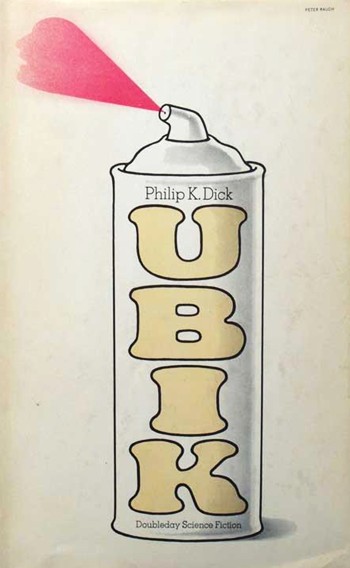
Ubik by Philip K. Dick

Finally--I feel like I've been reading nothing but disappointing books for months. Ubik is like a big-budget sci-fi blockbuster condensed to 200 pages: Full of action, intrigue, and a lot of confusing twists. I will try, without giving anything away, to explain the plot:

Sometime in the future, portions of mankind have developed psychological powers. These people are called psis, and come in various flavors, the two most important of which are telepaths and precogs. Precogs--you may recall from the Dick adaptation Minority Report--can predict the future. In the future, the psis represent a significant threat to business interests, as a rival organization may plant telepaths in your organization or use precogs to see what you're going to do, so "prudence organizations" use the talents of antis, who block psis' powers, to protect themselves. Glen Runciter is the head of one of these organizations, which he manages with help from his dead wife who is kept in "half-life"--a cryogenic stasis where communication with the dead can be maintained, although the more you speak with them, the closer they get to true death.

Runciter and his team, including his right-hand man Joe Chip, accept a job on the moon where they believe many of the world's greatest psis have gone to cause havoc. The job turns out to be a trap, and Runciter is killed--or so Chip and the others think. When the team returns to Earth to bury Runciter, they find that somehow every thing is reverting to its earlier incarnation--for example, automated pay elevators (you have to pay for everything in the future, even doors) have become old-fashioned elevators with steel grates and elevator operators. Cars are reverting to 1920's era-Model T's, etc., etc. At the same time, they seem to be receiving, on the backs of matchbooks and in newspapers, strange, cryptic messages from the dead Runciter, advising them to find a mysterious substance called Ubik, which is the only thing that can protect them when members of the team start dying off one-by-one. Luckily, it is available in convenient spray-can form. Whew.

I loved Ubik because it's unbelievably fun and quickly paced, as well as deeply funny. But it doesn't come off as hollow entertainment; Dick manages to weave some very interesting thoughts about God and death in as well. Ubik itself seems to be an analogue for God--after all, it comes from the Latin word ubique, meaning "everywhere." It is a protective force, preventing decay and staving off entropy, preserving the forward motion of time when all else is tumbling backward. A series of epigrams that begin each chapter tout Ubik as a commercial product (Can't make the frug contest, Helen; stomach's upset. I'll fix you Ubik! It takes more than a bag to seal in food flavor; it takes Ubik plastic wrap, etc., etc.), perhaps going so far as suggesting the commodification of God in this future society, perhaps suggesting that order can be found in the universe in strange places.

In any case, I highly recommend Ubik. Safe when taken as directed.

Saturday, July 4, 2009

Wise Blood by Flannery O'Connor

The boy didn't need to hear it. There was already a deep and black wordless conviction in him that the way to avoid Jesus was to avoid sin. He knew by the time he was twelve years old that he was going to be a preacher. Later he saw Jesus move from tree to tree in the back of his mind, a wild ragged figure motioning him to turn around and come off into the dark where he was not sure of his footing, where he might be walking on the water and not know it and then suddenly know it and drown.

Hm. I love Flannery O'Connor. Along with Carver, I think she is probably the premiere short story author to come out of 20th Century America. Her stories are invariably dark and tinged with a peculiarly Catholic brand of guilt and tragedy, and distinctively Southern in outlook and style. So why doesn't Wise Blood work?

I think it is because of precisely what I said--O'Connor is a fantastic short story writer, but many great American short story writers, like Carver and Poe, never tried to write anything longer. Poe had a theory he called "the unity of effect" that dictated that a work of literature must be read, and be able to be read, in a single setting to have the maximum impact upon its reader. I don't agree with Poe (who does?) but if he were to return from the dead (Zombie Poe!) and try to defend himself, he might point to Wise Blood, which is stitched together of fascinating parts but somehow fails to come together.

The story follows Hazel Motes, a young man just out of the army heading to the Southern city of Tulkinham. Hazel has some pretty peculiar ideas about Jesus--he can do without him--and when he runs into a street preacher named Asa Hawks, he is determined to outdo him by become a street preacher himself, one who preaches The Church of God Without Christ. You might call that Judaism, or Islam, but to Hazel it's a kind of religious philosophy that rejects the need for salvation. To spite Hawks further, he intends to seduce his underage daughter Lily, but Lily isn't exactly making it difficult for him to seduce her, and Hawks is pretty happy to have the girl out of his household.

Complicating matters is a young man who ingratiates himself to Hazel named Enoch Emery. Enoch believes that he has "Wise Blood," a kind of sixth sense that predicts the future in vague terms. Enoch, wishing to aid Hazel, and driven by his Wise Blood, steals a mummified child from a local museum to serve as the Christ figure in the Church.

There is a scene I liked a lot in which Enoch--an adult who, it is suggested, may be a little bit on the slow side--waits in line with a bunch of children at a theater to see the "star" of a King Kong-like movie only to find out it's a man in an ape suit. Angered and betrayed, he sneaks into the man's van and steals the ape suit, strips off his clothes in the middle of the forest, and becomes, by putting on the suit, the pinnacle of his desires. That's really fascinating in a particularly O'Connoresque way, but the problem is that it is difficult to place that scene, and many others, in the context of the entire novel. The scene is almost exactly duplicated in a short story of O'Connor's, though I don't know which came first. The short story by itself is intriguing, in the context of Wise Blood it is confusing.

Very few novels stump me. Though a lot of ideas may elude me, I am usually able to reflect somewhat meaningfully on a book I've read. Wise Blood is one of the first times that I've felt as if I just don't get the book. There is something going on with Christ figures--the way that Hazel tries to avoid Christ completely, but is bombarded with Christ substitutes, whether they be Hawks, or himself, or the mummified child, or Enoch's ape suit. It is, I suppose, a statement on the way that Christ pervades all things and cannot simply be escaped, even by a nonbeliever.

But that seems only a partial explanation. Why does Hazel want to separate Christ from God? What is the purpose, thematic or otherwise, of Enoch's "Wise Blood," which informs the title but seems to be near-irrelevant? What is the connection between Enoch and Hazel? There are too many questions. The pieces of this novel hang separate from one another and refuse, to my mind, to come together in anything approaching coherence.

Note: They made a movie of this where Hazel was played by Brad Dourif (One Flew Over the Cuckoo's Nest, That Really Good X-Files Episode Where He Plays a Psychic Murderer Who Speaks to Scully'sDead Father). Brad Dourif was born to play this role.

A Walk in the Woods by Bill Bryson

After finishing Into Thin Air, I needed to read something a little less harrowing. Sure, nature can be scary, but there have to be a few great pursuits that anyone with a little free time and a backpack can do, right? I picked up A Walk in the Woods because the premise sounded interesting and because Bill Bryson is a pretty amusing dude. I wasn't disappointed.


A Walk in the Woods follows Bryson and his friend Katz, an overweight, outgoing loudmouth, on their attempt to walk the entirety of the Appalachian Trail. The A.T. is a huge undertaking, 2,100 miles from Georgia to Maine, requiring 6-8 months, lots of food, and some good boots. Bryson and Katz start out as complete amateurs and end feeling like grizzled mountain men.


Although the trail itself was very interesting, some of the anecdotes not directly related were most interesting to me. For example, there's a town somewhere in the States (I can't remember which state and don't have the book handy) where, 80 years ago, a coalfire began underground. The heat caused the ground to begin cracking and collapsing, eventually turning Coalville into a vertual ghost town. The fire is still burning beneath it, and a few hearty souls still live there.


I don't really know what to say about this book. I enjoyed it and it had something of a surprise ending (SPOILER: They quit before the end of the trail), but mostly what I got out of it was an appreciation for nature and for the scale of the United States. Unlike Into Thin Air which probably put me off mountain climbing forever, A Walk in the Woods made me want to take a hike myself. Anyone want to be Katz?

Into Thin Air by Jon Krakauer

I read this book on a dare from Reinhold Messner. We were shooting the breeze one evening and he told that not only was I incapable of climbing Mt. Everest myself, I was probably incapable of even finishing a book about someone else's expedition. I took him up on this challenge, and while he was out climbing K2 for the fiftieth time, I read Into Thin Air.


I'm not a survivalist by any stretch of the imagination, but the first half of Krakauer's book, a true account of one of the most deadly ascents ever attempted on Everest, I was ready to go to base camp myself. The narrative follows Krakauer all the way from preparation until the disastrous denouement of the trip, when the majority of both parties on the mountain, including two of the most experienced climbers in the world, died as a result of an unexpected storm near the peak. There a little bit of dishy stuff, including some pretty direct criticism of some of the other climb leaders, but for the most part, Jon sticks with the narrative and the overarching theme: nature is dangerous and is not to be messed with, no matter how much experience you have.


By the time I finished reading, I'd completely lost any interest in climbing Everest myself. Messner returned from K2 and I filled him in. Of course, he just laughed. He's actually kind of a jerk. This book, however, was great. I recommend it.

Friday, July 3, 2009

The King of Torts by John Grisham

I'm getting tired of Grisham. I only read this one because I got it for 75 cents at the library. He must have had a bad experience at a big firm, because he is constantly writing the "young lawyer makes it big in corporate/personal injury law and then hubris sets in and he gets screwed" story. This one wasn't too bad; it was quick and accurately portrayed the settle first at almost any cost environment that pervades most civil suits these days. There were only a couple of places where I thought, "ok, that's completely ridiculous." and they were easy to get past, so I guess that's good. So yeah, I don't 100% agree with the guy who wrote "Of the 13 Grishams I've read so far this is the first one I didn't enjoy" in the front cover (for two reasons: I've read Grishams that I don't enjoy and because this one wasn't too bad, though that's probably because I have such low expectations for him at this point). If you ever find yourself with a day or two to kill and you're trying to pad your stats for some kind of book reading blog, then pick this one up. Otherwise you probably don't need to.

Thursday, July 2, 2009

Ludmila's Broken English by DBC Pierre

Blair's eyes cut into slices. He drew back his finger like an arrow, and fired it at the keyboard.

'www.kuzhniskgirls.com.ru.'

Women leapt on to the screen. Women with hairstyles and poses unseen since the days of sheiks and flappers, against lurid studio backdrops of lakesides, beaches, and boudoirs.

And in the lower right-hand corner of that self-conscious assortment, one face shone out from the thick of a genuine life.

One wild, beautiful face.

Blair's penis twitched up to his hand.


I was a big fan of DBC Pierre's first novel, Vernon God Little, which was despised by many critics but I felt succeeded on the virtue of its cojones alone, along with a skewed but evocative sense of language. That book was a dark comedy about a school shooting in Texas; it was amazingly distasteful but cut deeply into the insecurities of the American psyche in this century, and had quite a bit to say about how our superconsumptive and obsessive culture abets great violence. Ludmila's Broken English, by contrast, is a book written for some other audience, in some other time.

The titular character is Ludmila Derev, a young girl living in a war-torn Caucasian wasteland, who, in the opening scenes of the novel, kills her grandfather after he makes a drunken attempt at raping her. Without his pension check to keep their family afloat, Ludmila must journey to the nearest town to find work, and eventually--after many of what I can only describe as hijinks--her face ends up on a website advertising Russian brides.

The other half of the book follows Blair and Bunny Heath, a pair of recently separated conjoined twins who have been released from their group home and find themselves in London, a cosmopolitan world that they don't understand, where alcohol and sex--or at least the suggestion of sex--are readily available. Though Bunny wishes for nothing more than to return to the home, Blair is fascinated by this new world, and the prospect of getting laid, and finds Ludmila on the internet, bringing both stories together when he and Blair travel to the Caucasus to meet her.

What is the point? Vernon God Little seemed urgently relevant, but writing about Eastern Europe seems, without being condescending to those who live there, so twenty years ago. As far as I know, with the exception of the revolutions in Moldova and the Ukraine (both of which resulted in improved governments), and the Russia-Georgia conflict, Eastern Europe has been relatively conflict-free since the Clinton era. The rest of the world has turned its eyes to the Middle East; as a satire isn't this a case of beating a dead horse? Perhaps, as he did for American culture in Vernon God Little, Pierre wishes to show us how the endless pleasure gratification of the London lifestyle can corrupt the innocent in the case of Bunny and Blair, but Blair is assuredly not, like Vernon, an innocent caught up in chaos. Vernon is a child; Blair brings the horrific events of the novel's final chapters squarely upon himself.

Ultimately, Vernon God Little is composed of the grotesque and the baroque; Ludmila's Broken English is simply made up of ugliness. There is nothing really likeable or redemptive about it; when these characters fail I find myself without sympathy. It is as if, sadly, Pierre willfully took on the role that his critics tried to foist upon him after his first novel.

Tuesday, June 30, 2009

Four Mini-Reviews because I'm Lazy

Well... Not all lazy. I've been so busy with various Peace Corps duties that I haven't had time to get on here and review after each book I've finished. So now I'm so far removed from most of these books that I couldn't give them all the reviews they deserve, but here are a few thoughts

Dog Soldiers by Robert Stone
I don't know that I really enjoyed Dog Soldiers as a whole. I certainly enjoyed the writing style: very gritty and matter-of-fact about its violence and depravity. I found the story to be disjointed, however, and I can't say that I totally understood the motivation of many of the main characters. I might recommend it though, as its narrative structure is enough to keep you interested and it tells the Vietnam tale from a POV you might not have come across before. Also, Dog Soldiers reminded me a little of Apocalypse Now with the sophomoric, combat-engendered philosophies preached by various characters.

Life of Pi by Yann Martel
I really enjoyed Life of Pi. It's one of those books that everyone you know has read and probably recommended to you one time or another. Definitely pick it up if you have a chance. It tells the story of an Indian boy trapped on a lifeboat in the middle of the ocean with a full grown bengal tiger. It touches on religion, the human spirit, and the will to survive. I also like how the ending (without any spoilers) raises the question of whether or not the entire novel was allegorical or literal. Definitely check it out, it's a quick read and I guarantee you won't be disappointed.


Lolita by Vladamir Nabakov
Perhaps more than any of the other three books I'll review here, I wish I'd written about Lolita while it was still fresh in my mind so I could have given it a full write-up. I'm sure you already know the tale so I won't go into it at all. This is easily one of the most beautiful works of literature I've ever come across. The juxtaposition of Humbert Humbert's monstrous depravity and the flowery, artful prose could not have been more powerful. Unless you've read it already its hard to explain. But Humberts narration is so perfectly constructed and witty that you actually find yourself empathizing with an admitted pedophile. Do yourself a favor and read Lolita.

Middlesex by Jeffrey Eugenides
Definitely my favorite of the four books reviewed here, Middlesex took me completely by surprise. About 5 different Peace Corps volunteers recommended this book to me before I finally got my hands on it and now I understand why. The story of a pseudohermaphrodite named Cal, Middlesex traces the mutated gene back two generations to Cal's grandparents' village in Turkey. This tale of incest, mutation, sex, drugs, and war would be interesting by itself, but what pushes Middlesex over the top is one of the most entertaining narrators I've ever encountered. Cal is everything a narrator should be: witty, self-deprecating, ironic... You name it. Middlesex won the Pulitzer for Fiction in... I want to say 2003, and it was well deserved. If you only get to read one of these four books, pick up Middlesex.

Monday, June 29, 2009

The Host by Stephanie Meyer


I knew it would begin with the end, and the end would look like death to these eyes. I had been warned. Not these eyes. My eyes. Mine. This was me now. The language I found myself using was odd, but it made sense. Choppy, boxy, blind, and linear. Impossibly crippled in comparison to many I'd used, yet still it managed to find fluidity and expression. Sometimes beauty. My language now. My native tongue. With the truest instinct of my kind, I'd bound myself securely into the body's center of thought, twined myself inescapably into its every breath and reflex until it was no longer a separate entity. It was me. Not the body, my body.

And so begins Stephanie Meyer's first book for adults. Slow to start, and no great work of literature (though better written than the Twilight books, which I loved but which were clearly written at an eighth-grade level) but an arresting story nevertheless. Imagine that aliens invaded Earth, mostly good and kind but paternalistic in that they think they can run things a lot better than slow, violent humans. So they invade our bodies, tiny centipede creatures called "souls" that burrow into human brains and mostly eradicate the human mind that was there. This is the world that Melanie Stryder, her partner Jared and her brother Jamie live in. They are constantly on the run until the day Melanie is caught and a soul named Wanderer is put in her body.

Melanie, however, refuses to fade away, coexisting with Wanderer and eventually leading her to abandon her fellow alien souls and set off to find Jared and Jamie. They are living in an underground cell with other human rebels, and are not very welcoming to the alien life form that wanders into their protected home. While Wanderer/Melanie manages to convince a few, Jared and Jamie included, that Melanie is still around and Wanderer is on their side, on the whole the splinter cell of human survivors does not welcome the alien in their midst. Soon enough, she wears them down into grudging acceptance and proceeds to make life much easier for all - assisting with raids on the aliens' hospitals and stores - due to her eyes, which give her away as a body inhabited by an alien soul. Eventually, the inevitable happens (inevitable if you read Stephanie Meyer books) - interspecies romance. Of course one of the humans, Ian, falls for the soul Wanderer, while at the same time Melanie, and her body, love Jared. At the book's end, Wanderer finds that she loves Melanie too much to continue to control her body and arranges to give her the body back and die. Ian's love for the soul is too great, and the fondness of the rest of the colony for her too admiring, to let that happen. Instead Wanderer is separated from Melanie and put into another body, one who's human was eradicated by a previous soul - just a body. Ian and Wanderer and Melanie and Jared can all love and hang out and coexist. Yay!

The Host was definitely an interesting book. Though it started off slow, by the middle I had a hard time putting it down. A strange love story to be sure, but with the kind of universal themes - undying love, what makes us human, self-sacrifice, acceptance - that allow you to suspend your disbelief and just enjoy the story. I can't imagine what it would be like to be Wanderer, in love with Ian, but who's body, Melanie's, only responds to Jared. Pretty freaky stuff. Meyer released this book in the middle of the Twilight series, intending it to be an adult book. However, I didn't really see much to suggest that it was written for any different audience than Twilight. Still no sex scenes, no language, as could probably be suspected from a conservative (and I think Mormon?) author like Meyer (the entire Twilight series could be loosely read as an extended petition for abstinence until marriage). It really isn't written on a higher or more "literary" level. But it was an enjoyable summer read, and it certainly grabbed me in the same way the Twilight books had done. Oh and one thing that bothered me: Wanderer's name was shortened and humanized to Wanda, which I hated. It just did not seem to fit the character described in the book, and it grated on me every time I read the word- which was a lot.