Saturday, December 6, 2008

I Am the Cheese by Robert Cormier

I cannot remember ever being this impressed with a kid's book. Well, maybe Peter and Wendy. But certainly nothing from modern juvenile fiction has struck me as much as I Am the Cheese. In fact, it impressed me so much that I thought for a moment, "Oh shit--can my kids really read this?"

Well, they kind of have to because I told them to buy it, so. Anyway, as Carlton describes, I Am the Cheese is the story of Adam Farmer, who is trying to ride his bike from Monument, Massachusetts to Rutterburg, Vermont, to see his father. The narrative is interspersed with moments in which Adam is being interviewed by a psychologist, in which it is revealed that his family was in the Witness Protection Program and his real name is Paul Delmonte. And then, as you're trying to piece it together, Cormier slips the whole rug out from underneath you, with a pretty deft "it was all a dream/mental illusion/the Matrix" switcharoo.

How is it handled? Well, let me tell you this--I had to read the end a couple times to understand it. My seventh graders might read it once. Cormier smartly makes the bike ride narrative as simple as possible, letting readers (especially young readers) reserve their mental faculties for figuring out the interview sections, but at the end his straightforwardness gets muddled a little bit. And that's a shame, because this is a doozy of a book--full of pathos, with strong characters and a real ear for the thoughts and speech of children.

But try telling a thirteen-year old about pathos.

BONUS: SUPER-CREEPY COVER PICTURE!

The Joy Luck Club by Amy Tan

Here it is, in the twilight of the year, and not only am I getting destroyed by Carlton, I am getting passed by Brent, and it looks as if fifty is a near impossibility. Even the books I read I pretty much read for work--case in point, this novel, The Joy Luck Club, which I am about to read with my tenth graders (and so had to quickly read myself).

I had gotten the impression somewhere that Amy Tan was a lightweight, and that The Joy Luck Club was a pretty Hallmarkish simp-fest about mothers and daughters rediscovering their relationship. I am please to report that while it does fall firmly in the stylistic arena of most pop-fiction, Tan's dissection of how families interact across cultural boundaries is pretty compelling.

The Joy Luck Club is split into 16 stories, many originally considered as separate stories not meant to tell a single narrative. There are four mothers who escaped China during the Sino-Japanese War of the 1940's and their four daughters who grew up in San Francisco's Chinatown. The one is exception is Jing-Mei Woo, who, just as she has replaced her mother in the womens' mah jongg circle--the titular club--tells four stories, assuming her mother's pair.

In Chinese, "joy luck" is one word, and its English equivalent not quite up to the task of translating it completely. In the same way, Tan explores the way that certain Chinese concepts fail to make the translation in the lives of their daughters, and the frustration of both sides who essentially live in separate cultures. To one of the daughters, it may seem that feng shui is an outmoded concept with no practical meaning, but she fails to see that the way her hastily constructed table falls apart is indicative of the weakness and fragility of her household and her marriage.

I am having trouble remembering specific episodes; for the most part, these characters are interchangeable. They are all, you get the impression, Amy Tan an Amy Tan's mother, and so there is very little cross-pollination between the stories. For the most part, each story tells about one pair of mothers and daughters, and the other characters appear only incidentally. As a result, The Joy Luck Club cannot cohere an struggles as a narrative. But the stories themselves are carefully contained and affective; I hope that this makes it easier to read for my kids.

Monday, December 1, 2008

The Giver by Lois Lowry

Jonas trudged to the bench beside the storehouse and sat down, overwhelmed with feelings of loss. His childhood, his friendship, he carefree sense of security -- all of these things seemed to be slipping away. With his new, heightened feelings, he was overwhelmed with sadness at the way the other had laughed and shouted, playing at war. Be he knew that they could not understand why, without the memories. He felt such love for Asher and Fiona. But they could not feel it back, without the memories. And he could not give them those. Jonas knew with certainty that he could change nothing.

Chris just reviewed this book a couple of weeks ago. I would mention that while I don't disagree with his description of this book as essentially 1984 for tweens, The Giver actually put me in mind of A Brave New World. Chris does a good job summing up the book. I agree with his assessment. I too wish I had read this book when I was in the 5th or 6th grade, because I think it would have had a profound effect on me. This is yet another in a long line of books that unfortunately landed on the chopping block at the Christian school I went to.

The Unbearable Lightness of Being by Milan Kundera

Einmal ist keinmal. What happens but once, says the German adage, might as well not have happend at all. If we only have one life to live, we might as well not have lived at all.

I started my review of Lolita by saying that I was really unqualified to talk about the book in any sort of meaningful way. It was dense, complex, often over my head, and completely enjoyable. I feel roughly the same way about The Unbearable Lightness of Being. The difference being that I didn't like it nearly as much as I liked Lolita. And in my way of thinking, the books do share some similarities. Both could be described as a novel of ideas. Both of their stories have a dreamlike quality to them. And both of the books deal with sex. Sex was the underlying theme of Lolita, however, it was Humbert Humbert's lust that was on display, not his acts of sex. But in Lightness, sex is front and center and standing at attention. While the book itself is about something much bigger, sex is the driving force behind much of the storyline.

The novel is set in Prague in the 1960s, around the time of the invasion by the USSR. Tomas is a highly successful Czechoslovakian surgeon who looses his job for not towing the line of the Communist Party. His wife Tereza is a politically active photographer. There are two secondary characters, Tomas's mistress Sabina and Sabina's married lover Franz. The story revolves around the intertwined lives of these four people.

I have been thinking about how to describe this book for a while now, and the best I can do is that it is a like a licentious fairytale. But while the inherent moral of most fairytales is that love conquers all, the moral of Lightness is that life is ephemeral. Take this passage in which Franz is trying to figure out if he should leave his wife for his mistress: "Human life occurs only once, and the reason we cannot determine which of our decisions are good and which bad is that in a given situation we can only make one decision; we are not granted a second, third, or fourth life in which to compare various decisions." If each of us only has only one life to live, then does not that life take on a certain degree of lightness? Kundera's characters have little epiphanic bursts throughout the novel where they seem to grasp -- or at least grasp at -- at this concept. It is when they are most happy, most content with there life. And why not? By its very nature this concept is not burdensome, but liberatingly light.

Sunday, November 30, 2008

The Pleasure of my Company by Steve Martin

This book had the same pros and voice as Martin's first book, but I was about halfway through it before I really got into it. That surprised me since I was completely focused from the first sentence of "Shopgirl". In the end, Daniel Cambridge won me over though. At first I thought he was retarded and I thought the way he rationalized his own actions would look completely crazy to anyone looking on. He even recognizes that what he does might seem crazy to people who don't understand the reasoning.

I think the story is basically one of an obsessive compulsive trying to find someone to love. I like that, because I've thought a lot about the idea of perspective, and how everyone's actions are reasonable from their own perspective and how when I am looking at someone and evaluating them, they are taking in information about me at the same time. I think the best thing about Steve Martin's writing is that he gives every persons perspective rationally, and treats it like any person would treat their own thoughts and ideas.

Shopgirl by Steve Martin

"When you work in the glove department at Neiman's, you are selling things that nobody buys anymore."

I adored this book. It was simple, but a really accurate way of telling about life without embellishing anything, and still keeping it interesting. The characters aren't particularly compelling, but I loved them because they were so normal. Their screw-ups are just a part of the world they live in and not a tragic make or break to hang the story on. I also really liked that the story accepts that it is ordinary, and skips to the pertinent parts that need to be told instead of trudging through each day whether that day added to the story or not. I like they way Martin looks at Mirabelle, and says, this is what she is doing, this is what she is thinking, and this is what she is feeling, without ever judging her actions or motives.

Friday, November 28, 2008

The Homing by Jeffrey Campbell

I couldn't find a thing about this book anywhere online, and I can't find my copy of the book to get the author's name off of (edit: found it). Even this cover image is my rough Photoshopped approximation of the cover. I guess that means The Homing is either a lost classic or a piece of junk better off forgotten.

I bought this book (at Goodwill, .69) for two reasons. 1) The premise, a small town in upstate New York being taken over by a malevolent hospital, sounded interesting in a pulpy, cheap kind of way. 2) The name of the town is Chilton. An inside joke for the loyal 50Bers.

So, a retired cop, Darryl, visits his estranged daughter, Claire, in Chilton. They are estranged because she left college and a promising career as a doctor to marry a man (Phil), and move to Chilton to be his loyal housewife. Ever since the move, Claire hasn't seemed quite like herself. Darryl's first night in Claire and Phil's house is one of the only genuinely creepy bits in the whole novel, but it does manage to create an atmosphere where nothing is overtly wrong but nothing is quite right either.

Unfortunately, the book can't quite decide what it wants to be, so it jumps from atmospheric pulp to weak-sauce thriller to weird old-people romance to government conspiracy and back again over and over and over. By the time it ends (with Darryl being brainwashed into a permanent citizen of Chilton, for those interested), it's kind of numbing and really dull.

Also, the hospital mentioned in the back of the book? Two, three pages, max. I don't even remember what it was for. I would say making the fake cover was more fun than the book.

Thursday, November 27, 2008

The One Percent Doctrine by Ron Suskind

If the Western world was really going to make a pretense of a higher moral departure point — of greater sympathy and understanding for the human being as God made him, as expressed not only in himself but in the things he had wrought and cared about — then it had to learn to fight its wars morally as well as militarily, or not fight them at all; for moral principles were a part of its strength. Shorn of this strength, it was no longer itself; its victories were not real victories; and the best it would accomplish in the long run would be to pull down the temple over its own head.
-- George Kennan looking out over war-torn Germany after World War II

Pulitzer Prize winner Ron Suskind trains his sharp, analytical eyes on the War on Terror. His previous book, The Price of Loyalty, focus on the early years and of the Bush administration, revealing that the overthrow of Saddam Hussein was in the works long before the World Trade Center attacks. The One Percent Doctrine picks up roughly where Loyalty left off. It is the rest of the story, as Paul Harvey would say.

The "One Percent Doctrine" is often referred to as the "Cheney Doctrine" since he was the one to articulate it, and ensure that those in the administration as well as those in government agencies adhered to it. It its core, the doctrine is this: When assessing terrorist threats, if there is a one percent chance that the intel is correct, then the US acts as if the evidence is rock solid. Leave no stone unturned. It seems fairly easy to see the the problems that an approach such as this would cause. But after the 9/11 attacks, Cheney and the president held action in high regard. They didn't prize thinkers, people who could see that international issues are multifaceted. They wanted to surround themselves with doers, people who acted on instincts and suppositions, never mind that they weren't always right. Cheney's "One Percent Doctrine" was the framework under which these actions took place., and it fundamentally informs the way the US is fighting the War on Terror.

I am not going to attempt to get into the details of this book -- too much is covered. But I will say that this is not simply an attack on the Bush administration. It is a critique of US intelligence and of the way that our nation is waging this global war on terror. Suskind spoke with a host of government officials at the state and federal level -- some from the White House. The conclusion that he draws is that in its no-holds-barred pursuit of its enemies, the US has killed thousands of innocent people, alienated many of our allies, trampled the civil liberties of its citizens, and astonishingly caught very few terrorists.

Suskind ends the book by citing a text foundational to both Christianity and Islam. Deuteronomy 16:20: Justice, justice shalt thou follow, that thou mayest live, and inherit the land which the LORD thy God giveth thee. He states that most Hebrew scholars agree that the word "justice" is not simply repeated for emphasis, but that it is said once for the ends and once for the means.

Thursday, November 13, 2008

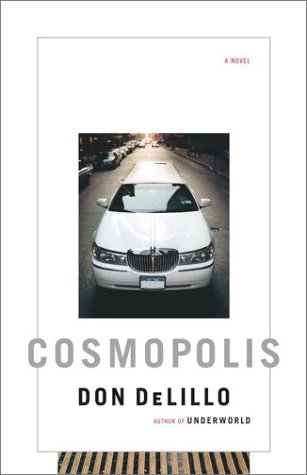
Cosmopolis by Don DeLillo

We declare that the splendor of the world has been enriched by a new beauty: the beauty of speed. A racing automobile with its bonnet adorned with great tubes like serpents with explosive breath ... a roaring motor car which seems to run on machine-gun fire, is more beautiful than the Victory of Samothrace.

--"The Futurist Manifesto," F.T. Marinetti

Beneath the data strips, or tickers, there were fixed digits marking the time in the major cities of the world. He knew what she was thinking. Never mind the speed that makes it hard to follow what passes before the eye. The speed is the point. Never mind the urgent and endless replenishment, the way data dissolves at one end of the series just as it takes shape at the other. This is the point, the thrust, the future.

--Cosmopolis,
Don DeLillo

It struck me while reading Cosmopolis that perhaps if Marinetti, the founder of the Italian mindfuck philosophy that was Futurism, were alive today he would love this book. Marinetti wrote his manifesto in 1909, not long after the invention of the automobile, and one can only imagine what he would say if he could see today's cars, which make the racecars of one hundred years ago look tortoise-slow.

On the other hand, it may not be the automobiles which capture his imagination. In Cosmopolis, Don DeLillo places his anti-hero, multi-billionaire Eric Packer, in an automobile, one of the world's finest stretch limousines, but the power and speed of the vehicle is wasted in the novel-length crawl across the width of gridlocked Manhattan. It takes Packer an entire day (and novel) to accomplish his goal, which is to drive crosstown and get a haircut. On this interminable journey he is an observer to a presidential motorcade, a rapper's funeral, and a violent process, and a participant in a small handful of sexual escapades. All this traveling at what must be a fraction of a mile per hour!

But that is not to say that the limousine does not embody Marinetti's love of speed--though the limousine may be nearly stationary, it is the conduit through which Packer can monitor all facets of his global finance empire, through which information moves at speeds which would give Marinetti wet dreams.

In fact, information in Cosmopolis moves so quickly that it surpasses even real time. Take the security monitor inside the limousine, for instance, that shows Eric his actions a split second before he even commits them. Cosmopolis is a messy, sprawling novel (even at a slim 200 pp.) but I think that it can be whittled down to this idea, that in our modern era we live on the edge of precipice so razor-thin that we are in danger of falling off.

The Futurists wished to destroy the museums, which they considered graveyards; true art, they felt, must be continually and violently replenished and started anew. Cosmopolis seems to argue that we live in the Futurists' ideal world, that the tides of progress have moved on without us, past all human control. Packer's other mission during his limo ride, besides the haircut, is to pursue a bet against the yen, which despite his best efforts, rises impossibly. By the end of the novel, in a matter of hours, Packer is penniless. This, DeLillo says, is our reality: fortunes amassed and lost in afternoons, and getting faster all the time. As Marinetti says, "Time and Space died yesterday." And as the things that Marinetti cherished--the automobiles, the guns--seem almost antiquated to us, so Cosmopolis forces us to face our own hurtling toward obsolescence.

I think perhaps that Marinetti was born one hundred years too late. Cosmopolis is the ultimate Futurist novel, but also quintessentially 21st-century; it is so cutting-edge that it edges beyond even postmodernity. But this also nurtures, and perhaps necessitates, its biggest flaw: a severe lack of humanity. The awesome James Wood, writing for the New Republic, notes that "Eric is really no more than a vessel for theory; he is given not thoughts but meta-thoughts." How true. Here is a novel with much to say, but at times seems so drunk on its ideas that it forgets that ideas are only as relevant as the people they impact.

I struggled with this--after all, isn't this the point of it all, that the human being has become as passe as the Sony Walkman? But I remember DeLillo's White Noise, a novel that managed to break through the ominous haze of turn-of-the-century paranoia and find two people simply scared shitless of dying. Where White Noise had power, Cosmopolis has portentousness.

And besides, isn't the Futurist ideal fundamentally flawed? I recall a conversation I once had with an Italian professor of mine who noted that though the Futurists believed that mankind would become more and more like the technology they created in the automobile, in truth la macchina e stata humanizata--the automobile has become humanized. Though DeLillo taps into an essential modern fear about technology run amok, the fact is that our creations are becoming more and more like us instead of the other way around. Though we may feel obsolete, it cannot be ignored that those feelings are ours; our machines and software have no opinion.

DeLillo comes around toward the end of the novel, when Packer, in a plot point I've neglected to mention, comes face to face with a would-be assassin. Face-to-face with the barrel of a gun, Packer recalls that he'd "always wanted to become quantum dust, transcending his body mass, the soft tissue over the bones, the muscle and fat. The idea was to live outside the given limits, in a chip, on a disk, as data, in a radiant spin, a consciousness saved from void."

There, confronting death like the protagonists of White Noise, Packer comes to realize from what stuff he really is made:

The things that made him who he was could hardly be identified much less converted to data... So much come and gone, this is who he was, the lost taste of milk licked from his mother's breast, the stuff he sneezes when he sneezes, this is him, and how a person becomes the reflection he sees in a dusty window when he walks by. He'd come to know himself, untranslatably, through his pain... His hard-gotten grip on the world, material things, great things, his memories true and false, the vague malaise of winter twilights, untransferable, the pale nights when his identity flattens for lack of sleep, the small wart he feels on his thigh every time he showers, all him, and how the soap he uses, the smell and the feel of the concave bar make him who he is because he names the fragrance, amandine, and the hang of his cock, untransferable, and his strangely achy knee, the click in his knee when he bends it, all him, and so much else that's not convertible to some high sublime, the technology of mind-without-end.

Friday, November 7, 2008

The Year of Living Biblically by A. J. Jacobs

I remember hearing a couple of years ago about A. J. Jacobs, the guy who spent a year reading through the entire Encyclopedia Britannica and then wrote a book about it. I always sort of planned on reading that book, but I never got around to it. Then a couple of months back, I stumbled across this video teaser for Jacobs' The Year of Living Biblically. For this book, Jacobs read through the Bible (various versions) and wrote down every rule or guideline that he came across. He then spent the next year trying to adhere to this list of rules. Intriguing.

I grew up in a family of religious conservatives who interpreted the Bible literally -- as far as I know they still do. Actually, it wasn't just my family, but many of the people I was in contact with on a day to day basis. Friends. Teachers. Neighbors. Even as a kid, I remember reading specific verses in the Bible and thinking, Okay, this doesn't make sense. If one simply takes the Bible at face value many books pose a lot of problems. For example, just try to follow all the rules laid down in Leviticus. Now some people say that Jesus wiped out many of the Old Testament laws, especially the ones regarding animal sacrifice. But there are a lot of other laws that don't have to do with sacrifices, such as the one is the teaser video, or Deuteronomy 21 which permits the stoning of a son or daughter that is rebellious or a glutton. Hmmm...things like this don't seem to jive with New Testament message of love and peace.

Jacobs comes to much the same conclusion. He prefers "Cafeteria Christianity." This is a derisive name that biblical literalists use to describe Christians that pick and choose from the Bible. I like the term too. There are some good things about the Bible, but you can't delude yourself into thinking that you can follow it in all of its precepts.

I was surprised at the level of respect that Jacobs maintains throughout the book. There are no "David Sedaris" descriptions of the people he encounters, no matter how crazy there beliefs may seem. In fact, Jacobs seems to find the silver lining in most of these beliefs. Not only that, but he does an alarming amount of research, both reading and talking with various religious people. This is not to say that the book is not funny. Jacobs has a good feel for what is funny, and his writing it witty. He just refuses to get his laughs from simply poking fun. Obviously, some of the situations were inherently funny. I particularly enjoyed his description of his trip to the Creation Museum, which is about twenty minutes from where I live.

At times this book reminded me of why I distanced myself from the way I was raised, but most of the time it was just a fun read.

Incidentally, Jacobs contributed an essay to Things I've Learned from Women Who've Dumped Me.