Showing posts with label harold bloom. Show all posts

Saturday, November 27, 2021

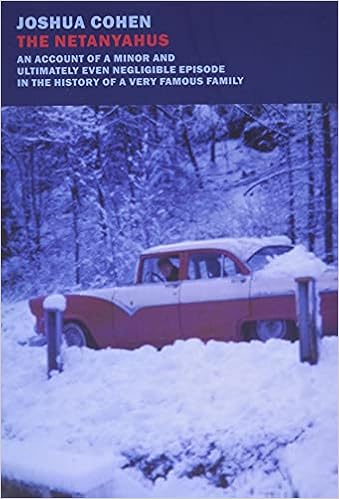
The Netanyahus by Joshua Cohen

You, Ruben Blum, are out of history; you're over and finished; in only a generation or two the memory of who your people were will be dead, and America won't give your unrecognized descendants anything real with which to replace the sense of peplehood it took from them; the boredom of your wife--who's tearing your program up into little white paper pills she'd like to swallow like Percodan--isn't merely boredom with you or her work or with the insufficiency of options for educated women in this country; it's more like a sense of having not lived fully in a consequential time; and the craziness of your daughter isn't just the craziness of an adolescent abducted from the city to the country and put under too much pressure to achieve and succeed; it's more like a raging resentment that nothing she can find to do in her life holds any meaning for her and every challenge that's been thrust at her--from what college to choose to what career to have--is small, compared to the challenges that my boys, for example--whom she's been condemned to babysit--will one day have to deal with, such as how to make a new people in a new land forge a living history. Your life here is rich in possessions but poor in spirit, petty and forgettable, with your frigidaires and color TVs, in front of which you can munch your instant supper, laugh at a joke, and choke, realizing that you have traded your birthright away for a bowl of plastic lentils...

Ruben Blum is the only Jewish faculty member at Corbin University, a small liberal arts college in the vast icefields between Albany and Buffalo, and the only Jewish person--excepting his wife and daughter--in the town of Corbindale. He's treated well, though condescendingly, though no one else seems satisfied with this role: not his wife, Edith, shouldered into menial work at the college library, not Edith's cosmopolitan parents, who look at Corbindale as a site of rural horrors, not his own parents, who believe he has forsaken the Bronx community of Jews that raised him. And certainly not his daughter Judy, who--in one of the novel's most, but not only, shocking scenes, plants her face in front of a doorknob so that her noticeably Jewish nose will at last be broken and repaired. Into this ripe pit of dissatisfaction a group of strangers enters: the family of Ben-Zion Netanyahu, an Israeli historian interviewing for a position at Corbin, and whom Ruben has been asked to shepherd around campus.

The Netanyahus is based on a real anecdote told to Cohen by the late Harold Bloom, another Jewish scholar who left the Bronx behind for the cold wilds of Northeastern academia. Bloom really was asked to host Ben-Zion Netanyahu, whose middle son Benjamin would later become the longest-serving prime minister of Israel. Bibi plays a surprisingly small role in the novel: he and his brothers enter the Blum household like three tiny tornados, fighting among each other and breaking television sets. It's Ben-Zion who really threatens to upend the fragile balance of Ruben Blum's existence. He's irascible, self-absorbed, contemptuous of the job offer and the school, and of the life that Blum leads willfully in America (while presenting himself as a kind of exile). Ben-Zion's scholarship focuses on the Jews of Medieval Iberia, but this description is too narrow: because the Jews have been caught in cycles of expulsion and reabsorption, he argues, they have truly been outside of history. Only the creation of the state of Israel brings to the Jews the possibility of living within history:

The world is full of real events, real things, which have been lost in their destruction and are only remembered as having existed in written history. But Zion, because it was remembered not as written history, but interpretable story, was able to exist again in actuality, with the founding of the modern state of Israel. With the establishment of Israel, the poetic was returned to the practical. This is the first example ever in human civilization in which this has happened--in which a story became real; it became a real country with a real army, real essential services, real treaties and real trade pacts, real supply chains and real sewage. Now that Israel exists, however, the days of the Bible tales are finished and the true history of my people can begin and if any Jewish Question still remains to be answered it's whether my people have the ability or appetite to tell the difference.

A careful letter from a concerned Israeli scholar describes Ben-Zion as a zealot, a dangerous man, and when at last he arrives in Corbindale, this assessment is hard to doubt. The way "the Yahus"--Ben-Zion, wife Tzila, children Jonathan, Benjamin, and Iddo--thoughtlessly take over the Blum household provides the novel with a manic energy punctuated by tremendous comedy. But Blum is unsettled, too, by what Ben-Zion says. It is true that the faculty chose Blum to babysit the Netanyahus because he's Jewish; though he is a scholar of American history his Jewishness can be abrogated or activated by his superiors at will. Certainly there is something frightening in the way his daughter Judy wishes to erase the very Jewishness of her face. Is Dr. Netanyahu's zealous Zionism the only alternative to expulsion or erasure? Would anyone in Corbindale say to Blum, as Ben-Zion does--though they clearly dislike each other--"And if the situation were reversed and your feet were in my shoes and you came to Israel, I'm not positive I could get you a job, but I'd do absolutely everything to find you a good apartment, and in a war, I'd die for you?"

I would leave it to a Jewish reader to say whether The Netanyahus resonates with the dilemmas of Jewish identity in the 20th century, but for me it seemed like a plausible and powerful presentation of the question, "How should a Jewish person be?" It's funny how a book set in upstate New York manages to outline so deftly the way the project of Israel intersects and makes demands on questions of Jewish identity, ones that might seem--to us goyim--as simplistic or strange. The Netanyahus is on Blum's side, not Ben-Zion's, whatever that might mean, but it captures what is so urgent in that worldview.

Wednesday, April 13, 2011

Tetelestai by Conrad Aiken

How shall we praise the magnificence of the dead,
The great man humbled, the haughty brought to dust?
Is there a horn we should not blow as proudly
For the meanest of us all, who creeps his days,
Guarding his heart from blows, to die obscurely?
I am no king, have laid no kingdoms waste,
Taken no princes captive, led no triumphs
Of weeping women through long walls of trumpets;
Say rather I am no one, or an atom;
Say rather, two great gods in a vault of starlight
Play ponderingly at chess; and at the game's end
One of the pieces, shaken, falls to the floor
And runs to the darkest corner; and that piece
Forgotten there, left motionless, is I....
Say that I have no name, no gifts, no power,
Am only one of millions, mostly silent;
One who came with lips and hands and a heart,
Looked on beauty, and loved it, and then left it.
Say that the fates of time and space obscured me,
Led me a thousand ways to pain, bemused me,
Wrapped me in ugliness; and like great spiders
Dispatched me at their leisure.... Well, what then?
Should I not hear, as I lie down in dust,
The horns of glory blowing above my burial?


I have not, as Harold Bloom suggests any lover of poetry should do, memorized many poems. However, I felt compelled to memorize the incredible first stanza of Conrad Aiken's self-elegy "Tetelestai," the remainder of which you can read here. (Being both sound in mind and body, I did it while on the treadmill at the gym.)

I love "Tetelestai" because its strong affirmation of the value of life. Not as cheery as Whitman, yet it has the Whitmanian sense of value in the smallest things, the smallest lives especially:

Is there a horn we should not blow as proudly
For the meanest of us all, who creeps his days,
Guarding his heart from blows, to die obscurely?


Reading Whitman often makes me feel like all human life is puppy dogs and buttercups, but "Tetelestai" is truer to my own heart's feeling, that to be a human being is often times a wretched, miserable endeavor. Haven't you felt this way?:

Say that the fates of time and space obscured me,
Led me a thousand ways to pain, bemused me,
Wrapped me in ugliness; and like great spiders
Dispatched me at their leisure...


Elsewhere in the poem is a litany of human guilt and impotence:

...I who was tyrant to weaklings,
Striker of children; destroyer of women, corrupter
Of innocent dreamers, and laugher at beauty; I,
Too easily brought to tears and weakness by music,
Baffled and broken by love, the helpless beholder
Of the war in my heart of desire with desire, the struggle
Of hatred with love, terror with hunger; I
Who laughed without knowing the cause of my laughter, who grew
Without wishing to grow, a servant to my own body;
Loved without reason the laughter and flesh of a woman,
Enduring such torments to find her!


And yet, like the sonnet's volta, Aiken declares, "Should I not hear, as I lie down in dust, / The horns of glory blowing above my burial?" Life is mean; life is petty; those of you waiting for it to settle itself into a neat order that exhibits its purpose and its grandeur shall be disappointed in this lifetime. And yet for all that, Aiken tells us, each life is worthwhile, and deserves its own exit music. (And note the little neatness of the "I," which we find twice at the end, the death, of each line...)

The title "Tetelestai" links the speaker with Christ, who speaks these words in the book of John: "It is finished." In the latter stanzas, Aiken makes this comparison explicit, calling himself "[t]he weakling / Who cried his "forsaken!" like Christ on the darkening hilltop!" Unlike "Poem on His Birthday," "I Am," and, to a lesser, or perhaps weirder, extent, "Shadows," I do not think that "Tetelestai" shares a vision of a Christian afterlife. "Press down through the leaves of jasmine," he writes, "Dig through the interlaced roots--nevermore shall you find me; / I was no better than dust, yet you cannot replace me..." Here death is an eradication.

And yet, by linking himself Christ, Aiken asserts the value of his own life and of others. Whatever Christ may have been, so we are, and whatever his value ours is, too. "Tetelestai," it is finished--but what is finished? For Aiken, the answer is, "something worth celebrating."

Wednesday, March 9, 2011

Henry IV, Part One

Henry IV is not the main character of Henry IV, Part One. He barely clocks in fourth--behind the impetuous rebel, Hotspur. But who is? Conventional wisdom would say that the center of the play is Hal, the future Henry V, who over the course of the Henry IV plays must learn to abandon his life of carousing in Eastcheap taverns, but Hal's drinking buddy Falstaff was perhaps his most popular creation, and according to Harold Bloom is one of the two greatest Shakespearean achievements (along with Hamlet).

The play opens with Henry IV wishing openly that his son were Harry Percy, or Hotspur, who within an act will be in open rebellion towards him:

Oh, that it could be proved
That some night-tripping fairy had exchanged
In cradle-clothes our children where they lay,
And called mine "Percy," his "Plantagenet,"
Then would I have his Harry, and he mine.


And yet, what strikes me is that from his very first appearance, Hal appears to have no qualms about leaving his life in the taverns behind in order to become more like Hotspur:

I know you all and will awhile uphold
The unyoked humor of your idleness.
Yet herein will I imitate the sun,
Who doth permit the base contagious clouds
To smother up his beauty from the world,
That when he please again to be himself,
Being wanted, he may be more wondered at
By breaking through the foul and ugly mists
Of vapors that did seem to strangle him.


Both Hal and his father have a nasty streak of uncharitableness; Henry's toward his son and Hal toward his friends. In particular I find Hal's insistence that he is better than his surroundings to be both ignorant and distasteful, as if his entire life he were merely "slumming it," waiting for an opportunity to show his true colors. It only makes it worse that Hal's self-assessment is essentially correct, and that he takes to the battlefield with natural ease, because it is unclear that the "true" persona is more valuable or honorable than the counterfeit.

This runs afoul of many readings of Henry IV (and here it seems as good a time as any to mention I have not read Part Two) which depict Hal as struggling to transform himself into the capable ruler of Henry V and Falstaff as his obstacle. But on Hal's part there is no struggle, no inner conflict about leaving his friends. On the other hand, Falstaff seems to overflow with love for Hal. In one scene, Hal and Falstaff are play-acting at being Henry and Hal, respectively, when Hal-Henry upbraids his Falstaff-Hal for the company he keeps. Falstaff's reply--clearly and pathetically not true to Hal's sentiments--becomes an endearing self-defense:

FALSTAFF: But to say I know more harm in him than in myself were to say more than I know. That he is old, the more the pity; his white hairs do witness it. But that he his, saving your reverence, a whoremaster, that I utterly deny. If sack and sugar be a fault, God help the wicked. If to be old and merry a sin, then many an old host that I know is damned. If to be fat be to be hated, then Pharoah's lean kine are to be loved. No, my good lord, banish Peto, banish Bardolph, banish Poins, but for sweet Jack Falstaff, kind Jack Falstaff, true Jack Falstaff, valiant Jack Falstaff, and therefore more valiant being as he is old Jack Falstaff, banish not him thy Harry's company, banish not him thy Harry's company. Banish plump Jack and banish all the world.

HAL: I do; I will.


Hal's banishment of Falstaff is completed in Part Two, and in the course of it he does in a way banish the world, as the pursuit of honor and glory is a lonely one by nature. Hal echoes this when he says to Hotspur before their final battle, "I am the Prince of Wales; and think not, Percy, / To share with me in glory any more. / Two stars keep not their motion in one sphere." Hal banishes his doppelgangers: first Hostpur, then his Eastcheap self.

Falstaff, impressed by Hal into service, is on the same battlefield and fakes his own death to spare his life. Is this cowardly? Soliloquizing, he seizes upon the symbolism of counterfeiting that Hal has long been employing:

Counterfeit? I lie; I am no counterfeit. to die is to be a counterfeit, for he is but the counterfeit of a man who hath not the life of a man; but to counterfeit dying when a man thereby liveth is to be no counterfeit, but the true and image of life indeed.


This is Falstaff's finest hour, a rejection of Hotspur's glories, which court death. Falstaff is a prophet of life; life is truth, and death a falsehood. In his war poem "Dulce et Decorum est," Wilfred Own would call it "the old lie," that there is value, or goodness, or sweetness in death on the battlefield. Falstaff's vitality is the overflowing of his insistence on life--"Give me life," he says--and he has no respect for the empty vanities of honor:

Can honor set to a leg? No. Or an arm? No. Or take away the grief of a wound? No. Honor has no skill in surgery, then? No. What is honor? A word. What is in that word "honor"? What is that "honor"? Air. A trim reckoning. Who hath it? He that died o' Wednesday. Doth he feel it? No. Doth he hear it? No. 'Tis insensible, then? Yes, to the dead.


We feel this deeply because we like Falstaff and want him to exist; for that reason Shakespeare wrote more total lines for him than any other character. Nothing is lost when Hotspur meets his end at Hal's hands, mostly because the two of them have been spent the entire play planning to eradicate each other. Falstaff values life and Hotspur values honor; in Part One at least they reap their rewards. I am suspicious of Bloom's desire to turn Falstaff into some sort of ubermensch, but if there is a choice to be made, I'll take Falstaff's worldview over Hal's.

Thursday, January 20, 2011

Titus Andronicus by William Shakespeare

Why, there they are both, baked in that pie;
Whereof their mother daintily hath fed,
Eating the flesh that she herself hath bred.
'Tis true, 'tis true; witness my knife's sharp point.


So, apparently Titus Andronicus is pretty much universally considered Shakespeare’s worst play. Even Harold Bloom, Bard booster extraordinaire, says the play can’t be taken seriously, and must be read as satire if anything at all is to be gotten from it at all; other critics attack its extreme—sometimes comically so—violence; still others point to the less than nuanced characters, none of which are really worth cheering for, as the play’s biggest weakness. And, I have to admit, on one level, it’s hard to disagree. Apart from Aaron, who’s certainly one of the most despicable villains in all of Shakespeare, most of the players are notable mainly for the gruesome ways in which they die. There are no “Alas, poor Yorick” moments, the poetry is spare, and the genuine emotion is thin—I felt revulsion more strongly than anything else while reading Titus Andronicus.

So, the story: Titus is returning from battle, bearing with him Tamora, Queen of the Goths and her sons, one of which he commands to be mutilated, in spite of Tamora’s pleas for mercy. This act of butchery sets off the whole play, most of which is taken up with Tamora’s revenge, which she plans with Aaron, her Moorish lover, and Titus’s response. You know the drill; it’s a Shakespearean tragedy—everyone dies, pretty much.

The thing is, while the criticisms of Titus Andronicus are basically true, they don’t make it a bad play. For Shakespeare, the man who gave us Hamlet, Lear, Macbeth, and scads of literature’s most famous characters, it’s definitely lower-tier. As an entertainment, though, it’s not bad. It’s grotesquely funny, fast-moving, and, as mentioned, Aaron is basically evil personified. It’s not going to change your life, but it’ll probably pass an afternoon, and, at the end (SPOILER) a mother’s sons are served to her in pies. Shakespeare knows pulp.

Sunday, December 26, 2010

Macbeth by William Shakespeare

MACBETH: ...Come, seeling night,
Scarf up the tender eye of pitiful day
And, with thy bloody and invisible hand,
Cancel and tear to pieces that great bond
Which keeps me pale. Light thickens,
And the crow makes wing to th' rooky wood.
Good things of day begin to droop and drowse,
Whiles night's black agents to their preys do rouse.
Thou marvel'st at my words, but hold thee still.
Things bad begun make strong themselves by ill.

My aunt gave me a copy of Harold Bloom's Shakespeare: The Invention of the Human for Christmas. In it, Bloom professes a special love for Macbeth, and calls him the most imaginative of Shakespeare's tragic heroes. Of course, Macbeth blurs the line between real apparitions and false. Some visions, like the witches on the heath are certainly real--Banquo sees them too--and others, like the "air-drawn dagger" that Macbeth sees just before killing King Duncan are certainly imagined. Others, like Banquo's ghost, lie somewhere between.

But the fact remains that Macbeth, in all his imaginative power, is someone who knows exactly what he's getting into. From the first, he seems to understand that the actions foretold of him spell his own doom:

I am Thane of Cawdor.
If good, why do I yield to that suggestion
Whose horrid image doth unfix my hair
And make my seated heart knock at my ribs
Against the use of nature?


So why does Macbeth do it? There are many answers, none of which feel quite sufficient. The worst of these is that Macbeth is prodded to it by his more domineering wife. Yet Bloom notes also that the Macbeths present us, ironically, what may be the strongest and most equal marriage in all of Shakespeare's tragedy. For my part, I note that long after Lady Macbeth has gone mad from guilt and committed suicide, Macbeth himself remains, showing a greater reserve of inner strength which belies this explanation.

Explanations that focus on Macbeth's destiny seem also insufficient, insofar as they downplay the natural qualities in Macbeth (and Lady Macbeth) that make him agreeable to the murder of Duncan, as well as those of Banquo and the family of Macduff. Nor do they fully embrace the chicken-and-the-egg ambiguity inherent in the witches' prophecy.

Bloom's suggestion is something I would never have considered on my own. It centers around Lady Macbeth's strange assertion in 1.7:

I have given suck and know
How tender 'tis to love the babe that milks me.


We know that the Macbeths are childless; what child is this? Is it from a former marriage? Or a child that has died? In any case, there is now no child and Macbeth has no issue. It is this fact that propels his murders: The witches foretell his kingship, but also that the line of Banquo will become king afterward, supplanting the heirless Macbeth.

Children make the fear of death more bearable. Our lives are by their nature too short to accomplish all that seems to us our potential, but while our children live something of us lives, too. Macbeth's frenzy, then, may be seen as a desperate rebellion against death, to take all power unto himself though the consequences are clear. He strikes at the children of others: It is Fleance, Banquo's son, he really wants to kill, and he succeeds in murdering Macduff's son. Blood, which is suggestive of both generative and destructive power, obsesses him:

It will have blood, they say. Blood will have blood.


Macbeth's wanton violence wavers somewhere between a will to destroy the issue of others and a perverse attempt at leaving a sort of negative legacy--rather than no legacy at all--and it is worth noting that the play has at least one example of a child born from violence, Macduff, who was "from his mother's womb / untimely ripped."

But Macbeth must ultimately face the fact that his only capabilities are negative capabilities; he engenders nothing but destroys all. His most poignant moments are late in the play, after Lady Macbeth's suicide, when his imaginative powers are transmuted into a prescient clarity about his own worth. His "tomorrow, tomorrow, and tomorrow" soliloquy is the most famous of these and is possibly bettered only by Hamlet's "to be or not to be." But almost as good is this less infamous one:

I have lived long enough. My way of life
Is fall'n into the sere, the yellow leaf,
And that which should accompany old age,
As honor, love, obedience, troops of friends,
I must not look to have, but in their stead
Curses, not loud but deep, mouth-honor, breath
Which the poor heart would fain deny and dare not.


Lear's tragedy is that he spends the entire play driving himself mad thinking that he does not have what he truly does, Cordelia's love. Macbeth's tragedy is that he has never made a Cordelia, and cannot escape such truths, like Lear and Lady Macbeth do, into madness. He is instead tormented by his sanity. Finally, the only thing left for him is to go into that abyss that he has created.

Note: This will be my last book of the year. The first book I read in 2010 was King Lear. Like all things, the year begins and ends with Shakespeare...

Thursday, July 8, 2010

How to Read and Why by Harold Bloom

How to Read and Why is a book that seems to accomplish its goals a little early. I had imagined it as presenting a Grand Unified Theory of Reading, by which I might expand my appreciation of literature as a whole, and in its first section it does something of that, as Bloom presents a set of what he sees as essential principles for reading. Among other things, he puts forth what seems to me the most persuasive and encompassing rationale for reading I have ever encountered:

Reading well is one of the great pleasures that solitude can afford you, because it is, at least in my experience, the most healing of all pleasures. It returns you to otherness, whether in yourself or in friends, or in those who may become friends. Imaginative literature is otherness, and as such alleviates loneliness. We read not only because we cannot know enough people, but because friendship is so vulnerable, so likely to diminish or disappear, overcome by space, time, imperfect sympathies, and all the sorrows of familial and passional life.


Terry Eagleton--basically England's Harold Bloom--notes in his remarkably negative review that "[i]t sounds as though Harold is a bit short of mates and reads to make up for it." With all due respect to the achievements of Prof. Eagleton, such a statement reeks of petty snark and, worse yet, of intellectual dishonesty. Loneliness is the undiscussed companion of the human condition and if you do not feel at least a little bit like Prof. Bloom does, then I simply don't understand you.

With the why out of the way, Bloom turns to the how in the 200-odd pages that follow, and it is here that Eagleton's criticisms have some bearing. Bloom divides his book into five sections, one each for short stories, poetry, and drama, and two for the novel, and within each section he briefly treats five to six major authors or works. Each gives the impression of being somewhat less than Bloom has to offer; while the section on Keats may serve as a passable introduction to the poet and enlightens us as to why Bloom treasures "Le Belle Dame sans Merci," it fails to break free from Bloom's solipsism. Despite Bloom's notions that we should be forever reading the best literature available to us, knowing how to read Keats is not the same thing as knowing how to read; knowing how to read Keats exactly like Harold Bloom is more distant still. Furthermore, the meager selections of works suggest no reason for their being included together, and while Bloom tosses superlatives around with impunity (there is no "higher aesthetic achievement by a twentieth-century American writer than As I Lay Dying," no greater book by a living American than Blood Meridian, no greater book by an American black than Invisible Man), their ubiquity drains them of power and it is hard to shake the feeling that the works have been selected, not for their greatness, but by whim.

One notable exception to this piecemeal feeling is the final chapter, on the American novel since Melville, in which Bloom articulates an affinity among seven novels: Moby-Dick, As I Lay Dying, Miss Lonelyhearts, The Crying of Lot 49, Invisible Man, Blood Meridian, and Song of Solomon. These novels all express a "negative sublimity," a horrific transcendence in the tradition of Moby-Dick and a uniquely American and apocalyptic vision:

It is not the function of reading to cheer us up, or to console us prematurely. But I conclude by affirming that all of these American visions of the End of our Time offer us more, much more, than their cleansing negativity... There are survivors among these: Ishmael, Oedipa, Invisible Man. Why read? Because you will be haunted by great visions: of Ishmael, escaped alone to tell us; of Oedipa Maas, cradling the old derelict in her arms, of Invisible Man, preparing to come up again, like Jonah, out of the whale's belly. All of them, on some of the higher frequencies, speak to you and for you.


This, unsurprisingly, does not meet Terry Eagleton's expectations of serious criticism, and though my expectations were quite different it did not quite meet them, either. But to read Bloom is to be in the presence of someone who truly loves reading; I hope that one day I should love my own children as much as Bloom loves books. There is little concrete advice in How to Read and Why, but I do find that it inspires me to find something in books that speaks to me as loudly as these works speak to him. Insofar as the success of How to Read and Why is encountering another soul with its unique passions, a literary fellow traveler, it fails as literary criticism but succeeds as something of sister text to the books it idolizes, alleviating a trace of human loneliness.

Friday, April 25, 2008

Harry Potter and the Deathly Hallows by JK Rowling (pt. 1)

Note: In the interest of readability, and avoiding spoilers before Brent has read it, I have broken my review of Harry Potter and the Deathly Hallows into several parts--just like the film adaptation. The first is a general post-mortem review of the entire Harry Potter Series.

When the seventh and final Harry Potter book appeared in July of last year, it became officially time for the cultural establishments of our world to look at the series as a whole and begin to discuss its place in the scope of world literature. That Harry Potter has made zealots of both his supporters and detractors is no secret; the images of Potterites young and old decked in glasses and orange-and-maroon Gryffindor scarves are fresh in our minds, balanced on the other side by the now less-frequent news reports of suburban parents challenging the books’ inclusion in their children’s school libraries. (Let’s not forget, Harry opens “a doorway that will put untold millions of kids into Hell.”)

But there are Harry-haters more respectable than Jack Chick, and none has more literary gravitas than Harold Bloom, the famous Yale critic who might be the world’s most well-read man. In an article that leads with Bloom’s disgust over the National Book Foundation’s presentation of an award to Stephen King, he targets Harry Potter as a particularly nefarious cog in the war machine that’s been sent to obliterate the literary awareness of the Western world: “I suffered a great deal in the process [of reading it],” he writes. “The writing was dreadful; the book was terrible.” One shivers at the image of poor septuagenarian Bloom forcing himself choke down another page of such drivel, while his collection of Romantic busts look on with horror. Lining up with Bloom on the anti-Harry side are prominent literary figures like A.S. Byatt, and a gaggle of literary and social critics.

Of course, Bloom is describing only his reaction to the first book, which underwhelmed me as well, and when he states that the Harry Potter books are unlikely to introduce kids to better-written children’s novels, he’s probably correct. The idea that Harry Potter is a net social good because it gets kids reading is not only a well-meaning falsehood, it’s a red herring of Hagrid-like proportions. Even if it were true, it would do little to help us judge the books on an aesthetic level—not to mention the fact that our children’s literacy is a burden meant for us, not Rowling.

On the other side of the divide are folks like that bete noir of Bloom’s, Stephen King, whose defense of the Potter books borders on adulation. I have unfairly singled out this one of King’s commendations as patently ridiculous: “Talent is never static, it's always growing or dying, and the short form on Rowling is this: She was far better than R.L. Stine (an adequate but flavorless writer) when she started, but by the time she penned the final line of Deathly Hallows (''All was well.''), she had become one of the finer stylists in her native country — not as good as Ian McEwan or Ruth Rendell (at least not yet), but easily the peer of Beryl Bainbridge or Martin Amis.”

King might have chosen two names at random. While I happen to agree with King on sentiment—Rowling has become a much better writer, something which I believe began with the fourth book—this affirmation is nonsensical. Amis’ Money, a book which I love, is composed of an inspired satirical style that combines the beautiful with the crude. I found it quite affecting. But of course, that’s what Amis meant to do—he is a writer in control of his prose, and can use it to create emotion, pace, and meaning. Can we say any of these things of Rowling?

That Rowling has learned to get out of her own way by the seventh book is a testament to her growth as an author, but if we are serious we must admit that in the entirety of the series great stylistic moments are hard to come by. The image of Hogwarts is strong in our minds, but I can find no passages in which Rowling’s style is up to her extensive imagination; if our mental picture of Hogwarts is vivid it is because of what it is and not the way it is described (and is attributable, I think, in no small part to the films). The dialogue, while frequently clever when it comes to cracking jokes, stumbles mightily in moments of great intensity or meaning, except perhaps for some of the more intimate moments between Dumbledore and Harry. Even the line which King holds in such high regard as the exemplar of the series’ growth—Mrs. Weasley’s battle-cry of “NOT MY DAUGHTER, BITCH!”—seems guilty of the lazy trick of resorting to unexpected profanity. Cue the “ooooohs” from the soundtrack.

But even in the places of the final book where Rowling’s prose remains clumsy or wooden, I am seldom bothered by it anymore. Rowling isn’t Amis, but so what? Why do we need her to be? Is it necessary for the Harry Potter books to be a great work of literature for us to appreciate them?

If we look at them only as literature, I suppose. This may seem a strange thing to say—after all, literature is what they are, right?—but the truth is that by any serious metric, the reality about Rowling’s magnum opus is closer to the conceptions of Bloom and Byatt than that of King. The prose, while much improved, never quite reaches anything worthy of being called “good,” and the plot is frequently contrived to the point of absurdity. Too often the best ideas and characters are mired in a mish-mash of half-baked concepts, confusing plot points, and clichés.

But I maintain that the best way of viewing the Harry Potter series is not a simply literature, but as a cultural event. The books are a big part of it, of course—the biggest—but so are the films, the video games, the action figures, the fan fiction, all of that. We live in a world that perceives itself to be so embattled in the “culture wars” and lacking truly shared cultural icons that the emergence of Harry into the pantheon that includes Mickey Mouse, Superman, and Luke Skywalker is welcome as proof that pop culture remains well and alive in my generation. I mention those examples because they are ones I believe exist in our cultural consciousness not merely as envisioned by their creators but through the eyes of hundreds or thousands of creative minds. Of course, gentlemen named Disney, Siegel and Shuster, and Lucas own the lion’s share of the way those figures and their respective universes are perceived, but their pull on our imaginations is so strong that we have been reinventing them for decades.

There was long speculation that Rowling might kill Harry off at the end of the series; this idea was spurred on by the thought that by doing so Rowling could protect him from other writers—who are cast in this scenario in quite a predatory light—who might wish to continue his story by their own hand. But Rowling went in the opposite direction, ending Harry’s journey—and, as King writes, “if you think that's a spoiler at this late date, you were never much of a Potter fan to begin with”—with the simple sentence “All was well,” assuring not only Harry’s survival but his health and happiness. I do not know if Rowling has considered that this might leave Harry open to such literary poachers, but it is my hope that she considered the possibility and considered it good. Certainly such a move leaves the characters open to be perverted and diluted—I’m sure Harry Potter: The Animated Series isn’t too far off—but I think it also will help Harry to remain a living, vibrant character. Of course, I have no statistical evidence on the popularity of Superman to back myself up, but I feel as if having Harry alive is on its face the best thing for his legacy. This way, he belongs to us all now.

With all due respect to Dr. Bloom and Mr. King, I hold with the middle road walked by Christopher Hitchens, a man not known for his moderateness: “It is given to few authors to create a world apart, and to populate it as well as illustrate it in the mind. As one who actually did once go to boarding school by steam train, at 8, I enjoyed reading aloud to children and coming across Diagon Alley and Grimmauld Place, and also shuddering at the memory of the sarcastic schoolmasters (and Privet Drives) I have known.” I can think of no better description of the Potter series’ strengths: its endless and captivating inventiveness, and the way that it plays to our deeply held desire to find reflected in our literature the familiar and the mysterious both.

And if there’s really a culture war going on, put me squarely on King’s side against the Blooms and Byatts of this world. It’s a post-modern world now, the era of the lowbrow, no matter how tightly Bloom holds the keys to the canon.