Showing posts with label song of solomon. Show all posts

Saturday, September 14, 2024

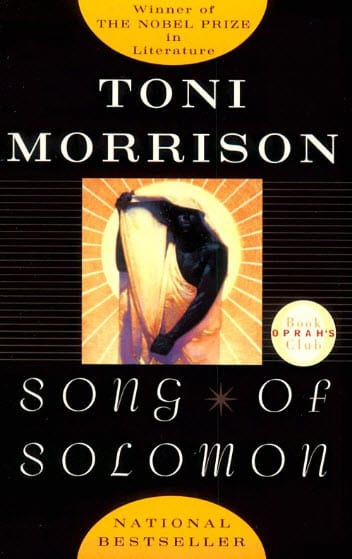
Song of Solomon by Toni Morrison

Every night now Guitar was seeing little scraps of Sunday dresses--white and purple, powder blue, pink and white, lace and voile, velvet and silk, cotton and satin, eyelet and grosgrain. The scraps stayed with him all night and he remembered Magdalene called Lena and Corinthians bending in the wind to catch the heart-red pieces of velvet that had floated under the gaze of Mr. Robert Smith. Only Guitar's scraps were different. The bits of Sunday dresses that he saw did not fly; they hung in the air quietly, like the whole notes in the last measure of an Easter song.

Four little colored girls had been blown out of a church, and his mission was to approximate as best he could a similar death of four little white girls some Sunday, since he was the Sunday man.

How could a novel like Song of Solomon exist? It's so overloaded with moments, images, ideas; it actually seems to totter like an overburdened basket, sure to fall over. Although I haven't read all of Morrison's books, I feel safe in saying that only Beloved comes close to the sheer scope and audacity of this novel (and in my opinion, Solomon easily outpaces it). I'm planning on teaching it for the first time in many years, and for every key detail that stuck in my mind--the doomed flight of the insurance salesman at the beginning of the novel, Milkman earning his nickname by feeding at his mother's breast well into his childhood, Pilate's name hanging from a box in her ear--there's another that I had forgotten all about--Reba's uncanny luck, Circe luxuriating in her dead master's house with her pack of dogs, Hagar's attempts to murder Milkman... How does it all manage to work together?

The word that comes to mind for me when reading Song of Solomon is "inheritance." What can be handed down, and what must be left behind? The inheritances in Song of Solomon are often unwanted: Milkman inherits his father Macon's self-centeredness and materialism in the same way that the mistaken name "Macon Dead" is passed down through the generations. Pilate's name is essentially meaningless, plucked out of the Bible by an illiterate father, and yet she treasures it by keeping it in her ear. Men and women fight to pass on their own secret souls to their children; when Ruth continues to give the child Milkman her breast, it seems to me that she is trying to claim him by bestowing something upon him from his own body, and thus fend off the cruel, possessive Macon's more aggressive claims on her only boy. In contrast, Pilate's navel-less stomach shows how her mother died in childbirth and was unable to pass anything on at all. And, of course, there's the literal inheritance of the book, a bag hanging from Pilate's ceiling that Macon believes contains a stash of gold they discovered together in the wake of their father's death. The bag of gold is one of literature's most powerful MacGuffins, and through a series of convoluted turns, is transformed into something far more meaningful, a real inheritance. (Although, having read this book probably four times now, I don't think I can faithfully render the shaggy dog story that results in Pilate stealing her own father's bones without knowing it.) Milkman's journey into the South undoes the great migration and performs inheritance in reverse, seeking out the secret messages and forms that lurk in his own psyche in the same veiled way as the song that children in Virginia sing about his ancestor, Jake Solomon.

But for my money, nothing in Song of Solomon is as effective or unnerving as the character of Guitar and the group of the Seven Days. Guitar is Milkman's best friend, but he comes from poverty while Milkman comes from the Black upper class. He routinely chides Milkman for caring too little about civil rights, and he's right, but Guitar's sense of bitter injustice leads him to join the Seven Days, who are tasked with "keeping the balance" by murdering an equivalent white person whenever a Black person is killed by white. (Guitar's ultimate turn against Milkman is fed by the need to fund a mission to kill four white girls after the Birmingham church bombing of 1963). What is so frightening and effective about Guitar is that his terror ideology is seductive and compelling. The reasoning is wonky, bordering on innumerate--you don't "balance" unequal amounts by removing the same number--but the larger logic of a people who face a true existential threat is hard to dismiss, especially when compared to Milkman's wishy-washiness and naivete. The Seven Days are Morrison's Grand Inquisitor: a way of thinking that the novel rejects but nonetheless finds too powerful to entirely expunge. 

Monday, August 19, 2013

Song of Solomon by Toni Morrison

As Milkman watched the children, he began to feel uncomfortable.  Hating his parents, his sisters, seemed silly now.  And the skim of shame that he had rinsed away in the bathwater after having stolen from Pilate returned.  But now it was as thick and tight as a caul.  How could he have broken into that house--the only one he knew that achieved comfort without one article of comfort in it.  No soft worn-down chair, not a cushion or a pillow.  No light switch, no water running free and clear after a turn of a tap handle.  No napkins, no tablecloth.  No fluted plates or flowered cups, no circle of blue flame burning in a stove eye.  But peace was there, energy, singing, and now his own remembrances.


Toni Morrison's Song of Solomon opens with this very crytpic sentence: "The North Carolina Mutual Life Insurance agent promised to fly from Mercy to the other side of Lake Superior at three o'clock."  To the story, the agent is nobody, a non-character, but his attempted flight--you can guess how it turns out--provides the guiding symbol for the rest of the novel: a man, alone, making a leap that, no matter how it ends, will take him away from his town, his home, and his family.  There are other flights in the novel, too: The protagonist, Milkman Dead, learns that his great-grandfather was reputed to be part of a legendary tribe of "flying" slaves in the antebellum South; at the end, Milkman too leaps into the air, his flight perhaps the most ambiguous of them all.

It's not hard to believe that someone in the world of Song of Solomon might able to fly.  Morrison crowds her plot with a number of details borrowed from Magical Realism: Milkman's Aunt Pilate, for instance, born just after her mother's death, has no navel.  Another character seems to be immortal.  Morrison's story bumps right up to the edge of realism, and when it's not fantastical, it's consistently weird.  But at the same time, it's one of Morrison's most straightforward works.  She explains in the (really great) foreword that, for Solomon, she abandoned the more complex experiments with time that characterize some of her other books because the traditional progression seemed more fitting for the male protagonist.  That's something I never would have thought of.

At its heart, Song of Solomon is a conventional novel; a bildungsroman about Milkman that follows him from his birth to his moment of "flight."  Morrison carefully details not only Milkman himself but his family--his greedy, callous father Macon, his abused mother Ruth, his sisters Lena and Corinthians, his otherworldly aunt Pilate, her granddaughter Hagar, whom he loves then abandons.  Each of these characters gets a really intricate, detailed plotline; to Morrison's credit, nothing among them seems extraneous and unnecessary.  In the second part of the novel, Milkman retraces Pilate's life history in Pennsylvania and Virginia searching for a sack of gold she described to him.  The gold, reliably, is a MacGuffin--what he really discovers is the story of his family, of flying Solomon, and the rest of his great-grandparents.  And just as reliably, he comes out of the experience a better person--regretful for the way he has treated Hagar, loving toward his parents, etc., etc.

That sounds hokey and cliched, but man, it works.  I think part of the genius of Song of Solomon is that Morrison finds the perfect balance between this well-worn structure and the accumulated strangeness of Milkman's family.  I don't think that my description of it has been really sufficient, but the book's greatness relies in its many intricate details, and I don't think reciting them here would really provide an understanding of how well they work together.

Thursday, July 8, 2010

How to Read and Why by Harold Bloom

How to Read and Why is a book that seems to accomplish its goals a little early. I had imagined it as presenting a Grand Unified Theory of Reading, by which I might expand my appreciation of literature as a whole, and in its first section it does something of that, as Bloom presents a set of what he sees as essential principles for reading. Among other things, he puts forth what seems to me the most persuasive and encompassing rationale for reading I have ever encountered:

Reading well is one of the great pleasures that solitude can afford you, because it is, at least in my experience, the most healing of all pleasures. It returns you to otherness, whether in yourself or in friends, or in those who may become friends. Imaginative literature is otherness, and as such alleviates loneliness. We read not only because we cannot know enough people, but because friendship is so vulnerable, so likely to diminish or disappear, overcome by space, time, imperfect sympathies, and all the sorrows of familial and passional life.


Terry Eagleton--basically England's Harold Bloom--notes in his remarkably negative review that "[i]t sounds as though Harold is a bit short of mates and reads to make up for it." With all due respect to the achievements of Prof. Eagleton, such a statement reeks of petty snark and, worse yet, of intellectual dishonesty. Loneliness is the undiscussed companion of the human condition and if you do not feel at least a little bit like Prof. Bloom does, then I simply don't understand you.

With the why out of the way, Bloom turns to the how in the 200-odd pages that follow, and it is here that Eagleton's criticisms have some bearing. Bloom divides his book into five sections, one each for short stories, poetry, and drama, and two for the novel, and within each section he briefly treats five to six major authors or works. Each gives the impression of being somewhat less than Bloom has to offer; while the section on Keats may serve as a passable introduction to the poet and enlightens us as to why Bloom treasures "Le Belle Dame sans Merci," it fails to break free from Bloom's solipsism. Despite Bloom's notions that we should be forever reading the best literature available to us, knowing how to read Keats is not the same thing as knowing how to read; knowing how to read Keats exactly like Harold Bloom is more distant still. Furthermore, the meager selections of works suggest no reason for their being included together, and while Bloom tosses superlatives around with impunity (there is no "higher aesthetic achievement by a twentieth-century American writer than As I Lay Dying," no greater book by a living American than Blood Meridian, no greater book by an American black than Invisible Man), their ubiquity drains them of power and it is hard to shake the feeling that the works have been selected, not for their greatness, but by whim.

One notable exception to this piecemeal feeling is the final chapter, on the American novel since Melville, in which Bloom articulates an affinity among seven novels: Moby-Dick, As I Lay Dying, Miss Lonelyhearts, The Crying of Lot 49, Invisible Man, Blood Meridian, and Song of Solomon. These novels all express a "negative sublimity," a horrific transcendence in the tradition of Moby-Dick and a uniquely American and apocalyptic vision:

It is not the function of reading to cheer us up, or to console us prematurely. But I conclude by affirming that all of these American visions of the End of our Time offer us more, much more, than their cleansing negativity... There are survivors among these: Ishmael, Oedipa, Invisible Man. Why read? Because you will be haunted by great visions: of Ishmael, escaped alone to tell us; of Oedipa Maas, cradling the old derelict in her arms, of Invisible Man, preparing to come up again, like Jonah, out of the whale's belly. All of them, on some of the higher frequencies, speak to you and for you.


This, unsurprisingly, does not meet Terry Eagleton's expectations of serious criticism, and though my expectations were quite different it did not quite meet them, either. But to read Bloom is to be in the presence of someone who truly loves reading; I hope that one day I should love my own children as much as Bloom loves books. There is little concrete advice in How to Read and Why, but I do find that it inspires me to find something in books that speaks to me as loudly as these works speak to him. Insofar as the success of How to Read and Why is encountering another soul with its unique passions, a literary fellow traveler, it fails as literary criticism but succeeds as something of sister text to the books it idolizes, alleviating a trace of human loneliness.