Showing posts with label as byatt. Show all posts

Saturday, October 28, 2023

The Game by A. S. Byatt

Cassandra did not look at him: she said, 'It seems sufficiently clear to me--to me--that you can both destroy and create reality with fiction. Fictions--fictions are lies, yes, but we don't ever know the truth. We see the truth through the fictions--our own, other people's. There was a time when I thought the church had redeemed fiction--that the Church's metaphors were truths--but lately that's seemed meaningless. Dangerous even, like any other fiction. We feed off it. Our fictions feed on us. 'And to deform and kill the things whereon we feed.' I don't know quite why Coleridge should have found the serpent's method of indigestion so peculiarly repellent... but it's a powerful metaphor..."

Julia is a successful author of domestic novels. She has a habit of drawing too heavily from life; her daughter and husband are resentful of the way their lives are often transformed into scenes of patriarchal oppression. Her sister, Cassandra, is an Oxford don of medieval studies. Once upon a time, Julia and Cassandra were a pair of imaginative siblings who bonded over "The Game," a medieval fantasy with carved pieces and an oilskin map they created together. Their present occupations can both be seen as an outgrowth of "The Game": Julia taking up the spirit of fiction, Cassandra retreating into the relative surety and safety of history and literature. As teenagers, the sisters grew apart because of their shared love of Simon, a young man who has since become a renowned nature presenter on TV, like David Attenborough. The sisters watch his programs religiously, and hate each other.

The Game throws Julia and Cassandra back into each other's lives, first through the death of their father, and then the return of Simon, who wants to reconnect with the sisters, but has troubles and anxieties of his own. Julia and Cassandra continue to treat each other in ways that are somehow both abominable and subtle--cold, dismissive Cassandra; Julia, who fashions a version of her sister and Simon into a new novel that threatens to make everyone miserable.

The strength of A. S. Byatt's novels and stories, in my opinion, has always been the way they draw on literary and artistic sources: the imitations of Rossetti and Browning in Possession, Lord Byron in Angels & Insects, Matisse in--well, The Matisse Stories. The Game makes a few gestures at medieval literature and philosophy, especially in Cassandra's work, but it doesn't really have an extratextual interest. "The Game" is something of a red herring, an important bit of context for the sisters' relationship, but never really explained or explored in a way that would provide another layer, as in those other novels. It's almost as if The Game is an opportunity to see Byatt as a pure novelist, writing a work with no references. The results are pretty middling, I think; what we're left with is a kind of Murdoch-ian novel of ideas in which the ideas themselves often feel absent.

The lack of a Byattesque textual reference is sort of strange, given how important the idea of "fiction" is to The Game: as in the passage quoted above, Cassandra struggles to understand how much our understanding--of life, of people--is purely fictive. She concludes that our lives are entirely fictional, that like Julia, we can only see through the fictions we create. It's this idea that Simon, who was once studying to become a priest, has run from, into the arms of cold, factual science. When Simon sees a snake, he sees only the animal--not, as Cassandra might, a symbol of sin, or death, or duplicity.

There is an interesting thread, too, with Julia's husband Thor, a Swedish Quaker--Julia and Cassandra are brought up Quakers, too--who is so obsessed with the need to do good that he invites a disadvantaged family to stay at their home without asking or informing Julia. He presses Julia to uproot her life and move to the Congo, where they can do more "good," and finally angrily leaves her because her commitment to "good" is not as total as his is. This was, I thought, one of the most interesting things about the book: an exploration of the limits of "the good" and the competing obligations we have to our immediate family and the larger world. But I struggled to see the connection between this thread and the central love triangle. Mostly, I thought The Game was a little too cold, too think-y, without the fun literary pleasures that define Byatt's best novels.

Tuesday, October 1, 2019

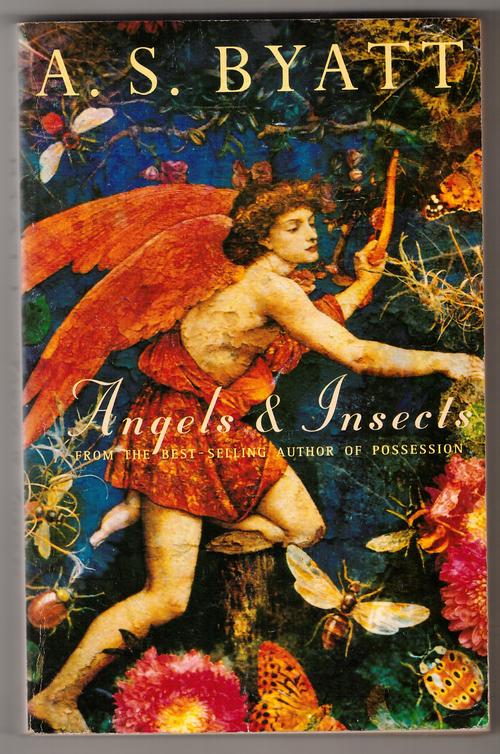
Angels and Insects by A. S. Byatt

And the Queens themselves, who emerge in their hundred of hundreds, must possess strength and skill and cunning and tenacity to survive more than a very few moments after successful fecundation, let alone start a nest.  The time in the blue sky, the dizzy whirling in the gauzy finery lasts only a few hours.  Then they must snap off their wings, like a young girl stepping out of her wedding veils, and scurry away to find a safe place to found a new nest-colony.  Most fall prey to birds, other insects, frogs and toads, hedgehogs and trampling humans.  Few indeed manage to make their way again underground where they will lay their first eggs, nourish their first brood of daughters--miserable dwarfs, fragile and slow, these early children--and in due course, as the workers take over the running of the nursery and the provision of food, they will forget that they ever saw the sun, or thought for themselves, or chose a path to run on, or flew in the midsummer blue.  They become egg-laying machines, gross and glistening, endlessly licked, caressed, soothed and smoothed--veritable Prisoners of Love.  This is the true nature of the Venus under the Mountain, in this miniature world a creature immobilised by her function of breeding, by the blind violence of her passions.

In "Morpho Eugenia," the first of two novellas that make up A. S. Byatt's book Angels and Insects, a young explorer and entomologist named William Adamson has returned to England from the Amazon.  He has spent years studying and collecting, but his entire collection is gone, shipwrecked, and so he has to find shelter at the mercy of an elder collector with whom he has had an ongoing correspondence.  In return for shelter, William agrees to help his benefactor, Harald Alabaster, to organize his own collection of specimens, as well as to converse with him about the arguments against and in favor of the existence of God, which Alabaster means to publish in a book.  And though William is anxious to return to raise funds for a new voyage and continue his studies in the rainforest, there is a consolation prize at Harald Alabaster's estate: his beautiful daughter Eugenia, with whom he falls in love, and whom he eventually marries.

William presents Eugenia with a gift: a specimen of the Morpho eugenia, a pale-colored but beautiful butterfly from the Amazon, who happens to share her name.  Much is made of the color of butterflies: they are a warning of toxicity, for one, so any time we see Eugenia in a brightly or pale colored outfit we're being asked to ponder the wisdom of William's marriage.  Male insects seem to be more brightly colored than females, and surely this says something about the natural relationship between men and women?  William, in his spare time, undertakes a longitudinal study of the ants around Alabaster's estate with the Alabaster children and a servant named Matty Crompton, who shares his interests in insects.  The lives of ants, too, seem to provide fertile metaphors for human life.  Is the ant Queen, the "glistening egg-laying machine" an image of Eugenia, who keeps pumping out children who seem not to have any resemblence to William?  Are the Sanguinea ants who literally enslave ants of other species and convert them under a kind of Stockholm syndrome a metaphor for William's relationship to the Alabasters?

"Men are not ants," William says to Matty, matter-of-factly.  It's a reminder that our habit of looking to the animal world to explain something about human nature is an act of anthropomorphism, that is to say, an act of projection.  Although what we conclude can be unpleasant, we can comfort ourselves by looking at the animal world and seeing ourselves reflected; we can say, look, that's just the way it is.  For Harald Alabaster, the social lives of insects are proof of a divine pattern he is desperate to see.  Darwin's ideas have arrived to threaten cultured belief in intelligent design, and Alabaster, who is old and frail, must ward them off to assuage his own fears of death.  But the animal world is incredibly diverse, and Byatt tells us that we can find anything in it, if we look hard enough.  What is much harder is to really look at people: see, for instance, how William Adamson steadfastly refuses to see the way in which his assistant Matty Crompton is better suited for him than Eugenia Alabaster.

Fears of death are even more explicit in the second novella, "The Conjugial Angel."  It's set among a small group of dabblers in the occult, who meet frequently to perform seances and the popular 19th century psychic practice known as "automatic writing."  Each of these characters is touched by grief: a woman who has lost several infants, all named Amy; a woman trying to reach her shipwrecked explorer husband; and the sister of Alfred, Lord Tennyson, who, like her brother, has spent decades dealing with the grief over the drowning death of her fiance Arthur Hallam.  Hallam is the subject of Tennyson's famous poem "In Memoriam A. H. H.," one of the most beautiful meditations on death in the English language.  In Byatt's account, Emily, who has since remarried, has always been conflicted by the depth and fame of her brother's famous poem; she has often felt like Alfred's grief has crowded out her own, and at the same time the poem's composition and reception have kept her, and Alfred, from any sort of closure.  That's emphasized when the medium, a weirdo named Sophy Sheekhy, conjures up Hallam's moldering and confused old spirit, who has been unable to "cross over" into the spirit world.

"The Conjugial Angel" would be familiar to readers of Byatt's PossessionIt, too, is centered on a 19th century poet, and Byatt's reading of Tennyson is deep and thoughtful.  It's a little knottier than "Morpho Eugenia," partly because it's an ensemble piece that really lacks a main character, and partly because so much of it really is a kind of literary criticism.  You get the impression that it might work best for "In Memoriam A. H. H." superfans, wherever they are, but for those of us who are only passingly familiar with the poem--or like most people, not familiar at all--it's hard to shake the idea that we're missing some crucial knowledge to make the novella work.  That being said, it's got some great moments, especially when it imagines a strange and colorful spirit world.  But it's "Morpho Eugenia," with its Victorian gothic narrative and colorful descriptions of insects, and which looks down at the ground instead of up to the heavens, which is going to stay with me most.

Friday, January 1, 2016

The Matisse Stories by A. S. Byatt

'I went to see him once, you know, after the war, when he was living in that apartment in Nice... The rooms in that apartment were shrouded in darkness.  The shutters were closed, the curtains were drawn.  I was terribly shocked--I thought he lived in the light, you know, that was the idea I had of him.  I blurted it out, the shock, I said, "Oh, how can you bear to shut out the light?"  And he said, quite mildly, quite courteously, that there had been some question of him going blind.  He thought he had better acquaint himself with the dark.  And then he added, "and anyway, you know, black is the colour of light".  Do you know the painting La Porte noire?  It has a young woman in an armchair quite at ease in a peignoir striped in lemon and cadmium and... over a white dress with touches of cardinal red--her hair is yellow ochre and scarlet--and at the side is the window and the coloured light and behind--above--is the black door.  Almost no one could paint the colour black as he could.  Almost no one.'

Each of the three stories in this collection is based on a different work by Matisse.  Writing about art is always tricky, and never seems to do the work justice, and here is no different.  Byatt throws up lists of numerous colors--see the "cadmium" and "lemon" and "scarlet" and "cardinal red" above--which never cohere into a successful visual object, instead remaining as half-realized as the black-and-white reproductions that preface each story.

But perhaps that's how it is meant to be; each story in some way shows us the impossibility of realizing the optimism and joy that embodied Matisse's work.  The first story, "Medusa's Ankles," is narrated by a woman grappling with her own aging appearance at her salon, where one of Matisse's nudes hangs, emblematic of a very different kind of beauty than the models who appear in the surrounding posters, but unlike the narrator, immune to change and decline.  The second, "Art Work," is about a family of frustrated artists who are shocked when their working-class maid finds success as a sculptor, knitting masterworks together from the clothes they gave her, thinking of them as hand-me-downs.  Each of these stories is about the gap between the way we are and the we are seen or the way we want to be seen.

The best of the stories, though, is the last, "The Chinese Lobster."  The narrator is a college's dean of women students, meeting a colleague at a Chinese restaurant to discuss sexual harassment charges made against him.  The student--who Byatt pointedly makes the subject of discussion, rather than a character with any agency--is neurotic and deeply troubled, and her thesis centers around a misguided perception that Matisse's work objectifies and belittles women.  She applies her thesis to a project smearing feces on reproductions of his work.  But the professor, an expert on Matisse, is almost comically villainous in his contempt for the student.

What seems at first to be a straightforward story about gender conflict becomes something different, though, when the narrator and the professor connect over a mutual understanding of Matisse:

Any two people may be talking to each other, at any moment, in a civilised way about something trivial, or something, even, complex and delicate.  And inside each of the two there runs a kind of dark river of unconnected thought, of secret fear, or violence, or bliss, hoped-for or lost, which keeps pace with the flow of talk and is neither seen nor heard.  And at times, one or both of the two will catch sight or sound of his movement, in himself, or herself, or more rarely, in the other.  And it is like the quick slip of waterfall into a pool, like a drop into darkness.  The pace changes, the weight of the air, though the talk my run smoothly onwards without a ripple or a quiver.

The professor notes that Matisse claimed his art was designed to "please and be comfortable," which, paradoxically, is what makes the work so radical.  Matisse's effusions of color are only sensible, only fruitful, when placed next to le porte noir, the black door.  The student is bereft, suicidal, but the tragedy is only compounded by her rejection of something that might ameliorate, even a little, the endemic misery of being.  "The Chinese Lobster" remains a story about a man's piggish inability to sympathize with one woman, but in his sympathy with another, the narrator, Byatt reveals something deeper and wiser.

Wednesday, June 18, 2014

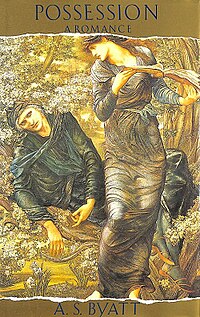
Possession by A.S. Byatt

The Historian and the Man of Science alike may be said to traffic with the dead.  Cuvier has imparted flesh and motion and appetites to the defunct Megatherium, whilst the living ears of MM Michelet and Renan, of Mr Carlyle and the Brothers Grimm, have heard the bloodless cries of the vanished and given them voices.  I myself, with the aid of the imagination, have worked a little in that line, have ventriloquised, have lent my voice to, and mixt my life with, those past voices and lives whose resuscitation in our own lives as warnings, as examples, of the life of the past persisting in us, is the business of every thinking man and woman.  But there are ways and ways, as you must well know, and some are tried and tested, and others are fraught with danger and disappointment.  What is read and understood and contemplated and intellectually grasped is our own, madam, to live and work with.  A lifetime's study will not make accessible to us more than a fragment of our own ancestral past, let alone the aeons before our race was formed.  But that fragment we must thoroughly possess and hand on.  Hoc opus, hic labor est.

"The question with Possession is," my professor told me, "do you read the poetry?"

That depends, of course.  It depends partially on how much you like poetry, and then again on how much you like Robert Browning and Christina Rossetti, who provide the templates for Randolph Henry Ash and Christabel LaMotte, the two 19th century lovers in Possession. In the 20th century, a down-and-out academic named Roland inadvertently discovers evidence of a secret romance between Ash and LaMotte, who--as with Browning and Rossetti--are not particularly thought of us as being similar poets.  Half of the story is Ash and LaMotte's, told through transcriptions of a cache of correspondence Roland unearths, and through scraps of their poetry, which suddenly, when you're looking for them, resound with traces of each other.

There's a lot of poetry, to be sure.  And like most poems embedded in novels, they're easy to skip over.  (I'm looking at you, Tolkien.)  But to do so misses the most wonderful thing about Possession.  First of all, to my non-expert ears, the Ash poems are an incredibly spot-on imitation of Browning.  (Cliffs Notes: Browning is notable for blank verse dramatic monologues which often took the voice of a specific historical character, like fresco painter Fra Lippo Lippi.)  Here's a snippet from an Ash poem which takes the voice of the 17th century microscopist Jan Swammerdam:

I sought to know the origins of life.
I taught it lawful knowledge.  Did not God
Who made my hands and eyes, lend me the skill
To make my patient copper mannikin
Who held the lenses, variously curved
Steady above the living particles
I learned to scry and then to magnify
Successively in an expending scale
Of dimuniton and magnitude,
Until I saw successive plans and lines
Of dizzying order and complexity
I could anatomise a mayfly's eye,
Could so arrange the cornea of a gnat
That I could peer through that at New Church Tower,
And see it upside down and multipled,
Like many pinpoints, where no Angels danced.
A moth's wing scaly like a coat of mail,
The sharp hooked claws upon the legs of flies--
I saw a new world in this world of ours--
A world of miracle, a world of truth
Monstrous and swarming with unguessed-at-life.

(The LaMotte/Rossetti I am less able to judge.)  Moreover, to pull off such a remarkable impression, and also craft these poems in such a way that they allude to the minutiae of the correspondence between Ash and LaMotte--I'm pretty blown away by that.  By contrast, the prose in the "real time" sections is nothing out of the ordinary, and to ignore the poetry is to ignore the novel's really great technical achievement.

But it's also to miss the larger point of the novel.  Half of it is given over to Ash and LaMotte, the other half to Roland and a LaMotte scholar, Maud Bailey, who work together to dig up the details of the poets' affair.  Perhaps predictably, Roland and Maud also fall in love.  But they must also defend their work, hiding their discoveries from other Ash experts on their trail, including an American millionaire whose obsession with Ash's life and biography comes off as selfish and predatory.  Roland and Maud are deeply invested in their work, but are also aware of their own personal need to possess the work of their critical icons.

The novel is always asking us to question that titular noun, possession.  To some extent, Roland and Maud are engaged in the same project as Ash, who writes to LaMotte that we have a duty to possess the past and preserve "the life of the past persisting in us."  But where is the line between this and the kind of self-preserving predation that Roland and Maud want to protect their discoveries from?  How can we possess the past and still honor the autonomy of those who lived it?

I'm getting my Masters degree in English literature now; I believe, despite recent reports of its death, in the project of literary criticism.  One of the things I love most about Possession is its defense of "lit crit" as something apiece with the literature it studies, vital and important for reasons both personal and historical:

Most of all, he [Roland] saw her [Maud's] waist, just where it narrowed, before the skirts spread.  He remembered her nakedness as he knew it, and his hands around that narrowing.  He thought of her momentarily as an hour-glass, containing time, which was caught in her like a thread of sand, of stone, of specks of life, of things that had lived and would live.  She held his time, she contained his past and his future, both now cramped together, with such ferocity and such gentleness, into this small circumference.  He remembered an odd linguistic fact--the word for waist in Italian is vita, is life--and this must be, he thought, to do with the navel, which is where our separate lives cast off, that umbilicus which poor Philip Gosse believed had had to be made by God for Adam as a kind of mythic sign of the eternal existence of the past and the future in all presents.  He thought too of the Fairy Melusina, a woman jusqu'au nombril, sino alla vita, usque ad umbilicum, as far as the waist.  This is my centre, he thought, here at this place, at this time, in her, in that narrow place, where my desire has its end.

This is a parody of academic writing, I have no doubt.  The connection straining for cleverness, the name-dropping, the knotted prose, the smug use of foreign languages--three of them!  It's literally a navel-gazing exercise.  And yet it's impossibly beautiful.  Roland is doing what he does best, thinking like an academic, but the result is neither arcane nor useless.  Rather, the little academic exercise he performs in his head leads him to a profound epiphany about his love for Maud, and an understanding of both Ash and himself.

Possession has quite a few flaws.  The Roland-Maud sections are rarely quite as imaginative or carefully conceived as the Ash-LaMotte ones (the above paragraph notwithstanding), and some of the minor characters--Roland's fiancee/es especially--are pretty underwritten.  Worse, the Elizabeth Barrett Browning character gets pretty short-changed, which may dismay those of us who prefer her poetry to her husband's.  (Though I suppose there are narrative reasons for that.)  But it reminded me what I love about reading, and what I love about criticism, which, at its best, lets me know myself and my world a little better.

Did I read all the poetry, though?  You can't prove I didn't.

Friday, April 25, 2008

Harry Potter and the Deathly Hallows by JK Rowling (pt. 1)

Note: In the interest of readability, and avoiding spoilers before Brent has read it, I have broken my review of Harry Potter and the Deathly Hallows into several parts--just like the film adaptation. The first is a general post-mortem review of the entire Harry Potter Series.

When the seventh and final Harry Potter book appeared in July of last year, it became officially time for the cultural establishments of our world to look at the series as a whole and begin to discuss its place in the scope of world literature. That Harry Potter has made zealots of both his supporters and detractors is no secret; the images of Potterites young and old decked in glasses and orange-and-maroon Gryffindor scarves are fresh in our minds, balanced on the other side by the now less-frequent news reports of suburban parents challenging the books’ inclusion in their children’s school libraries. (Let’s not forget, Harry opens “a doorway that will put untold millions of kids into Hell.”)

But there are Harry-haters more respectable than Jack Chick, and none has more literary gravitas than Harold Bloom, the famous Yale critic who might be the world’s most well-read man. In an article that leads with Bloom’s disgust over the National Book Foundation’s presentation of an award to Stephen King, he targets Harry Potter as a particularly nefarious cog in the war machine that’s been sent to obliterate the literary awareness of the Western world: “I suffered a great deal in the process [of reading it],” he writes. “The writing was dreadful; the book was terrible.” One shivers at the image of poor septuagenarian Bloom forcing himself choke down another page of such drivel, while his collection of Romantic busts look on with horror. Lining up with Bloom on the anti-Harry side are prominent literary figures like A.S. Byatt, and a gaggle of literary and social critics.

Of course, Bloom is describing only his reaction to the first book, which underwhelmed me as well, and when he states that the Harry Potter books are unlikely to introduce kids to better-written children’s novels, he’s probably correct. The idea that Harry Potter is a net social good because it gets kids reading is not only a well-meaning falsehood, it’s a red herring of Hagrid-like proportions. Even if it were true, it would do little to help us judge the books on an aesthetic level—not to mention the fact that our children’s literacy is a burden meant for us, not Rowling.

On the other side of the divide are folks like that bete noir of Bloom’s, Stephen King, whose defense of the Potter books borders on adulation. I have unfairly singled out this one of King’s commendations as patently ridiculous: “Talent is never static, it's always growing or dying, and the short form on Rowling is this: She was far better than R.L. Stine (an adequate but flavorless writer) when she started, but by the time she penned the final line of Deathly Hallows (''All was well.''), she had become one of the finer stylists in her native country — not as good as Ian McEwan or Ruth Rendell (at least not yet), but easily the peer of Beryl Bainbridge or Martin Amis.”

King might have chosen two names at random. While I happen to agree with King on sentiment—Rowling has become a much better writer, something which I believe began with the fourth book—this affirmation is nonsensical. Amis’ Money, a book which I love, is composed of an inspired satirical style that combines the beautiful with the crude. I found it quite affecting. But of course, that’s what Amis meant to do—he is a writer in control of his prose, and can use it to create emotion, pace, and meaning. Can we say any of these things of Rowling?

That Rowling has learned to get out of her own way by the seventh book is a testament to her growth as an author, but if we are serious we must admit that in the entirety of the series great stylistic moments are hard to come by. The image of Hogwarts is strong in our minds, but I can find no passages in which Rowling’s style is up to her extensive imagination; if our mental picture of Hogwarts is vivid it is because of what it is and not the way it is described (and is attributable, I think, in no small part to the films). The dialogue, while frequently clever when it comes to cracking jokes, stumbles mightily in moments of great intensity or meaning, except perhaps for some of the more intimate moments between Dumbledore and Harry. Even the line which King holds in such high regard as the exemplar of the series’ growth—Mrs. Weasley’s battle-cry of “NOT MY DAUGHTER, BITCH!”—seems guilty of the lazy trick of resorting to unexpected profanity. Cue the “ooooohs” from the soundtrack.

But even in the places of the final book where Rowling’s prose remains clumsy or wooden, I am seldom bothered by it anymore. Rowling isn’t Amis, but so what? Why do we need her to be? Is it necessary for the Harry Potter books to be a great work of literature for us to appreciate them?

If we look at them only as literature, I suppose. This may seem a strange thing to say—after all, literature is what they are, right?—but the truth is that by any serious metric, the reality about Rowling’s magnum opus is closer to the conceptions of Bloom and Byatt than that of King. The prose, while much improved, never quite reaches anything worthy of being called “good,” and the plot is frequently contrived to the point of absurdity. Too often the best ideas and characters are mired in a mish-mash of half-baked concepts, confusing plot points, and clichés.

But I maintain that the best way of viewing the Harry Potter series is not a simply literature, but as a cultural event. The books are a big part of it, of course—the biggest—but so are the films, the video games, the action figures, the fan fiction, all of that. We live in a world that perceives itself to be so embattled in the “culture wars” and lacking truly shared cultural icons that the emergence of Harry into the pantheon that includes Mickey Mouse, Superman, and Luke Skywalker is welcome as proof that pop culture remains well and alive in my generation. I mention those examples because they are ones I believe exist in our cultural consciousness not merely as envisioned by their creators but through the eyes of hundreds or thousands of creative minds. Of course, gentlemen named Disney, Siegel and Shuster, and Lucas own the lion’s share of the way those figures and their respective universes are perceived, but their pull on our imaginations is so strong that we have been reinventing them for decades.

There was long speculation that Rowling might kill Harry off at the end of the series; this idea was spurred on by the thought that by doing so Rowling could protect him from other writers—who are cast in this scenario in quite a predatory light—who might wish to continue his story by their own hand. But Rowling went in the opposite direction, ending Harry’s journey—and, as King writes, “if you think that's a spoiler at this late date, you were never much of a Potter fan to begin with”—with the simple sentence “All was well,” assuring not only Harry’s survival but his health and happiness. I do not know if Rowling has considered that this might leave Harry open to such literary poachers, but it is my hope that she considered the possibility and considered it good. Certainly such a move leaves the characters open to be perverted and diluted—I’m sure Harry Potter: The Animated Series isn’t too far off—but I think it also will help Harry to remain a living, vibrant character. Of course, I have no statistical evidence on the popularity of Superman to back myself up, but I feel as if having Harry alive is on its face the best thing for his legacy. This way, he belongs to us all now.

With all due respect to Dr. Bloom and Mr. King, I hold with the middle road walked by Christopher Hitchens, a man not known for his moderateness: “It is given to few authors to create a world apart, and to populate it as well as illustrate it in the mind. As one who actually did once go to boarding school by steam train, at 8, I enjoyed reading aloud to children and coming across Diagon Alley and Grimmauld Place, and also shuddering at the memory of the sarcastic schoolmasters (and Privet Drives) I have known.” I can think of no better description of the Potter series’ strengths: its endless and captivating inventiveness, and the way that it plays to our deeply held desire to find reflected in our literature the familiar and the mysterious both.

And if there’s really a culture war going on, put me squarely on King’s side against the Blooms and Byatts of this world. It’s a post-modern world now, the era of the lowbrow, no matter how tightly Bloom holds the keys to the canon.