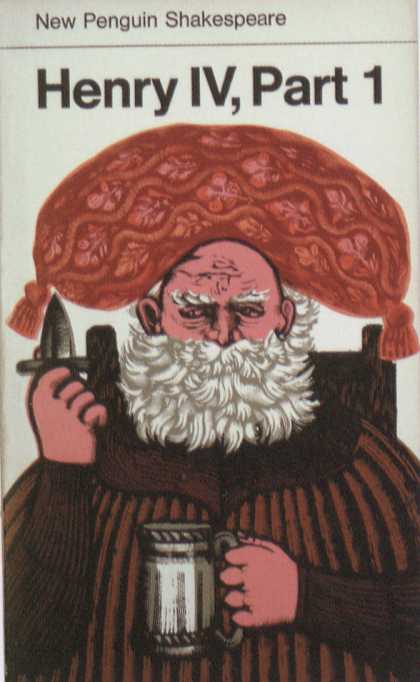
Showing posts with label Henry IV. Show all posts

Tuesday, January 30, 2018

Henry IV, Part One by William Shakespeare

FALSTAFF: Can honor set to a leg?  No.  Or an arm?  No.  Or take away the grief of a wound?  No.  Honor hath no skill in surgery, then?  No.  What is honor?  A word.  What is in that word "honor?"  What is that "honor?"  Air.  A trim reckoning.  Who hath it?  He that died o' Wednesday.  Doth he feel it?  No.  Doth he hear it?  No.

The theme of the ninth grade is, at my school like so many of others, "coming of age."  It doesn't really mean much, in practice, but it "sells" to the students that the arc of the year has a purpose.  And in some moments it lends a shape to cross-textual conversations.  How is the process of growing up different for Holden Caulfield than it is for Jeanette Winterson in Oranges Are Not the Only Fruit, or Pip from Great Expectations?  Unfortunately, it also means that we teach Hamlet way before kids, in my opinion, are really old enough to read it.  (Who is, though?)

My solution was this: I asked my assistant principal to order Henry IV, pt. 1.  Even more than Hamlet, I think of H4pt1 as Shakespeare's quintessential coming-of-age story, centering as it does on the young Prince Hal and his need to grow up and straighten out in order to inherit the throne of his father, the title king.  The dissolute prince, always hanging out with Falstaff and his cronies, pales when compared to the hotheaded bravery of Percy Hotspur, who drives the rebellion against Hal's father.  (In fact, I learned while reading about the play, that until relatively recently, most performances treated Hotspur as the protagonist, and relegated Hal to a supporting role.)

Reading it again this time, my attention was focused on these themes, and what would be accessible to my students.  Will they relate to the pressure put on Hal to be a model son?  Perhaps not as much as students at some of the schools I have taught.  Will they sympathize with the moralizing Henry IV, as they sympathize with Holden's stuffy old teacher who tells him, "Life is a game you play according to the rules?"  (It may sound weird, but teenagers have a conservative streak they have trouble growing out of.)  Or will they find Falstaff's catechism on honor, as I do, some of the truest words in literature?

One thing that struck me during this re-reading is that the conflict isn't really what I remembered it being.  It's not about Hal struggling with the decision to throw off Falstaff and his life in Eastcheap.  In fact, it seems that decision is made well before the play starts.  The love that Hal bears to Falstaff is pretty scant, and he can't really find a kind word to say to or about the man until he thinks he's died on the battlefield.  It's entirely believable that Hal hangs out in Eastcheap for exactly the reason he says he does: it will make his enemies underestimate him and make his ultimate rise to power seem all the more awesome.  If that reasoning is to believed, he's not a traitor to Falstaff, he's a psychopath.  And yet it will take literally another play to get to the point where Hal dismisses Falstaff for good.  Is that Machiavellian strategizing or real inner conflict?

I don't think this play will be easy to teach.  There are a lot of war-room strategy meetings that I often want to glaze over, as I do with those same scenes in Othello and Julius Caesar.  It's going to be important to find what matters about these scenes--Percy's hotheadedness, the eerie magic that hangs around Shakespeare's version of Wales, the parallel father-and-son relationships--and not skip them over to get to the tavern scenes and the grandiose speeches.  We'll see how that goes.

Wednesday, May 23, 2012

Henry IV, Part Two by William Shakespeare

CHIEF JUSTICE: Well, God send the Prince a better companion.


FALSTAFF: God send the companion a better prince.  I cannot rid my hands of him.

What is the point of Henry IV, pt. II?  I cannot tell.  The fundamental conflicts seem warmed over from Henry IV, pt. I: Prince Hal feels compelled to cast of Falstaff in order to claim his birthright; King Henry thinks little of Hal; there are some rebels.  The scene in which Hal, now Henry V, condemns Falstaff, is one of the best scenes in either play, but it lacks the impact it ought to have because we've been here already, when the Falstaff of Part I begs not to be "banished" by Hal, who replies, "I do; I will."

The rebels enter even more limply.  Instead of Hotspur--the furious, headstrong foil of Part I--Part II gives us his father Northumberland, whose defining trait is that he fails to actually show up to the rebellion.  Shakespeare promises another showdown between the rebel forces and the King's, but instead has the Prince's brother John capitulate to all their demands and then arrest them when their guard is down.  (In this case I imagine Shakespeare laughing maniacally while writing this scene, delighted to frustrate his audience's expectations.)  For these reasons it seems hard to regard Henry IV, pt. II as anything but an attempt to further capitalize on the popularity of the first part, and on Falstaff in particular.

As a play it's underwhelming, but it also seems to be a product of perverse genius.  In a way, Shakespeare gives us exactly the play we want--that is, a repeat of the last play--but refuses to give it to us the way that we want.  Probably Shakespeare knew that the greatest moments of Part I were the interactions between Falstaff and Hal, and he purposely kept their two storylines (mostly) separate until the final scene.

What a final scene it is, though.  Hal's vicious rejection of Falstaff is almost worth the price of admission:


FALSTAFF: My king, my Jove, I speak to thee, my heart!

KING: I know thee not, old man.  Fall to thy prayers.
How ill white hairs becomes a fool and jester.
I have long dreamt of such a kind of man,
So surfeit-swelled, so old, and so profane;
But being awaked, I do despise my dream.
Make less thy body hence, and more thy grace;
Leave gormandizing.  Know the grave doth gape
For thee thrice wider than for other men.
Reply not to me with a fool-born jest.
Presume not that I am the thing I was,
For God doth know--so shall the world perceive--
That I have turned away my former self.
So I will those that kept me company.


The bit about Falstaff being part of Hal's dream is especially telling, because we know that dreams will be few and far between for Hal.  In the play's other truly moving scene, Hal sees his ailing father asleep and thinks that he has died.  Reluctantly, he takes the crown as his, knowing that it represents a sleepless future:


Why doth the crown lie there upon his pillow,
Being so troublesome a bedfellow?
O polished perturbation, golden care,
That keep'st the ports of slumber open wide
To many a watchful night!  Sleep with it now;
Yet not so sound and half so deeply sweet
As he whose brow with homely biggen bound
Snores out the watch of night.


Henry will return to this thought in Henry V as he walks incognito through his military camps, soliloquizing that the trappings of a king, "laid in bed majestical, / Can sleep so soundly as the wretched slave..."  Of course, Henry IV is not dead, and when he discovers that Hal has come and gone with his crown, his response could not be more off the mark:


How quickly nature falls into revolt
When gold becomes her object!


And yet this gives Hal the opportunity to admit the truth to his father--that he regards the crown not as a prize, but that creature "that hath fed upon the body of my father."  It is a rare moment of honesty from Hal, who seems so often to be nothing but a collection of performances.  And it is a deeply tragic moment, because Hal takes up a burden that he does not want to honor a man who has loved him little.  Perhaps Hal's greatest tragedy is that he will make a great king.

Whether a noble self-sacrifice or a fetishization of honor, Hal's attitude in this scene is not something he has learned from Falstaff.  But the skills that make him a great king--the play-acting and manipulation of words--show the evidence of Falstaff's tutelage.  As Hal has been proving since Part I, he is a greater jokester than even his mentor, once again outwitting him by posing as a waiter to eavesdrop on what Falstaff says about him.  (This, in turn, is a pale imitation of Hal's trickery during the Gad's Hill robbery of Part I).  I really enjoyed Falstaff's soliloquy attributing Hal's skills to heavy drinking, of which I'll share only a part:


Hereof comes it that Prince Harry is valiant, for the cold blood he did naturally inhehrit of his father he hath, like lean, sterile, and bare land, manured, husbanded, and tilled with excellent endeavor of drinking good and good store of fertile sherris, that he is become very hot and valiant.  If I had a thousand sons, the first human principle I would teach them should be to forswear thin potations and addict themselves to sack.


This is not correct, of course, but neither is it wrong.  Hal could not have got his peculiar brand of histrionic valor from his father, but with Falstaff as his father he would never have possessed the cruelty kingship requires.  In a sense Hal has two fathers; though Falstaff imagines "a thousand sons," we know that he is thinking of only Hal.  That is why it is so painful to hear Hal say, "I know thee not, old man."

But as great as that scene is, and a handful of others (including Hal's trick and the snatching of the crown, as well as some of the comic Falstaff-only scenes) Henry IV, pt. II feels awfully shoddy, like a sagging tent held up with two few poles.  Though Henry is dead and Hal is king, nothing seems to have changed or been accomplished.  It is probably for the best that Shakespeare did not make good on his epilogue, which promises another play "with Sir John [Falstaff] in it," or else Henry V might have been just as inconsequential.

Wednesday, March 9, 2011

Henry IV, Part One

Henry IV is not the main character of Henry IV, Part One. He barely clocks in fourth--behind the impetuous rebel, Hotspur. But who is? Conventional wisdom would say that the center of the play is Hal, the future Henry V, who over the course of the Henry IV plays must learn to abandon his life of carousing in Eastcheap taverns, but Hal's drinking buddy Falstaff was perhaps his most popular creation, and according to Harold Bloom is one of the two greatest Shakespearean achievements (along with Hamlet).

The play opens with Henry IV wishing openly that his son were Harry Percy, or Hotspur, who within an act will be in open rebellion towards him:

Oh, that it could be proved
That some night-tripping fairy had exchanged
In cradle-clothes our children where they lay,
And called mine "Percy," his "Plantagenet,"
Then would I have his Harry, and he mine.


And yet, what strikes me is that from his very first appearance, Hal appears to have no qualms about leaving his life in the taverns behind in order to become more like Hotspur:

I know you all and will awhile uphold
The unyoked humor of your idleness.
Yet herein will I imitate the sun,
Who doth permit the base contagious clouds
To smother up his beauty from the world,
That when he please again to be himself,
Being wanted, he may be more wondered at
By breaking through the foul and ugly mists
Of vapors that did seem to strangle him.


Both Hal and his father have a nasty streak of uncharitableness; Henry's toward his son and Hal toward his friends. In particular I find Hal's insistence that he is better than his surroundings to be both ignorant and distasteful, as if his entire life he were merely "slumming it," waiting for an opportunity to show his true colors. It only makes it worse that Hal's self-assessment is essentially correct, and that he takes to the battlefield with natural ease, because it is unclear that the "true" persona is more valuable or honorable than the counterfeit.

This runs afoul of many readings of Henry IV (and here it seems as good a time as any to mention I have not read Part Two) which depict Hal as struggling to transform himself into the capable ruler of Henry V and Falstaff as his obstacle. But on Hal's part there is no struggle, no inner conflict about leaving his friends. On the other hand, Falstaff seems to overflow with love for Hal. In one scene, Hal and Falstaff are play-acting at being Henry and Hal, respectively, when Hal-Henry upbraids his Falstaff-Hal for the company he keeps. Falstaff's reply--clearly and pathetically not true to Hal's sentiments--becomes an endearing self-defense:

FALSTAFF: But to say I know more harm in him than in myself were to say more than I know. That he is old, the more the pity; his white hairs do witness it. But that he his, saving your reverence, a whoremaster, that I utterly deny. If sack and sugar be a fault, God help the wicked. If to be old and merry a sin, then many an old host that I know is damned. If to be fat be to be hated, then Pharoah's lean kine are to be loved. No, my good lord, banish Peto, banish Bardolph, banish Poins, but for sweet Jack Falstaff, kind Jack Falstaff, true Jack Falstaff, valiant Jack Falstaff, and therefore more valiant being as he is old Jack Falstaff, banish not him thy Harry's company, banish not him thy Harry's company. Banish plump Jack and banish all the world.

HAL: I do; I will.


Hal's banishment of Falstaff is completed in Part Two, and in the course of it he does in a way banish the world, as the pursuit of honor and glory is a lonely one by nature. Hal echoes this when he says to Hotspur before their final battle, "I am the Prince of Wales; and think not, Percy, / To share with me in glory any more. / Two stars keep not their motion in one sphere." Hal banishes his doppelgangers: first Hostpur, then his Eastcheap self.

Falstaff, impressed by Hal into service, is on the same battlefield and fakes his own death to spare his life. Is this cowardly? Soliloquizing, he seizes upon the symbolism of counterfeiting that Hal has long been employing:

Counterfeit? I lie; I am no counterfeit. to die is to be a counterfeit, for he is but the counterfeit of a man who hath not the life of a man; but to counterfeit dying when a man thereby liveth is to be no counterfeit, but the true and image of life indeed.


This is Falstaff's finest hour, a rejection of Hotspur's glories, which court death. Falstaff is a prophet of life; life is truth, and death a falsehood. In his war poem "Dulce et Decorum est," Wilfred Own would call it "the old lie," that there is value, or goodness, or sweetness in death on the battlefield. Falstaff's vitality is the overflowing of his insistence on life--"Give me life," he says--and he has no respect for the empty vanities of honor:

Can honor set to a leg? No. Or an arm? No. Or take away the grief of a wound? No. Honor has no skill in surgery, then? No. What is honor? A word. What is in that word "honor"? What is that "honor"? Air. A trim reckoning. Who hath it? He that died o' Wednesday. Doth he feel it? No. Doth he hear it? No. 'Tis insensible, then? Yes, to the dead.


We feel this deeply because we like Falstaff and want him to exist; for that reason Shakespeare wrote more total lines for him than any other character. Nothing is lost when Hotspur meets his end at Hal's hands, mostly because the two of them have been spent the entire play planning to eradicate each other. Falstaff values life and Hotspur values honor; in Part One at least they reap their rewards. I am suspicious of Bloom's desire to turn Falstaff into some sort of ubermensch, but if there is a choice to be made, I'll take Falstaff's worldview over Hal's.