Saturday, January 21, 2017

Herzog by Saul Bellow

If I am out of my mind, it's all right with me, thought Moses Herzog.

Some people thought he was cracked and for a time he himself had doubted that he was all there.  But now, though he still behaved oddly, he felt confident, cheerful, clairvoyant, and strong.  He had fallen under a spell and was writing letters to everyone under the sun.  He was so stirred by these letters that from the end of June he moved from place to place with a valise full of papers.  He had carried this valise from New York to Martha's Vineyard, but returned from the Vineyard immediately; two days later he flew to Chicago, and from Chicago he went to a village in western Massachusetts.  Hidden in the country, he wrote endlessly, fanatically, to the newspapers, to people in public life, to friends and relatives and at last to the dead, his own obscure dead, and finally the famous dead.

Moses Herzog is in crisis.  His wife, cold, beautiful, and shrewd, has left him for his best friend, a boisterous, redheaded man with a wooden leg named Valentine Gersbach.  Together they have evicted him from his own house, and given his picture to the local police.  His lawyer advises him not to sue for custody of his daughter, June--the mother, he says, always wins.  So he bounces aimlessly around New York, Chicago, Western Massachusetts, writing letters to people, some to friends, some to family, some to people he's never met.

The letters Moses writes are frenetic, neurotic, and filled with the heady intellectual musing of an academic.  They are as dense as the book he's written on Romanticism, but they don't help:

All the while his heart is contemptibly aching.  He would like to give this heart a shaking, or put it out of his breast.  Evict it.  Moses hated the humiliating comedy of heartache.  But can thought wake you from the dream of existence?  Not if it becomes a second realm of confusion, another more complicated dream, the dream of intellect, the delusion of total explanations.

In some sense Herzog is a satire of intellectualism, which fails to address Herzog's traumas.  In its place Bellow advocates what he calls, in a tremendous turn of phrase, "potato love"--the sub-verbal kind of love which Herzog has for his daughter, June, and which his wife has denied him.  It's a simple idea, really, dressed up in the incendiary volleys of Bellow's prose.

Nobody writes with the vitality of Bellow.  Herzog is low on plot, but it absolutely bursts with energy.  But Bellow--one of the very best prose stylists in the history of the English language--is never out of control, and the high-octane style of the book never gets tedious.  It helps that Bellow populates the book with a cast of vivid characters, almost all of whom exist only to be vivid.  And Bellow's eye for detail is tremendous:

He remembered that late one afternoon she led him to the front-room window because he asked a question about the Bible: how Adam was created from the dust of the ground.  I was six or seven.  And she was about to give me the proof.  Her dress was brown and gray--thrush-colored.  Her hair was thick and black, the gray already streaming through it.  She had something to show me at the window.  The light came up from the snow in the street, otherwise the day was dark.  Each of the windows had colored borders--yellow, amber, red--and flows and whorls in the cold panes.  At the curbs were the thick brown poles of that time, many-barred at the top, with green glass insulators, and brown sparrows clustered on the crossbars that held up the iced, bowed wires.  Sarah Herzog opened her hand and said, "Look carefully, now, and you'll see what Adam was made of."  She rubbed the palm of her hand with a finger, rubbed until something dark appeared on the deep-lined skin, a particle of what certainly looked to him like earth.  "You see?  It's true."

What a lovely story, I think, but it really lives because of the specificity and particularity of the description of the windows, and the snow in the street, and the light poles.  It's the kind of thing that lesser writers try, and can never seem to do right; for Bellow it never seems extraneous.

Bellow makes Herzog's story a moving reflection on suffering, and on the necessity of love amid great pain.  But the best thing about it is just getting caught in the torrential music of Bellow's writing.

Monday, January 16, 2017

Another Brooklyn, Jacqueline Woodson

The year my mother started hearing voices from her dead brother Clyde, my father moved my own brother and me from our SweetGrove land in Tennessee to Brooklyn.  It was the summer of 1973 and I was eight years old, my younger brother four, his thumb newly moving to his mouth in the hot city, his eyes wide and frightened.

To say that Jacqueline Woodson’s novel Another Brooklyn is poetic is not simply a nod to the beauty of her language, but a realization that the novel is structured around short prose flashes – rarely even a full page long, often a single line.  These slowly construct a story about 4 girls growing up in the Bed Stuy of the 1970s, with a heavy emphasis on how friendship – especially among girls – was necessary for survival.

There are glimpses of life in Tennessee, of the aftermath of the Vietnam War and of the importance of the Nation of Islam to that community.  There are brief scenes that build a narrative, but only the narrator, August, becomes a full-fledged character.  Her father and mother appear intermittently, but more as images than characters, while her brother and her three friends, Sylvia, Angela and Gigi come across more as forces for good, sources of strength than as people.  Everyone is beautiful, even the junkies and rapists that appear regularly on the periphery of Auggie’s life.


There is a good deal of music.  The birth of rap makes a ripple in the lives of these girls, but they are more interested in r&b and at least Auggie slowly comes to love jazz.  Jazz becomes a symbol for the ability to improvise and survive and the novel's structure is meant to nod to jazz's structure.  That structure is careful and impressive – looking back over the opening pages made clear how neatly subsequent surprises had been built.  

While there is a good deal of tragedy here, ultimately this is a story of survival and I was compelled to keep reading to learn how Auggie survives; in fact, I was much more moved by her survival than by the tragedies that befall other characters.

Saturday, January 14, 2017

Randy's Best of, 2016 Edition!

This is the first year my book total dipped since I re-joined Fifty Books back in 2013. I'm not 100% sure what happened. I think part of it was that I was reading more challenging books, as compared to previous years, and that I was busy (I done got married, and what not). Also, I think I went after both challenging and long books. Thus, Notes from a Dead House, though a good book, also was sometimes quite slow. Roughing It, The Years of Lyndon Johnson, and The Count of Monte Cristo were all quite long. And then, both Reading for Plot and From the War on Poverty to the War on Crime were difficult reads.

But perhaps I am just making excuses.

Notes about my 2016 reading:

  • Not a great year for novels. I only read eight, but if you cut out the short story collections (The Lone Ranger, Roughing It) and the one that is a thinly veiled memoir (Notes from a Deadhouse), and the one I was re-reading (The Count of Monte Cristo), I only read four novels (The Familiar, Small Gods, A Lesson Before Dying, and The Bluest Eyes). Given that one of these was a sequel, The Familiar, I feel that I read far too few novels.
  • A good year for me and non-fiction: almost half of my books were nonfiction.
  • Also, a big year for me and biographies. Historically I've had very little interest in biography, but I find that, as an adult, I have become more interested in learning about how other people have found their way. I suspect my future holds more biographies, and certainly more volumes of Caro's Lyndon Johnson.
  • Ten reviews. Last year I did eighteen reviews; the previous year, seventeen.  So, a low year for me. Perhaps 2017 will be better.


With my mere twenty-four books, I think a top five is within the spirit of the best-of lists. So, without more dithering about, my Top Five:

#5: On Writing: a Memoir of Craft by Stephen King

My literary snobbishness went through a period where I turned my nose at King, despite having reading his novels extensively in my youth. However, I revisited King to finish off The Dark Tower series and was generally satisfied. After reading Reading for Plot, though, I have really come to appreciate King's remarkable skill for plot design. King's memoir was an unexpected delight. I expected to enjoy it and get some tips on writing along the way. What I actually got was an extremely thoughtful and engaging memoir, not just of King's writing life, but his life. I'd suggest it's worth reading for anyone interested in the craft of writing.

#4: On Violence by Hannah Arendt

Per usual, Arendt blew my mind. I continue to find great insight in her words, regardless of how old they are. I want, some day, to feel I understand her enough to apply it to understand our world today. I feel that I got closer, but I still have quite far to go.

#3: Small Gods by Terry Pratchett

Quotable at every turn, entertaining on every page, and interesting to top it off, my first experience with Pratchett was as good as promised. Small Gods in particular was recommended to me by a friend as a book that would especially resonate with me. I am excited to know of another author whose work I can turn to and enjoy.

#2:The Years of Lyndon Johnson

Like some other books I've read over the last couple of years, this appeared on my radar because of a Paris Review interview. Ninety percent of the time, I find these interviews boring and self-indulgent; however the good ones are so good to justify reading all of them. The interview with Caro motivated me to give the first volume about Johnson a try, and it was great. Caro described his project as attempting to write a biography of power, and how it comes to be. The first volume in his Johnson biography did exactly that. It was about Johnson, yes, but it was also about how a person can become powerful.

#1: From the War on Poverty to the War on Crime: The Making of Mass Incarceration in America by Elizabeth Hinton

I list this as my best read of the year because it is the most likely to have the longest-lasting impression on me. I will probably have Hinton's book in mind for years to come as I continue my quest to try to understand our criminal justice system. And, Hinton's book, I feel, has brought me quite far.

Homegoing by Yaa Gyasi

I first heard of Homegoing when my eyes were drawn it's brightly cover on the front page of The AV Club, a pop culture site I frequent even though it mostly sucks now, and which rarely reviews any books I would consider reading. I skimmed the review, and then forgot about it, but the book kept popping up in my newsfeed and on endcaps at the bookstore. When I saw it on sale at the end of the year for 3.99, I couldn't resist, especially since it played into my goal, this year, of reading more lit by women and POC.

And it turns out Homegoing was a great choice for that particular initiative, since it covers men, women, racial minorities, and LGBT persons and it does so over the backdrop of 400 years of history, starting around 1600, I think (the book doesn't give dates and I'm terrible with them) and moving straight through till now, with the sections of the book each following some member of the family of a pair of half-sisters, Effia and Esi, whose stories begin in colonial Africa. As the book progresses, so does the timeline, with chapters alternating, roughly, between Effia's side of the family, whose stories largely take place in Africa, and Esi's, who is sold into slavery and taken to Europe and, eventually, America.

To go deep into all the different stories in Homegoing would take forever, and diminish one of the primary pleasures (and pains) of the book--seeing the clever ways Gyasi connects to family members to their different times, and how each deals with the dual impacts of racism and the destruction of their culture. And the impacts are really the part of the book that have stuck with me the most. The structure here, which gives the whole story an epic, almost mythological feeling at times, is constantly undercut by the brutal realities faced by these people, trials Gyasi wisely ties in with the unique traits of each protagonist. Instead of being the victim of generic "racism", we see Quey forced to travel to America when his father learns that he's gay. We see Willie faced with the powerlessness, in early 19th century America, of a woman who isn't light-skinned enough to pass. And there are many more (the genealogy in the front lists about 17 people who get their own stories here). The scope and Gyasi's willingness to make her characters bleed, as well as her canny ability to inject a ray of hope just when it all gets too depressing, drive the story.

I know I haven't spoken much here about the actual themes of slavery and oppression woven into the heart of Homegoing, but they are there, and they are impactful. Sometimes it was hard to even pick the book back up, because it seems (and, for some of the characters, it's true) that there is not, nor will there ever be, a way for them to transcend their blackness, but the last section--which ties everything up too neatly by half but also makes this important point--took me to task for these thoughts, rightly, because blackness is not a thing that should be transcended. Rather, it has always been the small-minded, small-hearted, wicked heart of man that needs elevation. And the kaleidoscope of people that populate Homegoing make the point beautifully.

Also, Gyasi is only 25 years old and this is her first novel. Really excited to see what she does next.

Thursday, January 12, 2017

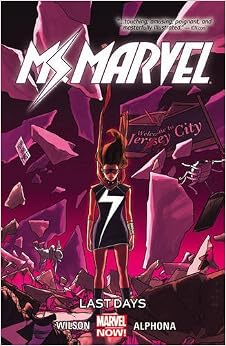
Comics 1-3, Ms Marvel volumes 4 and 5, Giant Days vol 2.

Read Harder orders a super-hero comic with a female lead, and also an all-ages comic. I was all too happy to oblige and knock a couple of the challenges out of the way early.

It broke through to the mainstream a few years back, but the current iteration of Ms Marvel is a Muslim Pakistani-immigrant teenage girl named Kamala Khan. Just typing all of that made me feel like Marvel was checking off a bunch of "let's get credit for making a bold choice" boxes, but I can say that the creative team does a fantastic job actually making Kamala all of those adjectives in their fullest sense. I read Volume 1 last year, and found it overall delightful, novel, and very interesting. It didn't do anything earth-shaking to the superhero genre, but it was obviously much, much more than a publicity stunt.

Volumes 2 and 3 weren't on the shelves of my local library, so I for no real reason picked up Volume 4, "Last Days." Some mysterious world-ending event is nigh. If you've seen a Marvel movie in the past four years, you are no doubt expecting a strange vortex forming in the sky above New York City. Marvel throws you a curve in this case; the danger is instead a strange planet approaching Earth in the sky above New York City. From that very unpromising start comes just a brilliant adventure. The world is ending, on a scale that Kamala simply cannot handle. Kamala Khan lives in Jersey City, and the town rallies to provide safe shelter for its residents as the end draws near. Kamala tries to save her her family and her friends, and is completely overwhelmed by the demands on her great powers, in the best Spider-man tradition.

In order to save her town, Kamala teams up with Captain Marvel, Carol Danvers, who is (understandably) her hero. I have not regularly read comics since the mid-90s, so I have no idea if Carol Danvers is a heavy hitter in the Marvel universe, but her presence gives Kamala the mentor figure she needs, facing her first world-ending threat as a superhero. Their interactions are well done and reminiscent of a college senior coming home from study abroad to discover that her annoying ten-year old sister has suddenly become capable and autonomous, and only needs a little direction.

The real pay-off of the book, however, comes in the last single issue collected in the volume, in which Kamala is out of costume for the entire issue. She bonds with her family, friends, and frenemies in a beautiful, all-hope-is-lost sequence. There is a sequence in which her mother tells her she knows her secret identity and "thank[s] God for having raised a righteous child." It is a lovely moment and a fantastic example of what comics can do right when they're firing on all cylinders. 

How excellent Ms Marvel is becomes even more clear when one reads the random Spider-man issues included in the collection after the main Ms Marvel story. I guess Dr. Ocotopus body-switched with Peter Parker? And there's a sexy Spider-lady? Besides being convoluted beyond all saving, the add-on story was just so tonally inconsistent with Kamala's adventures that it seems unfair to the Spider-man creative team to include it.

As excellent as Volume 4 is, Volume 5 is a mixed bag. There is a massive time skip that was very jarring. (The world-ending event was apparently part of a massive Marvel crossover, so Kamala's role was entirely in managing the Jersey City side of things. Also, evidently Kamala Khan has been invited to join the Avengers. I guess this is a really big deal.) There are some really good touches in this volume, such as Kamala's very religious brother marrying an African-American Muslim girl; an evil plot involving gentrification; Kamala's best friend and kind-of love interest dating a girl who purposefully does not embody the typical physique of a female in comics; and Kamala being stretched thin between super-heroing, helping with the wedding, and fulfilling the basic obligations of being in high school. That said, the gentrification plot veers into the overly cartoony (HYDRA has weaponized aerosol nanobots in order to reshape and take over... Jersey City?), and the answer to keeping up with the stresses of having to be in two places at once is to.. use the school's 3D printer and her best friend's physics genius to create an army of Kamala clones. Yeah  There are still some fantastic human touches in the story, but it's a definite downgrade from Volume 4. The change in artistic team doesn't help; in Volumes 1 and 4, the pencils were done by Adrian Alphona, who had a fairly realistic style and made sure to give Kamala Pakistani features. There's a rotating cast of artists in Volume 5 (including, I see, Alphona for some pages), but Kamala is much more of a manga-looking character for a lot of the book, which is not helpful.
Leon
Alphona

For my all-ages comic, I read John Allison's Giant Days 2. I've been a huge fan of Allison's since his original run of Scary-go-round in 2002, which was a huge inspiration for an online comic I used to draw. I've mostly gotten away from reading daily onlines, but I pick up some collected volumes from time to time. Giant Days features Esther, a character from Scary-go-round, now off at college! Or, rather, university, since this takes place in the UK. I don't have nearly as much to say about Giant Days as Ms Marvel - it's spritely, energetic, manic, and funny, but it's not capital I important like Ms Marvel is at its best. There is drama, misunderstanding, an evil city that's not really evil, and the interesting idea of one of Esther's roommates (or friends? I'm not really sure of the living situation) binging Friday Night Lights and bouncing between Coach and Tami Taylor personas to give various other characters pep talks. It's nice to know that even the Brits see the value in having clear eyes and full hearts!

Monday, January 9, 2017

#3 - An Ember in the Ashes by Sabaa Tahir


For the Book Riot Read Harder 2017 Challenge, I needed to read a fantasy book. Fantasy isn't a genre I normally pick up (I'm assuming the Game of Thrones books are the last fantasy books that I read), but I love a Hobbit as much as the next guy. An Ember in the Ashes, by Sabaa Tahir came out a few years ago and was evidently a Times bestseller, but I hadn't heard of the series until book 2 made someone's year-end list on the AV Club recently.

The story alternates perspectives between Laia, a slave girl of the Scholar people, and Elias, a gladiator-like warrior from the Martial empire. In the opening chapters, Laia's family is murdered, she finds the Resistance, and infiltrates Blackcliff, the military academy that Elias is about to graduate from. Elias, in the meantime, has a super-hot and super-awesome best friend gladiator-ess named Helene, attends Blackcliff, and is thinking of deserting the empire. (I wouldn't make a point of the super-hot, but it's brought up more than twice in the book.) Elias quickly finds himself involved in the Tri-wizard Tournament to see who gets to be the new Emperor, while Queen Cersei tries to rig the outcome to make sure he doesn't win.

That paragraph sounds much more negative than the book actually deserves. It's hard to establish a wholly creative and new fantasy word, and Tahir writes a gripping yarn that makes the 450 pages go really really quickly. Whether this is because of or in spite of the well-worn template that Ashes follows, it was definitely an interesting read. The first-person narration of a slave trying to just stay alive instead of purposefully overthrow an Empire was new; the first-person narration of Elias brings to mind the Kingslayer in some regards, but because he's also still essentially a college student, there is a nice amount of self-doubt and confusion that freshens things up. In the meantime, I wish Tahir had come up with better names for the Empire and its member ethnicities than "the Martials," "the Scholars," and "the Mariners," etc. That may sound like a small nit to pick, but world-building in fantasy novels is important, and an entire race being known as "the Scholars" is just, well, goofy. The AV Club article I mentioned earlier said that the series really gets going in book 2, where the characters get a lot more attention, and I do plan on reading A Torch Against the Night, because there was a lot to like in this book - probably why I'm so critical of what I feel needed another reworking.


#2 - Peril at End House, by Agatha Christie

For me, comfort reading gets no better than Agatha Christie. I first fell in love with her books in ninth grade, and went through such a prolonged spurt of reading them that a not-particularly-close friend called my house one time, and when my mom answered, my caller said, "What, is he off reading some Agatha Christie book again?" The fact that her books are old-fashioned bothers me not a whit (heck, they were old-fashioned for half of the time she was writing them), except for when the casual racism and antisemitism of pre-war Britain pops up (it does seems to have largely been extinguished in her post-war work). My love of Agatha Christie is so great that in my second year of teaching, I forced four classes of Brooklyn teenagers circa 2009 to read the Murder of Roger Ackroyd - and they liked it. A few years back, I decided I might as well keep track of all the Christies I have and haven't read, with an eventual aim of meandering my way through the trails of upperclass British corpses and completing her oeuvre. 

My most recent foray into Christie reunited me with everyone's favorite Belgian with an egg-shaped head, Hercule Poirot. Poirot, in turn, is reunited with Captain Hastings, his sounding board and the stand-in for the confused reader whenever Poirot finally solves the crime. (I think I'm up to about 40 Christies read at this point and I have never - not once - figured one of these things out.) 

Reviewing the particulars of any individual Christie is really beside the point, but this falls soundly into the category of Very Good Christie for me. (Christie books come in three varieties for me: Stone Cold Classics, Very Good, and Very Meh.) The imperiled character is a young woman named Nick Buckley, proprietress of the titular End House. She is a thoroughly modern young woman of the 1930s (Christie did write modern characters for a time!), and, in another very nice touch, is engaged to a young man who is trying to complete a Charles Lindbergh-esque feat of aviation before he is lost at sea. There's even an attempt made on someone's life involving chocolates filled with an overdose-inducing quantity of cocaine!

As I said, it's not a Stone Cold Classic, but as far as Very Good Christie goes, I'd put it up there with A Murder Is Announced. Sometimes, the best parts of a Christie novel are nothing to do with the crime, but are the parts that reflect the massively changing British society that they take place in. A Murder is Announced was one of Christie's first post-war books, when the entire idea of a servant class was basically thrown out the window once and for all. Similarly, Peril at End House features independent women, aviators when that actually meant something, and a not-really divorced woman with a new lover. For having a reputation of being old-fashioned, I have a feeling this was not the typical stuff of large circulation books in England in 1932.


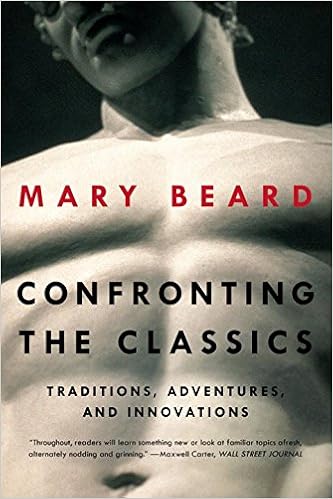
Introduction and Book #1, Confronting the Classics by Mary Beard

Greetings, 50 Books Project folks! I'm a coworker of Chloe's, and am very excited to be coming along for the 2017 50 Books Project. In addition to this blog, I'm also upping my reading game this year by participating in Book Riot's Read Harder 2017 challenge. For classification purposes, a few of the requirements for the Book Riot are comics/graphic novels, which I enjoy reading, but I count graphic novels in a separate category when I'm tallying my year-end book count. I'll post reviews of the comics I read, but I'll not be counting them toward the 50 books for the year.

My first book of the year was Confronting the Classics by Mary Beard, kind of an overview and a critical rethinking of the way we approach Greek and Roman literature. I read Beard's excellent SPQR last year, and added this to my To Read shelf on the BPL app immediately afterwards, figuring a time would come when I would like to dip my toe back into the classical waters. I didn't do a lot of prior reading about this book, but I thought it was essentially a series of essays about the Ancient World, which has always been a great interest of mine. (I studied abroad in Rome for a semester in college, where I learned very little Italian, but much about Roman art and architecture.) And the book is, in fact, a series of essays - however, the essays are reviews on the work of other academics. Far from being the new look at old ideas that I had hoped for, a lot of Confronting the Classics felt like inside baseball, except the baseball was being played in University halls instead of the Forum.

This is not to say that the book did not have noble aims - showing that the Classics are a living subject, all indications to the contrary. And when Beard is on, she's on - a reinvestigation of Nero was particularly interesting. If he was the reviled dictator who fiddled while Rome burned that we've all been told he was, why did several people step forward, pretending to be him, immediately after his assassination? Clearly he could not have been despised the way we've been taught. A rumination on the Laocoon group and its arm placements was also worthwhile. Her chapter on the grave of a bread maker in Rome is also quite charming (so charming that she expanded upon it in SPQR - I was momentarily stunned that I knew anything about this monument until I remembered why). However, a chapter on a book about the life of an Oxford Classicist, RG Collingwood, who died in 1943, seems out of place. Likewise, a chapter on the Dictionary of British Classicists. 

There is a lot to think about in Confronting the Classics, and Beard is a lively and witty writer, but I cannot recommend this when SPQR is out there, as well. For completists only. 


Hillbilly Elegy by J. D. Vance

[fart]

The Damnation of Theron Ware by George Frederic

His views on this general subject were merely those common to his communion and his environment. He took it for granted, for example, that in the large cities most of the poverty and all the drunkenness, crime, and political corruption were due to the perverse qualities of this foreign people—qualities accentuated and emphasized in every evil direction by the baleful influence of a false and idolatrous religion. It is hardly too much to say that he had never encountered a dissenting opinion on this point. His boyhood had been spent in those bitter days when social, political, and blood prejudices were fused at white heat in the public crucible together. When he went to the Church Seminary, it was a matter of course that every member of the faculty was a Republican, and that every one of his classmates had come from a Republican household. When, later on, he entered the ministry, the rule was still incredulous of exceptions. One might as well have looked in the Nedahma Conference for a divergence of opinion on the Trinity as for a difference in political conviction. Indeed, even among the laity, Theron could not feel sure that he had ever known a Democrat; that is, at all closely. He understood very little about politics, it is true. If he had been driven into a corner, and forced to attempt an explanation of this tremendous partisan unity in which he had a share, he would probably have first mentioned the War—the last shots of which were fired while he was still in petticoats. Certainly his second reason, however, would have been that the Irish were on the other side.

This book was written in 1896, if you've ever wondered how much people don't change. Change "Irish" to "Muslim" up there and this could be a snippet from Breitbart.

I didn't intend for several of my early reviews to be politically tinged, and I didn't think The Damnation of Theron Ware would likely be very political. I was expecting--hoping--for something along the lines of The Scarlet Letter when I saw this in the remainder bin at Barnes and Noble. And in some ways, the comparison is apt, mostly in the heavy emphasis on Christianity and a few very strange passages that belie the simplicity these sorts of themes sometimes engender.

But mostly, Ware is a different kind of book, telling the story of the titular Theron and his journey away from primitive Methodism, a movement in which he is an up-and-coming pastor. The book opens with a sermon at a new, much-desired post, but by the end of the first chapter, Ware and his wife are dealing with the disappointment of rejection and shunting out to a small church in the middle of nowhere, victims of petty fractures in the leadership.

Theron meets the elders of the church, who, again, spout monologues not too different from some I heard growing up:

Brother Pierce’s parchment face showed no sign of surprise or pleasure at this easy submission. “Another thing: We don’t want no book-learnin’ or dictionary words in our pulpit,” he went on coldly. “Some folks may stomach ‘em; we won’t. Them two sermons o’ yours, p’r’aps they’d do down in some city place; but they’re like your wife’s bunnit here, they’re too flowery to suit us. What we want to hear is the plain, old-fashioned Word of God, without any palaver or ‘hems and ha’s. They tell me there’s some parts where hell’s treated as played-out—where our ministers don’t like to talk much about it because people don’t want to hear about it. Such preachers ought to be put out. They ain’t Methodists at all. What we want here, sir, is straight-out, flat-footed hell—the burnin’ lake o’ fire an’ brim-stone. Pour it into ‘em, hot an’ strong. We can’t have too much of it. Work in them awful deathbeds of Voltaire an’ Tom Paine, with the Devil right there in the room, reachin’ for ‘em, an’ they yellin’ for fright; that’s what fills the anxious seat an’ brings in souls hand over fist.”

After this dressing down, Ware is out for a stroll when he stumbles into, and follows, for some reason not even he entirely understands, a Catholic funeral procession that meets its terminus in the administration of last rites by one Father Forbes, a veteran parish priest. He also meets the redheaded Celia, who eventually changes his perceptions about the Irish, among other things.

Celia is a very interesting character to exist in a book this old. A Hellenistic libertine, she worships the Greeks and their "gods", though she doesn't believe them to be real. She's a vivacious, complex character, and, in a lesser novel, one might expect her to end up in a pool of regret, repenting of her ways, similiar to the disappointing penultimate chapter of The Scarlet Letter. Instead, her ending is much more ambiguous. But more on this shortly.

The wake leads to Ware deciding on the one hand to write a book about Abraham, and on the other, to have supper with Father Forbes and his off-putting friend, Dr. Ledsmar. Upon sharing his book idea with them, rather than the affirmation and encouragement he expected, Ware finds himself awash in a sea of biblical criticism and liberal theology, things which have, to this point, been completely unknown to him. By the time he leaves, he's been introduced to the idea that Abraham was not a real person, the various supernatural events in the Bible are myth, that Jesus is a mythological/literary descendant of a snake god, and so on.

Again, in a lesser novel, I think the author might've felt compelled to take a position on what theology was right or wrong. After all, the Methodist elders early on are not sympathetic, though Ware's wife is, and grows moreso as Ware himself moves further and further from his original beliefs, culminating in a sex-fueled fever dream listening to Celia play Chopin in her quarters.

And Ware slowly distances himself from his church, his wife, his God, and becomes less and less likable, even as his newfound friends begin drawing further and further away, culminating in a surprisingly devastating and ambiguous speech from Celia, after Ware has determined to leave his wife and follow her to New York City:

"Let me go on. But then it became apparent, little by little, that we had misjudged you. We liked you, as I have said, because you were unsophisticated and delightfully fresh and natural. Somehow we took it for granted you would stay so. Rut that is just what you didn’t do—just what you hadn’t the sense to try to do. Instead, we found you inflating yourself with all sorts of egotisms and vanities. We found you presuming upon the friendships which had been mistakenly extended to you.
Your whole mind became an unpleasant thing to contemplate. You thought it would amuse and impress us to hear you ridiculing and reviling the people of your church, whose money supports you, and making a mock of the things they believe in, and which you for your life wouldn’t dare let them know you didn’t believe in. You talked to us slightingly about your wife. What were you thinking of, not to comprehend that that would disgust us? You showed me once—do you remember?—a life of George Sand that you had just bought,—bought because you had just discovered that she had an unclean side to her life. You chuckled as you spoke to me about it, and you were for all the world like a little nasty boy, giggling over something dirty that older people had learned not to notice. These are merely random incidents.
They are just samples, picked hap-hazard, of the things in you which have been opening our eyes, little by little, to our mistake. I can understand that all the while you really fancied that you were expanding, growing, in all directions. What you took to be improvement was degeneration. When you thought that you were impressing us most by your smart sayings and doings, you were reminding us most of the fable about the donkey trying to play lap-dog. And it wasn’t even an honest, straightforward donkey at that!”

In the end, Frederic refuses to provide any pat answers. Ware leaves the ministry, still feeling as if he has been wronged, Father Forbes continues to minister to his parish, in spite of his lack of belief, and Ledsmar... well, Ledsmar is an unlikable jerk, but he also never receives any kind of comeuppance. So although it can't help but feel like this book is a morality tale of some sort, exactly what the moral is eludes me... but it's a wonderful tale.