Showing posts with label Colson Whitehead. Show all posts

Tuesday, December 12, 2023

The Nickel Boys by Colson Whitehead

He thought long on Dr. Martin Luther King Jr.'s letter from the Birmingham jail, and the powerful appeal the man composed from inside. One thing gave birth to the other--without the cell, no magnificent call to action. Elwood had no paper, let alone the wisdom and the way with words. The world had whispered its rules to him for his whole life and he refused to listen, hearing instead a higher order. Do not love for they will disappear, do not trust for you will be betrayed, do not stand up for you will be swatted down. Still he heard those higher imperatives: Love and that love will be returned, trust in the righteous path and it will lead you to deliverance, fight and things will change. He never listened, never saw what was plainly in front of him, and now he had been plucked from the world altogether. The only voices were of those boys below, the shouts and laughter and fearful cries, as if he floated in a bitter heaven.

Elwood Curtis is a model student with big ambitions. While his peers are listening to Smokey Robinson and the Marvelettes, he's listening to records of Martin Luther King, Jr. speeches. He is honest and scrupulous in his part-time job at a local store, and he's been accepted to an early college program. All that comes crashing down one day when he accepts a ride from a stranger who, as it turns out, has stolen the car he's driving. He avoids jail, but his fate is worse: a reform school called the Nickel Academy, where young Black kids are tortured and humiliated under a thin pretense of "improvement." Elwood tries to abide by the school's rigid guidelines, believing that his own integrity will win out, but the purpose of the Nickel School is not to improve, but to crush. He quickly finds himself in the "White House," where students are savagely beaten. Repeat offenders, he quickly learns, are "taken out back"--and never heard from again.

I don't think Colson Whitehead's books are for me. Mostly, it's the writing, which often feels to me didactic and false. The Nickel Boys is a very different book from The Underground Railroad, of course, with its magical and anachronistic elements, but in a way it tell the same kind of story, about noble but ordinary people who bear the violent costs of American racism. Like The Underground Railroad, The Nickel Boys seemed to me to have few insights about racism except that it is cruel, and really sucks. Although The Underground Railroad is the science fiction novel, both books seem to me to operate in a kind of dystopian mode, depicting racism as a kind of closed system whose obstacles to escape ironically affirm the possibility that escape is possible. Elwood's misguided nobility strikes me as not so different than someone like Katniss Everdeen: a nobility that's doomed, perhaps, but even more noble for that fact. I want to phrase this carefully, because the obvious rejoinder is that racism really is cruel, and often cruel for its own sake, and nobility in the face of it really is a remarkable trait. But for a book that's based on a true story--that of the Dozier School in Florida's Panhandle--the obvious fictiveness of The Nickel Boys seems to paper over an urgent question like, "How could this really, really happen?"

What I did sort of like about The Nickel Boys was the final twist that--spoiler alert--Elwood died in an escape attempt, and the "older" Elwood we have received glimpses of is really his fellow escapee Jack Turner, who has taken on Elwood's name as a way of honoring his dead friend. (There's some suggestion that Turner changes his name to prevent being taken back to Nickel, but I'm not sure how such an obvious pseudonym would help?) There's a glimpse there of a more interesting story--though I would say it's rather bungled by the clumsiness of the flash-forward scenes--about subterfuge, about sacrifice, about the transformations wreaked by racism on a personal level. As the stories of the Nickel School--and the bodies--are dug up at last, Turner/Elwood decides to travel back down to Florida from his New York home to share the truth at last. Now, that interests me: what compels us to hide, or lie, what compels us to reveal and come clean, and whether the truth really will set you free.

Sunday, February 5, 2017

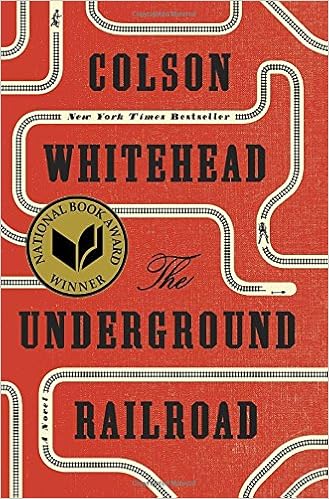
The Underground Railroad by Colson Whitehead

She discovered a rhythm, pumping her arms, throwing all of herself into movement.  Into northness.  Was she traveling through the tunnel or digging it?  Each time she brought her arms down on the lever, she drove a pickax into the rock, swung a sledge onto a railroad spike.  She never got Royal to tell her about the men and women who made the underground railroad.  The ones who excavated a million tons of rock and dirt, toiled in the belly of the earth for the deliverance of slaves like her.  Who stood with all those other souls who took runaways into their homes, fed them, carried them north on their backs, died for them.  The station masters and conductors and sympathizers.  Who are you after you finish something this magnificent--in constructing it you have also journeyed through it, to the other side.  On one end there was who you were before you went underground, and on the other end a new person steps out into the light.  The up-top world must be so ordinary compared to the miracle beneath, the miracle you made with your sweat and blood.  The secret triumph you keep in your heart.

What if the Underground Railroad really were an underground railroad?  That's the premise of Colson Whitehead's novel, which is a piece of what they used to call speculative fiction: not an extrapolation of contemporary politics onto the possibilities of the future, but a reimagining of the past in the service of contextualizing and reenergizing it.  By literalizing the railroad--and reimagining the slave societies of the South in such a way that turns their social realities into literal ones as well--Whitehead hopes to make the horrors of slavery seem new, and freshly horrible.

The heroine is Cora, a slave under the control of the sadistic Randall brothers in Georgia.  Her mother is the only slave to have ever escaped from the Randalls', and so when Cora escapes with a slave named Caesar, it raises the ire of the famous slavecatcher Ridgeway, whose failure to catch Cora's mother many years ago still haunts him.

Cora's path takes her through South Carolina, where what seems like a more enlightened society turns out to be stealthily designed to oppress slaves.  They don't seem like slaves anymore, and are granted limited freedoms, even healthcare, but Cora learns that medical studies are secretly carried out on them.  (Of course, this horrible invention is not an invention at all, but a literal description of the famous Tuskegee experiment, which infected black men with syphilis.)  Cora takes a job as a reenactor in a museum, depicting slave life in a way that makes it look anodyne and paternalistic.  (It reminded me of this Vox piece on what it's like to lead tours at a plantation.)  She escapes into North Carolina, where powerful whites have decided to eliminate the political anxiety slaves pose by simply getting rid of them--all of them--and hanging their bodies along a miles-long trail.  Tennessee is literally burning, an apocalyptic setting right out of The Road.

Ridgeway is the novel's most effective creation.  While the whites of Georgia, South Carolina, North Carolina, and Tennessee tie themselves in knots with moral justifications for the way they structure their societies, Ridgeway understands the cruelty of slavery, and simply doesn't care.  Which is more insidious: their rationalization, or his honesty?  Cora, by contrast, seems more like a bundle of heroic tropes: ignored, belittled, even among slaves, but intrepid, hopeful, headstrong.  It's an unfortunate result of the novel's construction, which requires Cora's virtue to contrast Ridgeway's evil, that makes her so dull.  Whitehead's attempts to complicate her psychology--her resentment toward her mother; her complicated guilt over killing a white boy in her escape--largely fall flat.

So does the novel as a whole, unfortunately.  For all its recontextualizing, it never seemed to me as if The Underground Railroad had something especially insightful or memorable to say about the practice of slavery or its effects.  Whitehead seems mostly to use his imaginative license to maximize slavery's depravity--but, unless you're one of those idiots asking the plantation tour guide if some slaves didn't have it real good, what kind of fresh understanding is that?  But the novel's biggest problem is that nothing in it is as imaginative, or out-there, as the railroad itself.  The Underground Railroad doesn't quite live up to the power of its premise.

Here's Chloe's review.

Sunday, April 22, 2012

Sag Harbor by Colson Whitehead


The entire time I was reading Sag Harbor, I waited for a reason for Benji’s constant judgments. Why was I enduring such a lackluster bildungsroman? Which is what I have to call this book, a coming of age novel, because it tries so hard to be one. For as much as the narrator describes one summer that “changed” his life, not much could be observed as improvement until he gets his braces off 50 pages before the end.
Benji’s family is middle class and black. There are some wonderful references to the accomplishments of black Americans early in the story, “Booker T. came out to Sag Harbor once.” But much of that is forgotten by the time Benji and his 9 month younger brother decide to stop riding their bikes around town; the first day back in Sag Harbor Long Island. 
The premise: middle class black families with summer homes on the north shore. I could step up to my soapbox and wax racial for a minute, but this book doesn’t really deserve a long-winded review. It’s rambling enough. There are redeeming moments of realization: Benji finds a note his mother wrote itemizing the shortcomings of her husband, but these flickers of intrigue are never flushed out. It’s all about Benji trying to figure out his identity. Maybe I don’t get it because I don’t know who I am, or maybe I don’t get it because I’m white.