Tuesday, February 7, 2017

Book 9: Homegoing by Yaa Gyasi

This has already been reviewed (at least) twice on this blog, so I feel like I can get away with a shorter review here. There's also precious little left to say; Homegoing is an amazing achievement. The structure, the scope, the maturity, the fact that Gyasi is a first-time novelist. Homegoing will be remembered, and taught, for decades to come, and she's 26. My mind reels.

I'll touch on just a few of my personal highlights. The machinations of imperialism are treated as well here as anywhere I've ever seen. The early chapters recall Things Fall Apart, but Gyasi's focus on the experience of women opens new horrors that have rarely been mentioned as explicitly in other accounts. The omnipresence of rape, for instance, made me think of the banality of evil, again and again. As the story shifts to America, the absence of the Civil War is fascinating. One of my favorite podcasts is Backstory, which focuses on American history in order to explain the America we live in today. The Civil War is constantly held as the major changing point in American history; in Homegoing, it is a passing reference at best, because, honestly, what is the difference between chattel slavery and the mass incarceration that puts H in the mines of Alabama for what is, at best, a misdemeanor offense?

The H chapter moved me more than any other. As a teacher, Homegoing just constantly thrilled me with its classroom possibilities. It could - and very likely will be - a semester-long class. There is just so much room to bring in other readings, other concepts, sprouting off of every single chapter. Honestly, there just aren't enough good things to say about this book.

So I'll end with a really pedestrian note: Gyasi's ability to create such fully realized characters, each in the space of about 20 pages (seriously, the chapters are super consistent in length), is incredible.

I will also brag that I read the physical book, and, yes, the family tree was super-useful.

Sunday, February 5, 2017

Homegoing by Yaa Gyasi

When she wanted to forget the Castle, she thought of these things, but she did not expect joy. Hell was a place of remembering, each beautiful moment passed through the mind's eye until it fell to the ground like a rotten mango, perfectly useless, uselessly perfect. 
Yaa Gyasi's Homegoing starts with two sisters in Ghana and traces their daughters and their daughters' daughters through 300 years of history, moving from Ghana to America and back again. Part of the beauty of the novel lies in the discovery of the structure, so I won't say much beyond that Gyasi has managed to make a 300 page novel spanning 300 years feel leisurely and measured, giving depth and weight to each generation's experience.

There is so, so much going on here. There are the ravages of slavery, of colonialism, of war, of imprisonment, of drug addiction. The family lineages are periodically severed--the passage of information from one generation to the next cut off by choice or by force--and yet each generation bears the burden of everything that came before, often subconsciously. Because of that (or maybe because I had more context for them), I found the more modern chapters more heartbreaking. The generations of horrific abuse that came with the slave trade and warring factions within Ghana were painful and difficult to read, but felt distant and foreign. When Gyasi got to life under Jim Crowe and poverty in East Harlem (compounded by the generations of pain and suffering laid out before), I almost couldn't bear it. That being said, the accumulation of traumatic memories (or their loss) seems just barely manageable:
"When someone does wrong, whether it is you or me, whether it is mother or father, whether it is the Gold Coast man or the white man, it is like a fisherman casting a net into the water. He keeps only the one or two fish he needs to feed himself and puts the rest in the water, thinking that their lives will go back to normal. No one forgets that they were once captive, even if they are now free. But still, Yaw, you have to let yourself be free."
The village where the stories begin is run as a matriarchy, and women, despite being treated as literal and figurative property, hold an almost mystical power all through the novel as mothers and wives. There is definitely a tension here; women seem to suffer the most brutal losses and abuses, but they are also revered and seem to be able to better fend off the isolation that runs throughout.

A homegoing can be a funeral, a return home to God, and to the generations that have gone before, and Gyasi plays with the idea of home and of return throughout. The book ends with a series of homegoings, and Gyasi manages to make a heart wrenching book end with an upward stroke without breaking form or seeming trite.

I can't believe this is a debut novel. The prose is gorgeous, the scope massive, and I couldn't put it down. Gyasi is able to weave just enough hope into a laundry list of horrors that you don't lose hope, and the jumps in time keep you moving forward just when you're ready to give up.

A note which I wish I'd known before reading: there is a family tree in the opening pages of the book (and before where the e-book starts you off) that is really helpful!


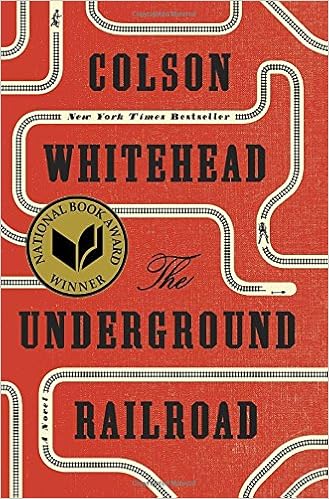
The Underground Railroad by Colson Whitehead

She discovered a rhythm, pumping her arms, throwing all of herself into movement.  Into northness.  Was she traveling through the tunnel or digging it?  Each time she brought her arms down on the lever, she drove a pickax into the rock, swung a sledge onto a railroad spike.  She never got Royal to tell her about the men and women who made the underground railroad.  The ones who excavated a million tons of rock and dirt, toiled in the belly of the earth for the deliverance of slaves like her.  Who stood with all those other souls who took runaways into their homes, fed them, carried them north on their backs, died for them.  The station masters and conductors and sympathizers.  Who are you after you finish something this magnificent--in constructing it you have also journeyed through it, to the other side.  On one end there was who you were before you went underground, and on the other end a new person steps out into the light.  The up-top world must be so ordinary compared to the miracle beneath, the miracle you made with your sweat and blood.  The secret triumph you keep in your heart.

What if the Underground Railroad really were an underground railroad?  That's the premise of Colson Whitehead's novel, which is a piece of what they used to call speculative fiction: not an extrapolation of contemporary politics onto the possibilities of the future, but a reimagining of the past in the service of contextualizing and reenergizing it.  By literalizing the railroad--and reimagining the slave societies of the South in such a way that turns their social realities into literal ones as well--Whitehead hopes to make the horrors of slavery seem new, and freshly horrible.

The heroine is Cora, a slave under the control of the sadistic Randall brothers in Georgia.  Her mother is the only slave to have ever escaped from the Randalls', and so when Cora escapes with a slave named Caesar, it raises the ire of the famous slavecatcher Ridgeway, whose failure to catch Cora's mother many years ago still haunts him.

Cora's path takes her through South Carolina, where what seems like a more enlightened society turns out to be stealthily designed to oppress slaves.  They don't seem like slaves anymore, and are granted limited freedoms, even healthcare, but Cora learns that medical studies are secretly carried out on them.  (Of course, this horrible invention is not an invention at all, but a literal description of the famous Tuskegee experiment, which infected black men with syphilis.)  Cora takes a job as a reenactor in a museum, depicting slave life in a way that makes it look anodyne and paternalistic.  (It reminded me of this Vox piece on what it's like to lead tours at a plantation.)  She escapes into North Carolina, where powerful whites have decided to eliminate the political anxiety slaves pose by simply getting rid of them--all of them--and hanging their bodies along a miles-long trail.  Tennessee is literally burning, an apocalyptic setting right out of The Road.

Ridgeway is the novel's most effective creation.  While the whites of Georgia, South Carolina, North Carolina, and Tennessee tie themselves in knots with moral justifications for the way they structure their societies, Ridgeway understands the cruelty of slavery, and simply doesn't care.  Which is more insidious: their rationalization, or his honesty?  Cora, by contrast, seems more like a bundle of heroic tropes: ignored, belittled, even among slaves, but intrepid, hopeful, headstrong.  It's an unfortunate result of the novel's construction, which requires Cora's virtue to contrast Ridgeway's evil, that makes her so dull.  Whitehead's attempts to complicate her psychology--her resentment toward her mother; her complicated guilt over killing a white boy in her escape--largely fall flat.

So does the novel as a whole, unfortunately.  For all its recontextualizing, it never seemed to me as if The Underground Railroad had something especially insightful or memorable to say about the practice of slavery or its effects.  Whitehead seems mostly to use his imaginative license to maximize slavery's depravity--but, unless you're one of those idiots asking the plantation tour guide if some slaves didn't have it real good, what kind of fresh understanding is that?  But the novel's biggest problem is that nothing in it is as imaginative, or out-there, as the railroad itself.  The Underground Railroad doesn't quite live up to the power of its premise.

Here's Chloe's review.

Wednesday, February 1, 2017

Dear Life by Alice Munro

Ships lost at sea and then, most dreadfully, a civilian boat, a ferry, sunk between Canada and Newfoundland, that close to our own shores.

That night I could not sleep and walked the streets of the town.  I had to think of the people gone to the bottom of the sea.  Old women, nearly old women like my mother, hanging on to their knitting.  Some kid bothered by a toothache.  Other people who had spent their last half hour before drowning complaining of seasickness.  I had a very strange feeling that was part horror and part--as near as I can describe it--a kind of chilly exhilaration.  The blowing away of everything, the equality--I have to say it--the equality, all of a sudden, of people like me and worse than me and people like them.


If Alice Munro's Dear Life has a theme, it's the way that men oppress women.  Munro's touch is so light that you might not notice, and her love and respect of the minutiae of domestic life can look a lot like traditionalism.  But it's there in "Amundsen," a story about a woman who takes a job teaching children being treated for tuberculosis at a far outpost, only to be romanced, and then abandoned, by the town's haughty doctor.  It's there in "Gravel," about a mother who is too absorbed with the hippie lifestyle of her new beau that she fails to see her daughter's unhappiness, with tragic results.  It's there in "To Reach Japan," about a woman who lets herself have a shocking affair aboard a train, only to be racked with guilt about leaving her daughter alone in the cabin.  It's there in "Corrie," about a woman who realizes--after decades--that there was never really a blackmailer, and that her lover's been pocketing all the hush money.

Brent said this was his first introduction to Munro, and it took him a while to get into it.  I can see that--nothing here strikes me on the same level as the best parts of The Lives of Girls and Women or The Passage of LoveI mention those stories above because they stuck with me the most, but there's a lot I have already forgotten: weird little slice-of-life tales that don't quite seem more than a slice.  (What's "In Sight of the Lake" about?  I can't recall even a little.)  But when Munro is good, she really is the best.  "Gravel" especially is a masterpiece of short fiction.  Munro's choice not to follow the voice of the girl, or the mother, but the girl's younger sister, as mystified by the actions of her older sister as she is of her mother, is so simple, but the kind of authorial choice that reflects her brilliance.

The best part of the collection, though, is the "Finale": a quartet of semi-autobiographical tales that Munro calls "the first and last--and the closest--things I have to say about my own life."  (Can we talk about Munro's mastery of the em-dash?)  These stories have the ring of truth; they feel real in a way that the calculated packaging of most of the collection's stories do not.  I particularly loved a story about Munro, seized in the middle of the night by the fleeting thought that she might, if she wanted, strangle her sister in the bunk bed below.  She slips out of the house every night and wanders town, unable to deal with this thought, which surely makes her a freak, only to encounter her father, waiting up for her, who says, in effect, that everyone has thoughts like that.  Of course they do.  But it's the province of great writers to put into words the things we are unaware of, or too afraid to say, and I think I'd have been to afraid to put a thought like that, dredged up even from my childhood, to paper.  Instead of the O. Henry-esque turn of some of the fictional stories in the collection, Munro gives us a classic reflection on the intersection of family and private fear:

However, on that breaking morning he gave me just what I needed to hear and what I was even to forget about soon enough.

I have thought that he was maybe in his better work clothes because he had a morning appointment to go to the bank, to learn, not to his surprise, that there was no extension to his loan.  He had worked as hard as he could but the market was not going to turn around and he had to find an new way of supporting us and paying off what we owed at the same time.  Or he may have found out there was a name for my mother's shakiness and that it was not going to stop.  Or that he was in love with an impossible woman.

Never mind.  From then on I could sleep.

Book 8: The Axe and the Oath by Robert Fossier

Dubbed as a history of ordinary life in the Middle Ages, the Axe and the Oath is easily one of the most confounding history texts I've read in a long, long time. Fossier, a professor emeritus at the Sorbonne, seeks to cover daily life of the non-nobility over a stretch of 1000 years, working thematically instead of chronologically. This task is massive, and, judging from this book, impossible.

Fossier's book is translated from its original French, and I found myself contemplating the writing on a meta-level almost as much as I found myself paying attention to the information in the book. I have to imagine the book makes more sense in French - or, at the very least, Fossier's constant declarations, "I could say more..." come off with a different meaning in French than they do in English. As just an example from the last 100 pages, after I had the brilliant idea to start taking notes on these things:

  • On law: "As is my wont, I will no venture into a technical area that is among the most encumbered..."
  • On peace and honor: "...war (about which I shall have more to say) and the periodic effrois, or terrors (about which I will not)..."
  • On weights and measures: "I shall not pursue the question of the calculation errors that abound in medieval accounting..."
  • On universities: "So much ink and saliva [ew] has already been spent on this majestic medieval 'heritage' that I shall add only a few minor notes..."
  • On literature: "The best I can do is sweep out a corner or two."
  • On monuments: "I am not about to draw up interminable lists of monuments, or painted and sculpted works."
  • On art: "I have no intention of studying the evolution of all these works."
  • On human knowledge: "During the course of my narration, few surveys have left me as unsatisfied as this one."
  • On the Church: "I am supposing that my reader is not hoping here for a history of the Church."
Fossier ends with a three-page epilogue that he mentions is there only because epilogues are expected in an academic work. In this epilogue, he writes, "In truth, I am not quite sure whom I am addressing." It shows.

Moving away from the book, I've actually been looking forward to this book for a few years now. Back in October of 2013, my wife and I took her visiting mother up to the Cloisters. Despite living in the city since 2000, it was my first (and so far only) trip to the museum. For those of you who aren't from New York City, the Cloisters is a branch of the Metropolitan Museum that focuses on medieval art, and mimics in part a medieval castle. I saw the Axe and the Oath in the bookshop and marked it down for future reading.

On that trip to the Cloisters, the 40-part Motet was on display. I had seen it once before at MoMA, but at the Cloisters, it took on an entirely different meaning. The Motet is an installation piece, with 40 speakers set up in a circle; each speaker is an individual voice of the Salisbury Cathedral Choir singing a sixteenth-century chant/hymn. In the antiseptic environment of the MoMA, it is breathtaking. There is nothing else to consider except the human voices coming together in concert to create such a moving, beautiful piece.

In the Langon Chapel at the Cloisters, built in 12th-century style, it is transcendent. Better than anything I can imagine, it captured the feeling of living in the Middle Ages and the role of the Church in such a world. Outside, it was a dark, violent world. The woods were dark and mysterious. Nature was unexplained. Death could come at any moment. Inside, in the confines of a chapel, there was beauty. There was the harmony of God. Better than anything else, it explains the role that a Church (however exploitative it may have even been realized to be at the time) played in the lives of the people. 

Tuesday, January 31, 2017

Book 7: How Soccer Explains the World, by Franklin Foer

I swear I'm not limiting my reading to the books in the Read Harder categories, but this is the sports book requirement from said challenge.

My dad loved Soccer Made in Germany on PBS in the early 80s. I had nothing to do in 1994 when the World Cup was on TV, since I only had a learner's permit until right after the Final, so that was my first taste of actual soccer (who could remember how Colombian gangsters killed that one guy who scored an own-goal, allowing the US to advance to the second round?!?!). As recently as 2007, I freely mocked my coworkers who followed the Premier League with their instance of saying "darby" when the word is clearly derby. Then I started playing in a few rec leagues with some friends and my cable carrier picked up NBC Sports so I could bother my poor wife by adopting another sports league. So I guess this is a long way of saying I've only really cared about soccer as a sport to watch more frequently than the world cup for about five years now.

Being interested in the results of the game for only a limited time, I have long been fascinated by the larger soccer culture and how it affects culture in general. The best book about sports fandom I've ever read remains Fever Pitch (when I read it in 2001, I told my friend Sweaty that it was the best book about being a Red Sox fan that could possibly ever be written - unfortunately, I must have said this within earshot of a Hollywood exec, because three years later there were Jimmy Fallon and Drew Barrymore on the field after Foulke flipped the final out to Miniwinivich)(not his name, I don't care). Bill Buford's Among the Thugs scared the holy hell out of me. The rivalries that competitions like the World Cup and the Euro Cup put on the field against each other resemble WWI or imperialistic struggles. Soccer truly can be used to explain the world, it seems.

Which Foer proves in a very entertaining read. He uses various clubs and national teams from around Europe and South America to explore most of the modern world, such as new oligarchs, American culture wars, antisemitism, and globalization. Each chapter makes its point in a compelling fashion, while touching on some of the most famous pieces of soccer history that even a casual fan of the beautiful game could connect to. (Like, Pele. I'm betting just about everyone knows who Pele is.)

While every chapter is interesting and worth reading, I think the first, on How Soccer Explains the Gangster's Paradise, is probably the most compelling to people unfamiliar with soccer, as it focuses on horrific violence. (Maybe I'm revealing a lot about myself? Meh.) As much as I loved Among the Thugs, it's from a time before I started paying attention to soccer, and a time that certainly seems like it's in the rear view now. Hooliganism has been priced and policed out of the British Premier League. I have no doubt that there are still fascist firms stirring shit up, but they no longer terrorize vast swaths of the population as they did in the 1980s. The hooligans that Foer tracks down (and this information, too, could be a bit dated, as this book was published in 2004 - recently to be sure, but before a vast infusion of Russian and Middle Eastern oil money that has greatly transformed a lot of the big leagues around Europe) are Serbian nationalists who partook in ethnic cleansing. In 2012, I took a group of students to the Hague and the International Court of Justice, where some Eastern European warlord was on trial for the murder of 40,000 civilians (obviously I did a great job tracking the details). Seeing this man, stone-faced, answering and deflecting questions about ordering his snipers to open fire on women trying to cross a river, was stomach-churning, and he was behind bulletproof glass and completely unaware of my existence. The characters that Foer encountered in shady bars and firm clubhouses... I can't even imagine.

Also amazing, because of his similarities with our own Dear Leader, was the chapter on Silvio Berlusconi and his teams at AC Milan. If only Trump had gotten permission to buy the Buffalo Bills... But it wasn't enough for Berlusconi, and it probably wouldn't've been enough for His Orangeness, either. Oh well.

Basically, this was great beach reading if you like either soccer or... the world.


Sorry. I couldn't resist.

Sunday, January 29, 2017

The Familiar, Volume 3: Honeysuckle & Pain

Do we miss not only the past but every future the lost past describes? Is that just the nature of missing? All the lost might-have-beens? The certainty that those uncertain futures are gone?

If we can't embrace uncertainty do we miss the point of love?

I waited, not intentionally, almost a year before picking up Volume 3. My reading suffered for it. Now, I could have looked up online summaries; I could have re-read Volumes 1 and 2 before picking up Volume 3.

I did not do this. I felt that I should read these as I'd read any other novel to see how Danielewski's literary experiment is working on me. In a sense, I wanted to know how this series would work for the type of fiction-reader I am: literary tastes, but not literary levels of attention to detail. A heavy reader, but not necessarily a heavy fiction reader. And also someone with other commitments and interests.

I'm also worried about looking at things on the internet because I'm worried that reading fan-theories about what is going on will ruin it for me. Give me ideas about the novel that I'm not ready for; plant thoughts I don't want because they haven't occurred to me, and I want the pleasure of coming to them myself.

But this approach was costly. Other than the general contours of what happened in Volume 1 and 2, my memory was pretty blank. I was reliant on cues within Volume 3 to remind me who characters were and what happened in the prior novels. Fortunately, in many cases Danielewski provides cues (not on par with, say, Rowling in the Harry Potter books, but still a helpful lifeline here and there).

My lack of memory was mostly okay for the main plotline: the family who adopts this cat and the strange events that start occurring around the daughter most invested in the cat. More strangeness surrounding the daughter; more day-to-day of the family. Danielewski's writing is the strongest here, as he shows a (relatively) normal family, with their (relatively) normal family concerns, and the gradual unnerving effect of the cat and the strange occurrences. We also saw another major plot line, involving hackers, develop in an interesting way and also intersect with the family plot line. This was entertaining and, alone, made Vol. 3 worth reading (and also maintains my interest in continuing to read the series).

My lack of memory, though, was a problem for basically every other plot line. There were often reminders, but most of the time, I was relying on hazy (at best) recollections. There was a strong correlation between how much a story line was written in dialect and how much I didn't remember.

I don't expect anyone to get
this reference except for me.
I think one of the difficulties of Danielewski's project is that he was inspired by television and the long-form narratives that audiences are interested in, exemplified by Breaking Bad and The Wire, to take two examples. However, one extremely fundamental difference between the two forms is that human beings are wired to take in information visually: we intuitively recognizes faces and register information from scenes. I think this information is ingrained into our minds without much conscious effort. With the written word, however, we see only what we ourselves envision, and our memories do not intuitively register information. Thus, recognizing characters is a very different experience in television as compared to novels.

All that aside, I remain steadfastly committed to continuing on with Mr. Danielewski's experiment. Vol. 4 comes out in just a couple of weeks (though I'm probably going to give it a second--I have other novels on my queue). Even with my memory issues, the main plot lines are good enough to subsist me.

And, hell, I'm 2,400 pages in. I can't stop now.

Saturday, January 28, 2017

The Dud Avocado by Elaine Dundy

I remember all this part so very clearly. And I remember a little later wondering why things always turn out to be diametrically opposed to what you expect them to be. It's no good even trying to predict what the opposite will be because it always fools you and turns out to be the opposite of that, if you see what I mean. If you think this is geometrically impossible all I can say is that you don't know my life. 
On the surface, Sally Jay Gorce sounds terrible: she roams around Paris on her uncle's dime, she has no real job, and she's on a quest to "find herself." My least favorite collection of things. But, somehow, she is sharp, funny, and one of the more endearing narrators I've found in a long time. In his review, Christopher likened her to Holden Caufield; I would add in Holly Golightly to explain the flighty behavior and Eloise for being queen of her castle and a propensity for being nosy.

Sally Jay's nicknames for the characters who populate her world are one of my favorite (and most Holden-esque) aspects of her prose. There's a "lazy, devastatingly handsome Princeton boy who owned a Glider and said mostly nothing but 'Zop, zop'" who is known exclusively as Zop Zop from that point forward, two men with beards known as Beard Boring and Beard Bubbly, and a bullfighter she dubs "El Wheero" His naming made me giggle: "Manuel Sanchez, 'El Wheero' (that may not be spelled right; it's the first time I've tried)." She's funny and sarcastic and honest and vulnerable all at once.

Paris is beautifully described, and Dundy pairs the longing way that expats, on the cusp of being insiders, look at Paris with Sally Jay's casual wit to great effect:
The interior of the café, a room of goodish size, was designed to satisfy every possible café desire. The counter, with its long brass foot-rail for bar-drinkers, was always propped up, even at this time of evening, by an exceedingly pickled Englishman in the company of his exceedingly sober dog. Along the walls ran a banquette upholstered in very old plush, ideal for  eavesdropping, or reading the evening papers, while the tables, generally occupied by rowdy groups such as the Hard Core, were placed in the center of the room, thus allowing breathing space for the other customers. At one point the room took a sudden L turn, and the six or seven booths built into this partition isolated the serious lovers and chess players from the rest of us. A beautiful, twilight neon tubing shed its mellow glow on the dim, dirty mosaic-tiled floor and flickered over the rainbow-hued coiffures of the women, as many-colored as the coats they sat in, which were made of the skins of some raffish, exotic creatures, totally unknown outside the city limits. On the banquettes a lot of American spinsters sat together, talking clearly and precisely of their travels, or else read and smoked alone while having to steel pots of un-American tea. It always made me sad to see that there were so many unmarried women in the world--sadder still to realize that they were largely unseen because there were so few public places they dared brave without a sense of strain.
I started typing that paragraph, fully intending to stop after the dog sentence, and had to keep going because each sentence seemed more worth including that the last. And the end! This turn from dry humor to serious introspection happens over and over in The Dud Avocado, and it's what makes Sally Jay so appealing.

Later in the novel, Dundy switches over to journal entries, giving us a more internal, more telegraphic version of Sally Jay that is even funnier and more endearing (and occasionally came off sounding like Trump tweets). A couple of my favorites:
"Have been watching our house chat for some days now, a real phony if I ever saw one."
"Hate birds. Hate cats too. Wish every bird would meet every cat and then every cat meet every dog. Don't like dogs much, either."
The book takes a satisfyingly dark turn at the end, saving it from being a rich girls travel log, and the last page is delightfully weird. Overall, I loved it. Great recommendation, Chris!

Wednesday, January 25, 2017

Alice's Adventures in Wonderland

"Dear, dear! How queer everything is to-day! And yesterday things went on just as usual. I wonder if I've been changed in the night? Let me think: was I the same when I got up this morning? I almost think I can remember feeling a little different. But if I'm not the same, the next question is 'Who in the world am I? Ah, that's the great puzzle!"
Our ninth graders are reading Alice's Adventures in Wonderland, and I've been spending time in one of the ninth grade classrooms, so I wanted to be able to keep up. I expected it to be weird, and my expectations were met and then some. If you've seen the movie or existed in the world, you know the vague outline: Alice follows a rabbit down a rabbit hole and finds herself in Wonderland. Bizarre adventures ensue.

The book (as is almost aways the case) is way darker and creepier than the movie. The inhabitants of Wonderland are all either vicious or so fully self-absorbed that they have no time to help Alice who spends the book lost and constantly changing sizes. Alice handles all this like a champ, only occasionally losing her cool. She deals gamely with endless nonsensical riddles and jibber jabber:
"I quite agree with you," said the Duchess; "and the moral of that is--'Be what you would seem to be'--or, if you'd like it put more simply--'Never imagine yourself not to be otherwise than what it might appear to others that what you were or might have been was not otherwise than what you had been would have appeared to be to them to be otherwise.'"
"I think I should understand that better," Alice said very politely, "if I had it written down: but I ca'n't quote follow it as you say it."
She even handles her constant and dramatic changes in size gamely: "Curiouser and curiouser" seems to be the most extreme emotion she feels (in situations where I would be caught in a cycle of panic attacks).

In another time and place, I would have read this as a metaphor for that in between spot between childhood and young adulthood--where everything is always changing and the world is a puzzling landscape filled with seemingly unfriendly people. But I read this the weekend before Trump's inauguration, and it became instead a metaphor for a country I no longer recognize as my own filled with people I have trouble fitting into my schema of how Americans behave. Trump is the Queen of Hearts, shouting "Off with their heads!" at every perceived slight, and women like Alice no longer can control their bodies. Alice is the lucky one here; she gets to wake up and go home.

Runaway by Alice Munro

Even the man in charge of learning in that place did not believe that learning had to do with life. He thought that what she had done was crazy, as everyone else did.

Except Mrs. Travers, who had been sent to business college, instead of a real college, in order to make herself useful, and who now wished like anything, she said, that she had crammed her mind first with what was useless.


Last year, I read my first Munro, Dear Life, and I liked it. It even made a good showing in my top 10 last year. But, as much as I liked some of the stories in it, I was left, a little, wondering what the big deal was. But Runaway, this was something else. I sort of wish I’d read it first, but...

All of the stories here involve women who, in various ways, are running from something. While that might seem a little on the nose, given the title of the collection, one thing that came to mind while thinking about what I’d write here was the great variety of things that exist, from which to run: plans that are not your own, lovers you no longer love, a life that is not what you expected, a rampaging sheep. Lots of things.

And while I wouldn’t exactly say that Munro varies her actual writing style a great deal throughout this collection, the voices of her characters, especially her protagonists are very distinct. There’s a cycle of stories in here, covering a girl, Juliet, as she moves from twenty-something Classics major to lonely widow which, to be honest, made me feel a little like I was entering an existential crisis. The title story, on the other hand, is much more optimistic and ambiguous, with small-riding-school-owning Carla doing the classic “what I wanted was right here all along”, but not in the classic way.

In fact, I want to talk for a moment about how brilliantly Munro constructs her stories. On paper, they sound like typical MFA fare--people finding themselves, having internal crises, etc--but in actuality, Munro starts with simple, almost cliche setups and then lets her dogged devotion to character--it is very hard to find anything out of character in these stories--take over and lead the whatever ending makes sense. In Runaway, for example, there are feints toward a divorce story, a lesbian affair, a country-girl-in-the-city narrative, a blackmail potboiler, and then Munro pulls back and draws those threads into something more special and unpredictable.

The final story in the collection, Powers, even dabbles in a little bit of the supernatural before turning a story about little white lies into a decade spanning epic (of sorts--it is only 50 pages long). It’s a masterful piece that encapsulates everything Munro does in this collection. There’s not a dud in the bunch.