Saturday, May 22, 2010

Riddley Walker by Russell Hoban

Note: I wrote this review a month ago, and saved it so that I wouldn't spoil anything for Brent. Any similarities between our reviews means that he cribbed off of me, and not the other way around.

On my naming day when I come 12 I gone front spear and kilt a wyld boar he parbly ben the las wyld pig on the Bundel Downs any how there hadnt ben none for a long time befor him nor I aint looking to see none agen. He dint make the groun shake nor nothing like that when he come on to my spear he wernt all that big plus he lookit poorly. He done the reqwyrt he ternt and stood and clattert his teef and made his rush and there we wer then. Him on 1 end of the spear kicking his life out and me on the other end watching him dy. I said, 'Your tern now my tern later.'

Sweet baby Jesus, I love Riddley Walker. I'm not really in the habit of re-reading books, but when I saw that the AV Club was doing their monthly book club on Riddley Walker in April, I encourage Brent to read this with me.

I am happy to report that it is as awesome as I remember. Riddley Walker is set approximately 2700 years in the future, in an England having advanced roughly to the Iron Age after a nuclear war that occurred around present day. England, now called Inland, is ruled by a shadowy government called the Ram, and order is maintained by the Pry Mincer and Wes Mincer (derivatives of prime minister and westminster) who maintain a traveling puppet show that tells and re-tells the culture's central myth, the Eusa Story. The Eusa Story is cobbled together from disparate parts; while it tells a broken version of the nuclear war that ruined society, it is also mixed with the story of St. Eustace, as well as government propaganda. Like most religious texts, various versions of it are told, and it is interpreted in wildly different ways.

When his father dies in a bizarre accident, Riddley becomes his community's conexion man, responsible for interpreting everyday events as well as telling the significance of the traveling Eusa show. Shortly after his initiation into this role, Riddley is drawn into a conflict between those who wish to seek the sort of knowledge that brought civilization to ruin and those who would stop them.

I have been thinking on Riddley Walker for a few days now, and it is a difficult book to characterize simply. It seems to me that it is ultimately a story about knowledge--what it is, how it is gathered, and what it is worth. In 2700 years language would surely have evolved into something much different from English, but the strange, broken idiom that Riddley speaks is representative of the perverse, askew version of Western culture and religion in which he lives. Knowledge, like language, has not been lost, but shifted, changed, twisted. Early in the book, Riddley is told the story of "Why the Dog Wont Show its Eyes," about how man and woman received the "1st knowing":

The man and woman seen the fire shyning in the dogs eyes. The man throwit meat to the dog and the dog come into them by the fire. Brung its eyes in our of the nite and then they all lookit at the nite to gether. The man and the woman seen the nite in the dogs eyes and thats when they got the 1st knowing of it. They knowit the nite the same as the dog knowit.


There seems to be a distinction being made between the "1st knowing," a sort of primal understanding of things represented by their shapes, and more advanced forms of knowledge. To understand the shape of something is to know it instinctively, to be able to feel it in three dimensions. In the legend, the man and woman become more "clevver," gaining the sort of knowledge that is represented by numbers instead of shapes, and they lose the 1st knowing.

Hoban presents this progression of knowledge without judgment. On the one hand, it is easy to lament the way that man has lost this primal knowledge, and it is easy also to sympathize with Riddley when he encounters the remnants of twentieth-century era machinery:

How cud any 1 not want to get that shyning Power back from time to time back way back? How cud any 1 not want to be like them what had boats in the air and picters on the wind? How cud any 1 not want to see them shyning weals turning?


And indeed it seems that progress is inevitable; Riddley is unable to stop the Pry Mincer of Inland in rediscovering the secret ingredients that create gunpowder, and it is unclear as to whether or not he should. Riddley is set deep in this conflict, but he seems to be on different sides at different times, desperate to act but unsure what for or what against.

There is much that I would like to talk about but am unable to touch upon. Riddley Walker is a complex book that rewards revisiting, and I think that it would take many more times re-reading to fully understand it. Even so, I recommend it highly--this is one of my absolute favorite books.

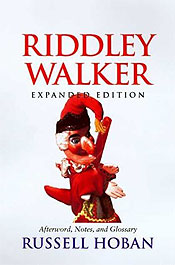
Riddley Walker by Russell Hoban

“I hispert back, "O, what we ben! And what we come to!" Boath of us were siffling and snuffling then. Me looking at them jynt machines, and him lissening to their sylents. Right then I didnt know where I wer with any thing becaws all on a sudden I wernt seeing any thing from where I seen it befor... Now all the sudden Eusa and Eusas head and the little shyning man had becom some thing woaly diifrnt in my mynd to what they were before. How cud any 1 not want to get that shining power from back way back? How cud any 1 not want to be like them what had boats in the air and picters on the winds? How cud any 1 not want to see them shyning weals terning?”

Minor Spoilers Below.

If you didn’t make it through the excerpt above, there’s a chance Riddley Walker isn’t for you. Told entirely in a severely degraded form of English, Riddley Walker follows the titular protagonist through approximately two weeks of his life, from his Naming Day on his 12th birthday. The setting in which Riddley Walker takes place is post-apocalyptic in the extreme. Although it’s never made explicit, it’s implied that there was a nuclear war which literally blew England (and possibly the entire world) back to the Stone Age. There are no guns, no computers, no electricity, and only the vaguest traces of the modern world remain. The government, what’s left of it, spreads information through religious/political puppet shows called Eusa Shows. Eusa himself may or may not have been a real person, but is now remembered mainly from Eusa Story, a religious myth which tries to explain, in terms the remaining humans can understand, what the human race used to be capable of and how they’ve ended up where they are today.

Summarizing the plot itself, which revolves around the attempts of several factions to create gunpowder, is pointless, since the real beauty of Riddley Walker comes from the themes and, especially, the language. As mentioned above, there’s hardly a sentence in the entire book written in modern English, save a short story about a painting of St. Eustace which is immediately (mis)interpreted by Goodparley, the acting Pry Mincer. Words are respelled and repurposed, first, to create dual meanings (such as “oansome” for lonesome, which rolls “on my own”, ”lonesome”, and “one” into one word); secondly, as an easy way of world-building—it’s immediately obvious that things here are different; and thirdly, to draw us into Riddley’s world and viewpoint—We’re forced to slow down and experience the world at the same pace as Riddley.

There’s a lot to this book, which took me a couple months to get through in spite of being only a couple hundred pages long, but I honestly don’t have a lot to say. There are difficult sections, but there are also moments of transcendent beauty, like the passage above, and their sheen is that much greater as a result of the ruined world surrounding them.

Thursday, May 20, 2010

The Driver's Seat by Muriel Spark

She will be found tomorrow morning dead from multiple stab-wounds, her wrists bound with a silk scarf and her ankles bound with a man's necktie, in the grounds of an empty villa, in a park of the foreign city to which she is travelling on the flight now boarding at Gate 14.

Here is another meditation on control and authority from Muriel Spark, who delights in the supreme joke the author plays on her characters: no matter how carefully they plan their lives, they are as at the mercy of their creator as we are at the mercy of ours. The titular conceit of The Driver's Seat is not the subtlest in Spark's oeuvre. It is easy enough to understand what it means when the heroine steals a car; she wants to be in the driver's seat.

The heroine is Lise, a young Danish woman, who tries to carefully design one fundamental moment in her life--the last, her death. Lise flies from Denmark to a "foreign city" (ostensibly Rome) in order to make the perfect arrangements for her murder, from the right color necktie that will bind her ankles to the identity of the murderer himself.

What is conspicuously lacking is any sort of rationale. We are not admitted into Lise's psyche, and are not permitted to know why she wants to die, much less in this particularly gruesome fashion. The details seem haphazard--why this color necktie? Why does it matter, beyond the fetish for control? Why does Lise purchase for her murder an orange, mauve, and blue dress and a decidedly non-matching red-and-white coat? Why does she change her story for every person she meets, when her need for control should warrant a meticulously composed lie? It is as if she wants only this moment to be perfect, and throws every superfluous detail to the wind.

It is possible that this is randomness disguised as order. It does not necessarily follow that because we do not know Lise's rationale she must not have one; it may be opaque to us. In this way Lise models God, who is notorious for working "in mysterious ways."

Or is it a rejection on God's insistence on determining who Lise is? If all determinism can be traced back to God--if every human plan has traces of God's design, since God has designed each human--then the only way to reject God is to embrace chaos and incongruity. Perhaps the brightly-colored dress is an act of rebellion. If Lise rebels against God, she really rebels against Spark, always standing in for Him, but the joke is on her because she can do nothing that Spark does not intend.

Like Lise, frantically trying to find the right murderer, Spark lacks patience. She seems unwilling to linger on Lise's motives, partly because it develops her theme, but also because she simply seems not to care. Because Spark is always aware that Lise is a fictional construct, we are aware of it, and we cannot connect with Lise because Spark cannot connect with her. Not coincidentally, Lise seems to be barely able to connect with herself.

As a result, it is difficult to say, as Frank Kermode does in his introduction to Spark's Everyman's Library collection, that The Driver's Seat is "chilling and desperate." Lise is desperate, but The Driver's Seat is not, and not a single word is chilling. Instead, it represents Spark at her most unmoving and brutal, and those who would seek the kind of pathos found in good thrillers would be advised to look elsewhere. As I have said before, the most unnerving thing about Spark's God complex is how little she seems to care about her characters. Should we find we are characters in a divine novel, I hope we find Him a bit more charitable.

Tuesday, May 18, 2010

Lady Chatterley's Lover by DH Lawrence

Then, one day, a lovely sunny day with great tufts of primroses under the hazels, and many violets dotting the paths, she came in the afternoon to the coops and there was one tiny, tiny perky chicken tinily prancing round in front of a coop, and the mother hen clucking in terror. The slim little chick was greyish-brown with dark markings, and it was the most alive little spark of a creature in seven kingdoms at that moment. Connie crouched to watch in a sort of ecstasy. Life, life! Pure, sparky, fearless new life! New life! So tiny and so utterly without fear! Even when it scampered a little scramblingly into the coop again, and disappeared under the hen's feathers in answer to the mother hen's wild alarm-cries, it was not really frightened; it took it as a game, the game of living. For in a moment a tiny sharp head was poking through the gold-brown feathers of the hen, and eyeing the Cosmos.

Connie was fascinated. And at the same time never had she felt so acutely the agony of her own female forlornness. It was becoming unbearable.

Lady Chatterley's Lover
is a kind of anti-Madame Bovary. The latter book is about a woman trapped in a loveless marriage who takes refuge in adultery, patterning it after the romances she adores, but the adultery itself becomes a kind of cage and she is ultimately done in by her own profligacy and petulance. Emma Bovary shuns the reality of things for convenient fantasies of sex, but Constance, the titular Lady Chatterley, achieves the opposite result through similar methods: Instead of pulling the veil further down over her eyes, her affair with her husband's servant frees her from the drudgery of her existence and imbues her, like the chick she spies in the passage above, with "sparky, fearless new life."

The book was roundly derided as pornographic. No wonder, it is basically an extended paean to sex. Consider Lady Chatterley's husband, Clifford, literally deadened from the waist down by a war injury. He and his friends extol the virtues of a "life of the mind," divorced from the "sex thing," which is banished to a lower sphere of human activity. Clifford remarks to Constance that he wouldn't mind if she had a child by another man (they would just lie and tell everyone that Clifford's boy bits work every now and then), but the man she chooses is not the kind she can go back and present proudly to her husband. He is Oliver Mellors, the estate gamekeeper, of a radically different class.

Lady Chatterley's Lover is one of those strange books in which people make plans that are not torn horrifically asunder; Constance plans to be impregnated by Mellors and he obliges. His ability to engender life in her is two-fold: He gives her a child, but also their passionate love affair brings her an unbridled joy.

This may be, without exaggeration, the most well-written book I have ever read. Lawrence is a master of style--eminently readable, vivid, graceful. I dog-eared maybe a dozen sections to show this, but could have marked a dozen dozen. Here is one:

The hard air was still sulphurous, but they were both used to it. Round the near horizon went the haze, opalescent with frost and smoke, and on the top lay the small blue sky; so that it was like being inside an enclosure, always inside. Life always a dream or a frenzy, inside an enclosure.


How much more wonderful is Lawrence's "small blue sky" that lays on top than Malamud's "
cerulean ocean-sky"? One of Lawrence's most successful techniques is to repeat certain words five or six times in the course of a paragraph, moving them around syntactically, like a form of jazz:

There had been no welcome home for the young squire, no festivities, no deputation, not even a single flower. Only a dank ride in a motor-car up a dark, damp drive, burrowing through gloomy trees, out to the slope of the park where grey damp sheep were feeding, to the knoll where the house spread its dark brown facade, and the housekeeper and her husband were hovering, like unsure tenants on the face of the earth, ready to stammer a welcome.


How simple these words are, and their repetition ought to be irksome, but somehow the rearrangement of them gives them new life, enables their expressiveness. The drive is dark and damp, the sheep are damp, the house is dark--instantly we know what is preoccupying the mind of Clifford, the "young squire," reflecting on his homecoming with some chagrin.

Even the sex writing is terrific:

Then as he began to move, in the sudden helpless orgasm, there awoke in her new strange thrills rippling inside her. Rippling, rippling, rippling, like a flapping overlapping of soft flames, soft as feathers, running to points of brilliance, exquisite, exquisite and melting all her molten inside. It was like bells rippling up and up to a culmination. She lay unconscious of the wild little cries she uttered at the last.


But then again, it's just that sort of thing that made Lady Chatterley's Lover impossible to publish in the United States until the 1960's. This didn't take Lawrence by surprise. It was his last novel, and he had been castigated for this sort of thing before. Naturally, it reads as sort of a response to his critics, who would do as Clifford and his friends would, and separate the world of sex from the "life of the mind." They talk, and talk of sex, and even talk of sex as a kind of talk, but this is a kind of subordination that seeks to describe the body on the mind's terms. When Constance is with Mellors, the sex is not like talking; what she receives from it is not knowledge but life, health, well-being.

It is this also, I think, that makes Lady Chatterley's Lover not as satisfying to read today. The sexual revolution has come and passed, and the idea that the life of the body and the life of the mind must coexist is, while not roundly accepted, a not very fresh idea. Sex as empowerment is old hat. Most of the critics that would suppress the book are gone, and unable to push against them, Lady Chatterley's Lover seems to me to lack bite.

But it was wonderful to read all the same. It is unthinkable that anyone ever considered it pornographic; any porno shot from Lady Chatterley's Lover would have to have absurdly high production levels to capture the clarity and nuance of Lawrence's descriptive prose.

I admit that there is something pornographic in the ethos of it--the extolment of the sexual act as worthy and fulfilling on its own. But to call it pornography, point blank? Laughable--after all, pornography generally serves one person alone, it only values the approximation of the sexual act, which requires two people. Lady Chatterley's Lover's message is far different: Go have sex! Speaking on its terms, the book seems to dismiss the idea that anyone might derive a purely sexual pleasure from it.

As a last thought, I leave you to consider how true pornography encourages the kind of character that Constance sees in Clifford:

He was remotely interested; but like a man looking down a microscope, or up a telescope. He was not in touch. He was not in actual touch with anybody, save, traditionally, with Wragby, and through the close bond of family defense, with [his sister] Emma. Beyond this nothing really touched him. Connie felt that she herself didn't really, not really touch him; perhaps there as nothing to get at ultimately; just a negation of human contact.

Lord of the Flies by William Golding

I am unsure of what to write. I read Lord of the Flies for the second time because I thought I had to; I thought that there would be a four-week space at the end of the freshman year with nothing to be read. As it turns out, that space is three weeks, which is not long enough to read anything like Lord of the Flies, or just about anything at all, except for Of Mice and Men, which, of course, they just read. No help there.

But enough about my issues. I liked this book only slightly more than I did when I read it last. I still agree with much of what I wrote in the review, especially about the characters. Ralph is nuanced, but he's boring; Jack and Piggie, the other two main characters seem awfully one-note. There is a fourth character I forgot to mention: Simon. Simon is caught in the conflict between Ralph and Jack for the allegiance of the marooned boys, and becomes the island's second casualty when Jack and his followers' bloodthirsty pantomime of hunting overtakes their senses and they rip Simon apart like a wild pig. (The first casualty is a boy caught in an unchecked fire in the book's first chapters. Metaphor ahoy!)

What I appreciate a bit more this time around is the way that Golding balances the political with the psychological. I said that "the symbols are hit too hard," but that's uncharitable. Yes, Jack might represent fascism, but that's reductive; this isn't Animal Farm with its clear analogue for the proletariat, and its Trotsky-pig and Stalin-pig. Instead, Jack, Ralph, and Piggie represent psychological and behavioral impulses that pull at the strictures of society. Lord of the Flies isn't an identifiable political allegory--it doesn't become a history lesson when you read it in class, like Animal Farm does so easily--but an investigation into the way that society is strengthened and dissembled by our inmost natures. (In fact, if those three fit any symbols too neatly, it is that Jack is the id, Ralph the ego, and Piggie the superego! I am embarrassed that this escaped me the last time around).

So, that's all that I have to say about Lord of the Flies. Though it's not my favorite, I will admit that it is better than every single book I have to teach my freshmen this year. That's me--instilling a distaste for literature, one student at a time.

Monday, May 17, 2010

Abraham Lincoln: Vampire Hunter by Seth Grahame-Smith


This may date me a bit, but this book reminds me of an old classic (and I use classic loosely here) from the 80's, Bill and Ted's Excellent Adventure with Keanu Reeves (I swear he deserved an Academy Award for this one, for his hair alone) and some other "dude" whom no one can remember (and do we really want to).


Anyway, those two go back in time in a phone booth time machine....(good grief, was it really this dumb) to ace a book report, you know, because they're the get good grades type of students, obviously, and end up bringing back famous people from history. One was Abe Lincoln, looking remarkably like the real thing by the way, his voice was like..a grumbling, deep canyon of manliness, if that makes any sense. That's the voice that kept playing though my head during the diary portions of this book. "Let us have faith that right makes right..." or "A house divided against itself can not stand," and lest we forget "I want to kill vampires until every ounce of blood is drained from their bodies.." Er, yeah..some of the greatest lines in history were uttered by this man. I guess.

This book will make a fine companion to the biography of Mary Todd Lincoln I'm reading in June for book club. Hopefully Mary kicks some serious vampire booty too. And she'll do it all while hand sewing a handkerchief. Of course.
3 stars

Saturday, May 15, 2010

God's Grace by Bernard Malamud

What might please God would be some sensible arrangement of the lives of the apes on the island into a functioning social community, interacting lives; and with Cohn as advisor and protector to help them understand themselves and fulfill the social contract. Maybe start with a sort of small family and extend into community? You are not the chimps your fathers were -- you can talk. Yours, therefore, is the obligation to communicate, speak as equals, work and together build, evolve into concerned, altruistic living beings. Not bad if it worked. How could Cohn know unless and until he tried? On this island more seemed possible than one might imagine.

My then-girlfriend Liz gave me this book to read, cautioning me that it wasn't necessarily a good book, but had a very interesting concept. Malamud, I said--interesting? I can't think of many books that I would describe as less inherently interesting than The Assistant, which is the only Malamud book I had read.

But Liz was right on both counts. God's Grace is just the kind of bizarre nugget I love: Its protagonist, Calvin Cohn, is the last man on Earth, having survived a nuclear holocaust by being in a pressurized chamber at the bottom of the sea when the nuclear bombs destroyed everyone else. God is dismayed:

...[T]hat you, Mr Cohn, happen to exist when no one else does, though embarrassing to me, has nothing to do with your once having studied for the rabbinate, or for that matter, having given it up.

That was your concern, but I don't want you to conceive any false expectations. Inevitably, my purpose is to rectify the error I have conceived.


But God does not say where he will strike Cohn down, or when. Fearing his imminent end, Cohn prays for mercy and heads off to a vacant island with a chimpanzee previously owned by a fellow scientist. He names the chimp Buz; serendipitously, Buz's former owner has surgically bestowed upon him the gift of speech. There Cohn and Buz try to recreate some measure of civilization.

Liz was right also that it is not a well-written book; Malamud's style can be graciously described as inelegant:

One day when the sun shone golden, and a summer breeze blew an armada of long white clouds through the cerulean ocean-sky...


But I found my affection for the book growing. The broad strokes that Malamud begins with become slowly finer: Buz discovers another group of chimps living on the island and teaches them--almost miraculously--how to speak. Cohn tries to build a society among the chimps, but his efforts are less obviously parable-like than the book's early chapters, though certain elements of strife within the group neatly mirror broader social issues. One source of tension is that Cohn, having once studied to be a rabbi, tries to instruct the chimps in Judaism, but Buz was raised a Christian by his former owner.

Is God's Grace an allegory for the relationship between Judaism and Christianity? A chimp named Mary Madelyn expresses a romantic interest in Cohn, and although at first--ahem--"Cohn observed her flabby, wilted flower, and the sight of it made him slightly ill"--he begins to wonder if a human-chimp offspring might not represent the redemption of the world and the cornerstone of a new, more altruistic society. They name their child Rebekah, after the ship from which they came.

(I will issue a spoiler alert here.) The associations seem clear: As father, teacher, and provider, Cohn emulates God in his relationship with Buz. When Cohn and Mary Madelyn (simultaneously Mary the virgin and Mary Magdalene, the prostitute) engender Rebekah, it is the Jewish god ushering in the Christian era. If Rebekah is Christ, then her sacrificial death should be no surprise. Esau, a violent chimpanzee resentful of Cohn's authority, sparks a mutiny among the group, some of whom take the child by force and drop her from a great height. Buz plays Judas.

All of which leads to three conclusions about the nature of Christ and Christianity in God's Grace. First, Rebekah's existence is purposeless; though Cohn expects her to found a new race and redeem the old, there is nothing redemptive about her birth or death. Second, the passage from the Jewish era to the Christian era is the cause of the violence of the book's final chapters, since it is Cohn's intimacy with Mary Madelyn that incenses the jealous Esau and Buz to murder. Finally, though Christ is the offspring of God so he represents the death of God; in return for his actions the chimpanzees slit Cohn's throat.

It seems to me that God's Grace is a lament of the way that Christianity both springs from and threatens Judaism, the son that devours the father. It is no mistake that Buz is depicted as a Christian; Christianity is given to the Judases. After the murder of Rebekah, the chimpanzees revert and can no longer speak. Wisdom is forsaken.

Is this too strong a reading? Perhaps, but it is the one that makes most sense to me. I would love to hear others, if I ever encounter someone else who has read this book.

Thursday, May 13, 2010

Of Mice and Men by John Steinbeck

What more is there to say about Of Mice and Men that I didn't already say, much more snarkily than I recall, in this review? It wasn't my intention to repeat books--in fact, I am not very fond of re-reading in general--and it certainly wasn't my intention to repeat this book. But it is the last book for my freshmen, and so I was obligated.

I have very few fresh insights, and I blame this on the book itself. It is not a book that wants to be reconsidered. Consider the too-neat symbolism: In the book's middle section, an old dog is put down to spare it suffering. At the end, the novel's protagonist, George--spoiler alert, if you need it--does the same to his friend Lennie, to save him from a crueler lynching at the hands of the other migrant workers. (Lennie, exceedingly strong but with the mind of a child, has accidentally killed a woman because he wanted to pet her soft hair.)

The only real question of significance Steinbeck offers is this: Does George make the right decision? I believe that Steinbeck wants us to think so ("Slim said, 'You hadda, George. I swear you hadda.'") But I do not think it is in keeping with George's wily, calculating character to give up so easily. As such, the premise of the question strikes me as faulty, and invalidates the question.

I noted in my old review that this final scene has "great resonance," and that remains true (though I might excise great). Like George, we are meant to understand that Lennie has been somehow spared, and so George himself receives the brunt of our pity. Lennie was the only constant in George's life:

George went on, "With us it ain't like that. We got a future. We got somebody to talk to that gives a damn about us. We don't have to sit in no bar room blowing in our jack jus' because we got no place else to go. If them other guys gets in jail they can rot for all anybody gives a damn. But not us."

Lennie broke in. "But not us! An' why? Because... because I get you to look after me, and you got me to look after you, and that's why." He laughed delightedly.


George's act of questionable kindness is perhaps cruelest to himself, as it leaves him alone--and after all, the migrant workers of the novel work near the California town of Soledad, Spanish for "loneliness." But it is also possible that soledad is a state that George and Lennie have always occupied, given their natural isolation from each other and inability to connect. Can George and Lennie possibly understand each other; can they know each other, or sympathize with each other in any meaningful way? In this way their relationship mirrors the chaotic, deracinated lifestyle of the Depression-era migrant worker, in which all relationships are by nature transitory and any connection impossible, whether it be to man or to place. We find an echo of this in the ranch that Lennie and George dream about, which will go unrealized: another abortive attempt to form a bond.

This would be a cruel reading, and I have serious doubts that it's the one Steinbeck intends. But I think it would be a hell of a lot more interesting.

Sunday, May 9, 2010

Pride and Prejudice by Jane Austen

It is a truth universally acknowledged that a single man in possession of a good fortune must be in want of a wife.

I begrudgingly concur with the department lead at my school who recommended that we read Black Boy as the final book of the senior year instead of what he calls "the pink book"--since our copies of Pride and Prejudice are the color of Pepto-Bismol. Surely he is right when he says that Pride and Prejudice is not a book that teenagers would find inherently interesting, and its feminine appearance doesn't help (though I leave the irony of judging this particular book by its cover to the reader to notice).

But I also admit that I was secretly pleased to find that there were only enough copies of Black Boy to be read by one class. I love Pride and Prejudice. This puts me in good company, since it seems that in recent years sequels to Pride and Prejudice have become sort of a cottage industry.

But why? What is it about "the pink book" that has made it such an enduring work?

I think part of its popularity has to do with the fact that it is sort of an ur-text for a very familiar type of story: the romantic comedy. All romantic comedies are structured essentially the same way: Two people of very different stations or perspectives meet, and at first their natural opposition makes them hate each other. Inevitably, despite all odds, their mutual antipathy turns to love.

Surely Pride and Prejudice wasn't the first to do this, but it does it so well. Elizabeth Bennet's cleverness and disdain clash immediately with Mr. Darcy's prim elitism, but the reader sees what they do not, that their intelligence and discernment (or even snobbishness) make them perfect for each other. As I've been teaching it, I try to get across what might be lost on a young, modern audience, that Darcy and Elizabeth's love forms across class boundaries, and that Darcy's love for Elizabeth represents a non-trivial social risk.

Furthermore, I think that Pride and Prejudice taps directly into that well of human feeling that romantic comedies exploit repeatedly, the desire to find one's soulmate. Darcy and Elizabeth are drawn just broadly enough to allow the reader to live vicariously through them; Darcy is handsome, well-mannered, eloquent, but also appealingly aloof. Likewise Elizabeth is clever and strong-willed. Not only is it easy to imagine ourselves in a relationship with (or someone like) one, it is easy to imagine ourselves as (or like) the other. We love the story because it affirms the archetype of finding "the One."

And, like romantic comedies ought to be, it's funny. This is especially lost on my students, who fail to pick up on the humor underneath the language. In this scene, Mr. Bingley's sister Caroline betrays her crush on Darcy, who earlier had remarked how he appreciates a woman who reads frequently:

Miss Bingley's attention was quite as much engaged in watching Mr. Darcy's progress through his book, as in reading her own; and she was perpetually either making some inquiry, or looking at his page. She could not win him, however, to any conversation; he merely answered her question, and read on. At length, quite exhausted by the attempt to be amused with her own book, which she had only chosen because it was the second volume of his, she gave a great yawn and said, "How pleasant it is to spend an evening in this way! I declare after all there is no enjoyment like reading! How much sooner one tires of anything than a book! When I havea house of my own, I shall be miserable if I have not an excellent library."

No one made any reply. She then yawned again, threw her book, and cast her eyes round the room in quest of some amusement...


I think the image of Caroline saying "How much sooner one tires of anything than a book," and then tossing her book aside when no one responds, is pretty amusing. But you know what they say about what happens to a joke when you explain it. Much of the humor is subtle, and based on changes in register that modern readers have trouble picking up on:

Sir William Lucas had been formerly in trade in Meryton, where he had made a tolerable fortune and risen to the honour of knighthood by an address to the King, during his mayoralty. The distinction had perhaps been felt too strongly. It had given him a disgust to his business and to his residence in a small market town and quitting them both, he had removed with his family to a house about a mile from Meryton, denominated from that period Lucas Lodge, where he could think with pleasure of his own importance, and unshackled by business, occupy himself solely in being civil to all the world.


The humor here lies in the diction: Lucas' house, "denominated from that period Lucas Lodge," his "tolerable fortune," all endowing the passage with a false grandiloquence that shows exactly why Lucas has felt "the distinction... too strongly." Lucas is a pompous ass, and has given up any useful contribution to society to "occupy himself solely in being civil to all the world," enamored of his own fortune and relatively paltry social status. But to recognize the different shades of meaning here requires a much more sophisticated sense of vocabulary than even the brightest teenagers possess.

Still, I hope to kindle in at least one student an appreciation of how good Pride and Prejudice is. If I can do that, then I will count this semester a grand success.

Thursday, May 6, 2010

The Gunslinger by Stephen King


The man in black fled across the desert, and the gunslinger followed.

I have mixed feelings about this book. Despite the fact that it was really slow at the beginning and frustrated me to anger for the first two thirds or so, it has a much better aftertaste. Also, as Jim pointed out, it has one of the baddest ass opening lines (quoted above) of any book I've read in quite some time.

The Gunslinger is the first book in Stephen King's Dark Tower series and follows the gunslinger, Roland, as he chases the man in black, searching for answers. The frustrating part of the beginning of the book is that not only are we in the same position as Roland, desperate for answers, we don't even know most of the questions. This book intrigued me because it was so different from anything else I've ever read by Stephen King (which is at least 18 books, btw). It was much more serious, much more focused on character development than his other novels. Like I said before, it takes awhile for anything to really happen. Eventually, however, King reveals some of the puzzle pieces, even if he doesn't necessarily show us where they go. It is enough, though, that I downloaded the second one and am going to bring the third and fourth books in the series back to DC with me (I think I might have read one of them out of order at some point, but I can't remember). Also, once the frustration from the beginning of the book sort of melted away, it became easier to focus on the fact that Roland is a straight up BAMF, and that's awesome/makes me want to read more about him.