Sunday, February 1, 2009

In the Woods by Tana French

My mind sideslipped and spun. Every step set recognition thrumming in the air around me, like Morse code beating along a frequency just too high to catch. We had run here, scrambling sure-footed down the hillside along the web of faint trails; we had eaten streaky little crab apples from the twisted tree, and when I looked up into the whirl of leaves I almost expected to see us there, clinging to branches like young jungle cats and staring back. At the fringe of one of these tiny clearing (long grass, sun-dapples, clouds of ragwort and Queen’s Anne lace) we had watched as Jonathan and his friends held Sandra down. Somewhere, maybe in the exact spot where I was standing, the wood had shivered and cracked open, and Peter and Jamie had slipped away.

First things first: READ THIS BOOK. I’ve never felt more comfortable recommending a story to anyone who’ll listen to me. Really, no matter what kind of reader you are, I bet you’ll thoroughly enjoy In the Woods by Tana French.

In the Woods is a police procedural novel set in present day Dublin. The protagonist and narrator, Rob Ryan, finds himself investigating the murder of 12-year-old Katy Devlin of Knocknaree. Ryan must solve the case without alerting his superiors to his personal connection to the case. 20 years earlier, Ryan and two of his friends went missing in the woods of Knocknaree. A police search eventually turned up the twelve-year-old Ryan, wide-eyed with blood-filled sneakers and mysterious scratches on his person. His two playmates were never recovered. Now Ryan must discover why Katy was found bludgeoned to death on an ancient Druid sacrificial altar just outside the very woods where he lost his friends.

I’ve never been a big crime drama type guy. Law and Order doesn’t really do it or me and I could never get into the hundreds of James Patterson and John Sanford crime thrillers that stock my mom’s bookshelf. And really that’s exactly what In the Woods is, a standard police procedural: Someone commits a crime. The detectives investigate the crime. They find their suspect! But wait, they were all wrong! Dead end. Eureka! A new suspect! Crime solved. I don’t say this to take away from the narrative itself. In fact, Woods has a really interesting plot with some good red-herrings and twists thrown in. But the story itself is far from ground-breaking. One thing about the plot, though, that was particularly well done was the subliminally supernatural tone. Nothing about Katy’s murder or any of the investigation lead you to believe that this is a Stephen King-type story with a monster on the loose. But certain details of Ryan’s friends abduction and his rescue keep that window slightly ajar. As if you wouldn’t be totally shocked if the story ended with some sort of werewolf conspiracy (which it sadly does not).

No, the beauty of In the Woods is all in French’s style. Her dialogue is fresh and realistic. There’s none of the melodramatic, hard-boiled bull-crap you almost expect to get in a crime drama. Or perhaps that’s that fair to say. You get a lot of the stuff you expect in a crime drama. Good cop, bad cop. Commanding officers behind desks questioning tactics and threatening to “take your gun and badge so quickly your head will spin.” Interrogation room scenes with jumpy suspects. The more I think back on it, the more cliché a number of things in the story were. I think the genius is in French’s ability to show you those clichés through the eyes of a player fully aware of those clichés. Ryan and his partners just come across as completely normal people who play the role of ‘television cop” when they find it necessary. Ryan explains his quick rise from uniformed officer to detective as having occurred because “he looked the part.” French’s characters are all too aware of the stereotypes and caricatures of police officers. And unlike the characters of so many other crime novels, they only use them to their advantage. They don’t live them.

I also enjoyed French’s uses of pop-culture references. A lot of times, things like that strike me as annoying for forced. As if the writer is trying too hard to relate to the reader. Maybe other’s will feel that way about French’s writing, but to me it just felt natural. Every random Simpsons or South Park reference felt appropriate. The detectives skipping lunch to play Worms on their computers or getting hammered and playing Cranium succeeded in making these characters seem flesh and blood. The way they talked and interacted after-hours reminded me of my friends.

As I’m sure you’ve already distilled, I loved In the Woods. It’s an exciting story from a new author that I think people are really going to enjoy. The plot/conclusion is nothing mind-blowing but it captures your interest enough for you to enjoy French’s dry sense of humor and smart dialogue. I’m already looking forward to reading French’s next book, whatever that may be.

Highlights: The hint of the supernatural, French’s dialogue, the cultural references

Lowlights: The ending was a little ho-hum, with too many questions left unanswered.

Saturday, January 31, 2009

Girls In Trucks by Katie Crouch


I have been a little bit too busy/high strung lately to take on any kind of reading that does not accompany curling up with Ben and Jerry's well and so several days ago I made it home from the library with a stack of Claire Dane's movies and the novel Girls In Trucks. There's something about southern chick lit with quirky female protagonists that makes the world make sense again. Sometimes I think that studying English has sucked my love out of reading anything "important" or canonical or respectable. Or maybe I'm making excuses.

Spoilers, because I doubt this would appeal much to anyone else here:
Sarah Walters, our main character, is a debutante and a fourth generation Camellia society member brought up in Charleston by a prim and proper mother desperate to marry her daughter off to someone, anyone, but preferably a man from a certain kind of class that knows how to Fox Trot. (I can appreciate this after I have heard the speech about how college is the mall of America for future husbands a couple too many times.) Her older sister goes to Yale and leaves impossible expectations for Sarah to live up to, Sarah moves to New York to work in publishing and spends her time falling for a cruel and abusive man while her best friend from back home spends all of her time drinking and shooting heroin in their dingy living room, and that prim and proper mother of hers comes out of the closet with another Camellia Society member after her husband shoots himself. What I like about Sarah is that she's honest and she has all of those embarrassing, heartbreaking moments that we all more or less deal with--the day you find out that the one person who would always want you suddenly doesn't anymore, the day you try to be inconspicuous while you accidentally run into your ex-boyfriend's new love interest, the day you realize the person you've been seeing is already in a relationship, or worse, a marriage. When Sarah needed a good slap in the face was usually when I found myself rooting for her the most, though. Her struggle for grace and resilience in the worst of situations made her voice feel authentic to me and her strange and obviously faulty ways of trying to bounce back endearing.

The thing that I appreciated about the book was that it had a strange circle of female friends that didn't exactly make sense and weren't compatible except for being raised in the same area, which I think is true of most groups of women. The thing that I liked about them, as catty and self-involved as some of them were, was that regardless of distance in miles between them once they had gone their separate ways and regardless of ideological differences as they bloomed into different people out of watchful eye of the Camellia society, they held one another accountable for their shit. So many women have to walk on eggshells around one another and aren't ballsy enough to serve up brutal honesty when it's needed, but the characters in Crouch's novel weren't that way. I think that the reason I couldn't stop thinking about that throughout reading this book was that my friend is getting married to someone who everyone else (including myself) realizes is not good for her but how do you tell that to someone you love who is glowing when they bring you the news? That also might have a lot to do with the Claire Danes and the Ben and Jerry's.

I think the main reason I ended up reading Girls In Trucks is that it started out with Sarah's years in cotillion, which was something that I was fascinated by as a kid. I went to this middle school in Raleigh where most of the girls in my class were taking cotillion classes and becoming well versed in becoming a lady while I was still chasing my brothers friends around trying to convince them to let me play basketball. I never understood why they were whirling around learning how to do what seemed like outdated dances but ended up asking my mother if I could join in on that, not wanting to be out of the loop. Lucky for me she knew that there was no way that was something that would have been good for me and if I had been accepted at all I never would have fit in. Later on, some of those same girls ended up becoming debutantes, and they seemed like they were from another planet, one that had rules dictated by what side of the beltline you lived on and snobbery. I'm glad that I was never one of them but I guess it was nice to be able to infiltrate that world for a couple hours as a fly on the wall through the pages of this book.

You can see Crouch talk about the novel here.

The Book of Lost Things by John Connolly

David loved listening to his mother read to him. But as she succumbed more and more to cancer, David had to start reading to her. His mother's death was traumatic for him. His father's remarriage only made things worse. David developed OCD and started have "episodes" where he would black out. Often after these blackouts he would have the faint recollection of talking with someone familiar, maybe someone from a book he had read or had read to him. The line between reality and fantasy continues breaking down for David, until he is sucks into a dark fantasy world, inhabited by many of the characters from the tales he is so familar with. Once in this world, he has to find his way back to his family.

Connolly borrows heavily from familar fairytales and mythologies. But in his hands, they become distorted echoes of themselves, helping Connolly to weave a much darker tale. This story is about the hardships we face in life, the journey into adulthood that we all eventually make and the magical power of books.

This was an enjoyable read, albeit quite weird in many spots.

The Abstinence Teacher by Tom Perrotta


Some people enjoy it. That was all Ruth had said. Even now, when she'd had months to come to terms with the fallout from this remark, she still marveled at the power of those four words, which she'd uttered without premeditation and without any sense of treading on forbidden ground.
...
"Oral sex is disgusting," Theresa declared, apropos of nothing. "You might as well French-kiss a toilet seat. You can get all sorts of nasty diseases right?"
Theresa stared straight at Ruth, as if daring her to challenge this incontrovertible fact. In retrospect, Ruth thought she should have been able to discern the hostile intent in the girl's unwavering gaze...but Ruth wasn't in the habit of thinking of her students as potential adversaries. If anything, she was grateful to the girl for creating what her grad school professors used to call a "teachable moment."
"Well," Ruth began, "from what I hear about oral sex, some people enjoy it."

This was the first Tom Perrotta novel I'd ever read. I've seen Election, but before I really ever cared about the books behind the popular films. So I can't tell you if this is true Perrotta, if all of his books are similar, or if this one was an aberration. So if you are a die-hard Perrott fan, don't hate when when I say I wasn't overly impressed by this book.

In "The Abstinence Teacher," Ruth Ramsay is a popular and well-informed sex ed teacher whose curriculum and professional career are threatened by parents from the new evangelical church in town who object to her frank honesty. After one family threatens suit over the incident above, Ruth finds herself both the target and unwilling ally in the school board's new plan, which includes a revamped abstinence-only curriculum and the hiring of JoAnn, the school's new Virginity Consultant.

Ruth's struggle with her feelings about denying her students the truth about contraception and safe sex, and her stagnant divorced-parent dating life, only make up one half of the book. At the beginning of part two, readers are introduced to Tim Mason, a former addict and born-again Christian who appreciates his new found home in the church while still having doubts about some of its tenets. The two meet on adversarial ground when Tim, who coaches Ruth's daughter's soccer team, initiates a team-wide prayer after one of the games.

Ruth and Tim's lives continue to cross in the book, and Perrotta uses an interesting narrative structure to do it. At first, their stories are completely separate, each getting an entire unit of introduction. As Ruth and Tim meet, talk about the prayer issue, and gradually forge the kind of friendship that is constantly fraught with sexual tension, the space allotted to each alone shrinks. By the end of the book, Perrotta is switching perspectives every paragraph, going back and forth to show Ruth and Tim's feelings about each other and the situation they find themselves in.

I read this book pretty fast. Actually I'm reading most books faster now that I am blogging. A few years ago, if I read a book really fast, it meant I really liked it. Now, I can efficiently get through a yawner book almost as fast as a one that's terrific. While I haven't found a great book that I haven't buzzed through, it doesn't go both ways. (If it did, I'd have to rank all of those Left Behind books pretty high on my list.) So even though this was a quick read, it wasn't a great read.

I was disappointed in the lack of drama. Call me crazy, but in fourth grade we learned that stories should go like this. I think I still judge books by that standard. I couldn't find any one plot point that made this book stand out. It was a creative and prescient premise, having been published at the tail-end of the Bush administration, whose abstinence-only policy was panned by a lot of teachers. But I didn't particularly like either character: Ruth was whiny and Tim was kind of a moron.

[On a side note, do you guys remember sex ed in high school? Ours consisted of our male assistant principal cross-dressing like a grandma and talking in a funny voice about the dangers of premarital sex. Oh, and the pages in our AP Environmental Science book that showed pictures of contraceptive devices were blacked out or removed. Thanks Wake County.]

Perrotta definitely wrote this book from a liberal/blue state position, which I think is fine (but then, I'm a liberal.) I wasn't expecting a balanced view of evangelical Christianity in a novel by an author who wears emo glasses. The Virginity Consultant's steely-but-fake-nice demeanor (which reminded me of Sarah Palin), Tim's homophobic pastor, Tim's own doubts about his new religion all serve as a damning indictment of the highjacking of the public sphere by the Bible Belt crew.

Bottom line: read this if you're already a Perrotta fan. Otherwise, I'd say go read "Election" or "Little Children" first. I haven't read those, but from what I hear, Perrotta does a good job of making adulterers, a pedophile, and Tracy Flick seem human and sympathetic. If he can do that, he should have been able to breathe more life into Ruth and Tim in this book.

Friday, January 30, 2009

The Inner Circle by T.C. Boyle

It was during this period--it might have been as late as 1944, now that I come to think of it--that we were finally able to induce the sexual champion I mentioned earlier to sit for an interview. Prok had been courting him for some time now, and the man had been cagey, feeding us portions of his sex diaries by mail, but expressing his reluctance to meet because of the criminal nature of so many of his sexual contacts. Certainly, what he'd sent us--photographs, penis measurements, case histories and written records of various sex acts with every sort of partner, male, female, nonhuman, preadolescents and even infants--was provocative, perhaps even offensive, but invaluable to our understanding of human sexuality. And, as Prok put it so well, we were scientists, not moralists--our duty was to observe and record, not to pass judgment.

Let me start out by saying that T.C. Boyle is clearly an excellent writer, and I have no qualms about the prose itself. That said, I really don't know if this book was a complete success or an utter failure. If Boyle set out to portray Professor Alfred Kinsey and his colleagues as heroic defenders of the sexually marginalized, I think he failed miserably. If Boyle wanted Kinsey to look like a stony, slightly demented old man who used his position of power over his colleagues to manipulate them for his own sexual gratification, then I have to applaud his successful efforts.

Before The Inner Circle, I'd never read a story where I genuinely came to detest each and every character I was introduced to. Even Iris, the narrator's wife and perhaps the only forgivable principle character, has moments where she behaves deplorably. The entire cast, it seems, is morally bankrupt. And if each and every character has fallen to turpitude, the onus falls on Prok, Professor Alfred Kinsey. I must note, this is a novel, not a memoir. Everything I say here is to be attributed to the character of Prok, as described by Boyle through John Milk's narration, not to the late Alfred Kinsey himself. That said, this fictionalization is based on factual research and one can only assume that certain aspects of Prok's character are reflections of Kinsey's actual behavior.

To me, Prok came across as a monster in a lot of ways. I've read that some of Kinsey's detractors claimed that the impetus for his research was his need to validate his own bizarre sexual appetites. That's exactly the impression I got from Prok in The Inner Circle. Prok removes any elements of love and affection from the act of sex. He coerces his colleagues into having sexual affairs with each others wives, with his own wife, with himself. He does so through subtle bullying. "You're not becoming sex shy on me, are you?" he asks a number of times throughout the story. Failing to follow his orders would have meant exclusion from the inner circle, exclusion from the groundbreaking research that was being carried out in Prok's institute.

People who know me will tell you I'm anything but prude. Yet reading this story I found myself genuinely disgusted by the attitude that Prok takes towards sex. And even more disgusted by the way he forces those around them to swallow his beliefs (among other things) and follow them blindly. And they do, they all do. I found it hard to read a book by a narrator that had no moral compass when it came to sex and sex alone. He was a moral man in just about every other facet of his life, but morality and sex had become mutually exclusive. Shortly after a row with his wife after she learned about his sexual research with Prok's wife, Milk has spontaneous sex with another woman in his apartment's hallway, with his wife sleeping only a few feet away. The Chicago Sun-Times says this book "should be read naked!" as if it's some titillating sex romp. At no point during this reading did I find myself so stimulated. If anything, I wanted to get naked after reading a handful of passages so that I could take a shower. It was that kind of book. It turned my stomach.

Specifically, the passages describing Mr. X and his sexual escapades with infants and toddlers. The way that Prok and Milk and all the rest remain scientifically objective while hearing accounts of X masturbating an infant boy. Honestly, am I supposed to find this pursuit of knowledge at all costs heroic... laudable? It's deplorable. The more I think about it, the more unlikely it seems to me that Boyle actually set out trying to make Prok and his cohorts look like good people. But then, who am I rooting for in this story? If Prok and Milk aren't the protagonists, who is?

All in all, this book was difficult to finish. The writing is excellent, really it is. The use of simple sentence structure coupled with the broad vocabulary you'd expect from an academic narrator made it very easy to read... In terms of mechanics, at least. But the subject matter was too unsettling for me. Page after page, characters manipulate each other, break each other's hearts, and make excuses for behaviors that I think can be objectively called malignant.

Professor Kinsey did a lot of great things. His work has given momentum to the sexual empowerment of women, society's acceptance of homosexuality, and review of archaic sodomy laws around the country. That can't (and shouldn't) be taken away from him. But if this fictional account of Kinsey's personal life is even half as accurate as I think it might be... Dude was kinda maladjusted.

Highlights: I like Boyle's style, lots of double entendre like when Prok is teaching Milk how to properly interview their subjects "He wound up drilling me for two hours that night."
Lowlights: It made my skin crawl about a dozen times, and who are we rooting for?

Tuesday, January 27, 2009

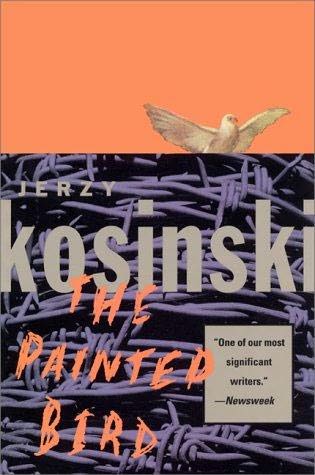
The Painted Bird by Jerzy Kosinski

When a sufficient number of birds gathered above our heads, Lekh would give me a sign to release the prisoner. It would soar, happy and free, a spot of rainbow against the backdrop of clouds, and then plunge into the waiting brown flock. For an instant the birds were confounded. The painted bird circled from one end of the flock to the other, vainly trying to convince its kin that it was one of them. But, dazzled by its brilliant colors, they flew around it unconvinced. The painted bird would be forced farther and farther away as it zealously tried to enter the ranks of the flock. We s aw soon afterwards how one bird after another would peel off in a fierce attack. Shortly the many-hued shape lost its aplce in the sky and dropped to the ground. When we finally found the painted bird it was usually dead.

Here is a rare book: a book about the Holocaust that does not take place in a concentration camp or on the field of battle, and in fact contains very few German characters. The Painted Bird is a parable, rather, of human cruelty, mean to contextualize what we know about the practices of the Nazi regime.

There are two ways to read it, I think: One is a wholly negative view, which states that the sadistic peasants who people the Polish countryside are the foundations of a European culture that allows Nazism to happen. The narrator, a young and unnamed boy has been abandoned by his parents, not out of malice but, we infer, in order to save him from the Nazis who have marked his parents as agitators. Somehow, the boy has ended up in the care of a superstitious peasant woman who regards his dark complexion and eyes as the harbingers of a great curse, and the cruelty that follows the boy around seem to validate this view. The old woman dies early in the book, and the boy wanders from one peasant home to another, witnessing a Bosch-like panorama of evil: savage beatings, men devoured in rat-filled bunkers, Russian mercenaries who castrate husbands and rape their wives, a peasant man who watches as his son and daughter couple with goats. In one protracted stay he is daily made to hang from a pair of hooks for hours on end while a ravenous dog nips at his feet below.

For a moment he stays with a bird-catcher who has a nasty habit of painted a captured bird bright colors and then releasing it to its flock. Unrecognized, the flock always tears the painted bird to pieces--a not-so-subtle metaphor for the severity and ubiquity of bigotry.

The other way to read it is more charitable: Europe, under the control of the Nazis, has become a cruel place. The fish, as they say, rots from the head. But I think Kosinski, who is Polish, includes few German characters for a reason. Instead of pointing his finger at the Third Reich, he turns his criticism on the primitive culture that lets such evil arise. Cruelty is not the domain of Germany here, and maybe not even Europe--perhaps it is a human trait.

Brooke asked me if I was enjoying this book; I told her that I do not think it means to be enjoyed. It gave me a lot to think about, and it made a strong impression on me, but it won't show up on my list of favorite books any time soon and I doubt that there are many people who would truly say they liked it. It was a chore.

Note: In reading about the book, I found some of the controversies surrounding it interesting: For one, Kosinski seems to have maintained privately for some time that it was autobiographical, but his foreword claims that it isn't and was never meant to be. Another, stranger, controversy is that some have claimed that Kosinski didn't write it; and barely knew English at the time. I really wouldn't know, but I think that that would make him a bit like the bird who paints himself.

Beautiful Boy by David Sheff

In his suicide note, Kurt Cobain wrote, "It's better to burn out than to fade away." He was quoting a Neil Young song about Johnny Rotten of the Sex Pistols. When I was twenty-four, I interviewed John Lennon. I asked him about this sentiment, one that pervades rock and roll. He took strong, outraged exception to it. "It's better to fade away like an old soldier than to burn out," he said. "I worship the people who survive. I'll take the living and the healthy."

The living and the healthy.

I do not know if my son can be one of them.


The full title of David Sheff's memoir is "Beautiful Boy: A Father's Journey Through His Son's Addiction." It's a pretty awesome book, and unusual because I haven't read a book about addiction from the view of a parent before this. There are a lot of former-addict memoirs out there (James Frey, Anthony Kiedis, the anonymous author of "Go Ask Alice") and while poignant and touching, the genre is starting to feel a bit tired. I think my disillusionment started with the whole "A Million Little Pieces" debacle (Oprah said she felt "really duped." Me too Oprah. Me too.)

Anyway, back to Beautiful Boy. Call me voyeuristic, but I enjoy memoirs and biographies (even fake ones; see my review of "American Wife") above all other forms of literature. I also really like the A&E show "Intervention." Put those two things together and you have this book. I knew I was going to like it and I did. What surprised me was the quality of the writing. This wasn't some random parent struggling to give his son's disease justice. This was a writer struggling to give his son's disease justice. Sheff was distinguished for his writing career before this best-seller's release. He had the privilege of writing one of the last interviews with John Lennon, when he asked the musician the question above.

Beautiful Boy is a story about addiction, but Sheff didn't want that to be his son's entire story. So he starts at the beginning of Nic's life, and spins a tale of a precocious, creative, adorable child growing up in Northern California amid the chaos of his parents' divorce and an imperfect joint custody agreement that spans several hundred miles. Nic seems like a pretty terrific kid all the way up through high school. He shares a special relationship with his dad, and welcomes a new stepmom and, in time, baby siblings. All the while, Sheff paints a portrait of an extraordinarily sensitive and caring child.

Nic is a friend to everyone. He experiments with alcohol and pot at an early age but after some initial concern, his dad dismisses the incidents as normal teenage experimentation. Sheff himself had a colorful adolescence with regard to drugs, so he is inclined to be forgiving. Later, his openness with Nic about his past will be one of the many things Sheff blames himself for.

It is not until Nic's senior year of high that his behavior and experimentation turn seriously harmful. While he does manage to graduate, Nic spends most of the year in a haze of smoke, and tries hard drugs for the first time the night of graduation. In college, Nic discovers meth, which he says is like finding something he's been looking for his whole life. "When I tried it for the first time, that was that," he says.

Nic's battle with drug and alcohol addiction, particularly to the pernicious methamphetamine, takes over the second half of Sheff's book. In and out of rehab, homeless on the streets, stealing from his own parents and grandparents, Nic is constantly attended by his addiction and his father's love. In the second half of Beautiful Boy, Sheff takes on a more introspective tone, as he turns inward to deal with what he calls his addiction to his son's addiction. Sheff realizes that he is so preoccupied with his son's disease that he's neglecting his wife, his other children and his own mental health. After a lot of family therapy, Al-Anon and his own life-threatening illness, Sheff ends the book on a cautiously optimistic note: Nic, despite several relapses, is sober for the time being.

I really appreciated the author's interesting writing style when reading this book. It kind of made me feel like I was drinking in this family's saga, rather than just reading words off a page. I'd confidently recommend this book to lit snobs just as often as story lovers like myself. Interestingly, Nic has written a YA memoir too, called "Tweak: Growing Up on Methamphetamines." I haven't decided if I'm going to read Nic's memoir yet, but if I do, you'll see it on here.

The Secret History of the Lord of Musashi and Arrowroot by Tanizaki

It is said, for example, that part of the Hori mansion in Anafu, where Emperor Godaigo once stayed, is still standing, occupied even now by descendants of the family. Also thriving are the progeny of Takehara Hachirō, who appears in "The Prince of the Great Pagoda Flees to Kumano" in the "Taiheiki." The prince stayed with this family for a time and had a son by their daughter. An even older tradition survives in the hamlet of Gokitsugu, on Mount Ōdaigahara. Asserting that the people of Gokitsugu are descended from ogres, residents of the surrounding villages never marry them... This being the nature of the region, there are a number of old families, called "people of descent" who claim to be descended form the local warriors who served the Southern Court. Even now they honor "The Lord of the Southern Court" every year... at the Kongō temple near Kashiwagi, the site of the Shōgun-prince's palance in Kono Valley.

First things first: I want to assure you, the reader, that I won't resort to Chris' antics of inflating my numbers with reviews of Garfield comic strip compilations. You deserve more than that. So, as the Ken Griffey Jr. to Christopher's Barry Bonds, I post the reviews of these two novellas together as one, in the way they were presented to me.

Now onto the stories. And wow... What crap they turned out to be. I was just thinking after finishing A House of Sand and Fog that I hadn't read a book this month that I haven't liked on one level or another. Along comes The Secret History... and Arrowroot. Let me start off with The Secret History... the first novella in the collection and the only one that had any semblance of pacing and story structure.

The Secret History of the Lord of Musashi is, essentially, exactly what it claims to be. Imagine a book about General George S. Patton. This book has nothing to do with Patton's brilliance on the battlefield. In fact, it often starts to describe his wartime heroics, but stops short, citing the multitude of literature available on the subject and deeming it unnecessary to rehash that which is already well known. Instead, the book in question is about Patton's dark, masochistic sex life based almost entirely on conjecture. Patton wore fur coats right? He probably liked putting cigars out on his balls. That's basically how I can best describe The Secret History. The story's sexuality is distinctly Japanese, dealing with erotic fixation on severed heads, romantic rendezvous in a latrine teeming with dung, and torture of underlings as foreplay. I got a few laughs from the overall absurdity of it all, but really the story itself was a bore. There is no consistency amongst the characters, there's no real conflict to live and die with, and you walk away from the whole thing scratching your head wondering what the hell did I just read about?

Highlights: It was only 140 pages, the part where the sadomasochistic warlord spends an afternoon chasing fireflies.
Lowlights: It sucked.

Now onto Arrowroot, and forgive me if I don't give this much attention. 4 pages into Arrowroot and I knew that finishing it was going to be an exercise in asceticism. I chose the passage above to illustrate just how cumbersome this story was. Hell, I use the word "story" here loosely. It's more or less an author's description of his efforts to tell a story. And the writing is very similar to other classical Japanese works I've read. It's all about how The Warrior of The Red Lotus used his Katana of Impending Nightfall to disembowel The Warlord of Three Blossom Petals on the Hill of Gokikongotsuguharasanachiro to win the hand of The Princess of Crouching Tiger and Hidden Dragon in the Year of Surprisingly Light Rainfall. No story actually gets told. It's just anecdote after lineage after landscape description. Maybe it's a cultural thing. Maybe if I was Japanese and I was raised with this type of storytelling I wouldn't find it so plodding and galumphing. Maybe I'm just a simpleton and Edmund White of The New York Times is right to call Tanizaki "the outstanding Japanese novelist of the century." Or maybe he's just pretentious as you'd expect a book reviewer named Edmund to be and it's really as bad as it seems to be. Maybe there's a reason the first edition hardcover of these two stories is going for $1.39 on Amazon marketplace. I don't know. I'm not a professional.

Highlights: It's only 57 pages. Also I got to use the word galumphing.
Lowlights: It was like 53 pages too long.

Do yourself a favor and don't read either of these stories. You can get a better taste of Japanese storytelling by playing Final Fantasy 7.

House of Sand and Fog by Andre Dubus III

He would drive to San Bruno and look for Kathy there. it was practically their entire geographical frame of reference. If she wasn't at the storage shed or the truck-stop bar or the El Rancho Motel, then he would try Carl's Jr. on the other side of the freeway. And if that didn't pan out he'd drive south to Millbrae to the Cineplex, where she could possibly be at the movies. Ahead of him in the fog, Corona's main street ended at the base of the hills and the intersection for the turn to Hillside Boulevard and San Bruno. The blinking yellow traffic light above was so obscured it looked to Lester more like a silent pulse. Kathy would not be at her stolen house up in the hills but the colonel would, and there was no crime in cruising slowly by; he was off-duty and out of uniform.

House of Sand and Fog
by Andre Dubus III is the story of Kathy Nicolo, Sheriff Lester Burdon, Colonel Massoud Amir Behrani and their tragic crossing of paths. Kathy wakes one morning to find Sheriff Burdon at her door, informing her that she has been evicted by the county for failing to pay back taxes. Ms. Nicolo informs the Sheriff that there must have been a clerical error, that she owes no taxes. Her pleas prove ineffectual, and her home is auctioned off to Colonel Behrani, a Persian immigrant set on reselling the house for a profit to provide for his family. Behrani is determined to see his family returned to the dignified position they once held in Iran. Kathy's home was all she had left after her husband suddenly left her and she is not willing to let it go easily. Lester find himself falling in love with Kathy and refuses to sit idly by while she suffers a grave injustice. The collosion of these three forces of will leaves families destroyed, lives ruined, and blood spilt.

Dubus' writing is smooth and has its own flow to it. His style is really a pleasure to read. But I have a hard time saying I enjoyed this book. There's really not much to come away from feeling good about. Simply put, House of Sand and Fog is a tragedy. More Shakespearean than Greek, I think. While Kathy and Behrani have their flaws, Lester reminded me of Paris in Romeo and Juliet in the sense that he was merely a victim of circumstance. More or less a simple man, Lester is driven to the edge by his love for a woman he barely knows. Like Paris, he strikes me as the most tragic character in the story, for his life (and that of his family) are ruined because of his involvement in the clash between Behrani and Nicolo.

I suppose if I had one problem with this story, it was the unbalanced portrayal of the plights of Kathy and Behrani. I don't know if Dubus intended to make Behrani seem more at fault than Kathy, but I think it's more likely that he simply failed at making Behrani's motives as justifiable as Kathy's. A young woman has her house stolen out from her because of an improperly addressed envelope. She finds herself homeless with nothing in the bank. She calmly explains this to the man who has bought her home from the county, and yet he refuses to help her rectify the situation by complying with the county when they try to rescind the sale. Now, I understand that Behrani is simply trying to enter the real estate market and provide for his wife and son. I understand that Behrani feels he has committed no wrongdoing in legally purchasing the house from the county. I understand that he has suffered greatly since the fall of the Shah's regime and his flight from Iran. But even with all that, I can't help but look at him as a stubborn, greedy man who knowingly held on to stolen property even after the situation was laid out in front of him. To me, this weakened the story a bit. It wasn't what Dubus (probably) intended, the story of two people with equal stake and righteousness battling for stability. It was an unlucky woman struggling to take back what's hers from a man who refuses to do whats right.

That said, there are enough mitigating factors to make the reader at least somewhat sympathetic to Behrani. And in the end, I suppose this imbalance is rectified as he is the one to lose everything, whereas Lester and Kathy lose only most everything.

Check this out if you like Steinbeck, as Dubus' writing style reminds of his, or if you're a fan of tragedies in general. It's really quite moving and you'll be surprised at how quickly you find yourself swept up in the rise and fall of the principle characters.

Highlights: Lester's mustache, the surprisingly action-packed final act, picturing Jennifer Connelly during all of Kathy's sex scenes.
Lowlights: Behrani's recalcitrance, The inevitably depressing ending

Sunday, January 25, 2009

The Tales of Beedle the Bard by J.K. Rowling


"Wizards still have not found a way of reuniting body and soul once death has occurred. As the eminent Wizarding philosopher Bertrand de Pensees-Profondes writes in his celebrated work A Study into the Possibility of Reversing the Actual and Metaphysical Effects of Natural Death, with Particular Regard to the Reintegration of Essence and Matter: 'Give it up. It's never going to happen.'"

The Tales of Beedle the Bard is the quintessential enjoyable children's book. It's very different from J.K. Rowling's other books, which were firmly within the realm of Young Adult literature at least. The first and most noticeable difference with Beedle is the font size, which is this big, the better for little eyes to decipher I suppose. This font has the added bonus of turning Beedle into a chapterbook that (barely) exceeds 100 pages. All in all, it took me about an hour to read.

The Tales of Beedle the Bard was first introduced in Harry Potter and the Deathly Hallows, the seventh and final book in Rowling's series. Hermione is gifted an original copy of the book from the estate of Albus Dumbledore after his death. In it, the story of "The Three Brothers" introduced Harry, Hermione and Ron to the Elder Wand, with which [SPOILER ALERT] Harry eventually kills Voldemort.

Like "The Three Brothers," all of the stories in Beedle are morally edifying, and teach the kind of lessons that young witches and wizards should take to heart. Thus, they don't resemble Muggle fairytales so much as Aesop's fables. In this edition, readers get the added bonus of Dumbledore's own footnotes following each story. The footnotes give additional information about wizarding lore, facts about the magical world and humorous asides.

It is this humor, this intentional naughtiness that you find in the very best children's books that I most enjoyed in Beedle. Like my other favorite children's book, J.M. Barrie's Peter and Wendy, Beedle was clearly written to be enjoyed by both the adult and child reader, for different reasons. Funny asides reveal themselves in the footnotes, and I can imagine that many of them would go right over a young child (or young wizard's!) head.

So there you have it. A short review for a short book. You can get this one at the bookstore for about ten dollars and if you are any kind of Harry Potter fan at all, I'd say buy it. All the proceeds go to a European children's charity, so you can pat yourself on the back for that too.