Monday, January 9, 2017

#2 - Peril at End House, by Agatha Christie

For me, comfort reading gets no better than Agatha Christie. I first fell in love with her books in ninth grade, and went through such a prolonged spurt of reading them that a not-particularly-close friend called my house one time, and when my mom answered, my caller said, "What, is he off reading some Agatha Christie book again?" The fact that her books are old-fashioned bothers me not a whit (heck, they were old-fashioned for half of the time she was writing them), except for when the casual racism and antisemitism of pre-war Britain pops up (it does seems to have largely been extinguished in her post-war work). My love of Agatha Christie is so great that in my second year of teaching, I forced four classes of Brooklyn teenagers circa 2009 to read the Murder of Roger Ackroyd - and they liked it. A few years back, I decided I might as well keep track of all the Christies I have and haven't read, with an eventual aim of meandering my way through the trails of upperclass British corpses and completing her oeuvre. 

My most recent foray into Christie reunited me with everyone's favorite Belgian with an egg-shaped head, Hercule Poirot. Poirot, in turn, is reunited with Captain Hastings, his sounding board and the stand-in for the confused reader whenever Poirot finally solves the crime. (I think I'm up to about 40 Christies read at this point and I have never - not once - figured one of these things out.) 

Reviewing the particulars of any individual Christie is really beside the point, but this falls soundly into the category of Very Good Christie for me. (Christie books come in three varieties for me: Stone Cold Classics, Very Good, and Very Meh.) The imperiled character is a young woman named Nick Buckley, proprietress of the titular End House. She is a thoroughly modern young woman of the 1930s (Christie did write modern characters for a time!), and, in another very nice touch, is engaged to a young man who is trying to complete a Charles Lindbergh-esque feat of aviation before he is lost at sea. There's even an attempt made on someone's life involving chocolates filled with an overdose-inducing quantity of cocaine!

As I said, it's not a Stone Cold Classic, but as far as Very Good Christie goes, I'd put it up there with A Murder Is Announced. Sometimes, the best parts of a Christie novel are nothing to do with the crime, but are the parts that reflect the massively changing British society that they take place in. A Murder is Announced was one of Christie's first post-war books, when the entire idea of a servant class was basically thrown out the window once and for all. Similarly, Peril at End House features independent women, aviators when that actually meant something, and a not-really divorced woman with a new lover. For having a reputation of being old-fashioned, I have a feeling this was not the typical stuff of large circulation books in England in 1932.


Introduction and Book #1, Confronting the Classics by Mary Beard

Greetings, 50 Books Project folks! I'm a coworker of Chloe's, and am very excited to be coming along for the 2017 50 Books Project. In addition to this blog, I'm also upping my reading game this year by participating in Book Riot's Read Harder 2017 challenge. For classification purposes, a few of the requirements for the Book Riot are comics/graphic novels, which I enjoy reading, but I count graphic novels in a separate category when I'm tallying my year-end book count. I'll post reviews of the comics I read, but I'll not be counting them toward the 50 books for the year.

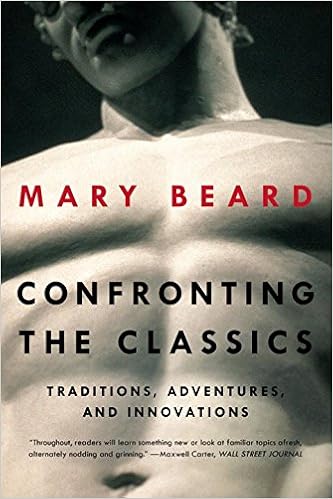
My first book of the year was Confronting the Classics by Mary Beard, kind of an overview and a critical rethinking of the way we approach Greek and Roman literature. I read Beard's excellent SPQR last year, and added this to my To Read shelf on the BPL app immediately afterwards, figuring a time would come when I would like to dip my toe back into the classical waters. I didn't do a lot of prior reading about this book, but I thought it was essentially a series of essays about the Ancient World, which has always been a great interest of mine. (I studied abroad in Rome for a semester in college, where I learned very little Italian, but much about Roman art and architecture.) And the book is, in fact, a series of essays - however, the essays are reviews on the work of other academics. Far from being the new look at old ideas that I had hoped for, a lot of Confronting the Classics felt like inside baseball, except the baseball was being played in University halls instead of the Forum.

This is not to say that the book did not have noble aims - showing that the Classics are a living subject, all indications to the contrary. And when Beard is on, she's on - a reinvestigation of Nero was particularly interesting. If he was the reviled dictator who fiddled while Rome burned that we've all been told he was, why did several people step forward, pretending to be him, immediately after his assassination? Clearly he could not have been despised the way we've been taught. A rumination on the Laocoon group and its arm placements was also worthwhile. Her chapter on the grave of a bread maker in Rome is also quite charming (so charming that she expanded upon it in SPQR - I was momentarily stunned that I knew anything about this monument until I remembered why). However, a chapter on a book about the life of an Oxford Classicist, RG Collingwood, who died in 1943, seems out of place. Likewise, a chapter on the Dictionary of British Classicists. 

There is a lot to think about in Confronting the Classics, and Beard is a lively and witty writer, but I cannot recommend this when SPQR is out there, as well. For completists only. 


Hillbilly Elegy by J. D. Vance

[fart]

The Damnation of Theron Ware by George Frederic

His views on this general subject were merely those common to his communion and his environment. He took it for granted, for example, that in the large cities most of the poverty and all the drunkenness, crime, and political corruption were due to the perverse qualities of this foreign people—qualities accentuated and emphasized in every evil direction by the baleful influence of a false and idolatrous religion. It is hardly too much to say that he had never encountered a dissenting opinion on this point. His boyhood had been spent in those bitter days when social, political, and blood prejudices were fused at white heat in the public crucible together. When he went to the Church Seminary, it was a matter of course that every member of the faculty was a Republican, and that every one of his classmates had come from a Republican household. When, later on, he entered the ministry, the rule was still incredulous of exceptions. One might as well have looked in the Nedahma Conference for a divergence of opinion on the Trinity as for a difference in political conviction. Indeed, even among the laity, Theron could not feel sure that he had ever known a Democrat; that is, at all closely. He understood very little about politics, it is true. If he had been driven into a corner, and forced to attempt an explanation of this tremendous partisan unity in which he had a share, he would probably have first mentioned the War—the last shots of which were fired while he was still in petticoats. Certainly his second reason, however, would have been that the Irish were on the other side.

This book was written in 1896, if you've ever wondered how much people don't change. Change "Irish" to "Muslim" up there and this could be a snippet from Breitbart.

I didn't intend for several of my early reviews to be politically tinged, and I didn't think The Damnation of Theron Ware would likely be very political. I was expecting--hoping--for something along the lines of The Scarlet Letter when I saw this in the remainder bin at Barnes and Noble. And in some ways, the comparison is apt, mostly in the heavy emphasis on Christianity and a few very strange passages that belie the simplicity these sorts of themes sometimes engender.

But mostly, Ware is a different kind of book, telling the story of the titular Theron and his journey away from primitive Methodism, a movement in which he is an up-and-coming pastor. The book opens with a sermon at a new, much-desired post, but by the end of the first chapter, Ware and his wife are dealing with the disappointment of rejection and shunting out to a small church in the middle of nowhere, victims of petty fractures in the leadership.

Theron meets the elders of the church, who, again, spout monologues not too different from some I heard growing up:

Brother Pierce’s parchment face showed no sign of surprise or pleasure at this easy submission. “Another thing: We don’t want no book-learnin’ or dictionary words in our pulpit,” he went on coldly. “Some folks may stomach ‘em; we won’t. Them two sermons o’ yours, p’r’aps they’d do down in some city place; but they’re like your wife’s bunnit here, they’re too flowery to suit us. What we want to hear is the plain, old-fashioned Word of God, without any palaver or ‘hems and ha’s. They tell me there’s some parts where hell’s treated as played-out—where our ministers don’t like to talk much about it because people don’t want to hear about it. Such preachers ought to be put out. They ain’t Methodists at all. What we want here, sir, is straight-out, flat-footed hell—the burnin’ lake o’ fire an’ brim-stone. Pour it into ‘em, hot an’ strong. We can’t have too much of it. Work in them awful deathbeds of Voltaire an’ Tom Paine, with the Devil right there in the room, reachin’ for ‘em, an’ they yellin’ for fright; that’s what fills the anxious seat an’ brings in souls hand over fist.”

After this dressing down, Ware is out for a stroll when he stumbles into, and follows, for some reason not even he entirely understands, a Catholic funeral procession that meets its terminus in the administration of last rites by one Father Forbes, a veteran parish priest. He also meets the redheaded Celia, who eventually changes his perceptions about the Irish, among other things.

Celia is a very interesting character to exist in a book this old. A Hellenistic libertine, she worships the Greeks and their "gods", though she doesn't believe them to be real. She's a vivacious, complex character, and, in a lesser novel, one might expect her to end up in a pool of regret, repenting of her ways, similiar to the disappointing penultimate chapter of The Scarlet Letter. Instead, her ending is much more ambiguous. But more on this shortly.

The wake leads to Ware deciding on the one hand to write a book about Abraham, and on the other, to have supper with Father Forbes and his off-putting friend, Dr. Ledsmar. Upon sharing his book idea with them, rather than the affirmation and encouragement he expected, Ware finds himself awash in a sea of biblical criticism and liberal theology, things which have, to this point, been completely unknown to him. By the time he leaves, he's been introduced to the idea that Abraham was not a real person, the various supernatural events in the Bible are myth, that Jesus is a mythological/literary descendant of a snake god, and so on.

Again, in a lesser novel, I think the author might've felt compelled to take a position on what theology was right or wrong. After all, the Methodist elders early on are not sympathetic, though Ware's wife is, and grows moreso as Ware himself moves further and further from his original beliefs, culminating in a sex-fueled fever dream listening to Celia play Chopin in her quarters.

And Ware slowly distances himself from his church, his wife, his God, and becomes less and less likable, even as his newfound friends begin drawing further and further away, culminating in a surprisingly devastating and ambiguous speech from Celia, after Ware has determined to leave his wife and follow her to New York City:

"Let me go on. But then it became apparent, little by little, that we had misjudged you. We liked you, as I have said, because you were unsophisticated and delightfully fresh and natural. Somehow we took it for granted you would stay so. Rut that is just what you didn’t do—just what you hadn’t the sense to try to do. Instead, we found you inflating yourself with all sorts of egotisms and vanities. We found you presuming upon the friendships which had been mistakenly extended to you.
Your whole mind became an unpleasant thing to contemplate. You thought it would amuse and impress us to hear you ridiculing and reviling the people of your church, whose money supports you, and making a mock of the things they believe in, and which you for your life wouldn’t dare let them know you didn’t believe in. You talked to us slightingly about your wife. What were you thinking of, not to comprehend that that would disgust us? You showed me once—do you remember?—a life of George Sand that you had just bought,—bought because you had just discovered that she had an unclean side to her life. You chuckled as you spoke to me about it, and you were for all the world like a little nasty boy, giggling over something dirty that older people had learned not to notice. These are merely random incidents.
They are just samples, picked hap-hazard, of the things in you which have been opening our eyes, little by little, to our mistake. I can understand that all the while you really fancied that you were expanding, growing, in all directions. What you took to be improvement was degeneration. When you thought that you were impressing us most by your smart sayings and doings, you were reminding us most of the fable about the donkey trying to play lap-dog. And it wasn’t even an honest, straightforward donkey at that!”

In the end, Frederic refuses to provide any pat answers. Ware leaves the ministry, still feeling as if he has been wronged, Father Forbes continues to minister to his parish, in spite of his lack of belief, and Ledsmar... well, Ledsmar is an unlikable jerk, but he also never receives any kind of comeuppance. So although it can't help but feel like this book is a morality tale of some sort, exactly what the moral is eludes me... but it's a wonderful tale.

Sunday, January 8, 2017

Chloe's Best of 2016

I really, really enjoyed doing this! I'd read 50+ books in a year before, but I'd never tried to write about them. Come to think of it, I don't think I've written a review of a book since I had to write book reports in middle school, so this was a whole new world. I noticed a few things about my reading habits as part of this process. The first is that I remember way more about books when I write about them. I'm a fast reader--possibly too fast--and I tend to consume books. By forcing myself to take time with a book afterwards, to pick out passages and process my thoughts, I actually remembered what I read much, much better. Go figure. The second is that in trying to get to 50, I read way shorter books than I usually do. I haven't decided yet how I feel about that. On the one hand, I think it got me out of my comfort zone and pushed me to read things that I wouldn't have otherwise, but on the other hand, I really love long, immersive novels, and I didn't read as many of them this year as I have in the past. I'm considering setting a page count for myself for this year instead of a number of books, but maybe that defeats the purpose of this whole endeavor.

Either way, this has made me a more careful, thoughtful reader, and I've loved getting to see what everyone else is reading. Christopher got me into this mess and lent me or directed me to many of my favorites this year, so I'm very grateful to him and his belief that I would be better at this than I have been at Learned League.

Here are my top 10 from 2016:

10. The Orphan Master's Son by Adam Johnson

This was totally engrossing partly because it was so beautifully written and partly because North Korea is an insane mystery of a place. Some of the moments from this are still bouncing around in my brain.

9. A Far Cry from Kensington by Muriel Spark

Mrs. Hawkins was one of my favorite characters from this whole year. I'd never read Spark before, and her heroines have been so much fun to get to know. Mrs. Hawkins was especially entertaining and her advice to live by has stuck with me.

8. I'll Give You the Sun by Jandy Nelson

This was by far my favorite YA novel this year. It was funny and sad and sweet and had way more depth than I've come to expect from YA writers. I've toyed with the idea of writing my own YA novel, and this book reawakened that idea for me. We need more books like this one!

7. Inside of a Dog by Alexandra Horowitz

I'm obsessed with my dog, and this book has made me, if possible, even more obsessed. I refer back to it constantly, and it's given me a deeper understanding of what exactly is going on in her adorable little head.

6. The Lives of Girls and Women by Alice Munro

This book was a beautiful, poignant description of the pain of female adolescence, but what stuck with me was the bevvy of quirky, funny, driven female characters. I never get books full of women I love, and Munro really delivered with this one.

5. Can't We Talk About Something More Pleasant? by Roz Chast

I love Roz Chast's cartoons, so I expected to love this, but I was suprised at how touched I was by it. Because it's a full length graphic memoir, she can go deeper than the beloved neurotic sarcasm that drives her cartoons, and I got to see a side of her that made me love her even more.

4. For White Folks who Teach in the Hood by Christopher Emdin

I wish I'd read this book years ago, and I wish I could force it on every such white person I know (especially the ones I work with). Emdin's wisdom and outrage have made me a better teacher and a better advocate.

3. The Optimist's Daughter by Eudora Welty

This was a total surprise favorite. I read it because it was short and Christopher told me to, and I just loved it. It was beautiful and strange and I loved it.

2. The Tsar of Love and Techno by Anthony Marra
This was the closest I got to a Russian novel this year (shame!), and I loved how weird, sad, and intricate it was. The sweeping scope, the bizarre characters, and the occasional moments of redemption made it an abiding favorite.

1. A Little Life by Hanya Yanigahara

Looking back through this list, I seem to be even more of a sucker for sad books than I previously thought (perhaps another takeaway for the year). This book was the saddest and best of them all. The characters are gorgeously broken, and Yanigahara weaves them together in gripping, heartbreaking ways. This has made it onto my all time top 10 for sure.

Honorable Mention:

Trauma Stewardship by Laura van Dermoot Lipsky and Connie Burk
This was not a particularly well-written book, but it was probably the book that most directly influenced my personal well-being. The authors' road map for how to manage your own stress and trauma while guiding others through their own has been invaluable. This is another one I wish I'd read years ago.


Next year, I'm aiming for more lady writers, more writers of color, and not entering into December with ten books left to read. Thanks for bringing me on!

Robinson by Muriel Spark

Jimmie and I were quite put out. My attempts to teach the cat Bluebell to play ping-pong were partly inspired by a desire to impress Miguel. He seemed to think it was an unworthy idea. Jimmie, who had been suffering from delayed shock, although his physical injuries had been slight, went so far as to attempt a cart-wheel on the patio, and suffered a nasty nose-bleed as a result. Miguel was indifferent. 

Muriel Spark's Robinson tells the tale of January Marlow (not Jan, thank you) and her months as a castaway on Robinson, an island in the middle of the Atlantic where her plane has crashed. Marooned with her are two other passengers along with Robinson and Miguel, the island's proprietor and his young, adopted son. The castaways arrive in June and are stranded until the pomegranate boat arrives in August. January entertains with her observations of her companions and life on the island until helps arrives.

Robinson is a reluctant host (he lives by himself on an island for a reason), and while he does his best to care for his guests and keep the peace, he remains withdrawn and enigmatic to us and to January. He does, however, encourage the narrator to keep a journal, and her narration is interspersed with excerpts from her journal in which Robinson has told her to write "only the facts." Halfway through the novel, Robinson disappears, and the ensuing search and mourning take up most of the rest of the story. With his disappearance, the tone turns darker. Suspicions run high, and January's mind is put to work deciphering what has happened (instead of training cats to play ping pong).

The other two castaways are the prime suspects in Robinson's disappearance (January knows she didn't do it and Miguel is too young). Tom Wells, the requisite con-artist/occultist in any Spark novel, spends his time making vaguely inappropriate sexual remarks about everyone and complaining about the income he's losing from being stranded on an island for two months, unable to sell good luck charms to unsuspecting desperate folks. Wells is much more interesting (and much creepier) once he becomes a murder suspect, but I found him sort of dull otherwise. Jimmie Waterford, January's Dutch love interest, is hilarious and sold the book for me. He has a somewhat mysterious connection to Robinson, a flirtatious relationship with January, and the best speech patterns I've seen since premium dancer, Alex Perchov, in Everything is Illuminated.  January explains that his "peculiar idiom [...] had been acquired, first from a Swiss uncle, using Shakespeare and some seventeenth-century poets as textbooks, and Fowler's Modern English Usage as a guide, and secondly from contact with Allied forces during the war." Here is my favorite snippet:
"I commence to think," said Jimmie, "that Robinson is becoming exceedingly cheesed." 
I plan on referring to every annoyed person I encounter as "exceedingly cheesed" from now on (and considered writing this entire review in Jimmie's voice).

Overall, I was just as charmed and entertained by Robinson as I've come to expect to be by Spark. January was gutsy and quick-witted, and Jimmie provided excellent inadvertent comic relief. The island was excitingly spooky, and the story was just enough of a twist on the prototypical castaway tale to work. 

Saturday, January 7, 2017

Reading Revelation Responsibly by Michael Gorman

[Revelation] is above all a community-forming document, intended to shape communities of believers in Jesus as the Lamb of God into more faithful and missional communities of uncivil worship and witness. The primary agenda of John the Seer is to increase the covenant faithfulness in the church universal–then and now…to form victorious communities, communities that do conquer and will conquer. And by “conquer,” Revelation means remaining faithful, even to death, in order to experience glorious, everlasting life with God, the Lamb, and all the redeemed in God’s new heaven and earth.

I was unsure whether I wanted to review this book. In general, I feel a little uncomfortable reviewing explicitly religious books on here, for some reason, but a book on Revelation (not Revelations) is something else entirely. In the entirety of the canon, there is perhaps no book that has been used to justify importing so much insanity into the Christian religion. Some of it is the book's apocalyptic nature, some of it the difficulty of interpreting it outside of its original context, and some of it, I believe, is tied to a certain strain of Americanized fatalism. If you grew up in a conservative church, as I did, you've no doubt hear terrifying sermons about being left behind, beasts from the pit (who have their own infernal number--666), a seven year tribulation, having your body parts chopped off and dipped in boiling oil, the antichrist... it would be hard for me to make up anything more outlandish than things I've heard presented with a straight face, and that's without even getting into the cottage industry of the end times--Left Behind books, movies, bumper stickers (In event of rapture, this car will be unmanned). The list goes on and on.

Since I won't be going into a lot of specific detail about this particular book' interpretation of Revelation, I want to drop a quick spoiler: I don't believe any of that stuff. Outside of Christ's second coming at some undisclosed point, in some largely undisclosed way, I take all of the rapture/antichrist/tribulation stuff to be nothing more than an embarrassing form of Christian mythology, meant to play into the way that Christians, especially American Christians, like to imagine the end of the world coming about. For the past decade, I've considered Revelation not to be a prophetic book, but rather a symbolic retelling of the fall of Jerusalem in 70AD, with a Christian overlay meant to encourage the faithful at that time.

However, this book has forced me to reconsider the ideas that I had formed about Revelation as it pertains to a specific event. Rather, Gorman posits that Revelation does not, in fact, refer to any one specific event, although much of the symbolism appears to be derived from Jewish writings about Rome, but functions rather as a template Christians can look to serve as both an encouragement pointing to the eventual triumph of God over all earthly powers and, in the more bracing portion of the book, as a guide for how Christians should resist Empire, or civil religion.

The thesis is somewhat complicated but Gorman lays out a few fairly straightforward interpretive keys then proceeds to run through the book applying them, and it's the most reasonable explanation I've ever heard. I can't go into it here because it's quite involved, but the gist is that Christians are not supposed to simply go with the flow--they are supposed to be emissaries of Christ's love, acting in love and mercy to their fellow men and women without respect to their country's current positions, whether they be for or against Christianity. In all honesty, parts of the book made me uncomfortable because of the way they criticized things I've always taken as good--church services observing military holidays, prayers at civil events, the ideas of how God has particularly blessed and "chosen" America, the veneration of military might, putting the good of the nation above "the least of these". None of this easy to avoid. It leaves open the question of exactly what relationship Christians should actually have with their country, and to what degree a Christian can be a patriot without sliding into syncretism. Much like Revelation itself, there are no easy answers, but at a time when 80% of Christians seem willing to put their Christian ethics on a shelf to Make America Great Again, I can't help but think that Gorman is more right than not.

Friday, January 6, 2017

The Black Stallion by Walter Farley

The Black was looking out on the open sea; his ears pricked forward, his thin-skinned nostrils quivering, his black mane flowing like windswept flame. Alec could not turn his eyes away; he could not believe such a perfect creature existed.

The Black Stallion is a classic kid's book that I could never get into because I never cared about horses. Or, more accurately, I really enjoyed the first third, in which our protagonist, Alec, is shipwrecked and pulled to safety by the Black. The book then becomes a Robinson Crusoe with a horse sort of thing, though to the book's credit, it seems pretty clear that had he not been rescued, Alec would have died. Of course, he is rescued and taken back to his home in the U.S. with the titular horse, who is frequently said be the finest piece of horseflesh which has ever existed.

None of that is to say I didn't enjoy the book this time through, but as a kid, I always found the preparation for the big race, between the stallion and the two reigning (LOL) champions pretty dull compared to breaking a horse on a desert island. I did enjoy the latter half of the book more this time, but I still like the survivalist first third the best. However, I read this book aloud to my four year old over the course of a couple weeks, and now she can't talk about anything else, so while I'd consider The Black Stallion to be a decent book for older readers, I'd say it's definitely a hit with its target audience.

The writing is mostly good and the plot makes sense, for the most part--the Black isn't allowed to race in regular races because he doesn't have his papers, which is a significant plot you don't see much in kids' books. Overall, it was fun. I'll be reading (but maybe not reviewing?) at least the next book too, wherein Alec and the Black head to Arabia after the Black's real owner shows up--the first chapter made my four-year-old sob, so we'll see what happens.

Brent's Best Books of the Year, 2016

So, 10 years, 500 books (never was an overachiever...) and countless shifts of perspective due to this stuff. Certainly, 50B has been one of the most rewarding things I've ever taken part in. When Christopher and I started this blog a decade ago, he was a eunuch who had never read a word of English, and I was living on the street of Bangladesh. Now, thanks to Austen, Klosterman and the rest, I'm the U.S. Ambassador to Russia and Christopher is CEO of Tandy Computers. How times have changed. Also, I used to do most of my reading on paper.

This year I made a conscious effort to break out of some reading ruts. I read very little YA lit, which I've always been shamelessly willing to read to keep my numbers up, very few graphic novels, and, most importantly, far less straight white males. Now, I love those guys so much, but with the way things have been over the past couple years and my own shifting perspectives, I decided it was time to broaden my horizons. And if you look at my book list, you'll see I'm still not at parity, but certainly some of the most powerful books I read this year were written from perspectives not my own. And here's to doing even better the next 10 years.

Because I read a lot of non-fiction and theology this year, it was a little hard to rank these after the first two, so take the numbers with a grain of salt. Some of these are longer becuase I dind't review most of them, so all my thoughts are here. And with no further ado:

9. The New Asceticism - Sarah Coakley
The only theology I read by a woman this year, this was more a philosophical work that challenged a lot of my beliefs about gender and sexuality, and did it within the bounds of what I'd consider orthodox Christianity. I haven't stopped thinking about it since I put it down.


8. The Takeover - Muriel Spark
Spark is almost always funny, but not funny like this. There are so many characters here, and so much going on, that it hardly feels surprising when the narrative shifts from a real estate swindle to something more existential and strange. I laughed a lot.


7. The Name of the Rose - Umberto Eco
Certainly the most purely fun book I read this year, this is what an adventure novel should be. A murder mystery set in a monastery, with a climax that revolves around nitpicky theological positions and the ambiguity of belief? Yes, please.

6. The True Deceiver - Tove Jansson
I debated whether to include this or The Summer Book, but this nasty little novella, about how even the best of intention can corrupt a good thing, is so trim, economical and unsparing that I wanted to give it some love. It reminded me a lot of Muriel Spark in its cyncism with just the barst glint of hope.

5. Water to Wine - Brian Zahnd
This one is more personal, but as a Christian, Zahnd's blog and Twitter feed were a great comfort to me in this embarrassing election year. His message that Christians are to emulate Christ first and foremost cut through a lot of the fundamentalism I've internalized throughout my life and helped me see that I'm not alone, as well as turning me on to a bunch of other great theology.


4. Dear Life - Alice Munro
The thing I liked best about the stories in this collection is that you get the feeling that any one of them could be turned into a novel quite easily, but at the same time, they feel like the perfect length. Munro has the amazing ability to craft a fully-concieved character simply by surrounding them with things and people that could only make sense with them. I didn't find the writing particularly flashy, but it's often subtly beautiful and alway appropriate. I recently saw a review that said Munro allows nothing to get in the way of character, and that's true even in the weaker stories here. Can't wait to read more of her stuff.

3. Oblivion- David Foster Wallace
I couldn't decide whether to put this or Munro higher. if I'm honest, Munro is a lot more consistent (the longest story in Oblivion didn't work for me at all), but Good Old Neon, about a guy who decides to kill himself because he's got it all and it doesn't matter, has the most devastating twist and closing passage I've read this year. It moved me to tears:

You already know the difference between the size and speed of everything that flashes through you and the tiny inadequate bit of it all you can ever let anyone know. As though inside you is this enormous room full of what seems like everything in the whole universe at one time or another and yet the only parts that get out have to somehow squeeze out through one of those tiny keyholes you see under the knob in older doors. As if we are all trying to see each other through these tiny keyholes.

The truth is you’ve already heard this. That this is what it’s like. That it’s what makes room for the universes inside you, all the endless inbent fractals of connection and symphonies of different voices, the infinities you can never show another soul. And you think it makes you a fraud, the tiny fraction anyone else ever sees? Of course you’re a fraud, of course what people see is never you. And of course you know this, and of course you try to manage what part they see if you know it’s only a part. But at the same time it’s why it feels so good to break down and cry in front of others, or to laugh, or speak in tongues, or chant in Bengali — it’s not English anymore, it’s not getting squeezed through any hole.

So cry all you want, I won’t tell anybody.


2. Beloved- Toni Morrison
What can I possibly say about Beloved that hasn't been said? Possibly the most beautifully brutal book I've ever read, Morrison's language and insight do nothing to blunt the edge of one of the best novels on race ever written. I most appreciated the concept that the worst part of being enslaved is not the treatment received, but the fact that slavery removes all personhood from even the best-treated. The best actor in a corrupt system is still spreading corruption. Powerful.

1. Silence- Shusako Endo
Graham Greene loved this novel about missionaries in Japan during a time of heavy persecution, and so does Martin Scorsese. It's not hard to see why. While the religious angle adds a lot of resonance for me, it is, at its heart, a story about people, their worldviews, and the way they do (and don't resist) systems that seek to destroy them. And it also about Jesus, and presents him in such a way to cut through the unforgiving dogmatism that often surrounds Christianity to end at a place of pure grace. A life-changer for me.

And that's it for this year. It's amazing that it's been 10 years. I'd like to say thank you to all the participants, now and in the past, and especially to Christopher who has helped me keep encouraged through marriage and three kids, that making time for reading is worthwhile. Here's to next 10!

Monday, January 2, 2017

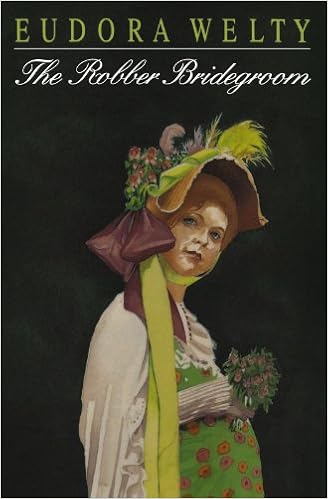
The Robber Bridegroom by Eudora Welty

"If being a bandit were his breadth and scope, I should find him and kill him for sure," said he. "But since in addition he loves my daughter, he must not be the one man, but two, and I should be afraid of killing the second. For all things are double, and this should keep us from taking liberties with the outside world, and acting too quickly to finish things off. All things are divided in half--night and day, the soul and body, and sorrow and joy and youth and age, and sometimes I wonder if even my own wife has not been the one person all the time, and I loved her beauty so well at the beginning that it is only now that the ugliness has struck through to beset me like a madness. And perhaps after the riding and robbing and burning and assault is over with this man you love, he will step out of it all like a beastly skin, and surprise you with his gentleness. For this reason, I will wait and see, but it breaks my heart not to have seen with my own eyes what door you are walking into and what your life has turned out to be."

Chloe's review of The Optimist's Daughter reminded me that I had a Eudora Welty book waiting for me: The Robber Bridegroom, her first novel.  Despite the strong themes that run through Welty's work--the singularity of families and the culture of the Mississippi Delta--she really never repeated herself, and The Robber Bridegroom is like nothing else she would ever write.  Welty borrows the folk tale of the Robber Bridegroom, in which a maiden unwittingly marries a savage highwayman, and melds it to 19th century Mississippi folklore.

The Robber Bridegroom is peopled with legendary Mississippi figures: Mike Fink, the braggart, brawler, and boatman, and the murderous Harp brothers (Little Harp keeps Big Harp's head in a trunk, where it keeps demanding to be let out).  To these it adds Welty's own sharp comic cast, including the young boy Goat, so called "because he could butt his way out the door when his mother left him locked in, and equally, because he could but this way in when she left him locked out," as well as an evil stepmother figure who dies of exhaustion doing an Indian dance meant to prove she is more powerful than the sun.

The protagonist, Rosamond, is the young daughter of a man named Clement Musgrove.  Clement's life is saved by a gentleman named Jamie Lockhart, who secretly robs travelers disguised with berry juice.  When Rosamond's clothes are stolen by a thief in the woods, Clement enlists Jamie's help to find the culprit, and in the kind of perfect mishap characteristic of fairytales, not Clement, Jamie, or Rosamond realizes that the culprit is really Jamie.

The Robber Bridegroom exhibits little of the sharp realist eye that Welty later developed, but a lot of the clear-eyed humor that characterizes The Ponder Heart and Losing BattlesThe characters hop from one fairytale-inspired crisis to the next, each one with its familiar contours: the innocent maiden, the evil stepmother, etc.  And when Clement believes he has lost Rosamond for good, Welty's elegiac power appears out of nowhere, if a little disorganizedly:

Like will-o'-the-wisps the little blazes burn on the rafts all night, unsteady beside the shore.  Where are they even as soon as tomorrow?  Massacre is hard to tell from the performance of other rites, in the great silence where the wanderer is coming.  Murder is as soundless as a spout of blood, as regular and rhythmic as sleep.  Many find a skull and a little branching of bones between two floors of leaves.  In the sky is the perpetual wheel of buzzards.

I read The Robber Bridegroom in a single breezy sitting--I'm on pace for 365 books this year!  But despite its lightness--both literal lightness and lightness of town--The Robber Bridegroom is as touching and thoughtful as the rest of Welty's work.