Thursday, November 22, 2007

I Shouldn't Even Be Doing This! by Bob Newhart

Bob Newhart is an incredibly funny person, not to mention successful. (Don’t know who he is? Check him out on IMDb.) His 1960 debut comedy album, The Button-Down Mind, sold more than a million copies, and supposedly outsold every album made by the Beatles in that decade. At that time there were a lot of guys still doing “take my wife, please” but Newhart and a group of younger comedians were carving out a niche as comedic storytellers. But even that fails to accurately describe Newhart’s act. He would present one side of a conversation, often on the phone. It may not sound all that funny, but it was…and is.

For example, in “The Submarine Commander” Newhart addresses the audience as if they were members of the crew, saying, “I’d like to congratulate you men on the teamwork we displayed. We cut a full two minutes off the previous record of four minutes and twenty-nine seconds in surfacing and firing at the target and resubmerging. I just want to congratulate you men on the team work. At the same time, I don’t want to in any way slight the men that we had to leave on deck. I think they had a lot to do with the two minutes we cut off the record, and I doubt if any of us will soon forget their somewhat stunned expressions as we watched them through the periscope.”

I don’t care who you are, that’s funny.

This book is essentially a memoir. Beginning with his early childhood, Newhart jumps around from one seminal event to the next, ending pretty much in the present. It was really interesting to see how long it took for Newhart to get his big break, and all the weird stuff he had to do to get by while waiting for this to happen. Newhart’s wry sense of humor comes through in the material, even when dealing with serious topics – which is not all that often.

I bought the paperback edition, so I was surprised at the number of simple typos, word omissions, and silly grammatical mistakes. It never ceases to amaze me how some things make it to press with so many basic errors. Some editor at Hyperion really dropped the ball. Besides these minor nuisances, the book was an enjoyable read, and often made me laugh out loud.

Newhart was the voice of Bernard in The Rescuers and The Rescuers Down Under. What more do you need to know? (That was a rhetorical question.)

Saturday, November 17, 2007

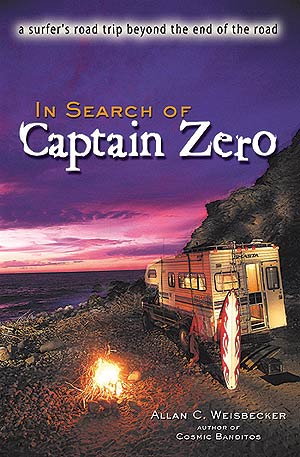
In Search of Captain Zero by Allan Weisbecker

A friend of mine who doesn't read much more than he has to once turned down a night buffoonery and drunken revelry to stay home and finish reading this book. So, I decided to pick up a copy. Good call.

Here's the premise. Weisbecker's old friend and surfing buddy Chris, aka Captain Zero, deserts his old life in the States and heads somewhere into Central America, cutting off all contact with his family and friends. Something like five years later, Weisbecker loads up his trailer and sets off along the Pacific in search of him.

It's more than just an account of his journey, it's a memoir. He inserts little tales from his past with Christopher. He talks about living in Hawaii during the advent of the short board. He describes a few failed attempts at running drugs from South America, and talks about growing up fishing off the far end of Long Island. He lets his personal philosophy bleed into all of the stories, and he really draws you into his worldview. Above all, it's entertaining. You'll probably find yourself wanting to do something slightly illegal and adventurous when you're finished.

As a side note, I think Nathan met Captain Zero in Costa Rica. Apparently he owns a book store somewhere near Puerto Viejo on the Caribbean side.

Wednesday, November 14, 2007

You Shall Know Our Velocity by Dave Eggers

Dave Eggers started McSweeney's. He runs a high school literary group in San Francisco called 828 Valencia that puts together The Best American Nonrequired Reading every year (they also sell pirate apparel I think). He wrote A Heartbreaking Work of Staggering Genius and a bunch of other books that people like, but the only one I've read is You Shall Know Our Velocity!

The story takes you inside the mind of a couple mental-whack-job characters as they travel the world giving away wads of cash. Their goal is to completely circle the globe in a week and hand out something like $30,000 to total strangers. The story's told from the perspective of an understandably disillusioned, fairly idealistic but totally irrational thirty-something named Will. His travel-mate, Will, brings a little reason and adventure along.

In this updated edition, Eggers has inserted a 50 page interlude narrated by Hand into the middle of Will's story. After reading both sides of the story, you can really see how unstable both of these characters are. The insertion is a good improvement on a great characterization novel. Everyone (in the English-speaking world anyway) can relate to parts of both of these personalities. Read it.

Monday, November 12, 2007

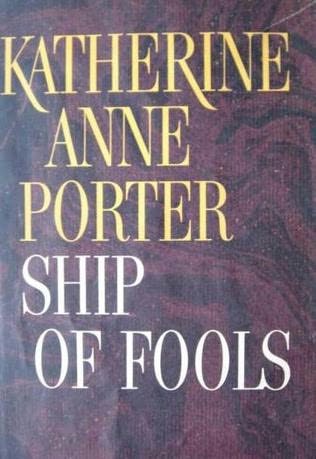
Ship of Fools by Katherine Porter

I realized with some chagrin the other day that I've posted nine books for class since the last one I finished as a personal choice, Tropic of Cancer. That's awfully depressing. To make matters worse, I had to suffer the ignominy of actually renewing the book I'd been reading, Katherine Porter's Ship of Fools, which had passed its one-month checkout limit. Clearly, school takes up far too much of my time, but at long last, here it is.

I decided to read Ship of Fools after I read one of Katherine Porter's short stories, "Flowering Judas," in the textbook for my 20th Century American Literature class (instead of actually paying attention to the lecture). It was a really beautifully written story, full of bright imagery and concentrated more on relating certain moods and images than advancing a plot.

Ship of Fools isn't like that; it lacks the hazy-but-languid style of "Flowering Judas" and replaces it with something dryer, but it isn't without its flashes of beauty. Instead, it's a character-based novel that examines what happens when a large group of strangers--an ensemble cast somewhere in the twenties--comes together on a transatlantic voyage from Mexico to Germany in the period leading up to the Second World War. Some of these characters are more interesting than others, and these are the most interesting: Jenny Brown and David Scott, a pair of American artists and lovers whose relationship is falling apart, Wilhelm Freytag, a young German who is banished from the captain's table when it's revealed that his wife is Jewish and who cultivates a relationship with Jenny, Dr. Schumann, the ship's conservative doctor who falls in love with La Condesa, an upper-class Mexican political prisoner and drug addict on her way to exile in the Canary Islands, and a group of Spanish zarzuela dancers who are also thieves, pimps, and prostitutes. Apart from being a well-developed character study, Ship of Fools is also somewhat of a political allegory that traces the rise of Nazism in Germany in the way that not only Herr Lowenthal, the voyage's only Jew, is treated by the censorious Germans, but also the uber-Gentile Freytag and the "unrespectable" lower-class passengers quartered in steerage.

I wasn't sure of this book at first, but I grew to really like it; by focusing on the more interesting and affecting strands and relegating others to B-plots, it actually becomes a heartbreaking study in human cruelty and loneliness. The most moving part, I think, is when Ric and Rac, the two troublesome twins that travel with the zarzuela company, throw overboard Bebe, a bulldog that belongs to a professor and his wife. Bebe is saved by a steerage passenger, who dies in the process. Porter offers the man's name--Echegaray, a common Basque name--but nothing else about him, and so we are forced to examine him uncomfortably through the eyes of the well-to-do first-class passengers on the upper deck, who regard his funeral with disdain or amused detachment. He is buried at sea without any known family to contact, forgotten somewhere in the Atlantic.

Its flaw is that many of the ensemble characters are wholly single-faceted, like profane, racist Texan William Denny or the Jew-hating Herr Rieber, but the detail given to the other characters more than makes up for it, I think. All in all, I enjoyed this book, though I think the next one I choose for myself will have to be a bit shorter than Ship of Fools' 497 pages.

An interesting observation

These are the five most popular books at UNC according to Facebook, which published it as an item in my newsfeed for some reason:

Harry Potter
Pride and Prejudice
Catcher in the Rye
To Kill a Mockingbird
The Great Gatsby

Except for Harry Potter, which is unsurprising, the newest book on there was published in 1960 and the oldest in 18-freaking-13. I am comforted by the thought that literature endures enough that college students could prefer "classics," for the most part, to newfangled crap like The Notebook (which is the no. 2 movie, after Wedding Crashers). I would not have expected that at all.

Here are the next five:

The Bible
1984
The Da Vinci Code
Angels and Demons
Ender's Game

Not quite as inspiring, but still. Also, if I have to hear another person say, "Never read The Da Vinci Code, huh? Read Angels and Demons, it's better," I might have to stab them in the mouth.

Depressing side note: The number four "interest" is "The Beach."

Sunday, November 11, 2007

The Ultimate Hitchhiker's Guide to the Galaxy by Douglas Adams

Nathan reviewed this book awhile ago, read his review. Some of the jokes did feel a little stale by the end, but I still enjoyed reading them. Adams did a wonderful job weaving together some very perceptive observations with a well-characterized cast, making the 800 page journey an entertaining read. If you pick it up not expecting to gain any huge insight into anything, you'll probably enjoy it. Basically it's a good vacation read if you don't feel like completely throwing intellect out the window.

The last book doesn't really come to any closure, but the fourth book, So Long and Thanks for All the Fish, was definitely my personal favorite. It's relatively independent from the rest of the series, so if you can only read one, make it that one (you'll probably still miss half the jokes though).

Friday, November 9, 2007

The World of Pooh by A.A. Milne

So, think about this: When you think about Disney, you think about Mickey Mouse first, right? Well, profits for Pooh alone for the Disney corporation are greater than all of the Mickey Mouse characters combined. Pooh is a juggernaut figure in our culture, which in many ways is a tragedy because it makes Disney's interpretation of Milne's character the most prominent conception by a tremendous ratio, and in many ways serves to obscure some of what Milne intended. I stop short of condemning Disney for this; there was no way for them to foresee the way that Pooh would blow up, and no reason for them to do anything differently even if they did. But it's a shame that the Disney version--which, though even I will admit in its earliest film versions shared much of the qualities that makes these books so enjoyable--has, through the litany of poorly conceived television shows (has anyone seen the new one where they're like, superheroes or something?) and new characters, has whitewashed some of the charm out of Pooh.

What is the charm about Pooh? I've been thinking about it, and I think part of what's so likeable about most of the children's books I've read for this class is that they work on two levels--one for children, which focuses on wonder, whimsy, and notions of "play", and one for adults, which focuses on cleverness and secondary levels of meaning. The Pooh books, though, are written for a much younger audience than the rest of these books, and they really only work on a single level, but in some way I think that that single level--innocent and carefree as it is--speaks to something in us that we carry with us from childhood but mostly ignore as frivolous. Wind in the Willows, too, I think, speaks to a similar notion of Arcadia--that realm that is lacking in the problems that characterize our adult lives, and which we identify with our own idealized childhoods--but focuses too much on the adult, transcendentalist notions of what simplicity and innocence are. Studio executives once complained that the Pooh stories lacked conflict, but that's central to what makes them so appealing.

Furthermore, they're genuinely funny. My favorite character is Eeyore, whose crippling depression is much more overstated and sardonic in the book. This is when Tigger and Roo are stuck in a tree (a plot element I do, in fact, recall from my childhood videos):

"I thought," said Piglet earnestly, "that if Eeyore stood at the bottom of the tree, and if Pooh stood on Eeyore's back, and if I stood on Pooh's shoulders--"

"And if Eeyore's back snapped suddenly, then we could all laugh. Ha ha ! Amusing in a quiet way," said Eeyore, "but not really helpful."


Eeyore is a jackass, and that's funny. It's also funny that Owl, the supposed wise member of the bunch, can't really read or write (he spells his name WOL). It's funny that Pooh, using a balloon to float up to a honeybee hive, thinks that he can trick the bees by painting himself black--like a small black cloud--and furthermore enhances the deception by singing a little song "such as a cloud might sing." Will it work? Who knows? "You can never tell with bees." Much of the humor, I think, is rooted in a child's sense of insecurity when compared with adults--by making the characters quite literally idiots, the humor is accessible to children, who, let's be serious, aren't very smart.

The history of criticism on Pooh is marked by scores of semi-serious books that use Pooh as a blank template to deal with concepts that Pooh really has nothing to deal with--I'm thinking of the Tao of Pooh, specifically, but there are also tons of half-baked lit crit theories on Pooh that revolve around feminism (Why does Kanga have to take care of all the other characters, anyhow?) or Marxism (How fucked up is it that upper-class Owl moves into poor lower-class Piglet's house?) or whatever. In some way, those books prevent us from looking critical at Pooh, but I'm not sure that there's any secondary level to be found here. If this were a book for adults, that might be a problem, but Pooh ought to get a pass just for being charming and idyllic. If it speaks to us, it's because there is a part of us that doesn't have that sort of need gratified enough.

N.B.: This book, The World of Pooh, contains two books: Winnie-the-Pooh and The House at Pooh Corner.

Wind in the Willows by Kenneth Grahame

Funny story: Kenneth Grahame couldn't find a publisher for Wind in the Willows, and so he sent it to the president of the United States at the time, Teddy Roosevelt, who had been a fan of his childhood memoir The Golden Age. Roosevelt didn't care for it, but his wife picked it up and started reading it to their children--and then, as Roosevelt overheard the book being read aloud, slowly came to like it and recommended it to his own American publisher. The rest is history!

I told that story because I didn't have much else to say about this book. I never read it as a kid, but I was pretty familiar with it by the cartoon film and it's various spinoffs. It tells the story of Mole and his friend Rat, and their friend Mr. Toad. Mole and Rat represent different class archetypes--Mole being the lower class and rat the middle class. They do things like go boating and walking through the woods and stuff. These sections of the book, I think, are supremely boring and their main characters awfully dull. The themes--most of which center around an appreciation for the outdoors and "simple living," along with a sort of wistful suggestion of childhood's implicit innocence. Boring.

But I did like Toad--the wealthy proprietor of Toad Hall--who is the antithesis of those things: vain, proud, extravagant, and obsessive. Midway in the book Toad gets on a kick where all he does is buy automobiles and drive them like a jackass until he crashes them. Awesome. Then, after Mole and Rat try to intervene, he escapes their clutches, steals a car, crashes it, and goes to jail. Awesome. He's the quintessential id-character. When he escapes from jail by dressing as a washer-woman, he ends up back at Toad Hall to find that it's been taken over by stouts and weasels, and so he, Mole, Rat, and the not-yet-mentioned Badger storm it with pistols and swords to take it back. Not only is that badass, it's meant to mirror Odysseus' return to Ithaca disguised as a begger in The Odyssey. Wind of the Willows is loosely modeled on that epic, though the particulars seem to escape me.

WTF moment: At one point in this book, Toad brushes his hair. What.

Tuesday, November 6, 2007

All Aunt Hagar's Children by Edward P. Jones

Edward P. Jones won the Pulitzer Prize for his previous work, The Known World, which I believe was his first novel. Prior to that he had written Lost in the City, a collection of short stories, as is All Aunt Hagar’s Children.

Jones uses a wide variety of writing styles throughout this book. ‘Spanish in the Morning’ is told from the perspective of a kindergartner who skips a grade in Catholic school. ‘All Aunt Hagar’s Children’ is a brilliantly written piece of detective fiction, similar to that of Walter Mosley’s. The main character and narrator of the story, is convinced by his elderly mother and her group of friends to look into the death of the son of one of the women. It was ruled a drug overdose by the police, but there was plenty of evidence to suggest otherwise.

‘Root Worker’ was one of my favorite stories, in which a medical doctor comes to terms with her mother being healed by a root worker (at that time, thought to be nearly synonymous with a witch doctor). ‘Blindsided’ was an interesting story about a young woman who unexpectedly lost her sight while riding a bus to a Sam Cooke concert. By far my favorite story was ‘The Devil Swims Across the Anacostia River’, which was about a woman who met the Devil (sans horns and pitchfork) in a grocery store.

I like reading collections of short stories for a number of reasons. And there is something unique about the stories in Hagar. Although few of them are longer than 40 pages, they read like full-length novels. Jones is so adept at developing his characters that it hardly feels like reading short stories. Two things are central to all of these stories: the African American experience and Washington, D.C. Ranging throughout the 20th Century, each of the stories either takes place in D.C., or involves the area in some way.