But then again, this home, this property, was evidence of the glory of the land, this country. There was so much. There was so much space, so much land, so much to spare. It invited the weary and the homeless like herself, her worthy children. She had the blurry thought that all the world's searching and persecuted could find a home up here. Alaska's climate was warming, was it not? It would soon be a forgiving place, with milder winters and uncountable millions of unpopulated acres, and so many empty homes like this, waiting to take in the desperate travelers of the world. It was a wonderful thought, a numbing notion.
Alaska likes to call itself The Last Frontier. The idea is that, while every inch of the mainland United States has been domesticated, Alaska remains wild, mostly unpeopled, unseen by human eyes. That's reflected in the lack of literature about Alaska--its more likely to attract someone like Christopher McCandless, the subject of Into the Wild, than a novelist like Dave Eggers. It's a place for applied philosophy, not navel-gazing.
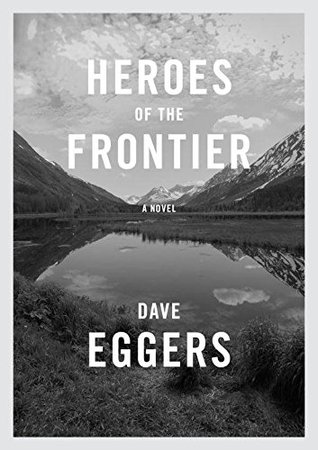
Which made it hard to find a book to bring with me on my trip to Alaska two weeks ago. As I've said on this blog many times, I love reading books that are set in the places where I'm traveling. But Alaska, though you might expect its distance and its mystery to be inviting subjects, has very few novels. So when Dave Eggers released his newest novel, Heroes of the Frontier, about a woman from suburban Ohio who escapes to Alaska in an RV with her two children, I did something I never do. I bought a hardcover book at full price.
The protagonist of Heroes of the Frontier is Josie, a dentist escaping personal and professional tragedy in Ohio. Her practice has been sued to oblivion by a woman who developed oral cancer, and she has grown to hate the father of her children, an "invertebrate" named Carl. And--making her decision to run unnecessarily overdetermined--she feels intense guilt over encouraging a young patient to join the military, where he died.
In response, she sets out with her young children, Paul and Ana, to Alaska, where they rent an RV. They follow, strangely enough, the basic route that my friends and I did: beginning in Anchorage, down the Kenai Peninsula to Seward, then the town of Homer, and finally up, up through the interior toward parts unknown. And yet I found these places, at least according to my own experience, difficult to recognize in Eggers' novel. Eggers wants to sell us on the cleansing possibilities of the wilderness, and the idea of frontier, but he has no real feeling for the physical beauty of the Kenai Peninsula, or the staggering visual difference between the mountainous peninsula and the flat, plain-like interior. Eggers' prose is too domestic, more Ohio than Alaska, too prosaic to match the environment. Furthermore, he's infinitely more interested in the people Josie and her children come across, even as he claims that the emptiness of the landscape is somehow transformative.
Heroes of the Frontier is in many ways an antiquated kind of book. It believes uncynically in the possibility of a frontier, and in the Thoreau-like ability of nature to improve us as people. At the novel's climax, Josie and her children become stranded in a lightning storm on top of a mountain, and find their mettle to survive challenged. She has an epiphany: instead of escaping to Alaska to find noble, courageous people, she must try to create them in her children. And despite his attempts to equivocate--the last chapter reads simply, "But then there is tomorrow"--there's no doubt in the sincerity of the faith that Eggers places in the frontier as a place untroubled by commercialism, domestication, and modernity. It's The Call of the Wild, but for people.
Showing posts with label Dave Eggers. Show all posts
Saturday, August 13, 2016
Heroes of the Frontier by Dave Eggers
Labels:
Alaska,
Dave Eggers,
Heroes of the Frontier
Wednesday, October 21, 2009
A Brief Roundup
I have actually been reading. Just not blogging. So here goes a (very) brief round up of the past few books.
1) The White Queen by Philippa Gregory
This one is by a favorite author of mine, who writes historical fiction, mostly about the Tudor family. This is her first book in a new series about the Plantagenets, the family that preceded the Tudors on England's throne. It's also about the Wars of the Roses, the decades-long war that took place in England in the late 1400s. The White Queen is Elizabeth Woodville, a commoner who marries a king and has two sons that are kidnapped by their dastardly uncle and locked in the Tower of London where they meet their fate of...nobody knows. The mystery of the two missing princes in the Tower of London is England's version of the Anastasia story; no remains of either boy were ever found. This story is mostly about Elizabeth however. Most of Gregory's books are character-driven; they focus on the women of the ruling class in pre-Renaissance England. Overall, better than some of hers I've read but still no The Other Boleyn Girl (a favorite by the same author).
2) In The Woods by Tana French - Jim reviewed this one earlier this year so I'll keep it short. Great book, but I was disappointed not to find out what happened to the two children that went missing from the wood in 1984. I know thats not meant to be the point of the story, but it felt like the point to me. Come on. Two children disappear and the third is found clutching a tree, shoes filled with blood and no memory? I want to know what happened there. The book revolves around a modern-day child murder, which is solved, but the fact tha multiple allusions are made to the earlier case makes it all that much more disappointing not to have an answer. Also, the answers the reader is meant to supply, given the information available to us in the book are that the children disappeared as a result of some large animal with huge eyes that spotted them in the woods one day and came back for them later.
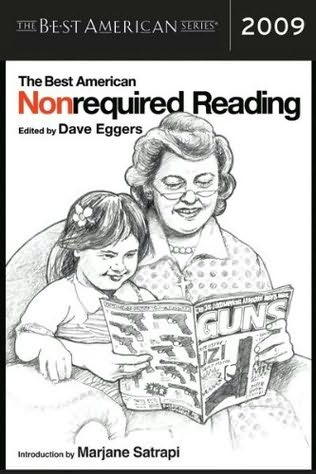
3) The Best American Nonrequired Reading 2009 - This is a collection of short stories I've bought every year its been in print - since 2002. Its a terrific little anthology full of short stories, articles, and graphic narratives edited by Dave Eggers and, of late, a group of high school students that participate in a writing work shop in San Francisco. Topics range from a short story about a grandpa to an article about the Jena 6 race riots to a French comic strip and the Best American Craigslist Items and Offers to Barter. Go buy this book, it's terrific. And because it is short stories, you can leave it and come back later as often or as little as you like. Say, like in between a murder mystery and historical fiction.
That's pretty much all I got right now. I think all my posts will be formatted like this from now on.
Labels:
Dave Eggers,
queens,
round up
Sunday, September 20, 2009
A Heartbreaking Work of Staggering Genius by Dave Eggers
“Why do you want to be on The Real World?”
“Because I want everyone to witness my youth.”
“Why?”
“Isn't it gorgeous?”
“We are the bright new stars born of a screaming black hole, the nascent suns burst from the darkness, from the grasping void of space that folds and swallows--a darkness that would devour anyone not as strong as we. We are oddities, sideshows, talk show subjects. We capture everyone's imagination.”
“I like the dark part of the night, after midnight and before four-thirty, when it's hollow, when ceilings are harder and farther away. Then I can breathe, and can think while others are sleeping, in a way can stop time, can have it so - this has always been my dream - so that while everyone else is frozen, I can work busily about them, doing whatever it is that needs to be done, like the elves who make shoes while the children sleep.”
When I went to find a passage to copy to entice you readers to read this book (most of you probably already have; it was quite the darling of the literary world a few years back and I am terribly behind when it comes to the darlings of the literary world) I couldn’t narrow it down to just one. So I included three. The first one was a bit of pithy dialogue between the author/memoirist and a casting agent for The Real World. The second and third are examples of what I liked so much about this book – the thick, lustrous description sliding down the page like a model’s hair sliding down her back in a shampoo commercial. (In related news, think I could place in that “worst abuse of a simile” contest?) A downside of so much description is that this book progressed sloooooowly. It is engaging but definitely not a quick read, for me at least.
A Heartbreaking Work of Staggering Genius (AHWOSG) begins and also ends with the death of the author’s mother, after a protracted battle with cancer. The four Eggers kids have recently lost their father to the disease as well. Hard times for any family, but the three older Eggers children, of which Dave is the youngest at 22 must also contend with guardianship of their littlest brother, Topher. Dave eventually takes on Topher, and moves from suburban Illinois to San Francisco where they live for several years. This book is the account of the boys’ SF years. David is a struggling writer, working with friends to produce a magazine that sounds so hipster-pretentious I would have hated it if I was reading pretentious magazines in 1995. I was not; I was 10, the same age as Topher.
Dave has lots of adventures despite the fact that he is effectively a single parent in his twenties. The boys rent a series of apartments together, and Topher attends school. They play a lot of Frisbee on the beach. In the book, Eggers tends to project his feelings into his recounted conversations with Topher, injecting the dialogue with a sophistication and level of detail that would only come from a writer and not from a fifth-grade. This is okay because at the beginning of the book Eggers writes that the dialogue is not a precise rendering of actual conversation. While the events in the book did happen, Eggers cautions that the book must be considered only somewhat non-fiction because of certain liberties taken with dialogue and with the names of those involved.
I was really glad to read this book for several reasons, one being that it has been on my book shelf forever. My bookshelf is small and I have a lot of books so they are double stacked. The entire front section of books on each shelf are ones I own but have never read. I bought a lot of paperbacks at the Bulls Head in Chapel Hill with my One Card…sorry Mom, that’s why I kept running out of meal money in college. Now I refuse to buy any more books until I read some of the ones on my shelf (library books are still okay).
Overall, this book kind of dragged for me. The writing was obviously excellent, but the plot was meandering. Sometimes I wanted to be Eggers’ best friend and sometimes I couldn’t stand him, especially when he talked about his magazine or his sexual encounters (awk. ward.) I’m kind of late to the Dave Eggers game (I also own What is the What, but haven’t read it yet either) so maybe I’ll read one of his other books and see how that compares. Not gonna lie, Wild Things (out in October, the book cover is covered in fur, it’s a redo of Sendak’s classic but for young adults) looks interesting too.
Labels:
Dave Eggers,
orphans,
san francisco
Wednesday, November 14, 2007
You Shall Know Our Velocity by Dave Eggers
Dave Eggers started McSweeney's. He runs a high school literary group in San Francisco called 828 Valencia that puts together The Best American Nonrequired Reading every year (they also sell pirate apparel I think). He wrote A Heartbreaking Work of Staggering Genius and a bunch of other books that people like, but the only one I've read is You Shall Know Our Velocity!The story takes you inside the mind of a couple mental-whack-job characters as they travel the world giving away wads of cash. Their goal is to completely circle the globe in a week and hand out something like $30,000 to total strangers. The story's told from the perspective of an understandably disillusioned, fairly idealistic but totally irrational thirty-something named Will. His travel-mate, Will, brings a little reason and adventure along.
In this updated edition, Eggers has inserted a 50 page interlude narrated by Hand into the middle of Will's story. After reading both sides of the story, you can really see how unstable both of these characters are. The insertion is a good improvement on a great characterization novel. Everyone (in the English-speaking world anyway) can relate to parts of both of these personalities. Read it.
Labels:
Dave Eggers,
McSweeney's,
travel
Subscribe to:
Posts (Atom)