Sunday, February 13, 2022
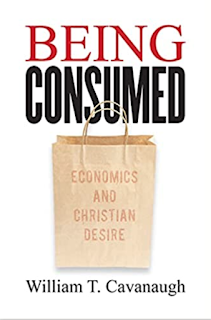
Being Consumed: Economics and Christian Desire by William T. Kavanaugh
In consumer culture, we plunge ever more deeply into the world of things. Dissatisfaction and fulfillment cease to be opposites, for pleasure is not in possessing objects, but in their pursuit. The dynamic is not that of inordiate attachment to material things, but an irony and detatchment from all things.
This isn't a healthy detatchment as is taught in ascetic Christianity and Buddhism. Rather it's a detatchment more akin to Marx's alienation--we are alienated from the products (and people) we consume because we lack a real desire to possess the object at all. Far from being a people that keep things forever, Americans are instead increasingly familiar with the idea of planned obsolescence and disposability. And even if corporations weren't in on the grift, who really wants to be using last year's iPhone?
Kavanaugh structures the book around four paradoxical concepts undergirding consumerism: freedom/unfreedom, detatchment/attachment, global/local, and scarcity/abundance. Each one is treated in a few pages and is then contrasted with a spiritual practice or theological concept: positive freedom via Augustine, Christian community, Balthassar's "concrete universal", and the Eucharist.
Every chapter is worthwhile: Augustine's concepts of "freedom to" counterpoints beautifully with Thomas Friedman's "freedom from"; persistent Christian community as an antidote to the consume/replace cycle of consumerism; the Eucharist as a model of abundance (one is reminded of Gerald Manly Hopkins "for all this nature is never spent"). The only contrast that didn't fully work for me was the "concrete universal", which I suspect I didn't fully understand. But that chapter also introduced a concept that I know I'll be thinking about for some times, that most attempts to globalize things--products, "diversity", religion--are actually a way of homogenizing them and stripping them of what is unique:
The mobility and universalization of transnational corporations has had a profound effect on culture. It is possible to drive from one coast of the United States to the other and eat the same food, stay at the same motel, shop at the same mall, hear the same music on the radio, hear the news delivered in the same accent, see the same cars, see the same clothes, and hear the same narrow range of political opinions all the way from Florida to Oregon, from California to Maine... I have heard "Disco Duck" in Yugoslavia and eaten at a Pizza Hut in Chile.
A diversity program where the skin tones are different but the culture stays the same; religions where a God of some sort is a constant but truth claims must be restricted to the most anodyne and agreeable, and steakhouses with identical menus but different copyrighted names for the dishes: as Hank Hill would say, "you're not making [the world] better, you're making [the world] worse. Ultimately such flattening erases any edges that can be picked at to escape the suffocating homogeneity of the modern world, and with no loose ends to pull, what is there to do but consume, replace, consume?
The most effective theological move in the book is the Eucharist--the infinite yet distinct body of Christ--as a model of abundance, one that doesn't simply state that abundance is an achievable state for some but actually overthrows the idea of scarcity altogether. I was strongly persuaded by the argument that Kavanaugh puts forth, that scarcity is manufactured to produce need and stimulate the borderline-metaphysical market:
It is not simply that the market encourages an erotic attachment toward things, not persons. It is that the market story establishes a fundamentally individualistic view of the human person. The idea of scarcity assumes that the normal condition for the communication of goods it through trade: to get something, one must relinquish someting else. The idea of scarcity implies that goods are not held in common, that the consumption of goods is essentially a private experience. The idea of scarcity establishes the view that no one has enough.
"The idea of scarcity establishes the view that no one has enough." What a powerful statement, and what an indictment of a nation where most of the populace lay claim to "life more abundant" while simultaneously affirming the sacred nature of commerce, the divine right of billionaire oligarchs, the destruction of the literal planet to drive endless growth (but only for the few) and the essential rightness of a world where millions starve while we consume more and more and more.
Wednesday, February 1, 2017
Book 8: The Axe and the Oath by Robert Fossier
Fossier's book is translated from its original French, and I found myself contemplating the writing on a meta-level almost as much as I found myself paying attention to the information in the book. I have to imagine the book makes more sense in French - or, at the very least, Fossier's constant declarations, "I could say more..." come off with a different meaning in French than they do in English. As just an example from the last 100 pages, after I had the brilliant idea to start taking notes on these things:
- On law: "As is my wont, I will no venture into a technical area that is among the most encumbered..."
- On peace and honor: "...war (about which I shall have more to say) and the periodic effrois, or terrors (about which I will not)..."
- On weights and measures: "I shall not pursue the question of the calculation errors that abound in medieval accounting..."
- On universities: "So much ink and saliva [ew] has already been spent on this majestic medieval 'heritage' that I shall add only a few minor notes..."
- On literature: "The best I can do is sweep out a corner or two."
- On monuments: "I am not about to draw up interminable lists of monuments, or painted and sculpted works."
- On art: "I have no intention of studying the evolution of all these works."
- On human knowledge: "During the course of my narration, few surveys have left me as unsatisfied as this one."
- On the Church: "I am supposing that my reader is not hoping here for a history of the Church."
Tuesday, January 31, 2017
Book 7: How Soccer Explains the World, by Franklin Foer
My dad loved Soccer Made in Germany on PBS in the early 80s. I had nothing to do in 1994 when the World Cup was on TV, since I only had a learner's permit until right after the Final, so that was my first taste of actual soccer (who could remember how Colombian gangsters killed that one guy who scored an own-goal, allowing the US to advance to the second round?!?!). As recently as 2007, I freely mocked my coworkers who followed the Premier League with their instance of saying "darby" when the word is clearly derby. Then I started playing in a few rec leagues with some friends and my cable carrier picked up NBC Sports so I could bother my poor wife by adopting another sports league. So I guess this is a long way of saying I've only really cared about soccer as a sport to watch more frequently than the world cup for about five years now.
Being interested in the results of the game for only a limited time, I have long been fascinated by the larger soccer culture and how it affects culture in general. The best book about sports fandom I've ever read remains Fever Pitch (when I read it in 2001, I told my friend Sweaty that it was the best book about being a Red Sox fan that could possibly ever be written - unfortunately, I must have said this within earshot of a Hollywood exec, because three years later there were Jimmy Fallon and Drew Barrymore on the field after Foulke flipped the final out to Miniwinivich)(not his name, I don't care). Bill Buford's Among the Thugs scared the holy hell out of me. The rivalries that competitions like the World Cup and the Euro Cup put on the field against each other resemble WWI or imperialistic struggles. Soccer truly can be used to explain the world, it seems.
Which Foer proves in a very entertaining read. He uses various clubs and national teams from around Europe and South America to explore most of the modern world, such as new oligarchs, American culture wars, antisemitism, and globalization. Each chapter makes its point in a compelling fashion, while touching on some of the most famous pieces of soccer history that even a casual fan of the beautiful game could connect to. (Like, Pele. I'm betting just about everyone knows who Pele is.)
While every chapter is interesting and worth reading, I think the first, on How Soccer Explains the Gangster's Paradise, is probably the most compelling to people unfamiliar with soccer, as it focuses on horrific violence. (Maybe I'm revealing a lot about myself? Meh.) As much as I loved Among the Thugs, it's from a time before I started paying attention to soccer, and a time that certainly seems like it's in the rear view now. Hooliganism has been priced and policed out of the British Premier League. I have no doubt that there are still fascist firms stirring shit up, but they no longer terrorize vast swaths of the population as they did in the 1980s. The hooligans that Foer tracks down (and this information, too, could be a bit dated, as this book was published in 2004 - recently to be sure, but before a vast infusion of Russian and Middle Eastern oil money that has greatly transformed a lot of the big leagues around Europe) are Serbian nationalists who partook in ethnic cleansing. In 2012, I took a group of students to the Hague and the International Court of Justice, where some Eastern European warlord was on trial for the murder of 40,000 civilians (obviously I did a great job tracking the details). Seeing this man, stone-faced, answering and deflecting questions about ordering his snipers to open fire on women trying to cross a river, was stomach-churning, and he was behind bulletproof glass and completely unaware of my existence. The characters that Foer encountered in shady bars and firm clubhouses... I can't even imagine.
Also amazing, because of his similarities with our own Dear Leader, was the chapter on Silvio Berlusconi and his teams at AC Milan. If only Trump had gotten permission to buy the Buffalo Bills... But it wasn't enough for Berlusconi, and it probably wouldn't've been enough for His Orangeness, either. Oh well.
Basically, this was great beach reading if you like either soccer or... the world.
Sorry. I couldn't resist.
Tuesday, January 24, 2017
Book 6: We Should All Be Feminists, Chimamanda Ngozi Adichie
Adichie ends with, "All of us, women and men, must do better." Since so much of, um, the conversation right now focuses on getting the conversation started, I feel like that is appropriate, useful, and, most importantly for my purposes, actionable. A lot of my kids realize that feminism is good, because they believe in equality, but they just don't know all the things that go into feminism. As one of the speakers at the March this weekend said, criminal justice is a woman's issue. Income inequality is a woman's issue. Healthcare is a woman's issue. Looking at society through that lens, I hope, will be an easy and useful leap for my kids (says the white, heterosexual, cisgender male who will be teaching his students about feminism).
Friday, November 21, 2014
The Lost Tribe of Coney Island by Clarie Prentice
Wednesday, January 29, 2014
No Applause, Just Throw Money: The Book That Made Vaudeville Famous by Trav S. D.
Not that I love every goofy, borscht belt joke or watch the 3 Stooges on a loop (I swear!), but there’s something so strange and appealing about the scene, Hollywood before Hollywood was a thing, a massive cultural phenomenon that, aside from the filmed work of some of it’s bigger stars, has been largely forgotten by the public.
Trav S. D., who apparently runs a modern Vaudeville revue of some sort, gives the whole movement a popular history that anyone could enjoy. Thoroughly sourced and pithily written, Trav spends time with not only the most well-known stars of the Vaudeville stage, such as the Stooges, the Marx Brothers, Bill “Bojangles” Robinson, and Buster Keaton, but he also turns his eye to lesser performers--sword swallowers, contortionists, freaks, weirdos and lunatics--and, in doing so, brings out what a strange, wonderful world Vaudeville really was.
I particularly enjoyed the first couple chapters, where Trav traces Vaudeville’s history back to the travelling minstrels and theater troupes in the Middle Ages, and even further, to the wild bacchanals of ancient Rome. While it seems like a little bit of a stretch to view Caligula as an early P. T. Barnum, if the shoe fits... From these inauspacious beginnings, Vaudeville developed from “Men Only” burlesque beginnings to the biggest show on earth, and then, in the span of only about a decade, was completely wiped out by motion pictures.
Although it’s doubtful that most of us would trade, say, Scorcese’s output to watch a man set himself on fire onstage, there is something sad about the disappearance of Vaudeville. Nowdays, unless you live in a large city, you probably don’t have much access to live theater and you certainly can’t see the large variety of things present in the average Vaudeville program. Trav also makes a fairly convincing, if somewhat rose-colored, case for Vaudeville’s inclusiveness of minorities and women and posits the movement on the whole as a net positive. I’m inclined to agree. In many ways, the rise and fall of Vaudeville seems like a uniquely American event, one brief moment when the melting pot came together to watch the world’s fattest lady do... whatever she did.
Thursday, July 18, 2013
The Executioner's Song by Norman Mailer
I had never read Mailer either, in spite of having a copy of The Naked and the Dead sitting on my bookshelf for a few years, but The Executioner’s Song caught my attention in the bookstore for two reasons--it was huge, and the premise--a man, Gary Gilmore, is given the death penalty and executed--didn’t seem like enough to support the length. Not to mention that it was a true story and I’d never heard of Gary Gilmore. So my interest was piqued.
In some ways, the single-sentence summary above does the book justice--it is single-minded in the sense that it keeps the execution front and center throughout--but, of course, further explication is necessary. Gilmore spent over half of his life behind bars, beginning as a juvenile. In 1976, he was paroled and sent to live with his cousin Brenda in Provo, Utah, the heart of Mormon country. During this time he struck up a tempestuous, intense relationship with a young single mother named Nicole Baker, and, after an unusually severe fight and breakup, killed two men, execution style, over a two night period. He was caught and sentenced to death, notable because, at the time, the U.S. was currently in the midst of a moratorium on the death penalty, imposed by Furman vs Georgia in 1972.
The death sentence happens less than halfway through the book. The rest is the story of Gilmore’s fight to be allowed to die and the media circus that surrounded him. Because of the moratorium, numerous civil rights groups, including the ACLU, were fighting Gilmore’s execution, even though he wished for his sentence to be carried out, because they feared, correctly, that if Gilmore was executed, many others would be executed in short order.
Normally, in a story like this, there are clearly defined heroes and villains, and, in true stories, if the facts don’t point to a clear dichotomy, the author usually chooses sides and, inadvertently or not, paints one side more sympathetically. Not so Mailer in The Executioner’s Song. As long as it is, the novel is a picture of restraint, with Mailer refusing to cast Gilmore as a misguided saint or his antagonists, such as they are, as anything other than complicated people with (generally) legitimate reasons for the things they do. It would have been far easier as a reader if I could have seen Gilmore as a monster or the ACLU lawyers as hypocrites, but Mailer’s thoroughness doesn’t really allow for such simplistic line-drawing. Even Gilmore’s motivations for the murders are in question: were they emotional responses to his problems with Nicole? Inevitable behaviors for a bad seed like Gary? Indicators of some deeper mental issue? Results of repressed pedophilic impulses? Deus Ex Machinas handed down from unfeeling gods? We’re never told, and the length of The Executioner’s Song serves as a challenge. Mailer seems to be saying, “Here’s all the information. Figure it out.”
There are moments in The Executioner’s Song that cut deep, like Mailer’s sensitive portraits of the two men Gilmore killed, but even here, he resists the urge to beatify, communicating the facts in flat, affectless prose that works even better than cloying melodrama. Gilmore’s letters to Nicole are the same way--of course, love letters from a man on death row are going to contain some pathos, but Mailer doesn’t edit, and their contents reveal Gilmore’s duality as well as his humanity, his intense longing beside his almost feral brutality. Finally, after Gilmore’s execution, the one spot where a little bit of punch-pulling might be in order, Mailer refuses look away from the grislier aspects of Gilmore’s death--including his autopsy, described in some detail--and the unresolved grief of his victims’ families and Nicole, who Mailer even dares to suggest may someday forget Gilmore, ostensibly her soulmate throughout his time on death row. At risk of hitting the point too many times, Mailer refuses to espouse one simple answer to the questions he raises. It’s what makes The Executioner’s Song worthwhile, what justifies its length, and it’s a good argument for why Mailer, great male narcissist or not, deserves to be part of the “great authors” conversation.
1The others being John Updike and Philip Roth, who we at 50B apparently love.
Tuesday, March 26, 2013
Capital of the World by Charlene Mires
I don’t want to give the wrong impression: Mires’ book is not a work of humor. It’s a scholarly work whose bulk is nearly 25% endnotes and other appendices, and, though Mires is a good writer, she isn’t aiming for comedy. It’s just that, as the story plays out, it’s hard not to laugh. There’s a large cast of characters and the story is writ large on the world stage. Apparently, everyone wanted the U.N. in their backyard (except Concord, CT) and residents, from average Joes to the Rockefellers, fought to get it there. The size of the “capital” also went through various metamorphoses during the process: originally conceived as a small town, the U.N. eventually became a large compound instead.
There’s far too much content in Mires’ book to go into much detail about the process, but Mires keeps the book moving at a pretty steady pace, even if I did get a little bogged down once or twice in the endless litany of names and places presented for consideration. Of course, even that isn’t necessarily a bad thing--it probably accurately replicated how the U.N. felt after being approached dozens of times by boosters from South Dakota, Michigan, San Francisco, and, of course, New York. The material, which could potentially be very dry, is handled well, and I suspect that someone more attuned to world history or any of the civic areas the book touches on would enjoy it even more than I did. There are also numerous photos and sketches throughout, and they serve as a powerful illustration of how crazily monomanicial the various boosters got in pursuit of their cause.
In the end, the U.N. ends up in New York City, of course, and, to us 75 years later, the competition for the U.N. looks a little silly. Mires is aware of this, but she addresses it well at the end of the book when she says:
Looking back, if it all seems a little crazy, then we have lost touch with the atmosphere of determination, hope, and anxiety the characterized American society at the end of the Second World War. We have forgotten the time when people in cities and towns across the United States imagined themselves on the world stage--and not just the stage, but at its center as the stars of the show.If you want to see if your hometown was a contender, check out the full list at Mires' blog, Capital of the World.
Thursday, March 14, 2013
The Myth of Persecution by Candida Moss
But first, the good. Moss is a good writer, and the book moves along at a nice clip, covering a lot of material that could have been dull in a quick, enjoyable way. I also really appreciated her attitude throughout, and her desire for open dialog and honest examination of even the most sacred of Christian cows. When she discussed Christians and their modern day martyr complex, I found myself agreeing with her that positing an “us-vs.-them” approach to life ultimately stifles dialog and and prevents open communication and fellowship from taking place. I’ll even go a step further and say that, when Moss draws conclusions at the close of each section, I often agreed with her big picture points, even while i disagreed with the manner in which she reached them.
I don’t want to go through the issues I had point by point, but here’s a summary, followed by a couple examples. Primarily, Moss seems to operate from the perspective that Christian writers can’t be trusted. In virtually every instance where a Christian document disagreed with a non-Christian document--or, in some cases, was simply not corroborated by a secular one--the Christian document is treated as though it were clearly incorrect. Christian writers are repeatedly referred to as “shrill” and Moss clearly views them as uncredible. There are a lot of semantic games as well, one in particular that I’ll touch on below, and data that seems to contradict the thesis of the book--that Christians never experienced sustained persecution--is frequently glossed over lightly.
For example, when discussing Saul, who later became the Apostle Paul, and his persecution of believers, she allows that this may, indeed be an example of actual persecution; however, she then reframes it thusly:
“It wasn’t until the end of the first century that Jesus followers began to refer to themselves as “Christians”. The historical period when Stephen died and Paul was writing cannot be considered a period in which Jews persecuted Christians, because Christians did not yet exist.”This is semantic hair-splitting of the worst kind. “Christian” literally means “little Christ” and the obvious implication is that a Christian is simply a Christ-follower. By Moss’ logic, Christ-followers who call themselves something besides “Christian” cannot be broadly thought of as persecuted Christians even if they are identical in all but name.
This isn’t the only instance of such pedantry either. Moss develops much of her thesis by carefully delineating between persecution and prosecution. Persecution, in the sense Moss uses it, covers only instances of violence targeted toward a specific group. Therefore, when Decius passed a law forbidding Christians from defending themselves in a court of law, this is not “persecution” but “prosecution”. She draws this same distinction between governmental “persecution” and personal “prosecution”. This seems ridiculous on its face: would anyone seriously argue that the Jews were not persecuted when they were ghettoized in Germany? Did their persecution begin only when violence against them was systematized?
Throughout the book, Moss relies on specious constructions like these, as well as examples that end with “We simply can’t know for sure” but carry the strong implication that her conclusions are correct. She takes traditional stories of martyrs, picks apart the embellishments, and then, frequently, dismisses the story altogether. She even does this with the story of Christ himself, whose death she unconvincingly compares to Socrates, after which she states,
“Every time someone is referred to or described as dying like Christ they are actually dying like Socrates and the Maccabees”Moss is a scholar of martyrdom, and to some extent, I’m willing to believe that her more scholarly works--this is her first for a general audience--are more substantially argued. The history she covers is fascinating, and her advocacy for historical skepticism is valuable. Her ultimate point--that a martyr complex inhibits, rather than enhances, the Christian life, is strong, and one that many Christians I know could stand to learn. Unfortunately, Moss’ biases and over-reliance on semantics severely undercut her arguments and the book as a whole.
A positive review of the book, from an atheist perspective
Monday, January 28, 2013
The King James Bible After 400 Years
Tuesday, November 20, 2012
Because You Have To: A Writing Life by Joan Frank
Where most books on writing seem to be written by fairly well-known authors or teachers, Joan Frank’s new collection of essays on the writing life comes from a different place, the pen of a writer who has learned, in her own words, “there may not be any breakthrough.” This is a woman who has published five works of fiction, been reviewed in the New York Times, but has come to accept that she may never be a household name, never able to answer the question, which she addresses in an essay, “Have you written anything I’ve heard of?” in the affirmative.
And yet, she continues to write, and write well, because, well, because she has to. Reading her essays felt more relatable to me, a wannabe writer who has published one story and a couple poems, than, say, Stephen King’s On Writing--although it’s good too. There is a compulsion in everyone who calls themselves a writer to create, to put the words down on paper and make them real, and Frank expresses that feeling more eloquently than most. She understands, and communicates, that writing is not about fame, or money, or notoriety. It’s about desire, about an insatiable need to get what’s inside outside. Every writer, famous or not, can relate to that.
Because You Have To isn’t a book on craft, for the most part. It’s more similar to Anne LaMott’s Bird by Bird or Ray Bradbury’s Zen and the Art of Writing. It’s full of advice--or sometimes just empathy--about the mundane things in a writer’s life: rejection letters, finding--or making--a place to write, and feeling as though you must “steal” time from the real world in order to get it down on paper.
Ultimately, what a reader gets from this sort of collection probably depends on what they brought into it. If they don’t write, have no desire to write, they won’t come away with a real understanding of the madness; but anyone who’s felt like they would burst if they didn’t tell their story, well, this one’s for you.
Tuesday, October 30, 2012
And Now We Shall Do Manly Things by Craig J. Heimbuch
And Now We Shall Do Manly Things is essentially summarized above, the through-line being Heimbuch’s journey from freelance writer to freelance writer with a gun. As with most “I did this” memoirs, the tone is light, but there’s a real pathos to the early sections, where Heimbuch reflects on his own history, from marriage through childbirth, and a poignancy to his description of his parents and extended family—outdoorsmen all— people he clearly loves but feels disconnected from in some essential way. Everyone has felt it, the sense of otherness, and Heimbuch, at his best, captures the feeling wonderfully. At his worst, he attempts to inject humor that just doesn’t work—most of the fictional conversations played out like vaudeville routines with no punchlines—but for the most part, I laughed where I was supposed to, and the book read amazingly fast.
The big question I had, coming into the book, was this: would it change my mind about hunting? I’ve always thought hunting for sport was kind of stupid at best, and kind of barbaric at worst—though I’m sympathetic to the idea that, if left unhunted, deer would overrun the world like so many graceful vermin—and I was genuinely hoping to have my perspective enlarged. To an extent, it was: Heimbuch’s discussion with various hunters made sense, especially the oft-repeated bromide that “if you’re willing to eat meat, you should be willing to kill it”, and, by the end of the book, I was rooting for him to finally get his elusive pheasant. On the other hand, the descriptions of field-dressing turned my stomach and I’m not planning to start hunting myself anytime soon, so, I don’t know... maybe I should be vegan?
I’m glad I read And Now We Shall Do Manly Things. It’s likely not a book I would have sought out myself (I received a free review copy), and it’s helped me understand a mentality I’ve been around but have never really understood. If I were feeling hyperbolic, I might even say it’s caused me to reconsider my own life and what it means, to me, to be a man. Maybe I’ll write a book about it.
Saturday, September 29, 2012
Reinventing Comics by Scott McCloud
But first, the good: McCloud is a remarkably versatile artist who clearly loves the medium and is adept at communicating fairly dense information in an intuitive way. I’m not sure the information in this book could have presented any better without changing its format completely. The entire book, aside from the appendices, is written in comic book form which sometimes works great, such as when demonstrating various distribution models, and sometimes doesn’t add much, as during his discussion of diversity in comics.
The downside is that a lot of the material here just isn’t that novel or interesting. One only has to walk into a comic book store, or even look at recent comic book movies, to see that the landscape is dominated by superheroes, mostly straight, male and white. McCloud’s solution to this problem--that more women, minorities, and gays be promoted in the comics world--is sensible, but doesn’t bring anything new to the table. His discussion of genre is similarly circular.
The back half of the book mostly discusses the pros and cons of creating and distributing comics on computers. Since the book was written in a largely pre-broadband time, many of McCloud’s suggestions seem quite prescient--online distribution, microtransactions, experimental layouts and formatting--but they too suffer from a little bit of been-there-done-that in 2012 (although it is notable that DC and Marvel both adopted same-day-as-print digital releases this year). McCloud’s once-exciting predictions about everything being available everywhere have been tamped down by both real-world issues, such as the complex legal weaseling necessary to move “everything” online, and by the fact that the future he talks about is largely here and doesn’t seem to have increased mainstream acceptance of comics much. Online, there are comics about everything under the sun, instantly available, but if no one new is reading them, what does it matter?
I don’t mean to be hard on Understanding Comics. It’s very well put together and I enjoyed reading it, but I’d recommend Understanding Comics or McCloud’s Zot omnibus as an introduction--Reinventing Comics is a little depressing.
Sunday, November 7, 2010
Divine Invasions: A Life of Philip K. Dick by Lawrence Sutin
“This has been a novel about some people who were punished entirely too much for what they did. They wanted to have a good time, but they were like children playing in the street; they could see one after another of them killed — but they continued to play anyhow.” The quote above is actually from A Scanner Darkly, not Divine Invasions (not be confused with The Divine Invasion, a novel by Dick), but it seems like such an appropriate summation of PKD’s life story that I couldn’t leave it out. As the title indicates, Divine Invasions is a biography, unauthorized, of one Philip K. Dick, author, counterculture hero, drug addict, schizophrenic, possible misogynist, hypochondriac, possible genius. But for those who don’t read past the first paragraph, here’s my summation of Divine Invasions: You can learn nearly as much about PKD from his novels as you can from this book, and the man who emerges is both fantastical and sort of terrible.
I try to avoid personal anecdotes in these reviews, but it seems appropriate to place myself somewhere in the pantheon of PKD fandom. I’ve read two of his novels, A Scanner Darkly and VALIS, seen one movie based on his work, Minority Report, and few short stories. I wouldn’t say I was the target audience for this book, but after reading VALIS, I was curious about the man behind it.
PKD was born in Chicago in 1928, along with a twin sister, Jane, who died six weeks later. Dick’s father, Edgar, left his mother when he was young, and thoughout the rest of his life, PKD’s contact with his father was minimal. His relationship with his mother was strained, running hot and cold. He began writing fiction while still in middle school, and by the time he was in his late 20s, he was working full time as a writer, barely eking out a living in the newborn gutter of science fiction. After several marriages, a lot of drugs, and a volume of work that makes the aspiring author shrink to think of it, he died of a stroke in 1982.
Biographies are tough to review because it’s hard to condense someone’s life down to the bare bones without sounding like an obit, but I’d like to focus on what was both the most fascinating aspect of PKD, the man, and the dullest of Divine Invasions: the visions. In my review of VALIS, I go into some detail concerning the imaginary cosmology of Horselover Fat, the novel’s protagonist who is also PKD. I didn’t realize, however, that Fat’s visions in VALIS were not fictionalized at all. They were taken whole cloth from Dick’s largest (unpublished) work Exegesis, which was over 3000 pages long at the time of his death, and was, in my opinion, the chronicle of a man slowly losing his grip on reality.
Divine Invasions goes into some detail on the content of the Exegesis—the final 3rd of the book is mostly dedicated to it--and while it’s interesting in theory, after a while, it gets to be a bit of a slog. Sutin will quote a section, explain how it related to PKD’s life, and speculate on whether or not Dick was actually learning about the ultimate truth or if he was just crazy. Perhaps an interesting book could be made out of this. Unfortunately, Divine Invasions is not it. The last 3rd starts well, but gets bogged down in this repetitive pattern it never really breaks out of. It’s interesting to read about the bizarre things that happened in PKD’s life; it’s less interesting to read about how he thought he caused it while possessed by the spirit of the prophet Elijah.
The other issue I have with Divine Invasions is one of tone. Sutin is clearly a huge fan of PKD’s work, and he makes this clear from the beginning. As a result, portions of the book read almost like a hagiography, with Sutin using Dick’s fixation of his sister’s death, his volatile relationship with his mother, et al. to justify, in part, some of the stupid or just plain malicious PKD did, like beating at least two of his wives. This might be ok, except Sutin seems to want to have his cake and eat it too—although he admits Dick might be crazy, and therefore not entirely to blame for his less forgivable episodes, he also wants to attribute some amount of veracity to Dick’s ever-changing visions. Brief consideration near the end of the novel, where Sutin mentions possible mental conditions that could have caused Dick’s visions, don’t counterbalance the suggestion throughout the rest of the work that PKD was more than a troubled soul—he was some sort of sci-fi prophet.
Divine Invasions isn’t terrible. It’s well-written and Dick’s life was certainly interesting. Ultimately though, it seems a little pointless—you can read about PKD’s crazy life on Wikipedia, his visions in VALIS, and his drug addiction in A Scanner Darkly, and probably enjoy yourself more. Why not get the information from the man himself? It’s not like he tried to hide who he was.
Tuesday, June 8, 2010
Cheaper By the Dozen by Frank Gilbreth Jr. and Ernestine Gilbreth Carey
They had a dozen children, six boys and six girls, in 17 years. Somewhat to Dad’s disappointment, there were no twins or other multiple births. There was no doubt in his mind that the most efficient way to rear a large family would be to have one huge litter and get the whole business over with at one time.First things first: this book has nothing in common with the 2003 movie starring Steve Martin except the title and the number of offspring in the featured family. Where the film was just a standard family comedy with a larger cast, the book is a genuinely sweet and funny look at an atypical family in the early part of the twentieth century. It’s also worth noting that this book doesn’t take much longer to read than the movie takes to watch.
Written by two of the dozen children, Cheaper By the Dozen is a memoir, basically a loosely-connected series of vignettes, mostly funny and occasionally moving. Although the title makes it sound like it focuses primarily on the children, the most vivid character in the story is actually Frank Galbrath, Sr., the father of the titular dozen. Both he and his wife Lillian are efficiency experts, making their living by showing companies and individuals how they can reduce “motion waste” and save time and money. They choose to apply these same principles to their family: irregular jobs are bid on by the children, with the job and the subsequent reward going to the lowest bidder; Morse code is taught by painting legends in every room of the house, and, similarly, foreign languages are taught by means of phonographs in every room.
Cheaper By the Dozen, like most funny books, doesn’t really benefit from a review. You can pick it up and read a couple pages and see if it’s for you. If you come from a family of thirteen, like me, it just might catch your attention.
Tuesday, November 17, 2009
Go Ask Alice by Anonymous
I wish I were popular and beautiful and wealthy and talented.-
My mind possessed the wisdoms of the ages, and there were no words adequate to describe them.
---
Go Ask Alice purports to be the honest-to-goodness real diary of a poor girl who starts off as a sterling, if somewhat shy, student and is gradually drawn deep into a web of drugs, alcohol, illicit sex, and suspiciously aggressive potheads. Of course, once the book became a hit, Beatrice Sparks, a Mormon psychologist and youth counselor, came forward, claiming to be the book's compiler and editor, though not it's actual author who was, of course, Alice. or, well, not really. Actually, Alice is in the book for about 3 sentences, but for simplicity's sake, I'm going to assume the anonymous diarist is named Alice as well.
Anyone who actually reads the book, however, will start suspecting early on that either Alice or Beatrice is making things up as they go along. I could buy that Alice started drinking out of peer pressure and a desire to be cool. I could buy that she started smoking pot for the same reason. I found it harder to believe that she became a voracious addict to LSD after being secretly given a spiked glass of beer. Credulity is stretched to the breaking point, however, after the second time Alice's addict friends break into her house to plant drugs then, later, inject the candy bowl at the neighbor's house with cocaine and call the police. Alice, of course, winds up on the street, alternately transcribing her pathetic sexual escapes and waxing philosophical in ways that your average teenager doesn't. In the last several entries, Alice kicks the habit but then mysteriously dies in a postscript that, presumably, was not part of the original diary.
Later, Dr. Sparks published a series of books, all with the "real-life diary" angle, dealing with a boy who falls into Satanism, a homeless teen, and a knocked-up teen. These, fittingly enough, were shelved under fiction, ensuring that their terribly contrived, retarded, didactic stories will never be taken as seriously as Alice's. Sparks's most recent book? Open and Say Ah: The Story of a Lying Psychologist.
Saturday, July 4, 2009
A Walk in the Woods by Bill Bryson
After finishing Into Thin Air, I needed to read something a little less harrowing. Sure, nature can be scary, but there have to be a few great pursuits that anyone with a little free time and a backpack can do, right? I picked up A Walk in the Woods because the premise sounded interesting and because Bill Bryson is a pretty amusing dude. I wasn't disappointed. A Walk in the Woods follows Bryson and his friend Katz, an overweight, outgoing loudmouth, on their attempt to walk the entirety of the Appalachian Trail. The A.T. is a huge undertaking, 2,100 miles from Georgia to Maine, requiring 6-8 months, lots of food, and some good boots. Bryson and Katz start out as complete amateurs and end feeling like grizzled mountain men.
Although the trail itself was very interesting, some of the anecdotes not directly related were most interesting to me. For example, there's a town somewhere in the States (I can't remember which state and don't have the book handy) where, 80 years ago, a coalfire began underground. The heat caused the ground to begin cracking and collapsing, eventually turning Coalville into a vertual ghost town. The fire is still burning beneath it, and a few hearty souls still live there.
I don't really know what to say about this book. I enjoyed it and it had something of a surprise ending (SPOILER: They quit before the end of the trail), but mostly what I got out of it was an appreciation for nature and for the scale of the United States. Unlike Into Thin Air which probably put me off mountain climbing forever, A Walk in the Woods made me want to take a hike myself. Anyone want to be Katz?
Monday, January 19, 2009
Outliers: The Story of Success by Malcolm Gladwell
Part I deals with Gladwell's assertion that it is not the most brilliant or talented people that ultimately succeed; it is those who have been given the most opportunities to do so. He illustrates this fact by examining cases like why most professional hockey players in Canada are born in January (a simple collusion of the junior leagues' cutoff date and the rate at which young boys grow); why some geniuses succeed but not others (contrasting the very different lives of Robert Oppenheimer and an unfortunate but brilliant man named Chris Langan); and why it is a boon to be a Jewish lawyer born in 1935.
In Part II, Gladwell argues that cultural differences are not only very real, they must be taken into account in order to succeed. He looks at the success of the KIPP charter school program, which places poor urban children in school 9 hours per day, 6 days a week, 11 months of the year in an attempt to close the achievement gap; he studies why the airlines of certain countries have had to enforce communication training between captains and first officers to overcome cultural boundaries that threaten aviation safety.
In the end, Gladwell argues that in a truly democratic society, people would not be left to pull themselves up by their bootstraps, allowing those given the most to rise to the top. It would be recognized that those who do succeed do so not only on their own talents but on the enormous opportunities bestowed upon them by society, and there would be sufficient checks in place to ensure that everyone was given those same opportunities.
I've read Malcolm Gladwell's two other books, Blink and The Tipping Point, and I believe that his thesis comes through most clearly in this latest volume. I've found some of his other works difficult to follow, as he tends to jump from example to example without bringing each back to his main argument. In all of his books, Gladwell's talent lies in telling a story. He provides a wealth of interesting and entertaining examples and tries to loosely tie each of them to an overarching thesis. In Outliers, he succeeds.
Gladwell's examples of hockey players, geniuses, Bill Gates, Korean Air, Appalachian feuds, KIPP's success, Jewish attorneys, and his own family's history may not seem to have much in common besides all being interesting stories in their own rights. That Gladwell can weave between them and tie each back to his master argument, that it is not talent but opportunity that determines success, is a testament to his growth as a writer since The Tipping Point.
I would recommend this book to anyone who enjoys books in the same vein as Steven Levitt's Freakonomics (read) or Nassim Taleb's The Black Swan (on my list). It is highly entertaining and interesting, and poses some great food for thought for those of us who have enjoyed many of the opportunities Gladwell describes.
Saturday, December 13, 2008
Marley and Me by Josh Grogan

"A person can learn a lot from a dog, even a loopy one like ours. Marley taught me about living each day with an unbridled exuberance and joy, about seizing the moment and following your heart. He taught me to appreciate the simple thing--a walk in the wood, a fresh snowfall, a nap in a shaft of winter sunlight. And as he grew old and achy, he taugh me about optimism in the face of adversity. Mostly, he taught me about friendship and selflessness and, above all else, unwavering loyalty."
While this may not be the best way to judge character, I feel that men that love dogs are generally trustworthy. After all, any good dog owner has to value simple companionship and have a lot of patience. When I met Jamie (the significant other) at the beach and we started talking about our favorite books, he cited Marley and Me as one of his. I had not heard of the book and assumed it was about Bob Marley (who the dog in the book is named after). His correcting me on the subject matter led into a story about the love of his life--a boxer named Tyson. This is when I decided that Jamie was probably a pretty good guy. After we got back from the beach, Jamie gifted me the book that we had talked about as a going away present when I headed back to Boone for school.
Grogan, who is a journalist by profession, writes in a way that I can see appealing to a broad audience, both book lovers and the book shy alike. I feel like 300 pages about man and his best friend would be too much for anyone, however, regardless of the quality of writing. That's exactly what made Marley and Me an appealing read... it wasn't just about Marley, though he certainly played an important role. The book is about a dog, but it's also about forming a new family, miscarriage, postpartum depression, the love between Grogan and his wife, and what happens when crime becomes personal. Of course, there are plenty of light hearted moments that the book touches on as well--the day Grogan decided to move his family across the country on a whim so that he could see what following a dream felt like, how children from Florida react to their first snow, and the day Grogan became a stage dad for Marley on the movie set of The Last Home Run. When Jamie told me that the book would make me laugh and it would make me cry, I told him he was full of it. In the end, he was right. I bawled.
The novel is suppose to be about "life and love with the world's worst dog." I don't know that Marley is the world's worst, but I don't know if I'd want him for a pet, regardless of all of his more endearing qualities. Marley flunked out of obedience school (as did my dog Jazz, more or less, but I was 9 when I took her so that might be a factor). He had a cage that he managed to work his way out of that was so impregnable looking that Grogan named it Alcatraz. Marley clawed and bit his way through hundreds of dollars worth of drywall not once but every time it stormed. You get the picture.
This book took me all semester to read. It wasn't that I didn't enjoy it, because clearly, I did. Grogan just didn't pull me in quite enough to make me work him into my schedule as often as I made time for my required class reading, I guess. My time with Marley was squeezed in between classes and before work meetings more than it was enjoyed in lengthy sittings.
While I haven't seen the movie based on the book as it hasn't been released yet, I do have to say that whoever did the casting made very different decisions than I would have (not that anybody asked me). Jennifer Aniston and Owen Wilson are nowhere near the Josh and Lisa that live in my head.


