Showing posts with label memoir. Show all posts

Monday, February 9, 2026

Emily Dickinson Face to Face by Martha Dickinson Bianchi

Her love of being alone up in her room was associated with her feeling for a key, which signified freedom from interruption and the social prevention that beset her downstairs. She would stand looking down, one hand raised, thumb and forefinger closed on an imaginary key, and say, with a quick turn of her wrist, 'It's just a turn--and freedom, Matty!' She read her letters there, never opening one until she was alone--not even so much as a note from a neighbor. Her loneliness has been much deplored; but where and with whom would she not have been lonely? her kind of loneliness was the gift whose riches she herself pronounced beyond the power of 'mortal numeral to divulge.' And what society of her contemporaries would have made up to her for the loss of that precious guest of her solitude she named 'Finite Infinity?'

It seems strange to even have a book like this, Martha Dickinson Bianchi's memoir about her famous aunt. We think of Emily Dickinson locked up in a room, never seeing anyone, never even venturing downstairs for her father's funeral. And yet, as Emily Dickinson Face to Face tells us, Emily was social, a favorite aunt and beloved family member that seemed to have been treasured by everyone she knew, even as they found her eccentric habits a little bit annoying. (As for the funeral thing, well, it also makes clear that Emily was devastated by her father's death, and perhaps retreated even further into isolation after it.) And yet, in passages such as the one above, Dickinson Bianchi--an accomplished writer and novelist in her own right--makes it clear that isolation and solitude were part of what animated the writer, and one feels the strong impression of a brilliant person whose self-sufficiency comes from an abundance of her own capacities.

Because Dickinson Bianchi was a child when she knew her aunt best, what we get most of is a child's impression of an older adult. Emily, as her niece describes her, was particularly beloved by children, and had a way with them, though it's a little like the way that children get attached to someone who remains a little withholding of themselves. The images that struck me most, I think, were of Emily walking to and fro in Amherst with gifts and notes. The notes, as Dickinson Bianchi describes them, were made of the same wit and cleverness as her poetry, as are the clever little letters she would write her niece, and especially the letter she would write to Dickinson Bianchi's mother, Sue, whom as we now know, was deeply romantically entwined with Emily. Are these little letters poems? Why not? I mean, are the poems poems? This is part of what I love about Emily Dickinson: her poetry flouts all the little fence-posts we put up around the entire concept of poetry.

Emily Dickinson Face to Face is a slim little vignette (it is short book February, after all), and so there's little here to really hold on to. Biography-heads looking for a close and intimate look at the poet might want to look elsewhere. But it might be enjoyed by those looking for something a little more like a poem by Emily Dickinson: brief, vivid, contradictory, mysterious.

Saturday, January 24, 2026

The Names by N. Scott Momaday

The events of one's life take place, take place. How often have I used this expression, and how often have I stopped to think what it means? Events do take place; they have meaning in relation to the things around them. And a part of my life happened to take place at Jemez. I existed within that landscape, and then my existence was indivisible with it. I placed my shadow there in the hills, my voice in the wind that ran there, in those old mornings and afternoons and evenings. It may be that the old people there watch for me in the streets; it may be so.

When I visited Walatowa, the main settlement at the Jemez Pueblo in northern New Mexico, a couple summers ago, I told the guide at the visitor center that I was interested in the life of author N. Scott Momaday, who had grown up at Jemez. He took me into their small museum and showed me a huge photograph of Momaday's mother, Netachee, who had come with Momaday's father to teach at the Jemez Day School. A similar photograph, or perhaps even the same one, is printed in Momaday's memoir The Names, an illustration of the community that adopted Momaday and his family, inviting him into the place about which he writes, "My spirit was quiet there." As in House Made of Dawn, Momaday writes so beautifully about the landscape of Jemez, and it's clearer here than ever that it's a loving eye that produces such descriptions. It's the voice of a man writing about his home.

The Names begins with accounts of Momaday's ancestors, including his namesake Mammedaty, and Pohd-lohk, who gave Momaday his "Indian name," Tsoai-talee, which is derived from the name of Bear Lodge, or Devils Tower, in Wyoming. On his mother's side, Momaday describes a heritage that is part Cherokee but mostly white Kentuckians. His father's side is Kiowa, and here as in The Way to Rainy Mountain, Momaday writes with affection about his Kiowa family in Oklahoma. These places and heritages combine to make Momaday who he is, but not all equally; you can see that Momaday writes with respect and reverence for the Kiowa of Oklahoma, and with a mystic detachment about Bear Lodge, but much more ardently about Jemez. Between these there is a sojourn to Gallup, the colorful, largely Native city of western New Mexico, and Hobbs on the state's northeastern side, where Momaday's account of his life might be difficult to distinguish from any of the other children, whose big themes are school and sports, bullying and being bullied. This section contains a long section of stream-of-consciousness that captures the point-of-view of young Momaday, and is some of the memoir's most experimental and unusual writing.

What struck me when the novel turns to Jemez was the feeling that Momaday has of being an outsider. The hero of House Made of Dawn (and I did read much of The Names through the lens of this novel) is a native of Jemez, made an outsider by his alcoholism and the alienating experiences of war, but the novel is also interested in true outsiders, like the white woman Angela and the priest, Father Olguin. Here, as in the novel, Momaday writes of the Pecos Pueblo people who were given refuge at Jemez when their pueblo was destroyed. But only here in the memoir did I understand how much Momaday identifies with those people: refugees. The Names illuminates other parts of the novel, too. Here, for example, is an old and admired man named Francisco, who no doubt has become the Francisco of the book, and here is an account of the strange ritual where men try to pluck a buried chicken from the ground on horseback. Momaday describes it here as an ancient tradition that has degenerated, becoming a game for boorish young men; this really recontextualizes the scene in House where Abel kills the man who has embarrassed him at it.

More than anything, I thought The Names was beautiful. Momaday has a way of writing that feels utterly sincere. I guess it's not true that there's no room for irony here--Momaday's account of growing up in Hobbs makes great use of a child's narrow and self-involved worldview--but when Momaday grows up, or when he talks about Jemez, or the land, there's none of that, no detachment. I think of it as the prose of a writer who is deeply engaged with the world, and who speaks only when he has something to say. He really was remarkable.

Sunday, February 19, 2023

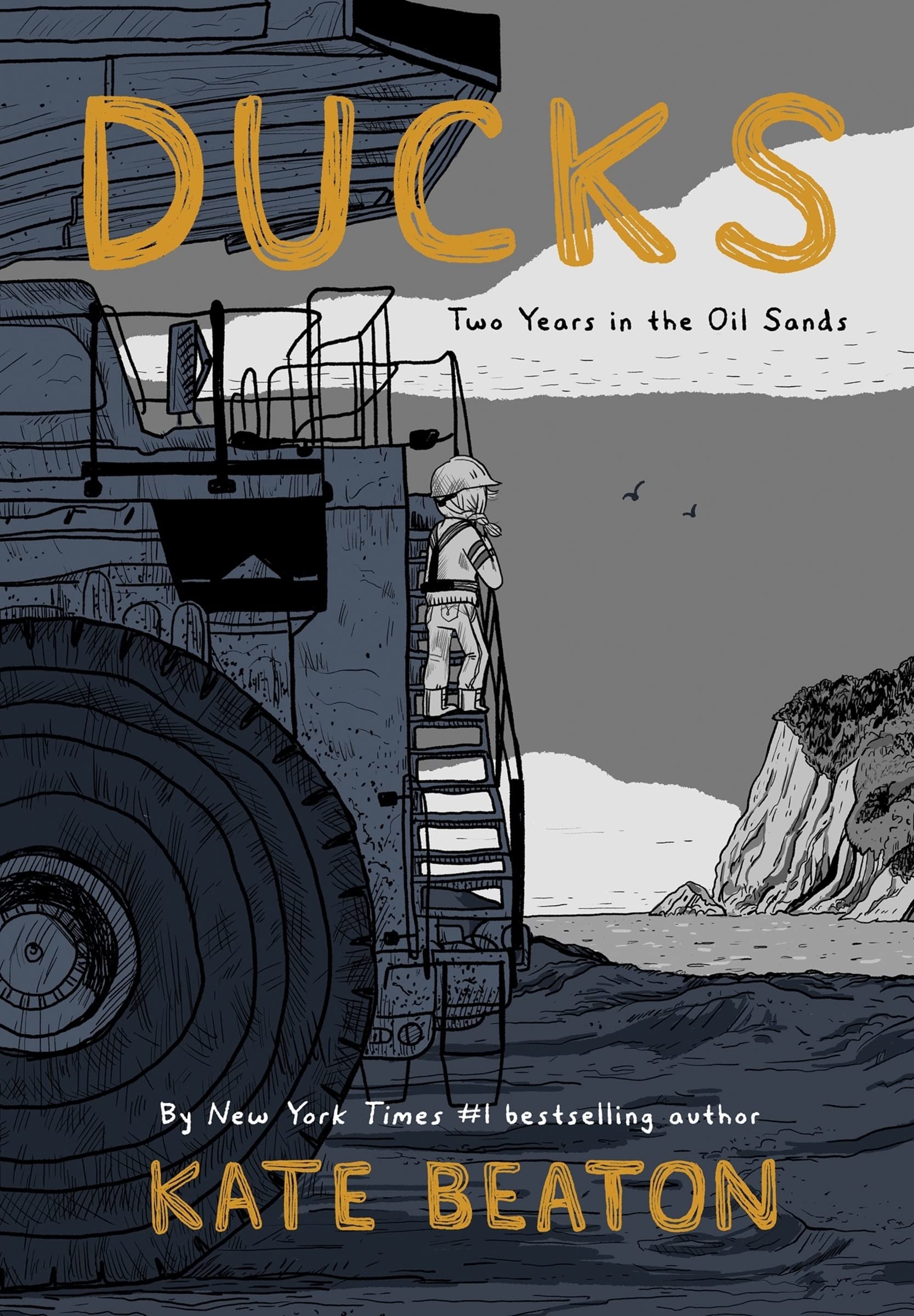
Ducks by Kate Beaton

I’ve waited too long to review Ducks, one of my favorite books of the year. I know this because I’ve already returned it to the library so I don’t have it on hand to consult. In my defense, Chris’s review is so good, I didn’t feel like I had much to add. But in the interest of reviewing everything this year, and not wanting to leave something that will likely make my year end list without a review, here goes.

Ducks is a graphic memoir, recounting the two years cartoonist and writer Kate Beaton spent working in the oil sands of Alberta, Canada. This is, I learned, a common rite of passage for young Canadians, and so, in spite of her family’s concerns, the book opens with Kate at the airport with her mother, about to leave her hometown of Cape Breton for the wild North.

The story is structured around the various camps at which Kate works plus one brief period at a museum in Victoria, and, within those sections, the story is broken up into a series of moments, interactions, and small scale events. The larger narrative emerges as the characters recur throughout various vignettes in different settings, as do the larger thematic concerns, most of which revolve around what it’s like to be one of the only women surrounded by hundreds of men who have largely been freed from the constraints of society.

And it must be said, the picture that emerges of the men here is not flattering. From her first moments in the sands, Kate finds herself being stared at, accosted, insulted, treated as inferior or, worse, as a prize, by seemingly every man she encounters. There are a few exceptions, characters whose names I can’t look up because I don’t have the book handy, and to Beaton’s credit, the portraits that emerge of the men are nuanced and complex--what are we to make of the men who are here working for their families, who gushingly share photos of wives and daughters and then make gross advances? Or of Kate’s boss who makes constant sexist remarks but also acts protectively? Or the hundreds of men with whom she never interacts, the silent majority, perhaps, who keep their heads down, make their money and go home? Beaton confronts this question head on, in a great conversation she has with her sister late in the narrative, but even there, no answers are forthcoming. Something about the isolation, the freedom from censure, the loneliness, the constant stress, causes breakdowns both internal and external, and, like the Safety Pyramid from the repetitive introductory seminars at each camp, these small disintegrations lead to larger disintegrations. Kate asks explicitly the question that the #NotAllMen contingent presumes the answer to: if our dad, our brother, our cousin were here, would they be any different?

The threat of sexual violence hangs heavy over the narrative; even before its explicitly mentioned we, the readers, can feel the looming threat, simply from the ratio of men to women. Later, it’s made more explicit, particularly when Kate visits a strip club with some of the men and learns about the practice of heating a quarter and tossing it at the dancer, with the intent that it hit and burn her genital area. Kate doesn’t know what to say to this; neither do I. But the darkest and boldest moment in the book comes when Kate, drunk at a party after being plied all night with drinks is taken to a back room and raped. And then, mere pages later, it happens again. The second time, Beaton illustrates her dissociation in a way that could exist only here, in the realm of graphic art, as she leaves her body, lets it happen, then tries to forget.

Beaton’s uncanny skill for capturing faces and expression with a few scratchy strokes pays big dividends as the cast grows. Her environments reflect the sameness and repetition of life on the sands, lulling the reading into the same cyclical rhythms without ever becoming visually boring. And the large illustrations, used sparingly, are both beautiful and imbued with meaning: the aurora borealis, the final group photo.

She leaves the sands only twice. Once to work at the aforementioned museum in Victoria, where we witness the birth of Beaton’s famous horse and, implicitly, Hark a Vagrant, her most famous work. And, at the end, when she returns from the sands and reunites with her family. In town, still with her family, she’s seen by a man she worked with on the sands, who says hello then tells her that, while she was stationed at his site, the men had a bet going about who would sleep with her first. She laughs it off, to the shock of her family, who ask why. And, like this book, she doesn’t offer them any answers.

Saturday, January 28, 2023

Ducks by Kate Beaton

I loved Kate Beaton's webcomic series, Hark! A Vagrant. It was erudite without being smug or obscure, consisting of rapid-fire riffs on literature and history, drawn in a charismatic pen-line style. It's funny to learn, from Beaton's graphic memoir Ducks, that the series began while she was toiling in the remote Alberta oil sands, a place where men--almost entirely men--come to pad their bank accounts by working under hard conditions, far away from home. For Beaton, the oil sands were a way to quickly pay down student debt, a brief but difficult experience meant to allow her to pursue her dream of being a cartoonist, as opposed, perhaps, to taking a job as a teacher or in a museum, where she might be more comfortable but never get out from under the debt, or follow her dreams.

For Beaton, the worst thing about the oil sands turns out not to be how remote they are, nor the spartan conditions of "camp" living, nor even the brutal physical ugliness of the tailing ponds. It's the men. The oil sands, like North Dakota's oil towns here in the U.S., are overwhelmingly masculine places, and they are difficult for women. Beaton immediately finds herself the object of unwanted attention: stares and leers, crude jokes, sexual propositions and harassment. Ducks shows well just how wearisome such a life can be, how it can wear one down. Each joke or crude suggestion in and of itself can be written off as men being men, or not a big deal, but they never stop, and they come from every man, even the "nice" ones. These crudities culminate in rape--twice. Writing such a thing into your own memoir, especially when you must actually draw it, and not just write about it, seems to me an act of remarkable authorial bravery. The rapes, we come to understand, are like the "safety pyramid" that illustrates how fatalities and injuries are the consequences of thousands of small negligences: they are inextricable from the larger culture of sexism and unaccountability that pervades the oil sands.

There's an interesting resonance, I thought, between Ducks and Alistair MacLeod's No Great Mischief, which I recently read. Both Beaton and MacLeod are Nova Scotians, Cape Bretoners, and both write about the way western resource extraction peels Atlantic Canadians, many of whom live in generational poverty, away from their homes. For MacLeod, it's the coal mines of western Ontario; as someone explains to Beaton in Ducks, those opportunities have all dried up and Nova Scotians and Newfoundlanders have had to move west, to the oil sands. But both depict the pain and uncertainty of leaving home, and the physically and mentally demanding conditions of this unlovely work. The ducks of the title are those who land in the oil sands' tailing ponds and become stuck in the oil, drowning and being poisoned. In a literal sense, the ducks awaken Beaton to a new understanding the environmental and social catastrophe that the oil sands represent--amplified by watching a local First Nations leader on YouTube--but in another sense, they are a symbol for the Canadians who are drawn to the oil sands' beguiling economic promise.

Beaton's style isn't much changed from the Hark! A Vagrant days: she still has a knack for creating charismatic expressions with a few simple lines only. The workers in the oil sands are cartoonish but wholly human. I liked especially how Beaton uses a simple three-by-three grid, reminiscent of the stacked "episodes" of the old webcomic, which every know and then opens up into a full page scene of massive scope: the Northern Lights over a frozen field, or a "photo" taken from a crane of all the workers at the camp. The oil sands are somehow both immense and confining, a vast landscape and a cramped cage.

Saturday, January 21, 2023

The Years by Annie Ernaux

The year 2000 was on the horizon. We could not believe our luck in being there to see it alive. What a shame, we thought, when someone died in the weeks before. There were rumors of a Y2K computer bug, a planetary malfunction, some kind of black hole portending the end of the world and a return to the savagery of instinct. The twentieth century closed behind us in a pitiless succession of end-of-millennium reviews. Everything was listed, classified, and assessed, from works of art and literature to wars and ideologies, as if the twenty-first century could only be entered with our memories wiped clean. It was a solemn and accusatory time (we had everything to answer for). It hung darkly overhead and removed personal memories of what for us had never been an entity called "the century" but only a slipping-by of years that stood out (or didn't) depending on the changes they had brought to our lives. In the coming century, parents, grandparents, and people we'd known in childhood would be dead for good.

The Nobel Prize Committee, in awarding its 2022 prize to French writer Annie Ernaux, described "the courage and clinical acuity with which she uncovers the roots, estrangements and collective restraints of personal memory." The Years is a book that highlights the tension between the "collective" and "personal" aspects of that sentence: it's a memoir, ostensibly, of Ernaux's life, but one in which the personal is subsumed in the collective. It begins in the post-war boom of France in the late 1940's and ends after the arrival of the new millennium and, shortly after, September 11th. It covers these seven-odd decades, vacillating between two modes. The first is a first person collective "we" that is a kind of memoir of an entire generation ("The speeches said we represented the future"). The second is an estranged third person linked to photos of Ernaux herself, minutely described and imagined ("The raked-back hair, drooping shoulders, and shapeless dress, in spite of her smile, indicate fatigue and the absence of a desire to please").

The effect is one of estrangement, estrangement from one's self, estrangement from the specific, and a flight toward notions of a collective experience. This experience, the collective experience of Ernaux's generation, is defined by political attitudes and rituals of consumption; Ernaux compiles lists of novels, magazines, television shows, films, cosmetics and consumables; these things have as much weight as the protests of 1968 or an increasing disillusionment toward Mitterand. History, such as it's defined, barely touches them; events in Algeria or Vietnam have no reality, or as little reality as anything else. And all of these things, once they become memory, are at risk of total loss: "Everything will be lost in a second," Ernaux writes at the memoir's beginning. As the memoir goes on, details pile up, but so does an increasing awareness of those details' ephemeral nature. What will be left, Ernaux wonders, when the person is gone, and their memory gone with them?

I think The Years might have been more effective for me if I had been French, and had a better idea of what the cultural touchstones of the memoir are. I have a passing familiarity with Charlie Hebdo and "ye-ye" music, but I don't know who Coluche is, or les Guignols. Still, I was fascinated by the general arc of social history The Years presents, beginning with the affluence of the post-war years, moving through the furor of the 1960's, into a late 20th century in which attitudes become soured and ripe for the kind of reactionary politics of Le Pen. The "we" of The Years acts as a reminder, at times, that one is never entirely apart from society's churning; it doesn't matter much whether the Ernaux of the photographs is taken in by Le Pen or not, if her generation is. I got the sense, reading The Years, of history as a kind of ocean that carries one along on its tides

Sunday, January 8, 2023

My Friend Dahmer by Derf Backderf

Ya know what? Dahmer is probably a serial killer by now!


Serial killers are having a moment. Of course, in a sense, they’re always having a moment--American culture has been fascinated with them since they Ted Bundy lured the first woman into his murder van--but they’re extra hot right now, thanks in no small part to Monster, Netflix’s dramatization of the life and deaths of Jeffrey Dahmer, the most famous cannibal in American history.


I haven’t watched Monster (and won’t be, fwiw) but I’ve seen enough clips to know that My Friend Dahmer takes a much different, more distant approach. John “Derf” Backderf went to middle and high school with Dahmer, and witnessed, at only a slight remove, his progression from slightly weird kid to, well, extremely weird kid. The book ends right after Dahmer’s first murder, but Backderf doesn’t recount the murder itself. In fact, aside from a very unfortunate fish, Backderf eschews illustration of any of Dahmer’s violence, focusing instead on Dahmer’s family life, most of which, we learn in the extensive endnotes, he knew of only secondhand, and a handful of notable interaction between Derf and his circle of friends.


The art calls to mind the comix movement of the 60s and 70s, and the influence of Crumb is especially evident; but where Crumb’s art is anarchic and wobbly, Backderf’s is more static, a series of thick-lined snapshots. It’s very effective and genuinely unsettling, especially when depicting something that’s badly “off”.


I learned a lot about Dahmer I didn’t know. His father and mother fought constantly and his mother had seizures and episodes that caused her to shake and produce only incoherent sounds, shakes and sounds Dahmer incorporated into the strange public demonstrations that served as his only real claim to fame in high school. He didn’t really kill animals, by his own account, except for one dog. And his murders and their macabre aftermath were driven by his (sometimes erotic, sometimes seemingly not) desire for “complete control”.


That said, as Chris mentioned when we discussed the book, I’m not sure how much insight there really is into Dahmer himself in this book, possibly even by design. Of more note is the way the interactions between Derf and his friends play out, and what it says about the disturbing and othering ways we tend to treat “freaks”. Derf and his friends spearheaded a group call the Dahmer Fan Club, which mostly consisted of doodling pictures of Dahmer all around the school, trying to sneak him into high school photos where he didn’t belong, and, later, encouraging him to do his spastic character in public so they could laugh at the reactions. The overall impression one gets is that Dahmer was a genuine weirdo, but the group of “friends” treated him as little more than a mascot or sideshow. My Friend Dahmer is, in fact, a very generous title--there’s not much here to suggest that anyone saw Dahmer as a friend. They all saw his drinking, his antisocial behavior, and his offensive odor growing worse but, at least as recorded here, no one so much as asked, “How’s it going, Jeff?” Derf does approach the question a few times, but it seems to me that while he recognizes that no one reached out, he never mentions the ways that he and his friend group exploited Dahmer’s tics for their own amusement.


Does My Friend Dahmer make a cannibal into a sympathetic character? No, it does not, and it’s hard to imagine a story told like this attracting the same sort of the fanfic “I can fix him” crowd that I saw all over Twitter when Monster premiered. Like most narratives about serial killers, this one offers no answers, because really, what could those answers possibly be?


Thursday, January 5, 2023

The Best We Could Do by Thi Bui

Have our parents ever looked at us and felt slightly... disappointed? Such high hopes, so much possibility, to fall short. And though my parents took us far away from the site of their grief, certain shadows stretched far, casting a gray stillness over our childhood, hinting at a darkness we could not understand but could always feel.


We open in a hospital. Thi, the protagonist and author, is having her first child. Her mother, Má, has traveled across the country to be there for her first grandchild’s birth but can’t bear to stay in the room. Her father, Bố, is nowhere to be found, nor are any of her three siblings. A doctor is assisting with the birth, but she’s brusque and implacable. Her husband, Travis, is nearby, but Thi is--or at least feels--alone.


The Best We Can Do is, at heart, is about family--the way our parents, grandparents, and siblings shape us, either by their direct action or, more often and persistently, by the ways their actions shaped others. But it’s more than that too. It’s beautiful to look at, with clean but energetic linework counterbalanced by earthy pastel watercolors varying in hue and presence as the emotional beats of the story ebb and flow.


Although the story always comes back around to Thi, a first generation Vietnamese immigrant who came over on a boat, as a child, during the Vietnam War, the lion’s share of the narrative is given to her parents, Bố and Má, tracing their lives through childhood, college, marriage, exile, and eventually separation. Má, bookish and ambitious, comes from wealth; Bố, street smart and booksmart, grows up beneath a piece of cardboard nailed between two buildings. They meet at college as the war is beginning. Má, in spite of earlier proclamations that she wouldn’t marry, does so anyway, less for love than because she assumes she doesn’t have long to live with the county crumbling around her. Bố, on the other hand, falls for Má right away, but finds himself mostly unable to connect with Má or, for that matter, anyone else. At the beginning of the story, they’re separated and what happened in the intervening years becomes the story, as Thi slowly draws their story out so it can be told.


The middle section, where Má and Bố watch as their lives and their country are ripped apart by the Vietcong and, it must be said, the Americans who treat them scarcely better and tell the story of the war in ways that incense Bố. In one of the most memorable scenes, Bố defends the general from the famous photo, you know the one, taken just before a VC gets his brains blown out. We also learn that the general, after the war, came to the US and spent his last years working at a pizza parlor. And these sorts of details, the straggling conclusions of lives ripped to shreds by circumstances beyond their control, are the controlling throughline.


Yes, Thi builds a good life, but she’s haunted by the sense of otherness she feels, by the ugliness she sees in the American landscape, and, more ominously, the specter of becoming like her parents, of breaking her beautiful baby the way she was broken. The other side of the coin, though, is water--the water coming through Bố’s childhood roof, the lake where Thi learns to swim, the river that carried the “boat people”, the rain when they arrive on the peaceful beach--with its cool implacability, bringing (and taking) with it both the good and the bad. When Má’s third child, Queyen (River in Vietnamese), dies soon after being born, it feels like a repudiation of water as cleansing, lifegiving. But on the final page, the image is redeemed (or maybe just shaded) with a full page spread of Thi’s child, at ten, swimming joyously, unstoppable, as Thi narrates:


What has worried me since having my own child was whether I would pass along some gene for sorrow or unintentionally inflict damage I could never undo. But when I look at my son, I don’t see war and loss or even Travis and me. I see a new life, bound with mine quite by coincidence, and I think maybe he can be free.


Wednesday, November 16, 2022

Six Walks by Ben Shattuck

The idea to follow Henry David Thoreau's walks came while I was standing in the shower at dawn one May morning, listening to the water drill my skull and lap my ears, wondering what I could do to stop the dreams of my past girlfriend. This was years ago, in my early thirties, when I couldn't find a way out of the doubt, fear, shame, and sadness that had arranged a constellation of grief around me. In this last dream, the one that got me into the shower at sunrise, she was in labor. I dreamt that she had a husband--dark-haired, wearing a red shit with sleeves rolled to his elbows--show stood bedside, gripping her hand while she breathed. I stood against the wall, touching a white handkerchief I wanted to offer them.

My wife and I went to Cape Cod last weekend, her first time, my second. It stretches out in the shape of an flexed arm, with the long sand beaches of the Outer Cape running from the knuckle to the elbow. They are beautiful beaches, cream-colored running beneath tall ochre cliffs, looking out on an eternal sea dotted with gulls and eiders and kittiwakes as white and numerous as the little caps of the waves. You're guaranteed to see a seal, and if you're a little lucky, a whale. But only someone who is deeply strange, or deeply damaged, could imagine walking the entire stretch of the Outer Cape, someone like Henry David Thoreau, with a touch of the misanthrope. For Ben Shattuck, who sets out to trace Thoreau's footsteps, the walk offers a way to step out of oneself, out of the sleeplessness of a bad breakup and the chronic misery of Lyme disease. Shattuck is in a bad place when he starts his walk: at the Truro cliffs he eats a bar of clay like a hunk of chocolate.

The Cape Cod walk will become the first in a series of six walks that Shattuck takes, each in the footsteps of Thoreau, who recorded his walks in his journals. The second is a hike up Mt. Katahdin, the towering axe-head in Maine that lies at the terminus of the Appalachian trail. The third is an MDMA-laced trip to the top of Massachusetts' Wachusett Mountain, now a ski resort. The fourth is a walk from Shattuck's Massachusetts' home across the Rhode Island border, in the spirit of a walk that Thoreau took due southwest from his house, not knowing what he'll find. The fifth is a paddle up the Allagash River in far north Maine to a place where Henry camped, one of the few spots that seems to remain true wilderness, and the final one is a return to Cape Cod.

By the time Shattuck makes his return, his life is changed. The first three walks are records of misery, desperate attempts to outrun fatigue and depression. They seem often recklessly unplanned: Shattuck ends up spending the night with a pair of gracious Cape Codders who live near Thoreau's old property, but only by luck and happenstance. The MDMA on Wachusett mountain fails to bring the required transcendence, but it does lead to a moment of détente with a porcupine. But years pass between the first three walks and the second, and in the meantime Shattuck has conquered his Lyme disease and gotten a new girlfriend, an actress named Jenny who, as I was forced to curiously Google, turns out to be SNL alum Jenny Slate. (Honestly: Good work, Ben.) As Shattuck's life improves, the tone of the essays changes; the walks go from being flights from human life to deep engagements with the natural world.

Shattuck is a visual artist, and the essays are dotted with evocative black-and-white charcoal drawings of his walks. He brings an artist's visual sense to the landscapes he and Thoreau share: imagining the heart "the size of a chestnut" in the porcupine: "There's a heart at the center of all animals. Everything is soft underneath." In Henry's words: "A very suitable small fruit." There's the "black wedge" of a whale's mouth, and the way sunlight "raked across" the tops of Wellfleet houses. A coastline is "crenellated." And often Shattuck's language works in service of profound meditations on loss and grief: the most successful of the essays might be the Allagash one, in which Shattuck ties together an alien abduction reported in the area in the 1970's and Henry's loss of his own brother. Henry's guide, a Penobscot Indian named Joe for which Thoreau has little respect, also lost a brother, probably at the hands of whites, and agrees to serve as guide so he can go looking for him, but Thoreau is unable to cross the boundary of race to see a common kinship. These threads, along with Shattuck's own griefs and losses--chief among them the loss of a fingertip on his writing and painting hand--become a strong rope.

I really enjoyed Six Walks. I love reading books set in the places I travel to, and sometimes there is a resonance, but often not. Six Walks made me look at the Cape Cod landscape a little differently: I saw, standing on the thin fringe of beach, how someone might feel at the edge of their life there. I saw the cliffs at Truro, but I didn't stop to eat any of the clay. And I also saw how, standing with my wife and watching a seal roll around in the surf, how different it might be to be at that edge with someone loved.

Monday, June 13, 2022

The Lover by Marguerite Duras

In the books I've written about my childhood I can't remember, suddenly, what I left out, what I said. I think I wrote about our love for our mother, but I don't know if I wrote about how we hated her too, or about or love for one another, and our terrible hatred too, in that common family history of ruin and death which was ours whatever happened, in love or in hate, and which I still can't understand however hard I try, which is still beyond my reach, hidden in teh very depths of my flesh, blind as a newborn child. It's the area on whose brink silence begins. What happens there is silence, the slow travail of my whole life. I'm still there, watching those possessed children, as far away from the mystery now as I was then. I've never written, thought I thought I wrote, never loved, though I thought I loved, never done anything but wait outside the closed door.

A fifteen year old French girl, traveling by ferry from her home in Sadec, Vietnam, to her boarding school in Saigon, meets a Chinese man being driven in a black town car. She is wearing a man's fedora and gold high-heeled shoes. Instead of returning to the school, she goes with him to his home, where she has sex for the first time. The affair they have hastens the mental and physical deterioration of her recently widowed mother, and somewhere in China, in the city of Cholon, the Chinese man's father isn't too happy, either. Their relationship, both troublesome and doomed, emerges from a deep sadness they share, and the adult writer--a narrator, perhaps, but one that seems very close to the real life Duras, writing in her 70's--imagines the whole of her troubled childhood balanced on the pinhead of these moments.

I thought The Lover was a remarkable book. Remarkable in one sense, because you couldn't write it today. I know hack writers and comedians say stuff like that all the time, because they can't handle any kind social progress, but in this case it strikes me as being true. You couldn't write about a relationship between a 27-year old man and a 15-year old girl without making certain ethical prefaces, and you certainly couldn't explore the extent to which she desired the relationship, or how it develops in tandem with a desire for self-annihilation. Nor could you see him, as Duras does, as inherently pathetic, as squashed and bruised by a suffocating family life as the teenager he seduces. It has the benefit of likely being true, and being published after Duras was a known quantity (she was nominated for an Oscar!) and the things that make such a book unlikely are worth the price, in my opinion, but still, such a book seems to speak from a different era.

But remarkable, more importantly, for the quality of the writing, which possesses a superficial simplicity that's quickly complicated by a deeper intricacy that unfolds as the novel unfolds. Duras writes as one remembering a story from long ago, one in which what remains is not the narrative but the images. She lingers on these images--the man's hat, the gold high-heeled shoes, the black town car--layered over one another like transparencies, still moments that come forward and recede, but don't really move. At times I felt like the titular "lover" is really a distraction, only a moment to look through and see what Duras is really interested in, the tortured relationship she had with her mother and two brothers after their father's death, stranded in a strange and foreign country.

In her brothers, Duras describes a Manichaean division of good and evil. You know, like Goofus and Gallant, but with psychic and violent stakes. Her elder brother is a gambler, an amoral thief and destroyer. She describes him as a murderer, though it wasn't ever clear to me if she meant this in a literal or metaphorical sense. She blames the death of her younger brother, the pure and guileless one, on this older brother, even many years after they went their separate ways in life. It's this relationship, really, which hovers just beyond the scene of The Lover, and somehow the relationship between the young Marguerite and the Chinese millionaire's son is a way of looking past it, or not looking at it, or looking at it obliquely. Her younger brother's death, the image held till the end of the book, like something kept at the edge of the mind, gives Duras the chance to write some of the book's finest prose:

It was a mistake, and that momentary error filled the universe. The outrage was on the scale of God. My younger brother was immortal and they hadn't noticed. Immortality had been concealed in my brother's body when he was alive, and we hadn't noticed that it dwelt there. Now my brother's body was dead, and immortality with it. And the world went on without that visited body, and without its visitation. It was a complete mistake. And the error, the outrage, filled the whole universe.

There's a wonderful universality to that, the feeling of grief as an immortality being stolen from the world. One of those feelings that good writing reveals to exist, when you hadn't realized it existed before. But it has a specificity, too, a sense of truth, that reveals the writer behind the images, and which seems like it can hardly be invented. The Lover sits in that uncomfortable space, perhaps, between novel and memoir, and it's not like anything else I've ever read.

Saturday, June 12, 2021

My Autobiography of Carson McCullers by Jenn Shapland

I am hardly qualified to write a biography of Carson McCullers. Who am I to her? I slid my arms up the sleeves of her long lime-green wool coat, I folded her nightgowns, I labeled her socks. I made biscuits in the kitchen of her childhood home and I walked in the park where she used to play by herself. I have read enough biographies to know, in no uncertain terms, that they are built of artifice and lies. I am not a fiction writer, and this is not a biography.

While working as an archivist at the University of Texas' Ransom Center, Jenn Shapland discovered a set of letters from a Swiss socialite named Annemarie Schwarzenbach to the American author Carson McCullers, letters of fondness that don't shy away from words like "love." The discovery led Shapland to embark on the project that would become My Autobiography of Carson McCullers, a project in which Shapland plumbs the depths of McCullers' archives trying to reconstruct her relationships with women like Schwarzenbach and, in her later years, her therapist Mary Mercer, whose letters to and from Carson show too a profound intimacy. Shapland traces McCullers' life, quite literally: first as a researcher-in-residence at the museum that was her childhood home in Columbus, Georgia, and later as a resident at the Yaddo writers' colony in upstate New York McCullers joined a dozen times in her life.

For Shapland, the mission is personal: in recovering McCullers' lesbian relationships, she is able to recognize and affirm her own repressed and uncertain sexuality:

So it isn't about "Is Carson a lesbian?" or "Carson is a lesbian" or "What is a lesbian?" What I want to know is, how have lesbians gotten by and had relationships and found love and community? What does that look like? One answer: If we--writers, historians, biographers--can just start acknowledging the lesbian parts of ourselves and others, maybe we can start to know what it is. What it is to love women. But please, no more demands for certain kinds of proof, no more "doesn't count unless--" bullshit. Don't tell me there's just not enough evidence. Let's call a lesbian a lesbian. Loved another woman. Period. You loved your mother? Lesbian.

There is a danger, Shapland concedes, in applying labels to people who did not or could not apply them to themselves. She pores over an account McCullers provides to Mercer of the time McCullers' abusive husband demanded to know if she was a lesbian. In the moment McCullers demurred, but Shapland sees in the silence and uncertainty around McCullers' the very dynamics of erasure that continue today. She recalls being sat down by the director of the McCullers home and being told that, in no uncertain terms, McCullers was not a lesbian and had no romantic relationships with women--though one can plainly see in the letters and notes Shapland collects that McCullers' intimacy with Schwarzenbach and Mercer, and many others, the pitch and resonance of love. Shapland rejects the constant demands of proof that are made regarding the sexuality of historical figures, as if in the absence of proof of queerness one remains conscripted by heterosexuality.

To my mind, the director's insistence is not only shocking, but silly. When you read McCullers' books, queerness is there on the page: the repressed lust of the army captain in Reflections in a Golden Eyethe love of Singer for Antonopoulos in The Heart is a Lonely Hunter, Biff's androgyny in the same, the wild love of Jester for Sherman in Clock Without Hands. What's the point of looking at all of that and saying, Oh no, McCullers might have written all of that--but she herself could never be queer? The question's outside of my expertise and capacity, but the defensiveness of such a position, regarding a writer whose work is so clearly queer, baffles me. Yet this thought reveals what I found missing in My Autobiography of Carson McCullers: a deeper investigation of her books themselves. They feel sometimes like an afterthought, far less important than the letters and the notes from therapy--which perhaps they are, but they might have provided a richer context than they do.

Still, Shapland does a great job illuminating McCullers' life. Having never read another biography, I had never heard of how tumultuous McCullers' two marriages to Reeves McCullers, a tormented and closeted gay man himself, who once tried to kill her. This marriage, for both obvious and insidious reasons, has apparently captured most of the imagination of McCullers' other biographers. But it's Shapland who shows, in painstaking and thoughtful detail, the love that exists between the lines, for which those other biographers failed to account. At times I did feel like Shapland's identification with McCullers became overpowering--it struck me as sort of cringeworthy, for example, to insist that McCullers would have been excited about the election of Hillary Clinton. But the story that Shapland tells of her own sexuality, which she comes to embrace wholeheartedly by tracing McCullers', proves in the end to be very powerful.

Wednesday, May 19, 2021

Speak, Memory by Vladimir Nabokov

In March of 1919, the Reds broke through in northern Crimea, and from various ports a tumultuous evacuation of anti-Bolshevik groups began. Over a glassy sea in the bay of Sebastopol, under wild machine-gun fire from the shore (the Bolshevik troops had just taken the port), my family and I set out for Constantinople and Piraeus on a small and shoddy Greek ship Nadezhda (Hope) carrying a cargo of dried fruit. I remember trying to concentrate, as we were zigzagging out of the bay, a game of chess with my father--one of the knights had lost its head, and a poker chip replaced a missing rook--and the sense of leaving Russia was totally eclipsed by the thought that Reds or no Reds, letters from Tamara would still be coming, miraculously and needlessly, to southern Crimea, and would search there for a fugitive addressee, and weakly flap about like bewildered butterflies set loose in an alien zone, at the wrong altitude, among an unfamiliar flora.

There's something unexpected about the idea that Vladimir Nabokov would write a memoir. There's no space in a "traditional" memoir for the kind of parlor tricks that populate his novels, and the practice of putting down a real life, faithfully, on the page, seems quite at odds with the many concealed identities of Nabokov's narrators: Charles Kinbote, pretending--maybe--to be John Shade while concealing his identity as an exiled king, or Humbert Humbert entering baroque joke names into the registers of American motels. But now that I think about it, there's something Kinbote-like about Speak, Memory, which is at heart about exile.

One thing that surprised me to learn--though perhaps I knew it once--is that the young Nabokov was quite an aristocrat. His childhood at St. Petersburg was spent at a cluster of family estates, with holidays at country dachas and in Paris; his father, Vladimir Sr., was a minister whose taste for liberal reform disquieted his elders, who thought--quite correctly, it turns out--that he was ensuring his own obsolescence. Nor did I know that Nabokov's father was assassinated by Tsarists, an event that is only lightly touched on here, an event too difficult to write about, perhaps, or in its sheer magnitude lacking in the kind of impressionistic detail that develops the book's theme of nostalgia.

Though I knew Nabokov was exiled by the Bolsheviks, I was surprised at the book's rich cultivation of the early 19th century, rather than the mid-century era I associate with Nabokov's novels. (We overhear, for instance, that Tolstoy has just died.) This world is seen through a veil of nostalgia, so to speak, because we know it is lost, inaccessible not just in the way that all our childhoods are inaccessible. This is the main charge that Nabokov brings against the Bolsheviks, an apolitical charge in a book that seems to take great pains to be apolitical: 

My old (since 1917) quarrel with the Soviet dictatorship is wholly unrelated to any question of property. My contempt for the emigre who "hates the Reds" because they "stole" his money and land is complete. The nostalgia I have been cherishing all these years is a hypertrophied sense of lost childhood, not sorry for lost banknotes.

Among the memoir's many pleasures is Nabokov's loving and detailed attention to the people who made up his childhood life: his hapless Swiss governess known as Mademoiselle, his rigid tutor Lenski. I loved, too, reading about the young Nabokov's love for butterflies. Nabokov's success as a lepidopterist has become a Thing to Know about him, but to read the wistful accounts of Orange Hairstreaks and Poplar Admirables (this is, I believe, Nabokov's winking nickname for those butterflies known as "Admirals") in Speak, Memory brings such knowledge to life. There is a touching bittersweetness in the knowledge that these butterflies have their own climates and regions, and that the exile of young Nabokov separated him from them. And yet Nabokov treats the event itself with a surprising lightness: on the moment he leaves Russia for the last time, he's locked in a chess match with his father, thinking of the girl he's leaving behind. 

Friday, January 15, 2021

Black Elk Speaks by John G. Neihardt

It is hard to follow one great vision of this world of darkness and of many changing shadows. Among those shadows men get lost.

"My friend," said Nicholas Black Elk to the poet and writer John G. Neihardt on his visit to Black Elk's home near Manderson, South Dakota in the 1930's, "I am going to tell you the story of my life, as you wish; and if it were only the story of my life I think I should not tell it; for what is one man that he should make much of his winters, even when they bend him like a heavy snow? So many other men have lived and shall live that story, to be grass upon the hill." And yet, though many Lakota (and Cheyenne and Arapaho) lived alongside Black Elk during the Indian Wars of the late 19th century, few stories in their own words seem to remain. I was struck, actually, reading Neihardt's version of Black Elk's life, that I have never read about these conflicts in the words of those who suffered most in them at all.

There is some controversy, I think, surrounding the question of how much in Black Elk Speaks is Black Elk and how much is Neihardt, and certainly Black Elk's words have been filtered twice over, once through his translator and son Ben Black Elk, and then again through Neihardt's lucid and elegant poetic sensibility. But even taken with a grain of salt, the book is remarkable. Black Elk's life touches upon all the tumultuous events of the Indian Wars, from the skirmishes and assassination of Crazy Horse to the Ghost Dance craze that led ultimately to the killing of Sitting Bull and the massacre at Wounded Knee.

But I loved hearing, too, about Black Elk's journey to the east and to Europe with Buffalo Bill's Wild West Show, complete with his descriptions of Riker's Island ("This made me feel very sad, because my people too were penned up in islands, and maybe that was the way the Wasichus were going to treat them") and Queen Victoria, whom the Lakota call, amazingly, Grandmother England ("She was little but fat and we liked her, because she was good to us"). And I was moved by the Black Elk's description of the starvation and humiliation the Lakota faced at the hands of the United States, who lied when they told the Lakota they would keep their lands as long as the grass grew long and the water flowed. "You can see that it is not the grass and the water that have forgotten," writes Black Elk.

But the story in Black Elk Speaks is not just the story of a Lakota everyman, but a medicine man and a man beset by visions. Black Elk describes having his first vision at nine years old, a cosmic dream of horses, the Six Grandfathers, and the sacred hoop. It isn't until Black Elk is a teenager that he tells anyone about this vision, and a fellow medicine man tells him that a vision is not real until it is danced for the tribe, which he does, ushering in his new identity as a healer and holy man. Black Elk Speaks, too, struck me as a kind of dancing of Black Elk's visions, a way of bringing them into the world.

But the saddest thing about Black Elk Speaks is that, by his own admission, Black Elk's visions had little effect. Speaking from his house near Manderson--a gray box, and not the tepee, whose circular shape signifies wholeness, he points out--Black Elk bemoans himself as "a pitiful old man who has done nothing, for the nation's hoop is broken and scattered," and thinks himself to weak for his visions. Like Dee Brown, Black Elk--or perhaps Neihardt--sees the massacre at Wounded Knee as the end of visions:

I did not know then how much was ended. When I look back now from this high hill of my old age, I can still see the butchered women and children lying heaped and scattered all along the crooked gulch as plain as when I saw them with eyes still young. And I can see that something else died there in the bloody mud, and was buried in the blizzard. A people's dream died there. It was a beautiful dream.

Saturday, May 5, 2018

H is for Hawk by Helen Macdonald

With the plucking of the pigeon came more revelations, as if with its uncovering other things were uncovered.  I thought of the dreams I'd had that spring of the hawk slipping away into air.  I'd wanted to follow it, fly with it, and disappear.  I had thought for a long while that I was the hawk--one of those sulky goshawks able to vanish into another world, sitting high in the winter trees.  But I was not the hawk, no matter how much I pared myself away, no matter how many times I lost myself in blood and leaves and fields.  I was the figure standing underneath the tree at nightfall, collar upturned against the damp, waiting patiently for the hawk to return.

Helen Macdonald's father died suddenly, of a heart attack, along the Thames while taking photographs.  He was a photographer.  It was his job to photograph things, to notice and capture them; and it's a similar talent that Macdonald exhibits in this finely noticed account of grief and loss.  Macdonald is a Cambridge academic and an amateur falconer (are there professional ones?) and the way she copes, or attempts to cope, with her father's death is through the challenge of training a goshawk, a bird known to be notoriously bloodthirsty and difficult.

What does the hawk, named Mabel, have to do with the father?  That's not an easy question to answer, because H is for Hawk gives a picture of Helen in the process of figuring out her own motives and motivations.  She offers up several explanations for what she's trying to accomplish with Mabel, and rejects some and modifies others.  At the same time she presents a reading of T. H. White's The Goshawk, a book written about the closeted man's attempts to do the same thing while drastically underinformed and underprepared.  Her analysis of White is as lucid and thoughtful as you might expect from a literary critic, but it's hard to shake the feeling sometimes that White's presence in the text makes one dead man too many.

I say that not to criticize, but to ponder the way that H is for Hawk captures the essential messiness of grief, the alienation it provokes from one's own feelings and thoughts.  H is for Hawk can be all over the place, but that doesn't feel wrong, and it's kept together by the strong throughline of the narrative--woman trains hawk--and the unfussy beauty of the prose, evidence of Macdonald's other career is a poet.

Few other books capture the feeling of bereavement so well.  "The memories," she writes, "are like heavy blocks of glass.  I can put them down in different places but they don't make a story."  She says she's been crashing her father's car, scraping it against walls.  Is it because she's trying to punish her absent father?  No, she says--it's that she no longer understands the shape of the car.  She writes with a chill:

There is a time in life when you expect the world to be always full of new things.  And then comes a day when you realise that is not how it will be at all.  You see that life will become a thing made of holes.  Absences.  Losses.  Things that were there and are there no longer.  And you realise, too, that you have to grow around and between the gaps, though you can put your hand out to where things were and feel that tense, shining fullness of the space where the memories are.

In some respect, Mabel is something to throw herself into, a distraction.  In another, she's a familiar kind of figure: a female companion who helps the traumatized protagonist heal through her companionship.  (Reading the old 19th-century accounts of falconers who excoriated goshawks, she recognizes the male tropes of sulkiness and mysteriousness that get applied to women.)  In another, she's a metaphor, the father who is lost among the clouds, but who will return at the call of a whistle as trained.  And perhaps not least she is an escape, a running from the world of men and women into a closed society of woman and hawk that occludes healing as much as it fosters it:

"Nature in her green, tranquil woods heals and soothes all afflictions," wrote John Muir.  "Earth hath no sorrows that earth cannot heal."

Now I knew this for what it was: a beguiling but dangerous lie.  I was furious with myself and my own unconscious certainty that this was the cure I needed.  Hands are for other human hands to hold.  They should not be reserved exclusively as perches for hawks.  And the wild is not a panacea for the human soul; too much in the air can corrode it to nothing.

She likes that line so much--"hands are for other human hands to hold"--that she repeats it at least once.  It has the pithiness of an aphorism, or a bromide, but Macdonald has earned it.  The novel ends with Mabel placed in an aviary, where she will moult for the summer, and Helen distraught, a repetition on a smaller scale of the mechanics of loss.  But it's tempered by the suggestion that Helen will return to friendships and to human life.  It's a vision of healing that is honest, and never too pat or neat.

To be honest, I wasn't sure they wrote books like this anymore, much less turned them into bestsellers.  There's an Oxbridge fussiness to it, a Victorian solipsism borrowed from White and  other falconers that Macdonald reads about.  (And despite Macdonald's insistence that austringers, hawk-trainers, are thought of as a lower breed than genteel falconers, it's hard for this American to see the pastime as anything but tweedy.)  But its beauty and honesty make it a book out of its own time, and one I'm grateful to have read.

Thursday, August 10, 2017

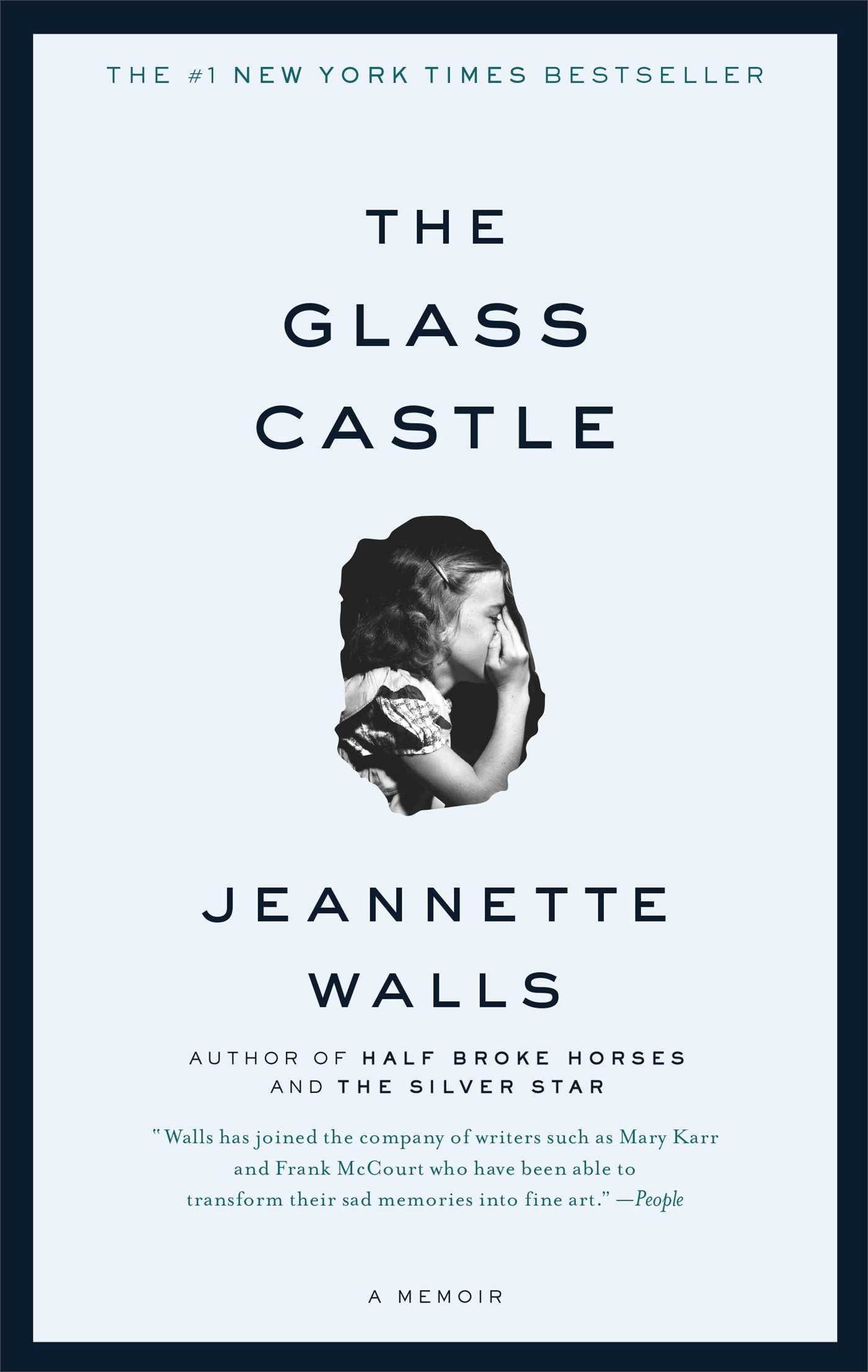
The Glass Castle by Jeanette Walls

We might enroll in school, but not always.  Mom and Dad did most of our teaching.  Mom had us all reading books without pictures by the time we were five, and Dad taught us math.  He also taught us the things that were really important and useful, like how to tap out Morse code and how we should never eat the liver of a polar bear because all the vitamin A in it could kill us.  He showed us how to aim and fire his pistol, how to shoot Mom's bow and arrows, and how to throw a knife by the blade so that it landed in the middle of a target with a satisfying thwock.  By the time I was four, I was pretty good with Dad's pistol, a big black six-shot revolver, and could hit five out of six beer bottles at thirty paces.  I'd hold the gun with both hands, sight down the barrel, and squeeze the trigger slowly and smoothly until, with a loud clap, the gun kicked and the bottle exploded.  It was fun.  Dad said my sharpshooting would come in handy if the feds ever surrounded us.

The first surprising thing, for me, about Jeanette Walls' The Glass Castle was the epigram: "Dark is a way and light is a place."  It's from Dylan Thomas' "Poem on His Birthday," and I have the very same line tattooed on my left arm.  When people ask what it means, I tell them it means, "everything is going to be okay."  But it can't mean us much for me as it does for someone like Walls, whose story of her tumultuous childhood with her shiftless, selfish, and frequently homeless parents, has a lot of dark ways and very few light places.  (Makes you wonder if she considered, and rejected as too mean, Philip Larkin's line about parents: "They fuck you up, your mum and dad.")

Her father Rex is an autodidact, a self-proclaimed genius who loves to live off the grid.  They flit from one small town in the Southwest to another, where her father takes odd jobs as an electrician so that he can support his more important efforts, like building a machine called "The Prospector" to help them pan for gold.  The titular "Glass Castle" is a home with transparent windows and walls that Rex promises Jeanette they'll build one day.  A lot of dads make hollow promises, but how many carry actual blueprints in their pockets?  His real intelligence blurs with selfish bragging; much of the time he claims to be investigating the nefarious unions that keep him out of work, he's actually at the bar, nursing his alcoholism.

Rex Walls is so similar to some of the other "bad dads" in the books I've read the last couple of years--Sam Pollit in The Man Who Loved Children and Allie Fox in The Mosquito CoastLike those two, he may actually be a genius, but his brains are dwarfed by his vast selfishness which puts his family repeatedly at risk.  But, unlike those two, he has the special and curious quality of having actually existed.

Walls' mother Mary is an artist and sometimes teacher who makes it clear to her children that they are a burden, part of a life that she never really chose for herself.  When the Wallses move back to Rex's home of Welch, West Virginia, she refuses to find work, even though teachers are in short supply and her family is nearly starving.  That's not an exaggeration--at times, Jeanette and her siblings surreptitiously pull food out of the trashcans at school just to make it through the day.  Jeanette and her sister Lori start a fund to help them move to New York and escape the turbulence of their life, only to have their father break their piggy bank and steal the money for booze.

Later on, when Jeanette finally does make it to New York, her parents follow her there and become effectively homeless.  They sleep in parks, or in shelters, and end up squatting in an abandoned apartment on the Lower East Side.  Jeanette tells her mother that she's worried about her, but her mother counters, "I'm worried about you"--as if the bourgeois values that Jeanette aspires to are a violation of the spirit of adventure with which she had been raised.  There is a faint suggestion that things were not all bad--we get a sweet story of her father "claiming" the stars for her in lieu of a birthday present, and another where they traipse around the desert fighting an imaginary demon.  The trailer for the upcoming film suggests to me that the rascally-but-free-spirited qualities of Jeanette's parents will be played up, in contrast to Brie Larson's dour boogie face.  But it seems to me that whatever value is in the Wallses' free spirited nature fails to balance letting their children go unschooled and hungry.  As difficult as her life was, Jeanette is no more able to detach herself from her parents, or condemn them, than any daughter might.  I suspect other readers like me don't have any of those compunctions.

Not that she absolves them completely.  There's an interesting parallel between this and another non-fiction book making the rounds this year, J. D. Vance's Hillbilly Elegy, partly because Walls' story ends up in the Appalachia that is the setting of Vance's book as well.  But just as Vance, having grown up among broken families in Ohio, is reluctant to lay the blame on structural problems rather than personal failures, Walls confronts a professor at Columbia who claims that the poor don't really want to be poor:

"I think that maybe sometimes people get the lives they want."

"Are you saying homeless people want to live on the street?" Professor Fuchs asked.  "Are you saying they don't want warm beds and roofs over their heads?"

"Not exactly," I said.  I was fumbling for words.  "They do.  But some of them were willing to work hard and make compromises, they might not have ideal lives, but they could make ends meet."

Professor Fuchs walked around from behind her lectern.  "What do you know about the lives of the underprivileged?" she asked.  She was practically trembling with agitation.  "What do you know about the hardships and obstacles that the underclass faces?"

The other students were staring at me.

"You have a point," I said.

The professor's not wrong.  But there's a lesson here about judging books by their cover, and a deeper lesson that warns us about some of the condescending and infantilizing language of our most cherished liberal platitudes.  But mostly it's a condemnation of Walls' parents, whom she loves despite the chaos and ruin they inflicted on her.  That takes quite a bit of strength of character, I think.

Tuesday, July 28, 2015

Yes Please by Amy Poehler

There are moments in this book that Poehler infuses with such reflection, honesty, and humor that it is impossible not to love it. Descriptions of family and friends, of her early life in comedy are some of the best. It is clear that she is a comedienne through and through--everything in her life, including the pain of losing a childhood friend's mother to cancer, is seen through the filter of her humanity and comic genius. In some places these reflections fall flat.

It felt to me that she isn't fully comfortable in the spotlight. Her descriptions of the set of Parks and Recreation seem to be included simply to meet the expectation that they will be. It's such a cursory treatment, that I wished she had omitted it entirely. The chapter in which is discusses her resentment of those trying to take what she views as shortcuts to enter "the business" felt forced and preachy. It was ungracious to jump on someone who dropped a screenplay on her lap on a commute (it is beyond obvious that this person was rude and disrespectful). I didn't need her to tell me that she worked hard to achieve her level of success--she showed that beautifully in other places in the book. This treatment simply made her seem out of touch with those who haven't made it.

The only thing about the book that I found unforgivable, however, was her seeming distaste for the task. She calls herself on it in the preface. But that honest reflection did not warm me to the moments she felt the need to point out that "writing a book is hard" or is "no fun." Again, this is something I already know, and perhaps I'm a reading snob, but I believe writing is like figure skating: those who do it best make it look easy. Every time she mentioned this, it pulled me up short and diminished the fun I was having reading the work.

The book was disorganized and jumpy, almost to the point that I wanted to pull out my red pencil. After a little while though, I realized that quality added to the fact that the book is a great representation of the human who wrote it: silly, scattered, energetic, and flawed. While there are parts that are dull, forced, or cringe-worthy, it is clear that Poehler's approach to life requires that she include them. Like any good improv actor, she can leave nothing on the table.
    

Tuesday, January 13, 2015

Curriculum Vitae by Muriel Spark

It was in Africa that I learned to cope with life.  It was there that I learned to keep in mind -- in the front of my mind -- the essentials of our human destiny, our responsibilities, and to put in a peripheral place the personal sorrows, frights, and horrors that came my way.   I knew my troubles to by temporary if I decided so.  There was an element of primitive truth and wisdom, in that existence in a great tropical zone of the earth, that gave me strength.

Muriel Spark's life contained quite a lot of interesting stories.  She worked at Bletchley Park, the famous English intelligence station during World War II (you may have seen Alan Turing in The Imitation Game).  She lived in colonial Africa, at a time when tensions between Africans and their colonizers were high.  Half-crazed by diet pills, she once thought that T. S. Eliot was sending her cryptic messages through his plays.

But if you're looking for in-depth treatment of those years in her autobiography, Curriculum Vitae, you'll be disappointed.  Spark is as eager to get out of the Africa section of the novel as she was to get out of Africa; the Eliot mania gets a sentence or two.  The Bletchley Park stuff is well served enough, but it pales in length and detail compared to the sections on her childhood in Edinburgh, which are wistful and overlong, lingering on every teacher and school chum that Spark can remember.

In other words, as a biography, Curriculum Vitae isn't much.  How did Spark feel about choosing to separate from her young son, who went to live with her parents during the war, and with whom she had a famously tense relationship through his adult years?  Either not much, or whatever she did feel hasn't made it in here.  Curriculum Vitae isn't the kind of memoir that spends its time hand-wringing over past actions; I suspect that Spark wasn't that kind of person, either.

The most interesting parts, to a reader of Spark's novels, are the brief insights to the origins of her novels: The Helena Club becomes the May of Teck Club in Girls of Slender Means; her experience battling literary fogeys at the Poetry Society becomes the plot of Loitering with IntentSpark gives credit for her terse and "managerial" prose to the technical instruction she had in college, though her peers thought her choice of school was strange.  And best of all, Spark goes on at length about her grade school teacher Miss Kay, who would later become the basis of her most famous character, Jean Brodie.  Miss Kay has all her charisma, but there's no hint of Jean Brodie's malevolent or controlling tendencies.  It makes me wonder if Miss Kay ever knew what Spark, who speaks so warmly about her class, had made of her.

The narrative ends as soon as Spark publishes her first novel.  This suggests we are meant to read Curriculum as a memoir about her formation as an artist--there's a long German word for this I forget--and dissatisfying as it is, since the hallmarks of her art are terseness, disinterest, and reticence, I guess it's hard to imagine it being any other way.

Friday, May 10, 2013

Immortal Bird by Doron Weber

I have struggled with what to say about this book for the past couple of days. It is not that I am having trouble organizing my thoughts, but that my thoughts fall squarely into two categories. I am having trouble rectifying these two, rather disparate, groups of thoughts. To fully explain the quandary that I am in, I have to talk about the book in such a way as to give away some of what happens.

Immortal Bird is a account of Damon, a young boy with serious health problems. I can't fathom the stress and heartache that Damon and his family went through. The author, Damon's father, does an excellent job of conveying the uncertainty of a life lived with such a serious heart condition. He chronicles what Damon went through as he struggled with various disorders and illnesses related to and exacerbated by his condition. The book draws to a close with Damon slowly passing from this earth in an ICU, surrounded by the love of his parents. The last few pages of the book were absolutely gut-wrenching.

It's hard to bring myself to type the next sentence, in light of what I have just described in the previous paragraph. However, I had a number of issues with the writing. All too often there was a self-serving and even pretentious tone to the writing. There were many sentences like this one: "I've written a couple of medical books, I work with top scientists and researchers, and I'm relentless in my digging." There were many places where I found myself thinking that the book was just as much about Doron as it was about Damon. I know if seems ridiculous to accuse a man who has written a book about his son's death of self-promotion, and let me be clear, I am not doing that. I am simply saying that there many points throughout Immortal Bird where I cringed at something I read. I think the problem may have been that editors struggled with the same thing I am struggling with. How do you critique a book such as this? How do you tell this father that he should change this line or that line because it sounds to self-serving? I don't envy the position they were in.

I don't know who among my friends and acquaintances I would recommend read this book. This is not because of the issues I had with the writing, but because of the nature of the story. A book such as this would crush someone like my mom. Its grief would be too much for her to handle. I do feel that this should be required reading for medical students. The experiences the Weber family went through at hospitals and doctors offices could provide valuable instruction for those going into any medical profession that interacts directly with patients.

Tuesday, October 30, 2012

And Now We Shall Do Manly Things by Craig J. Heimbuch

Craig Heimbuch could almost be me. We were both born in the Midwest, to families and cultures that were more outdoorsy than us. We both have an unnatural, borderline prejudicial fear of rednecks. We‘ve both fought insecurities about financial stability, fatherhood, our relative manliess. The difference between us is essentially this: To combat his insecurities, Heimbuch took up hunting. I decided to read 50 books a year, which isn’t as memoir-ready.

And Now We Shall Do Manly Things is essentially summarized above, the through-line being Heimbuch’s journey from freelance writer to freelance writer with a gun. As with most “I did this” memoirs, the tone is light, but there’s a real pathos to the early sections, where Heimbuch reflects on his own history, from marriage through childbirth, and a poignancy to his description of his parents and extended family—outdoorsmen all— people he clearly loves but feels disconnected from in some essential way. Everyone has felt it, the sense of otherness, and Heimbuch, at his best, captures the feeling wonderfully. At his worst, he attempts to inject humor that just doesn’t work—most of the fictional conversations played out like vaudeville routines with no punchlines—but for the most part, I laughed where I was supposed to, and the book read amazingly fast.

The big question I had, coming into the book, was this: would it change my mind about hunting? I’ve always thought hunting for sport was kind of stupid at best, and kind of barbaric at worst—though I’m sympathetic to the idea that, if left unhunted, deer would overrun the world like so many graceful vermin—and I was genuinely hoping to have my perspective enlarged. To an extent, it was: Heimbuch’s discussion with various hunters made sense, especially the oft-repeated bromide that “if you’re willing to eat meat, you should be willing to kill it”, and, by the end of the book, I was rooting for him to finally get his elusive pheasant. On the other hand, the descriptions of field-dressing turned my stomach and I’m not planning to start hunting myself anytime soon, so, I don’t know... maybe I should be vegan?

I’m glad I read And Now We Shall Do Manly Things. It’s likely not a book I would have sought out myself (I received a free review copy), and it’s helped me understand a mentality I’ve been around but have never really understood. If I were feeling hyperbolic, I might even say it’s caused me to reconsider my own life and what it means, to me, to be a man. Maybe I’ll write a book about it.

Friday, July 20, 2012

I Hardly Ever Wash My Hands: The Other Side of OCD by J.J. Keeler

"I have always imagined my obsessions to be like little demons working inside the brain: the have little faces and bodies and work inside cubicles. Sometimes, a particular demon endorsing a specific obsession will get a promotion. He will be moved to a bigger office, get a little demon secretary, and suddenly have a lot more influence."

With I Hardly Ever Wash My Hands, J.J. Keeler gives readers a glimpse inside the mind of someone with obsessive-compulsive disorder. As someone with OCD, Keeler is able to describe how the disorder has effected her on a daily basis for much of her life and how she has been able to manage.

The book is essentially a memoir. Keeler takes us through some of her experiences coping with OCD at various points throughout her life, and she manages to do so with a good deal of humor and wit. As a young child, she was obsessed with contracting AIDS and for weeks was convinced that a stuffed teddy given to her by a neighbor had a bomb implanted inside of it. As she grew older, so did her obsessive fears. They transitioned into a fear of inadvertently causing a car accident and incredibly detailed harming obsessions.

I had never heard or read of harming obsessions before this book. According to Keeler, they are not uncommon among those suffering from OCD. Keeper started fearing that she would stab strangers as she walked past them, intentionally hitting pedestrians with her car, and strangling people. She makes it clear that these are not fantasies, but rather fears. She does not wish to do these things, but is terrified that she will or in many cases, already has. Driving over a speed bump in her car meant spending the next few minutes checking her mirror and even pulling over or circling back to verify that she hadn't run anyone over.

I particularly enjoyed the chapter "A Talk with God." Keeler explains how some aspects of religion can exacerbate OCD. As she puts it, "The problem with being religious and having OCD is an underlying, and unrelenting, need to know." When her grandmother was in the hospital, Keeler started praying for her to get better. She crafted meticulous prayers that had to be said just so in order for them to have the desired effect. If she messed up, even in the slightest way, she would start over from the beginning.

Keeler isn't someone who blames the everyday worries of life on OCD. As she says, "A lot of the time, people with OCD have fears and worries that have nothing to do with being obsessive-complusive--they merely have to do with being alive."

The final chapter of the books is directed at those with OCD. Keeler imparts some advice and tricks--some of them quite interesting--that have helped her manage. Despite this last chapter, the book doesn't strike me as having been specifically written for those with OCD. Keeler wants to dispel some of the misinformation and challenge the stereotypical portrayals of the disorder in films and television. Toward the end of the book, Keeler states, "If there is one thing you take away from this book, I hope you learn that OCD is not a disease as cut and dry as people think."