Sunday, October 29, 2023

A Gate at the Stairs by Lorrie Moore

From our perspective that semester, the events of September--we did not yet call them 9/11--seemed both near and far. Marching poli-sci majors chanted on the quads and the pedestrian malls, "The chickens have come home to roost! The chickens have come home to roost!" When I could contemplate them at all--the chickens, the roosting--it was as if in a craning crowd, through glass, the way I knew (from Art History) people stared at the Mona Lisa in the Louvre: La Gioconda! its very name like a snake, its sly, tight smile encased at a distance but studied for portentous flickers. It was, like September itself, a cat's mouth full of canaries. My roommate, Murph--a nose-pierced, hinky-toothed blonde from Dubuque, who used black soap and black dental floss and whose quick opinions were impressively harsh (she pronounced Dubuque "Du-ba-cue") and who once terrified her English teachers by saying the character she admired most in all of literature was Dick Hickock in In Cold Blood--had met her boyfriend on September tenth, and when she woke up at his place, she'd phoned me, in horror and happiness, the television blaring. "I know, I know," she said, her voice shrugging into the phone. "It was a terrible price to pay for love, but it had to be done."

After three books, I see what Lorrie Moore is up to. She wants to make us laugh, and then devastate us. We're not supposed to see it. I'm onto you, Lorrie. In this case, the set-up centers on Tassie Keltijn, the daughter of a small organic farmer who enters a college that looks and sounds suspiciously like the University of Wisconsin. Tassie takes a job as a nanny from a woman named Sarah, but she starts before the baby arrives: Tassie and her husband Edward are trying to adopt. She's whisked off on a flight to Green Bay to pick up a biracial child who becomes Tassie's charge. Tassie becomes enamored with the girl, who begins as Mary, extended to Mary-Emma, then just "Emmie," and she finds herself fascinated by the steely, middle-aged Sarah, who seems alternately impossibly self-assured and strangely desperate.

A Gate at the Stairs has all the hallmarks of a coming-of-age novel: Tassie, on her own for the first time, looking to Sarah and her unconventional family, contemplating Sarah as a model--or a warning. Tassie is wry and jocular, in a way that sometimes sounds a little too much like Lorrie Moore, and not enough like a 20-year-old, even a particular observant or knowledgeable one. Moore has a real gift for the humorous detail, one that thrives on a brisk pace: not every joke lands, but before you have time to think about it, she's onto the next one. And Tassie is growing up in a rapidly changing world: 9/11 has rapidly transformed the country, and though the Twin Towers and the war may seem distant from this Wisconsin college town, it intrudes upon Tassie's life in surprising ways, not least of which is her younger brother's decision to join the army when he graduates from high school. 

From there Moore ushers the reader into a series of utter shocks--spoiler alert: first, Tassie's new Brazilian boyfriend Reynaldo turns out not to be Brazilian at all, or Reynaldo, but a young Muslim en route to vague missions in the U.S. Sarah admits to Tassie that she has a horrible secret: she and Edward once had different names, which they changed after running over their own son in a horrible and negligent car accident. (The parallel between Reynaldo and Sarah--the hidden identity, the assumed name--stands out, and contribute to the feeling that Tassie's life has destabilized, become uncertain.) When the adoption agency discovers their deceit, Mary-Emma is taken away from them, and never seen again. Finally, Tassie's brother is one of the first servicemen killed in Afghanistan. In one bold scene, Tassie climbs into her brother's coffin, feeling his mangled body, stuffed with replacement parts because he was blown apart, and is accidentally whisked away inside the coffin to the graveside. It's a scene that probably shouldn't work, but the fact that it does is testament to Moore's writerly skill.

I've had a similar experience with all the Moore novels I've read, which include this, Who Will Run the Frog Hospital? and Anagrams: I start impressed by the writing, if a little impatient with how loose and silly it can be, and by the end I'm absolutely devastated. Moore writes like that, I suppose, because sometimes life is like that, with humor and grief mixed in unequal measure.

Saturday, October 28, 2023

The Game by A. S. Byatt

Cassandra did not look at him: she said, 'It seems sufficiently clear to me--to me--that you can both destroy and create reality with fiction. Fictions--fictions are lies, yes, but we don't ever know the truth. We see the truth through the fictions--our own, other people's. There was a time when I thought the church had redeemed fiction--that the Church's metaphors were truths--but lately that's seemed meaningless. Dangerous even, like any other fiction. We feed off it. Our fictions feed on us. 'And to deform and kill the things whereon we feed.' I don't know quite why Coleridge should have found the serpent's method of indigestion so peculiarly repellent... but it's a powerful metaphor..."

Julia is a successful author of domestic novels. She has a habit of drawing too heavily from life; her daughter and husband are resentful of the way their lives are often transformed into scenes of patriarchal oppression. Her sister, Cassandra, is an Oxford don of medieval studies. Once upon a time, Julia and Cassandra were a pair of imaginative siblings who bonded over "The Game," a medieval fantasy with carved pieces and an oilskin map they created together. Their present occupations can both be seen as an outgrowth of "The Game": Julia taking up the spirit of fiction, Cassandra retreating into the relative surety and safety of history and literature. As teenagers, the sisters grew apart because of their shared love of Simon, a young man who has since become a renowned nature presenter on TV, like David Attenborough. The sisters watch his programs religiously, and hate each other.

The Game throws Julia and Cassandra back into each other's lives, first through the death of their father, and then the return of Simon, who wants to reconnect with the sisters, but has troubles and anxieties of his own. Julia and Cassandra continue to treat each other in ways that are somehow both abominable and subtle--cold, dismissive Cassandra; Julia, who fashions a version of her sister and Simon into a new novel that threatens to make everyone miserable.

The strength of A. S. Byatt's novels and stories, in my opinion, has always been the way they draw on literary and artistic sources: the imitations of Rossetti and Browning in Possession, Lord Byron in Angels & Insects, Matisse in--well, The Matisse Stories. The Game makes a few gestures at medieval literature and philosophy, especially in Cassandra's work, but it doesn't really have an extratextual interest. "The Game" is something of a red herring, an important bit of context for the sisters' relationship, but never really explained or explored in a way that would provide another layer, as in those other novels. It's almost as if The Game is an opportunity to see Byatt as a pure novelist, writing a work with no references. The results are pretty middling, I think; what we're left with is a kind of Murdoch-ian novel of ideas in which the ideas themselves often feel absent.

The lack of a Byattesque textual reference is sort of strange, given how important the idea of "fiction" is to The Game: as in the passage quoted above, Cassandra struggles to understand how much our understanding--of life, of people--is purely fictive. She concludes that our lives are entirely fictional, that like Julia, we can only see through the fictions we create. It's this idea that Simon, who was once studying to become a priest, has run from, into the arms of cold, factual science. When Simon sees a snake, he sees only the animal--not, as Cassandra might, a symbol of sin, or death, or duplicity.

There is an interesting thread, too, with Julia's husband Thor, a Swedish Quaker--Julia and Cassandra are brought up Quakers, too--who is so obsessed with the need to do good that he invites a disadvantaged family to stay at their home without asking or informing Julia. He presses Julia to uproot her life and move to the Congo, where they can do more "good," and finally angrily leaves her because her commitment to "good" is not as total as his is. This was, I thought, one of the most interesting things about the book: an exploration of the limits of "the good" and the competing obligations we have to our immediate family and the larger world. But I struggled to see the connection between this thread and the central love triangle. Mostly, I thought The Game was a little too cold, too think-y, without the fun literary pleasures that define Byatt's best novels.

Friday, October 27, 2023

Dhalgren by Samuel R. Delany

They exhaust my eyes. My ears are on fire. There is nothing left to watch but fire and the night: circle within circle, light within light. Messages arrive in the net where discrete pulses cross. Parametal engines of joy and disaster give them wave and motion. We interpret and defeat their terms by terminus. The night? What of it. It is filled with bestial watchmen, trammeling the extremities and the interstices of the timeless city, portents fallen, constellated deities plummeting in ash and smoke, roaming the apocryphal cities, the cities of speculation and reconstituted disorder, of insemination and incipience, swept round with the dark.

Something has happened in Bellona. We don't know what it is--maybe nobody does--but it has turned the Midwestern city into a place isolated from the rest of the country, without government or utilities, cut off from commerce, largely abandoned. Gangs of "scorpions," petty thugs hidden in giant hologram animals, roam the street. Geography shifts; streets and neighborhoods change places. A second moon appears in the sky; a new sun absorbs the sky and threatens to set everything on fire. A man makes his way into this city wearing only one shoe and unable to remember his name. Called "The Kid," he takes up with a commune living in the park, then with a nest of scorpions, who make him their leader. He gets a girlfriend, and then also a boyfriend, and he writes a book of poetry, which becomes--well, not a bestseller, because money in Bellona is no good, but whatever the equivalent is.

What is Dhalgren? It's science fiction, maybe. The scorpions, the second moon, the claw-like "orchid" he wears for protection, all seem like images taken from old pulps. Stylistically, Dhalgren lies somewhere between those pulps and Beat writing, with a dash of the exploitation movies of the 1970s. Bellona is post-apocalyptic in its way, though I'm not sure I've ever seen a self-contained dystopia, one that crumbles while the rest of the world trucks on as usual.

What is Dhalgren? Well, it's long for one--my copy is exactly 800 pages. It's very metatexual: the notebook that the Kid discovers, and scribbles his poems in, seems to be a copy of the book itself. After the successful publication of "Brass Orchids," a critic who's seen this notebook--we're never allowed to see any of the Kid's poems ourselves--remarks that he thinks they've been cribbed right from the notebook, which means that the character is somehow a collaborator in the work itself, which is also therefore circular, feeding on itself. Like Finnegans Wake, the final sentence wraps around to the beginning. The last section is, ostensibly, a facsimile of the notebook itself, written in the first person and crowded with disordered fragments. What is text and what is commentary, exactly? And how does the fragmented writing capture the fragmented self of the Kid, who does not know his identity and who frequently "loses" hours and days in time?

I want to make a suggestion: Dhalgren is about, among other things, the city of the 1970s. Bellona is less the Thunderdome than Cleveland or Detroit, emptied out by years of white flight and suburbanization, and with the coffers so empty that the normal course of life threatens to break down. The scorpions that Kid hangs out with--who have evocative names like Copperhead, Filament, Tarzan, Glass, Dragon Lady, Lady of Spain--are undoubtedly violent, going on "runs" for food and supplies that make little distinction between homes that are occupied and those that aren't, but they also provide community for each other, in the manner of an urban underclass who have been shunted aside. Bellona's disintegration is a catastrophe, but also an opportunity: it allows the family unit to be reimagined. The scorpions follow a kind of free-love philosophy that allows Kid to have his throuple with Lanya and Denny. (Much of the book's second half is taken up with scenes of tedious, queasy sex. Let's pass over the fact that Denny is fifteen.)

Not everyone can embrace the change. The best parts of Dhalgren, in my opinion, come when the Kid, new to the city, is given a job moving furniture from one floor of an apartment building to another for a middle-class family. The mother stays inside, clinging to a version of normalcy. Her husband pretends to go to work each day, because there is no work. (For that matter, there is no good reason for Kid to have a "job," when their money--which they plan to stiff him anyway--is good nowhere in Bellona.) But their daughter June is obsessed with George, a charismatic character from Bellona's Black neighborhood, and whose immense penis, for reasons that were never clear to me, is plastered on posters all over town. When her kid brother discovers the poster, June may or may not push him down an empty elevator shaft with a rolled up carpet. This is the novel's most shocking act of violence, far worse than anything the scorpions cook up, and it seems to suggest the futility of the family's attempt to keep the city locked outside, or escape it by moving two floors up.

Kid, however, comes to embrace the possibilities of Bellona, and for this he's made king of the scorpions. The final chapter, the notebook, troubles this somewhat: in its fragmented form, the violence and dissolution seem more frightening, as if they are also part of the Kid's unraveling. But more than anything I think Dhalgren, science fiction or not, captures the pulp era's dizzy sense of possibility, and applies it to the American metropolis. Here anything is possible. "I come to wound the autumnal city," the first--and last--sentence goes: a city in decline, but which perhaps can be reconstituted, made into something new. When the end is reached, there's the beginning.

Saturday, October 21, 2023

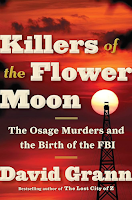
Killers of the Flower Moon by David Grann, Sundown by John Joseph Mathews, and Mean Spirit by Linda Hogan

This so-called Indian business, as White discovered, was an elaborate criminal operation, in which various sectors of society were complicit. The crooked guardians and administrators of Osage estates were typically among the most prominent white citizens: businessmen and ranchers and lawyers and politicians. So were the lawmen and prosecutors and judges who facilitated and concealed the swindling (and, sometimes, acted as guardians and administrators themselves).

Like many people, I hadn't heard of the Osage Murders until recently. Earlier this year, when I read Cimarron, Edna Ferber's story of white settlement in the Oklahoma territory, I thought the detail about the Osage growing rich on their oil deposits was a fanciful fiction, a Tarantino-style literary justification for people who had been marginalized in the real world. But as David Grann's Killers of the Flower Moon makes clear--and as Martin Scorsese's movie adaptation, out this week, will make even clearer--the story is true, and underappreciated: after oil headrights made many among the Osage tribe rich, they were subjected to a spate of horrible murders by covetous white settlers.

Grann's book focuses on the story of Mollie Burkhart. Like many Osage women at the time period, Mollie is married to a white man who lives off of her wealth. Her sister, Anna, is shot and killed; Anna's death is followed by the murder--by bomb--of another sister and brother-in-law. These murders were just a few of the many that took place in what's now known as the Osage "Reign of Terror," but their startling nature and obvious connection to one another made them the focus of the FBI's investigation. The FBI is, for Grann, the story's second thread, a watershed moment in the transition of the Bureau from a group of ragtag cowboys to an efficient, professionalized institution under the control of J. Edgar Hoover. What the FBI, led by a rangy Texan named Tom White, uncover is a conspiracy of elaborate scope. The deaths in Mollie's family are ultimately traced back to her own husband, Ernest, working under the guidance of his uncle, a powerful cattle rancher named William Hale.

Killers of the Flower Moon is, to some degree, more interesting as a story than it is a book; it has the breezy efficiency of many similar pop history books, though I can imagine the prose is a shade better than many of its equivalents. Its greatest moments are journalistic ones, as with the stunning final chapter in which Grann's research reveals that the scope of the conspiracy among Oklahoma's white settlers was much larger than initially imagined. Though Hale is--spoiler alert--convicted and sent to prison, Grann is able to identify a handful of powerful bankers and operatives with bloody hands who were never apprehended. The story is simply a story of racism write large, a system of depredation that goes above and beyond Hale to the very nature of white settlement in the Oklahoma territory.

Killers of the Flower Moon offers a kind of double revelation: as Grann uncovers the further secrets of the Osage murders, so too he uncovers a part of history that has been hidden from view for too long. In the 1920s, the Osage murders were front page news, but in the wake of the Great Depression and the drying up of the Osage oil feeds, they were largely forgotten. Grann's book and Scorsese's movie will, I imagine, move the story into a kind of public consciousness that will be difficult to dispel a second time; the Osage murders will go from a thing that nobody knew to a thing that everybody knows. What more can you ask for from a popular history book?

If I had my way, I'd direct people's attention to the system of allotment that facilitated both the Osage's incredible wealth and the murders that attended it. The 1887 Dawes Act split many tribal lands into small "allotments" which could then be claimed by individual Indians, who supposedly would be transformed by the virtue of property ownership into real Americans. Of course, when the land was divvied up, there was usually a big chunk left over that went into the ownership of white settlers. In this case, the allotment had the ironic effect of giving individual Osage "headrights" over the vast oil reserves that made money through lucrative leases. And yet, the money was control as the Osage, being considered by the government incompetent to handle their own affairs, were put under the authority of guardians. A guardian might be a trusted community figure or, as in Mollie Burkhart's case, a husband, and in most cases the murders were orchestrated by these guardians in order to ensure the headrights passed to them.

It was a system of such obvious and vicious racism that it shocks us today, but other vestiges of injustice remain as relevant as ever. Consider, for example, the threat posed by the judicial determination that the murders took place outside tribal land, moving the case out of federal courts and into local courts where men like William Hale could bribe, threaten, and kill their way to possible acquittal. And then consider a case like McGirt v. Oklahoma from last year, at the heart of which was the very question of whether Oklahoma tribes have jurisdiction over crimes committed against them on their own lands. Killers of the Flower Moon, both book and film, may bring the Osage murders into a kind of sustained historical consciousness, but whether we'll absorb the right social and political lessons from them is another matter.

Away from the activity of Progress which had become so important, he felt a pleasure which seemed to be absent when he was in town. On the few occasions when the pounding hoofs of his pony flushed a small flock of prairie chickens, he would come to the realization that he didn't see them in large flocks any more; that it had been years since he had heard the familiar booming carried across the April prairie. When he came to little blackjack-covered ravines that reached out like feathered fingers into the prairie, he didn't seem to miss the band of deer bounding away; their white tails bobbing and seeming to float away among the black boles of the trees. Had he seen one lone frightened buck, he might not have missed the band, but there were no more deer, and he was not acutely conscious of their absence. Sometimes as he rode along, a golden eagle would sit high on a limestone escarpment, watching him, and the redtailed hawks were always present and seemed to taunt him as usual about being earthbound; circling low and screaming weakly their contempt.

Before it was stolen from them, or dried up and blew away, how did the Osage get their riches? What must that have been like for a people a single generation away from mass white settlement? Part of that story can be found in Sundown, a novel by the Osage writer John Joseph Mathews. Sundown is--to my understanding--regarded as one of the first English-language novels published by a Native American, along with D'Arcy McNickle's The Surrounded, which came out in 1936, two years Mathews' novel. Like Archilde in The Surrounded, and like Mathews and McNickle themselves, Challenge Windzer, the novel's protagonist, is part-Native and part-white, an inheritance that at times leaves him torn between two modes of existence, feeling as if he fits into neither. Chal is a teenager when the oil boom begins in earnest, and part of what makes Sundown such a fascinating text is that it represents a contemporary, though fictional, account of the real-life stories that Grann has resurrected.

Challenge's father John names him for the "challenge" he hopes he will represent for his people against those who would oppress them. John is pro-allotment, a big believer in progress, a word that means turning "away from the blanket" and embracing business and industrialization. He is enthusiastic about Chal's decision to play football for the University of Oklahoma. But Chal's experience at school is a tortured one: not knowing how to act or speak, he grows a reputation for being taciturn. How can he explain, for example, why is it is such a desecration for an Osage man to be struck with a paddle, as his frat brothers do to him in a hazing frenzy? A couple of Chal's friends from "the Agency" drop out, despite being football stars, unable to handle the difficulty of the experience: one turns to the bottle and the other returns "to the blanket." Chal tries to muddle on, yearning for the ability to do as his peers do, to dance and flirt and sweat for grades.

Chal is a difficult protagonist to follow. So much of the novel's drama derives from his inability to act, but neither can he articulate his difficulties--he's like Hamlet, if Hamlet didn't know how to make a speech. Chal's life is largely a series of unmade gestures. When the first World War breaks out, he moves from college to flight school, where excels as a pilot, but his social relations are much the same; he longs to speak or act, but can't find the words, and so every episode just sort of... ends. But neither can Chal take part in the Osage rituals he sees among those who still live in the traditional fashion. He longs for the Osage hills of his youth, filled with animal life and a proper canvas for the size of his imagination. But when he returns home, he finds the land largely diminished by the oil derricks, which have depleted the waters and repelled the animals. This is his father's progress, a sacrifice whose rewards his father can't even enjoy--he's killed by white men who covet his headrights.

His father's death marks a final blow for Chal, who descends into a life of hard drinking and carousing, one that's ironically made possible by the flow of payments from his oil headrights. What Sundown suggests, I suppose, is that the trouble for the Osage didn't begin with the murders. Rather, the murders are themselves the consequence of devastating social changes, brought on by white settlement and a belief that old ways could be discarded in favor of an elusive "progress" that turned out to be another settler trick. 

Ben still noticed how few Indians were visible on the streets of town, a couple of dark men, perhaps, sitting on the running board of a car. He said nothing about this to anyone, but he knew the Indians were going home. They'd become peyote men with long hair and some of these were still the richest people in the world. They'd entered a house of fear and closed the door, become invisible once again. But out in the country, their homes and barns were strung with lights in hopes that no secrets would hide in the darkness. In other circumstances, the lights in the night's black country would have been beautiful. But these were lights of terror, and farther out, the fires could be seen scattered around the dark hills while people went to the roundhouse and the peyote lodge and sang and drummed, and the drumming joined the early rains, and it was felt in the topsoil and subsoil of earth. It filled up the hollow dark nights when the moon was swallowed by earth's hazardous shadow.

So, Killers of the Flower Moon is a book about recovering a lost history. But as with all lost histories, they're not lost to everybody: as the Osage contributors to the film make clear, the Reign of Terror has never been forgotten about their communities. Linda Hogan's novel of the Reign of Terror, Mean Spirit, came out nearly thirty years before David Grann's book. Hogan is Chickasaw, not Osage, but Mean Spirit suggests that the memory of this bloodthirsty period remains strong among the Native American groups who call modern-day Oklahoma home. And, in fact, Mean Spirit tells almost exactly the same story as Killers of the Flower Moon, only lightly fictionalized: the villainous cattle baron is John Hale, rather than William Hale. Anna Brown becomes Grace Blanket, an Osage woman shot to death in the book's opening chapters, while her children--who, as her inheritors, are the next to be threatened--look on in fear.

Amazingly, Hogan seems to have decided that the story described in Killers of the Flower Moon didn't have enough characters: Mean Spirit is so crowded with people it's almost Dickensian. Uncharitably, you might say it's kind of a mess; I found myself unable to remember who was who and how they were all related. It's a mistake, I think, not to have streamlined the story a little. More than once, when someone was killed--or revealed to be a villain, in league with Hale and the other oil-grabbers--I felt nothing, because I had barely processed who that character was or was pretending to be. I actually found myself wondering if it was better or worse to have read Killers before reading Mean Spirit. Perhaps it would have been clearer to approach the story on its own terms rather than as a slightly recombinated version of history. Or maybe it would have made it all even more inscrutable.

That said, the great strength of Mean Spirit is the detail that Hogan adds to the plainness of history. Consider this passage, which follows the bombing of a house that kills Grace's sister Sara (Hogan spares the husband figure, here a half-Indian named Benoit, not a white guy named Bill, so that he can be fingered for the murders):

Benoit was still in jail and people continued to find pieces of Benoit and Sara's blown-apart life. A mattress remained on top of a tree and some hawks built a nest in it. One of the cattle grazers who leased Indian land filed a lien against Benoit's estate for the cost of a calf that had been hit on the skull and killed by a flying cast iron skillet. Treasure-hunters traveled in far and wide to search the land for possessions that had blown free of the explosion. A silver cuff link was found beneath the steps of a farmhouse a quarter mile away. One man, out scavenging the woods that autumn with a war surplus metal detector, found a nightgown hanging neatly over a tree limb. It was his wife's size. He took it home.

One addition I really liked is the character of John Stink, an Osage deaf-mute who is mistakenly buried alive. When he emerges from his burial--the Osage place rocks only loosely over the bodies--he assumes he's become a ghost. The only thing is, everyone else assumes that he's a ghost too, and they go on for months or years like that. I was delighted, too, to discover in the book's acknowledgements that John Stink was a real person, though he seems to have had little or no connection to the Reign of Terror. Also added are a series of "Watchers," people from the "Hill tribes" of Osage who still choose to live in a traditional manner, who come down to hang out outside the house of Grace Blanket's family. It wasn't clear to me that the Watchers ever really did any protecting, but the symbolism is powerful: when the oil seeps up through the land like blood, it is the traditional Osage who have no need for money or motorcars who watch over their wayward relatives.

Hogan also replaces Tom White, the Texan FBI agent who led the investigation into Hale, with a Lakota FBI operative named Stacey Red Hawk. Like the Watchers, Red Hawk's role in the actual plot felt elusive to me, but his role is more symbolic than it is principal: he widens the perspective of the novel from an Osage story to something that implicates Indians of all tribes, and Indianness in general; even Stacey Red Hawk, toward the novel's end, has abjured the Bureau of Investigation, humbled by the simplicity and depth of the lives lived by the Hill Osage.

Mean Spirit is more comic than Solar Storms, the other Hogan novel that I read. And it's very different in this way from Sundown, which is almost completely humorous. Perhaps it's a difference of stakes--the Osage writer and the Chickasaw--but perhaps it is a difference of historical perspective, too. John Joseph Mathews, like Chal Windzer, may have looked around at a world that seemed intent on destroying the Osage one way or another, either by recruiting him into the white capitalist world of oil barony, or assimilating him at the end of a fratboy's wooden paddle--or by just plain shooting him, exploding him, or poisoning. At times, Chal seems unsure whether the life of the Osage can survive. Hogan, perhaps, has the luxury of writing with the knowledge that, while the Reign of Terror brutalized families and ended dozens of hundreds of lives prematurely, the Osage live on, as the rest of us are all getting to see right now as well.

Saturday, October 14, 2023

A Manual for Cleaning Women by Lucia Berlin

At first, when a voice on the intercom would say, "Nurse! Quick!" I'd ask, "What's the matter?" That took too much time; besides, nine times out of ten it's just that the color's off on the TV.

The only ones I pay attention to are the ones who can't talk. The light comes on and I push down the button. Silence. Obviously they have something to say. Usually something is the matter, like a full colostomy bag. That's one of the only other things I know for sure now. People are fascinated by their colostomy bags. Not just the demented or senile patients who actually play with them but everyone who has one is inevitable awed by the visibility of the process. What if our bodies were transparent, like a washing machine window? How wondrous to watch ourselves. Joggers would jog even harder, blood pumping away. Lovers would love more. God damn! Look at that old semen go! Diets would improve--kiwi fruit and strawberries, borscht and sour cream.

Must an incredible writer lead an incredible life? No, surely not, given how much of it takes place in a small room in front of a keyboard. But there are writers like Lucia Berlin who make you wonder otherwise: born in Alaska, having grown up in a series of mining camps from Idaho to Chile, working as a nurse or cleaning woman in El Paso or Mexico City, overcoming the ravages of alcoholism. These experiences make their way into the stories that make up the collection A Manual for Cleaning Women, though Berlin's stand-in is only sometimes labeled as Lucia--sometimes she is an analog named Carlotta--along with a number of repeating motifs that were surely drawn from real life: a sister, reconnected with only after her terminal cancer diagnosis, a sexy fling with a Mexican deep sea diver, a bitter, witty mother with her many "suicides." In the hands of Berlin the writer, these experiences are transmuted into vignettes that are blackly funny and deeply touching.

The comparisons are already there in the introduction: there's Grace Paley, whose stories of Jewish New York have a freewheeling, riotous nature that's mirrored in Berlin's. (It's a bad comparison, because it can only diminish Berlin a little, given that no American short story writer ever really reached the heights of Paley's best work.) I thought of Joy Williams, perhaps because I'm always thinking of Joy Williams, or maybe because Berlin's downtrodden but spirited desert dwellers seem as if they could come right out of Williams' Arizona

What sets Berlin's stories apart, I think is their structural boldness and looseness. Look close at the spaces between the paragraphs, which often have no connecting tissue whatsoever; they jump from idea to idea in a way that obscures the structural inventiveness and circuitousness of the stories. The title story might be the best example of this, which weaves together the narrator's descriptions of her clients with the route of a Berkeley bus, labeled by stop, and bits of guidance for other cleaning women. It's a story that seems like it's doing too much, but at length the story that binds the thread together emerges: grieving the death of a friend, the narrator is stockpiling sleeping pills from her clients with which to commit suicide. ("Ter," she addresses the dead toward the end, "I don't want to die at all, actually.")

A Manual for Cleaning Women collects over 40 of Berlin's stories. There's something a little unjust about putting so many in one place; inevitably, the awe wears off and the seams in some of the stories begin to show. I felt that the stories in which Berlin tries to take on the voice of a first person narrator who's not her own analog--as she does with the high-flying lawyer in "Let Me See You Smile"--were the weakest. But there are far fewer missteps than triumphs: the abortive Mexican abortion of "Tiger Bites," the hilarious account of a dowdy woman who sets off to have a post-menopausal affair in "A Love Affair," the joyous account of little Lucia's first child love with a mischievous mining camp boy in "Temps Perdu." A mad comic energy enlivens most of the collection's best stories, but Berlin's relentless focus on the poor and the working class, especially in the barrios of Mexico and around El Paso, means that some of the powerful are not funny at all: never again will I want to read "Mijito," the story of how poverty and neglect lead to the death of an infant child, despite the best intentions of the doctors and nurses at the free clinic. Elsewhere, Berlin describes the life of the true alcoholic, shaking with withdrawal, who wonders if they'll even be able to live before the first liquor store opens at five in the morning.

Berlin's endings are special: they always seem to flip the story on its head, or at least wrench it a little out of place. They do what's nearly impossible to do: seem both surprisingly and entirely logical. Sometimes they are little stories in themselves, moving from laughter to tears and back again:

Sally and I write rebuses to each other so she doesn't hurt her lung talking. Rebus is where you draw pictures instead of words or letters. Violence, for example, is a viola and some ants. Sucks in somebody drinking through a straw. We laugh, quietly, in her room, drawing. Actually, love is not a mystery for me anymore. Max calls and says hello. I tell him that my sister will be dead soon. How are you? he asks.

Wednesday, October 4, 2023

Mayumi and the Sea of Happiness by Jennifer Tseng

Alone with my secret, I indicted and rehabilitated, analyzed and haggled. I accused my self of rape, molestation, and willful negligence. Alternately, I defended my right to feel pleasure and love, my right to refuse loneliness. The accusing self and the accused self, though not identical, were like two images seen through binoculars. My vision was double. As I strained to make sense of the world I saw, to make sense of my own vision, the two selves moved closer to one another. They touched hands, their hips overlapped, their hearts lay astride one another like the folded wings of a red butterfly until at last the two merged into a single image, the single self that became the self I saw myself as.

Mayumi is a 41-year old librarian living on one of those islands in New England that are clogged with visitors in the summer and nearly empty in the winter. She has a five year-old daughter and a husband who spends most of his time whittling gnomes, and who is virtually a stranger to her. When a handsome young seventeen year-old appears in the library, she develops an intense fixation with him. It becomes the fodder for jokes with her coworkers, but Mayumi is serious: she sees that the "young man"--who's never given a name, for reasons that are later made clear--has eyes for her as well. She invites him on a hike, and then into an empty summer home, and the rest goes as you might imagine.

"Age gap discourse" being what it is these days, you have to admire the boldness of writing a book like Mayumi and the Sea of Happiness. Last week in my senior class we read Mary Robison's amazing story "Yours," about an old man and his younger wife who has terminal cancer, and it was very difficult for them to understand what might bring together even two people facing the final stages of their life. Mayumi resigns herself, if not quite embraces, her newfound status as a predator. (When, after weeks of sexual liaisons with the young man, she finally looks up the age of consent in Massachusetts, she's almost shocked to find it's only sixteen.)

It's easy to understand how Mayumi finds herself attracted to the young man, who is sensitive and intelligent in addition to being handsome. But he's not precocious; you don't find yourself excusing the impropriety of their relationship because he is an "old soul." It's a testament to Tseng's skill that the relationship is both understandable and entirely wrong. The book's pathos, in fact, comes largely from Mayumi's intense awareness that the young man's life is before him, while she lurches further into an unsatisfying middle age. She has more in common with the young man's mother, a local shop owner who befriends Mayumi over book recommendations; when Mayumi cheekily offers up a copy of Lolita it feels a little on-the-nose but inevitable, like the joke's long-awaited punchline.

I was impressed by the Mayumi's voice, which is just a shade over the line that separates erudition and pretension. We catch it, but even an intelligent seventeen year-old never would. He'd never see what a mature reader sees: the way the language of intelligence assuages an abiding loneliness. Mayumi is sometimes ridiculous, but never pitiable, and her slight pretensions only make her insights more powerful.

I haven't yet decided what I think of the ending, which I won't spoil. We expect everything to come crashing down around Mayumi, and it does, though not in the way we expect. Part of me felt that the way it does come crashing down is something of a dodge. Yet the late "twist" opens new avenues in the novel, transforming it into something new, or perhaps transmuting the quiet tragedy that was already there. 

Monday, October 2, 2023

Unrest by Yeng Pway Ngon

For a while, because the storyline of the male protagonist and me wouldn't move forward, the whole novel got stuck there, and the writer didn't know what to do next. But he sensed that this delay and blockage were caused by me. He was right, I deliberately escaped from his narrative, because I wasn't satisfied with his writing, nor the way he arranged my destiny. I felt this was a book about several men, with the women there to run circles around them--marry a chicken, lead a chicken's life. Why should I put up with a husband who considered himself a playboy? Why give up my individuality and freedom to live with such a man, just because that's the author's plan? Can't I decide my own destiny and future? Shouldn't my existence have some meaning apart from satisfying the possessive urges of men?

Once a revolutionary, always a revolutionary--in the eye of the regime, at least. In reality, rebellion is often the brief province of youth, though its consequences may resound through the years, determining the course of a life long after the revolution has died. The four Chinese characters at the heart of Singaporean Yeng Pway Ngon's novel Unrest find middle age to be as great a challenge, at least, as the political upheavals of their youth--and one they must face without the ardor of their early life.

Weikang and Guoliang grow up in Malaysia and attend a prep school in Singapore, where they become involved with communist student groups. From there, their paths diverge: Weikang, targeted by the regime of Lee Kwan Yew, emigrates to China, where he finds his idealism dashed by the brutal realities of the Cultural Revolution. Guoliang stays in Singapore, growing meek and purposeless under the eye of a mother he despises. Ziqin and Daming are a couple who, also intending to emigrate to China, never get past Hong Kong. Daming, the most radical of them all, becomes a capitalist and a womanizer whose infidelities torture Ziqin.

In the 1980s, the characters find themselves thrust together in various combinations for the first time in decades: Weikang and Guoliang meet for the first time since, as young men, a drunk Weikang took sexual advantage of his equally drunk friend. In another moment, Ziqin initiates an affair with Guoliang. Guoliang, still meek and abashed, is the opposite of the caddish Daming; though Ziqin is ambivalent about the affair at first, it is a first step toward agency and independence. Sex hangs over the novel as intensely as political violence--obviously, the secondary meaning of the title can hardly be ignored. Is it too late for sexual gratification, just as it seems too late to truly be a radical? Is Weikang's indiscretion with Guoliang something that can be left in the past, or will it follow as surely as his political baggage?

Yeng inserts himself ostentatiously into the narrative as the "author," arranging the plot of the book to his satisfaction. In Guoliang and Ziqin's narrative, they are identified at first only as the "male protagonist" and the "female protagonist." The female protagonist soon escapes the author's control, first disappearing, then refusing to follow Daming in emigration to Vancouver. When she's allowed to speak to herself, Ziqin asserts her right to an independent life, not just from Daming, but from authorial possessiveness; she's not required, she insists, to do what the author demands simply because his story demands it. These metafictional touches are probably the most interesting part of the book, though they don't feel exactly innovative or fresh. Still, in a novel whose characters are pushed around by the implacabilities of history, it's refreshing to see one stand up and say, No thanks--I'll live the life I want.

With the addition of Singapore, my "countries read" list is up to 83!

Sunday, October 1, 2023

The Good Rain by Timothy Egan

The Snake, the Pend Oreille, the Spokane, the Clearwater, the Owyhee, the Deschutes--all of these rivers used to carry salmon to the desert, a twice-yearly occurrence surely as miraculous as the irrigation which brought wheat and plump fruit to the treeless hills above the central Columbia. Now the desert east of here is full of Corps of Engineers trucks; the salmon travel the interstate, or die. Most of the young fish don't do well on the highway. A maze of ladders, locks, lifts, channels and portages is used to help the dying older chinooks reach their spawning grounds upstream. When their eggs hatch and the young fry start to head downstream, they run smack into the hydroelectric turbines. Many are sliced and diced in these massive blenders. Others die of the bends, tossed to such depths and then pushed up so quickly that their respiratory systems can't adjust in time. More than half of all the young salmon which head downstream, seeking the ocean and three or four years of wandering, expire before they get past the first hurdles.

The Pacific Northwest of North America is one of the truly great places. The wildflowers of Mount Rainier, the looming haystacks of the Washington and Oregon coasts, the volcanic power of Mount Saint Helens and Crater Lake, the rugged cliffs of the Columbia River--the PNW offers all of this, plus places you'd never think to look for, like the high desert of eastern Oregon or the lush orchards of Washington. Timothy Egan, the one-time Seattle correspondent for the New York Times, writes about all these places in The Good Rain, subtitled "Across Time and Terrain in the Pacific Northwest," traveling as far north as the English gardens of Victoria and as far south as the Siskiyou National Forest, Oregon's timber basin.

The book begins with Egan scattering the ashes of his grandfather, a lifelong Pacific Northwesterner, along the flanks of Mt. Rainier. In the distance is a glacier named for Theodore Winthrop, a Civil War officer who traveled extensively throughout the region when there were few white people off of the coasts. Egan's journey ostensibly follows Winthrop's, but the conceit is lightly held, and the essays are more linked to theme than place: "Salmon," "The Natives," "Wood Wars," "Under the Volcano," "Columbia." Still, a little pen-and-ink drawing accompanies each chapter, pegging each one to square of the map: the Strait of Juan de Fuca, the North Cascades, the Yakima Valley, etc. Egan evokes each of these places with the easygoing fluency of a journalist, and often with the awe of a PNWer endeavoring to see the majesty of the places that have underpinned much of his life.

The Pacific Northwest that Egan describes is one threatened by capital and greed. Once, he suggests, the borders of the Pacific Northwest were easy to adjudicate: the Pacific Northwest reaches as far as the salmon do on their journey back to their hatching grounds. But the mighty Columbia and all its tributaries have been dammed, and the hatching grounds replaced with fish hatcheries which not only produce weakened, inferior salmon, but which have devastated the lifeways of the Indigenous tribes who live throughout the region. The book's heroes are men like Billy Frank, the Nisqually elder who successfully led a campaign to preserve the tribe's fishing rights. Like the salmon, the trees are threatened by rapacious logging, which has rooted up a majority of the region's old-growth forests, abetted by the National Forest Service. (Egan suggests the Forest Service ought to know better, but anyone who's seen the way Ken Burns depicts NFS founder Gifford Pinchot as a mustache-twirling villain will know it's always been this way.) Threatened, too, are the wolves, the orcas, the wild river.

In some ways, The Good Rain wears the thirty years since its publication poorly. In a chapter on Seattle, Egan focuses on a movement to "freeze" the city by preventing new residents and new development, likened either by Egan or the movement's proponents to the "monkeywrenching" of Edward Abbey. It's a little strange, actually, to read a dispatch from a time before density disputes had reached the level of nationwide intensity they now have, and when you could call yourself an environmental warrior for standing in the way of housing development with a straight face. We now know, of course--though I suppose not everyone wants to admit it--that encouraging new growth in cities and away from sprawling suburban tracts is an important step toward the healing of the environment. And I'd like to think that if The Good Rain were written now, a good journalist like Egan would reveal a little more clearly the chauvinism at the heart of people who, by the very nature of history, have only a handful of generations of history in a place and want to pull the door closed behind them. It's as quaint to read, in a way, as Egan's description of Washington's Red Delicious apples as the country's most popular--well, it took a while, but we figured out those apples sucked, too.

The best parts of The Good Rain for me were the descriptions of the places I'd never visited: the eerie bend of the Columbia at Hanford Reach, left wild because it was where uranium was processed for nuclear bombs; the wild wooded Siskiyou; the Yakima Valley. I read the chapter about Astoria, Oregon--the oldest town west of the Rockies--on an airplane headed to a visit there, and I loved seeing the rainy, hardscrabble town through Egan's eyes. (I also wondered if, given the number of bakeries and breweries we saw there, and the long line of people queued up for the old boat that sells fish and chips out of a parking lot, if the town's circa-1990 motto of "We Ain't Quaint" has been revised.) I've been lucky enough to see a lot of the PNW in my life, but The Good Rain made me feel like there's much more to explore.

Saturday, September 30, 2023

I Should Be Extremely Happy in Your Company by Brian Hall and The Lost Journals of Sacajewea by Debra Magpie Earling

Oh! This one jumped up and threw the pronghorn around we-both and hung on rides ahead and wailed and thanked and sang grief for her long thoughts of his death, as spirit said a sister should, and felt his short hair against her fingers and cried more, wondering whether it was brother or father who died, and she cried for the starvation in his face. Rides ahead was a good brother (he was the son of two bears' younger brother, white elk skin, five or six winters older, a man already when this one was a child, and often speaking to her, but protecting her from black cheek and sometimes taking her up on his horse), and as a brother and a man should, he accepted her tears and let himself be fondled and hung on, and thanked for, keeping back his own tears, and his words. He said only, calmly, in the man's way (the ant-sting of hunger on his breath),--Walks slow, small mother, scar cheeks. We thought you were lost.

There are few stories as foundational to the myth of America as that of Lewis and Clark, speaking as it does to the country's vastness and wildness, and the intrepid nature of those who chipped away at its frontier. The coast at which they arrived was already mapped and more or less well-known by sailors and trappers, but the interior, which had recently been added to the United States by way of the Louisiana Purchase, was a blank map. In a way, every cross-country road trip is a kind of reenactment of the Corps of Discovery, who embarked from St. Louis on a journey through the continent just to see what was there--not to arrive somewhere, but to travel through.

In reality, of course, the interior of the country was well known to the Indigenous people who lived there, a fact acknowledged by the popular memory of Sacagawea, the Shoshone woman who helped guide the Corps through the Missouri River and across the Rockies. Sacagawea is only mentioned a few a times in Lewis and Clark's journals, and they seemed mostly to have considered her a kind of emblem of peace--a woman's presence signaled a disinterest in war. There's actually something in the Sacagawea legend that's ahead of its time, in that it has always sought to "recover" the contributions of an Indigenous woman to American history. Such stories seem more common now, but Sacagawea may have been one of the first figures to be dredged up in this way. 200 years later, it's worth wondering what purpose the elevation of Sacagawea in the Lewis and Clark myth has served, and whether that elevation has in turn served Sacagawea. These two books--I Should Be Extremely Happy in Your Company by Brian Hall and The Last Journals of Sacajewea by Debra Magpie Earling--both try to enliven the story of Sacagawea and make us see it in new ways.

Hall's novel takes its title from a line in Meriwether Lewis' letter to his old friend, William Clark, inviting him to join the Corps of Discovery. Though I Should Be Extremely Happy in Your Company is a novel of many voices--Clark, Sacagawea, Sacagawea's French-Canadian trapper husband Toussaint Charbonneau, and Clark's enslaved servant York all get a chance to speak--Lewis is at the story's center. In Hall's telling, Lewis is a mercurial and depressive figure who feels inadequate to the task of leading the Corps of Discovery, which President Jefferson has assigned to him more out of personal affection than a sober assessment of his abilities. Lewis is prone to long bouts of depression and frustration; he can't even work up the resolve to write regularly in his journal. His anxieties and fear of failure are self-fulfilling: his experimental boat (called, naturally, the "Experiment") sinks, the Corps faces starvation, then months of rain on the Oregon coast. On the way back Lewis is shot in the buttock by one of his own men, mistaking him for a deer, and he lies face down on the company's pirogue as it travels down the Missouri, embarrassed and ashamed. This Lewis would be surprised to hear that his name has hardened into myth. Few remember from their high school history classes that Lewis was shot to death under mysterious circumstances only a few years later, probably by suicide, after a disastrous governorship of the Louisiana Territory that left him broke. In Hall's novel, the suicide hangs over Lewis' character, as if worked out backward from his tragic end.

One thing that works about I Should Be Extremely Happy is the way it presents the Corps as a collection of colorful personalities: besides Lewis, the neurotic sadsack, there's the enslaved York, who present mixed feelings about the attention lavished on his skin and body by Indigenous people whom the Corps wants to impress. (Hall relies on an old and possibly true legend that York, after being cruelly denied freedom by Clark, ran away to live the rest of his life with one of the Indigenous tribes encountered by the Corps.) There's also Charbonneau, a shrewd scumbag, whose slimy and cynical sections are probably the book's best parts. Charbonneau, who was living with Sacagawea and another Indigenous wife near the Mandan villages in North Dakota, is hired as a translator, and is often in the forefront of the Corps' interactions with Indians. This, perhaps, is the biggest way that Hall subverts the myth of Lewis and Clark: by presenting it not as a story of traveling through wilderness, but as it was, a journey from tribe to tribe, begging for food, supplies, horses. What the Corps found in the end was not just rivers, plants, and animals, but people.

So, Sacagawea. Except for a short prologue, she's the first voice that appears in Hall's novel, narrating her capture as a child by the Hidatsa Mandan Indians that abducted her and sold her, in the end, as a wife to Charbonneau: "This one," Hall writes in a defamiliarizing imitation of Shoshone grammar, "was still a child." Her voice is a kind of pidgin, cobbled together from Shoshone and English, and though sometimes it's a little too hard to follow, it works, because it helps us understand Sacagawea's experiences as a kind of rough encounter with language; she slowly learns to understand the husband she does not want, and then the white "sun-men" who arrive at the Mandan village heading west. The story becomes one of restoration and return: after identifying the area at the headwaters of the Missouri as the place she had been abducted from many years ago, Sacagawea helped guide the Corps to the Shoshone camp where she was reunited for the first time with her brother Cameahwait, who had since become chief. It's a hell of a story, almost melodramatic, and Hall captures the sweetness of it well.

Here's the same scene from Debra Magpie Earling's new novel The Lost Journals of Sacajewea, where the presence of Cameahwait is deemphasized in favor of a communal embrace among women, all of whom, as far as I know, are invented characters:

Many People are coming toward me. They surround me and embrace me. Onion Wife makes her way to me and holds my hands so tightly I see Bia. The People, my People, turn to someone coming toward me. I see the top of her head before I see her.

She struggles to get to me.

.. I look .. I cannot believe .. I cannot believe .. I bite my fingers ..

Li-li-li, I shout. Women join me. Li-li-li-li-li-li, we call.

I cannot hold what overflows me. I am river.

It's easy to see the linguistic similarities between Hall and Earling's renditions. Both have sensed that a too-familiar language would elide the differences between us and Sacagawea; only a language that is, or feels, closer to the historical figure's will allow us to see past the myth into something true. Interestingly, in some respects they come up with opposite approaches: Hall places everything, including names, in lower-case, as if to emphasize the connection between names and things: "camas flower" is both a flower and a person. By contrast, Earling capitalizes more things and ideas, as if to elevate certain words to the level of the sacred. Some words that are too sacred are even italicized and printed in fainter type, to signify that speaking them endangers their sacredness and threatens to make them disappear. (As with the double-period "pauses," though, I wonder if a linguistic trick that needs explaining in advance isn't a little too clever.)

Lewis and Clark don't show up until late in The Lost Journals of Sacajewea, which chooses to emphasize not the story of Sacagawea's return but the story of her abduction. Although Earling is as scrupulous as Hall when it comes to the historical record of the Corps of Discovery, most of The Lost Journals is, by necessity, pure invention. Young Sacagawea is, in Earling's telling, promised to a handsome young warrior named Blue Elk, which causes the tribe's jealous beauty to curse her, perhaps bringing on the violent abduction of the Mandan. Before she is violated by Charbonneau, Sacagawea is raped by one of her Mandan captors, reminding us that the myth obscures the fact that Sacagawea's presence with the Corps is ultimately rooted in sexual violence. Earling's Sacagawea is endowed with mystic powers, too, able to see the water monsters and ogres that are invisible to most people.

Earling's Sacagawea is defined by victimhood and violence, but she has a raft of helpers and allies as well, starting with a "White Man" who teaches her rudimentary English. These lessons are meant to explain, I think the nature of the novel as a literally written "journal," but it's an idea that doesn't quite do enough. Among the Mandan, Sacagawea finds a supporter in the form of a Two-Spirit person whose name--and yes, pronouns--shift along with the gender by the page. Those are fine, but I really hated the depiction of York, who sneaks away from the Corps to inform Sacagawea of how much he hates Lewis and Clark: "Makes me sick. I get sick every time I think about it. Because what they want is every goddamn thing! They ain't lookin' to discover nothin'. The reason these people are white is they already dead." Though Hall perhaps doesn't give us enough of York, saving his section until the very end, this version of York--who already innately shares a perspective with Sacagawea on the sacredness of the land and the futility of the Corps--is too didactic to be interesting.

As for Lewis and Clark themselves? They are arrogant, cruel, and rapacious. They believe that, by seeing and naming every place, animal, and plant they come across, they have possession of it, and by doing so they violate the sacredness of these things: "If we name things," Sacagawea writes, "we kille the gifts they offer." I would have liked the book to do more with the tension between this and Sacagawea's own "naming"; the faded words suggest that her journal puts her in a kind of complicity with Lewis and Clark, but the novel isn't quite bold enough to commit to such an idea. Lewis remains a pathetic figure, but not because of his doubts, but rather because of his confidence; when Sacagawea convinces her brother to provide the Corps with horses, it's because she knows they are too stupid to survive without them. (Something about this doesn't work right, because they are a little too evil: see Clark--who took in Sacagwea's son Jean Baptiste after the Corps returned--bouncing the baby on his knee and scheming to steal it from her.)

Still, the book ends with Sacagawea--jilted by Blue Elk, whom she had trusted to save her--deciding to continue on with the Corps to the coast, inspired by a vision of a whale. (This is one of my favorite stories about Lewis and Clark, which neither book is interested in putting on the page: they traveled down to the Oregon seaside to see a big beached whale, with Sacagawea insisting she had a right to see it just like anybody else.) Hall's book is either not very interested in why Sacagawea wouldn't stay with her family after returning, or it gets lost in the profusion of historical detail. But for Earling, it's key: Sacagawea insists on her own tour of discovery; she'll do it smarter, kinder, better.

Neither of these books quite worked for me. I thought Hall's attempts at capturing the various voices worked better than Earling's, which I sometimes found inconsistent and gimmicky. But I also found Hall too scrupulous about the historical record, and unable to separate the details that matter from the ones that don't: every little thing makes it onto the page, which means that every little thing gets lost in the deluge. And the decision to cut out the expedition's nadir, the miserable months-long idle at stormy Ft. Clatsop and the "Dismal Nitch," which are instead recollected by butt-shot Lewis face down in the boat, to be nearly unforgiveable. Earling's book is more imaginative, which perhaps is right, because figures in the margins of history will never be completely rediscovered by history alone. It gives Sacagawea a hell of a story, but what gets sacrificed, I think, is a more complex, and thus more interesting, version of the others: Lewis, Clark, Charbonneau, York. Reading them back-to-back made me feel that there's still a great novel about the Corps of Discovery to be written, and next time, please don't forget the whale.

Sunday, September 17, 2023

The Abyss by Marguerite Yourcenar

For nearly half a century Zeno had used his mind, wedge-like, to enlarge, as best he could, the breaks in the wall which on all sides confine us. The cracks were widening, or rather, it seemed that the wall was slowly losing its solidity, though it still remained opaque, as if it were a wall of smoke and not of stone. Objects no longer played their part merely as useful accessories; like a mattress from which the hair stuffing protrudes, they were beginning to reveal their substance. A forest was filling the room: the stool, its height measured by the distance that separates a seated man's rump from the ground, this table which serves for eating or writing, the door connecting one cube of air, surrounded by partitions, with another, neighboring cube of air, are were losing those reasons for existing which an artisan had given them, to be again only trunks or branches stripped of their bark, like the Saint Bartholomews, stripped of their skin, in church paintings, here and there the carpenter's plane had left lumps where the sap had bled. The corpses of trees were laden with ghostly leaves and invisible birds, and still creaked from tempests long since gone by. This blanket and those old clothes hanging on a nail smelled of animal fat, of milk, of blood. These shoes gaping open beside the bed had once moved in rhythm with the breathing of an ox at rest on the grass; and a pig, bled to death, was still squealing in that lard with which the cobbler had greased them.

Zeno, a young man from a wealthy family in 16th century Belgium, leaves home to pursue a life of the mind. Stories of his exploits trickle back to his hometown of Bruges: he has become a renowned physician, treating those dying of plague, and his writings about philosophy and alchemy have been condemned by the church and burned. Later in his life, an aged Zeno decides to return to Bruges under the assumed name of Dr. Sebastian Theus, settling down to contemplate at last the nature of things. But Zeno/Dr. Theus is threatened by the raging fires of the Reformation; as splinter religions proliferate, the Church is all the more eager to punish those it suspects of heresy, atheism, and sexual deviancy.

What The Abyss captures, I think, is a sense of what we call The Enlightenment: the collapse of old structures and the rise of new ways of thinking, epitomized in Great Thinkers like Zeno, who is cobbled together from real-life figures like Paracelsus and Erasmus. This period produced some of the greatest advances in knowledge in all of human history, but it also produced a lot of battiness and violence: Zeno's estranged mother, for instance, gets caught up in the millenarian cult of the Anabaptists in Munster, led by the Christ-figure John of Leiden, and is killed when the cult is violently crushed. For his part, Zeno is one of those figures whose specific title or field--physician--belies an interest in the totality of the natural world, and a viewpoint that sees all fields as intrinsically connected.

The French title of The Abyss, L'Oeuvre au Noir, means "The Black Work" or "The Black Phase," referring to the phase of alchemical transition in which the substance of things is unmade so that it can be remade. (If you ask me, they should have stuck with The Black Phase as a title in English, too.) In a way, the black phase is what Europe itself is going through, and Zeno himself goes through a black phase when he returns to Bruges, captured in the section I quoted above: the nature of things begins to dissolve and return to its origins, and so the structures of Zeno's mind themselves begin to dissolve. In contrast to the wanderings of Zeno's life, it seems that the black phase is something you have to do on your own, alone in a room, and points toward the importance of Zeno's work as a physician, searching for truth not in the cosmos but deep within the human body itself.

I thought this "black phase" was the most compelling part of a book which, though really tremendously written, often felt elusive to me. I loved Yourcenar's Memoirs of Hadrian, a book which, according to her postscript, is similar in conception and in history--both books were put away for decades before being complete, and both of course are scrupulously researched accounts of history. It may be that I just don't have as clear a mental picture of the Holy Roman Empire as I do the Roman Empire of Hadrian's time; I often found myself meekly retreating to Wikipedia to remind myself who is who and what is going on. But the strangeness and richness of The Abyss is part of its appeal, and its depiction of a world that is different from our own simply because such great philosophical upheavals no longer seem possible.