Showing posts with label British Columbia. Show all posts

Sunday, October 1, 2023

The Good Rain by Timothy Egan

The Snake, the Pend Oreille, the Spokane, the Clearwater, the Owyhee, the Deschutes--all of these rivers used to carry salmon to the desert, a twice-yearly occurrence surely as miraculous as the irrigation which brought wheat and plump fruit to the treeless hills above the central Columbia. Now the desert east of here is full of Corps of Engineers trucks; the salmon travel the interstate, or die. Most of the young fish don't do well on the highway. A maze of ladders, locks, lifts, channels and portages is used to help the dying older chinooks reach their spawning grounds upstream. When their eggs hatch and the young fry start to head downstream, they run smack into the hydroelectric turbines. Many are sliced and diced in these massive blenders. Others die of the bends, tossed to such depths and then pushed up so quickly that their respiratory systems can't adjust in time. More than half of all the young salmon which head downstream, seeking the ocean and three or four years of wandering, expire before they get past the first hurdles.

The Pacific Northwest of North America is one of the truly great places. The wildflowers of Mount Rainier, the looming haystacks of the Washington and Oregon coasts, the volcanic power of Mount Saint Helens and Crater Lake, the rugged cliffs of the Columbia River--the PNW offers all of this, plus places you'd never think to look for, like the high desert of eastern Oregon or the lush orchards of Washington. Timothy Egan, the one-time Seattle correspondent for the New York Times, writes about all these places in The Good Rain, subtitled "Across Time and Terrain in the Pacific Northwest," traveling as far north as the English gardens of Victoria and as far south as the Siskiyou National Forest, Oregon's timber basin.

The book begins with Egan scattering the ashes of his grandfather, a lifelong Pacific Northwesterner, along the flanks of Mt. Rainier. In the distance is a glacier named for Theodore Winthrop, a Civil War officer who traveled extensively throughout the region when there were few white people off of the coasts. Egan's journey ostensibly follows Winthrop's, but the conceit is lightly held, and the essays are more linked to theme than place: "Salmon," "The Natives," "Wood Wars," "Under the Volcano," "Columbia." Still, a little pen-and-ink drawing accompanies each chapter, pegging each one to square of the map: the Strait of Juan de Fuca, the North Cascades, the Yakima Valley, etc. Egan evokes each of these places with the easygoing fluency of a journalist, and often with the awe of a PNWer endeavoring to see the majesty of the places that have underpinned much of his life.

The Pacific Northwest that Egan describes is one threatened by capital and greed. Once, he suggests, the borders of the Pacific Northwest were easy to adjudicate: the Pacific Northwest reaches as far as the salmon do on their journey back to their hatching grounds. But the mighty Columbia and all its tributaries have been dammed, and the hatching grounds replaced with fish hatcheries which not only produce weakened, inferior salmon, but which have devastated the lifeways of the Indigenous tribes who live throughout the region. The book's heroes are men like Billy Frank, the Nisqually elder who successfully led a campaign to preserve the tribe's fishing rights. Like the salmon, the trees are threatened by rapacious logging, which has rooted up a majority of the region's old-growth forests, abetted by the National Forest Service. (Egan suggests the Forest Service ought to know better, but anyone who's seen the way Ken Burns depicts NFS founder Gifford Pinchot as a mustache-twirling villain will know it's always been this way.) Threatened, too, are the wolves, the orcas, the wild river.

In some ways, The Good Rain wears the thirty years since its publication poorly. In a chapter on Seattle, Egan focuses on a movement to "freeze" the city by preventing new residents and new development, likened either by Egan or the movement's proponents to the "monkeywrenching" of Edward Abbey. It's a little strange, actually, to read a dispatch from a time before density disputes had reached the level of nationwide intensity they now have, and when you could call yourself an environmental warrior for standing in the way of housing development with a straight face. We now know, of course--though I suppose not everyone wants to admit it--that encouraging new growth in cities and away from sprawling suburban tracts is an important step toward the healing of the environment. And I'd like to think that if The Good Rain were written now, a good journalist like Egan would reveal a little more clearly the chauvinism at the heart of people who, by the very nature of history, have only a handful of generations of history in a place and want to pull the door closed behind them. It's as quaint to read, in a way, as Egan's description of Washington's Red Delicious apples as the country's most popular--well, it took a while, but we figured out those apples sucked, too.

The best parts of The Good Rain for me were the descriptions of the places I'd never visited: the eerie bend of the Columbia at Hanford Reach, left wild because it was where uranium was processed for nuclear bombs; the wild wooded Siskiyou; the Yakima Valley. I read the chapter about Astoria, Oregon--the oldest town west of the Rockies--on an airplane headed to a visit there, and I loved seeing the rainy, hardscrabble town through Egan's eyes. (I also wondered if, given the number of bakeries and breweries we saw there, and the long line of people queued up for the old boat that sells fish and chips out of a parking lot, if the town's circa-1990 motto of "We Ain't Quaint" has been revised.) I've been lucky enough to see a lot of the PNW in my life, but The Good Rain made me feel like there's much more to explore.

Sunday, May 7, 2023

Friend of My Youth by Alice Munro

Trouble began, perhaps, as soon as they said that they loved each other. Why did they do that--defining, inflating, obscuring whatever it was they did feel? It seemed to be demanded, that was all--just the way changes, variations, elaborations in the lovemaking itself might be demanded. It was a way of going further. So they said it, and that night Georgia couldn't sleep. She did not regret what had been said or think that it was a lie, though she knew it was absurd. She thought of the way Miles sought to have her look into his eyes during lovemaking--something Ben expressly did not do--and she thought of how his eyes, at first bright and challenging, became cloudy and calm and sombre. That way she trusted him--it was the only way. She thought of being launched out on a gray, deep, baleful, magnificent sea. Love.

In "Oranges and Apples," a story in Alice Munro's collection Friend of My Youth, a man named Murray comes home to see his wife suntanning by the pool, and Victor, his friend who has been staying in the pool house after a rough split with his wife, watching her through binoculars. Something in her body language makes Murray certain Barbara is aware of Victor, even arranging herself for him to sea. Murray spins this moment into a rage-inducing fantasy of betrayal, even going so far as to arrange for Victor and Barbara to be alone together, as if to confirm his own nightmare by forcing it to become true. In "Goodness and Mercy," young Averill listens to the captain of a passenger ship tell a story of an elderly woman who once died on board, and whom he buried at sea. Averill becomes convinced he is talking about her; after all, she is on board with her elderly and terminal mother, both of whom suspect she may expire before journey's end. Somehow, without even uttering a word, Averill comes to believe she is collaborating with the captain in a fantasy in which, her mother having been discarded, she is free to be seduced by him.

Friend of My Youth is probably the most subdued of all the collections of Munro's I've ever read. Some disasters remain--a drowning, a boy blinded by a rake, and any number of tawdry affairs--but they are somehow less real than the things that do not happen; the lives that people live in their own head, simply because the ones they really do lead are too narrow, or because everyone really wishes they could lead more than a single life at a time. This is the impulse that leads to the cuckold fantasy of "Oranges and Apples," and the dead-mom-sex-with-the-boat-captain fantasy of "Goodness and Mercy." "Differently" is another version of "Oranges and Apples" in which Georgia abandons her closest friend because of a notion--not even a belief or a conviction, it doesn't even quite get that far; it doesn't need to--that she has bedded Georgia's lover. In "Hold Me Fast, Don't Let Me Pass," a woman travels at last to the small town in Scotland where her now-dead husband spent the happy years of his deployment, only to discover that no one remembers him and he probably invented the relationships he had with every one of them.

Perhaps it's this impulse that leads Munro's characters, especially women, to pursue affairs with men they know are unattractive, and don't really like.  Perhaps this impulse leads to the many lies that are told. In one of my favorites in the collection, "Pictures of the Ice," an elderly minister goes around showing his parishioners a photo of the woman in Hawaii he plans on marrying, and describing the life he'll live out there in retirement. Meanwhile, his true intentions are to take a position exactly like the one he has now, in an even more frigid and remote part of Ontario. Or maybe he's the inverse of all the others: the man who loves his single life so much he wants to live a version of it forever, and must pretend to have dreams for the sake of others.

Fantasies, lies, telling stories. Many of the stories are really about telling stories. The narrator of the title story hears second-hand, from her mother, a story about a woman who gives up her fiancé when he impregnates her own sister. In the mother's version, the woman is saintly, self-sacrificial; but the narrator wants to write the version wherein the woman is proud and controlling, all too happy to have her sister and former lover under her roof to arrange their lives according to a logic of guilt and shame: "a Presbyterian witch." Of course, we never are to know who the "real" Flora was; such questions are barely worth mentioning. What the story is really about is the writing of the story--though it is also about her mother, and about mothers. In "Meneseteung," an unnamed narrator tells the story of an underappreciated Ontario writer who lived a life of spinsterhood; though the details are drawn from the writer's journals, we are keenly aware that the gaps are filled with supposition and invention. There's no other way. Even stories that don't seem to be about stories are: Georgia of "Differently" is told by a creative writing instructor, in a nice Munrovian touch, that her stories contain "Too many things": "The instructor said that she expected too much, of herself and of the process, and that she was wearing him out."

Sometimes Munro's stories are set in Vancouver or Victoria or Toronto, but they're most often set in small-town Ontario, and those that are always feel as if they are set in the very same place. Maybe they are. In Lives of Girls and Women, the town is called Jubilee; in Friend of My Youth, it's Walley. One of the secondary themes of all the stories is that way that Walley has changed, the way that towns change, and the way the 1950's housewife world has passed into something different--and not necessarily better. People return to Walley and see its changes, as they make note of the changes in their old friends, and in themselves. I think you have to squint a little, dig a little deeper, to find the richness and drama in Friend of My Youth, like you do with a town like Walley. When I think back on Munro's stories, I don't know that any of the ones from this collection will be on the forefront of my mind. Small towns are like that, too: sometimes they blend together, and sometimes you forget them altogether. But they are still out there, full of life and living.

Friday, July 22, 2022

Northland by Porter Fox

At sunset, the sky turned dark blue. I tried to remember the color of the stones, the cool air, the auburn sunlight touching my forehead. I thought about the first day of the trip at West Quoddy Head in Maine and tried to memorize the dark spires, rounded massifs, and marshmallow flanks of Mount Baker's glaciers. I thought about all the parts of the northland--oceans, rivers, lakes, plains, cities, reservations, towns--and how they linked from east to west. It was indeed its own territory: a forgotten belt of wild, old America delineated by iron monuments, rock piles, and clear-cuts.

We ended our trip through the Pacific Northwest last week at the Peace Arch, a monument that stands on the border between the towns of Blaine, Washington and Douglas, British Columbia. A tall white arch stands in the middle of a green park that stretches between both countries, with the entry lines on either side of it, the Canadian to the left, the American to the right. The monument is supposed to be a monument to peace between the two countries; in the middle, there is a ceremonial gate attached to the wall below a sign that reads MAY THESE GATES NEVER BE CLOSED. Just beyond the arch, a sign on the Canadian side reads, "Park Closed."

We saw a woman enter idly from the Canadian side and walk to the American, where she was collected by an official looking man who might have been from either country and directed toward a booth, presumably to be sent off to a black site. A few feet away the park becomes a stretch of carefully tended flowers and picnic benches (and the Peace Arch Park Snack Shack) on the American side. On the Canadian side, the border follows a street where a row of houses look out in to America, their residents only needing to make a few steps out of their door to enter another country. These houses made the stern theater of the border crossing stations seem performative and silly.

Porter Fox ended his journey along all 4,000+ miles of the USA-Canadian border at the Peace Arch, too. By then, the peculiar logic that exists at the Peace Arch has appeared many times: the world's longest peaceful border has, since 9/11, become hardened in ways that have sundered communities and put an end to the free travel that was once common between the two countries. The "Park Closed" signs we saw were, no doubt, the vestiges of Canadian COVID-19 policy, which has hardened the border even more--in many places, trains still can't pass through it. But even a few years ago, when Fox took up the project of canoeing, hiking, boating, and driving from the border's eastern terminus in Maine to its western one in Washington, the border was increasingly contentious.

The thesis of Fox's book is that the area around the border has its own particular identity and existence, as a region he calls "The Northland." He wants to explore the Northland, a region that is, with some exceptions, remarkably rural and remote, and understand how the border has shaped this identity. He begins in Maine, canoeing along the St Croix river, then hitches a ride on a Great Lakes tanker that takes him all the way from Lake Erie to Lake Superior. From there, he drives across the oil-rich boomlands of North Dakota, making a quick and timely sojourn into the protest camps at Standing Rock, which are not really near the border--though the oil in the pipeline is. His journey continues along the "Medicine Line," as the Native Americans who were pushed across it in the 19th century call it, stopping in at the Blackfeet Reservation and through Glacier National Park. In the North Cascades, he sleeps in a fire tower, as Jack Kerouac once did, during one of his most prolific periods.

The book is part travelogue, part social commentary, part history. As Fox travels, he recounts the history of the border, which has always been a contentious one. The 18th and 19th century politicians who negotiated the border really had no idea about the geography of the land they were dividing, and time and time again, created impossible borders that would lead to more contention, and more need for tenacious explorers and surveyors. The creation of Minnesota's Northwest Angle, for instance, the little chopped-off bit on the other side of the Lake of the Woods, exists because the agreed border point--the headwaters of the Mississippi--is a hundred miles south of where the negotiators thought it was. Fox adds to this history a sympathetic portrait of Angle Inlet, the Angle's only community, where schools and businesses have closed over the last few decades because of the stubborn and increasing difficulty of crossing the border--twice. And similar stories are told in Maine and along the Great Lakes.

I appreciated Fox's focus on Native Americans, for whom the border takes on a special relevance. Fox's sojourn to Standing Rock fits uncomfortably with the book's overall thesis (I mean, Google it, it's mostly in South Dakota) but along with his stop at the Blackfeet Nation, it gives an effective portrait of the way the border was placed over the existence of tribal nations, and which has profoundly shaped their existence. Even before the Indian Wars of the 19th century, the border was an indigenous problem, as Fox explains in his recounting of the alliance between Jesuit explorer Champlain and the Hurons against the Iroquois.

We crossed the border four times on our trip: twice by airplane, once by boat, and once on the road. But we experienced only one small part of its four thousand miles. I loved reading Northland while on this trip because it gave me a sense of exploring something larger; not merely of stepping over an imaginary line but passing through a real place on which history works its considerable, sometimes transformative, sometimes brutal efficacy.

Sunday, March 1, 2020

Hateship, Friendship, Courtship, Loveship, Marriage by Alice Munro

Young husbands were stern, in those days.  Just a short time before, they had been suitors, almost figures of fun, knock-kneed and desperate in their sexual agonies.  Now, bedded down, they turned resolute and disapproving.  Off to work every morning, clean-shaven, youthful necks in knotted ties, days spent in unknown labors, home again at suppertime to take a critical glance at the evening meal and to shake out the newspaper, hold it up between themselves and the muddle of the kitchen, the ailments and emotions, the babies.  What a lot they had to learn, and so quickly.  How to kowtow to bosses and how to manage wives.  How to be authoritative about mortgages, retaining walls, lawn grass, drains, politics, as well as about the jobs that had to maintain their families for the next quarter of a century.  It was the women, then, who could slip back--during the daytime hours, and always allowing for the stunning responsibility that had been landed on them, in the matter of the children--into a kind of second adolescence.  A lightening of spirits when the husbands departed.  Dreamy rebellion, subversive get-togethers, laughing fits that were a throwback to high school, mushrooming between the walls that the husband was paying for, in the hours when he wasn't there.

The first and title story of Hateship, Friendship, Courtship, Loveship, Marriage, a collection for which, no matter how hard you try, you'll never remember how the title words are ordered, is uncharacteristically optimistic.  I don't mean to say that Munro's stories are bleak or sad, but they are honest about the realities of fortune; adulterers and new spouses take big gambles on happiness, which pay off incompletely, if at all, but the chance of illness and disease are surer bets.  "Hateship" is a story in which fortune works out with almost comic grace: a pair of young girls play a cruel trick on their housekeeper, writing letters as if they are a distant acquaintance, claiming to be head over heels in love with her.  When the housekeeper throws caution to the wind, quits her job, and climbs upon a train to Saskatchewan with an entire trousseau packed away in the next car, we expect disaster.  But when she arrives she finds her "beau" catastrophically ill with fever, and once she's nursed him back to health, he's wise enough not to question why or how she arrived.

It's a charming story, and intriguingly structured: Munro follows one point-of-view character at a time, "handing off" the story to the next when they are encountered in the narrative, from the trainyard clerk to the housekeeper to the girls to their father, and so on.  It's a method that seems cribbed from film, which is funny, because few short story writers seem as cinematic as Munro.  The other stories have few surprises--beyond the surprises of life that Munro relishes, I mean--and for the first time I felt a dim sense that these stories were deeply familiar.  Something of the freshness of Munro has worn away for me, replaced by a very different sensation, that of settling into something friendly and familiar--an old worn armchair feeling.

Many of her usual themes are evident here.  There are fewer bad men than usual, but there is Mr. Vorguilla in "Queenie," a demanding and cruel old widower who whisks the narrator's young half sister away to Toronto in a misbegotten marriage.  Adultery is all over the place, from the imagined ("Post and Beam") to the brief and epiphany-like ("Floating Bridge," "What is Remembered," "Nettles") to sustained and life-altering ("Queenie," "Comfort," "The Bear Came Over the Mountain").  There's lots of illness and death: in "Comfort," Munro invents a hardcore atheist schoolteacher, Lewis, who is dying of ALS.  He's a prig and a boor, but his values are sincere and deeply held, not unlike Del's mother in The Lives of Girls and Women, and his wife struggles with how to honor her husband's skepticism at the end of his life, when the idea of his immortal soul would be of great comfort.  In "The Bear Came Over the Mountain," maybe the collection's best story and one of Munro's most anthologized works, Grant places his wife of fifty years, Fiona, in a nursing home because she is suffering from Alzheimer's.  When he visits, she seems only to dimly remember him, and yet he has to watch as she forms an intense bond, even a love, for another patient.

Another story, "Family Furnishings," tells of an eccentric old aunt, estranged from the narrator, who learns only late in life that her aunt was deeply offended by the way the narrator seized on a stray remark of hers and used it in her fiction.  Like "Material," one of my favorite stories of Munro's, it deals with the ethical question of using real life people in our writing: real life, of course, being the only resource we have, and yet even though the aunt's words have been totally recontextualized, something essential has been betrayed.  More than any of the stories here, I wondered if "Family Furnishings" was drawn from an experience in Munro's own life.  Is it permissible to use other people in our stories?  We already do, Munro answers, all the time, in the kind of narratives we construct around our lives, which always serve ourselves more than those who are supporting characters; in our memory we tell stories that real people--like Fiona, for example--will always betray.  That's a sure bet as anything.  But like in the title story, sometimes the stories we tell have a way of coming true.

Friday, July 20, 2018

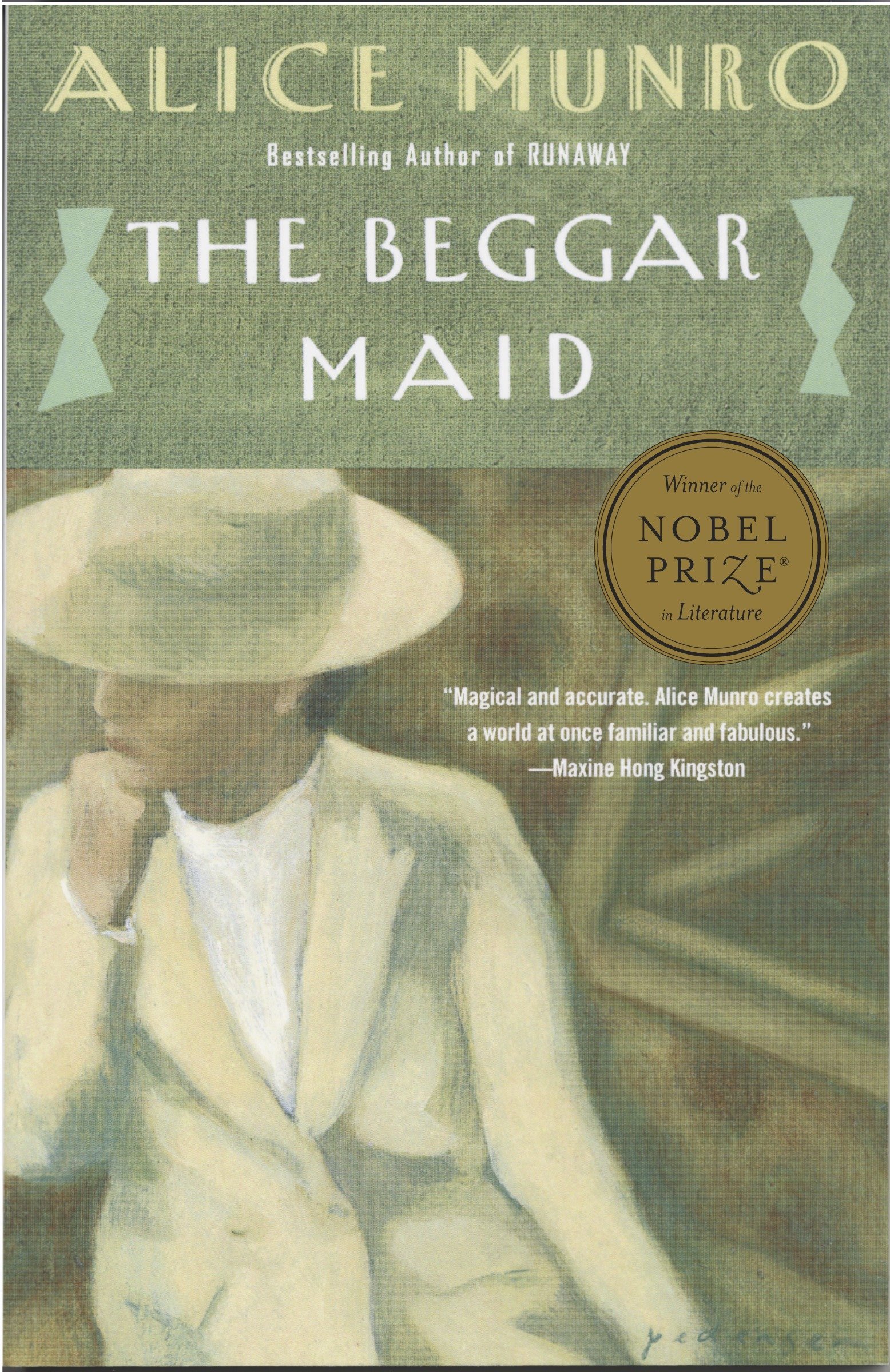
The Beggar Maid by Alice Munro

She could not turn Patrick down.  She could not do it.  It was not the amount of money but the amount of love he offered that she could not ignore; she believed that she felt sorry for him, that she had to help him out.  It was as if he had come up to her in a crowd carrying a large, simple, dazzling object--a huge egg, maybe, of solid silver, something of doubtful use and punishing weight--and was offering it to her, in fact thrusting it at her, begging her to take some of the weight of it off him.  If she thrust it back, how could he bear it?  But that explanation left something out.  It left out her own appetite, which was not for wealth but for worship.  The size, the weight, the shine, of what he said was love (and she did not doubt him) had to impress her, even though she had never asked for it.  It did not seem likely such an offering would come her way again.

Rose grows up, like all of Alice Munro's characters, in a little town in Ontario, this one called Hanratty.  It's not far from Toronto, but it sure feels far, and the first trip to Toronto is always a moment of mysterious ritual, a moment in which one's life changes for good.  It's a testament, I think, to Munro how similar Rose is to someone like Del Jordan from Lives of Girls and Women, but still so real and alive.  Nothing in her seems like a pale imitation.

The distinguishing mark given to Rose is her poverty.  Not that Del isn't poor, or essentially working class, but this collection of stories revolves around Rose's childhood poverty like an orbiting planet.  Poverty's at the heart of the stories that her stepmother Flo peddles about hard-luck locals: vigilante mobs, cruelly treated dwarves, incestuous siblings.  Reflecting on her stepmother, Rose maintains that poverty is the source of not just horror but also pride: "It meant having those ugly tube lights and being proud of them.  It meant continual talk of money and malicious talk about new things people had bought and whether they were paid for.  It meant pride and jealousy flaring over something the new pair of plastic curtains, imitating lace, that Flo had bought for the front window."

Rose ends up at school in Toronto, where she meets Patrick, the wealthy heir to a set of BC department stores.  Their love is no Romeo and Juliet story; it's an unflinching portrait of people whose capacity to understand each other is so limited as to doom their marriage from the very beginning.  Patrick romanticizes Rose's poverty, likening her to the Beggar Maid in a painting: "She studied the Beggar Maid, meek and voluptuous, with her shy white feet.  The milky surrender of her, the helplessness and gratitude.  Was that how Patrick saw Rose?  Was that how she cold be?"  The novel, or collection of stories, follows Rose through her tumultuous marriage and out the other side, after which she becomes a lonely and single actress and television presenter.  (So much of the latter stage of Rose's life seems like an alternate version of Juliet from the three-story cycle in Runaway.)  I particularly liked this observation about Patrick and Rose's daughter of Anna, a canny insight into the life of children of divorce:

Yet for Anna this bloody fabric her parents had made, of mistakes and mismatches, that anybody could see ought to be torn up and thrown away, was still the true web of life, of father and mother, of beginning and shelter.  What fraud, thought Rose, what fraud for everybody.  We come from unions which don't have in them anything like what we think we deserve.

Eventually, the story returns to Hanratty and Flo.  Of course, Rose's experience outside the world of Hanratty means she can never really go home again.  It's left her behind as much as she has.  Life in Hanratty has been pretty bitter for those who stayed, but it hasn't been a cakewalk for Rose, either.  Flo ends up in a home.  I loved this passage especially, about a blind old woman whose only way of interacting with the world is spelling words that she's given by a nurse:


There she was sitting waiting; waiting, in the middle of her sightless eventless day, till up from somewhere popped another word.  She would encompass it, bend all her energy to master it.  Rose wondered what the words were like, when she held them in her mind.  Did they carry their usual meaning, or any meaning at all?  Were they like words in dreams or in the minds of young children, each one marvelous and distinct and alive as a new animal?  This one limp and clear, like a jellyfish, that one hard and mean and secretive, like a horned snail.  They could be austere and comical as top hats, or smooth and lively and flattering as ribbons.  A parade of private visitors, not over yet.

Too good.  Like this woman, like Flo maybe, stricken with dementia, there is a great and painful loss in losing the knowledge and experience of your youth.  But maybe there's an opening, too, to see life as a child again, to remake and remold oneself.  Or at least, to believe that such a thing is possible.

Saturday, July 7, 2018

Obasan by Joy Kogawa

Where do any of us come from in this cold country?  Oh, Canada, whether it is admitted or not, we come from you we come from you.  From the same soil, the slugs and slime and bogs and twigs and roots.  We come from the country that plucks its people out like weeds and flings them into the roadside.  We grow in ditches and sloughs, untended and spindly.  We erupt in the valleys and mountainsides, in small towns and back alleys, sprouting upside down on the prairies, our hair as wild as spider's legs, our feet rooted nowhere.  We grow where we are not seen, we flourish where we are not heard, the thick undergrowth of an unlikely planting.  Where do we come from, Obasan?  We come from cemeteries full of skeletons with wild roses in their grinning teeth.  We come rom our untold tales that wait for their telling.  We come from Canada, this land that is like every land, filled with the wise, the fearful, the compassionate, the corrupt.

Naomi Nakane is a schoolteacher in rural Alberta, where her Japanese ancestry makes her--well, not unique, exactly, but it provokes comments from her students, largely the children of white farmers.  Naomi is prickly with her students, resentful toward their ignorance and prying.  Behind the discomfort--behind the central fact of her life in Alberta--is a history that Naomi wants to move past, unlike her Aunt Emily, including her own childhood in Canada's Japanese internment camps and her own separation from her mother and father.  When her great-uncle--Obasan's husband--dies suddenly, she's forced to confront the truth of her internment and the Japanese-Canadian experience as a whole.

Obasan's dive into Naomi's memories is often impressionistic, and though chronological, can be difficult to arrange into a coherent narrative that helps the reader understand exactly where the Japanese were sent and why.  She relies on overheard conversations between adults to fill in the gaps, but the method makes sense--what can a child understand of the reasons that she has been taken from her mother and sent to the British Columbia mountains?  Kogawa renders these scenes with an eye for strong detail, like the orange that Obasan, her aunt, presents to a destitute and desperate mother on the train toward internment, or the treasured doll that gets left behind.  A deep dive through a set of documents provided by her Aunt Emily helps Naomi discover at last what happened to her mother, who returned to Japan instead of being sent to the camps, and Kogawa's description of the destruction by atomic bomb of Nagasaki is an unflinching portrait of pure and honest horror that few real horror books could ever match.

There are few books that are set in Alberta, where I recently went.  At least half of Obasan actually takes place in British Columbia.  But what I didn't expect was that Obasan would feel so relevant and fresh to my own place and time.  It is, at its heart, a story of what happens when you separate families in the name of abstract notions of national security.  What happens is you fuck them up forever.  Naomi's separation from her family--even though much of Obasan is a story of perseverance and strength in the face of adversity--has provided her with nearly insoluble trauma.  Facing it, as her aunt encourages, can bring her to a kind of detente with it, but it is ineradicable.  And as Aunt Emily reminds us, about a different country but not less true: "What this country did to us, it did to itself."  The trauma we inflict on those seeking asylum at our own southern border we inflict on ourselves, and sooner our later, it will come back around to us.