Sunday, January 7, 2024
Night of the Living Rez by Morgan Talty
Sunday, January 8, 2023
Night of the Living Rez by Morgan Talty
Star- and moonlight hit the water. Down by the river, I sat on a rock, wishing I'd eaten and grabbed those pills and had a cigarette. Wishing I'd never heard of Antiques Roadshow. Maybe even wishing I was a winooch and didn't live on a reservation whose history was in a little museum and could be stolen for a buck. Didn't make any sense that parts of us were worth so much and at the same time we were worth so little. "You're nothing."
David is young when his mother, a Penobscot woman, leaves his white father and comes north to Maine to return to the reservation. It's disorienting for young David, of course, and not least because his mother has come to live with an older Native named Frick who seems to have a low opinion of David's connection to his indigenous background. David's sister, Paige, appears as well, mysteriously pregnant, and then mysteriously un-pregnant. As he grows up, David's life on the reservation becomes a checkered one. As a teenager, he develops an addiction to pills, and then methadone. As the lives of his mother, of Frick, and of Paige unravel in devastating ways, he finds himself--as he was as a child--challenged to provide meaningful support, or stability amid the chaos.
There is a familiar kind of story I have seen in many books by Native writers, a story in which lost Natives, mixed up with substance abuse or crime or simple despair and mental instability, find safety and wholeness by returning to their land. That's the story, more or less, of James Welch's Winter in the Blood, Leslie Marmon Silko's Ceremony, and N. Scott Momaday's House Made of Dawn. Contemporary Native writers have been interrogating that story, I think, in interesting ways: Tommy Orange, for instance, in his novel about Natives living in urban Oakland, remarks that "the land is everywhere or it's nowhere." I'm interested in how Night of the Living Rez presents this story: David's "return" to the Penobscot reservation brings him closer to his sister and his grandmother, and to Penobscot life, but it's troubled in many ways that subverts the straightforward positivity of such narratives.
For instance, there's Frick: when David first arrives, Frick chastises him for his inability to shoot and hunt, suggesting this makes him deficient as a Native. It's only later (or I missed it the first time) that we learn that Frick is a western Native, not Penobscot at all--a small but clever dig, I think, at the way certain ideas about Native people dominate American cultural media. And yet, the reservation is always being mined for media. One subplot involves David's friend Ferris breaking into the Penobscot museum to steal a "root club," having seen one go for big bucks on Antique Roadshow. In the title story, a film crew trying to produce a documentary on the reservation ends up filming one of the most harrowing and traumatic experiences of David's life. These details provide a vision of Native life that is offered up as a consumable commodity, even as Natives like David remain, or feel they remain, estranged from it. Running from the cops, David ends up hiding out in a sweat lodge--a grimly ironic symbol, until he returns later to actually go through with the sweat lodge ceremony: "[A]nd right then my body sweated all that was left in it, which really wasn't very much at all." So there is a positive vision here; I don't mean to suggest there isn't--only that one of the things Night of the Living Rez suggests so eloquently is that sometimes, coming home isn't enough.
Not every story in Night of the Living Rez landed for me, but one thing I did really enjoy about it was its structure: David is the narrator of each story, but the stories are out of order chronologically; the book skips from child David to the teenage "Dee" to the adult, looking back. Partly this structure helps the book to subvert familiar expectations about problem and resolution, sickness and recovery, alienation and integration. Like my old friend Infinite Jest, it struck me how much Night of the Living Rez is a story about addiction--David waking up in a grain silo, David stealing money from his grandmother to pay for Klonopin, David adrift at the methadone clinic--and the structure reveals something about the halting and peripatetic nature of recovery. The title story, maybe the best story, reveals that it's not just David who struggle with substance abuse: Paige and Frick, too, stumble around like the zombies suggested by the title, and the abuse facilitates horrible acts that rupture lives. But although there are no simple solutions, life goes on--the "Living Rez."
Wednesday, November 16, 2022
Six Walks by Ben Shattuck
The idea to follow Henry David Thoreau's walks came while I was standing in the shower at dawn one May morning, listening to the water drill my skull and lap my ears, wondering what I could do to stop the dreams of my past girlfriend. This was years ago, in my early thirties, when I couldn't find a way out of the doubt, fear, shame, and sadness that had arranged a constellation of grief around me. In this last dream, the one that got me into the shower at sunrise, she was in labor. I dreamt that she had a husband--dark-haired, wearing a red shit with sleeves rolled to his elbows--show stood bedside, gripping her hand while she breathed. I stood against the wall, touching a white handkerchief I wanted to offer them.
My wife and I went to Cape Cod last weekend, her first time, my second. It stretches out in the shape of an flexed arm, with the long sand beaches of the Outer Cape running from the knuckle to the elbow. They are beautiful beaches, cream-colored running beneath tall ochre cliffs, looking out on an eternal sea dotted with gulls and eiders and kittiwakes as white and numerous as the little caps of the waves. You're guaranteed to see a seal, and if you're a little lucky, a whale. But only someone who is deeply strange, or deeply damaged, could imagine walking the entire stretch of the Outer Cape, someone like Henry David Thoreau, with a touch of the misanthrope. For Ben Shattuck, who sets out to trace Thoreau's footsteps, the walk offers a way to step out of oneself, out of the sleeplessness of a bad breakup and the chronic misery of Lyme disease. Shattuck is in a bad place when he starts his walk: at the Truro cliffs he eats a bar of clay like a hunk of chocolate.
The Cape Cod walk will become the first in a series of six walks that Shattuck takes, each in the footsteps of Thoreau, who recorded his walks in his journals. The second is a hike up Mt. Katahdin, the towering axe-head in Maine that lies at the terminus of the Appalachian trail. The third is an MDMA-laced trip to the top of Massachusetts' Wachusett Mountain, now a ski resort. The fourth is a walk from Shattuck's Massachusetts' home across the Rhode Island border, in the spirit of a walk that Thoreau took due southwest from his house, not knowing what he'll find. The fifth is a paddle up the Allagash River in far north Maine to a place where Henry camped, one of the few spots that seems to remain true wilderness, and the final one is a return to Cape Cod.
By the time Shattuck makes his return, his life is changed. The first three walks are records of misery, desperate attempts to outrun fatigue and depression. They seem often recklessly unplanned: Shattuck ends up spending the night with a pair of gracious Cape Codders who live near Thoreau's old property, but only by luck and happenstance. The MDMA on Wachusett mountain fails to bring the required transcendence, but it does lead to a moment of détente with a porcupine. But years pass between the first three walks and the second, and in the meantime Shattuck has conquered his Lyme disease and gotten a new girlfriend, an actress named Jenny who, as I was forced to curiously Google, turns out to be SNL alum Jenny Slate. (Honestly: Good work, Ben.) As Shattuck's life improves, the tone of the essays changes; the walks go from being flights from human life to deep engagements with the natural world.
Shattuck is a visual artist, and the essays are dotted with evocative black-and-white charcoal drawings of his walks. He brings an artist's visual sense to the landscapes he and Thoreau share: imagining the heart "the size of a chestnut" in the porcupine: "There's a heart at the center of all animals. Everything is soft underneath." In Henry's words: "A very suitable small fruit." There's the "black wedge" of a whale's mouth, and the way sunlight "raked across" the tops of Wellfleet houses. A coastline is "crenellated." And often Shattuck's language works in service of profound meditations on loss and grief: the most successful of the essays might be the Allagash one, in which Shattuck ties together an alien abduction reported in the area in the 1970's and Henry's loss of his own brother. Henry's guide, a Penobscot Indian named Joe for which Thoreau has little respect, also lost a brother, probably at the hands of whites, and agrees to serve as guide so he can go looking for him, but Thoreau is unable to cross the boundary of race to see a common kinship. These threads, along with Shattuck's own griefs and losses--chief among them the loss of a fingertip on his writing and painting hand--become a strong rope.
I really enjoyed Six Walks. I love reading books set in the places I travel to, and sometimes there is a resonance, but often not. Six Walks made me look at the Cape Cod landscape a little differently: I saw, standing on the thin fringe of beach, how someone might feel at the edge of their life there. I saw the cliffs at Truro, but I didn't stop to eat any of the clay. And I also saw how, standing with my wife and watching a seal roll around in the surf, how different it might be to be at that edge with someone loved.
Friday, July 22, 2022
Northland by Porter Fox
At sunset, the sky turned dark blue. I tried to remember the color of the stones, the cool air, the auburn sunlight touching my forehead. I thought about the first day of the trip at West Quoddy Head in Maine and tried to memorize the dark spires, rounded massifs, and marshmallow flanks of Mount Baker's glaciers. I thought about all the parts of the northland--oceans, rivers, lakes, plains, cities, reservations, towns--and how they linked from east to west. It was indeed its own territory: a forgotten belt of wild, old America delineated by iron monuments, rock piles, and clear-cuts.
We ended our trip through the Pacific Northwest last week at the Peace Arch, a monument that stands on the border between the towns of Blaine, Washington and Douglas, British Columbia. A tall white arch stands in the middle of a green park that stretches between both countries, with the entry lines on either side of it, the Canadian to the left, the American to the right. The monument is supposed to be a monument to peace between the two countries; in the middle, there is a ceremonial gate attached to the wall below a sign that reads MAY THESE GATES NEVER BE CLOSED. Just beyond the arch, a sign on the Canadian side reads, "Park Closed."
We saw a woman enter idly from the Canadian side and walk to the American, where she was collected by an official looking man who might have been from either country and directed toward a booth, presumably to be sent off to a black site. A few feet away the park becomes a stretch of carefully tended flowers and picnic benches (and the Peace Arch Park Snack Shack) on the American side. On the Canadian side, the border follows a street where a row of houses look out in to America, their residents only needing to make a few steps out of their door to enter another country. These houses made the stern theater of the border crossing stations seem performative and silly.
Porter Fox ended his journey along all 4,000+ miles of the USA-Canadian border at the Peace Arch, too. By then, the peculiar logic that exists at the Peace Arch has appeared many times: the world's longest peaceful border has, since 9/11, become hardened in ways that have sundered communities and put an end to the free travel that was once common between the two countries. The "Park Closed" signs we saw were, no doubt, the vestiges of Canadian COVID-19 policy, which has hardened the border even more--in many places, trains still can't pass through it. But even a few years ago, when Fox took up the project of canoeing, hiking, boating, and driving from the border's eastern terminus in Maine to its western one in Washington, the border was increasingly contentious.
The thesis of Fox's book is that the area around the border has its own particular identity and existence, as a region he calls "The Northland." He wants to explore the Northland, a region that is, with some exceptions, remarkably rural and remote, and understand how the border has shaped this identity. He begins in Maine, canoeing along the St Croix river, then hitches a ride on a Great Lakes tanker that takes him all the way from Lake Erie to Lake Superior. From there, he drives across the oil-rich boomlands of North Dakota, making a quick and timely sojourn into the protest camps at Standing Rock, which are not really near the border--though the oil in the pipeline is. His journey continues along the "Medicine Line," as the Native Americans who were pushed across it in the 19th century call it, stopping in at the Blackfeet Reservation and through Glacier National Park. In the North Cascades, he sleeps in a fire tower, as Jack Kerouac once did, during one of his most prolific periods.
The book is part travelogue, part social commentary, part history. As Fox travels, he recounts the history of the border, which has always been a contentious one. The 18th and 19th century politicians who negotiated the border really had no idea about the geography of the land they were dividing, and time and time again, created impossible borders that would lead to more contention, and more need for tenacious explorers and surveyors. The creation of Minnesota's Northwest Angle, for instance, the little chopped-off bit on the other side of the Lake of the Woods, exists because the agreed border point--the headwaters of the Mississippi--is a hundred miles south of where the negotiators thought it was. Fox adds to this history a sympathetic portrait of Angle Inlet, the Angle's only community, where schools and businesses have closed over the last few decades because of the stubborn and increasing difficulty of crossing the border--twice. And similar stories are told in Maine and along the Great Lakes.
I appreciated Fox's focus on Native Americans, for whom the border takes on a special relevance. Fox's sojourn to Standing Rock fits uncomfortably with the book's overall thesis (I mean, Google it, it's mostly in South Dakota) but along with his stop at the Blackfeet Nation, it gives an effective portrait of the way the border was placed over the existence of tribal nations, and which has profoundly shaped their existence. Even before the Indian Wars of the 19th century, the border was an indigenous problem, as Fox explains in his recounting of the alliance between Jesuit explorer Champlain and the Hurons against the Iroquois.
We crossed the border four times on our trip: twice by airplane, once by boat, and once on the road. But we experienced only one small part of its four thousand miles. I loved reading Northland while on this trip because it gave me a sense of exploring something larger; not merely of stepping over an imaginary line but passing through a real place on which history works its considerable, sometimes transformative, sometimes brutal efficacy.
Tuesday, November 5, 2019
The Catherine Wheel by Jean Stafford
School has ended and Andrew Shipley has returned to the small Maine town where his mother's cousin Katharine lives in a stately manor. He has been looking forward to seeing his cousin, but mostly to seeing his friend Victor, a strange and ugly boy whose friendship is the best thing in Andrew's life. But the very day he arrives, he learns that Victor's brother Charles is home from the army, and sick: Victor, who idolizes his brother, will be too sick to spend time with him. Andrew passes the summer in boredom and near-violent resentment; inside him, a voice--the kind of voice that only children, who have not lost the belief that their thoughts can have a physical effect in the world--commands Charles to die.
Meanwhile, Cousin Katharine, a beautiful and eccentric spinster, has her own inner turmoil. Andrew's father John, who long ago chose their friend Maeve (Andrew's mother) over her, has changed his mind after decades of unhappy marriage. Katharine knows that her love won't solve John's existential misery, but the lost past tortures her. She plans a big party that reenacts the moment she realized that John was in love with Maeve, a party with big fireworks. The Catherine wheel--that's a firework--becomes a symbol of the vanishing summer, the fleeting happiness that both Katharine and Andrew wish they could recover:
A crimson girandole mounted with a hiss to the sky and fell, a fountain of blinding orange fire; the fine, showering colors were unreal and chemical, plangent pinks and purples, sharp blues and violent greens, and the rapidity with which the rockets vanished, leaving for only an instant afterward the image of their course and the echo of their explosion, so excited her that she had been lightheaded and tears had started to her eyes. As the last Catherine wheel revolved insanely on its separate planes of scarlet and green, sizzling and thundering as the wild spokes fired each other, Katharine, in ecstasy, turned to face John Shipley. No longer than it took the Catherine wheel to spin itself to nothing and leave the summer sky to the stars did it take her to see that he could not, could never see her.
All the drama in The Catherine Wheel is purely psychological. Andrew and Katharine's preoccupations become obsessions, useless and painful, but neither of them can let go, and each becomes convinced that the other knows exactly what's going on in their heads: Andrew childishly, and Katharine because she believes that Andrew has read her diary. (Isn't that a recognizable truth: how often we worry that the shameful things we are thinking are readable on our face?)
The Catherine Wheel moves the action from wild Colorado to genteel Maine, but the novel works on the same formula as The Mountain Lion. In both novels, Stafford reveals a canny ability to capture the strange mental universe of children, which seems as real as any physical thing. And like The Mountain Lion, The Catherine Wheel is all mind-drama until it isn't, hurtling toward a final brief moment where the psychological really does manifest itself in the world in a flash of horrific violence. But whereas the end of The Mountain Lion felt inevitable and terrible, the end of The Catherine Wheel felt gratuitous to me. It was all out of proportion, I thought, to the more painstaking grief of lost summer happiness that is the novel's topic otherwise.
On a macro level, I'm not sure The Catherine Wheel worked for me. But man, can Jean Stafford write a sentence. In the context of Northeastern gentility her prose loses something of the Western sparseness present in The Mountain Lion; these sentences bloom like flowering vines. Here you can really see the influence, I think, of D. H. Lawrence (maybe the best sentence writer in 20th century English). Stafford is a master of the specific detail--whole lives get crammed into sentences and phrases with stunning realness--and a skilled articulator of mental states: "his loneliness," she says of Andrew, "stayed like a bone in his heart." You leave the book feeling scorched, singed, as if by fireworks.
Friday, November 24, 2017
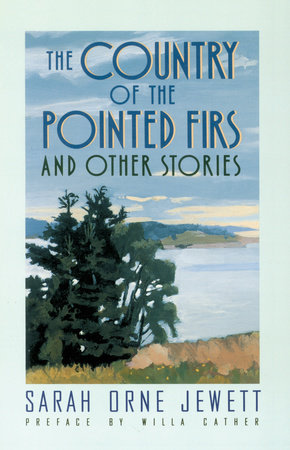
The Country of the Pointed Firs by Sarah Orne Jewett
My new wife and I recently went on our mini-moon to Portland, Maine, a lovely but cold town set on the rocky New England coast and ringed with islands. I've been saving this book for the next time I was in Maine, and as far as local color goes, it didn't disappoint: Jewett's account of a small coastal town in Maine certainly feels unmistakably like a product of its own place and time, as closely tied to its setting as Twain's novels are to the Mississippi River.
The unnamed protagonist of The Country of the Pointed Firs is an older woman writer--probably very closely identified with Jewett herself--who summers in the town of Dunnet Landing, where she rents out an abandoned schoolhouse for her writing and becomes fast friends with another woman named Almira Todd, who is an expert in growing medicinal herbs. The book unfolds over several summers, as the protagonist gets to know the local denizens of Dunnet Landing better little by little, as well as Almira's simple but loyal family, who live out on one of the harbor islands. Jewett has a sensitive eye for the habits and personalities of the Mainers of the 19th-century people: proud but unpretentious, friendly but insular, with a propensity for sea travel (they rely on a fishing economy, after all) but unfamiliar with places fifteen miles away by land.
This novel was a challenge for me. It flouts one of the principles of fiction we hold to be most inviolable: it really has nothing resembling a conflict. The people of Dunnet Landing undergo hardships, of course; they've buried loved ones and endured harsh winters, which they bear with equanimity, but these things are rarely represented in the narrative. The protagonist and Almira are friendly with just about everyone; you get the sense that small-town people can't afford to be enemies. In place of conflict is a series of detailed sketches of Maine life that illuminate the richness in everyday life even as they zero in on characters who are, for lack of a better word, "quirky."
My favorite comes late in the book, when Almira and the protagonist visit a reclusive woman known as "The Queen's Twin," because she shares a birthday with Queen Victoria. There's a tremendous pathos in the image of the woman, living alone in the Maine woods, but imagining a kind of friendship with a powerful woman across the Atlantic:
"Sometimes I think, now she's older, she might like to know about us. When I think how few old friends anybody has left at our age, I suppose it may be just the same with her as it is with me; perhaps she would like to know how we came into life together. But I've had a great advantage in seeing her, an' I can always fancy her goin' on, while she don't know nothin' yet about me, except she may feel my love stayin' in her heart sometimes an' not know just where it comes from. An' I dream about our being together out in some pretty fields, young as ever we was, and holdin' hands as we walk along."
And yet Jewett is as interested in the walk to the Queen's Twin's house as she is what in what happens there, and lingers for pages and pages over the landscape and the untroubled path of the two visiting friends. Most of the characters in the novel are women, and older women at that, and the uncomfortable dramalessness of it may reflect a particular mode of existence circumscribed for women in 19th century America. But I admit to being frustrated by it, and being most interested in the novel when it rises above the quotidian, as with a chilling early tale from a Sea Captain who describes, from secondhand accounts, a terrifying Arctic world of strange shadow-creatures. It sets a strange tone for the novel that it never returns to, or validates.
My copy of the novel is accompanied by several short stories, most of which tell similar stories about older women visiting older women. Most of them I have forgotten completely, but a couple stand out: "The White Heron," about a young girl's awakening to the natural world around her in contrast to the rapaciousness of a visiting hunter, and "The Hiltons' Holiday," whose story of a pair of young girls visiting the town for the first time just stands out as being unerringly charming (and which reminds me of a similar account, accompanied by more menace, in Independent People). But by the time I'd put the book down, I'd had enough of charm, and of local color.