Showing posts with label Henry David Thoreau. Show all posts

Wednesday, November 16, 2022

Six Walks by Ben Shattuck

The idea to follow Henry David Thoreau's walks came while I was standing in the shower at dawn one May morning, listening to the water drill my skull and lap my ears, wondering what I could do to stop the dreams of my past girlfriend. This was years ago, in my early thirties, when I couldn't find a way out of the doubt, fear, shame, and sadness that had arranged a constellation of grief around me. In this last dream, the one that got me into the shower at sunrise, she was in labor. I dreamt that she had a husband--dark-haired, wearing a red shit with sleeves rolled to his elbows--show stood bedside, gripping her hand while she breathed. I stood against the wall, touching a white handkerchief I wanted to offer them.

My wife and I went to Cape Cod last weekend, her first time, my second. It stretches out in the shape of an flexed arm, with the long sand beaches of the Outer Cape running from the knuckle to the elbow. They are beautiful beaches, cream-colored running beneath tall ochre cliffs, looking out on an eternal sea dotted with gulls and eiders and kittiwakes as white and numerous as the little caps of the waves. You're guaranteed to see a seal, and if you're a little lucky, a whale. But only someone who is deeply strange, or deeply damaged, could imagine walking the entire stretch of the Outer Cape, someone like Henry David Thoreau, with a touch of the misanthrope. For Ben Shattuck, who sets out to trace Thoreau's footsteps, the walk offers a way to step out of oneself, out of the sleeplessness of a bad breakup and the chronic misery of Lyme disease. Shattuck is in a bad place when he starts his walk: at the Truro cliffs he eats a bar of clay like a hunk of chocolate.

The Cape Cod walk will become the first in a series of six walks that Shattuck takes, each in the footsteps of Thoreau, who recorded his walks in his journals. The second is a hike up Mt. Katahdin, the towering axe-head in Maine that lies at the terminus of the Appalachian trail. The third is an MDMA-laced trip to the top of Massachusetts' Wachusett Mountain, now a ski resort. The fourth is a walk from Shattuck's Massachusetts' home across the Rhode Island border, in the spirit of a walk that Thoreau took due southwest from his house, not knowing what he'll find. The fifth is a paddle up the Allagash River in far north Maine to a place where Henry camped, one of the few spots that seems to remain true wilderness, and the final one is a return to Cape Cod.

By the time Shattuck makes his return, his life is changed. The first three walks are records of misery, desperate attempts to outrun fatigue and depression. They seem often recklessly unplanned: Shattuck ends up spending the night with a pair of gracious Cape Codders who live near Thoreau's old property, but only by luck and happenstance. The MDMA on Wachusett mountain fails to bring the required transcendence, but it does lead to a moment of détente with a porcupine. But years pass between the first three walks and the second, and in the meantime Shattuck has conquered his Lyme disease and gotten a new girlfriend, an actress named Jenny who, as I was forced to curiously Google, turns out to be SNL alum Jenny Slate. (Honestly: Good work, Ben.) As Shattuck's life improves, the tone of the essays changes; the walks go from being flights from human life to deep engagements with the natural world.

Shattuck is a visual artist, and the essays are dotted with evocative black-and-white charcoal drawings of his walks. He brings an artist's visual sense to the landscapes he and Thoreau share: imagining the heart "the size of a chestnut" in the porcupine: "There's a heart at the center of all animals. Everything is soft underneath." In Henry's words: "A very suitable small fruit." There's the "black wedge" of a whale's mouth, and the way sunlight "raked across" the tops of Wellfleet houses. A coastline is "crenellated." And often Shattuck's language works in service of profound meditations on loss and grief: the most successful of the essays might be the Allagash one, in which Shattuck ties together an alien abduction reported in the area in the 1970's and Henry's loss of his own brother. Henry's guide, a Penobscot Indian named Joe for which Thoreau has little respect, also lost a brother, probably at the hands of whites, and agrees to serve as guide so he can go looking for him, but Thoreau is unable to cross the boundary of race to see a common kinship. These threads, along with Shattuck's own griefs and losses--chief among them the loss of a fingertip on his writing and painting hand--become a strong rope.

I really enjoyed Six Walks. I love reading books set in the places I travel to, and sometimes there is a resonance, but often not. Six Walks made me look at the Cape Cod landscape a little differently: I saw, standing on the thin fringe of beach, how someone might feel at the edge of their life there. I saw the cliffs at Truro, but I didn't stop to eat any of the clay. And I also saw how, standing with my wife and watching a seal roll around in the surf, how different it might be to be at that edge with someone loved.

Friday, August 29, 2014

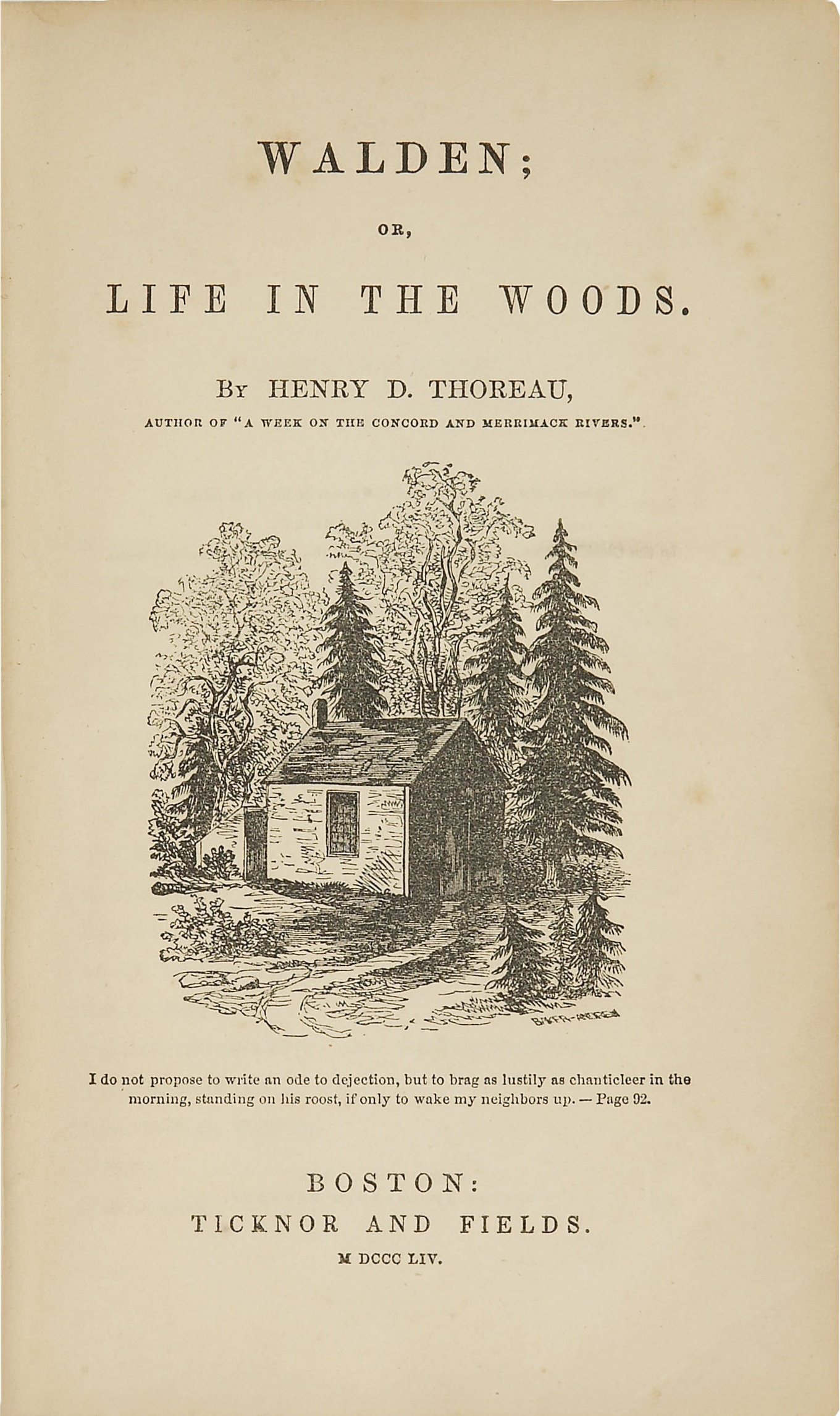
Walden by Henry David Thoreau

I went to the woods because I wished to live deliberately, to front only the essential facts of life, and see if I could not learn what it had to teach, and not, when I came to die, discover that I had not lived.  I did not wish to live what was not life, living is so dear, nor did I wish to practice resignation, unless it was quite necessary.  I wanted to live deep and suck out all the marrow of life, to live so sturdily and Spartan-like as to put to rout all that was not life, to cut a broad swath and shave close, to drive life into a corner, and reduce it to its lower terms, and, if it proved to be mean, why then get to the whole and genuine meanness of it, and publish its meanness to the world; or if it were sublime, to know it by experience, and be able to give a true account of it in my next excursion.

 Small guy, small house.

Apparently John Updike wrote about Walden that it "risks being as revered and unread as the Bible."  That's a good line, but not as good as a lot of lines in Walden that those who revere it are missing.  On the other hand, I think the opposite has become an equally valid risk: that Walden has become a book that is unread and mocked.  It seems like there's always some jagoff wanting to point out that Thoreau's cabin was, like, a mile from town, and that he went into Concord and ate at restaurants and stuff all the time.  (Am I the only one that hears that stuff a lot?)  Both attitudes--the mockery and the reverence--are silly because they misapprehend what Walden is about, and having not read it, I think I misapprehended it a little as well.

First of all, it isn't really transcendentalist in the way that I think of Emerson as being.  Thoreau gets a lot out of Nature, but there's no Wordsworthian sense that a communion with nature lifts Thoreau to a higher plane of existence.  Rather, living the kind of simple life that Thoreau leads in his two-year experiment at Walden Pond allows him to observe his natural surroundings more closely, and to appreciate them more intensely.  Some of the most beautiful passages of Walden are Thoreau's description of animal life.  I especially like his account of a war between red and black ants:

Looking farther, I was surprised to find that the chips were covered with such combatants, that it was not a duellum, but a bellum, a war between two races of ants, the red pitted against the black, and frequently two red ones to one black.  The legions of these Myrmidons covered all the hills and vales in my wood-yard, and the ground was already strewn with the dead and dying, both red and black.  It was the only battle which I have ever witnessed, the only battle-field I ever trod while the battle was raging; internecine war; the red republicans on the one hand, and the black imperialists on the other.  On every side they were engaged in deadly combat, yet without any noise that I could hear, and human soldiers never fought so resolutely.

But again, communion with nature isn't really the point of Thoreau's experiment.  He says: "If I were confined to the corner of a garret all my days, like a spider, the world would be just as large to me while I had my thoughts about me."  Thoreau goes to the woods to rely on himself as much as possible, and to reduce his need to depend on other people as much as possible.  Walden is really an experiment in hyperindividuality, part and parcel with the irascible libertarianism of "Civil Disobedience."  As he writes, "I would have each one be very careful to find out and pursue his own way, and not his father's or his mother's or his neighbor's instead."


Thoreau's grave, Concord, Mass.

Thoreau's version of this philosophy is quite extreme.  Sometimes it leads him to (hilarious) crankism.  Among the things he hates are: farms, politics, post offices, clothes, philanthropy, and other people.  But elsewhere it leads to observations of persuasive beauty:

I have a great deal of company in my house; especially in the morning, when nobody calls.  Let me suggest a few comparisons, that some one may convey an idea of my situation.  I am no more lonely than the loon in the pond that laughs so loud, or than Walden Pond itself.  What company has that lonely lake, I pray?  And yet it has not the blue devils, but the blue angels in it, in the azure tint of its waters.  The sun is alone, except in thick weather, when there sometimes appears to be two, but one is a mock sun.  God is alone,--but the devil, he is far from being alone; he sees a great deal of company; he is legion.  I am no more lonely than a single mullein or dandelion in a pasture, or a bean leaf, or sorrel, or a horse-fly, or a bumble-bee.  I am no more lonely than the Mill Brook, or a weathercock, or the north star, or the south wind, or an April shower, or a Jaunary thaw, or the first spider in a new house.

That paragraph indicates to me a strength of mind I know I don't possess.  Thoreau only managed to live like this for a couple of years before he rejoined society--but that's more than I think I'm capable of.  Certainly others have tried, some extremely so, and failed.  But I do think Thoreau's experiment is worth admiration, and Walden worth reading.