Sunday, March 22, 2020

The True Heart by Sylvia Townsend Warner

What she wanted to say was:

'Save me!  You must save me, for I am in despair and only you can rescue me.  I am alone, I am in love, I am terrified out of my wits.  Everything is in a conspiracy against me, everything menaces me, everything is new and unknown and terrifying, for love has changed it, and changed me too, so that I can do nothing to save myself, I can only whirl to and fro among my fears.  Oh, save me, you ought to save me, for I am yours, I have given myself to you, I am not my own any longer.  And yet I don't feel as thought you had got me.  I am like a ghost, I don't know myself any longer.  I am like a dream.  The sight of my own hand is enough to startle me, it seems strange and not mine.  I am like your dream, and you may wake up and forget me, and I shall never be able to find my way to you any more.'

Orphan Sukey Bond is placed as a servant with a family on a small farm in the marshes of England.  By the members of the family there she is either ignored or condescended to, with one exception: a mysterious young man named Eric, who the brothers of the family insist is not their relation at all.  One day, Eric leads Sukey to a secret and abandoned orchard full of fruit, where he kisses her for the first time.  Eric is pure and good-hearted--perhaps, you might suspect, a little too pure, as when he suggests they climb through the window of an empty church and get married.  Later, he has a convulsive fit when Sukey is compelled to slaughter a chicken for dinner.  Eric, the family explains, is "an idiot"--and soon his haughty and ashamed mother has spirited him away from the house where she has hidden him away, leaving Sukey alone.

The True Heart is the story of Sukey's long quest to find Eric and bring their promise of marriage to each other to fruition.  Townsend Warner gives the impression that Sukey, too, doesn't quite have full possession of her faculties: entreating Eric's mother, she confesses an unshakable belief that she is pregnant, though all the pair has done is smooch in an orchard.  But Sukey's naivete is not permanent, but the product of youth and inexperience, which finds in Eric a kind of familiar companion.  The True Heart believes that there is a wonder in the simplicity of childhood and its imaginative power, which is lost in the process of aging.  See how, by contrast, a slightly older Sukey veers toward cynicism and despair:

One day, in the midst of stilling the outcries of little Louise, who had stuffed her nostrils with soap, it flashed upon her with an extraordinary unreality that she had once believed herself to be pregnant.  It seemed the delusion of a child.  Just so, in the old days at Notting Dale, she had awoken one morning firmly convinced that she could fly, and had launched herself down a flight of stairs, to roll bewildered and howling into a clothes-basket.  Perhaps her very love had been a delusion too.  It had seemed like love, but so had it seemed to her that she would bear a child.  One was untrue, so might the other be.  For what did she know about love?  Nothing.  A farm-servant, very young, very ignorant, who had been kissed by a boy who was not quite in his right mind.

But Eric acts like a lifeline for Sukey's youthfulness, keeping it alive even in his absence.  It's this youthful imagination that gives Sukey the boldness to abandon three different placements to renew her search for Eric, and to traipse around the English countryside, relying on the kindness of tramps and madams.  She develops a ridiculous notion that if she can procure a signed Bible from Queen Victoria and present it to Eric's mother, she will see the light and permit the marriage.  It seems impossible, but Sukey's firm belief makes it possible, and in the end, she really does meet the Queen, she really does get the Bible.  Things don't quite work as she expects, but that doesn't seem to matter; what matters is that Sukey believes in the dream of her youth at all costs.

The True Heart is very charming; it's the kind of heartwarming and optimistic--but not shallow or didactic--book that I needed at this difficult moment.  As in Lolly Willowes and Mr. Fortune, Townsend Warner creates characters that are appealing and convincing, sympathetic even in their follies and mistakes. 

Friday, March 20, 2020

The Plague by Albert Camus

In this respect our townsfolk were like everybody else, wrapped up in themselves; in other words they were humanists: they disbelieved in pestilences.  A pestilence isn't a thing made to man's measure; therefore we tell ourselves that pestilence is a mere bogy of the mind, a bad dream that will pas away.  But it doesn't always pass away and, from one bad dream to another, it is men who pass away, and the humanists first of all, because they haven't taken their precautions.  Our townsfolk were not more to blame than others; they forgot to be modest, that was all, and thought that everything still was possible for them; which presupposed that pestilences were impossible.  They went on doing business, arranged for journeys, and formed views.  How should they have given a thought to anything like plague, which rules out any future, cancels journeys, silences the exchange of views.  They fancied themselves free, and no one will ever be free so long as there are pestilences.

Why did I do this to myself?  If I were being self-congratulatory, I might say that I read The Plague during a global pandemic because I have decided to face facts, and look the enemy in the eye.  But that's not true; I've stopped looking at Twitter because I can't take the news at the moment.  Maybe there's something pacifying about reading about a fictional plague, one that unfolds over the pace of 200 pages, and doesn't have to be lived through at the agonizing rate of a day at a time.  Maybe it's just a kind of grim joke I decided to play on myself.

In Camus' novel, the place is Oran, a French Algerian port, and the plague is the plague.  It begins, as the plague does, with rats: first a couple of rats dying in the streets, then dozens, then hundreds, then thousands.  The rats unleash the bubonic plague on the people of Oran, in isolated instances at first, and then, again, by dozens, hundreds, thousands.  Soon Oran finds itself shut off from the outside world as plague rampages through it, separating lovers, family, and incarcerating those inside.

Oran is not the world.  That's the first big difference between The Plague and the coronavirus; there's no sense at the moment that other places have it better, and if you could just be elsewhere, everything would be all right.  But the sense of exile, of being cut off, doesn't that describe what we're all going through with extreme social distancing?  Thank goodness we have more, these days, than telegrams.  In a hundred other little ways, The Plague is spot-on about the dynamics of the pandemic, from the bureaucratic slowness and ineptitude which is formed by an unwillingness to admit the truth:

Then, after sweeping the other members of the committee with a friendly glance, he said that he knew quite well it was plague and, needless to say, he also knew that, were this to be officially admitted, the authorities would be compelled to take very drastic steps.  This was, of course, the explanation of his colleagues' reluctance to face the facts and, if it would ease their minds, he was quite prepared to say it wasn't plague.

To the enervating mystery of when things will get back to normal:

It is noteworthy that our townspeople very quickly desisted, even in public, from a habit one might have expected them to form--that of trying to figure out the probable duration of their exile.  The reason was this: when the most pessimistic had fixed it at, say, six months; when they had drunk in advance the dregs of bitterness of those six black months, and painfully screwed up their courage to the sticking-place, straining all their remaining energy to endure valiantly the long ordeal of all those weeks and days--when they had done this, some friend they met, an article in a newspaper, a vague suspicion, or a flash of foresight would suggest that, after all, there was no reason why the epidemic shouldn't last more than six months; why not a year, or even more?

Even to the way an epidemic exacerbates the injustice of society and falls hardest on those like prisoners:
"I should tell you, however, that they're thinking of using the prisoners in the jails for what we call the 'heavy work.'"
"I'd rather free men were employed." 
"So would I.  But might I ask why you feel like that?" 
"I loathe men's being condemned to death."

But I'll say this: the focus of The Plague is not really on the dying or the beleaguered, but on a small group of people, led by Dr. Bernard Rieux, who risk their lives to help Oran through the plague.  Rieux tells those who volunteer with him that they stand a one in three chance of surviving, if they assist in what are called "sanitary squads," but each of them comes to realize the work as a kind of human duty.  You can't read about Rieux without thinking about the thousands of doctors, nurses, and yes, grocery store workers who are putting their lives at risk every day to combat the coronavirus.  In the end, The Plague is a very human and humane book; it sees self-sacrifice and community as the heart of what is best about people.  As one of Rieux's friends and associates, Tarrou, says, "What's natural is the microbe.  All the rest--health, integrity, purity (if you like)--is a product of the human will, of a vigilance that must never falter."

Late in the book, the inept magistrate M. Othon, who spends weeks in a horrid isolation camp, decides upon his release to return there in order to help it run.  Pestilence, Camus says, offers the opportunity for human beings to become better and wiser, if we'll take it.  Ultimately, the lesson of the novel is that "there are more things to admire in men than despise."  Maybe I'm grasping at any kind of straw, but I closed the novel with at least a little bit of that kind of hope.

Wednesday, March 18, 2020

Memoirs of Hadrian by Marguerite Yourcenar

Different persons have ruled me in turn, though none of them for long; each fallen tyrant was quick to regain power.  Thus have I played host successively to the meticulous officer, fanatic in discipline, but gaily sharing with his men the privations of war; to the melancholy dreamer intent on the gods; the lover ready to risk all for a moment's rapture; the haughty young lieutenant retiring to his tent to study his maps by lamplight, making clear to his friends his disdain for the way the world goes; and finally the future statesman.  But let us not forget, either, the base opportunist who in fear of displeasing succumbed to drunkenness at the emperor's table; the young fellow pronouncing upon all questions with ridiculous assurance; the frivolous wit, ready to lose a friend for the sake of a bright remark; the soldier exercising with mechanical precision his vile gladiatorial trade.  And we should include also that vacant figure, nameless and unplaced in history, though as much myself as all the others, the simple toy of circumstance, no more and no less than a body, lying on a camp bed, distracted by an aroma, aroused by a breath of wind, vaguely attentive to some eternal hum of a bee.

Machiavelli called Hadrian one of the "Five Good Emperors": a stretch of Roman emperors also including Nerva, Trajan, Antoninus Pius, and Marcus Aurelius, each of whom used power effectively and wisely, and who were distinguished from those who came before and after them by adopting a successor they thought deserving of leadership, rather than letting the role fall to their biological heirs.  Hadrian, if he's remembered at all today, is probably remembered for Hadrian's Wall, the defensive battlement that stretches across the narrowest part of Britain, and which still stands.  That's  a pretty good monument for Hadrian, who was a builder above all else, and who wisely fortified the edges of the empire.  Marguerite Yourcenar's novel Memors of Hadrian imagines the emperor toward the end of his life, crippled by disease, reflecting on his achievements and missteps in a long missive to the emperor-to-be Marcus Aurelius.

The obvious analog to Memoirs of Hadrian is John Williams' terrific novel AugustusBoth mine the last days of the emperor's life, and the approach of terminal illness, for incredible pathos.  But Williams was interested in the way that myths and legends accrete around a person, and how the subject beneath them remains true to is own human weakness.  For that reason, Williams keeps Augustus from speaking on his own behalf until the end of the novel; it becomes the pulling away of a veil.

Hadrian is no Augustus: his achievements, while far-reaching, are hardly the stuff of legend.  He discards many of the territorial gains under his predecessor Trajan, knowing that they only make the empire more vulnerable to attack.  He builds cities and public works projects: temples, aqueducts, stadia, defensive battlements.  He spends much of his time away from Rome, visiting the far-flung places that Rome has conquered, seeking ways to incorporate these strange new lands into the body politic.  These achievements are not flashy, and they gain Hadrian little support in the Senate or fame in Rome, and yet they are more permanent than any of the bloodthirsty conquest perpetrated by Hadrian.  Hadrian's greatest gift is his far-reaching sense of time; he seeks a Rome that will endure for centuries, even while he's aware that nothing can endure forever.  This is a difficult wisdom that, in his last days, he applies to the realization of his own mortality.

Yourcenar imagines this mindset with great subtlety and generosity; the 20th century never filters through ironically.  It's not hard to imagine, with some concession to the language itself, that you're really reading the private thoughts of a 2nd century emperor.  Even privately, Hadrian can be wonkish and aloof, but from time to time the emperor lets great emotions bubble up.  The most convincing and tragic part of the book is when Hadrian's young lover Antinous has himself killed in a ritual sacrifice for Hadrian's good fortune without the emperor realizing it:

I descended the slippery steps; he was lying at the bottom, already sunk in the river's mud.  With Chabrias' aid I managed to lift the body, which had suddenly taken on the weight of stone.  Chabrias hailed some boatmen who improvised a stretcher from sail cloth.  Hermogenes, called in haste, could only pronounce him dead.  That body, once so responsive, refused to be warmed again or revived.  We took him aboard.  Everything gave way; everything seem extinguished.  The Olympian Zeus, Master of All, Saviour of the World--all toppled together, and there was only a man with greying hair sobbing on the deck of a boat.

I'd never heard this story, and I was affected by it here.  Yourcenar is able to do something extraordinary here: she bridges a gap of 1800 years to allow us to feel the pain of someone who would ordinarily seem impossibly remote.  In her afterword, Yourcenar emphasizes that the expanse of time is not as great as we think: "Some five and twenty aged men, their withered hands interlinked to form a chain, would be enough  to establish an unbroken contact between Hadrian and ourselves."  In this--the ability to compress the immensity of time, and make it seem not so immense--Yourcenar shares a gift with Hadrian himself.

Monday, March 16, 2020

The Abbess of Crewe by Muriel Spark

Upstairs and far away in the control room the recorders, activated by their voices, continued to whirl.  So very much elsewhere in the establishment do the walls have ears that neither Mildred nor Walburga are now conscious of them as they were when the mechanisms were first installed.  It is like being told, and all the time knowing, that the Eyes of God are upon us; it means everything and therefore nothing.

The abbey in the English town of Crewe has become the epicenter of a national scandal.  It seems that to help ensure her election for abbess (is that a thing?) a nun named Alexandra has been bugging the entire abbey to listen in on her rivals.  One particular bugging operation--the installation of a microphone in her opponent Felicity's sewing box--was badly bungled, and suspected by Felicity when she discovered that her silver thimble was missing.  Fast forward a few months: Alexandra is abbess, but Felicity has disappeared with her lover, a Jesuit priest, and all of England is consumed with the salacious story of the silver thimble and the bugged Abbey.

The Abbess of Crewe makes its inspirations plain: the subtitle on the cover is "A wicked satire on Watergate."  Alexandra is the Nixon figure, a megalomaniac and paranoiac who, although almost assured to win the position, must subvert the rules of power and transform the entire abbey under the power of her will.  Abbess is weakest, I think, when it cleaves to closely to the Watergate model and the conception of Alexandra as Nixon, and best when Alexandra, as a character, breaks out of the narrowness of that restriction.  When faced with public scandal, Alexandra barrels ahead happily; she's convinced that she and the abbey have entered a life that is mythological rather than historical:

The Abbess continues evenly, 'The more scandal there is from this point on the better.  We are truly moving in a mythological context.  We are the actors; the press and the public are the chorus.  Every columnist has his own version of the same old story, as it were Aeschylus, Sophocles, or Euripides, only of course, let me tell you, of a far inferior dramatic style.  I read classics for a year at Lady Margaret Hall before switching to Eng. Lit.  However that may be--Walburga, Mildred, my Sisters--the facts of the matter are with us no longer, but we have returned to God who gave them.  We can't be excommunicated without the facts.  As for the legal aspect, no judge in the kingdom would admit the case, let Felicity tell it like it was as she may.  You cannot bring a charge against Agamemnon or subpoena Clytemnestra, can you?' 
Walburga stares at the Abbess, as if at a new person.  'You can,' she says, 'if you are an actor in the drama yourself.'

While the other nuns are singing along with the hymns in the book, Alexandra chants to herself passages of British poetry.  For her, the bugging isn't even really an expression of the will to power, but a kind of art piece.  Good art, she says, needs "not be plausible, only hypnotic," and she's more than willing to provide the spectacle that the public craves because it puts her beyond the realm of history and politics.  Applied to Watergate, it seems like Spark is less interested in the petty reality of a politician trying to consolidate power than the idea that great actors on the world stage are involved in a kind of mythopoesis, the making of a legend or story.  I doubt Nixon thought of it that way, but Alexandra embraces it.  (Frighteningly, I think our current president does think that way: political reality is subservient to a mythic story at which he's at the center.  Alexandra is really more Trumpian than she is Nixonian.)

The Abbess of Crewe is one of those Spark books that you admire and enjoy, but you wish were just a little longer and more substantial.  Its moments of comedy are as charming as ever--the Jesuit priest dressing up as a woman to meet Sister Walburga in the Harrod's dressing room to recover the illicit tapes, the globetrotting missionary Sister Gertrude who calls in on the "green phone" to act as a kind of guiding conscious--but they seem... parsimonious?  Alexandra wants an epic, something on the scale of the Odyssey or the Iliad, but Spark has the last laugh--she only gets these slim pages.

Sunday, March 15, 2020

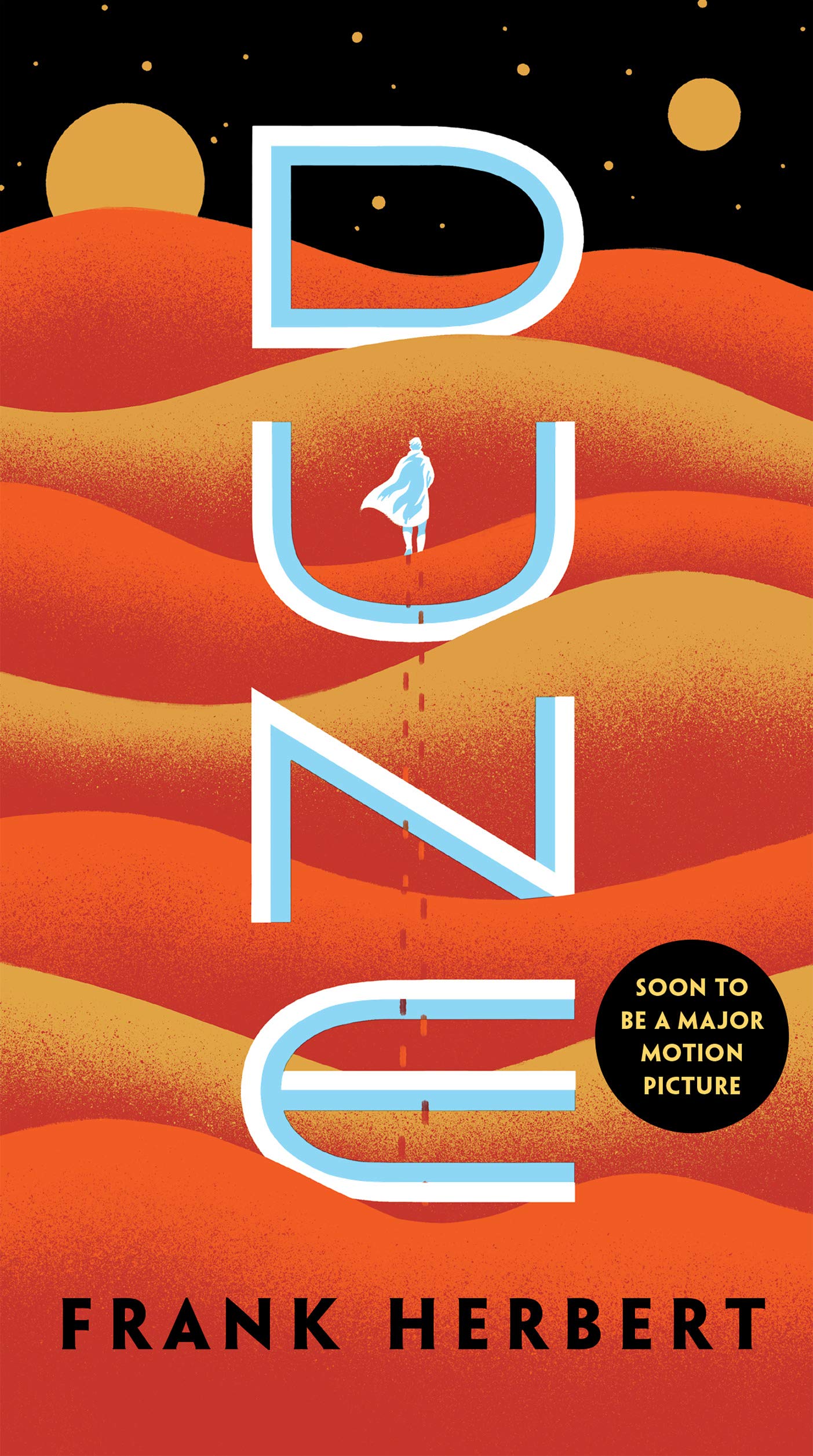
Dune by Frank Herbert

And what he saw was a time nexus within this cave, a boiling of possibilities focused here, wherein the most minute action--the wink of an eye, a careless word, a misplaced grain of sand--moved a gigantic lever across the known universe.  He saw violence with the outcome subject to so many variables that his slightest movement created vast shiftings in the pattern.

The vision made him want to freeze into immobility, but this, too, was action with its consequences.

The countless consequences--lines fanned out from this cave, and along most of these consequence-lines he saw his own dead body with blood flowing from a gaping knife-wound.

Last weekend I visited America's second-newest national park, Indiana Dunes.  (Remember travel?  Maybe we'll be able to do it again someday.)  I took along with me Frank Herbert's science fiction masterwork Dune, only partly as a pun and a joke: Herbert claimed that he was inspired to write the novel by the sand dunes he knew so well in Oregon.  The planet Arrakis in Dune is not so much a giant beach but a giant desert, and I had forgotten--I read this book, like I think a lot of young boys did, as a teen--how it's meant to be an amalgamation of the different desert landscapes of the earth.  The planets of Dune are all sort of biological manifestations of what the book calls mankind's "terran" origins, and so Arrakis is filled not just with sand and spice and giant worms but also saguaros, eagles, kangaroo mice.  It supports the plants and animals of the American southwest but the culture of the Fremen--the roving bands who live there and who prop up the spice trade--cribs a lot from the Islamic desert cultures of the Middle East and North Africa.

I was really interested in seeing how Dune stacked up against my memory.  At first blush, my reaction was that the novel seems like a high-quality version of many of the same narratives and archetypes that we see so often in fantasy.  It begins with a quarrel between "great houses": House Atreides, led by Duke Leto and his young son, Paul, and House Harkonnen.  The Emperor has recently replaced the Harknonnen monopoly on Arrakis, which produces the galactically valuable spice, giving it to the Atreides, but it's a trap: the Harkonnens and the Emperor are working together to destroy the Atreides.  Add to that a "chosen one" narrative: in the opening scenes of the book, Paul Atreides survives the trial of the gom jabbar, suggesting that he might be the Kwisatz Haderach, a prophet-like figure who is the end result of millennia of eugenic breeding by the secretive Bene Gesserit.  So far, so good.

The Harkonnen trap more or less works, but Paul and his mother Jessica survives, though they are pushed out into the desert where no one expects them to survive.  They're taken in, however, by the Fremen, who suspect that Paul might be their own chosen one: a messiah figure called the Mahdi.  (Paul has about a billion names in this thing: Mahdi, Muad'Dib, Usul, Kwisatz Haderach, Lisan al-Gaib, etc., etc.--like the many epithets of Jesus or something.)  One of the more interesting ideas in Dune is that local religions, like that of the Fremen, have actually been planted by the Bene Gesserit over thousands of years in order to enable them to do their secretive work among the many peoples of the universe.  Religion, for the Bene Gesserit, is a sociopolitical sham.

I think Dune ultimately rejects that view of religion.  Paul fits neatly into the chosen-one narratives of both the Bene Gesserit and the Fremen, but he manages to overshadow them both.  With the help of the spice, he gains incredible powers of seeing, into the future and the past, and the ability to see the consequences of billions of tiny choices.  Almost everyone in Dune has special powers--the hyperintelligence of the Mentats, who are like human computers, the mind-control training of the Bene Gesserit--but Paul outstrips them all.  In that way he suggests a power beyond reason, beyond history, something religious or prophetic in nature that cannot be controlled by the sociopolitical.  With these powers he seeks not only revenge on the Harkonnens but a way to guide the future of humanity, and part of his vision is that he will unerringly unleash a terrible jihad on the universe through his Fremen followers.

The best thing about Dune, in the end, is this: it has that quality of great science fiction that seems to collapse millennia into the space of a book.  It's big in a way that only Isaac Asimov's Foundation series really resembles, as far as I can recall.  In his desert stronghold, Paul considers the fate of humanity over a thousand years, and Herbert really makes you believe that he's doing it.


Exhalation by Ted Chiang

It cheers me to imagine that the air that once powered me could power others, to believe that the breath that enables me to engrave these words could one day flow through someone else’s body.  I do not delude myself into thinking that this would be a way for me to live again, because I am not that air, I am the pattern that it assumed, temporarily.  The pattern that is me, the patterns that are the entire world in which I live, could be gone.

Ted Chiang is a highly successful science fiction writer, winner of 4 Hugo and 4 Nebula awards.  To date, he has focused exclusively on short stories – Exhalation is his second collection.  Science fiction is not usually a genre I read, but this was a gift from my son and I decided to expand my tastes a bit.  My chief response is that most of these stories are extremely well-written and while their plots focus on details that don’t excite me, Chiang is most interested in theme and idea.  His plots are carefully thought through, but what kept me turning the pages was his interest in identity and its relationship to memory and event.

In the title story, quoted above, a scientist begins an exploration into the nature of memory.  What only slowly becomes clear to the reader is that this is not a human scientist.  The narrator is some form of robot or cyborg, living in a human-like society and on an earth-like planet, but whose body is a mechanical and electrical construct.  As a result, the narrator’s exploration involves finding the physical location and structure of memory – something he accomplishes by performing brain surgery on himself.  Chiang creates a really beautiful description of the mechanical brain uncovered in the surgery – a series of very thin gold leaf sheets, physically imprinted with memory lines that interact with each other as air circulates among them.  This circulation is uncontrolled and extremely delicate, so that what memories become important and how they feed the identity of the self becomes a subtle and unpredictable phenomenon.

There is an entertaining time travel story, “The Merchant and the Alchemist’s Gate” in which characters are able to travel forward and backward in time in twenty year intervals – so that multiple versions of the same person interact with each other, carefully figuring out how to optimize their lives by showing up at key moments every two decades.  The story is written as if it is a kind of Arabian tale, mixing the science fiction with a variation on the mysticism of the 1001 knights.  

In “The Lifecycle of Software Objects,” people live with a kind of very advanced Tamagotchis – electric pets that evolve to be like children because of their human qualities (language, ethics, learning).  The relationship between owner and “digient” grows to be very similar to a parent-child relationship.  Chiang makes this observation more powerful by incorporating elements of the corporate history of electronics into a long narrative (this is really a novella, rather than a story).  Start-ups that create digients go out of business or are sold to larger conglomerates, early digient platforms are abandoned by their developers in the same way that computer programs and operating systems have become obsolete.  As a result, some digients have vastly more constrained lives and opportunities than others.  Thus, the parent-child relationship metaphor is given a socio-economic component.

In “Anxiety of the Dizziness of Freedom” society has found a way to track parallel universes.  Every time someone makes a major decision, it affects the quantum field (the relationship between time and space?) and multiple versions of the decider are created, each of whom follows one of the possible decision paths.  An inventor has developed a machine called a prism that allows people to communicate with their “paraselves” and see what the result of the other decision would have been.  This causes much heartbreak for those people who see their paraselves leading much happier and more successful lives than their own.  One lonely character discovers his paraself is happily married.  He responds by finding the version of his paraself’s wife in his branch and proposing to her out of the blue.  There are also people who use the prism for criminal activity and we follow a pair of con artists attempting to fool people into paying for information from another branch of their lives.  The plot is entertaining and Chiang has a good eye for character development, but his major interest is always identity and its relationship to phenomena:  which self is the real one?  If you behave the same way in every branch, does that prove something about your character? Do you have a greater obligation to the branch you live in or to your paraself even in another branch of the quantum universe?

In most of these stories, minimal time is spent exploring the details of the alternative universe posited for the story.  The worlds here are usually very much like earth, with obvious, key differences.  While even the explanation of the key differences was sometimes too much for me, I appreciated Chiang’s ability to create settings and plots that opened up avenues for speculation and wonder about the world we live in.

Saturday, March 14, 2020

House Made of Dawn by N. Scott Momaday

Abel walked into the canyon.  His return to the town had been a failure, for all his looking forward.  He had tried in the days that followed to speak to his grandfather, but he could not say the things he wanted; he had tried to pray, to sing, to enter into the old rhythm of the tongue, but he was no longer attuned to it.  And yet it was still there, like memory, in the reach of his hearing, as if Francisco or his mother or Vidal had spoken out of the past and the words had taken hold of the moment and made it eternal.  Had he been able to say it, anything out of his own language--even the commonplace formula of greeting "Where are you going"--which had no being beyond sound, no visible substance, would one again have shown him whole to himself; but he was dumb.

This semester, I'm teaching a class on Native American literature for the first time.  I had planned on teaching four texts: Tommy Orange's There There, LeAnne Howe's Savage Conversations, Louise Erdrich's Future Home of the Living God, and this novel, N. Scott Momaday's House Made of Dawn.  Of course, the outbreak of the coronavirus pandemic has changed my plans.  I don't know if school will be happening this week or next, or if I'll be there even if it is.  If I have to cut a book from the curriculum, it's probably this one, important and vital as it is.  It's demanding, challenging--but I don't know if I'm in the right frame of mind for this kind of challenge right now, and I don't know if my students are either.

Anyway.  I did find that, reading it a second time, it wasn't as difficult a read as I had first found it.  It helps, of course, to know what happens; I spent the second time around not reading for the plot but for other things: the spareness of the language, for one, which is actually quite striking.  Some other things I discovered:

House Made of Dawn is a multiethnic and multicultural story.  On the surface, it's a story like Leslie Marmon Silko's Ceremony, in which a Native man, his spirit ravaged from war, returns to his tribal home only to find he no longer fits.  When he finds a way at last to reintegrate himself into the cultural and religious life of his community, his mental anguish disappears.  But for Silko, this means a rejection of white culture, which she associates with a malevolent force named "witchery," and complete reabsorption into the lifeways of the Laguna Pueblo.

In House Made of Dawn, on the other hand, Abel already begins as a kind of outsider: his mother is not Pueblo but Navajo.  His community, Walatowa, has opened their doors to a small group of refugee Navajo, whose ceremonies become part of Pueblo life.  The rites of the community are a mishmash of traditional Pueblo religion, Navajo religion, and Catholicism, which Momaday seems to respect.  And furthermore, my first reading of Abel's trist with the white woman Angela St. John (whose name is an Anglicization [Angela-cization?] of Walotawa's patron saint-figure Santiago, who may or may not be the St. John of of the Bible) as something nefarious now strikes me as a mistake.  Angela, after all, ends up helping to nurse Abel through his hospitalization in Los Angeles, when his hands are badly broken by a corrupt cop.  It seems hard to read House Made of Dawn as an embrace of a specific cultural tradition; after all, Abel's friend and narrator Ben Benally, who is Navajo, seems to be comfortable in Anglo-dominated L.A.

House Made of Dawn is structured around rituals and rites.  Part of what makes the book a challenge at first is that these rites are totally unfamiliar, and Momaday is not particularly forthcoming with explanations or justifications.  At Walatowa, there is ritual distance running and the Navajo practice of hunting and capturing eagles (!).  In L.A., there is the peyote ritual of the Native American church.  These rituals are what give order to life among the Native people of House Made of Dawn, and Abel's distress is clearest when he is unable to comprehend them.  During the festival of Santiago at Walatowa, Abel is bested in a strange ritual by an albino man named Juan Reyes, who rubs a bloody chicken in his face.  The first time around I read this as an act of gloating, but now it seems to me that it may be part of the ritual itself--who knows, honestly--which Abel misinterprets.  He kills Reyes in a fit of anger, perhaps because his mind remains on the field of battle, rather than the world of ritual.

House Made of Dawn is very good.  I'm sorry to think I won't get a chance to read it with my seniors, if that's really what's happening.  Doubtless some of them would breathe a sigh of relief if they knew they were being absolved of reading such a challenging text, but that's OK.  Maybe some of them will come back to it someday, like I did, and see how stunning it can be.

Thursday, March 5, 2020

The Quest for the Historical Satan by Miguel A. De La Torre and Albert Hernandez

In a very real way, the search for the historical Satan is an attempt to justify God's grace while legitimizing the reality and presence of evil in human history.  At least this seems to be what was occurring with the birth and development of Satan in the legends of pre-Christian mythology and across the pages of the Jewish, Christian, and Islamic sacred texts and Scriptures.  It appears that the development of Satan was, to a certain extent, trying to save God form appearing as the source of evil that is so much a part of the reality of human suffering and death.  The Scriptures attempt to convince us that God is still worthy of our worship despite the presence of evil, even though the most troubling conclusion derived from the Judeo-Christian biblical text is the discovery of a God who is the cause and author of all that is good--and all that is evil.

For Miguel De La Torre and Albert Hernandez, the authors of The Quest for the Historical Satan, the nature of Satan is inextricably tied up with the biggest question about God: if God is both omnipotent and perfectly good, why does evil exist?  Pre-Christian Jewish texts seem to have no problem casting God in a dubious light, as when he encourages Abraham to kill Isaac.  A "Satan" appears in the book of Job, of course, but his relationship to God is awfully ambiguous; is he an agent of God or an adversary?  And if he's an adversary, why is God so willing to do what he suggests and torture poor Job?

In The Quest for Historical Satan, De La Torre and Hernandez trace the growth of the Satan figure over centuries.  When Christian thought begins to demand God's perfect goodness, they argue, conceptions of Satan change.  The story of Lucifer, the fallen angel, gets assimilated into the story of Satan because it allows us to understand how evil comes about, not from God himself, but from a rebellious angel who works to undo God's beneficence and grace.  And yet, this understanding of Satan is troublesome, too.  If Satan is so powerful, a kind of foil to God himself, doesn't Christianity stretch the definition of monotheism?

The authors' history of Satan through the years is as predictable as it is bleak.  Time after time, this version of Satan, with slight ideological and theological emendations, is used as a representation of the political and cultural other.  It begins with the Church Fathers, claiming their opponents are not just heretics but inspired literally by the devil.  In the hands of medieval Christians, Satan becomes a Jew, then a Muslim; in the hands of explorers, the rites of Native Americans become Satanic.  There's a whole thing about witches in Puritan Massachusetts you might have heard about.  Throughout it all, De La Torre and Hernandez stress the continuing development of an ideology that associates Satan with "pure evil," an observation that seems somehow too commonplace and dreary to fully appreciate its implications.

The most interesting part of The Quest for the Historical Satan comes after the authors are done questing: they offer, in place of the popular conception of Satan as an antagonist of God who represents pure evil, an understanding of Satan as a kind of trickster figure, like Coyote or Br'er Rabbit.  Like those legendary figures, Satan uses deception to spur the complacent to reassess their own beliefs and habits--look what happens to Job when Satan convinces God to trick him, after all.  This reimagining of Satan comes from the context of a liberation theology, and fashions a Satan that serves as a goad for powerful and self-righteous people.  I'm not sure I buy it, but it sure is interesting and bold--and a hell of a lot better than the way we think about Satan now, and have been for centuries.

Tuesday, March 3, 2020


Reconstruction:  America’s Unfinished Revolution, 1863-1877.  Eric Foner


What remains certain is that Reconstruction failed, and that for blacks its failure was a disaster whose magnitude cannot be obscured by the genuine accomplishments that did endure.  For the nation as a whole, the collapse of Reconstruction was a tragedy that deeply affected the course of its future development.  If racism contributed to the undoing of Reconstruction, by the same token Reconstruction’s demise and the emergence of blacks as a disenfranchised class of dependent laborers greatly facilitated racism’s further spread, until by the early twentieth century it had become more deeply embedded in the nation’s culture and politics than at any time since the beginning of the antislavery crusade and perhaps in our entire history.  The removal of a significant portion of the nation’s laboring population from public life shifted the center of gravity of American politics to the right, complicating the tasks of reformers for generations to come.  Long into the twentieth century, the South remained a one-party region under the control off a reactionary ruling elite who used the same violence and fraud that had helped defeat Reconstruction to stifle internal dissent.


When it was published in 1988, this volume was a stunning revision of the period immediately after the Civil War; by the time it was revised and reissued in 2014, it had become the standard account of that period.  It is deeply researched, strategically organized and dispassionately written in order to establish both the importance of the period and the tragedy of the events that unfold in these 600 pages.  It is possible that readers younger than myself may not find its conclusions so remarkable:  at the end of the 600 pages Foner recounts some of the myths that had grown up around Reconstruction, and it is these myths that, to historians “everlasting shame,” I learned in what were considered excellent high school history classes.  I suspect that younger readers of history were never burdened with these misconceptions and that Foner’s work would represent something less revolutionary to them.

In this volume he narrates the nations attempts to confront several essential questions in the aftermath of the bloodiest war in its history:
·      How could the rebellious Confederate States, and their citizens, be reunited into the political and social life of the nation?
·      Who should decide the answer to that question – the President or the Congress?  Behind this question lay a deeper one:  to what extent would the question be answered by the evolution of social and political practices that the President and Congress were nearly powerless to influence?
·      What system of labor should replace plantation slavery?
·      What should be the place of blacks in the economic, political and social life of the nation?
It would be foolish to try to summarize Foner’s account of how the nation addressed these questions in any detail.  He moves at a pace of about a page a week, looking at key dates and periods through multiple lenses and offering voluminous supporting details for each and every pattern that he outlines.  However, it is possible for me to outline his major accomplishments by simply discussing the aspects of what I learned that surprised me – knowing that the surprise may tell you more about me than about Foner’s work.

To begin with, I was surprised that Foner begins his work in 1863.  He does this in order to outline the ways that the Civil War changed America generally, to capture the context that Reconstruction needed to take place within.  But he also makes clear that the nation began the process of Reconstruction in ad hoc and evolving ways throughout the war.  Lincoln and Johnson both outlined Reconstruction ideas before the war ended, but more importantly, wherever the Union Army took control of a region, the general in charge of local forces had control over the liberation and livelihood of the formerly enslaved peoples. Tennessee and Louisiana were occupied by the Union Army in 1863, so these were not small tracts of land in question.  

Many of the questions and controversies that will focus the nation’s attention for the dozen years after the war’s end are present in these early experiments – which vary tremendously with the ideas and energy of the generals involved.  In some cases, enslaved peoples were encouraged to continue living and working on plantations (to the benefit of Northern industries) with the Union army doing little more than insisting upon and enforcing work contracts.  Often the enforcement was to the benefit of the plantation rather than the worker – as when rules were established requiring workers get a plantation owner’s permission to change jobs.  However, in Louisiana, the earliest attempts to reconstitute a government included an established minimum wage, a nine-hour work day for non-agricultural employees, a progressive income tax to replace the corrupt antebellum property tax system and free public education – with some schools and other public accommodations being desegregated.  This central division – whether to support the return to something closest to the old system or to forge an entirely new role for government – would reverberate through all the debates of the period.


Foner is deeply critical of Johnson’s Reconstruction plans – citing the ease with which he allowed former Confederates to retake control of their states and communities.  What was most surprising about this phase of Presidential reconstruction was the revolution in thinking about voting rights that took place during this phase despite the President’s desire to prevent it.  At the war’s end, there is near total agreement that black suffrage was anathema to all powerful parties.  Blacks could generally not vote in Northern states, and there was little power behind any idea to change that.  But the Fifteenth Amendment passed just a few years later.  Foner makes clear that some of the change comes from political calculation as Republicans realized that blacks would overwhelmingly vote for them.  But a much larger factor is that Radical Republicans win the battle for the hearts and minds of the country, at least temporarily.  Foner points out several times that granting former slaves citizenship and voting rights was beyond what any other nation dealing with emancipation accomplished.

Perhaps the greatest change in my understanding of the period centers on that term Radical Republican.  I had been under the impression that the term “Radical” in that title simply connoted a desire to black political rights too far and too fast, with the label being essentially a critique that argued that the pace of change was unreasonable.  I was taught that this rush promoted changes that former slaves were not ready, that it put illiterate and ignorant blacks in power where they were easily manipulated by corrupt carpetbaggers.  That gave a powerful argument to the white South as it tried to reclaim its right to good government.  What Foner makes clear is that the Radical Republicans were advocating a complete rethinking of the role of government, beginning an argument that still rages in the 21st Century  

Foner uses the term “activist government” to describe Southern constitutions written by Radical Republicans.  Their view, which Foner presents as eminently logical, is that a society in which one of the main forms of economic relations has been abolished and which now has almost 4 million new citizens with whom a new social contract must be developed, requires a larger and more active role by government.  That absorbing these changes and finding a peaceful and productive role for newly freed workers and their families will require planning and programmatic experimentation that is best handled by government.  The Radical Republicans – pushed largely by newly enfranchised blacks not afraid in these early years to demand a government that met their needs, promoted a dramatic change in Southern Society.  Among the  measures enacted in this period, in addition to black enfranchisement and basic protections for labor, were government sponsored medical care for the poor, government supported legal counsel for the poor, liberalized divorce laws that protected the rights of women, legal requirements for child support that included children born of formerly enslaved mothers raped by their masters and free public education, with some areas experimenting with desegregation.

Foner makes clear that this thoroughly modern view of the state would not simply address needs of the South.  There is an extensive chapter on economic and political issues faced by the North in this period, as class warfare begins between labor and capital.  This new concept of government is as much a subject of debate in New York and Chicago as in the rural South.

Of course, this radicalism was by no means the sole point of view within the Republican party.  An equally strong wing of the party – deemed “liberal” – was primarily interested in stabilizing the agricultural economy through enforceable labor contracts and expanding the opportunities for railroads and other public works. In other words, the Republican Party was the main voice for both workers and business.  The two sides were united by their role in the war years and their fervor for black rights.  However, as the Radicals pushed for a broader transformation and were less than enthusiastic about aid to railroads, many Liberal Republicans began to find common ground with Democrats.  When Republican promises of a resurgent Southern economy failed to come true, these new alliances opened the way for a resurgence of Democratic political power in the elections of 1870 and 1872.

Though Grant was re-elected in 1872, he faced a hostile Congress and the economic collapse of 1873 (caused by a bursting bubble in railroad investments).  This panic plunged the nation into its worst economic crisis since 1837.  I had studied the 1873 Depression in both college and graduate school without ever linking it to the end or Reconstruction.  The collapse of the economy also meant the collapse of Republican economic policy.  Republicans took the brunt of the blame for the widespread poverty and Democrats won back what was to become the Solid South.  It only remained for the election of 1876 to cause the Republicans to abandon Reconstruction and bargain away protecting African Americans for the White House.  However, Foner is clear that the liberal wing of the Republican Party was already looking for a way to abandon what they saw as a failed policy.  As a result, the kind of mob rule that would effectively eliminate black political participation for the next 90 years had already begun. 

In discussing the end of Reconstruction, Foner puts two other ideas I had learned in context.  The first was that the period was marked by unprecedented corruption in Southern government.  Foner points out that corruption in the South was indeed endemic and unprecedented – except by the contemporaneous corruption in the North.  His time period saw the rise of urban political machines like Tammany, with Boss Tweed the most glaring example of bosses who enriched themselves.  Corruption was a national problem:  it hurt Reconstruction, but was not caused by it.

The final revelation for me was the level of violence endured throughout the period.  My history education left the impression that freedmen and their allies had been protected by Federal troops during Reconstruction and fell victim to the KKK after the troops were withdrawn.  But there was never a period where blacks or their allies were secure and protected.  The constant, daily threat of violence was punctuated by massacres like the murder of 2000 people in Shreveport Louisiana, and a later massacre in Colfax Louisiana.  The level of violence varied tremendously from place to place, but there was never a time when Northern politicians could have fooled themselves into thinking the freed peoples were secure and safe. That is, until they needed to believe that for political purposes.  As for the protection of the troops, it is true that the situation got worse after they were withdrawn in 1877, but in fact by that time there were only a few thousand troops left of the more than a million that had originally occupied the Confederacy.  The final removal of troops (most of which travelled west to fight Native Americans) represented breaking the promise of protection, but that promise had never been fulfilled.

By the end of the century the combination of sharecropping, strict social segregation, voter suppression and state sponsored violence that has been called slavery by another name was firmly established.  It provided the Northern industrialists with the labor stability they needed after the chaos of the war and would, therefore, go unchallenged until the second half of the next century.  


Sunday, March 1, 2020

Hateship, Friendship, Courtship, Loveship, Marriage by Alice Munro

Young husbands were stern, in those days.  Just a short time before, they had been suitors, almost figures of fun, knock-kneed and desperate in their sexual agonies.  Now, bedded down, they turned resolute and disapproving.  Off to work every morning, clean-shaven, youthful necks in knotted ties, days spent in unknown labors, home again at suppertime to take a critical glance at the evening meal and to shake out the newspaper, hold it up between themselves and the muddle of the kitchen, the ailments and emotions, the babies.  What a lot they had to learn, and so quickly.  How to kowtow to bosses and how to manage wives.  How to be authoritative about mortgages, retaining walls, lawn grass, drains, politics, as well as about the jobs that had to maintain their families for the next quarter of a century.  It was the women, then, who could slip back--during the daytime hours, and always allowing for the stunning responsibility that had been landed on them, in the matter of the children--into a kind of second adolescence.  A lightening of spirits when the husbands departed.  Dreamy rebellion, subversive get-togethers, laughing fits that were a throwback to high school, mushrooming between the walls that the husband was paying for, in the hours when he wasn't there.

The first and title story of Hateship, Friendship, Courtship, Loveship, Marriage, a collection for which, no matter how hard you try, you'll never remember how the title words are ordered, is uncharacteristically optimistic.  I don't mean to say that Munro's stories are bleak or sad, but they are honest about the realities of fortune; adulterers and new spouses take big gambles on happiness, which pay off incompletely, if at all, but the chance of illness and disease are surer bets.  "Hateship" is a story in which fortune works out with almost comic grace: a pair of young girls play a cruel trick on their housekeeper, writing letters as if they are a distant acquaintance, claiming to be head over heels in love with her.  When the housekeeper throws caution to the wind, quits her job, and climbs upon a train to Saskatchewan with an entire trousseau packed away in the next car, we expect disaster.  But when she arrives she finds her "beau" catastrophically ill with fever, and once she's nursed him back to health, he's wise enough not to question why or how she arrived.

It's a charming story, and intriguingly structured: Munro follows one point-of-view character at a time, "handing off" the story to the next when they are encountered in the narrative, from the trainyard clerk to the housekeeper to the girls to their father, and so on.  It's a method that seems cribbed from film, which is funny, because few short story writers seem as cinematic as Munro.  The other stories have few surprises--beyond the surprises of life that Munro relishes, I mean--and for the first time I felt a dim sense that these stories were deeply familiar.  Something of the freshness of Munro has worn away for me, replaced by a very different sensation, that of settling into something friendly and familiar--an old worn armchair feeling.

Many of her usual themes are evident here.  There are fewer bad men than usual, but there is Mr. Vorguilla in "Queenie," a demanding and cruel old widower who whisks the narrator's young half sister away to Toronto in a misbegotten marriage.  Adultery is all over the place, from the imagined ("Post and Beam") to the brief and epiphany-like ("Floating Bridge," "What is Remembered," "Nettles") to sustained and life-altering ("Queenie," "Comfort," "The Bear Came Over the Mountain").  There's lots of illness and death: in "Comfort," Munro invents a hardcore atheist schoolteacher, Lewis, who is dying of ALS.  He's a prig and a boor, but his values are sincere and deeply held, not unlike Del's mother in The Lives of Girls and Women, and his wife struggles with how to honor her husband's skepticism at the end of his life, when the idea of his immortal soul would be of great comfort.  In "The Bear Came Over the Mountain," maybe the collection's best story and one of Munro's most anthologized works, Grant places his wife of fifty years, Fiona, in a nursing home because she is suffering from Alzheimer's.  When he visits, she seems only to dimly remember him, and yet he has to watch as she forms an intense bond, even a love, for another patient.

Another story, "Family Furnishings," tells of an eccentric old aunt, estranged from the narrator, who learns only late in life that her aunt was deeply offended by the way the narrator seized on a stray remark of hers and used it in her fiction.  Like "Material," one of my favorite stories of Munro's, it deals with the ethical question of using real life people in our writing: real life, of course, being the only resource we have, and yet even though the aunt's words have been totally recontextualized, something essential has been betrayed.  More than any of the stories here, I wondered if "Family Furnishings" was drawn from an experience in Munro's own life.  Is it permissible to use other people in our stories?  We already do, Munro answers, all the time, in the kind of narratives we construct around our lives, which always serve ourselves more than those who are supporting characters; in our memory we tell stories that real people--like Fiona, for example--will always betray.  That's a sure bet as anything.  But like in the title story, sometimes the stories we tell have a way of coming true.