Tuesday, January 8, 2013

Glittering Images by Camille Paglia

History shows that, for both individuals and nations, political power is transient.  America's true legacy is its ideal of liberty, which has inspired insurgencies around the world.  Politicians and partisans of both the Right and the Left must recognize that art too is a voice of liberty, requiring nurture without intrusion.  Art unites the spiritual and material realms.  In an age of alluring, magical machines, a society that forgets art risks losing its soul.

Camille Paglia's art book Glittering Images is remarkably unremarkable.  I don't mean that as a judgement on the book's quality, but a question about its purpose.  What, exactly, is this book meant to do and for whom?  It is easy enough to tell from flipping through its pages that there is no real guiding theme to the double-handful of artworks Paglia chooses to discuss, and if you were to assume that the only real criterion for inclusion is that Paglia really likes each one, you'd be about half right.  Paglia likes to position herself as an outsider to the critical establishment, but it's a special class of people who can publish things merely because they like them.

What Paglia wants to do is reintroduce art to a culture that is drifting away from it, and thus drifting away from itself.  Art, Paglia says, has been caught in a "political cross-fire" between Leftists who rush to defend mediocre shock art like Andres Serrano's "Piss Christ," which ignited a firestorm of in the 1990's, and Rightists who believe that "the art world is a sterile dead zone of elitist snobs and that artists are pretentious parasites and con men."  But Glittering Images is too slim to present itself as a primer for the art novice, who probably wouldn't look to someone like Paglia for such an artifact in the first place.  Yet, insofar as it manages to be accessible and readable yet still serious and thoughtful about art, it marks a step in the right direction.

Each work is representative of a period or style Paglia deems significant, and the format "is based on Catholic breviaries of devotional images, like Mass cards of the saints."  In this sense form follows function, since one of Paglia's central (and strongest) points is that a diminishing religious tradition is one of the culprits of art's endangerment.  Some of the works are quite well known, but most are not, and in one case, Paglia reproduces a little known portrait by African-American artist John Wesley Hardrick:


Always attuned to the rich palette of black skin, Hardrick appreciatively streaks Xenia's shapely, bare arms and shoulders with tawny, caramel tints--fashionable "high yellow."  The aura around her head, achieved with confident, choppy strokes, captures her aspirations and creative hunches, a scintillating burst of gingery gold.  This is a woman who knows the world and feels at home in it.


Glittering Images would be a worthwhile effort if all it did was bring that little known but wonderful painting a larger audience.  (A Google search for it before the book's publication probably would have been useless!)  Similarly, I find Paglia's commentary most fascinating when it champions the forgotten, such as the maligned Art Deco painter Tamara de Lempicka or Eleanor Antin's "100 Boots":


As a work of Conceptual art, 100 Boots consisted of temporary on-site sculptural installations documented by photographs (taken by Philip Steinmetz), which were sent uninvited to a distant, dispersed audience.  The formal, squadron-like patterns assumed by the boots parody the frigid geometries then being made my Minimalist sculptors... Antin strategically varied the look of the cards so that "seductively beautiful" images were not he rule.  Most of them have the bleak desolation reminiscent of existential European art films.


The random mailing of the photographs is what elevates "100 Boots" beyond a mere gimmick.  What must those who received these pictures in the mail have thought?  It must have been as if you had received a postcard from old friends, but old friends you can't remember and don't recognize; in fact, you don't recognize them because they don't seem to have any appearance at all.  And when that incorporeality is juxtaposed with their martial dress and arrangement, isn't there something menacing about it, now that you think about it?

I think Paglia is less successful when she treads common ground.  Her pieces on David's "Death of Marat" and Mondrian's "Composition with Red, Blue, and Yellow" made me look at those works in new ways, but I got very little out of her explications of "Les Demoiselles d'Avignon" and Jackson Pollock.  Too much of the book is taken up by rote history and social context, but every now and then thoughts burst through that expose the bloodlessness of most academic criticism:


...Mondrian's floating, weightless images vibrate with an internal drama.  Do his black lines define and limit his colors?  Or is color, like a divine spark, an autonomous form pushing its way toward life?


Paglia ends with a chapter on the man she believes to be the greatest living artist: George Lucas.  Her evidence for this is, even stranger, the volcano planet fight scene from The Lord of the Sith.  I knew she believed this before I picked up the book; it's half the reason that I wanted to read it.  But Paglia's connective, impassioned way of thinking and writing does not lend itself to persuasion and I found myself disappointed in the argument it presents.  Although, any book that compares the volcano planet of Mustafar to "J. M. W. Turner's eyewitness painting of the catastrophic burning of the British Houses of Parliament in 1834" earns points for sheer chutzpah.

Is this part of Paglia's attempt to convince us that great artists are still among us?  Or does the idea of George Lucas as the world's greatest living artist meant to bolster the argument that art is in dire straits?

Monday, January 7, 2013

The Hound of the Baskervilles by Arthur Conan Doyle

A spectral hound which leaves material footmarks and fills the air with its howling is surely not to be thought of...if I have one quality upon earth it is common sense and nothing will persuade me to believe in such a thing.  To do so would be to descend to the level of these poor peasants, who are not content with a mere fiend dog but must needs describe him with hell-fire shooting from his mouth and eyes.

This is a fun novel.  First, Sherlock treats Watson like a little kid; this amuses me to no end.  Second, unraveling the hound's mystery makes this an easy page turner.

But, what I love about the novel is the distinction Watson draws above: the distinction between reason and superstition.  Watson, as an educated, enlightened man is above buying into the foolish superstitions.  In a reversal of the more orthodox faith crisis, Watson is regularly confronted with a need to question the efficacy of reason.  As the novel progresses, the reader (and Watson) are given more and more evidence that the Hellish hound exists.

This evidence is all but confirmed when Sherlock and Watson see the hound itself, glowing and fiery in the night.  Of course, reason carries the day, and Sherlock's brilliant mind explains to everyone else how the hound came to be.  A rational, scientific explanation, free of any supernatural non-sense.

Lawyer sidenote:  I also enjoyed this novel because we see the utopian ideal promised by reason properly applied: no crime is unsolvable, if the right mind applies itself.  This utopian ideal is represented in every single crime drama currently on television.  The reality of criminal investigations bemoans this ideal.  I mention this because one of my (anticipated) themes for this year is crime.  Yup.

One down.  Forty-nine to go.

Sunday, January 6, 2013

"The only building in sight was a small block of yellow brick sitting on the edge of the waste land, a sort of compact Main Street ministering to it, and contiguous to absolutely nothing."

Ann Althouse has started a project where she's blogging one sentence a day from The Great Gatsby, which she contends is uniquely made up of all perfect sentences, and breaking it down.  Althouse is primarily a political blogger, but her allusive, connective way of thinking is perfect for this kind of project, and I've really been enjoying the results.

Is The Great Gatsby made up of perfect sentences?  I don't know; I haven't read it in years, though I'm planning on reading through it in the spring sometime before the Baz Luhrmann film comes out.  I think the sentence above, which Althouse blogged about yesterday, is an interesting test subject because it contains what I perceive as a flaw:

Let's examine the post-waste land segment. Our yellow block is on the edge of a waste land. If it's an edge, could there not be interesting things somewhere else? No. We're told that it's contiguous to absolutely nothing. I'm having a bit of a hard time understanding how the building can be on an edge when everything around it is nothing — absolutely nothing — especially since there's Main Street in the picture too. A sort of compact Main Street ministering to it.

That's a mystery, so I take it we need to get the message: There is a mystery here.


Althouse is being generous because she's starting from the assumption that every sentence in the book is perfect, so if something doesn't make sense, it must be all part of a design.  But that's an awfully high standard to set for anyone, even F. Scott Fitzgerald, and I think it's more likely that the phrase "sitting on the edge of the waste land" is merely slightly sloppy.  If the building is on the edge of the waste land, it must also be on the edge of whatever is beyond the waste land, but it isn't: it's right in the middle of it.  Not the edge, but the center.  Now, "the edge of the waste land" is more evocative than "the middle of the waste land," and maybe Fitzgerald decided that it was the better choice despite its inconsistency.

Althouse reads the reference to the waste land as a reference to Eliot's poem "The Waste Land," which was published the same year that Fitzgerald began writing the novel.  I'll buy that.  I hear another allusion in the description of the building as a "small block of yellow brick"--The Wizard of Oz.  Wait, you say, The Wizard of Oz came out in 1939, and you're right, but L. Frank Baum's novel came out in 1900, when Fitzgerald was four.  It's certainly possible that he read the book as a kid.  In that case, Althouse is only slightly off when she reads the block as a "child's toy."  Perhaps the building represents a ruined or abortive fantasy, a childlike wonder that fails to spread to the bleakness of its real world surroundings.  It's made of the same stuff as the yellow brick road, but it leads nowhere; it is "contiguous to nothing."  Therefore its yellow "jazziness" and "hopefulness," which Althouse identifies, represents a promise as of yet unfulfilled.

Note: This post is part of a resolution I made to myself to blog more non-review content, as long as that content is about books.  I'd also like to welcome our new reviewer Kunal, and welcome back Randy and Billy, our prodigal sons!

Devil in the White City by Erik Larson

After reading this blog for many years, I have finally decided to post now that I am finally reading non-legal books.  Diving in to real reading after this many years inevitably means I am reading books everybody else read 5 years ago.  Enter Devil in the White City, which, as far as I can tell, has already been blogged about twice here (and probably read by everyone else).  Re-read Jim and Billy's posts for a detailed analysis of the plot, but for my purposes, there are three pillars of plot in this book: 1) the rise of industrial Chicago; 2) the 1893 World's Fair; and 3) MURDER.

I am new to the Fifty Books Project and cheated just a bit.  I mostly read this book at the end of last year (I am a slow reader, there's no way I'm getting to 50...).   I bring this up because there was a contemporary event which actually enhanced Larson's narrative for me: Sandy Hook. Consider the book's introduction of its all-important setting:

Nothing like the Whitechapel killings had occurred. Jack the Ripper's five-murder spree in 1888 had defied explanation and captivated readers throughout America, who believed such a thing could not happen in their own hometowns. But things were changing. Everywhere one looked the boundary between the moral and the wicked seemed to be degrading. Elizabeth Cady Stanton argued in favor of divorce. Clarence Darrow advocated free love. A young woman named Borden killed her parents.


Enter a deranged H.H. Holmes to take advantage of a city in the midst of massive social and, more importantly, economic change.  This change, especially Chicago's meteoric economic growth, is the true protagonist of this book.   In the clearest example of juxtaposition I have seen since Romeo and Juliet, Larson elaborates on twin effects of Chicago's massive industrialization:   freedom and isolation. Considering H.H. Holmes' penchant for killing single women, the below sentence, which was ostensibly used to describe Chicago's  unprecedented population growth,  demonstrates the haunting way Larson uses setting to foreshadow evil:

Never before in civilization have such numbers of young girls been suddenly released from the protection of the home and permitted to walk unattended upon the city streets and to work under alien roofs."

All of Larson's seemingly glowing descriptions of "the white city" and the wonders of industrialism have an alternate (and understated) application to H.H. Holmes. Devil in the White City is about change: Change creates wonders like the World's Fair and Chicago's new skyscape, but it also creates conditions for the horror of Jack the Ripper and H.H. Holmes.  I may have missed this point (and simply enjoyed the book's great writing and interesting facts) if it weren't for Sandy Hook. Its hard to miss the similarities.  We are obviously living amongst change (no need to elaborate as I write on an internet based blog); and there is new type of evil in the world.  Are the shooters of Columbine/Aurora/Sandy Hook the Jack the Ripper/H.H. Holmes of our age? Maybe.  In any event, it's a good book.

Friday, January 4, 2013

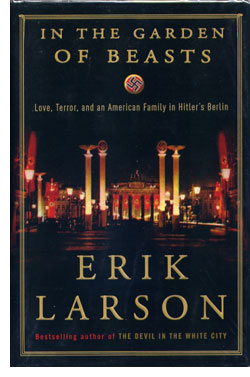
In the Garden of Beasts by Erik Larson

She wrote, "I have had enough blood and terror to last me for the rest of my life."

This fascinating book tells the story of William Dodd, the American ambassador to Germany from 1933 to 1937 and his daughter, Martha (SPOILER ALERT: Hitler seizes full control of Germany and starts World War II).  In the Garden of Beasts is the second Larson book I've read (Devil in the White City was the other), and he does a wonderful job of taking letters and other accounts and turning compelling episodes of history into almost novel-like stories.  Beasts was  very readable and never lagged.

When Dodd was named ambassador to Germany, he had no diplomatic experience and was actually Roosevelt's third or fourth choice to assume the position.  This lack of experience and unfamiliarity with the traditions and expectations of diplomats at the time (the "Pretty Good Club") caused endless friction with members of the State department back home but ended up, along with his experience as a history professor, serving him well.  While he was tasked primarily with ensuring Germany paid its massive post WWI debts to American companies, his endeavor was to serve as a "lone beacon of American freedom and hope in a land of gathering darkness."  However, even Dodd did not realize the extremity of the situation when he first arrived, admiring the way the Nazis had revitalized the country and hoping that moderate factions of the government would eventually overcome the more fanatical members.  Though attacks on Jews and sometimes Americans (usually for not standing at attention and saluting during SA parades) were rough patches, they seemed generally isolated at first, and Dodd believed the governments' assurances that they would be stopped in the future.  As Hitler gained more and more power and the regime became increasingly intolerant and censorious, Dodd became one the first and most vehement voices warning against the coming disasters (in fact, he was "dubbed the Cassandra of American diplomats).

Interestingly, Martha played a large role in shaping her father's views on the Nazis and the political climate in Berlin.  Originally enamored of the Nazis and living in Berlin, Martha (who was 24 when the Dodd family, also including Mrs. Dodd and Martha's 28 year old brother, Bill, moved to Berlin) spent much of her time interacting with high ranking members of the German government (including a love affair with Rudolf Diels, head of the Gestapo from 33-34), various intellectuals and society members, and foreign correspondents and diplomats.  She witnessed much of the tide of totalitarianism as it affected those closest to her and eventually turned completely against the Nazis, even having a long, passionate affair with a Soviet diplomat/spy and doing a small amount of spying for the NKVD (the precursor to the KGB).  Martha also fascinated me for two reasons: first, I thought it interesting to think about how differently her affairs would have been covered if she lived in today's internet age.  Who knows, maybe the daughter of the American ambassador to, say, Russia or China sleeps around with all kinds of prominent people and government officials and no one cares because whatever, but I feel like if Twitter and 24 hour news existed back then she would have been much more prominent and discussed.  Second, Martha also interested me because she slept around so much!  She boned down with everyone!  Which, good for her!  It was remarkable how little of an issue it was.  Sure, people talked about it and maybe looked down on her behind her back, but given the progress of feminism and women's sexual liberation in the mid 1930s, I was surprised to find that she wasn't a pariah.  Very interesting.

Another thing I found interesting were the was in which Germany and America were different, but also kinda similar.  For example, at one point a Jewish group in America staged a mock trial of Hitler in Madison Square Garden, which infuriated the Germans.  They simply could not understand why our government didn't just shut it down.  On the other hand, there are several times when Larson describes the treatment of Jews in Germany that I at first found outrageous, but then realized were a little too familiar.  One example was when Larson wrote about the benches in the park, the least desirable of which were painted yellow and were the only ones upon which Jews could sit.  My righteous indignation was tempered a little when I realized we were basically doing the same thing to African Americans at that time, a point that Larson once mentions that the Germans made in response to a critical speech by an American government official.

Overall I heartily recommend Beasts and probably anything else by Larson.  Very interesting.

Flesh of My Flesh by Kaja Silverman

Finitude is the most capacious and enabling of the attributes we share with others, because unlike the particular way in which each of us looks, thinks, walks, and speaks, that connects us to a few other beings, it connects us to every other being.  Since finitude marks the point where we end and others begin, spatially and temporally, it is also what makes room for them--and acknowledging these limits allows us to experience the expansiveness for which we yearn, because it gives us a powerful sense of our emplacement within a larger Whole.  Unfortunately, though, finitude is the most narcissistically injurious of all the qualities we share with others, and therefore the one we are most likely to see in them, and deny in ourselves.

One day you will die.  This is an astonishingly hard concept to accept.  Many, I imagine, never do, at least not until death intrudes upon them.  Death is always something that happens to somebody else, not to me--I've even rejected it in this very paragraph, by opening in the second person.  A more truthful beginning would be: One day I will die.

The thesis of Kaja Silverman's book is that the unwillingness or inability to see ourselves as mortal is the greatest cause of suffering, cruelty and violence in human history, and that if we recognize mortality (what she calls "finitude" above") as the essential similarity between all of us--we become capable of the very transcendent experience we seek by denying death.  She calls this "analogical thinking," and traces it through a series of works from Ovid, Leonardo, Rilke,  Freud, Terence Malick, and contemporary painter Gerhard Richter.  Silverman works mostly in a psychoanalytic vein, yet the breadth of the study makes it incredibly persuasive.

The fundamental story of this way of thinking, she argues, is the story of Orpheus, whose gaze at Eurydice banishes her back to a land of death from which he is excluded.  Boldly, Silverman argues that there is an "Orpheus inside every Oedipus," shoving Freud's quintessential human narrative aside to argue for another primal story.

I thought this book was incredible.  I think it ought to resonate with anyone who has felt the fear of death, and especially those of us who have found some comfort in the idea that if it is an inscrutable terror, it is an inscrutable terror that each of one us will face.  For Silverman (and every other atheist critic, to be sure) religion is an offshoot of man's fear of death.  The violence done in religion's name, then, is sadly consistent with its purpose, which is to say, "Death for thee, but not for me."  I'm not willing to go that far, but I think that Silverman's thinking can be accommodated by a believing psyche, as her brief thoughts on analogical thinking in Donne shows.

Perhaps most impressive: Flesh of My Flesh is a rigorous and thoughtful piece of academic criticism that is neither unintelligible nor pointless.  That's a rare breed.

Thursday, January 3, 2013

Three Plays by Shakespeare

I read three plays by Shakespeare which I have not before reviewed on this site for a class last year.  Here are my brief thoughts on each of them, from the one I liked the least to the one I liked the most:

Titus Andronicus: I couldn't stop thinking about Titus when I saw Django Unchained last week.  Both are revenge narratives--the revenge aspect of Django I won't go into needlessly here (you can read the plot summary on IMDB) but Titus gets his revenge on the Goth queen Tamora, her Moorish companion Aaron, and her sons Chiron and Demetrius, who have raped Titus' daughter Lavinia and killed his step-brother with the aid of the other two.  Shakespeare plumbs the sordid depths of folklore and myth to cobble this plot together, but he feels compelled to outdo his sources: Like in the story of Philomel, the brothers rip out Lavinia's tongue so that she cannot identify them as the perpetrators, but for good measure they cut her hands off as well.

Since Tamora is seeking revenge in turn for Titus' sacrifice of her son as a prisoner of war, it is possible Shakespeare is making some commentary on the cyclical, all-devouring nature of revenge.  Yet, it seems plain that the greatest joy of seeing Titus performed is to watch the brutality of each escalating incident of vengeance, which I think reduces the power of that commentary.  It reminds me too much of Django, which I thought was entertaining but fundamentally shallow.  It is a rare Shakespearean play where the fun is in the spectacle, not the language, which is really devoid of anything interest except for what comes out of the mouth of Aaron, more eloquent than his Roman masters.  Here he is determined to protect the child he has with Tamora from Chiron and Demetrius, though the child's skin tone gives reveals their intimacy:

What, what, ye sanguine, shallow-hearted boys,
Ye whitelimed walls, ye alehouse painted signs,
Coal-black is better than another hue,
In that it scorns to bear another hue;
For all the water in the ocean
Can never turn the swan's black legs to white
Though she lave them hourly in the flood.

Timon of Athens: I am convinced by those who contend this play is not finished; it was never performed, and it has a strange raggedness.  That's a shame, because it's really fascinating.  Timon is a wealthy patron in Athens, noted for his generosity, but when he finally runs into debt he finds that all of his former "friends" have abandoned him.  Disgusted, he leaves Athens in self-exile and wanders around the forest heaping scorn on all mankind.

Timon's about-face is too exaggerated and compressed to be convincing; he never quite becomes a human being.  Yet, his long rants against Athens and all of humanity are a lot of fun, and some of Shakespeare's most bitter and ornate poetry.  I particularly like when Timon, digging for roots to sustain himself, accidentally digs up the last thing he wants--gold:

What is here?
Gold?  Yellow, glittering, precious gold?
No, gods, I am no idle votarist:
Roots, you clear heavens.  Thus much of this will make
Black white, foul fair, wrong wright,
Base noble, old young, coward valiant.  Why this, what, this,  you gods?  Why, this
Will lug your priests and servants frm your sides,
Pluck stout men's pillows from below their heads.
This yellow slave
Will knit and break religions, bless th'accursed,
Make the hoar leprosy adored, place thieves,
And give them title, knee, and approbation
With senators on the bench.

A Midsummer Night's Dream: I have been saying for years that the freshmen where I teach should read A Midsummer Night's Dream instead of Romeo and Juliet.  They read one tragedy a year, and come away with the idea that all Shakespeare is murder, suicide and madness.  (Plus, Romeo and Juliet is 30-40% penis jokes.)  Midsummer, on the other hand, is a lot of fun, and what's more, it's the only play of Shakespeare's that I would actually call funny.  The inept play the Mechanicals put on for the noble characters at the play's end never fails to crack me up in its badness:

BOTTOM [as Pyramus]: Thus die I: thus, thus, thus.
[He stabs himself]
Now am I dead,
Now am I fled,
My soul is in the sky.
Tongue, lose thy light;
Moon, take thy flight.
Now die, die, die, die, die.

I'm actually laughing as I write this.  Although, maybe my freshmen wouldn't really get the humor--they might think this is the most moving passage in the play, and post it on their tumblrs.  Of course, Midsummer also offers the really fantastic scenes where Puck transforms Bottom's head into that of an ass, and then gives the Fairy Queen Titania a potion which makes her fall in love with him.  People have been doing cheap transformation scenes for hundreds of years, and they're always the same: Michael J. Fox stares into the mirror, his hair, nails and teeth start to grow, and he screams.  OH NO, I'M A TEEN WOLF.  Shakespeare, five hundred years ago, gave us the most original and amusing take on transformation scenes; Bottom just rolls with it, unfazed by it all, not noticing he's changed, and not being in the least shocked that a Fairy Queen wants to get her bone on with him.  The rest of the scattershot plot is all great, but it's the Bottom scenes that really elevate this, for me, to one of Shakespeare's greatest works.

EDIT: I accidentally wrote that Tamora's sons kill Lavinia, when in fact they only rape and mutilate her.  Titus himself kills Lavinia, in fact, out of either shame or an overflow of vengeful feelings.

Wednesday, January 2, 2013

The Appointment by Herta Muller

Now all I hear is the noise; I don't go to the window, and I don't look at the moon.  I remember that it looks like a goose egg, and that it leaves the city on one side of the sky while the sun comes up at the other.  Nothing's changed there; that's how it was even before I knew Paul, when I used to walk to the tram stop on foot.  On the way I thought:  How bizarre that something so beautiful could be up in the sky, with no law down here forbidding people to look at it.

What does it mean to love in authoritarian state?  When life is proscribed by a law that is exacting and absolute yet somehow arbitrary in its application, what areas of life does it not proscribe or threaten?

The Appointment is a novel about a woman living in Romania under Nicolae Ceausescu, supposedly the most repressive of dictators in the fringe of Soviet states.  Ceausescu himself is not mentioned except on the dust jacket; the narrator (who is nameless) battles with smaller authorities.  She is summoned, frequently and randomly, to appear in the office of Albu, a local magistrate.  The appointments are always at ten sharp, that sharp emphasizing the bureaucracy's menace as well as its exactitude.  The crime which Albu grills her about: sewing notes into clothes bound for Italy that read "marry me."  In his interrogations, which Muller only allows us to glimpse, he suggests that he suspects her of more vital communication with the West, but more than anything it seems that the narrator's crime is simply wanting to escape.  For this crime the authorities impress her neighbors into watching her movements; for this crime her husband is nearly run over on his motorcycle.

Albu can gain nothing from these interrogations; the narrator cannot escape them.  Yet the strength of the repression is predicated on this aimless urgency.  But the narrative of The Appointment revolves around one tram ride to Albu's office broken by the narrator's reminiscences, which recount her attempts to carve out a personal and human space:

Instead of these thoughts we're constantly mulling over, it would be better to have the actual things inside your head, so you could reach in and touch them.  People you want, or people you want to be rid of.  Objects you've held on to or lost.  There would be an order to things in my head: in the center would be Paul, but not clutching at him and running away from him and loving him all at the same time.  The sidewalks would run along my temples, as far as they like, and under my cheeks might be the shops with their glass display cases, though not my pointless destinations in the city.  Of course there's no escaping Albu's lackey, who's probably sitting out there in that red car to give me my summons--not deliver, it's never in writing, so that I'm always left to worry whether Paul or I might have misheard the date.  Albu's lackey would be lurking somewhere in the back of my head...


You can see how the narrator is half-resigned to her place in the world; she doesn't seek to banish Albu's lackey, only shuffle him around in the order of things.

The Appointment leaps dizzyingly from the present tram ride to a number of points in the narrator's past, chopped up and reshuffled so that the timeline is difficult to keep straight.  (Maybe this mental reshuffling, too, is an attempt to impose a personal order on a proscribed one?)  But each memory is wonderfully and uniquely realized, and together they form a rich picture of life: The narrator's marriage to Paul, who sells illegal television aerials that reach Western stations.  Her previous marriage to the son of a Communist operative who once lorded over her hometown and its bitter dissolution.  Her young, beautiful friend Lilli, shot dead trying to cross the border with an older soldier she had fallen in love with.

The Appointment, in fact, is full of relationships, prurient and not, between younger women and older men.  Muller makes the Electral connotations of this explicit by having her narrator remember walking in on her father with a girl her own age:

I'm better than that girl with her braid, I thought, why doesn't Papa take me.  She's dirty, her hands are green from all the vegetables.  What does he want with her, she has a good husband.


Lilli begins with her father-in-law, the first in a long string of older men who eventually lead her to a premature grave; the narrator recounts being hit on by her father-in-law, the Communist operative in addition to wishing to take the place of her father's lover.  Albu, with his unwelcome kiss of the hand at each appointment, is a kind of father, too.  Are we meant to read the state as a kind of father figure, demanding sexual satisfaction, prying abhorrently into places that ought to be closed to it?  And--SPOILER ALERT--what are we to make of the end?  In the present, the narrator misses her stop on the tram and is made late for her appointment.  But before she can make it, she sees her husband Paul with an older man she does not know:

Quite by accident, just out of boredom, the old man glances at the bush and bends down to Paul's ear.  Now Paul stands up and sees me.  Why is he buttoning up his shirt.


What am I supposed to make of this?  Is Muller suggesting a homosexual relationship between Paul and the old man, or is that reading too much into it?  Is her ambiguity incredibly bold or am I incredibly dense?  If that's the implication, is it a chilling notification that authority, personified in the watchful old man, pries even into those places you expect it least?

Other reviews of The Appointment:

The Ardent Reader
Erin Reads
Tim Gebhart at Blogcritics

A Series of Unfortunate Events by Lemony Snicket

I confess, I started reading A Series of Unfortunate Events last year because I was extremely busy and my book count was extremely low. My only exposure to the series previously had been the decent but not particularly good movie adaptation--which actually combines the first three books—and being impressed by the very nicely designed little volumes I saw in the store. I also read a couple interviews with Daniel Handler, the man behind Lemony Snicket, and was intrigued by his description of the series.

Reading the first few Snicket books, I was struck by the willful similarity between them—the plots were identical. The Baudelaire orphans, Violent, Klaus, and Sunny, whose parents died in a fire, are taken by their caretaker, Mr. Poe, to a new guardian, who eventually turns out to be evil, incompetent, or both. At the end of each book, their living situation has fallen apart, the guardian is frequently dead or MIA, and they’re on the way to the next event in the unfortunate series. The guardian in the first book is Count Olaf, the series’ primary villain, who hatches a plot to steal their family fortune. In each subsequent book, up until The Carnivorous Carnival, #9, Olaf disguises himself—as a detective, scientist, receptionist, auctioneer, et al, and the adults around the Baudelaires have no idea anything out of the ordinary is going on. It’s a little like a series of horror films, where the teenagers being hunted down have no recourse but themselves. At the end of The Vile Village, #7, the Baudelaires finally break from Mr. Poe and strike out on their own, seeking the mysterious organization V.F.D., which may hold information about their parents’ death. The rest of the books, from #8, The Hostile Hospital onward, mix things up structurally, as the orphans try to find old friends, solve the V.F.D. mystery, and find someplace they belong.

The real constant in the books, however, is Lemony Snicket, who is retracing the orphans’ steps and writing their history. He’s an engaging narrator, opening every book by warning the reader that the story to follow is quite miserable, and that they might be better off to read something else. As the series goes on, a meta-story begins to develop, one that is connected to the Baudelaire’s own. It involves Count Olaf, a woman named Beatrice, Lemony himself, and lots of daring escapades. Although this story is extremely interesting, and is revealed very well in snatches throughout the series, the full narrative is never given. Blank spots abound, plot points are missing, ambiguity is everywhere. While Snicket is an engaging narrator, he’s not a very direct one. The meta-story really pulled me through the slow spots in the series, and while it’s not entirely satisfying, it is thematically appropriate, which leads naturally into the next section of this review.

There’s really no way to discuss the series without discussing the end—which, conveniently, happens in #13, The End, so spoilers follow.

In The End, the Baudelaires seem to have found a safe place, a desert island inhabited by a group of people—many of whom are given names from Shakespeare’s The Tempest—and Ishmael, their benevolent-or-is-he leader. The villagers see right through Olaf’s disguise, the first people in the entire series to do so, and banish him. This leads to several weeks of peaceful living for the Baudelaires, but, unsurprisingly, the island is not as utopian as it first appears. Ishmael exercises, through force of peer pressure, an iron control over the populace, “suggesting” to them that any item that washes up on the shore would be better stored in the “arboretum” to prevent rocking the boat. The Baudelaires, however, are unsatisfied with this arrangement and sneak into the arboretum, only find a huge book called, of course, A Series of Unfortunate Events. It’s here that the series shows its hand. It doesn’t explain, or even attempt to explain all the mysteries that have cropped up throughout the narrative. Although it is implied that many answers reside in the book—which is not the same as the Unfortunate Event books themselves—the reader is only able to read one short excerpt. Instead, the book serves as reminder that stories never really begin or end, that every story starts and stops arbitrarily and all life—and fiction—really happens in media res.

One of Ishmael’s favorite sayings is, “It depends on how you look at it”, and that turns out to be the watchword for the entire series—of course we don’t get all the answers, because we’ve seen everything through the Baudelaires’ eyes. Snicket makes the point that simply by shifting perspective, another 13 book series could be written on Olaf, or Ishmael, or any of the guardians, or, as in the case of the Snicket meta-story, someone not directly connected to the Baudelaire orphans at all. I’ve never seen a young adult series—or many adult ones, for that matter—so comfortable with ambiguity. It’s to Handler’s credit that the ending doesn’t feel like a cop-out. There’s a very real sense that he knows exactly what’s going on, and could pull back the curtain if he wished, but that’s not the story he’s chosen to tell. The exact relationship between the Snickets and the Baudelaires is never made explicit; the possible wrongdoings of the Baudelaire parents are never enumerated; things are left up in the air in many ways, but that only makes sense—we’ve only followed one series of unfortunate events, and the world is made up of nothing else.

Tuesday, January 1, 2013

Middlemarch by George Eliot

Here and there a cygnet is reared uneasily among the ducklings in the brown pond, and never finds the living stream in the fellowship with its own oary-footed kind.  Here and there is born a Saint Theresa, foundress of nothing, whose loving heartbeats and sobs after an unattainted goodness trembled off and are dispersed among hindrances, instead of centring in some long-recognizable deed.

Middlemarch is a book about a pair of bad marriages.  The first is that of Dorothea Brooke, the "Saint Theresa" of the above passage, who is ardently devoted to religion and to charity, and hopes to marry a man whose wisdom and devotion will help to elevate her spirit.  She thinks that the aging, ugly Reverend Edward Causubon is that man:

"He thinks with me, said Dorothea to herself, "or rather, he thinks a whole world of which my thought is but a poor twopenny mirror.  And his feelings, too, his whole experience--what a lake compared with my little pool!"


But, as she will learn, Casaubon is not that man--his life's work, a Robert Graves-like "Key to All Mythologies," remains unrealized, an abortive intellectual project that would be useless and meaningless even if he could ever get around to writing the first page of it.  Casaubon feels keenly that he is a failure, and Dorothea's devotion to him ultimately only spurs his anger and resentment.  Because this kind of plot requires there to be a right man for Dorothea, Casaubon's insecurity is amplified by his fear that Dorothea is in love with his young cousin Will Ladislaw.

The second marriage is that of the young doctor Tertius Lydgate and Rosamond Vincy.  Lydgate is an ambitious man, eager to contribute to the world of medicine and with the talent to do so, but he falls for the vain Rosamond, who drives him into debt and derails his hopes.  These two marriages act as pillars for the novel, which also contains a handful of side plots concerning the inhabitants of the titular town, but Eliot puts the Dorothea story clearly at the center of the novel.  Ironically, Dorothea's poor marriage does elevate her spirit and grow her in wisdom, as she shows when she finally meets Rosamond in the book's final pages:

"Marriage is so unlike everything else.  There is something even awful in the nearness it brings.  Even if we loved some one else better than--than those we were married to, it would be no use"--poor Dorothea, in her palpitating anxiety, could only seize her language brokenly--"I mean, marriage drinks up all our power of giving or getting any blessedness in that sort of love.  I know it may be very dear--but it murders our marriage--and then the marriage stays with us like a murder--and everything else is gone.  And then our husband--if he loved and trusted us, and we have not helped him, but made a curse in his life..."


"The marriage stays with us like a murder"--that is wonderfully evocative, and a great example of Eliot's formidable prose and strong characters.  Dorothea is intricately realized, but so are the "fringe" characters that populate Middlemarch, like Dorothea's scatterbrained father Mr. Brooke, the lazy but warm-hearted Fred Vincy, and ten or fifteen others.  I mentioned in my year-end review that Tolstoy was a big fan of Eliot's, and Middlemarch has that kind of immense Tolstoyan scope but also the kind of fine attention to the peculiarities of character that I associate with somebody like Austen or even Shakespeare.

Eliot sets her story at the historical moment of political argument over the Reform Bill of 1832.  The minor figures of Middlemarch talk about it constantly; Will Ladislaw champions it as the editor of a local paper with the patronage of Mr. Brooke, who mulls a candidacy for Parliament.  I admit I didn't understand most of the details, but I did glean that the reform in question was the expansion of suffrage, and Middlemarch reflects that in the expansiveness of its depiction of the town.  By focusing on such a large cast of characters, Eliot expresses a kind of universal suffrage, as she is interested in capturing the voices of as many people as possible.  Reform, too, seems to me to be a central idea: how people seek to reform themselves by seeking wisdom, prudence, and responsibility.

The story of Dorothea knits those two aspects up nicely: she is constantly seeking to be a better person, though she is certainly the best person in the book already.  Furthermore, Eliot is deeply interested in the idea that there are unrecognized saints, like Dorothea, whose goodness never gets recognized because it toils in anonymity.  Eliot ultimately can't bear to deny Dorothea the happiness she deserves, and though perhaps it would have been bolder to let her remain in selfless abegnation, it's rewarding to see goodness rewarded.