Sunday, July 29, 2007

Notes From the Underground by Fyodor Dostoevsky

Notes From the Underground represents my second excursion into Dostoevsky, after reading The Brothers Karamazov last year. Notes was more or less beach reading for me, since I read most of it on a beach in North Carolina while fighting off killer stingrays and trying to keep my dog from attacking copperheads.

Notes focuses on an unnamed protagonist who narrates the book. It's divided into two sections, the first of which is a mostly plotless character study and the second of which is the story proper. I n first part, we learn the the narrator dislikes his jobs and tries to make things as difficult as possible for his customers. Or maybe he doesn't. The protagonist's indecision about how he really feels is an ongoing theme of the first half of the book, where virtually every statement that he makes is then deconstructed, deciphered, reconstructed, and then questioned further. He convinces himself that he desires pain and loneliness, that laziness is a virtue if it is practiced intentionally, and that there is a deeper need in him that he doesn't fully understand. All of this is run through with a self-loathing born of his inability to relate properly to the world and ideologies around him. Sound confusing and a little pretentious? It is, but it's only about 40 pages long and is pretty interesting despite that.

Possible spoilers below.

Part two is really the main part of the book. It's about twice as long as part one, and it contains a plot, or, better said, three loosely connected vignettes demonstrating the practical results of the philosophy in part one. The first two vignettes are tragically comical. In the first, he buys a new coat for the express purpose of wearing it while bumping into a man who doesn't even know he exists, thinking that a nicer manner of dress will add some significance to the collision. In the second, he invites himself along to the birthday party of a man he despises, and spends most of the party pacing by himself and making snide remarks about whatever topics arise. The third story is tragic, as he meets a young prostitute and alternately loves and hates her until finally driving her away, thus cementing, I guess, his misanthropic tendencies.

Notes
if I had to draw a comparison, Notes has a lot in common with something like Catcher in the Rye. The narrator has served as a type for many misanthropic protagonists throughout literature, and it's interesting to see the parallels. Besides that, it's a pretty good story, but not exactly light reading. And, that is all.

Oh, I like this cover a lot better than the cover of my copy.

Live From New York: An Uncensored History of Saturday Night Live by Tom Shales and Andrew Miller

So, does this book win the title for having the longest title?

If you enjoy Saturday Night Live, reading about television shows from the 70's, or just insider perspectives of the entertainment world, this is a good book. Following the progression (or regression) of SNL from it's start in the 70's clear through the early 2000's, it's unlikely that such a comprehensive book has ever been written about the show.

The book is split up into major sections, mostly by decade, and, aside from some brief historical information provided by the authors, the entirety Live From New York is made up of snippets from interviews with the cast members, crew, and hosts over the past 30 years. It's pretty impressive in its scope. Virtually every SNL alum is represented, with the notable exception of Eddie Murphy who was evidently too busy filming Pluto Nash 2 to spend 10 minutes talking about the show that made him famous.

The book as a whole is pretty good guilty pleasure reading, and the best bits are when the cast talks about the best and worst hosts. Best include people like John Goodman, Steve Martin, and Alec Baldwin, and the worst include Ben Stiller (who refused to host if he couldn't host the first non-Guliani post-9/11 episode, and Steven Seagal, who spent most of his time sexually harassing the crew and thought a skit about a psychologist who drugs and rapes his patients would be hilarious.

Dress Your Family in Corduroy and Denim by David Sedaris

Well, I read this book about a week before Kelly posted it, and seeing as it's a colection of essays, his review sums them up pretty well. I agree with him on pretty much every point, including that 'Six to Eight Black Men' is the funniest essay in the book. A close runner up is 'Blood Work,' wherein Sedaris the housecleaner is mistaken for Sedaris, the erotic housecleaner. Hilarity, of course, ensues.

Of all of Sedaris' books I've read (which is everything but Me Talk Pretty One Day), this one was the funniest and most consisent. So if you like David Sedaris, read it. If you don't, read something else.

Friday, July 27, 2007

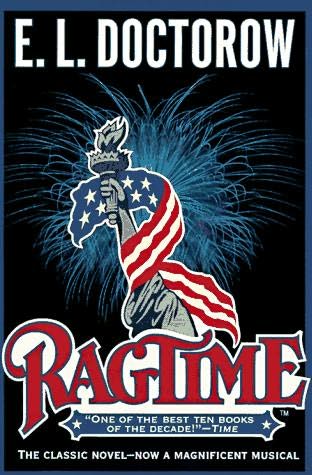
Ragtime by EL Doctorow

The plot of Ragtime is not easy to define but I'll try: The time is the first decade of the 20th century. The main characters are two families living in the greater New York area, a middle-class Protestant family (Father, Mother, Son, Mother's Younger Brother) in the suburb of New Rochelle, and a poor Jewish family (Tateh, Mameh, and Little Girl, yes, these are their only freaking names). Other characters include Sarah, the black girl who comes to live with the Protestant family with her child for some reason, her lover the ragtime pianist Coalhouse Walker, and various real people from this time, including Houdini, Freud, Emma Goldman, and J.P. Morgan. Several real stories are woven throughout the narrative, all of which connect in some tangential way to the tales of these two families which don't come together properly until the book's end.

The plot's pretty impressive in its complexity, but the style almost drove me crazy. Perhaps in an imitation of the musical manner of ragtime, the whole thing is written in short, choppy sentences and includes no direct dialogue. This, when combined with the nameless characters, creates a feeling of distance that made it difficult to really care about what happens. If you ever wonder why English teachers tell you to "show, and not tell," this is why: endless repetitions of phrasing like "Father felt this way" or "Father felt that way," no matter how poetic, is super-boring.

To be honest, for the first two sections of this book, I was bored out of my mind. It picks up quite a bit in the second half, which skips around less and deals mostly with the story of Coalhouse Walker, the book's single interesting character: Coalhouse is somewhat of an oddity as a black man who dresses nicely and owns a Model T, and for this he is picked out for harassment by the local Fire Chief, who stops his car outside the fire station and tells him that he's driving on a toll road. Coalhouse is too proud to pay off the Fire Chief, so he leaves the car, which has been barricaded, and tries to find a policeman, but when he comes back without help he finds that the car has been vandalized and defecated in. Coalhouse wants to sue, or press charges, but can't seem to find anyone to represent him. Sarah, in a moment of foolishness, tries to get the attention of the Vice President (who she thinks is the President) to solve the problem on a campaign stop nearby, but after the assassination of McKinley the secret service is anxious and violently stops her from approaching him, and she dies. Enraged, Coalhouse goes on a terroristic rampage, blowing up the fire station and causing general mayhem for months, demanding that his car be restored and the Fire Chief turned over to his justice.

So, that's pretty cool. But the rest of this book is weighed down by really irritating prose and boring shit. In its clear attempt to be "The Great American Novel," Ragtime often comes off like a dry history lesson and not like a compelling work of fiction.

Saturday, July 21, 2007

The Last King of Scotland by Giles Foden

I find that The Last King of Scotland makes me wonder again about the relationship between books and their film adaptations. The Last King of Scotland, while a good book, is still vastly inferior to the film version, for many reasons, perhaps not the least of which is the fact that I saw the film before reading the book--though I think that part of the pattern lies in the fact that great films are more likely to inspire people to read the books on which they are based. After all, The Shipping News is an amazing book and one of my favorites, but who would want to read it after seeing the dull Kevin Spacey-Julianne Moore turd they made out of it?

Anyway, The Last King of Scotland is the almost entirely fictitious story of Nicholas Garrigan, a Scottish doctor who travels to Uganda on the eve of Idi Amin's successful coup to work for its National Ministry of Health, and through sheer accident (Amin is involved in a car-cow collision near the bush town where Garrigan practices) becomes Amin's personal physician. But Amin, it turns out, is a psychopath, and Garrigan is unwittingly drawn into his closest circle and finds himself unable to extricate himself from an increasingly violent Uganda. The title, The Last King of Scotland, refers to Amin's real-life idiosyncrasy of styling himself "The Conqueror of the British Empire in Africa in General and Uganda in Particular," and his affinity for the Scots as an "oppressed people."

The film wisely noted that Amin is the most interesting character in this story; though it is about Garrigan, it's Amin's colorful insanity that really makes the story worthwhile. The relationship between Garrigan and Amin is the focus of the film, but the book is burdened by its opening third, which describes Garrigan's experience as a doctor in the bushland, and its final chapters, in which Garrigan inadvertantly finds himself among a Tanzanian company invading Uganda. For someone whose presence overshadows the entire novel, Amin is present very little. The rest of the characters are largely insignificant.

All in all, this is a better book than High Fidelity or Midnight in the Garden of Good and Evil or Children of Men, all of which are nearly made irrelevant by their film adaptations. In this case, at least, it forms a good companion to the film, though not quite measuring up to it. Case in point: the film has a scene where James McAvoy is pierced by hooks through his nipples.

Friday, July 20, 2007

The Jungle Books by Rudyard Kipling

This might be the best book I've read all year. Kids can read it, sure. I probably would have loved it when I was little, but I think I would have missed out on all the undertones that Kipling pours into every story.

First you should know that Rudyard Kipling was born and raised in India, studied in England and lived his married life in Vermont. He sounds like a pretty rugged guy, maybe on par with Bear Grylls. So he knows what he's talking about when it comes to lions and elephants and the rest of the bunch.

Secondly, I have to say that Mowgli is a bad ass. I mean he hangs out with wolves all day and then kills Shere Kahn with his bare hands. Hardcore. I want to be him.

There's more to The Jungle Books than action. These are stories about a deep-rooted disenchantment with the modern world. In one story, "Letting in the Jungle," Mowgli becomes upset with a small Indian village that's been encroaching on the forest, so with the help of Hathi the elephant, they topple every building in the town. There's sticking it to the man for ya. Mowgli 1, Urban Sprawl 0. This theme pops up in almost every story.

Kipling also creates an order within Jungle life. It's a natural order, not one fabricated with plastic by men in ties. In the jungle hierarchy, humans are pretty far down - again, dissatisfaction with modern living - but Mowgli spans the gap. He's more than just an action adventure star. He's the model citizen, that which we should emulate.

There are some other jewels here other than the Mowgli stories. "Rikki Tikki Tavi" is excellent. If you never read this when you were little, it's not too late. If you did read it, I think it merits a second look.

One Flew Over the Cuckoo's Nest by Ken Kesey

Warning: this review contains some mild spoilers.

I am by no means a fast reader, but even so this book took me much longer to read than it should have. I don't know exactly why this was the case. It wasn't like I was slogging through it. On the contrary, I thoroughly enjoyed it.

Most people know the basic story of this book because they have seen the film, which is a pretty good adaptation. The basic story is that a ne'er-do-well convict gets himself admitted to a psychiatric hospital, seemingly to get out of work duty. McMurphy is obviously different than the rest of the men on the floor, who are split in to two groups: the acutes and the chronics. The acutes are men that the hospital is trying to rehabilitate. They are generally functional human beings with a few "defects". The chronics are those that will no doubt live out the rest of their days on the ward. They are considered beyond help. What makes the book especially interesting -- and sets it apart from the movie -- is that the story is told from the perspective of one of the chronics, Chief Bromden, a Native American whose hulking size belies his diminutive personality. At the beginning of the book Bromden tells the reader:
"I been silent so long now it's gonna roar out of me like floodwaters and you think the guy telling this is ranting and raving my God; you think this is too horrible to have really happened, this is too awful to be the truth! It's still hard for me to have a clear mind thinking on it. But it's the truth even if it didn't happen."
This sets the story up quite nicely, for what follows is truly a mixture of reality and the slightly-skewed reality that Bromden sees around him, as he recounts the battle that ensues between McMurphy and the Big Nurse, Ms. Ratched.

It has been a while since I have seen the movie, but what I remember of it syncs up rather well with the book. I don't think anyone other than Nicholson could have played Randle Patrick McMurphy the right way. The character was perfect for him. However, the humor was already there in the character. The macho posturing, the quick wit, and the overall demeanor of McMurphy were carefully-crafted creations of Kesey (how's that for alliteration). Other than the Nicholson-McMurphy connection, the film was not instrumental in the mental pictures that I created while reading the book. Kesey writes well and his sparse, yet somehow still vivid, descriptions trumped the film in my mind's eye. One night as Bromden is telling McMurphy about his dad, he says:
"And the last I see him he's blind in the cedars from drinking and every time I see him put the bottle to his mouth he don't suck out of it, it sucks out of him until he's shrunk so wrinkled and yellow even the dogs don't know him, and we had to cart him out of the cedars, in a pickup, to a place in Portland, to die."
While on a trip outside of the hospital, Bromden describes the landscape around him: "Out along the dim six-o'clock street, I saw leafless trees standing, striking the sidewalk there like wooden lightning, concrete split apart where they hit, all in a fenced-in ring."

The writing is excellent, and the characters are full of life. There is good reason that this book is considered a classic.

_______________________________

Check out Christopher's review of this book.

Wednesday, July 18, 2007

Portnoy's Complaint by Philip Roth

Jews and sex. Sex and Jews. Sexy Jews. Jewy Sex.

Thus can Philip Roth's book Portnoy's Complaint be described. In it, Alexander Portnoy, a successful thirty-something civil rights lawyer monologues to his shrink, Dr. Spielvogel, about the travails of his childhood and his many unsuccessful sexual affairs. Portnoy's problem (his "complaint") is that while he has a monstrous and somewhat deviant sexual appetite, his ethics will not let him engage in sexual diversion without much inner struggle. This is connected to his childhood and to his strict Jewish parents, who seem to be a lot like Fran Drescher's mom on The Nanny. When Portnoy isn't thinking about sex (at one point, he masturbates into a cored apple), he's thinking about Jews, and how as a self-described atheist he finds it difficult to relate to his family and surroundings, which are uber-Jewish.

This book is dark, funny, and extremely crude (it uses the word "cunt" more often than any book I have read, or any pornography I have seen), but for all that it's a little disappointing. Portnoy's monologue jumps around so considerably that it lacks any real narrative or forward structure, and it just doesn't have a lot of emotional heft. I have a feeling that this book may be enjoyed more by a Jewish person, but as a goy it left me sort of unimpressed. It certainly didn't leave me feeling that Roth is, as many have described him, the greatest living American author.

Sunday, July 15, 2007

Return of the King by JRR Tolkien

The Return of the King was my favorite of the three Lord of the Rings movies, but out of the three books it's probably the most flawed. For one, a lot less happens than in the first and second books (the first particularly is just crazy wizard shit after crazy wizard shit). Most of the book is overshadowed by two big events: the Battle of the Pelennor Fields, in which the forces of Gondor and Rohan beat back the forces of Sauron's Mordor, and Frodo and Sam's final trip into Mordor to destroy the Ring. In retrospect, it's probably good that Peter Jackson was least faithful to this book out of all of them, because the movie is more exciting.

The other problem is that all that is finished by page 200 (out of 300). The final third of the book drags on excessively after most conflict has ended, plowing through funerals, and coronations, and lots of goodbyes and such. The only interesting part of the final third is the Battle of Bywater, in which the four hobbits amass a hobbit army in order to reclaim the Shire from Saruman, who has moved in and taken over since he was expelled from Isengard.

What I did like about this book, though, was the character of Denethor. Too many of Tolkien's characters are wholly good, noble characters--there is no discernible difference in character, for example, between Faramir and Eomer and Theoden and even Aragorn. But Denethor, King of Gondor, is a flawed character and thus more interesting: He is always suspicious of Gandalf, who he thinks wants to take over his kingdom, and then when his son Faramir is gravely wounded in battle, Denethor goes crazy and assumes he's dead and then tries to burn him (and himself) on a funeral pyre. What a nut!

Anyway, I'm both glad I read these books and glad I'm done reading them. Few other books give the same impression of having read something huge and important, but they can be tiring and the storytelling is not always fantastic. Far more interesting than the books themselves is all the stuff that went into their creation, like the languages (you can learn Quenya, or Elvish, today, and it's only one of tons of languages Tolkien created for the book) and the geography and history.

Here is a Middle-Earth map for nerds.

Wednesday, July 11, 2007

Dress Your Family in Corduroy and Denim by David Sedaris

Hilarious. I liked this even more than Me Talk Pretty One Day. Sedaris' pours his dry, sarcastic sense of humor into every sentence of every story in this collection. He has a knack for storytelling as it is, but it doesn't hurt that his family - featured in most of the stories here - is a couple beers short of a six pack.

In this book, the stories range from childhood adventures to anecdotes from his life in rural France. My personal favorite is "Six to Eight Black Men." I don't know what else to say about this. If you haven't read/heard anything by this author, you need to. This is as good a starting point as any.