Showing posts with label james mcavoy pierced by hooks through his nipples. Show all posts

Thursday, August 23, 2007

Harry Potter and the Prisoner of Azkaban

When people found out that I had started reading the Harry Potter books, they kept telling me that the series really takes off with the third book – that things really get started with The Prisoner of Azkaban. Well, everyone was right. This was leaps and bounds better than the first two, which were both pretty good. The main difference was that Azkaban felt like less of a kid's book.

Harry starts to find out more about his parents and his past in general in the third installment of Rowling’s series. Rowling also spends less time describing the wonderful world she has created, and a little more time developing her characters, which is good, considering that most of the new characters will no doubt be around for a while.

So I have read three of these books so far, and my main complaint is that Rowling starts each book as though her readers are almost completely unfamiliar with the series and its characters. Guess what? By the third book, I know how Quidditch is played, and that Mr. Dursley is fat. I just started The Goblet of Fire, and Rowling doesn’t do it quite as much. I am hoping it will stop altogether.

Beside that rant about something rather minor, I really have enjoyed these books.

Tuesday, August 21, 2007

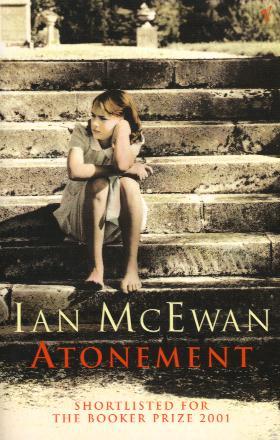
Atonement by Ian McEwan

I had such unreasonable expectations for Atonement that I'm almost disappointed it's not the best book I've read all year--though it is, safe to say, very good.

Some books are good because of their plot, and some because of their style; few, I think, boast both. The style of Atonement might be perfect for someone who likes a lot of James, Austen, or Auden, who are sort of reference points for the book though it takes place in the 1930's, but to me it was a little dry--but it's also one of the most intense books I think I've ever read.

In the early 1930's, 13-year old Briony Tallis, a girl with a very active imagination and a jones to become a serious writer, is witness to a series of events that she does not understand: a scene in which her sister emerges from a fountain in her underwear while the son of the family housekeeper stands by, a mistakenly sent letter, an illicit moment in a library. But Briony, the conceiver of plots, feels compelled to connect these events into a narrative which leads to a misunderstanding so great it threatens to ruin the lives of two people. I wish that I could say more, and were this a book I really didn't expect anyone to read, I would elucidate, but I think everyone here would probably enjoy Atonement, and I don't want to ruin it for anyone if they should choose to read it. But what happens in the first, longer section of the book possesses both the convincing detail of realism and the dread of inevitable doom, and it's very affecting.

The book has three other sections, one set in 1939 as the British Army retreats through France to the port of Dunkirk, one set in the same period that follows Briony as a nurse--trying to "atone" for the horrendous misunderstanding of four years previous--and a fourth set in 1999 that reveals that the book is actually of Briony's creation, as a way of atoning and coping with the events of her childhood. It is somehow both enormously sad and reassuring. The final three sections, however, seem somehow less consequential than the first, as lagging after the novel's true climax. Not to say that McEwan ought to have ended it after the first section, but in parts the final three seem brief and perfunctory, and too little attention is given to Briony's realization of her mistake and the ensuing, eponymous atonement.

A movie has been made of this book and will be released in December starring James McAvoy and Keira Knightley. It's directed by the same guy who directed Pride and Prejudice, so it should be very good.

Saturday, July 21, 2007

The Last King of Scotland by Giles Foden

I find that The Last King of Scotland makes me wonder again about the relationship between books and their film adaptations. The Last King of Scotland, while a good book, is still vastly inferior to the film version, for many reasons, perhaps not the least of which is the fact that I saw the film before reading the book--though I think that part of the pattern lies in the fact that great films are more likely to inspire people to read the books on which they are based. After all, The Shipping News is an amazing book and one of my favorites, but who would want to read it after seeing the dull Kevin Spacey-Julianne Moore turd they made out of it?

Anyway, The Last King of Scotland is the almost entirely fictitious story of Nicholas Garrigan, a Scottish doctor who travels to Uganda on the eve of Idi Amin's successful coup to work for its National Ministry of Health, and through sheer accident (Amin is involved in a car-cow collision near the bush town where Garrigan practices) becomes Amin's personal physician. But Amin, it turns out, is a psychopath, and Garrigan is unwittingly drawn into his closest circle and finds himself unable to extricate himself from an increasingly violent Uganda. The title, The Last King of Scotland, refers to Amin's real-life idiosyncrasy of styling himself "The Conqueror of the British Empire in Africa in General and Uganda in Particular," and his affinity for the Scots as an "oppressed people."

The film wisely noted that Amin is the most interesting character in this story; though it is about Garrigan, it's Amin's colorful insanity that really makes the story worthwhile. The relationship between Garrigan and Amin is the focus of the film, but the book is burdened by its opening third, which describes Garrigan's experience as a doctor in the bushland, and its final chapters, in which Garrigan inadvertantly finds himself among a Tanzanian company invading Uganda. For someone whose presence overshadows the entire novel, Amin is present very little. The rest of the characters are largely insignificant.

All in all, this is a better book than High Fidelity or Midnight in the Garden of Good and Evil or Children of Men, all of which are nearly made irrelevant by their film adaptations. In this case, at least, it forms a good companion to the film, though not quite measuring up to it. Case in point: the film has a scene where James McAvoy is pierced by hooks through his nipples.