Showing posts with label atonement. Show all posts

Thursday, April 4, 2013

"To produce a novel that was entirely and deliberately bad — not merely bad at the beginning as part of a plan to tease readers about their desire for naive realism — would be a truly daring artistic move."

The danger, of course, is that people will assume you are simply a bad writer, a risk all the more pronounced when this is your first novel. It’s true, the narrator of “The Unchangeable Spots of Leopards” is exactly the sort of writer who would produce a self-involved meta-narrative, but Jansma could be, as well. And surely if Jansma were so fiendishly clever as to devise such a plan, he would have done so in service of a more interesting theme than that most tiresome of authorial assertions, that fiction writers tell “lies.”


From Laura Miller's interesting take on postmodern "sneaky author tricks" in Salon, a critical view that inspired Flavorwire to post their top ten "phenomenally tricky books."

Miller goes after two different, but often related, gimmicks: The reveal that everything you've been reading is a fictionalized account all along, and the gimmick of writing poorly on purpose because your story represents someone else's work.  Miller relies on Ian McEwan and Kristopher Jansma's The Unchangeable Spots of Leopards (which I've never heard of), but each of those made me think of a different book: First, Life of Pi (link to Kunal's recent review), which I thought was far more patronizing than Atonement in the exact same fashion that Miller it is criticizing.  Second, The Iron Dream, which asks the question: What if Hitler was a science fiction author?  The Iron Dream is the best example I can think of what Miller's talking about above, a bizarre achievement that's either a total success or a complete failure--and absolutely excruciating to read.

Tuesday, August 21, 2007

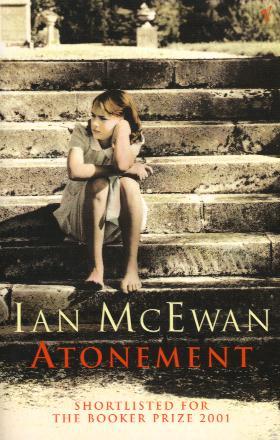
Atonement by Ian McEwan

I had such unreasonable expectations for Atonement that I'm almost disappointed it's not the best book I've read all year--though it is, safe to say, very good.

Some books are good because of their plot, and some because of their style; few, I think, boast both. The style of Atonement might be perfect for someone who likes a lot of James, Austen, or Auden, who are sort of reference points for the book though it takes place in the 1930's, but to me it was a little dry--but it's also one of the most intense books I think I've ever read.

In the early 1930's, 13-year old Briony Tallis, a girl with a very active imagination and a jones to become a serious writer, is witness to a series of events that she does not understand: a scene in which her sister emerges from a fountain in her underwear while the son of the family housekeeper stands by, a mistakenly sent letter, an illicit moment in a library. But Briony, the conceiver of plots, feels compelled to connect these events into a narrative which leads to a misunderstanding so great it threatens to ruin the lives of two people. I wish that I could say more, and were this a book I really didn't expect anyone to read, I would elucidate, but I think everyone here would probably enjoy Atonement, and I don't want to ruin it for anyone if they should choose to read it. But what happens in the first, longer section of the book possesses both the convincing detail of realism and the dread of inevitable doom, and it's very affecting.

The book has three other sections, one set in 1939 as the British Army retreats through France to the port of Dunkirk, one set in the same period that follows Briony as a nurse--trying to "atone" for the horrendous misunderstanding of four years previous--and a fourth set in 1999 that reveals that the book is actually of Briony's creation, as a way of atoning and coping with the events of her childhood. It is somehow both enormously sad and reassuring. The final three sections, however, seem somehow less consequential than the first, as lagging after the novel's true climax. Not to say that McEwan ought to have ended it after the first section, but in parts the final three seem brief and perfunctory, and too little attention is given to Briony's realization of her mistake and the ensuing, eponymous atonement.

A movie has been made of this book and will be released in December starring James McAvoy and Keira Knightley. It's directed by the same guy who directed Pride and Prejudice, so it should be very good.