Showing posts with label Blackfeet. Show all posts

Tuesday, January 5, 2021

Winter in the Blood by James Welch

I had had enough of Havre, enough of town, of walking home, hung over, beaten up, or both. I had had enough of the people, the bartenders, the bars, the cars, the hotels, but mostly, I had had enough of myself. I wanted to lose myself, to ditch these clothes, to outrun the burning sun, to stand beneath the clouds and have my shadow erased, myself along with it.

The unnamed narrator of James Welch's Winter in the Blood returns home to his mother's house on the Ft. Belknap Reservation in Montana with a hangover and a bum knee. His girl has left him, running off with his gun and his electric razor. His mother is set to marry a man who covets her land more than he does her, and she may be a little too close to a white priest who refuses to set foot on the reservation. He barely knows or understands his aging grandmother, referred to mostly as "the old lady," and who was once the teenage bride of a renowned Blackfoot chief. In this inhospitable environment there is, unsurprisingly, no rest, no solace, and he cruises back out into the street again. He zips between small towns like Malta and Havre, looking for his girl, his gun, and his razor, drinking too much and slipping into bed with strange women.

More than anything, the middle of Winter in the Blood reminded me of the kind of drugged-out spacemen you find in the books of Denis Johnson. The narrator's wanderings are episodic, peripatetic; he does things without giving a reason, or without having one. In a barroom a man offers to give him a car if he'll drive him to Calgary, where he can elude the police; they plan it as they play the bar's punchboard game, winning box after box of chocolate-covered cherries. Welch skirts close to stereotypes about Native Americans and alcohol, but like any good novelist, imbues his narrator with a specificity and detail that brings the link between alcohol abuse and trauma--both personal and historical--to life. "They were the same faces I had memorized so many years before," the narrator says of the wanted posters at the Havre post office. "Only the names were different."

The secret to Winter in the Blood is that the scattered nature of the narrator's boozing and bar-hopping conceals a more conventionally causal story, running through it like an underground stream. The clue is in the title: although the novel itself takes place during a stiflingly hot summer, the narrator cannot shake the memory of a fatal wintertime accident--involving a horse and a car--that took his brother's life. His grandmother, too, the "old lady" has "winter in the blood"--she carries with her the experience of being blamed, after her husband's death, for the wintertime starvation of her people, the Gros Ventre. This story goes untold until the narrator hears it from the blind hermit Yellow Calf, who turns out to know more--and be more entangled--with the narrator's family history than he knew. In this you get glimpses for the first time of the mythic-historical epic that Welch would later write in Fools Crow, which seems otherwise like a very different book.

I didn't realize it while reading, but looking back, I see that Winter in the Blood is, at least in some part, about the narrator's need to reconcile himself with the women in his life. His relationships with them are largely rotten: he's ambivalent at best toward the girl he claims to be searching for, and the sexual dalliances he gets into during his bar-hopping are pathetic, even violent. He claims to have "no particular feelings" toward his mother or grandmother, and he identifies that disinterest as a distance with himself: "But the distance I felt came not from country or people; it came from within me. I was as distant from myself as a hawk from the moon."

Yellow Calf's story points the way forward, but still his grandmother dies before he can talk with her about her experience. The novel ends, not with a final engagement between grandmother and grandson, but with the narrator rescuing a wayward cow from drowning in the mud. There's something there about the feminine principle, about women as the physical links to history and lineage--the cow's calf looks on, panicked--but the symbolism seems slippery, partial, troubling. It seems not enough, and perhaps that's why it's so perfect for such a slippery and troubling book.

Saturday, April 4, 2020

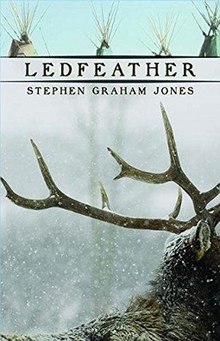
Ledfeather by Stephen Graham Jones

The only fitting sentence for his crimes would be to live as they did, as they had.  As an Indian.

It was why the girl he'd kissed up against the wall had black hair instead of blonde, and those perfect, heavier-than-the-world fingertips.

It was why he'd been remembering another's life.

It was his punishment, to become Blackfeet, to be Piegan.  To live on the reservation he'd created, the situation he was already leaving behind.  To replace his own life with an Indian one, and thus know firsthand the end result of his policies.  An end result generations away from last Winter, just so he could see the scope of what he'd done, that it still had a traceable effect.  So that, in a sense, he could be inflicting it upon himself.

Doby Saxon is a teenager living on the Blackfeet reservation that abuts Glacier National Park in Montana.  Doby is a down-and-out kid in a down-and-out place: he's missing three fingers from the time he and his father tried to poach elk from the park, and his father fell from his snowmobile and died.  He has a run of untold luck at a casino, then loses it all, and causes a violent scene that ends up putting his mother in jail.  He fails to save his friend from overdosing in a concrete tipi; he tries to kill himself in a hundred unsuccessful ways.

But Doby is also extraordinary: he discovers a cache of letters from a white Indian agent that lived on the reservation a century ago, and then begins to see the agent in visions.  Doby is torn between these two realities, and we come to learn that Doby might be the Indian agent himself, reborn as a Blackfeet Indian through a curse that condemns him to live as those he had a part in starving.

There's much to admire about Ledfeather.  It's a novel with one very good idea at its heart, but it's also a novel of terrific detail and writerly skill.  Unlike Moon of the Crusted Snow, which I bring up only because it seems to fit in the box of indigenous science fiction, though the context and community is much different, Ledfeather seems to understand that community life thrives in specifics.  Ledfeather, among other things, is a lovingly rendered version of what is often a difficult life on the Blackfeet reservation: it gives life to casinos, game wardens, schools, hospitals, chintzy little museums, basketball courts.

But I also have to admit that I found the whole thing extremely hard to follow.  Jones' novel has, if I'm counting correctly, at least four different narrative modes: 1.) first-person narratives by various people on the reservation about Doby, which ask us to piece together an understanding of him (these sections often refuse to identify clearly who the narrator is, in a way that seems self-consciously literary) 2.) the unsent letters of the Indian agent Francis Dalimpere to his wife Claire 3.) third-person accounts of the Indian agent flashing "forward" in time, 4.) second-person (!) accounts of Doby's life.  I could have managed maybe two of those, but not three, and certainly not four.  Ledfeather's not a long novel, but it just has one too many tricks up its sleeve, and I felt like some streamlining might have made it more readable.

As a result, I felt like the novel's many good ideas didn't land with enough emotional power for me.  And they are very good: I liked especially the novel's motif of self-sacrifice, which comes in both noble and misbegotten stripes.  One of the subplots of the modern narrative is that the local school's star basketball player has a terrible kidney disease, and young people from all over the reservation rush to commit suicide in order to give him their kidneys.  There's kind of grim, very grim, humor that works because it sits aside other kinds of sacrifice: the Indian agent's, for example, who first kills a herd of U.S.-owned cattle for the starving Blackfeet, knowing that he'll be put in prison, and then later "sacrifices" himself by becoming Doby Saxon.  Or Doby's mother, who goes to jail protecting her son in that casino fiasco.  These stories of self-sacrifice are linked by the image of the elk that Doby and his father go hunting:

The story, too, it was a joke mostly, like all of Earl's stories, was that one time an elk had found a white man lost and dying in the storm, and they'd talked to each other, and finally the elk, because it knew the man needed to live, to be warm, it took pity and laid on its side and let the man cut it open and crawl inside, and stay warm like that even though the snow piled up all around them for days and days and even years, only when the man finally crawled out again, everything was different, because that elk you crawl into, it's not the same one you crawl back out of, right?

In the end, Ledfeather is a hopeful kind of book, one that shows that nobility and selflessness are alive on the reservation, and that even has hope for white people, like Dalimpere, who think to make amends.  So much so that you might forgive it for asking a little too much of its readers.

Monday, February 11, 2019

Fools Crow by James Welch

"Where are the seizers now?"  Fools Crow's voice was sharp.  Anger welled up within him, an aner that was directed at the futility of attempting to make the seizers pay.  He had always thought that the Pikunis would fight these hairy-faces.  He had prepared himself for this fight, he was ready to die a good death to defend this country.  Now he knew that his father had been right all along--the Pikunis were no match for the seizers and their weapons.  That the camps were laid low with the white-scabs disease did not even matter.  The disease, this massacre--Sun Chief favored the Napikwans.  The Pikunis would never possess the power to make them cry.

I've been trying to read more Native American literature.  I'm thinking about teaching a class on contemporary Native writers next year, if I can figure out how to do it with sufficient humility and respect.  Again and again, the news seems to serve as a chorus to my reading: the Dakota Pipeline fight, the derecognition of the Wampanoag, and now the President's crude "Trail of Tears" joke about Elizabeth Warren.  For Donald Trump, the genocide of hundreds of thousands is dumb joke material, as fundamentally unserious as, say, the life of Pocahontas.  Meanwhile, I was reading James Welch's novel Fools Crow, a book about what genocide looks like from the ground.  It's a reminder that the atrocity of the Trail of Tears is only part of the larger story of American genocide against Native Americans, a story that continued after the civil war with westward expansion.  Fools Crow tells the story of the Pikuni Blackfeet of Montana, who were decimated by white expansion and smallpox, culminating in the massacre of a non-hostile community at the Marias River in 1870.

Fools Crow is the story of White Man's Dog, a Blackfoot brave of the Lone Eaters band.  When the novel begins the white settlers, called Napikwans or "seizers," are more rumor than anything else, and we are given a glimpse into the traditional life of the Blackfeet before their decimation.  They survive by hunting buffalo, here called "blackhorns" (as distinguished from "whitehorn" cattle, imported by Napikwans), but they aren't exactly the peaceful close-to-the-earth people that Native American fetishists imagine: the Pikunis are horse-takers, and the first third of the book is taken up by the thrilling account of a horse-stealing raid against the enemy Crow people.  In that raid, one of the leading chiefs, Yellow Kidney, is taken prisoner and his fingers cut off, an act that brings cascading repercussions to the Lone Eaters.  White Man's Dog gets his new name--Fools Crow--during the raid that is revenge for Yellow Kidney's dismembering, when he kills a Crow after seeming to be dead.  Welch brings the same kind of ambiguity and nuance to the Lone Eaters' violent excursions that we might expect from a modern war narrative:

Fools Crow.  The naming ceremony.  Three Bears had named him Fools Crow after hearing how he had tricked Bull Shield into thinking he was dead and then risen up to kill the Crow chief.  But was that how it was?  The story of how he had earned that name had been greatly exaggerated, despite his initial protests, until many thought he had tricked the whole Crow village, that his medicine contained some magic that made another man's eyes see wrong.  The story of how Fools Crow had killed and scalped the man who had mutilated Yellow Kidney was even more embellished.  Now Fools Crow had made the man cry, had laughed and spit on him, had made love to his wife, then killed him and stuffed his bloody genitals in his mouth.  The men of the warrior societies laughed and kidded Fools Crow, but in their eyes he had become a man of much medicine.

The conflict with the Crow--and the careful identity-making among the Blackfeet that is predicated on that conflict--is quickly supplanted by conflict with the Napikwans.  A rogue band of Pikunis led by Owl Child (a historical figure) and Fools Crow's old friend Fast Horse leads violent raids against the white settlers.  Reading Fools Crow is like reading a fictionalized version of Dee Brown's Bury My Heart at Wounded Knee.  We know that debate will rage among the Pikunis, deliberating between war and appeasement, and that in the end these arguments won't matter one bit: the U.S. Army will attack innocent Pikunis for what Owl Child has done, and ultimately, that's exactly how the massacre occurs.

Fools Crow reads, in some respects, like a fantasy epic: Fools Crow is the young underdog destined to lead his people, the Napikwans are the forces of Sauron.  But we know that there's no possible way that the story can end with victory for Fools Crow and the Pikunis, and that makes the novel a deflated, ragged affair.  It never recaptures the thrilling nature of the Crow raid at the beginning; no real showdown with the Napikwans ever comes (the massacre occurs "off-stage"); in the end, it's the slow massacre of smallpox that does Fools Crow's people in.

Instead, Fools Crow asks, how does a man lead his people through defeat?  Like Erdrich and Silko, Welch treats the myths and traditions of the communities he writes about with literal seriousness; toward the end of the novel, Fools Crow is compelled by a dream to travel to the house of Feather Woman, a mythological figure who shows him a vision of the future.  It's bleak.  Fools Crow sees the massacre, the smallpox, and the ultimate assimilation of his people through boarding school regimes.  But Fools Crow also sees that he and his ancestors will survive, and that there is a victory of sorts in remembering, and in that way the vision becomes Fools Crow's argument for itself: that as long as the story of the Blackfeet is told, then the victory of white Napikwan society can never be entirely complete.  It's small comfort, but it's what's available.  And while it's a different story, a different massacre that the President thinks is funny, Fools Crow is a reminder that it's important to remember what actually happened and just how horrible it was.