Showing posts with label Gros Ventre. Show all posts

Saturday, January 29, 2022

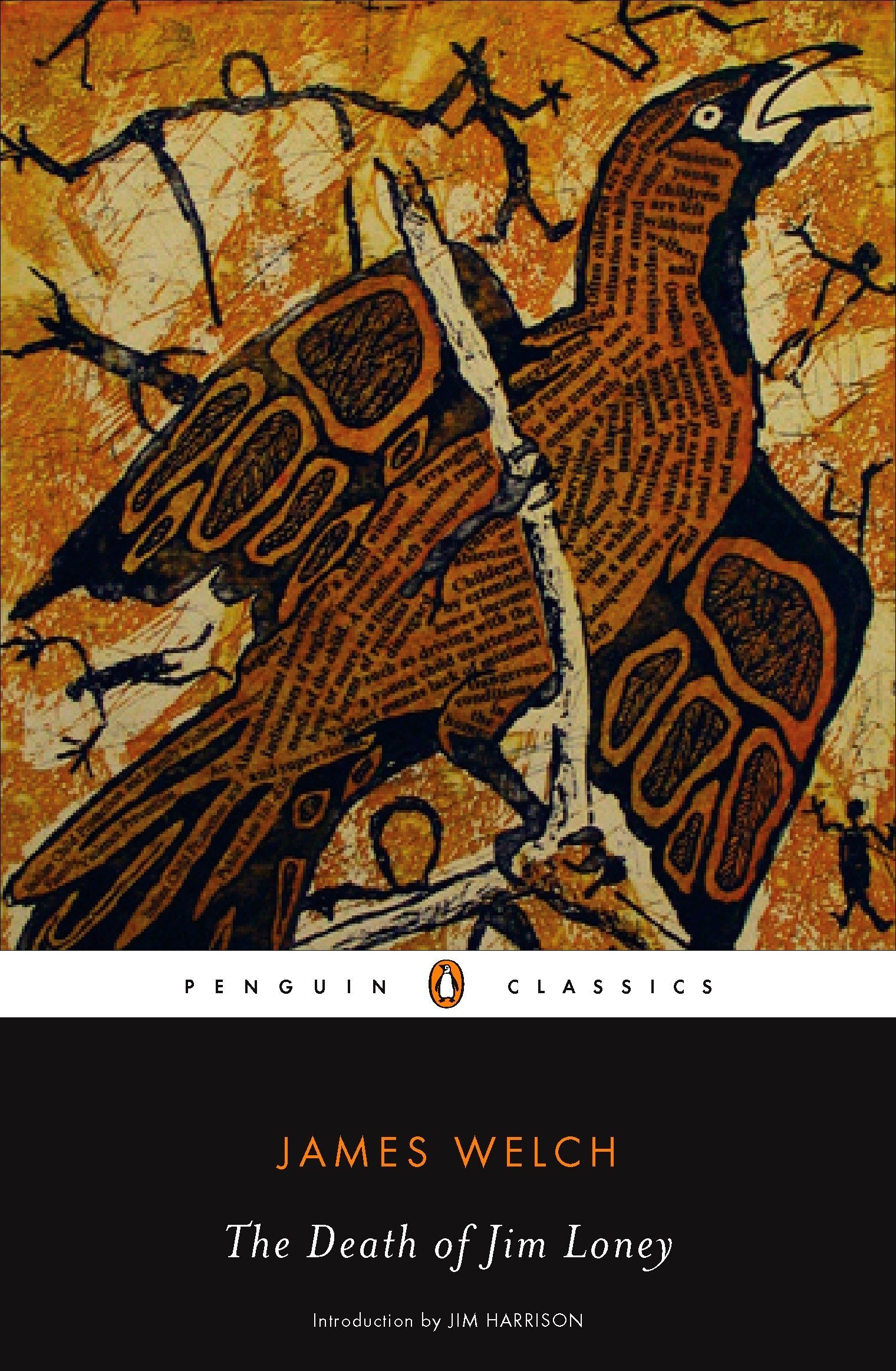
The Death of Jim Loney by James Welch

As he tried to strike another match to light a cigarette, he realized that his hands were trembling. He wanted to believe that they trembled because of the cold, but he knew without thinking it that they trembled because there was no real love in his life; that somehow, at some time, everything had gone dreadfully wrong, and although it had something to do with his family, it had everything to do with himself.

Jim Loney lives a quiet life at the edge of the Blackfoot reservation in Montana. Once a star high school basketball player, his life has shrunk down to almost nothingness. He feels detached from it, detached from himself; he feels, as the protagonist of Welch's Winter in the Blood does, "as distant from myself as a hawk from the moon." Materially, things are not so bad for him: he doesn't seem to be especially hard-up or poor, and is well-liked--his old teammate Myron Pretty Weasel is constantly trying to get him to go hunting--and he has a beautiful, intelligent girlfriend, a white Texan named Rhea. And yet these things seem unable to penetrate the solitude of his spirit.

In one sense, The Death of Jim Loney is a "half-breed" story like Solar Storms or Ceremony: about a half-white, half-Indian person trying to find their place in a divided world. Rhea believes that it must be sort of nice to have two sets of ancestors: "you can be Indian one day and white the next. Whichever suits you." But Loney feels just the opposite, unable to connect to either of his lineages, not the family of his alcoholic white father, nor his absent Indian mother and the "reservation families, all living under one roof, the old ones passing down the wisdom of their years, of their family's years, of their tribe's years, and the young ones soaking up their history, their places in history, with a wisdom that went beyond age." There is a parallel to this divided life in the way that Rhea and Loney's sister Kate, a successful bureaucrat in Washington, D.C., spend the middle of the book in a cold war over who will get to take Loney away from Montana. Rhea wants to move to Seattle, Kate to take him home to D.C.; and Loney is split between two coasts (two Washingtons) even.

But Loney is unmoved; he doesn't want to go to either place. He is already in the place he feels he needs to be to figure out the nature of his life and his self; he is home, and yet these things remain hidden to him. In a sense, The Death of Jim Loney is a rejection of the "half-breed" narrative, in which resolution and healing can be found in embracing one's indigenous side. In Winter in the Blood, the narrator returns to himself by returning home and helping to dig a horse out of the mud (think I'm remembering that right), but the people who need Loney are all headed elsewhere.  Being in Montana, that ancestral homeland, provides no answers:

He had been thinking of his life for a month. He had tried to think of all the little things that added up to a man sitting at a table drinking wine. But he couldn't connect the different parts of his life, or the various people who had entered it and left it. Sometimes he felt like an amnesiac searching for the one event, the one person or moment, that would bring everything back and he would see the order in his life. But without the amnesiac's clean slate, all the people and events were as hopelessly tangled as a bird's nest in his mind, and so for a month he had been sitting at his table, drinking wine, and saying to himself, "Okay, from the very moment I will start back--I will think of yesterday, last week, last year, until all my years are accounted for." But the days piled up faster than the years receded and he grew restless and despondent. But he would not concede that his life had added up to nothing more than the reality of a man sitting and drinking in a small house in the world.

I suspect there's something of a feint happening here, that The Death of Jim Loney suggests that these healing processes are not so easy. While both an earlier and a simpler book than Winter in the Blood, it seems almost like a response or refutation. We start to suspect that Loney has been sold, through cultural osmosis somewhere, a kind of lie, that knowledge of your past will make you whole. He searches for the name of the woman who took him in after his mother left and his father abandoned, but knowing it does nothing for him. He sees his father in the bar every day, but when they finally speak after decades, nothing is revealed. And in the process Loney passes up on not one but two opportunities to take control of his life and make it into something different. The result is not that Loney gets to know himself better but that he gets to know the world less, and the preordained "death" of the title--spoiler alert, a violent suicide-by-cop--is the result of a fundamental misunderstanding about his own deeds and their relationship to the law, to the world of others.

Tuesday, January 5, 2021

Winter in the Blood by James Welch

I had had enough of Havre, enough of town, of walking home, hung over, beaten up, or both. I had had enough of the people, the bartenders, the bars, the cars, the hotels, but mostly, I had had enough of myself. I wanted to lose myself, to ditch these clothes, to outrun the burning sun, to stand beneath the clouds and have my shadow erased, myself along with it.

The unnamed narrator of James Welch's Winter in the Blood returns home to his mother's house on the Ft. Belknap Reservation in Montana with a hangover and a bum knee. His girl has left him, running off with his gun and his electric razor. His mother is set to marry a man who covets her land more than he does her, and she may be a little too close to a white priest who refuses to set foot on the reservation. He barely knows or understands his aging grandmother, referred to mostly as "the old lady," and who was once the teenage bride of a renowned Blackfoot chief. In this inhospitable environment there is, unsurprisingly, no rest, no solace, and he cruises back out into the street again. He zips between small towns like Malta and Havre, looking for his girl, his gun, and his razor, drinking too much and slipping into bed with strange women.

More than anything, the middle of Winter in the Blood reminded me of the kind of drugged-out spacemen you find in the books of Denis Johnson. The narrator's wanderings are episodic, peripatetic; he does things without giving a reason, or without having one. In a barroom a man offers to give him a car if he'll drive him to Calgary, where he can elude the police; they plan it as they play the bar's punchboard game, winning box after box of chocolate-covered cherries. Welch skirts close to stereotypes about Native Americans and alcohol, but like any good novelist, imbues his narrator with a specificity and detail that brings the link between alcohol abuse and trauma--both personal and historical--to life. "They were the same faces I had memorized so many years before," the narrator says of the wanted posters at the Havre post office. "Only the names were different."

The secret to Winter in the Blood is that the scattered nature of the narrator's boozing and bar-hopping conceals a more conventionally causal story, running through it like an underground stream. The clue is in the title: although the novel itself takes place during a stiflingly hot summer, the narrator cannot shake the memory of a fatal wintertime accident--involving a horse and a car--that took his brother's life. His grandmother, too, the "old lady" has "winter in the blood"--she carries with her the experience of being blamed, after her husband's death, for the wintertime starvation of her people, the Gros Ventre. This story goes untold until the narrator hears it from the blind hermit Yellow Calf, who turns out to know more--and be more entangled--with the narrator's family history than he knew. In this you get glimpses for the first time of the mythic-historical epic that Welch would later write in Fools Crow, which seems otherwise like a very different book.

I didn't realize it while reading, but looking back, I see that Winter in the Blood is, at least in some part, about the narrator's need to reconcile himself with the women in his life. His relationships with them are largely rotten: he's ambivalent at best toward the girl he claims to be searching for, and the sexual dalliances he gets into during his bar-hopping are pathetic, even violent. He claims to have "no particular feelings" toward his mother or grandmother, and he identifies that disinterest as a distance with himself: "But the distance I felt came not from country or people; it came from within me. I was as distant from myself as a hawk from the moon."

Yellow Calf's story points the way forward, but still his grandmother dies before he can talk with her about her experience. The novel ends, not with a final engagement between grandmother and grandson, but with the narrator rescuing a wayward cow from drowning in the mud. There's something there about the feminine principle, about women as the physical links to history and lineage--the cow's calf looks on, panicked--but the symbolism seems slippery, partial, troubling. It seems not enough, and perhaps that's why it's so perfect for such a slippery and troubling book.