Saturday, June 30, 2007

The Man Who Was Thursday by G. K. Chesterton

I have started three different reviews for this book in the last hour, and ended up scrapping each one of them. I can't figure out what I want to say about this book. More importantly I can't figure out how to say much about the book without giving away key plot points.

The Man Who Was Thursday follows detective Gabriel Syme, part of a special corps that tracks anarchists in London, as he gets deeper and deeper into a sinister plot to kill a foreign dignitary. Crap, I am really having trouble with this.

I give up. I really enjoyed this book, although I think some of it was over my head. For a much better synopsis, check out Christopher's review of Thursday.

Absurdistan by Gary Shteyngart

Absurdistan is the story of Misha Vainberg, the American-educated 325-lb. son of the 1,238th richest man in Russia. His father has murdered a businessman in Oklahoma, an act which prevents Misha from obtaining a visa and leaving the country to return to America and be with his ghetto girlfriend Rouenna. After his father's murder, he is offered a solution: travel to the obscure former Soviet republic of Absurdistan and obtain a Belgian passport from a corrupt official there. While there, Misha gets accidentally tangled up in the conflict between the two ethnic groups in Absurdistan, the Sevo and the Svani, their main difference being whether Christ's footrest, the bottom crossbar on the Slavonic cross should be tilted to the left or right. In particular, he falls in love with a girl who turns out to be the daughter of the leader of the Sevo minority forces, and becomes a part of their circle, only to find out that he's been deceived about the nature of the conflict.

This is a good book, but not as good as it could have been, I think, or good as I expected it to be (Absurdistan was the final competitor to The Road in The Morning News' 2006 Tournament of Books), though it has many virtues. It's quite funny and clever in parts, and part of its charm is the way it satirizes the modern mixing of different cultures--Misha, for instance, considers hip hop to be the voice of his generation. But in many ways it's muddled, and its plot, once it gets off the ground, doesn't quite fit together.

Two observations: 1.) I would put good money on the notion that Shteyngart has read Martin Amis' Money, which I finished just a week or so ago, because as a character Misha bears a lot of similarities to John Self, the rich and fat protagonist of that novel. Similarly to Amis, Shteyngart also writes himself into the novel, but as Jerry Shteynfarb, the duplicitous professor for whom Rouenna leaves Misha. Amis did it with more subtlety, though, like most of this book, which lack's Money's fine sense of detail and structure. 2.) There is much to ponder, I think, about the way Shteyngart ends his book on September 10th, 2001, as Misha seems just about to leave Absurdistan once and for all. What's the purpose of this? To suggest that Misha may be stuck in Absurdistan for just a little longer? To suggest that the world Shteyngart depicts is one that stopped existing on September 11th? For the most part, Shteyngart lets the fact pass without mentioning its significance, and while I couldn't fault the rest of this book for having too little subtlety, it would be nice to understand this choice a little better.

Wednesday, June 27, 2007

Treasure Island by Robert Luis Stevenson


I'm hopping on the fifty books boat a little late, but I have read a few books since the new year, and I'll go ahead and count them. First up, Treasure Island.

I know, I know, the book was written for children. The author says so much on the first page, but that doesn't make it any less of a book. It may be the original, and perhaps the best, swashbuckling soirée ever staged. I just don't know why I've never read it before.

Because the Muppets and Wishbone have both dramatized the book, everyone clearly already knows the plot. But just in case you were one of those kids (who grew up without TV) here it is: little Jim Hawkins suddenly finds himself owner of a treasure map and soon after sets out across the Atlantic in search of Skeleton Island. His pirate infested vessel is secretly headed by Long John Silver in the guise of ship's cook. But seriously Jim, he's got a peg leg. You should have seen that one coming.

So there's the set up. The Cap'n is looking for some booty to fund his south Florida retirement, and half a dozen honest men are trapped on an island with him. Action ensues.

It's hard not to get hooked by the story, and with pirates taking the theaters by storm, I think it's time for another look at the original. The third installment of Pirates of the Caribbean was a little disappointing, and now that I think about it, it was probably because I read Treasure Island about a week beforehand.

Tuesday, June 26, 2007

Fellowship of the Ring by JRR Tolkien

Part the next of "Books that everyone else read in high school but me": the Lord of the Rings trilogy by JRR Tolkien.

Brief synopsis: The first of the Lord of the Rings trilogy, the Fellowship of the Ring follows Frodo as he embarks on a quest to destroy the ring left to him by his uncle Bilbo (of The Hobbit fame), which as it turns out is the tool of an evil overlord named Sauron who is regathering his strength to take over Middle-Earth. Along the way he takes Aragorn, heir to the scattered kingdoms of Men, envious Boromir, Legolas the Elf, Gimli the dwarf, Gandalf the wizard, and a Sam, Merry, and Pippin, a trio of hobbits. Barrow-wights, ring wraiths, orcs, lake monsters, wolves, and snowstorms do their best to stop them, etc.

There's no doubt that this trilogy is one of the most beloved works ever written, and it's easy to see why: Tolkien's Middle-Earth is such an amazing invention that I think it really speaks to the imagination and wonder of almost every one who reads it. Even now, when fantasy books filled with Orcs and Elves and Dwarves and crap are basically a dime-a-dozen, none seems so impressive and endearing as this one, and why should they? No other genre owes so much to one book.

To my surprise, these books are extremely readable: there are very few descriptive or expository passages, and a fair amount of suspense (I had imagined that much of the more suspenseful action moments of the movie were beefed up by Peter Jackson, but in fact most are quite faithful to the book). I suppose I ought to have known that a book appreciated by so many would be easy to read, though. However, some of the story seemed a little stale to me--probably, unfortunately, because I had seen the movie, which does quite well by the book. There were a few sections omitted by the movie, most notably the series of events involving Tom Bombadil, master of the wood. But the omitted sections are no grave loss, really.

What's really exceptional about Tolkien's works is the sheer volume of mythology he provides. Outside of the narratives provided here, Tolkien's construction of Middle-Earth (and Arda, the name for the entire world at this point in "prehistory") is a finely-tuned tome of myth, legend, history, invented geography and language--it's simply the most detailed and intensive universe created by any writer ever. As a result, even at the times when the book drags on a bit--lots of storytelling, and poems and the like--it's just an amazing thing to behold.

I think I will finish the series, since this book turned out to be less imposing than its 400+ pages, but I think I'll read another book before I take up the next volume, and something else before the final book as well.

Twenty-Five Bookers

Since Alyson's personal goal is also 25 books, I've changed the format of the front page to include a separate sidebar for our "Twenty-Five Bookers." Good times.

It's a boy!

Exciting news, Fifty Bookers. I would like to formally introduce to you the newest member of The Fifty Books Project family: Kelly Wilkinson. Weighing in at about 150 pounds, I guess, and probably about 5'10", Kelly enjoys sunsets, freshly baked cookies and hobo fights to the death. Hopefully, like the rest of us, he'll learn to judge a review based not on its content, but rather on the number of comments it receives. And hopefully, unlike myself, he'll learn how to keep all of his reviews from showing up double-spaced and extra long.

Let's all give Kelly a warm Fifty Books Project welcome, and, soon enough, we'll all know him well enough to make fun of him on the comments section of his posts.

Good luck, Kelly, and Godspeed.

The Yiddish Policemen's Union by Michael Chabon

I think this is the newest book I've ever read. He published it this May, and the cover is the main reason that I absolutely had to have it. This is the first in a series of reviews I'm doing called "my birthday presents."

This is the second of Chabon's books I've read, so my expectations were set pretty high. Unfortunately, it's hard to measure up to The Amazing Adventures of Kavalier and Clay. Basically the premise for this book is an actual Senate proposal from the 1940s that, should the Jews lose Israel in WWII, the USA would give them a piece of Alaska. In The Yiddish Policemen's Union, Jews from Israel, Germany, Poland, the Ukraine, and other parts of Europe have all migrated to the newly created Sitka District of Alaska. Chabon never actually goes says how the war ended, or what the political situation is in Europe now, he just lets readers guess at that, I suppose. It's set in the early 21st century, and the District is about to be revoked, meaning that the last of the world's Jews will have nowhere to go in two months from the novel's opening. The story follows Sitka District Detective Meyer Landsman, who is one of my new favorite characters (Chabon also wrote another of my favorites, Joe Kavalier). He's basically an embellished stereotype: the washed-up, renegade cop who doesn't play by the rules. But Chabon manages to make him a lot more human than that; he's easy to sympathize with. Landsman sets about solving a murder that shows up in the dingy hotel he's been living in, which turns out to be a case much bigger than he originally thought.

Landsman notices how quiet it is on Verbov Island, in the snow, inside a stone barn, with dark coming on, as the profane week and the world that profaned it prepare to be plunged into the flame of two matched candles.

"That's right," Zimbalist says at last. "Mendel Shpilman. The only son. He had a twin brother who was born dead. Later, that was interpreted as a sign."

The whole book is wildly imaginative, full of Yiddish puns that I really didn't understand (if you know why a Shoyfer should be a name for a cell phone, please tell me), and a few that I did (a restaurant named "Hands of Esau"). It was a great tribute to 1940s noir, with everyone in porkpie hats, smoking like chimneys and solving crimes involving Russian mobsters. The dark and gritty noir feel meshed strangely well with the Yiddish puns and snappy dialogue. Unfortunately, at times, the gimmick got in the way of the story. Having such a far-fetched setting has to be incredibly hard to pull of (David Mitchell managed it with Cloud Atlas unbelievably well). The book lost steam towards the middle, landing in an uncomfortable zone where it was too realistic to be surreal, but too far-fetched to feel believable. It picked back up at the end, and was a great, unique read. I'm still a Chabon fan.

Monday, June 25, 2007

Harry Potter and the Goblet of Fire by J.K. Rowling

This is when I consider the series to turn dark. This is the first book in which a character with whom the readers are familiar dies. The Triwizard Tournament is held at Hogwarts during Harry's fourth year, and visitors from two other wizarding schools are invited to stay at the castle for the year to compete in the Tournament. Although Harry isn't old enough to compete, his name is produced from the Goblet of Fire, and he must compete, as this represents a binding magical contract. Obviously someone has put Harry's name in the goblet to try to bring harm to him, as the Tournament is highly dangerous and people who don't have enough magical training could die while completing the three tasks. After a year of Harry surviving Tournament tasks, fights with friends, and girl troubles at the Yule Ball, he competes in the third and final task. But someone has rigged the game, and as Harry completes the last task for the win, he is magically transported to a graveyard, where Lord Voldemort is resurrected. After being tortured for a couple dozen pages, Harry manages to escape the Dark Lord and get back to the Hogwarts castle. In the end, only Dumbledore and a few of Harry's friends believe his story of Voldemort's return. The Ministry of Magic refuses to believe him, thus setting up the premise of book #5.

Wow, this is a long book. I'd forgotton how long these get toward the end of the series. It's so long that the movie really couldn't possibly include everything unless they made a 5-hour movie. There were many plot developments and a few sub-plotlines that were completely left out, so it was exciting to read again since I couldn't remember everything.

Once again, one of my favorite parts of this series is following the characters as they grow. Rowling seems to think that in their fourth year (when Harry is 14 years old), the students of Hogwarts must have matured enough to think about the opposite sex. This allows for a few comedic scenes where Harry and Ron worry about asking a girl to the Yule Ball, and a few painfully embarrassing scenes (at least for those of us who remember middle school) where feelings between Hermione and Ron are suggested but ignored. Rowling also seems to think that at this age, the students are mature enough to handle more Dark things. Harry's friend/competitor, Cedric, dies, and Lord Voldemort returns. The scene where Voldemort tortures Harry with the Cruciatus Curse (an Unforgivable Curse that causes intense pain in the recipient's entire body) is pretty disturbing. I wouldn't want my little sister reading that before bedtime.

The series is written in the third person, but limited to Harry's point of view. As is usual in the case of books vs movies, the book does a better job of describing how terrible the experience of coming face-to-face with Voldemort is and all the emotional issues Harry has, mostly just because Rowling has the advantage of peering into Harry's thoughts. I've already started onto the fifth book, which picks up a few weeks after Harry leaves Hogwarts, and Rowling describes his issues from such a traumatizing experience and how he has regular nightmares about it. Harry's life gets pretty dark from here on out.

Friday, June 22, 2007

The Jesus Machine by Dan Gilgoff

The full title of this books is The Jesus Machine: How James Dobson, Focus on the Family, and Evangelical America Are Winning the Culture War. The title sums up the book quite nicely. I had this professor who referred to titles as contracts with the reader. Well, Dan Gilgoff's book would pass this stupid little test.
Gilgoff is not concerned with what can be done to combat the increase of the political power of Evangelicals, as I thought he would be. Instead, he just describes how the Evangelical movement has changed in the last forty years. While the book is ostensibly about James Dobson and Focus on the Family, Gilgoff is careful to place both Dobson and Focus in the proper context. He charts the rise of the Christian Right, beginning with Moral Majority, and then Christian Coalition, and then what is commonly referred to as the New Right, of which he sees Dobson as the unofficial leader.

Gilgoff asserts that Dobson filled the void left as the political influence of Jerry Falwell and Pat Robertson declined, and that what makes Dobson's rise to political prominence so interesting is that Focus on the Family was intended to be apolitical. But, in 2004 Dobson actively campaigned for Republican candidates whose values aligned with his. According to Gilgoff, Dobson's increased involvement in politics is what sealed the 2004 election for Bush.

I was surprised at the understanding that Gilgoff had of conservative Christians. Later I found out that he minored in religion at George Washington University, and regularly writes about the intersection of politics and religion for US News & World Report. He writes well, and had a clear understanding of his subject matter. More importantly, Gilgoff was able to show how influential the Christian Right has become in the political arena.

Thursday, June 21, 2007

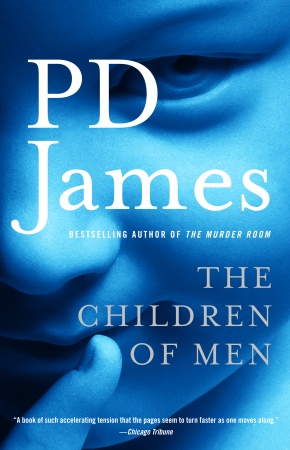
The Children of Men by PD James

Alfonso Cuaron's film Children of Men, a loose adaptation of this novel, is a great piece of art: smartly written, perfectly acted, and very suspenseful. I hadn't heard of the novel before the release of the film, so I was hoping that by reading it some of the few plot holes of the movie might be explained better in the book. Not so, though--not only is the film so loosely adapted from the novel that it fails to help explain anything, by my measurement the book fails to measure up to the film.

Here's a short synopsis for those who haven't seen the film: In the near future, all of humanity has become infertile and there have been no children born for twenty-five years, and the world is coming to grips with humanity's upcoming extinction. Theo Faron, an Oxford professor of English, is approached by a would-be revolutionary group to help them gain an audience with his cousin, the Warden (Dictator) of England. Also, one of the revolutionaries is pregnant (though in the film it is a young black girl, in the novel it is the character played in the film by Julianne Moore, with whom Faron also falls in love).

Unlike the film, which has the gritty feeling of being just a short time in the future, the novel has a strange, backward-looking Victorian feel, in both style and subject. That would be all well and good if the whole thing were written from the first person perspective of the main character, Theo, whose background is in Victorian literature, but only half of the book is written as a diary; the other half as a straightforward narrative. And yet, the styles are regrettably identical. The first half of the book is numbingly slow, focusing mostly on Theo's loneliness and regret as he looks back on his own life and toward the extinction of the human race; the second half is a clumsily constructed suspense story in which Theo helps the revolutionaries escape, but where to and why are never clear (the film has this problem too, a little bit, but it's more crippling in the novel). The novel lacks also the best part of the film, the final chapter in which Theo has to help the pregnant character get to a boat off the shore of the vicious Isle of Man penal colony, during which time her baby is born. The love story between Theo and pregnant Julian (in the film, Theo and Julian are ex-husband and -wife) makes no sense, and all of the characters other than Theo are pretty thinly constructed.

This isn't a bad book, but I was really disappointed in it after seeing the film. I wonder if part of that has to do with having seen the film first, since the few films I've felt were better than the novels they were based on--namely, High Fidelity and Midnight in the Garden of Good and Evil--I saw before I read the novel, too. Who knows how much of an effect that has.