Showing posts with label jack nicholson. Show all posts

Monday, March 23, 2009

Ironweed by William Kennedy

That scab was the first man Francis Phelan ever killed. His name was Harold Allen and he was a single man from Worcester, Massachussetts, a member of the IOOF, of Scotch-Irish stock, twenty-nine years old, two years of college, veteran of the Spanish-American War who had seen no combat, an itinerant house painter who found work in Albany as a strikebreaker and who was now sitting across the aisle of the bus from Francis, dressed in a long black coat and a motorman's cap.

Why did you kill me? was the question Harold Allen's eyes put to Francis.

Ironweed
is a prime example of the letdown of strong memories; some books you think of very highly at one point in your life only to find upon re-reading them that, though still good, they don't live up to the way you remember them.

Francis Phelan is an ex-ballplayer, an ex-father, and an ex-husband, but he is currently a bum. He has returned to the Albany his youth with his bum ladyfriend Helen, to do bum things like taking small jobs and drinking and sleeping in old ruined cars and drinking. This is the time of the Great Depression, and Phelan's condition is unexceptional; he lives in a subterranean bum culture where he knows everyone and is known by everyone. Francis has no illusions about the cause of his poverty: He is his own downfall. But he is also the downfall of others, and on this pair of days in Albany--Halloween and All Saints' Day--he finds himself being followed by those whose death he has caused in his life. None of these murders is indefensible--the killing of the scab was (mostly) unintentional; another bum he killed when attacked; a horse thief he simply failed to pull onto a moving train-car before he was shot in the back. And yet they are attached to Francis in death nonetheless.

The most significant of these is his son Gerald, whom he dropped as an infant, a crime for which Francis has not forgiven himself and which caused him to leave home. Gerald does not follow Francis around, but they "meet" in the beginning of the book, when Francis visits the graveyard:

In his grave, a cruciformed circle, Gerald watched the advent of his father and considered what action might be appropriate to their meeting. Should he absolve the man of all guilt, not for the dropping, for that was accidental, but for the abandonment of the family, for craven flight when the steadfast virtues were called for? Gerald's grave trembled with superb possibility. Denied speech in life, having died with only monosyllabic goos and gaahs in his vocabulary, Gerald possessed the gift of tongues in death...

Gerald, through an act of silent will, imposed on his father the pressing obligation to perform his final acts of expiation for abandoning the family. You will not know, the child silently said, what these acts are until you have performed them all. And after you performed them you will not understand that they were expiatory any more than you have understood all the other expiation that has kept you in such prolonged humiliation. Then, when these final acts are complete, you will stop trying to die because of me.


Perhaps Francis sees his life as a slow death, inching aimlessly toward the grave that others keep falling into. But perhaps it is through the bum's life--the sickness, the hunger, the decreptitude--that Francis is unconsciously repaying the immensity of his sins. Late in the book Francis revisits the house of his estranged wife, and looks on as the collected souls he has killed build a set of bleachers in the yard. Though Francis' steps toward rehabilitation are small and they seem to come without premeditation, we are invited to see them as a grand finale in which wrongs finally become righted. There is a strong undercurrent of Catholicism in Ironweed, and this is a particularly Catholic idea: To be of a bum is to wear a hairshirt for decades; forty years of saying "hail-mary."

Bits like the ones I quoted above keep the novel interesting, but they are ponderous and Ironweed never seems to come up for air. Even in Francis' rehabilitation the sense of loss is crushing, and Kennedy's slow, genealogically detailed style makes it sometimes a difficult slog. One exception is a long chapter in which we follow Helen, who has left Francis to fend for himself, as she does what bums do all day: wander and scrounge for food. Without the troop of the dead following the narrative, it becomes lighter and more fluid, and perhaps Helen is just more genuinely likeable than Francis. And I think perhaps the conceit of the dead physically following a man around is too doggedly literal; Kennedy shows Francis his ghosts to remind him that they are there, but they are given awfully little to do and too often seem untethered to present events.

Thinking back on the book now, after having put it down for about a week, perhaps my initial thoughts were unfair: Ironweed has a lot to think about, probably more for me now than it did in high school. And yet, I don't think I'll be picking it up a third time.

Friday, July 20, 2007

One Flew Over the Cuckoo's Nest by Ken Kesey

Warning: this review contains some mild spoilers.

I am by no means a fast reader, but even so this book took me much longer to read than it should have. I don't know exactly why this was the case. It wasn't like I was slogging through it. On the contrary, I thoroughly enjoyed it.

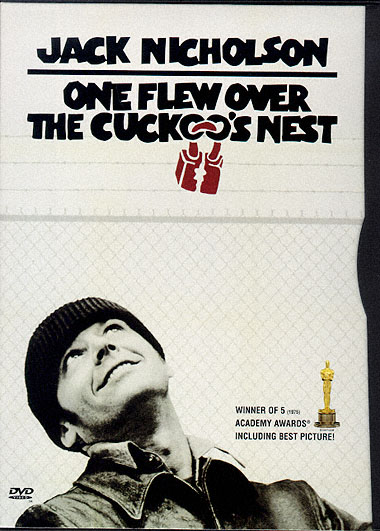
Most people know the basic story of this book because they have seen the film, which is a pretty good adaptation. The basic story is that a ne'er-do-well convict gets himself admitted to a psychiatric hospital, seemingly to get out of work duty. McMurphy is obviously different than the rest of the men on the floor, who are split in to two groups: the acutes and the chronics. The acutes are men that the hospital is trying to rehabilitate. They are generally functional human beings with a few "defects". The chronics are those that will no doubt live out the rest of their days on the ward. They are considered beyond help. What makes the book especially interesting -- and sets it apart from the movie -- is that the story is told from the perspective of one of the chronics, Chief Bromden, a Native American whose hulking size belies his diminutive personality. At the beginning of the book Bromden tells the reader:
"I been silent so long now it's gonna roar out of me like floodwaters and you think the guy telling this is ranting and raving my God; you think this is too horrible to have really happened, this is too awful to be the truth! It's still hard for me to have a clear mind thinking on it. But it's the truth even if it didn't happen."
This sets the story up quite nicely, for what follows is truly a mixture of reality and the slightly-skewed reality that Bromden sees around him, as he recounts the battle that ensues between McMurphy and the Big Nurse, Ms. Ratched.

It has been a while since I have seen the movie, but what I remember of it syncs up rather well with the book. I don't think anyone other than Nicholson could have played Randle Patrick McMurphy the right way. The character was perfect for him. However, the humor was already there in the character. The macho posturing, the quick wit, and the overall demeanor of McMurphy were carefully-crafted creations of Kesey (how's that for alliteration). Other than the Nicholson-McMurphy connection, the film was not instrumental in the mental pictures that I created while reading the book. Kesey writes well and his sparse, yet somehow still vivid, descriptions trumped the film in my mind's eye. One night as Bromden is telling McMurphy about his dad, he says:
"And the last I see him he's blind in the cedars from drinking and every time I see him put the bottle to his mouth he don't suck out of it, it sucks out of him until he's shrunk so wrinkled and yellow even the dogs don't know him, and we had to cart him out of the cedars, in a pickup, to a place in Portland, to die."
While on a trip outside of the hospital, Bromden describes the landscape around him: "Out along the dim six-o'clock street, I saw leafless trees standing, striking the sidewalk there like wooden lightning, concrete split apart where they hit, all in a fenced-in ring."

The writing is excellent, and the characters are full of life. There is good reason that this book is considered a classic.

_______________________________

Check out Christopher's review of this book.

Thursday, March 29, 2007

One Flew Over the Cuckoo's Nest by Ken Kesey

I love this book. I'd say that it's tied with Watership Down for the best book I've read so far this year.

You may be familiar with the story from the movie: R.P. McMurphy, a gregarious and "cagey" rascal, gets himself transferred to a sanitarium to escape a relatively short prison sentence. At the sanitarium, his outgoing personality clashes with that of Miss Ratched, the sadistic and fascist head nurse who runs the place with an iron fist. In the movie, McMurphy is the main character; the book is narrated by Chief Bromden, a massive Native American who pretends to be deaf and dumb, hanging out with the "Chronic," unfixable patients instead of the "Acute" fixable ones. Reportedly Kesey refused to see the movie because it wasn't narrated by Bromden, and one can see why: Bromden is pretty central to the book. He believes that a shadowy force called "The Combine" is slowly mechanizing all human beings, causing them to conform and think the same way. When the Combine can't mechanize someone, they go to the sanitarium, where more drastic measures are taken.

One of the central ideas of the book is that sanity is a false idea promoted by society to remove undesirable elements. This may seem silly, but the patients in this sanitarium, all based on people Kesey knew when he worked in a similar facility, include a "latent homosexual" and a stutterer whose only problem is that his mother has kept in an eternal childhood. The latter character, Billy Bibbitt, becomes the best example of Nurse Ratched's cruelty: as a friend of Billy's mother, she is able to control him utterly by insinuating that every time he tries to stand up for himself that she'll tell his mother about his insubordination.

The whole thing is told in spooky, surreal prose. The Chief repeatedly suggests that not everything in the book is real--and of course everything can't be, because there are some very odd depictions of life in the sanitarium that seem like they're taken from Dali paintings--but the presence of McMurphy, who is a racist and a sexist and a jerk but stands up for the patients against the tyranny of Nurse Ratched, brings a growing clarity that helps the Chief finally become a speaking member of the sanitarium's "society." This is one of those books that manages to be beautiful and horrible at the same time, and I love it.

Now I just have to see the movie.