Showing posts with label ken kesey. Show all posts

Friday, September 4, 2026

Sometimes a Great Notion by Ken Kesey

Not when it was so goddam evident, so right-before-your-eyes obvious, that in Wakonda, that year, the town's worries and woes were being caused by nobody else but that goddam hardnose up the river! And rain is one thing and, fine, maybe you can't do nothing about the weather except yak about it, but Hank Stamper is a different breed of cat from the rain! And you can maybe put the blame on the Arm of the Lord those years when that arm puts a stranglehold of frost on the woods so tight it freezes all the way to your pay envelope, and maybe you can roll with the blow of the wind if there's nothing else except the wind blowing... but when the arm is the arm of Hank Stamper strangling off your income, and you know damn well that the blow is being dealt by the fist on that arm, then you find yourself having a pretty hard time blaming your woes on anything other than that arm!

Ken Kesey's Sometimes a Great Notion is set in the fictional town of Wakonda (lol), Oregon, where a strike has brought the lumber industry to a standstill, except for one family: the Stampers, who make a private contract with the local lumber company to continue felling trees. (These small non-union outfits not associated with sawmills were called gyppo loggers, and in the real world they were as hated by their union counterparts as the Stampers are in Kesey's novel.) Hank Stamper, the oldest son of grizzled patriarch Henry, is just the kind of guy to make such a contract, not selfish, really, but stubborn, and insensate to what other people might think about him. But Hank needs labor, and few of the locals are willing to scab for the man they see as taking money out of their pocket. Lucky, then, is the return of Hank's half-brother Lee from school in the East. Lee and Hank have a complicated history: Hank may have been sexually involved with Lee's mother, who has recently committed suicide, and Lee has always felt in Hank's shadow. His return to Wakonda is a chance to either prove himself or defeat his brother--in his neurotic state he vacillates between these goals--both of which might mean making off with Hank's wife Viv, whose intelligence and sensitivity are wasted in that remote ramshackle house on the Wakonda River.

Sometimes a Great Notion is a one hell of a tome. Not only is it 700+ pages, it's stylistically frenetic, most notably in its habit of switching from third to first person without warning. Often I found myself reading whole paragraphs before realizing I'd been dropped into the first person, then having to go back and figure out whose head exactly I'd been dropped into. In moments of high physical or mental intensity, Kesey will even switch rapidly back and forth between, say, Hank and Lee within the same paragraph, often with liberal, but not perhaps clarifying, use of italics and parentheses. It's a big, beautiful mess, and in my opinion it tries to do too much. But it's clear that Kesey is trying, and often succeeding, to capture several levels of human experience, from the larger communal life of the logging town to the inner turmoil of the individual psyche. The ramshackle house, with its precarious add-ons supported by innumerable timbers and pillars to keep it from sinking into the river, is a symbol of the precariousness of the Stamper family, besieged both from without--as with the locals angry with their lumber contract--and within--by the inflexibility of Hank and the psychosexual vengeance of Lee.

Sometimes I felt like the boat needed to cross the river and reach the Stamper place, bobbing up and down on uncertain waters. But when the narrative finds moments of pathos and intensity, it's really something, as when [spoiler alert] one of the Stampers' most loyal associates is pinned by a log against the bank of the rising river, certain to drown before the heavy log can be lifted. The characters here are at the mercy of happenstance, including the torrential rains and natural remoteness of the coastal Oregon landscape, but even moreso they are the mercy of themselves, their stubbornness, their desires, their inability to see and speak to each other. As the passage above suggests, it may be the Stampers themselves who most resemble the weather, implacable, insensible, and unstoppable, even by themselves. 

Friday, July 20, 2007

One Flew Over the Cuckoo's Nest by Ken Kesey

Warning: this review contains some mild spoilers.

I am by no means a fast reader, but even so this book took me much longer to read than it should have. I don't know exactly why this was the case. It wasn't like I was slogging through it. On the contrary, I thoroughly enjoyed it.

Most people know the basic story of this book because they have seen the film, which is a pretty good adaptation. The basic story is that a ne'er-do-well convict gets himself admitted to a psychiatric hospital, seemingly to get out of work duty. McMurphy is obviously different than the rest of the men on the floor, who are split in to two groups: the acutes and the chronics. The acutes are men that the hospital is trying to rehabilitate. They are generally functional human beings with a few "defects". The chronics are those that will no doubt live out the rest of their days on the ward. They are considered beyond help. What makes the book especially interesting -- and sets it apart from the movie -- is that the story is told from the perspective of one of the chronics, Chief Bromden, a Native American whose hulking size belies his diminutive personality. At the beginning of the book Bromden tells the reader:
"I been silent so long now it's gonna roar out of me like floodwaters and you think the guy telling this is ranting and raving my God; you think this is too horrible to have really happened, this is too awful to be the truth! It's still hard for me to have a clear mind thinking on it. But it's the truth even if it didn't happen."
This sets the story up quite nicely, for what follows is truly a mixture of reality and the slightly-skewed reality that Bromden sees around him, as he recounts the battle that ensues between McMurphy and the Big Nurse, Ms. Ratched.

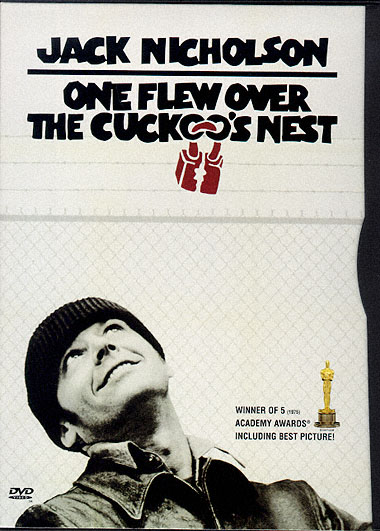
It has been a while since I have seen the movie, but what I remember of it syncs up rather well with the book. I don't think anyone other than Nicholson could have played Randle Patrick McMurphy the right way. The character was perfect for him. However, the humor was already there in the character. The macho posturing, the quick wit, and the overall demeanor of McMurphy were carefully-crafted creations of Kesey (how's that for alliteration). Other than the Nicholson-McMurphy connection, the film was not instrumental in the mental pictures that I created while reading the book. Kesey writes well and his sparse, yet somehow still vivid, descriptions trumped the film in my mind's eye. One night as Bromden is telling McMurphy about his dad, he says:
"And the last I see him he's blind in the cedars from drinking and every time I see him put the bottle to his mouth he don't suck out of it, it sucks out of him until he's shrunk so wrinkled and yellow even the dogs don't know him, and we had to cart him out of the cedars, in a pickup, to a place in Portland, to die."
While on a trip outside of the hospital, Bromden describes the landscape around him: "Out along the dim six-o'clock street, I saw leafless trees standing, striking the sidewalk there like wooden lightning, concrete split apart where they hit, all in a fenced-in ring."

The writing is excellent, and the characters are full of life. There is good reason that this book is considered a classic.

_______________________________

Check out Christopher's review of this book.

Thursday, March 29, 2007

One Flew Over the Cuckoo's Nest by Ken Kesey

I love this book. I'd say that it's tied with Watership Down for the best book I've read so far this year.

You may be familiar with the story from the movie: R.P. McMurphy, a gregarious and "cagey" rascal, gets himself transferred to a sanitarium to escape a relatively short prison sentence. At the sanitarium, his outgoing personality clashes with that of Miss Ratched, the sadistic and fascist head nurse who runs the place with an iron fist. In the movie, McMurphy is the main character; the book is narrated by Chief Bromden, a massive Native American who pretends to be deaf and dumb, hanging out with the "Chronic," unfixable patients instead of the "Acute" fixable ones. Reportedly Kesey refused to see the movie because it wasn't narrated by Bromden, and one can see why: Bromden is pretty central to the book. He believes that a shadowy force called "The Combine" is slowly mechanizing all human beings, causing them to conform and think the same way. When the Combine can't mechanize someone, they go to the sanitarium, where more drastic measures are taken.

One of the central ideas of the book is that sanity is a false idea promoted by society to remove undesirable elements. This may seem silly, but the patients in this sanitarium, all based on people Kesey knew when he worked in a similar facility, include a "latent homosexual" and a stutterer whose only problem is that his mother has kept in an eternal childhood. The latter character, Billy Bibbitt, becomes the best example of Nurse Ratched's cruelty: as a friend of Billy's mother, she is able to control him utterly by insinuating that every time he tries to stand up for himself that she'll tell his mother about his insubordination.

The whole thing is told in spooky, surreal prose. The Chief repeatedly suggests that not everything in the book is real--and of course everything can't be, because there are some very odd depictions of life in the sanitarium that seem like they're taken from Dali paintings--but the presence of McMurphy, who is a racist and a sexist and a jerk but stands up for the patients against the tyranny of Nurse Ratched, brings a growing clarity that helps the Chief finally become a speaking member of the sanitarium's "society." This is one of those books that manages to be beautiful and horrible at the same time, and I love it.

Now I just have to see the movie.