Wednesday, July 30, 2008

The Good German by Joseph Kanon

I wrote a couple paragraphs, summarizing this book, but scrapped them when I realized that they made The German Sound sound interesting. This is the first book that I have read this year that I truly disliked. It was such a waste of my time. Kanon relied much too heavily on sub-par dialogue to progress the plot. His characters were either stiff or incredibly clichéd...some managed to be both.

When I was about halfway through I realized that I didn't care at all what happened in the rest of the book. I just wanted it to be over. When I finally did get to the ending, it was extremely predictable and boring. There is no reason that you should ever read this book. And I heard the movie based on the book was also awful.

Tuesday, July 29, 2008

Barrel Fever by David Sedaris

I have had a few people tell me that of Sedaris' books, this is their least favorite. Some described it as "not nearly as good as his other books," or stated that it "mostly sucks." That is very likely the reason that I waited so long to read it. After completing Barrel Fever, I can now say two things: 1.) I have read all of Sedaris' books, and 2.) the people who told me that this book was not good were just wrong.

Barrel Fever is split up into two parts. Short stories make up the first section, which is about three fourths of the book. The last fourth is essays, what have now become the standard fair of Sedaris. While the essays were good, I particularly enjoyed the short stories, especially "Glen's Homophobia Newletter Vol. 3, No. 2," "Don's Story," and "Season's Greetings to Our Friends and Family!!!"

Published in 1994, Barrel Fever was Sedaris' first book. Naked was the follow-up, and it contained no short stories. Since these stories were obviously completely fictional, they allowed Sedaris to create some interesting characters and situations that he isn't normally able to deal with. I would be interested in why he stopped including short stories in his books.

Barrel Fever did not disappoint in the slightest.

Friday, July 25, 2008

The Mission Song by John le Carré

I wasn't going to count this book because I didn't actually read it. I listened to part of it while driving home from New Orleans, and the rest while driving home from Atlanta. But Brent made a convincing argument for my counting it.

I must confess that the name John le Carré meant nothing to me prior to this book. I have since been informed that he was written quite a few well-known spy novels, such as The Spy Who Came in from the Cold, The Constant Gardener, The Tailor of Panama, and Tinker, Tailor, Soldier, Spy.

The Mission Song is told in first person past tense, by Bruno Salvo, a top-class interpreter who works for the British Secret Service. Born in the Congo, he now resides in London and is married -- although not happily -- to a prominent tabloid journalist. As the son of an Irish Catholic priest and a Congolese woman, Salvo is somewhat of an outcast. He knows many Congolese languages, as well as French and Enlgish., making him a valuable asset to the secret service.

The story that Salvo recounts is one of political machinations. An unknown entity -- it is hinted that it is some American corporation -- has arranged talks between the various ethnic groups within the Democratic Republic of the Congo, with the stated purpose of brokering peace that would be economically beneficial to all involved parties. But as the summit progresses, Salvo begins to suspect that instead of peace, the goal is really to spark a civil war in the Congo. He realizes that he must do what he can to stop this from happening.

I don't particularly like audiobooks. I think the medium only works well in a small number of cases. Books of essays, such as the works of David Sedaris or Sarah Vowell, work well. Memoirs too. However, the novels that I have listened to have lost something in the translation. John le Carré is a good writer, but I found it harder to appreciate his writing when it was read to me. I plan on actually reading one of his other books.

Thursday, July 24, 2008

The Every Boy by Dana Adam Shapiro

"For his fifth birthday Henry got two presents that would come to shape his soul. From Dad, a bean-stuffed cow that went moo when squeezed. Henry called it Moo. From Mom he got an inner voice, a grand and booming yes man for each of his stooped shoulders. Gift-wrapped in silver, Great Ovations was a forty-five-minute record filled with nothing but applause from "major moments" of the twentieth century. There was no context for the claps—it could have been a Puccini encore, Willie Mays on the fly in center field, hails for the Führer in Berlin. What difference did it make? The message never muddled, and while Dad thought it was coddling and hollow and bad for a growing boy’s spine, Henry fell asleep to it every night for three years. He even carried a dubbed cassette in his knapsack just in case he needed exaltation on the go."


I'm sorry for being MIA. After not being able to sit through more than twenty pages of the last several books I tried to read (John Crow's Devil, The Edible Woman, While I Was Gone, ect.) I finally found one that grabbed me.

Our main character, Henry Every, is dead. Left behind is his ledger, all entries color coded by category for their subject matter. He’s fifteen, spunkier than even the Holdens of the literary world could hope to be, and maybe a little crazy. Mostly endearing, though, I’d say. Since he grew up listening to the Great Ovations tape during all of his minor moments of triumph it's no wonder that he brings so much drama and self reflection to the plate. We’re guided through the story by Henry’s father Harlan, a man plagued by loneliness with a strange affinity for jellyfish who is both trying to cope with the death of his son and smooth out some major character flaws.

I think what resonated with me the most is how Henry captured the way one experiences being in a constant state of observation with others and the world but not being able to really connect with those people/things that one is observing. Henry articulated those feelings of detachment and longing in a way that seemed very real and very wise for a boy so young. It seems that no matter where he is, he feels displaced. Who doesn’t feel that way at fifteen? Who doesn’t sometimes feel that way now? While I was mostly drawn to Henry's story as he was much more likeable than Harlan, I got rather tangled up in the subplot with what happened with his parents, as well.

I don’t want to give anything away because I think that you should read it yourself. However, I will say this... It has Santeria, teenage death, breaking and entering, a Bulimic dad, family secrets, a girl with one hand, young love, an adventure to New York, and some pretty crazy schemes. Also, Amy Sedaris was a fan, and if you won’t take my word for it you’ll probably take hers. Right? (Speaking of which, I need to to write up I Like You: Hospitality Under The Influence, but I'm not sure her kind of cookbook/rambling counts.)

The author is the filmmaker responsible for bringing us Murderball. He’s currently working on a film adaptation of The Every Boy due out two years from now.

Monday, July 21, 2008

Identify the Book

"So, you boys want to help me on another case?" Fenton Hardy, internationally known detective, smiled at his teenage sons.

"Dad, you said you're working on a very mysterious case right now," Frank spoke up. "Isn't there some angle of it that Joe and I could tackle?"

Sunday, July 20, 2008

The A.B.C. Murders by Agatha Christie

The A.B.C Murders was recommended to me by a friend, and it did not disappoint. It was my introduction to Hercule Poirot. For some reason it took me a very long time to get through this relatively short novel. I don't think that is a reflection on the book as much as it a reflection on my mental state at the time. I hit a little bit of a reading lull for a week or two. I think I am through it now. But please keep me in your thoughts.

Saturday, July 19, 2008

Pale Fire by Vladimir Nabokov

When I read Nabokov's books, I can't help but feel that the whole thing is a big joke somehow and I'm at the butt of it. I said that to someone the other day and they sort of twisted up their face like the thought of reading such a book was disgusting, but I don't really mean it in a bad way; in fact, to the contrary, I love the way Nabokov plays games with his reader's minds.

Pale Fire might be, at its heart, a colossal bait-and-switch, but that doesn't make it any less awesome: The heart of the book is a 999-pp. poem supposedly written by one John Shade, poet and professor at Wordsmith College in a town called New Wye. The commentary, which takes up the bulk of the book, is by his friend and colleague Charles Kinbote, who, instead of providing any meaningful commentary on the poem (which is a solid but unspectacular autobiographical treatise focusing on death and loss), finds any slight excuse to go off on tangents about the story of exiled Zemblan king Charles Xavier, a story which he claims provided the inspiration for the poem. King Charles Xavier, we come to understand quite quicky, is actually Kinbote, and the recent death of John Shade has occurred at the hands of the king's would-be assassin.

Schools of thought have cropped up about the novel; Shadeans believe that Kinbote is a creation of Shade, and Kinboteans vice versa. Some believe that the whole thing is made up by a minor character in the book, a Professor Botkin (whose name anagrams nearly to Kinbote), a theory that Nabokov himself has supported. But of course, this is the bait and the switch: Shade and Kinbote aren't creations of each other; they're fictitious--they are creations of Nabokov. The whole argument is the perpetuation of Nabokov's joke, because at no meaningful level can one claim that either character is more "real" than the other.

Pale Fire has been called Nabokov's masterpiece. While it certainly provided some excellent mental calisthenics, it's hard to speak of it in the same breath as Lolita when it lacks so much of that book's haunting beauty. There's a lot of depth in Shade's work and in his depiction as a character in the commentary, but--true to the book's central questions concerning surface realities--it is difficult to extricate Shade's wisdom from the kind of academic pretension that pervades his relationship with Kinbote. Pale Fire may be one of a kind, but Lolita is the better book.

Thursday, July 3, 2008

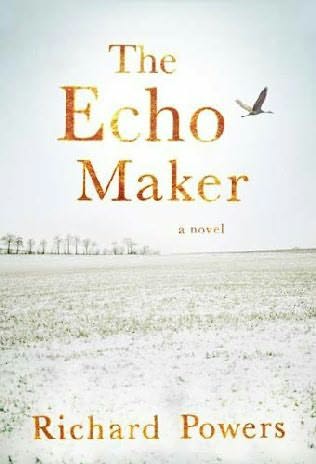
The Echo Maker by Richard Powers

There are some truly remarkable things about Richard Powers' The Echo Maker, a novel about a young Nebraska man named Mark Schluter who is in a horrible car crash and develops a rare psychological condition known as Capgras syndrome, which causes him to believe his sister has been replaced by a high-quality duplicate. Upon this background Powers has free license to wonder aloud about the nature of the self, its messiness, its unity, its mere existence. And his description of the Nebraska marsh even makes it seem mildly pleasant.

But there's a lot of flaws to The Echo Maker I simply couldn't get over: It's long, ponderous beginning, Mark's clumsy blue-collar gratingness, the completely unsatisfying solution to the big mysteries that surround Mark's accident. The Echo Maker seems much better in concept than solution, and while it has a heap of interesting things to say, Powers' attempts at spicing up the plot with intrigue fall surprisingly flat.

Tuesday, June 24, 2008

A Dog Among Diplomats by J. F. Englert

Randolph and his owner (Harry) become embroiled in an international plot that involves Imogen, Randolph's real owner, and Harry's missing fiance. The story is told from the perspective of Randolph, which adds to the novel's charm. J. F. Englert has a good grasp on canine behavior. His weird little insights into doggy world are enjoyable. Englert is also a good writer with a good sense of humor. Also, this book has a chapter titled, "Liverwurst Is Discovered to Be a Glorious Food."

Read my review of A Dog about Town, to which this book is a sequel if you want to find out more about the characters and the overarching storyline. I enjoyed the first book a lot. This one was just okay. The plot was a little sloppy at points. But it was still an enjoyable read.

I have been trying to come up with alliterative ways to describe Randolph, a murder-solving black Labrador. All I could come up with is:
Doggy Detective
Murder-solving Mutt (although he is not technically a mutt)
Querying Quadruped

Sunday, June 22, 2008

The New York Trilogy by Paul Auster

The garish cover of the recent Penguin Classics edition of Paul Auster's New York Trilogy, drawn by comics veteran Art Spiegel, harkens back to the pulps of the mid-20th century, the ones in which dames are always popping into the darkened offices of private eyes, and the detectives themselves are boiled as hard as anyone can be boiled. And indeed The New York Trilogy is a trio of detective stories in a way, as tightly written as a Raymond Chandler novel, but the searches that occupy the protagonists of these three novellas are circuitous, without solution, circling back on themselves until the possibility of solution has disappeared and the search is all that is left.

The first of these, City of Glass, opens with Quinn, a part-time writer who gets a call for Paul Auster (that's the author's name!), a private eye, begging him to take a case. Eventually, Quinn takes the case despite the case of mistaken identity. His client, Peter Stillman, who gives a long speech that sounds something like the word salad of a schizophrenic, hires Quinn to track down his father, who has just been released from prison and who Stillman thinks is going to try to kill him. The crime for which he was convicted? Locking Peter in a room for nine years as a child in an attempt to discover in isolation man's natural language, the language of God, which will reverse the curse of the Tower of Babel and present the key to understanding all. Here is a passage from City of Glass, where Stillman's father is speaking to Quinn:

"My work is very simple. I have come to New York because it is the most forlorn of places, the most abject. The brokenness is everywhere, the disarray is universal. You have only to open your eyes to see it. The broken people, the broken things, the broken thoughts. The whole city is a junk heap. It suits my purpose admirably. I find the streets an endless source of material, an inexhaustible storehouse of shattered things. Each day I g o out with my bag and collect objects that seem worthy of investigation. My samples now number in the hundreds--from the chipped to the smashed, from the dented to the squashed, from the pulverized to the putrid."

"What do you do with these things?"

"I give them names."


If there is an overarching theme to The New York Trilogy, it is the insufficiency of words to describe the world. Stillman's father combs the streets looking for broken things because he claims that our language is insufficient to describe what happens to an object when it is destroyed beyond use; is an umbrella with no cloth between the spokes still an umbrella? I do not know if Auster is aware of this, but there are cultures all around the world who think in exactly this manner. When this sort of thinking is applied to the detective novel, we come to understand that there is no way for a detective to find what he is looking for if he hasn't the words to describe it. All three of the protagonists in this book are following someone, and they all keep copious notes, but in the end, what good comes from writing it down? Truth remains elusive.

The second and third novellas play like a variation on a theme. Ghosts follows a man named Blue hired by a man named White to watch a man named Black--and all the peripheral characters on down the line are named after colors. This is a wink from Auster, a clue that we are not reading fact but fiction, and that he can create as he sees fit. The suggestion here is that a detective's work is as much to create as it is to discover. In a complicated bit of self-reflexivity, we begin to wonder who is watching whom--and for that matter, who is who. But Ghosts, for the most part, treads too nearly to the same ground as City of Glass while lacking the human connection that Quinn provides.

Much better is the final novella, The Locked Room, a name that mystery enthusiasts will immediately recognize as a type of book or story in which the detective must figure out how a crime was perpetrated in a room that usually would be impossible to enter. But again Auster subverts our expectations; the novella does not begin with a locked room but ends with it; it does not ask how one gets in to the locked room but how to get another man out. (And of course, it must be noted that by ending in a locked room, we have come full circle from the mad experiments of Stillman's father in City of Glass).

In the room is a man named Fanshawe, a brilliant man who disappears and burdens his wife with the task of contacting his childhood friend, the narrator, to read his unpublished novels and judge whether or not they are worthy of publication. The books become a minor hit among critics, but the presence of Fanshawe in the narrator's life begins to complicate his new marriage to Fanshawe's wife. Under the guise of writing a biography, the narrator sets out to find Fanshawe and perhaps take him out of the equation permanently.

Like all the protagonists of The New York Trilogy, he becomes obsessed to the point where the search is all that he can focus on, and it brings him near the brink of destruction. In Auster's world, the detective is forever being forced into a double-bind: by the very nature of knowledge he cannot find what he is looking for, but he cannot simply quit the search. Like Stillman's father picking garbage off of New York streets, we are forced to wonder if you can call a detective who has no ability to detect a detective at all.