Monday, April 30, 2007

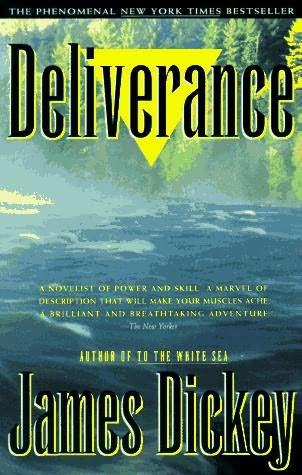
Deliverance by James Dickey

This book is completely terrifying. Many are probably familiar with it from the film version: A quartet of suburbian clock-punchers go on an impulsive canoing trip down a secluded north Georgia river, and along the way two are molested by a pair of rednecks. This horrible act causes a struggle for vengeance and survival that the survivors (I won't say how many) carry with them for the rest of their lives.

The movie is well known--though, sadly, it has become a one-word joke about sodomy in our popular culture--but you may not be aware that the book is equally highly regarded, appearing on Time's 100 Greatest Books Since 1923 list. The author, James Dickey, was best known as a poet before the publication of Deliverance, and accordingly he gives the book a sense of hideous wonder, preventing it from becoming the plain sort of thriller the topic might suggest.

Deliverance is a book about primitivism, the way it remains in us like a reservoir waiting to be tapped. At the end of the book, the dead lie at the bottom of the river which is about to be dammed into a lake, suggesting that the primitive part of all of us that remains from our ancestors lies dormant beneath what society makes out of us. What it brings out in Ed Gentry, the main character, is both amazing and awful: the power to survive as well as the power to kill. Perhaps the most frightening part occurs when Ed waits in a tree with a bow and arrow for one of the molestors, who plans on returning and shooting the suburbanites, and forces his mind and the molestor's to merge so that he might anticipate where and when he will return. Ed is forced to recognize that what the rednecks do to them, their violence and perversion, is not something that they possess alone but something that dwells within himself, and is necessary to survive in this backwoods Southern jungle.

This brings my total from the Times List to 22. I'd like to read them all, but I don't think I could sit through Infinite Jest.

Tuesday, April 24, 2007

The Time Traveler's Wife by Audrey Niffenegger

Why is love intensified by absence? Long ago, men went to sea, and women waited for them, standing on the edge of the water, scanning the horizon for the tiny ship. Now I wait for Henry.

This is easily the best book I’ve read this year, and probably the most moving book I’ve ever read. I couldn’t put it down. It was great.

Henry, the time traveler of the title, has a genetic disorder that causes him to travel through time, mostly his own past, without warning. His episodes can be triggered by stress, illness, surprise, or even standing up too quickly. He finds himself whenever and wherever, completely naked, often vomiting, and occasionally surrounded by very confused strangers. Some of the most interesting parts of the novel were when Henry had to cope with being dropped in different situations that were completely out of his control, often having to seek help from his past or future self. Clare is Henry’s wife, in some, but not all, layers of time that the story follows. The story is almost evenly divided between her narration and Henry’s. She plays Penelope to Henry’s Odysseus, and a lot of her plot is figuring out how to cope with this strange part of their relationship, but she does it gracefully. "Love conquers all," or so I've heard.

As you can probably imagine, a lot of Niffenegger’s plot is very circular. Henry grows up, meets Clare, marries her, then travels back into the past and meets her as a six year-old girl. Clare grows up, recognizes Henry in a library, and asks him out. This is the first time Henry meets Clare. There are all kinds of situations like this one: one of them has almost always experienced the majority of their relationship before the other, past and future. Often times, something very important to their life and the story happens only as a result of Henry accidentally (or intentionally) affecting their past or future. But, and here’s the only place where the book teeters on the frontier of science-fiction land, everything that’s ever happened, or will happen, or is happening, is unchangeable, and on the same plane. Time is viewed as something very parallel. The whole novel is written in the present tense to emphasize this, which I liked very much. You might expect a plot that constantly jumps backwards or forwards in time any number of years or days to be a headache, as I did, but Niffenegger handled it perfectly, and managed to completely avoid any redundancy that probably could have sprung up very easily.

The most beautiful thing about this book is the joy or pain that they share (or that Henry keeps from Clare) at knowing certain inevitable parts of their future, good or bad. The Time Traveler’s Wife raises a lot of questions about how much of our lives are actually in our own hands, and I don’t mind that it doesn’t bother to answer them, or speculate as to whose hands they might be in. That’s not the point. The point is that they fell in love, and they couldn’t help it, and nothing can change it. It’s completely new to see love overcome something like a genetic time travel disorder, but it still feels familiar. Anyone who’s ever fallen in love, or cared deeply for anyone, will be able to understand a lot of what Henry and Clare go through, even if they don’t have a genetic disorder that causes them to instantaneously travel through time and space, completely naked.

Niffenegger, although she has a silly name, wrote a great novel. And I don’t care what you think about love stories; this is a great story no matter what you call it. Read it.

Monday, April 23, 2007

Vernon God Little by DBC Pierre

Jesus Navarro was born with six fingers on each hand, and that wasn't the most different thing about him. It's what took him though, in the very, very end. He didn't expect to die Tuesday; they found him wearing silk panties. Now girls' underwear is a major focus of the investigation, go figure. His ole man says the cops planted them on him. Like, 'Lingirie Squad! Freeze!' I don't fucken think so.

Why do people find Vernon God Little difficult to finish? In an informal survey, the BBC found that more than a third of Britons put this book down before they've finished it. It isn't a particularly dense or boring book, like fellow Booker Prize winner The Line of Beauty, and it's not particularly long, like the second least-finished book, Harry Potter and the Goblet of Fire. Maybe it's because VGL is so distasteful--you see, it's about a school shooting in the small town of Martirio, Texas by an abused Mexican boy named Jesus Navarro. Jesus' best friend in the world is Vernon Gregory Little, a typical white Texan boy who feels trapped by the insanity of small-town living. When Jesus goes on a rampage and ultimately kills himself, the town and the country turn to Vernon, the killer's only friend, as a scapegoat for the murder, trying him as an accessory. But it's a delicate subject that Pierre treats with a sledgehammer.

I planned on reading this book before what happened at Virginia Tech a week ago, but those events pushed it to the front of my reading list. But VGL isn't necessarily about the shooting, which occurs before the action of the novel, but the later reaction, which is dark, hilarious, obscene, scatalogical, and terrifying. It's full of vain, fat proto-American characters who are always coming from or going to the local Bar-B-Chew Barn, overcome by their own idiocy and shallowness. Vernon's mother never really seems convinced of Vernon's innocence, though she tells him tritely while waiting for her new fridge to arrive, "Even murderers have mothers who love them." No wonder Vernon feels he has to escape to Mexico. It is tempting to scorn Pierre, who was born in Australia, lived in Mexico during his youth, and currently lives in Ireland, for satirizing Americans so ruthlessly, but his satire falls embarrassingly near the mark.

It's a punishing read psychologically, but it has a certain poignancy given the media frenzy over the identity of Cho Seung-Hui. The plot of VGL is driven by a similar media frenzy that whips up over Vernon: Every murder that occurs in the state of Texas during the time he's on the run is attributed to him. A power-hungry would-be reporter cashes in on his affair with Vernon's mother and buys the rights to televise his trial--and possibly his execution. Reading it, I couldn't help but think about the decision of NBC to televise the video manifesto made by Cho, and the outpouring of disgust at that over copycat concerns. This book was written four years ago, but it seems even more relevant now, if you can get over its general tastelessness.

Side note: I don't know why I've read so many more Booker Prize books than Pulitzer Prize books. (The Booker Prize is the analogous prize for Britain or former members of the British commonwealth, minus America.) But the Pulitzer Prize was recently awarded to The Road, so it's not like I'm some weird Anglophile or something.

On the Road by Jack Kerouac

Sometimes I think Sal Paradise was right
Boys and girls in America
Have such a sad time together

--The Hold Steady, “Stuck Between Stations”

The way I felt about this book before reading it was pretty similar to the way I felt about Catcher in the Rye: It’s such a hallowed tome for so many people, especially college kids, that I was wary to sit down and read it. I’m suspicious of popular things; that’s who I am. With Catcher in the Rye I was rewarded with a book that exceeded all the expectations I had for it, with On the Road, my expectations were pretty much spot on.

On the Road is a story not about one road trip, but about several—I think there’s roughly four or five, each one corresponding to a different “book.” There’s something amazing and fascinating about it, the way that, in essence, it is a day-by-day account of three formative years in Kerouac’s life, compiled in copious notes and then written down in a “creative explosion” that took only three weeks. It’s hard to tell, but I’d guess that there’s more truth to it than fiction; all the characters in the book are people Kerouac knew. Kerouac himself is narrator Sal Paradise, but the focus of much of the book belongs to Dean Moriarty, the analogue of hipster-king Neal Cassady. It’s the whims of Moriarty, who is a fickle, half-crazed pseudo-intellectual who moves from place to place and wife to wife without thought, that really drive the events of the book. Moriarty is a sort of god-figure to Paradise, who admires his impulsiveness and raw human nature, but throughout the book Paradise has to confront the fact that both Moriarty and their adventures are in some ways failures that cannot possibly live up to Paradise’s hopes for them.

There are some heartbreakingly beautiful scenes in this book; I am particularly fond of the final trip in which Sal and Dean venture to Mexico City and end up lost in a sort of marijuana-fueled haze. However, in between those heartbreakingly beautiful scenes, there is a gross amount of tedium. I suppose that is, after all, real life, but it makes for a really frustrating book. Truman Capote famously dissed Kerouac’s style by saying, “That’s not writing, that’s typing,” but that doesn’t quite pinpoint the huge flaw with this book: Even at only 300 pages it’s a lumbering monster that never much answers the question why we ought to care about the minutia of the life of Sal Paradise and his jackass friend. Whereas Catcher reads so breezily that you could finish it in a matter of hours, reading On the Road can be like trying to wade through pudding.

Sunday, April 22, 2007

Tales from Watership Down by Richard Adams

I read Watership Down a few years ago, and it has quickly become one of my favorites. It's one of those books that you just don't want to end. Apparently Adams didn't want his stories of Hazel, Fiver, and Bigwig to end either. In 1996, over twenty years after the publication of Watership Down, he published Tales from Watership Down.

The book is divided into three sections. The first contains stories about El-ahrairah, which Adams describes as traditional tales that all rabbits would know. The second section is made up of stories told about the journey that El-ahrairah and Rabscuttle took to see the Black Rabbit of Inle. The last section of the book picks up the story with the Watership Down rabbits in the months that followed their defeat of General Groundwort at Efrafa.

The first two sections were a little hit-and-miss for me. There were some stories that I found very entertaining and others that failed to hold my attention. The third section was by far the most satisfying portion of the book. I loved being able to read about all the Watership rabbits once more.

Although Tales from Watership Down came a long time after its predecessor, I wonder if some of the book wasn't simply portions that Adams cut from the original. Most all of the tales from parts one and two could have easily fit into Watership Down. That said, if you enjoyed Watership Down, then you simply cannot pass up this book.

Tuesday, April 17, 2007

The Picture of Dorian Gray by Oscar Wilde

I’ve resolved to read more classic fiction. I’ve always been skeptical of the classics because these were the books that used to bore me in high school English classes (this has nothing to do with the books themselves, and is due entirely to the simple fact I was reading them for said English classes). I got lucky when I found these incredibly cheap ($3.00) Penguin classics; I love the simple binding too: thin paperweight, lime-green covers. I also seem to have this notion that anything written in the 19th century is bound to seem stuffy and outdated today, but Wilde proved me wrong.

Yes, there would be a day when his face would be wrinkled and wizen, his eyes dim and colourless, the grace of his figure broken and deformed. The scarlet would pass away from his lips, and the gold steal from his hair. The life that was to make his soul would mar his body. He would become dreadful, hideous and uncouth.

There were certainly parts of The Picture of Dorian Gray that would appeal more to someone reading it in the late 1800’s, particularly the dinner scenes in the beginning. Oscar Wilde spends a lot of time writing snappy dialogue for his aristocratic characters, the kind whose inheritances permits them to do nothing but sleep late, drink a lot, stay out late, and think of stupid philosophies to try out on one another. Sound familiar? This wasn’t at all what I was expecting. I’d led myself to believe that this book was much more grim and fantastical, but it didn’t keep the frivolous, social atmosphere for more than the first few chapters.

The Picture of Dorian Gray is the story of a young, English noble, Dorian Gray, and his degeneration as a result of his extreme indulgence. Dorian Gray sits for a portrait while Lord Henry Wotton talks to him about his ‘New Hedonism,’ in which one cures the soul with the senses. When Gray sees his finished portrait, he’s struck at the injustice of the way his beauty will one day fade, but the portrait will always be young; in a moment of passion he prays that he could sell his soul if only the painting would bear the weight of all his sins and the affects of aging. Not too long after, Dorian discovers that, for better or worse, his wish was somehow granted. He immerses himself in a vulgar life of self-indulgence (the descriptions of his varying obsessions are particularly interesting: jewels, fabrics, books), participating in acts that are more and more vile. He becomes possessed by his own transgressions, obsessing over the changes he sees wrought in his portrait, both by time and by whatever evil acts he commits. Guided by Lord Henry Wotton, Dorian goes through various stages of regret or bitterness, but slowly and surely destroys himself throughout the book. It’s an amazing thing to follow.

One thing that interested me was something that Chris also pointed out in his review of The Catcher in the Rye: people never change. It’s easy for me to imagine that members of the English high society of the late 19th century never did a thing—that they were disciplined and virtuous and highly religious—but it just isn’t so. They were rich brats, lazy partiers, and pretentious snobs. The Picture of Dorian Gray had a slow start, but was absolutely gripping by the end, and a peaceful, monotonous beginning only serves to punctuate his later decline. Maybe it’s just schadenfreude, but there’s something about watching an honest man become consumed by his own vices that makes for a very good story.

Sunday, April 15, 2007

The Memory Keeper's Daughter by Kim Edwards

I saw this book numerous times on endcaps and special tables at Joseph-Beth, and the snob in me decided that I wouldn't read it. I tend to baulk at things that are popular. It is one of my many personality defects. But the book came highly recommended. So, I read the first chapter at the bookstore and was hooked. I challenge anyone (of the 8 people who regularly view this blog) to read the first chapter and try to put the book down.
The book essentially follows a family from the 60's through the late 80's. I found the structure of the book particularly alluring. The reader gets little snapshots from different areas during this 30-year period. I don't want to give anything away, because there are relatively few twist and turns of plot. Although The Memory Keeper's Daughter had a good plot, the characters are what really drive the book.

As I was reading the book, I got the distinct feeling that the end was going to ruin the story. However, Edwards does an excellent job tying up all the loose ends she created throughout the book, bringing the storylines of the various characters to a satisfying close. This was an excellent first novel.

One Flew Over the Cuckoos Nest by Ken Kesey

After Christopher read this, he told me I would probably like it. Since I had an old copy I hadn't yet read, I decided to give it a go. Chris summarized it well in his earlier review, so I'm going to give only my thoughts about it.

It was quite different from the movie, probably to the extent that a new movie could be made and be almost entirely different.

It's interesting to see how the 60s' mindset of "anything goes" being equivalent to real freedom is portrayed in the changes McMurphy makes to the ward, and also to see the general disdain for authority exhibited throughout (Not that the authority needs any help to be disdainable, since Nurse Ratched is one of the most easily hateable antagonists in recent memory.)

Chief Bromden narrates the book, and his story is easily the poignant.

And, I think that's it for me.

Coincidences, Chaos, and All That Math Jazz by Burger and Starbird

As a certified Mathophobe, it was a little upsetting to me when I came up with an idea for a brilliant, earth-shattering novel based on, what else, mathematical principles. Since I know less about Math than I do about books under 100 pages, I tried to find the simplest primer on complex mathmatics I could. I believe I've succeeded. Most of the concepts in this book were explained in a simple enough way for even me to understand, although, as both Carlton and Chris can attest, not simple enough for me to actually explain.

The book touches on some very interesting topics, such as probability (What do mathematics say about your chances of winning the lottery?), to chaos theory (Can your calculator be trusted?), to the relationship between pineapples and Debussy. There are also chapters on alternate dimensions, and topics such as imaginary numbers are touched upon at points.

Overall, I really enjoyed the book, and one of the topics, the Golden Ratio, is something I'm hoping to study a little more in depth. In a nutshell, this book won't turn you into Steven Hawking, but at least it will make you a little less like Homer Simpson.

Saturday, April 14, 2007

Never Let Me Go by Kazuo Ishiguro

Even I am a bit surprised by the clip I've been moving through books; this is the fifth book I've read this month, which is only half over. I credit this to a.) choosing books that are short or easy to read, and b.) having a lot of dead time recently in the form of plane and car rides, and jury duty. In short, it's a combination of luck, effort, and strategy, none of which describe Brent's efforts to read War and Peace, the poor schmuck.

Kazuo Ishiguro won the Booker Prize for his novel The Remains of the Day, the story of a butler dealing in his old age with the fact that his employer during World War II had been a Nazi sympathizer. Never Let Me Go was shortlisted for the Booker Prize, and appears on the Time list, but it's a completely different kind of book: a science fiction tale about cloning and organ farming.

It follows the lives of three youths, Kathy, Ruth, and Tommy, who are clones who will one day become "donors," which basically means their bodies will be harvested for their organs. Never Let Me Go is short on the details of this process, but it's not the kind of book that's interested in minute scientific details, only broad concepts and the way they affect the minutiae of human life. It is perfect in its scope, realizing that the most genuine way to analyze the social effects of its particular vision of the future is not through sweeping narratives about the history and development of the cloning culture, but through the everyday accounts of three people who wholly inhabit it. At first it is unclear how much the three and their friends, who reside at a private home for future donors, understand about the process, but as the details become clearer there is a surprisingly small amount of resistance to the program. The donors do not protest their lives, which must inevitably end in their 20's or 30's after they have "completed" their organ donations, because they are the only lives to know. It is almost as if it never occurs to them to protest--strange to say, but how true is this in our own lives? The clones live together throughout their adolescence, isolated; they know no other life.

A lesser author might have turned Never Let Me Go into a novel that beats you over the head with the "big picture." But at its heart it is about friendships, crushes, petty arguments, because it is about people and not concepts. The characters only consider questions like "what does it mean to be human?" in the periphery of their minds, as we all tend to do. Because of all this it is all the more powerful when, in the book's final chapters, Kathy and Tommy learn that in truth most outsiders have always reviled the clones and considered them something less than human, because Ishiguro paints his characters with all the creativity, pettiness, and inconsistency that we've come to expect from human beings.