Sunday, February 4, 2024

S. S. Proleterka by Fleur Jaeggy

All the rooms know. Likewise the portraits. Ancestors who do not favor a better lot for their successors. For the children. Perhaps Johannes's twin in his wheelchair went from garden to garden trampling over the fate of Johannes's daughter. Objects and predecessors, names no longer uttered, a genealogy of images was against me. I stand listening to the news, the decision of my departure. Orsola's voice comes from a chair behind the desk. "It is for your own good." "And Johannes?" "Your father will do as we decide." It is for my own good. A venomous expression. But it sounds good. I know that that expression has never boded any good. Since then it has worsened my condition as a minor. You ought to watch your back when listening to diktats of this kind. When you are a hostage to the good. A prisoner to the good. The good of the people. Expressions typical of dictatorships. I leave the house with a suitcase and my schoolbag. I have been consigned to others.

For my own good.

Happy SHORT BOOK FEBRUARY, everyone. I've got all the books in my house that are under 200 pages stacked up, ready to be read in a 29-day frenzy. First up is S. S. Proleterka, a crisp 120-pager from Swisss author Fleur Jaeggy, a book as compact and sharp as "incorruptible crystal," a phrase the narrator uses to describe her heart. Having just received the ashes of her dead father, Johannes, she reminisces about a Mediterranean voyage they once took to Greece among the namesake ship. On this trip, the daughter fails to grow any closer to her aloof, unknowable father. She does get to know, however, at the age of fifteen, several of the ship's mates, who induct her into the world of sexual maturity--at her demand:

Johannes's daughter follows him to the cabin. He tells her to strip. He tells her to do what she does with Nikola. And no nonsense. The daughter thinks that this is part of experience. She strips and does what she does with Nikola. The mate's rough fingers fondle her. Scales. Like Nikola, he is violent. She feels as if drawn by lots. Drawn by lots by the crew. she feels pleasure in the disgust. I don't like it, I don't like it, she thinks. Yet she does it all the same. She no longer has much time. The Proleterka is the locus of experience. By the time the voyage is over, she must know everything. At the end of the voyage, Johannes's daughter will be able to say: never again, not ever. No experience ever again. "I want to go," she says now. The other throws her clothes at her. "Be my guest." He laughs, pointing at the door.

S. S. Proleterka is a book that makes you want to quote it rather than write about it, partially because of Jaeggy's staccato, almost violent, prose, and partially because it is so self-contained and self-possessed that it leaves you unsure of what to say about it. The key word in this passage seems to me to be "knowing": the narrator desires knowledge through experience, and sexual experience specifically, knowledge as in "carnal knowledge." Yet on the deck, she emphasizes over and over again how little she knows of her father, with whom she does not live, and who expresses no feelings whatsoever toward her, though it seems he has asked for her to accompany him on this jaunt. At the end of his life, she puts a nail in his pocket before cremation, hoping that something of hers will be mingled with him at last, but it comes back from the crematory whole alongside his ashes.

Jaeggy's narrator flips back and forth between the first person and third, between "I" and "Johannes's daughter"; her alienation from him is linked to an alienation from herself. (Anyone who's ever tried to play around with point of view in writing might recognize what a skillful thing this is.) She slips between the present tense and the past tense, too, mingling the present with memory in a way that collapses the distinction. She describes herself as haunted by a spectral twin, as Johannes had his own twin, a version of himself confined to a wheelchair. And then, at the end of the novel, a surprise, a swerve: the narrator is contacted by an aging man who insists that he is her biological father. The spectral twin, then, is that man's son, who died as a little boy. It's almost as if, for Jaeggy, learning the truth about oneself means nothing at all, has no impact. The strange man and his wife enter the narrator's life with belated chumminess, and we're not sure what to make of them. The truth, if it is the truth, has the air of falsehood. Who could be the real father of this narrator, so detached and severe, so haunted by the limitations of her own knowledge, than the man in the urn, Johannes?

Saturday, February 3, 2024

Two Books About the Aztecs: Fifth Sun by Camilla Townsend and The Mexican Dream by J. M. G. LeClezio

Many years later, it would become an accepted fact that the indigenous people of Mexico believed Hernando Cortes to be a god, arriving in their land in the year 1519 to satisfy an ancient prophecy. It was understood that Moctezuma, at heart a coward, trembled in his sandals and quickly despaired of victory. He immediately asked to turn his kingdom over to the divine newcomers, and naturally, the Spaniards happily acquiesced. Eventually, this story was repeated so many times, in so many reputable sources, that the whole world came to believe it. Moctezuma was not known for his cheerful disposition. Even he, however, had he known what people would someday say, would certainly have laughed, albeit with some bitterness, for the story was, in fact, preposterous.

The word "advanced," like the word "primitive," is a word that's slung around too often without being questioned. Yet, by any metric, the Aztec civilizations that the Spanish conquerors encountered were the most "advanced" of North American peoples. They planned and lived in great urban cities; they had complex systems of trade and technology; they had spectator sports and libraries. In many ways, they are more recognizable to us as "modern" than, say, the nomadic tribes of the U.S. plains. And yet, they found themselves quickly subdued by a small group of Spaniards. Why? Answers to this question have often relied on the Aztecs' religion. I remember learning in school that the Aztecs believed that the Spaniard and the horse were a single, frightening creature, and that they saw in Cortes the return of the god Quetzacoatl. Camilla Townsend's award-winning history of the Aztecs, Fifth Sun, calls bullshit.

The problem with these accounts, as Townsend describes it, is that they rely too heavily on Spanish language accounts of the conquest. This, despite the fact that several accounts written in the indigenous Nahautl language survive, and present a very different story. Townsend's history--she implies, and I'm ready to believe--is the first account of the Aztecs to prioritize indigenous sources. And what those sources, like several "annals"--basically Aztec accounts of what happened each year--and the history of the Indigenous historian Don Domingo Chimalpahin, tell is a different story. In this story, the Aztecs quickly understood the military superiority of the Spanish, predicated on "the Spaniards' use of metal, and their extraordinary communication apparatus." "What is striking," Townsend writes about the Aztec reaction to the Spaniards' military advantages, was not that they interpreted them as divine, but "how quickly they realized that these issues were at the heart of the matter." The choices made by Moctezuma and his allies, as well as those who allied with the Spaniards like the Maya woman historically known as Malinche, begin to make sense as pragmatic and political acts. 

Townsend's history is split basically into thirds: Aztec life before the conquest, the conquest, and the aftermath. I really enjoyed reading the first part, about the Aztec world pre-Cortes, which is something about which I knew very little. I was especially eager to hear what Townsend had to say about human sacrifice, which, if you've ever had the misfortune of interacting with a Twitter racist, you might know is used to justify the brutal colonial practices of not just the Spanish but all European colonizers of the new world. Townsend notes that the scale of human sacrifice is, first and foremost, much smaller than formerly assumed--she estimates it at perhaps two thousand sacrifices over a hundred year period. For the Aztecs, sacrifice was connected to stories in which a god allowed themselves to be destroyed so that a new world might be born; they themselves believed the universe had exploded four times and they were living in the "fifth sun."

But Townsend makes it clear that, during the rise of the Mexica Empire centered on Tenochtitlan, sacrifice took on a practical and military aspect as well, punishing cities that refused to pay homage and allegiance. Fascinatingly, the Mexica engaged in "Flower Wars" with their most entrenched enemies like the city of Tlaxcala: a type of ritualized, less lethal warfare, which maintained the status quo between rivals who would otherwise attack one another. The Spaniards, who attacked and then allied with the Tlaxcala against their Mexica rivals, actually managed to explode a stable political detente into the violence that had long been avoided.

The "after," too, is fascinating for its glimpse into the processes which transformed a nation of conqueror and conquered into the Mexico of today: the beginning of the encomienda system, which supplanted and extended the Aztec system of imperial tribute, the brutality of forced labor, the subsummation of Aztec identity into a Spanish identity that evolved into the mestizaje ideology of Mexican "mixedness," etc. I was surprised to hear that much of the instability of early colonial Mexico fell not just on the Indigenous but on Black slaves imported from Africa. It's in the midst of this world that writers like Don Chimalpahin wrote their own accounts of the conquest in their own language, and knowing the circumstances they were writing under makes their resolve in recording their story for future generations all the more impressive.


Thus began the True Story, with that meeting of two dreams. There was the Spanish dream of gold, a devouring, pitiless dream, which sometimes reached the heights of cruelty; it was an absolute dream, as if there were something at stake entirely different from the acquisition of wealth and power; a regeneration in violence and blood to live the myth of Eldorado, when everything would be eternally new.

On the other side was the ancient dream of the Mexicans, a long-awaited dream, when from the east, from the other side of the ocean, those bearded men guided by the Feathered Serpent Quetzalcoatl would come to rule over them once again. Thus, when the two dreams and the two peoples met, the one demanded gold and riches, where as the other wanted only a helmet to show the high priests and the king of Mexico, since, as the Indians said, it resembled those once worn by their ancestors, before they disappeared.

After reading Towsend's history, it's hard to turn to Nobel winner J. M. G. LeClezio's account of the Spanish Conquest of Mexico and not think bullshit, bullshit, bullshit. All the myths Townsend identifies are here: the single creature made of horse and rider, the reincarnation of Quetzalcoatl in the form of Cortes. The Aztecs' fall to the Spanish can be explained, for LeClezio, by the intensity of their apocalyptic religious beliefs, by the power of prophecy and visions that foretold the coming of the conquerors. It's no surprise that LeClezio, writing in the mid-60s, draws entirely on the True History of Spanish evangelist Bernardino de Sagahun that Townsend identifies as the source of many of these self-serving stories.

To his credit, LeClezio seems to really know a great deal about Indigenous Mexican religion, not just that of the Mexica and other Aztecs, but the Maya and the Purepecha, who were and are centered in the western region of Michoacan. I have no way of knowing how accurate he is--I have a general sense that Indigenous Mexican religion is often misread, that some figures are falsely conflated and figures who really are avatars of one another are often missed--but LeClezio's account of the three main religious systems in rich and detailed. For LeClezio, these are "barbarian" religions, a term used more with admiration than disgust: he believes that the immanence of their religion made them closer to both nature and the divine, which is supposedly in contrast to European Christianity, which is less an animating force for the Spaniards than a quasi-religious "dream" of riches and gold. LeClezio's interlude about Antonin Artaud, who went to Mexico in search of a pre-European way of being only to come back a mental and physical wreck, make the stakes of The Mexican Dream clear: LeClezio is less interested in understanding Aztec religion than he is in using it as a kind of mirror held up to European degradation.

In this one respect, I do agree with LeClezio: the conquest of Indigenous America interrupted a process of historical development that might have served us better than the European colonial project did. LeClezio asks: "How might those civilizations, those religions have evolved? What philosophy might have developed in the New World if the destruction of the Conquest had not taken place?" In one way, this is a silly question; Indigenous civilizations did not disappear; they're still with us, and they have evolved. Mexico is home to two million Nahuatl speakers. But in another way, I think LeClezio is plainly right. He writes about an Indigenous belief in that "equilibrium was the very expression of divine creation," that we have a divine mandate to live in reciprocal relationships with places and resources. I often wonder what our world would be like today if it were this ideology that had taken root around the world, rather than one predicated on resource extraction and economic development at all costs. When LeClezio writes that Western man has "put himself in a position of disequilibrium, because he has let himself be carried away by his own violence," it's hard to disagree.

Sunday, January 28, 2024

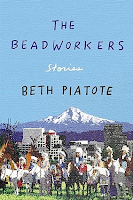
The Beadworkers by Beth Piatote

A few years ago one of these unextinct Sinixt men killed an elk in his homelands. Then he called the game officials in Canada and turned himself in. They took the bait. When the province pressed charges against him for taking big game without a license, he pleaded not guilty. He cited his aboriginal rights to hunt in his own territory. And now that case is in court, and Canada will have to look at that man, standing in the middle of the room, and all his people around him, and Canada will have to admit that the Sinixt are not extinct. The Sinixt man is very brave. And so is the elk who gave himself. That man and that elk knew each other from long ago; they met in dreams and sweat, blood and forest. The man needed the elk; the people need the elk. Without the elk, there would be no case, no path home, no court for the man to present himself to the state and say: we are alive.

In August, I visited Big Hole National Battlefield in Montana, where American forces ambushed a group of Nez Perce who were in the midst of a "fighting retreat," trying to make their way to the Canadian border to escape confinement on reservations. Big Hole is hallowed ground, still a cemetery, where the bodies of Nez Perce leaders were buried. It's a place you want to walk through quietly. I bought Beth Piatote's book The Beadworkers in the gift shop there. I hadn't remembered it at the time, but I'd read some of Piatote's work in Poetry; I had been struck by the power in her appropriation of Walt Whitman's "Song of Myself." Her collection The Beadworkers is a lovely kind of extended coda to a quiet walk through Big Hole: a loud assertion that the Nez Perce are still here, and their living stories are worth as much attention as their silences, their absences.

The pieces in The Beadworkers are a diverse bunch: some are relatively straightforward, like "Fish Wars," which might be my favorite. In "Fish Wars," a young girl worries that the tense conversations she overhears between her parents mean that, like her friend's parents, they're headed for divorce. When her father is arrested, her white schoolmates taunt her--just another drunk Indian--but the truth is that he's been arrested for illegal fishing, an act of civil disobedience in the "Fish Wars" of the 1970s and 80s in which tribes around Puget Sound pressured the government to recognize their treaty rights. "Falling Crows" tells the story of a young Indian who comes back from Afghanistan missing an arm and leg, and his extended family's attempts to help him adjust to his new existence.

But others are more experimental, like the trio of pieces labeled "Feast I," "Feast II," and "Feast III" that open the book. "Feast I" is a poem that, littered with Salish words, at first estranges and alienates a casual reader. But "Feast II" provides a kind of dictionary or key, elaborating on each term. We read the section quoted above and now we know what it means when Piatote writes, "where wewukiye bugle / in fog-mantled mornings. "Feast III," a story about a pair of women living on the Nez Perce reservation of the early 20th century, seems rather slight and uneventful on its own, but when paired with the other two parts we see the way that the poem, the unfamiliar Salish words of "Feast I," the piecemeal anecdotes of "Feast II," combine in the actual living of a life. 

The most unusual piece in The Beadworkers is "Antikoni," a dramatic retelling of the Antigone myth. In Piatote's version, the brother Polynaikas is a set of remains held in a tribal museum, and the king Kreon is the tribal chief who punishes Antikoni/Antigone for stealing the remains and ceremonially burying them. Interestingly, the piece depicts Kreon as rather understandably trying to navigate the demands of the tribe and the demands of the federal government; NAGPRA--the Native American Graves Protection and Repatriation Act--is depicted as a kind of bureaucratic force that keeps tribal members like Antikoni tied up in red tape and reinforces the very practices it's supposed to solve. Tribal politics are a repeated theme of The Beadworkers; in "wIndin!" a woman works to create a tongue-in-cheek board game that satirizes the greed and self-interest of tribal government. Kreon is something of an accommodationist, who thinks he's doing the best he can for his people under the law, but Antikoni makes it clear that in doing so he has alienated himself from them: "I do pity you, Uncle, for you have long ago admitted yourself / To this prison, a darkness of another name."

Thematically, this is one of the most interesting things about The Beadworkers: its political approach is as much about tribal government as it is the federal government. Given the extent to which Indigenous writers know they are writing for a largely non-Indigenous audience, tribal government tends to be more or less ignored. Piatote does a great job of making a critique that's understandable, even universal. And she does so with a great deal of creativity and innovation.

Friday, January 26, 2024

Calling for a Blanket Dance by Oscar Hokeah

"Kiowas always wear red on the left," I told them. I wanted to teach them about their culture. I knew Turtle and Lila were always busy with work. I didn't know how much time the spent at the gourd dances.

"What color do Cherokees wear?" Ever asked.

"Cherokees don't have a color."

"Mom is not going to like that," Quinton aded.

"No, I mean in the gourd dances there are two colors. Red for Kiowa and blue for Comanche."

"My dad's a Comanche," Quinton said. He was almost to the end of his popsicle.

"Your dad is Kiowa and Comanche," I told Quinton.

"Do Mexicans have a color?" Ever asked.

"No, Mexicans don't have a color."

"How come I saw three colors on a big blanket at my house?" Ever asked. "Red, white, and green."

"That was a flag, Ever."

Ever Geimausaddle is like a lot of people growing up in Oklahoma, the crossroads of Indian culture in the United States: a mix of cultures. His mother Turtle is Kiowa and Cherokee and his father Everardo is Mexican. Though Everardo is an abusive brute, made bitter by a beating he receives at the hands of Mexican border agents, Ever himself has a large, rich extended family to support him during what turns out to be a coming of age made difficult by poverty, addiction, and violence. Calling for a Blanket Dance is a polyphonic novel, a collection of stories that capture a snapshot of Ever's life from childhood to adulthood, each one narrated by a different person in his life--mother, auntie, cousin, girlfriend, son.

The central story, to me, was the one narrated by Ever's most distant relative, Opbee--the niece of his grandfather Vincent. In this story, the title "blanket dance" is performed at a powwow for Ever and his family, in which they are surrounded by dancers, symbolizing the support of the larger community--who also toss cash onto their blanket. Later, Opbee realizes that a quilt she's purchased from Ever after the powwow is one knit by his grandmother Lena for her great-grandchild. Opbee travels around the area searching for the blankets, sold out of necessity, to re-purchase them and collect them so they can be returned to Ever and his children. There's a neat symbolism to the quilt, itself a woven object, and the act of "knitting up" committed by Opbee, who literally ties together the loose strands of Ever's life and gathers them back together. One of the strengths of Calling for a Blanket Dance is its insistence that all the strands of one's life and heritage are important. The passage above, from when Ever is a child, is pretty funny, but it also captures some of the difficulty of navigating the many facets of one's identity--Mexican, Kiowa, Cherokee, Comanche, each with its own gifts, and its demands.

Calling for a Blanket Dance is interested, too, in the ways young men grow up. Men like Ever's father Everardo and his grandfather Vincent never grow out of their destructive patterns, or, as in the case of Vincent, who gives up alcohol to late to save his health and his life, grow out of them too late. Ever, too, must fend off the allure of gang violence and drug addiction; his first wife, Lonnie, is ravaged by meth. Ever seeks a refuge in the army, but even this proves to be a false start; discharged, he returns home. Ultimately, it's fatherhood that saves him, first by adopting a troubled teen named Leander (whose casual and sarcastic voice is one of the novel's best artistic strokes) and then having children of his own.

Funnily, Calling for a Blanket Dance covers some of the same ground as Brandon Hobson's novel of the Oklahoma foster system, Where the Dead Sit Talking. But the comparison reveals the limitations of Calling for a Blanket Dance. When, in Hobson's novel, Sequoyah imagines grinding his thumb into the face of his sleeping roommate, we believe him; we are convinced that he may lash out in violence he cannot control. When Leander feels like lashing out, we are certain that social worker Ever's solution--"When you get angry, I want you to draw"--will help Leander channel his impulses into positive behavior. There's never any other narrative possibility; though marginal characters like Vincent and Lonnie may suffer, we are sure that Ever and his immediate family will be knit back into health and safety. When, in the final story, narrated at last by Ever, he camps out overnight waiting for a crack at a foreclosed house being distributed by the Cherokee Nation, is there any doubt that he'll receive one--or that, in a gesture toward the possibility of loss, that he'll be the last person in line to get one? Still, the many voices of Calling for a Blanket Dance are a difficult feat, and are what make it worth reading.

Sunday, January 21, 2024

Blood Run by Allison Adelle Hedge Coke

Civic, ceremonial, elegant effigy--Snake--
our purposes funerary, fundamental, immaculate.

Until sons of Orpheus, fools of fortune,
looters, anthros, squatters--their tractors, rakes--
altered, removed on superiority-driven raids.

When the animals leave this place,
now without protective honorary sculpture.
When River returns with her greatest force.

When flora, fauna will themselves back,
here where we all began ago, long for.
When our people return, to the place
offerings kept free, balanced, hallowed,

when The Reclaiming comes to pass,
all will know our great wombed hollows,
the stores of Story safely put by.
All will come to truth.

I first read about Allison Adelle Hedge Coke's poetry cycle Blood Run in Chadwick Allen's book Earthworks Rising about the literary uses and abuses of Native American mounds. Allen approached Hedge Coke's poems, at least in part, as a numerological exercise, counting the many voices and their place in the narrative: the Mounds, the River, the Deer, the Skeletons, the Ghosts, the Beaver, etc., etc. It all seemed a little silly to me, but I was interested in what Allen had to say about the importance of the voices themselves, which represent the different aspects of the Blood Run Mounds in Iowa's far northwest corner, how the act of letting the mounds themselves speak--as opposed to being spoken for by white historians and anthropologists--constitutes a radical act.

I wish I hadn't left Allen's book at work, because I'd like to go back and read through what it is he said about Hedge Coke's poems, and not rely on my former review, or on memory. For myself, what struck me most about the poems is the unfolding of their chronological structure: first, the Mounds speak from memory, from prehistory, and then they witness--along with the animals and the skeletons and the ghosts--the cataclysmic arrival of settlers, who tear the Mounds to pieces and interrupt the wholeness of the ecology of which the Mounds are a part. I liked the Serpent, a snake-shaped mound like the famous one in Ohio that has since been obliterated, who predicts his own return: "Though my body / suffered sacrifice / to railway fill, / my vision bears/ all even still. / Be not fooled. / Be not fooled. / I will appear again. / Sinuous, I am." And true to form, the poem then moves toward a narrative of future return, in which the river and the mounds are made whole again.

As poetry, it felt a little clunky to me. I love the sinuousness of the snake, the turning of its simple lines, but other poems struck me as being rather plodding. Perhaps that's all right, perhaps they're meant to be solid and earthlike. I did laugh when I got to the cycle's only rhyming poem, narrated by "The Jesuits"--Europeans who brought their ways of poetry with them as surely as their religion and their ways. But in the end I did enjoy the sense of the land speaking, and the interconnectedness of things, and the cycle's proud insistence that things which many have insisted are lost might return again, to their rightful place.

Saturday, January 20, 2024

Where the Dead Sit Talking by Brandon Hobson

No matter what, I could not bring myself to think of Rosemary any less. Little by little, the days were like thieves, stealing parts of me, including any courage I had to confront my feelings toward people: my growing interest in Rosemary, my hatred for Nora Drake, my friendship with George. At night I began to think more and more about my mother, as her court hearing grew closer. I worried about her release. I worried about her remaining locked up. And I worried the days were taking my feelings, how the more I thought about everyone, the more dead I felt inside.

Sequoyah is fifteen years old, Cherokee, caught up in the faceless indifference of the foster system. His mother is in prison, perhaps up for parole soon, but in the meantime he's been placed with the Troutts, a well-meaning couple who live out in the sticks of rural Oklahoma. Life with the Troutts, at least, is better than life in juvenile detention, or some of the other foster homes that Sequoyah has been in and out of. He finds a friend in George, another foster kid who prefers to write messages than to speak, and who clearly has some kind of autism. But it's the Troutts' third foster kid, an older girl named Rosemary, who really captivates Sequoyah. Like him, she's Cherokee, she's disaffected, she's not like other kids. "I feel a weird connection to you," she tells him. "I mean like you're a lost soul from a thousand years ago who's here to deliver something to me."

Maybe that sounds heartwarming, or worse, banal, but it's not. What Rosemary and Sequoyah really have in common is that they've both been deeply damaged by troubling childhoods, and they are both strange, dark, and prone to antisocial behavior and violent thoughts. We come to understand that people are actually afraid of Sequoyah; when George wakes up bleeding from his mouth during a bad sleepwalking spell, he assumes that it's Sequoyah that has hit him in his sleep. When Rosemary's girlfriend (perhaps in both senses) Nora tells her that the way Sequoyah looks at Rosemary is creepy, are we sure that she's wrong? Sequoyah's affection for Rosemary is both a desire to be with her and a desire to be her; he sneaks into her room when she's not around and wears her clothes. Rosemary, for her part, steals money and things and disappears for days; she gives and then cruelly retracts her affection for Sequoyah and talks openly of suicide.

What I liked best about Where the Dead Sit Talking, I think, is that Hobson manages to make Sequoyah and Rosemary poignantly empathetic, rather than repulsive or frightening. We see quite easily how they've been shaped by their difficult circumstances; Sequoyah literally bears scars on his face from an episode of his mother's negligence. As teenagers, they feel real; in the afterword, Hobson talks about how the book was inspired by children he knew working in Oklahoma's foster system. In fact, one of my biggest reactions to Where the Dead Sit Talking was jealousy: I've been working on my own book about disaffected teens, and I wish I had Hobson's talent for detail. Time and time again Hobson has Sequoyah, Rosemary, George, or even some rando at their shared school, do or say something that I bookmarked to steal--or, I should say, for inspiration.

Where the Dead Sit Talking is a grim book. It's narrated by a slightly older Sequoyah, looking back at this transformative experience in his life. We know from the beginning that things haven't gotten better for him; the book's first line is "I have been unhappy for many years now." Sometimes he'll interrupt the narrative to let us know how a particular character dies: "on October 12, 1999 of mysterious causes," or, "who later died on January 19, 2003 of strangulation." These asides are never justified or explained; we're not meant to think something as gruesome and manipulative as that Sequoyah has become a serial killer or anything. But he is someone who grew up surrounded by loss and death, who sees death. On a narrative level, Where the Dead Sits Talking avoids overarching narratives in favor of something more vignette-like. When climactic things happen--the one moment of grand violence in the novel is the one moment that feels a little off--they both grow out of and interrupt the persistent ebb and flow of hope and despair that characterize the life of a foster child like Sequoyah.

This is the fourth year in a row that I have dedicated January to reading books by Native American authors, and Where the Dead Sits Talking is one of the most rewarding discoveries from the experience. Sequoyah's Cherokee identity isn't exactly central to the narrative, but neither is it incidental. Looking back, I was struck by his desire to be like his "great-grandfather," who saw spirits in every thing. It's not such a big leap from there to a teenager who yearns for the mystical experience of a soulmate like Rosemary: "My great-grandfather claimed to have met a beautiful spirit woman... Her eyes were fire. She held my great-grandfather's gaze, kissed his hands, and fell into a long, deep sleep with him." Perhaps we are invited to see a connection between the kinds of displacement that the Cherokee suffered and the displacement that kids in the foster system suffer. Maybe not. But at the very least, Hobson reminds us that displacement--alienation, isolation, and loss--have many forms, and each is more enduring than we might hope to believe.

Monday, January 15, 2024

The Sentence by Louise Erdrich

Many books and movies had in their plots some echoes of my secret experiences with Flora. Places haunted by unquiet Indians were standard. Hotels were disturbed by Indians whose bones lay underneath the basements and floors--a neat psychic excavation of American unease with its brutal history. Plenty of what was happening to me happened in fiction. Unquiet Indians. What about unquiet settlers? Unquiet wannabes? According to Penstemon, the earth's magnetism directs many actions in an unseen world. Maybe the bookstore itself was located on some piece of earth crossed by mystical lines. These invisible runes had touched during what... a shift, perhaps cosmically... a solar storm--something had jostled reality.

What is a sentence? In one sense, it's a judgment, like the sentence handed down to Tookie, the narrator of Louise Erdrich's novel The Sentence, which unjustly keeps her locked up for many years. In another sense, of course, it's a string of words, one of the units from which a book is made, like the books that Tookie sells in a Minneapolis bookstore after her release. For Tookie, the bookstore--the real-life Birchbark Books in Minneapolis, owned and operated by Louise Erdrich herself, who appears in the novel--is quite literally a lifesaver. It's a place where she's given a second chance, and one surrounded by the very things, books, which kept her alive during her time in prison. But perhaps these two kinds of sentence are the same in the end: after all, our words have power to pass powerful judgments, even kill, as one seems to have recently killed a bookstore patron named Flora. But in Tookie's case, words have the power to save, to cleanse, and to heal as well.

The problem in The Sentence is not so much that Flora has died, but that she has come back and is haunting the bookstore, and Tookie specifically. Flora was a Pretendian, a white woman desperate to claim an indigenous identity. When Flora's spirit tries to forcibly enter Tookie, in an event Tookie describes as being zipped open and put on like a wetsuit, the imagery is clear enough. But both Tookie and Erdrich have a kind of sympathy for Flora as well, even in her misguided desperation, and Tookie's investigation into Flora's death suggests that she was killed by a sentence in a historical book that exposed the truth about her racial and cultural heritage. What Erdrich suggests is that, if settlers and Pretendians act on Indians like ineradicable spirits, impossible to fully exorcise, so do they haunt themselves, or cannot keep themselves from being haunted by the truth of their relationship to the world as it is.

The Sentence is almost certainly the most personal book that Erdrich has ever written. By writing herself into the book, Erdrich joins a long list of greats, including Patrick White and Martin Amis, who have fashioned themselves into characters in their own books. But The Sentence has a ripped-from-the-headlines quality, too, that follows those momentous events of 2020: the onslaught of COVID-19, which closes the bookstore and gives Flora the ghost more freedom to prod Tookie, and the killing of George Floyd, which brings a conflagration to Minneapolis. I wouldn't say I loved these parts of the book, mostly because the protests seem to bring a stop to the central plot of Flora's haunting, but given how cringey it might have been and how little I think most of us really want to read a book about this stuff, it seems remarkable that they work at all. Ultimately, Erdrich brings it all back together, and we come to understand that the injustice of Floyd's death, the violent reaction to the protests by the Minneapolis police, even the negligence that leads to COVID running rampant, these are all manifestations of the same specters that haunt our country, like Flora haunts the bookstore. And it doesn't sound as cheesy coming from Erdrich.

What really makes it work, though, is the voice of Tookie: brash, brazen, playful, and profound. The first thirty pages, which detail the madcap scheme that got Tookie sent to prison in the first place--a scheme involving a refrigerated truck and a dead body with cocaine taped beneath its armpits--are some of the best writing to come out of Erdrich's pen in many years. The Sentence can't sustain that momentum. Perhaps it's unsustainable, but it certainly establishes a great reserve of goodwill the novel draws from in its more tedious moments. In keeping with other Erdrich books, there are a few other plot threads I haven't mentioned, including Tookie's marriage to the tribal policeman who arrested her and her stepdaughter's new baby by a Canadian Metis man who may or may not be a wolf creature known as a Rougarou. It's that voice, lively and fresh, which brings all of these together and makes The Sentence worth reading. It's a book that understands that words have power.

Friday, January 12, 2024

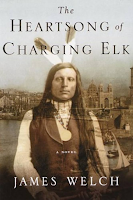
The Heartsong of Charging Elk by James Welch

Then, looking down into the hand mirror on the box of drawers, he lifted the brush to his hair, then stopped, shocked to see that his hair had been cut off to just around his ears. Of course, he had touched the short hair in disbelief many times since yesterday morning, but to see it now filled him with fear. How would Wakan Tanka know him? Charging Elk suddenly felt ashamed of himself. He had gone from being a wild Indian to this creature in the mirror. He glanced down at his new clothes, his new rough shoes. What had happened to him? Just a few sleeps ago, he had possessed his father's hairpipe breastplate, his own badger-claw necklace, his skin clothing--above all, the long hair that had never been cut. Even when he put on the washichu's blouses and pants, he wore brass armbands, earrings, and the two eagle feathers in his hair. He wore moccasins and wrapped his braids in ermine and red yarn. Now, this creature that looked back at him in the mirror didn't look like the Oglala from the Stronghold. The face had grown thin, the eyes seemed unsure, and the mouth looked weak. How would Wakan Tanka know that it was Charging Elk? How would Charging Elk again become the man he once was?

 A man wakes up in a sick ward in Marseille. He doesn't understand where he is, and no one can tell him, because he doesn't speak their language. He is Charging Elk, a young Lakota man who has traveled to Europe with Buffalo Bill and the famous Wild West Show, pretending to hunt buffalo--and Custer--for admiring audiences. But he takes ill, the Wild West Show leaves Charging Elk behind, and through a series of legal mishaps and a great deal of mutual misunderstanding, it seems no one can figure out how to get him back to America, or even Rome, where Buffalo Bill is. It's the beginning of a long exile for Charging Elk, who will spend at least the next sixteen years of his life in France.

The Heartsong of Charging Elk reminded me a great deal of Caroline Dodds Pennock's book On Savage Shores, which I read last year, and which is about the experiences of Indigenous people from the Americas visiting Europe. In a way, it turns colonial narratives on their head: here, it is Marseille that is the strange and exotic place and the Indigenous man the traveler. But no, not quite, because the prejudice that Charging Elk experiences in Marseille is colonial to its core; even those who seek to help him are convinced that he is a "savage" who will never be able to adjust to civilized European life. And they are right insofar as life in Europe is bewildering for Charging Elk, one to which he has much trouble adjusting, especially because he knows no French (and of course there is no one in France who speaks Lakota). He ends up in the home of a kindly fishmonger, who adopts him as a kind of second son, and little by little Charging Elk finds himself adopting French ways--chiefly, drinking wine.

When he arrives in Europe, Charging Elk is young, and has little experience with women, even back home in America. As many of the Lakota in the Wild West Show, he has a profound interest in European women. Out of both deep lust and deep loneliness, he begins patronizing a prostitute named Marie, even falling in love with her, but she is blackmailed by an unscrupulous restaurateur into drugging Charging Elk so that he might rape him. During the act, Charging Elk wakes up and stabs the man to death. At his trial, he struggles to explain himself: though a sympathetic jury looks to him to explain the mitigating circumstances, he is only able to say that he killed a siyoko, an evilness, as any Lakota might have done. This, of course, is taken as more proof of savagery, of an incompatibility with the civilized world. Ironically, Charging Elk becomes a cause celebre in the papers; most of the French seem to believe that he has been unfairly charged, and yet this is only enough to save him from the guillotine, not a sentence of life imprisonment. The French may sympathize with him, or pity him, but there is no one who truly understands him.

Welch passes over the many years that Charging Elk spends in prison with relative swiftness. Eventually, he's released on a grimly ironic technicality--something about him not being an American citizen and thus not able to be tried. (I forget.) Life improves for him after prison: he is placed with a farmer, and eventually falls in love with the farmer's daughter, and marries her. It is a bittersweet development; Charging Elk finds love at last, and someone in this immense and frightening continent who understands him, but he knows all too well that to marry a French woman means to give up the dream of return. It means to become, irrevocably, French--to live between two worlds. The novel treats this with a touching ambiguity, which suggest perhaps that there is much to be gained by becoming "civilized," though much, too, is lost. The novel's most affecting moment comes at the end, when the Wild West Show returns after sixteen years and Charging Elk finds himself among a new generation of Lakota. The story they tell is a horrible one, of boarding schools and forced assimilation, of the desperation of the Ghost Dance and the death of both Charging Elk's father and the great Sitting Bull. The bitter irony is that the home Charging Elk left is rapidly being Europeanized, and that there's no guarantee that, had he stayed in the Badlands, he might not have been forced to cut his hair and adapt to European ways anyhow. Here, in Marseille, at least, he has his wife and child-to-be waiting.

Monday, January 8, 2024

Two Old Women by Velma Wallis

On their way back to the camp, Sa' heard something skitter lightly along the bark of a tree. She stood very still, motioning her friend to do the same. Both women strained to hear the sound once more in the silence of the night. On a tree not far from them, silhouetted in the now-silvery moonlight, they saw an adventurous tree squirrel. Sa' slowly reached to her belt for the hatchet. With her eyes on the squirrel and her movements deliberately slow, she aimed the hatchet toward this target that represented survival. The animal's small head came up instantly and as Sa' moved her hand to throw, the squirrel darted up the tree. Sa' foresaw this, and, aiming a little higher, ended the small animal's life in one calculating throw with skill and hunting knowledge that she had not used in many seasons.

In Alaska, a band of Athabascans are struggling with the onset of winter. Without enough food to go around, and few opportunities to hunt, they make a difficult decision: to abandon two burdensome old women. Not only are the old women--Sa', meaning Star, and Ch'idzigyaak, meaning Chickadee--unable to contribute to the band's survival, they are always griping and complaining. Still, their children and grandchildren are among those who must move on as the old women are left in the snow, certainly to starve or freeze to death. But then, left to their own devices, the two old women decide they must commit themselves to their own survival, activating long-dormant lessons about how to hunt and survive in the difficult Alaskan winter, and soon they find themselves with a new passion for old ways.

Alaska Native writer frames Two Old Women as a story told to her when she was a girl, and it has the simplicity and straightforwardness of an instructive tale for children. By the time the band returns to their former hunting grounds, the situations have reversed: it is the women who have stored a cache of dried fish that they are generous to share with the larger band, who have only continued to struggle. The lesson is two-fold: one, in such difficult conditions, each member of the band must work together, and no one can be left behind; those you believe to be a burden may turn out to be an asset. It's easy to see how such a lesson, passed down from generation to generation, would provide important guidance for a culture that lives in some of the harshest conditions known to man. But the other lesson is that the old ways must not be forgotten: once Sa' and Ch'idzigyaak are abandoned, it is traditional methods of hunting and shelter-building that turn out to be their saving grace, and it is perhaps no coincidence that they are elders, who are meant to be repositories of old wisdom and knowledge.

As literature, Two Old Women isn't much. It has a pleasing clarity of voice, and honed but simple language that well reflects the nature of the story, as well as the landscape. It's most interesting, perhaps, as a reflection of the difficult choices made by those living traditionally in the Alaskan interior, and the way these communities prosper and thrive even in conditions that seem, to us down here, entirely unliveable.

Sunday, January 7, 2024

Night of the Living Rez by Morgan Talty

It was all sickness, the whole thing, something that couldn't be cured, but--and maybe it was because I was tired--I felt that I had done something terrible, like I had been the one doing all the violent hunting, and I wanted to get up and right it all, but I didn't know how. Maybe that was how Great-Uncle Robbie had felt, like he had no choices, that no right way existed to fix anything at all. In the moments before my eyes shut, hearing Frick snore and the clock tick toward 4:00 AM, I felt like I knew Robbie, felt like I had memories of him where he took me fishing or hunting, and when I couldn't take the fish off the hook or when I couldn't kill the white rabbit, he told me that was fine, and he unhooked the fish--its jaw popping, gills throbbing--and plopped it into the river, or he took the rifle from my hands, and after all that we walked away through mud or snow until I stopped walking but he kept on going and going and going out there in quiet strides through a dark-pined forest until he was gone.

For the past few years, I've spent each January reading fiction by Native American authors. I call it "Indijanuary." This year, I'm starting with a re-read of Morgan Talty's story collection Night of the Living Rez, because I'm hoping to teach it to my students in the spring. Last year, we did selections from it, combined with a few chapters from Tommy Orange's There There, but students by and large seemed to feel that they were missing something by not getting either text in full. So we're going to try to read the whole thing this semester.

Night of the Living Rez is a collection of stories about David, a Penobscot who, as a child, moves with his mother back to her home on the reservation in central Maine. The first time I read it, I noted that I was interested in the way that Living Rez complicates a very familiar narrative of return and healing: David's return to the Penobscot reservation don't prevent him from growing up to battle with drug addiction; nor do they prevent his sister Paige from being assaulted by their stepfather, Frick. When David and his family first arrive, they discover a jar of corn and teeth that Frick determines has been left as a kind of curse, and it's the first indication that life on the rez may not always be easy. This time around, I had a new appreciation for the way that the stories jump around in time, which encourages the reader to focus less on causality--that is, it prevents us from focusing too intently on the root causes of David's addiction and other struggles--and more on the images and motifs that thread between the various stages of David's life.

This time around, I also appreciated the extent to which Night of the Living Rez is about addiction. In his older stages, David is in methadone treatment, a burdensome regime of injections he must go through at the clinic each day, and which prevent him from participating in Penobscot ceremonies. But David is far from the only person in the book struggling with addiction: his sister Paige, too, takes methadone, and her addiction struggles account in part for an early miscarriage and, I think, the physical vulnerability of another infant who dies. Frick, who represents for David's mom a renewed life on the reservation, becomes an inveterate alcoholic; that moment that shocked me so much in my first read-through--David catches Frick trying to tear the clothes off of Paige--struck me clearly this time as someone who doesn't know where they are or what they are doing because their brain has been so addled by drink. David interprets Frick mindlessness in terms of the zombie moves that he loves; The Night of the Living Rez is the night that addiction turns men into zombies, or the spirits called Goo'gooks.

Whereas There There explicitly frames addiction and substance abuse as the consequences of settler colonial history--the legs of the spider-trickster that show up in characters' bodies--I think Living Rez has a more complicated and nuanced view of the connection. David says quite explicitly that the valuable root clubs at the local museum make him feel worthless in comparison, as if he and his community only have value when interpolated through a white gaze. But we also get the sense that addiction and methadone treatment are fairly common in the area around the rez, and that whites (like his bitter ex-girlfriend Tabitha) are not immune from the effects of rural poverty and neglect. The question for Talty seems to be more about the cure than the cause: why is it that David must choose between methadone and the sweat ceremonies of the reservation? Does one of these offer a "real" cure for him? As with Leslie Marmon Silko's Ceremony, I think Night of the Living Rez asks us to consider what is meant by the word "medicine"--that jar of corn and teeth is "bad medicine"--and whether sickness and health are concepts that take in whole communities and relationships, and not just what can be measured when David pisses in a cup.