Sunday, December 20, 2020

Light Years by James Salter

Their life is mysterious, it is like a forest; from far off it seems a unity, it can be comprehended, described, but closer it begins to separate, to break into light and shadow, the density blinds one. Within there is no form, only prodigious detail that reaches everywhere: exotic sounds, spills of sunlight, foliage, fallen trees, small beasts that flee at the sound of a twig-snap, insects, silence, flowers.

And all of this, dependent, closely woven, all of it is deceiving. There are really two kinds of life. There is, as Viri says, the one people believe you are living, and there is the other. It is this other which causes the trouble, this other we long to see.

Nedra and Viri are married. Nedra is beautiful, creative, mysterious; Viri is a middling architect who dreams of being famous. They live in the suburbs of New York City with their daughters, Danny and Franca. From the outside, their life seems perfect, and often it seems that way from the inside, too: see, for example, the pair painstakingly huddled over the kitchen table writing an illustrated book about the mystery of eels for their daughters. Viri puts on plays for them, and elaborate Easter egg hunts (the speckled ones are more points than the plain, and there are several golden bees worth five times as much--some, he explains, should be hidden so that they are never found). But of course, there are cracks: both of them are carrying on affairs.

Is it that kind of novel? You know the one I mean: a mid-century family, a home in Westchester, adultery, prose that leers at women, an insistence the American family is in disarray, but for reasons having to do entirely with postwar ennui, and not with, say, income inequality or the stifling nature of patriarchal institutions. Well, it is and it isn't. It certainly checks all of those boxes, but the description seems to fall short of capturing what Light Years really is or does. It's highly impressionistic, floating, it often seems, from one dinner party to another. Friends of Nedra and Viri drift in and out like friends in real life do, appearing for a while to be crucially important and then fading away, having left few traces of themselves. The marriage does begin to dissolve, does end, but in the final reckoning it's hard to figure out why; it certainly doesn't have anything to do with the affairs, which mean next to nothing. A few moments shine out brilliantly--like the collaboration over eels, or Viri's encounter with a tailor who has devoted his life to making beautiful shirts, like a kind of yogi--but fail to generate conflict. Conflict is there, but it seems to have birthed itself.

The prose is absolutely impeccable, yet Light Years often left me feeling cold. "Cold," in fact, is one of the words that seems to characterize the novel most perfectly. The first line of Part Two might as well be the novel's epigraph: "In the morning the light came in silence." Everything in this novel is cold, light, silence; Salter lingers over the image of the Hudson on a winter's afternoon, or the sensation of being in a dark room in the middle of the day, doing nothing at all. I found it a relief, actually, when toward the novel's end the divorced Viri relocates to the sweaty chaos of Rome, where his life is reinvigorated by a new woman and a new environment. But for much of the novel I felt myself skipping off of the words like--oh, I guess, a stone being skipped on the frozen Hudson river, with some seagulls scattered around.

One thing I think Salter does really well is capture the way that violence, sickness, and death punctuated the sterility of bourgeois existence. Those things haunt the edges of the novel, affecting at first acquaintances, then friends, and then family. The death of Nedra's father is one of the most touchingly rendered passages in the book, and perhaps even moreso because it's neither young nor unexpected. As they age, Nedra and Viri must confront these things among their friends:

His voice was the only thing unchanged, his voice and character, but the structure that held them was dissolving. All the old and interconnected knowledge--architecture joined to zoology and Persian myth, recipes for hare, the acquaintance with painters, museums, inland rivers dark with trout--all would vanish when the great inner chambers failed, when in one final hour the rooms of his life dropped away like a building being wrecked. His body had turned against him; the harmony that once reigned within it had disappeared.

Of course, the tragedy of these dissolutions is always, in part, due to the fact that you know they'll come for you one day, too, and they do. The title Light Years, I suppose, is meant to emphasize the way that life is both vast--it is the only time and space allotted to us--but the way that it passes so quickly. I've found life a little warmer and more messy than Salter seems to, but it's easy to see why others, whom the novel has touched more deeply, have found it to be underappreciated.

Wednesday, December 16, 2020

 Best books of 2020


My total for the year will be 59, a new record for me (retirement has consequences).  I have mixed all genres together here and given myself 15, in no particular order.


·      On Earth We Were Briefly Gorgeous by Ocean Vuong – a lyrical and powerful coming of age novel by a young, already noteworthy poet.

·      New York Burning by Jill Lepore – the first book by this public intellectual; a stunning history of a racist campaign in early New York; a misuse of legal execution that rivals the Salem witch trials. 

·      The Nickel Boys by Colson Whitehead – funny, sad, surprising – a great tale.

·      Reconstruction by Eric Foner – the now standard history that changed the direction of thinking on this period.

·      The Courtship of Eva Eldridge by Diane Simmons – a thoroughly enjoyable non-fiction look at the life of an ordinary woman and her romantic troubles; excellent, small-bore history.

·      Deacon King Kong by James McBride – a comic story of a Brooklyn just as it is coming apart at the seams in the late 1960s.

·      New Selected Poems by Eavan Boland – I wish I had read her when she was alive; a worthy companion to Seamus Heaney.

·      Normal People by Sally Rooney – a powerful and enjoyable love story, told with great realism; I miss these two young people.

·      Night Boat to Tangiers by Kevin Barry – Waiting for Godot with drug dealers.

·      The Sounds of Poetry by Robert Pinsky – brilliant literary criticism for the layperson; sensible and smart.

·      Lost Children Archive by Valeria Luiselli – a unique and original encounter with an American tragedy.

·      Outline by Rachel Cusk – a slow, painstaking, examination of a woman’s life, revealed through her brief sojurn in Athens.

·      Red at the Bone by Jacqueline Woodson – several generations of a Bed-Stuy family captured in short, vivid vignettes.

·      How to Be Gay by David Halperin – a fascinating examination of what progress costs; a plea for respect for pre-Stonewall gay life; a warning against too much assimilation.

·      Apeirogon by Colum McCann – 1001 small stories surrounding a real-life friendship, Palestinian and Israeli.

·      Dorothea Lange, A life Beyond Limits by Linda Gordon – the fascinating photographer’s fascinating life; like Lange herself, quietly feminist.

The Argonauts by Maggie Nelson

How to explain--"trans" may work well enough as a shorthand, but the quickly developing mainstream narrative it evokes ("born in the wrong body," necessitating an orthopedic pilgrimage between two fixed destinations) is useless for some--but partially, or even profoundly, useful for others? That for some "transitioning" may mean leaving one gender entirely behind, while for others--like Harry, who is happy to identify as a butch on T--it doesn't? How to explain, in a culture frantic for resolution, that sometimes the shit stays messy? I do not want the female gender that has been assigned to me at birth. Neither do I want the male gender that transsexual medicine can furnish and that the state will award me if I behave in the right way. I don't want any of it. [Beatrix Preciado] How to explain that for some, or for some at some times, this irresolution is OK--desirable, even (e.g., "gender hackers")--whereas for others, or for others at some times, it stays a source of conflict or grief? How does one get across the best way to find out how other people feel about their gender or their sexuality--or anything else, really--is to listen to what they tell you, and try to treat them accordingly, without shellacking over their version of reality with yours? 

Maggie Nelson's theory-memoir The Argonauts tells the story--peripatetic, looping--of her marriage to Harry Dodge, a non-binary sculptor and playwright, and the birth of their son, Iggy. The title refers to the ship Argo, which, according to myth, was rebuilt plank by plank, provoking the question: is the new ship the same as the old? And if not, when did the transition occur? The word transition makes the metaphor plain, but hides much of the nuance: Nelson dwells at length on the nature of bodies and identities that change in all sorts of ways, not just because of the presence of prescribed hormones, but because of the nature of aging and childbirth. For Nelson, the body is a site of indeterminacy and slippage, but this is one of its wonders. We want our gender roles, like our bodies, to be clear and coherent, but as she writes above, "the shit stays messy."

One of the peculiar things about The Argonauts, especially for a book that is relatively popular, is that it's absolutely dripping with theory: Lacan, Freud, Deleuze and Guattari, Judith Butler, Eve Sedgwick, and many, many others. You might be forgiven for picking up and putting it down, thinking it pretentious, but to me, one of the marvels of The Argonauts is that it is anti-pretentious: by weaving the words of theorists into her own paragraphs and sentences--Nelson highlights them by italicizing, and places the names in the margin, even as her "borrowing" makes it clear that she speaking for herself with their voices--Nelson removes theory from the realm of the brain and claims it as a way of understanding her own body, her own husband, her own child. She's contemptuous of the trendy notion that our words are tragically incapable of conveying real truths; it may be true, but still they do much for us, and The Argonauts is clearly a book by someone for whom words are a mode of self-exploration.

One of the remarkable things about gender is that, even though it permeates our lives in ineradicable ways, we seem to be unable to talk about it. The conservative understanding is, as Nelson writes, like a child's drawing of a mommy and a daddy, all simple triangles and squares, but even thoughtful and accepting people have trouble being able to even say what gender is. I appreciated Nelson's attempt to mine the words of others to communicate her own experience, as a woman, as a pregnant body, as a lover, as a wife, etc., etc. But I appreciated, too, the honesty with which Nelson approaches the messiness of it all, and the way gender, like so much about our identities, refuses to be pinned down, like a butterfly to a board. 

Tuesday, December 15, 2020

Stream System by Gerald Murnane

In all the world there has never been, there is not, and there will never be any such thing as time. There is only place. What people call time is only place after place. Eternity is here already, and it has no mystery about it; eternity is just another name for this endless scenery where we wander from one place to another.

The world of Gerald Murnane is an insular one. He has never been on a plane, has never worn sunglasses, has left Australia only for places that can be reached by boat, and lives a hermetic existence in North Victoria. He spends his time keeping detailed files on his own life, something he has been working on since he was young. He's obsessed with horse-racing and has records of thousands of fictional horse races that he's simulated using an arcane system involving picking up random volumes of fiction, choosing a paragraph, and using the data contained in the words to determine the winner. Each of these horses has racing colors a complicated history, and all the races take place in a fictional, but not fantastical, world of his own making.

With an ordinary collection, including so much biographical data would probably be unwise and might serve to obscure the fictions themselves; but Stream System, a collection of all of Murnane's short fiction (a term used loosely since two pieces in this collection crack 100pp) is not a regular collection. There are virtually no character names at all, not a single line of dialog, and very little explicit action. Murnane, throughout the collection, explains bits and bobs about his writing methods through the voices of his narrators, while always taking care to remind the reader, sometimes explicitly, that what they are reading is a work of fiction and not, as they might be tempted to believe, a work of lightly fictionalized autobiography.

And yet, the stories are so internal and the narrators so like Murnane that the collection as a whole has a metafictional quality--what are we to make of dozens of middle aged Australian men who refuse to set foot on planes, who fantasize about race horses, who write fiction exactly like Murnane's? But these narrators also can't be the same person, because they have different backgrounds, different paths that led them to similar places. A Vietnam veteran in Finger Webs, blue collar workers in Stone Quarry and The White Fields of Uppington, a monk in As It Were a Letter, a teacher in When the Mice Failed to Arrive, etc etc.

These characters have in common many things, but one especially: all are driven throughout their lives by images they've seen, read about, conjured, and spend most of their time trying to connect them, and that is what these stories do as well. They achieve their momentum and denouments (almost all of which are spectacular) through the slow accretion of minutae and the revelation of the places created by their mental sediment, The collection's title story, Stream System, makes this explicit--the story takes place entirely as the narrator looks at the titular system and connects the shapes of the various pools to events thoughout his life. The images the characters carry around, sometimes happily, sometimes reluctantly, share many common elements (fathers, time-as-place, isolated phrases from books, race horses, the faces of women) and yet each man is subtly different. But different as they are, none of them are able to ultimately put the images in their heads into an order that solves the puzzle they're all mystified by, the infinite depths of their humanity.

You'd be forgiven, if you didn't read the cover copy, if you completed Stream System and thought it was a novel rather than an omnibus. The stories are of a piece, circling around variations, could-have-been, versions of the same man. And lest this review makes it sound tedious, it's full of dry humor, clever turns of phrase, and a sense of momentum that frankly makes no sense given the subjects of the stories. Murnane is a master of this style and indeed, I suspect he's the only one who could really pull it off, given how much of himself is within his carefully constructed fictions.

Ultimately, Murnane seems ambivalent about even his own work, citing repeatedly Philip  Larkin's line "Books are a load of crap" and giving his characters crises wherein they determine never to read/write again, and to live only within their own minds, a landscape which, even among the many he evokes throughout the stories, feels the most infinite of all.

Saturday, December 12, 2020

Fleischman is in Trouble by Taffy Brodesser-Akner


This was who Seth was going to marry.  But here’s what he didn’t know, I told him, and he would learn:  A wife isn’t like an ultra-girlfriend or a permanent girlfriend.  She’s an entirely new thing.  She’s something you made together, with you as an ingredient.  She couldn’t be the wife without you.  So hating her or turning on her or talking to your friends about the troubles you have with her would be like hating your own finger.  It’s like hating your own finger after it becomes necrotic.  You don’t separate yourself from it.  You look at your wife and you’re not really looking at someone you hate.  You’re looking at someone and seeing your own disabilities and your own disfigurement.  You’re hating your creation.  You’re hating yourself.


Toby Fleishman is in trouble, but so is everyone else in this novel.  It takes a little while to realize the seriousness of the trouble, because Brodesser-Akner presents it in comic terms for the first three quarters of the novel.  That comedy is fun, but when things turn serious, they disappoint.


Toby is separated from Rachel – their final divorce papers will appear in the second half of the novel – and he is just getting the hang of separation.  That means he is just beginning to date.  In the world of this novel – a very wealthy and privileged slice of Manhattan – that means that Toby, a short, balding, 41 years old with two kids, low self-esteem and a very demanding job, is having more sex than he ever imagined possible.  He has a wide variety of apps that allow him to preview, chat with, and select potential partners and virtually all of them want no-strings-attached sex.  Phone sex, text sex, quickies in the hall, mad romps on the floor, anything that is neither demanding nor emotionally involved. 


His trouble seems at first to center around whether he can balance the time required to harvest all this pleasure with the time he wants to put into raising his children and being a top liver specialist at NYU Medical Center.  This is made more difficult because Rachel is presented as a narcissistic, greedy and overly ambitious woman who cares little for her children.  We are told that Rachel’s was always the primary career in the family, that she makes many times Toby’s salary and was driven always to make her business larger and more lucrative. That early portrait is confirmed when – after dumping the kids on Toby so she can go on a yoga retreat – she disappears from their lives.  She returns from the weekend but never comes to pick up the kids or return Toby’s calls.  He makes moves to jettison her completely from his life and become a single father.  These attempts seem sincere – he takes time off from work and loses out on a promotion as a result.  


Somewhere in the midst of all this, Toby meets Nahid, the one sexual powerhouse from his internet dating who seems to connect on an emotional level, and for a time it seems that Fleishman will pull out of the trouble and lead a happy life, without Rachel.


Around this time, the narrative changes in two ways:  first, we begin to focus on the life and moods of our narrator.  For the first 50-60 pages, the novel appears to have a limited omniscient narrator who is following Toby’s thoughts and moods, knows the history of his marriage, the intimate details of his children’s birth, the conversations and fights that are milestones in both the deepening and the devolution of his relationship to Rachel.  But then it becomes clear that the narrator is a character in the story – one Libby who, along with Seth, is an old friend of Toby’s from pre-Rachel days.  We begin to learn of Libby’s complex relationship with these two men, Seth and Toby and of her own struggles with career and family.  While Libby is on a vacation from her strained marriage, she bumps into the long-absent Rachel and discovers that Rachel has not abandoned her family, but had a full nervous breakdown from the strain of her divorce and the pressure of trying to be the main bread winner for 14 years.  She is a flawed, but far more sympathetic person than Libby (who has only known Toby’s side of things) has believed.  Libby makes sure Rachel gets the help she needs, then returns to her own long-suffering husband; Toby realizes that Nahid is just as flawed as any other human and Seth plans to marry for the first time in spite of what he has seen from these friends.


Then novel ends with several pages of Libby’s reflections on marriage – including the analysis of Seth’s situation quoted above.  (He has delayed marriage into his 40s, but is now marrying a beautiful 27-year-old.) That reflection is serious and offers some interesting and thoughtful ideas about the challenges and rewards of spending decades in an intimate relationship with someone as complex and flawed as you yourself likely are.  It almost makes me take the rest of this seriously, but there has been too much breezily taken for granted for me to fully buy this turn of events.  


The feminist turn here – that Rachel is not a total bitch, that Toby’s sexual escapades are a childish male fantasy, that women are under enormous pressure to claim it all and that it is wives who bear much of the burden of marriages complexity – can only be revelatory if you believed something different at any point in the novel.  The first third of the book, when all Fleishman’s trouble seems to be libidinal, was only interesting because it was written by a woman.  It was a great male fantasy and it was written with humor and energy – I breezed through it.  The list of slogans on women’s t-shirts alone provides enough jokes to carry a novel. But it was never believable or challenging or interesting in any serious way.  Nor was Libby to be taken seriously as a narrator.  There is not the slightest attempt to explain how she knows so much about Toby’s life, or why, having intensely disliked and avoided Rachel for 15 years, she is  the one person capable of really understanding and helping her.


The fact that these basic elements are not plausible is layered on the hyperbolic focus on wealthy Manhattanites here.  Toby is a well-respected specialist at NYU, the kind of person a hedge fund manager calls in when his wife is sick, but he is the underpaid person whose career allows time for his children?  Rachel’s salary is many times his, but even with their combined income, they are the poor relations in their social group?  It is not a question of whether these conditions are possible, but whether they make fertile ground for a serious novel about relationships.  And in the end, Brodesser-Akner is attempting a serious novel about relationships.  The reading is entertaining and some of this is funny, and when it was just going to be that, I enjoyed it.  But as she turns towards tragedy, the breach between the reader’s pleasure and the reader’s trust grows too wide.

Wednesday, December 9, 2020

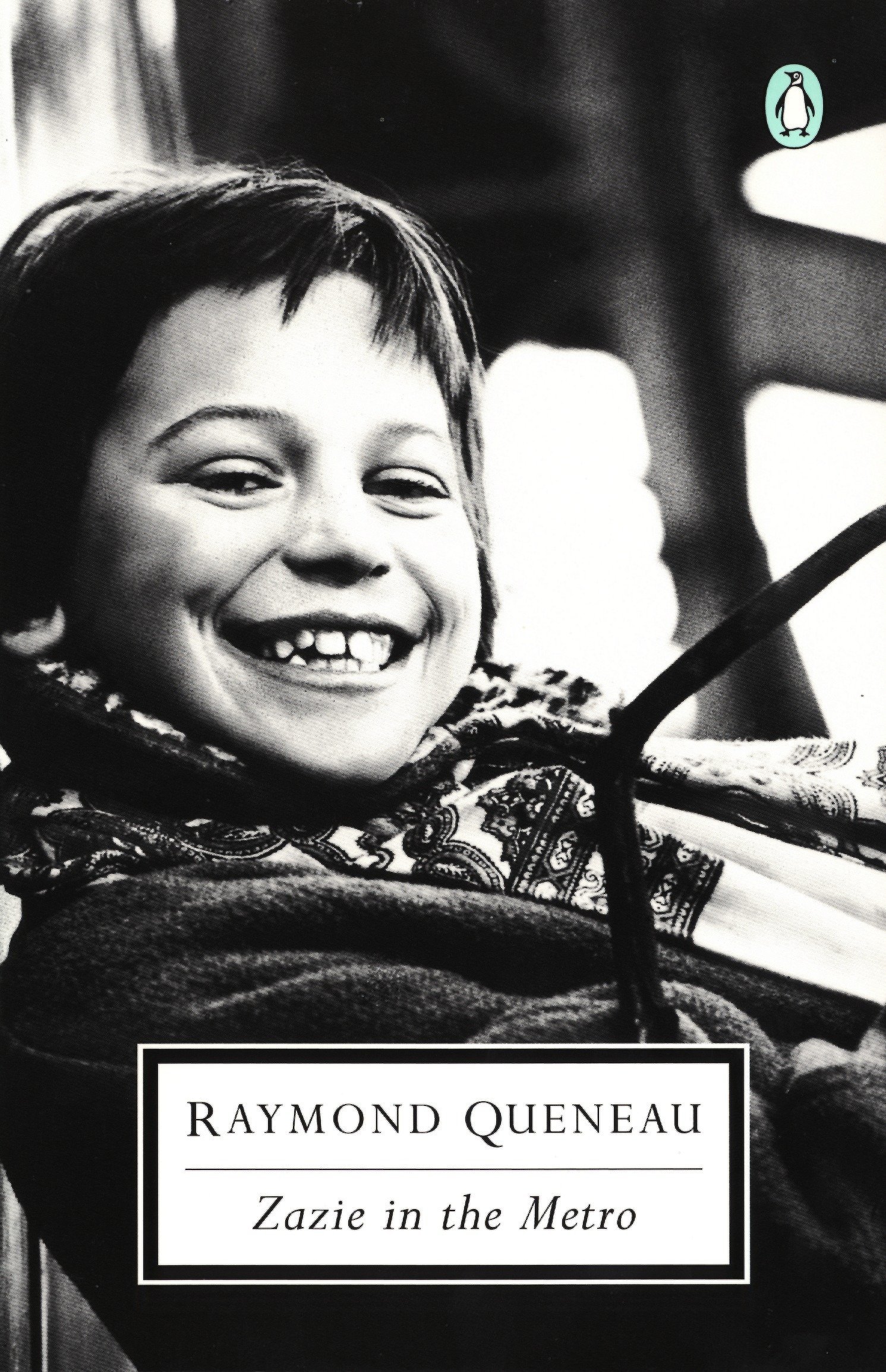
Zazie in the Metro by Raymond Queneau

'Being or nothingness, that is the question. Ascending, descending, coming, going, a man does so much that in the end he disappears. A taxi bears him off, a metro carries him away, the Tower doesn't care, nor the Pantheon. Paris is but a dream, Gabriel is but a reverie (a charming one), Zazie the dream of a reverie (or of a nightmare) and all this story the dream of a dream, the reverie of a reverie, scarcely more than the typewritten delirium of an idiotic novelist (oh! sorry). Over there, farther -- a little farther -- than the Place de Republique, the graves are overflowing with Parisians who were, who ascended and descended the stairs, came and went in the streets, and who did so much that in the end they disappeared. Forceps bore them, a hearse carries them away, and the Tower rusts and the Pantheon cracks a little more rapidly than the bones of the dead who are too much with us to dissolve into the humus of the town impregnated with cares. But I am alive, and there ends my knowledge...'

One fact that will tell you what Raymond Queneau's Zazie in the Metro is like is that Zazie, the foul-mouthed little girl from the French countryside who arrives to spend the weekend with her uncle Gabriel, never rides the Paris Metro. No doubt you will think about Waiting for Godot, another text where the promise of the title never happens; it's merely set over the page like a winking irony. Like Becket, Queneau's characters are all surface. It's hard to recognize any human depth in them, which makes their conversations hard to follow, composed as they are of verbal tics being spooled out again and again. The characters are composed of verbal tics, I mean. They are like the parrot Laverdure, who says only one thing: "Talk, talk, that's all you can do."

French people, the introduction informs me, find Zazie in the Metro enormously funny. There's a recognizably comic plot, that goes something like this: Zazie arrives to visit her uncle with only one desire, to ride the Metro, but there's a strike on. Her uncle tries to give her a tour of Paris, but she eludes his control, skipping off to pester and curse at strangers. Zazie is in turns chased after and spurned by Gabriel, as well as his gentle wife Marceline, his landlord Turandot, Turandot's parrot Laverdure, a disguised cop named Trouscaillon, and several other broad comic figures.

There's something ultramodern about Zazie, something that captures a postwar Paris emerging into a global culture. What Zazie jones for, other than to ride the Metro, is a nice pair of American blue jeans and a Coca-Cola. Her uncle Gabriel and his friend Charles, a taxi-driver, try to show Zazie the "real" Paris, but prove to know as little as she does: they bicker over whether a certain building is the Place de Republique, or the Gare de Lyon, or the Commercial Court. The only landmark they can really identify is the Eiffel Tower, but standing at the top of it with Zazie, they no longer have any faithful reference point at all.

All of which is underlined when Gabriel is "captured" by a group of tourists who, despite not thinking any French, believe him to be a tour guide; instead of taking Zazie to see the "real" Paris, Gabriel finds himself kidnapped by the group, leading them to sites neither he nor they can recognize. If you're still thinking of Waiting for Godot, you might read Zazie at the Metro as a romp through the postmodern emptiness of words, which fail time and time again to locate the characters in space or in meaning. The blue jeans are real but the Pantheon is just some building.

Zazie is a novel also about modern sex panic. It seems awfully prescient, for example, in the way that Zazie's solo adventures invoke anxieties about sex perverts, anxieties that Zazie herself is more than willing to weaponize when, for example, she wants to duck Trouscaillon. But it's Zazie herself that turns out to be sex-obsessed: an off-hand remark by Trouscaillon pushes her to ask her uncle, again and again over the course of the novel, whether or not he is a "hormosessual." He's not, he insists, but he does make his living by dancing at a nightly drag show. And neither does he consent to tell Zazie what a "hormosessual" is exactly--in another way failing as a guide to his young nice.

What this edition could have really used, I think, is a translator's note. Queneau was famously the linchpin of Oulipo, a group of French writers whose hallmark is wordplay. I'm sure the translations into English here are very clever when you know the original French, but I found myself wondering why I should really be interested in calling the blue jeans "blewgenes" or the Coca-cola "cacocalo." Some layer of meaning--like the blue jeans themselves, for Zazie--kept alluding me. The madcap energy of Zazie's weekend was never enough, for me, to make up that deficit.

Sunday, December 6, 2020

The Wreath by Sigrid Undset

Kristin felt that she was kneeling with Erlend on a cold stone. He knelt with the red, singed patches on his pale face. She knelt beneath the heavy bridal crown and felt the crushing, oppressive weight in her womb--the burden of the sin she was carrying. She had played and romped with her sin, measuring it out as if in a child's game. Holy Virgin--son it would be time for it to lie fully formed before her, looking at her with living eyes, revealing to her the brands of her sin, the hideous deformity of sin, striking hatefully with misshapen hands and his mother's breast. After she had borne her child, after she had seen the marks of in on him and loved him the way she had loved her sin, then the game would be played to the end.

For the last three years, I have had a December tradition of reading one of the books in Sigrid Undset's series about medieval Norway, Kristin Lavransdatter. Though the books span several years and thus, several seasons, there's something especially wintry in them; they match the cold weather and the cozy hearth. I thought this year I would begin reading Tiina Nunnally's newer translation, only to discover that I actually had read Nunnally's version of The Wreath, and the other two books in Charles Archer's older translation. Still, going from Archer's to Nunnally's emphasized the benefit of Nunnally's clear and modernizing language when compared to Archer's attempt at using medieval English vernacular. Kristin's desire to marry for love, rather than expectation or honor, is wholly recognizable, even when her social context seems foreign or strange, and Nunnally's translation produces an intimacy with the reader that Kristin and these novels deeply deserve.

Reading The Wreath again, I was struck by how well Undset anticipates The Cross, the final novel in the series. (Brent, you may want to skip this paragraph.) Kristin and her forbidden love, Erlend Nikulausson, meet while she is spending a year at the Nonneseter convent, which is something apparently that young women did before they became adults. If she cannot have Erlend, Kristin insists that she--having already given her virginity to him and thus being effectively married in the eyes of God--will go into the convent for good. This doesn't come to pass, but Kristin does end up in the convent in the end, after her husband has died and her children left home, giving her life at last to the service of God when it is most needed, during the Black Plague. Even Brother Edvin, Kristin's beloved priest and mentor, suggests that he dreamed she would choose the convent life. The scenes at Nonneseter in The Wreath, the second time through, are riddled with this irony, and they make me feel as if Kristin ends up in the right place in the end, after a long detour on which she is set by her "original sin." In a thousand other small ways--like the brief attention paid by Kristin's jilted fiancé Simon Andresson to her little sister Ramborg, who he will marry after being widowed in The Wife--I was impressed by how Undset seems to have the entire trilogy already fully mentally formed.

I know it's gauche to look at everything through the lens of television, but The Wreath had me wondering what an HBO-style Kristin Lavransdatter series would look like. I'm imagining a season for each novel where, like with The Crown, the main characters are recast as they age. The Wreath is punctuated by moments of sheer drama that would play well on the screen: the attempted rape by Bentein and the murder of Kristin's friend Arne (ingeniously set up by Undset as the "forbidden love" Erlend later becomes), the moment Erlend meets Kristin by saving her from a pack of thieves (and a escaped leopard!), the standoff over a cup of poison between Kristin and Erlend's former mistress Eline, the accident that cripples Kristin's sister Ulvhild, the church fire that brings Erlend and Kristin's father Lavrans inches closer to reconciliation.

The challenge, of course, would be convincing a modern audience that the morality of these novels deserves to be taken seriously. I don't think that sex before marriage is a big deal, but the Norway of Kristin Lavransdatter does, and for good reasons: marriage in this society, as in many, is not merely an act of personal love but a way of binding families and communities, and a sacrament jealously guarded by God. Only a skilled director and actors, I think, could sufficiently remind us, as Undset does, that marriage has meant something different to other cultures than ours. If you could get over that hurdle, Kristin Lavransdatter is riddled with moments of excruciating pathos. As when I first read it three years ago, I was deeply moved by the tense moment between Lavrans and his wife Ragnfrid at the end where she admits that she was not a virgin at their wedding, a moment which recontextualizes the entire novel that has come before it. And knowing that marriage is not the end for Erlend and Kristin--that the future holds further, deeper challenges--makes The Wreath even more heart-jerking.

Tuesday, December 1, 2020

As You Like It by William Shakespeare

ROSALIND: Love is merely a madness, and, I tell you, deserves as well a dark house and a whip as madmen do; and the reason why they are not so punished and cured is that the lunacy is so ordinary that the whippers are in love too.

It was a real pleasure to read As You Like It; it's been such a long time since I've read a Shakespeare play I felt a little out of touch with that part of my reading identity. I once decided to read all of them, and although I've read most, it's been a while since I worked on that particular resolution. And As You Like It is such a pleasant one to return to, as whimsical and free-wheeling as the Forest of Arden that provides its setting.

The plot--though it isn't really a play where much happens--goes like this: Duke Senior, having been usurped by Duke Ferdinand, has fled to the Forest of Arden. Senior's daughter Rosalind has been allowed to remain because she is besties with Celia, Ferdinand's daughter, but not for long: when the jealous Ferdinand exiles Rosalind, she flees in disguise as a young man, Ganymede, with Celia in tow. Meanwhile, Orlando has been denied any inheritance by his cruel brother, Oliver, and, having fallen in love with Rosalind, flees to Arden as well. In Arden, Rosalind--as Ganymede--promises to "cure" Orlando of his lovesickness by pretending to be Rosalind.

As You Like It reminded me strongly of A Midsummer Night's Dream, another play that differentiates the civilized world from a "green" space where freedom and fluidity reign. The Duke's kingdom is a nasty place, where brother conspires against brother, and "civilized" institutions, like the primogeniture that robs Orlando of an education and an income, perpetuate misery. But civilized hierarchies collapse in Arden, a place whose essence is inherited from Roman pastorals. (It's a funny place, this forest: for one, there seem to be a lot of shepherds and sheep for a forest.) In Arden, plot seems to stop almost entirely; the most exciting action--including, amazingly, a lion attack--all happens off stage. Instead, what Shakespeare stages is a series of interactions and dialogues between residents and outsiders about the nature of love and the relative virtues of life in country versus life at court. Arden is a space for wit, which might be describes a kind of verbal free play, free of the consequences they may have in the ivilized world.

It's only in Arden that Rosalind can get away with the gender and identity slippage that she enjoys. The irony of Rosalind's identity--she's pretending to be a man who is pretending to be herself--is one of the core pleasures of the play, and as elegant a setup as it is, I don't think I've ever seen anything quite like it. Rosalind is often described as Shakespeare's wittiest female character, and that's probably true, but Orlando, who is never quite more than a decent and victimized lunk, never seemed to live up to her. As a result, their relationship lacks some of the heat of Beatrice and Benedick in Much Ado About Nothing. But Arden is too gentle a place for that kind of sparring, and instead what stands out about Rosalind is the way she exerts control over her identity, and thus the relationships in Arden. She withholds her true identity until she knows she can use it to arrange everyone's lives in harmony: she with Orlando, Celia with Orlando's brother Oliver, and the shepherd Silvius with Phoebe--a young maiden who, as genre demands, has fallen in love with "Ganymede."

There's a feminist reading in there somewhere: only in Arden, a place of fantasy, can a woman even as intelligent and perceptive as Rosalind have real control over herself and her place. And even that has its limitations, because her last-minute sorting has the ironic result of reinscribing everyone into the rigid hierarchies of the civilized world. It's hard to imagine the marriage between Rosalind and Orlando surviving back in the Dukedom, even with Senior on the throne. But Shakespeare allows her at least the right of the play's epilogue, in which she stakes a final claim to total freedom: "If I were a woman, I would kiss as many of you had beards that pleased me, complexions that liked me, and breaths that I defied not. And I am sure as many as have good beards, or good faces, or sweet breaths will for my kind offer, when I make curtsy, bid me farewell."

Monday, November 30, 2020

Our Spoons Came From Woolworths by Barbara Comyns

This book does not seem to be growing very large although I have got to Chapter Nine. I think this is partly because there isn't any conversation. I could just fill pages like this:

'I am sure it is true,' said Phyllida.

'I cannot agree with you,' answered Norman.

'Oh, but I know I am right," she replied.

'I beg to differ,' said Norman sternly. That is the kind of stuff that appears in real people's books. I know this will never be a real book that business men in trains will read, the kind of business men that wear stiff hats with curly brims and little breathing holes let in the side. I wish I knew more about words. Also I wish so much I had learnt my lessons at school. I never did, and have found this such a disadvantage ever since. All the same, I am going on writing this book even if business men scorn it.

Sophia Fairclough, the narrator of Barbara Comyns' Our Spoons Came From Woolworths, seems entirely guileless. She begins her marriage to a commercial artist, at 21 with no guidance or model; Charles' family seems to hate her, in fact. She has a childlike innocence that seems rather foreboding for a woman embarking on an adult marriage: she keeps newts, for example, in her pockets. Her husband, Charles, is equally unprepared for marriage, but he has a malicious streak that allows the burden of their poverty and ignorance to fall entirely on Sophia.

Sophia's narration has such a light touch that the Faircloughs' poverty seems, at first, rather picturesque, even comic. The spoons may come from Woolworths, but the second-hand furniture is all painted sea-green, a symbol, maybe, of need transformed into domestic coziness. But the light touch is a feint; Our Spoons Came From Woolworths actually has a razor-sharp idea of what poverty does. Never is that clearer than, a third of the way through the novel, Sophia delivers her first child, in a public hospital, described in sinister and bewildering detail. Charles' family blames her for having the child, and even as Sophia grows older, she never seems able to eradicate this internalized guilt, even as future pregnancies unfold in even more grotesque permutations, including an abortion that the penniless Charles pressures her into having. "I knew men hate women when they are unhappy," Sophia writes, excusing Charles' cruelty. If this seems like the final intersection of poverty and misogyny, just wait until the moment where Sophia, cast out of her home, spends the night in a cold alley with her infant in her arms.

One thing I teach my fiction writing students is that tone and mood ought to contrast, or be different. Our Spoons Came From Woolworths is the perfect illustration of that rule: though its depiction of poverty is horrifying, it never loses the whimsical and slightly befuddled tone of Sophia's worldview. She comes off as a sort of holy fool, an ingenue who has been profoundly tricked and mistreated. The reader's expectation that someone will see and reward her earnestness and honesty is answered by Comyns, who contrives at the end for Sophia and her son to end up with the kind of husband that she has deserved; anything else would have seemed far too cruel for such a sympathetic heroine. I like the passage at the top of this review because it suggests that, at last, Sophia has found a way to tell her own story without the mediation of a husband figure at all: she's going to share it no matter whether the "business men" like it or not.

Friday, November 27, 2020

Solomon Gursky Was Here by Mordecai Richler

When Callaghan returned, he settled into his chair, reached for the bottle and said, "Let me put it this way. Canada is not so much a country as a holding tank filled with the disgruntled progeny of defeated peoples. French-Canadians consumed by self-pity; the descendants of Scots who fled the Duke of Cumberland; Irish the famine; and Jews the Black Hundreds. Then there are the peasants from the Ukraine, Poland, Italy, and Greece, convenient to grow wheat and dig out the ore and swing the hammers and run the restaurants, but otherwise to be kept in their place. Most of us are still huddled tight to the border, looking into the candy store window, scared by the Americans on one side and the bush on the other. And now that we are here, prospering, we do our damn best to exclude more ill-bred newcomers, because they remind us of our own mean origins in the draper's shop in Inverness or the shtetl or the bog. What was I talking about?"

"Solomon."

Moses Berger is consumed by two things: alcoholism and Solomon Gurksy. Solomon was--or is--a member of the infamous Gursky family, who rose from obscurity to conquer the bootlegging industry in Canada, eventually becoming powerful and respected men of business. Solomon, embroiled in a bitter rival with his brother Bernard, the company's CEO, died years before in a mysterious crash on his way to the Arctic. Moses, whose association with the Gurskys goes back to his childhood, when his poet father was hired as a speechwriter for Bernard, has become obsessed with the question of what happened to Solomon. Was he murdered? If so, by whom? And why was his body never found? And who's ominously leaving dead ravens everywhere, and is it the same person secretly buying up shares of Gursky stock under the name "Corvus?"

Solomon Gurksy is based on the real-life Bronfman family, who turned a bootlegging operation into the Canadian conglomerate now known as Seagram, one of the largest liquor companies in the world. But Richler takes an interesting story and turns it into an epic, stretching across the length of the Canadian continent and the breadth of history. The history of the Gursky family is inextricable from the history of Canada: Solomon's grandfather Ephraim, sources suggest, was a member of John Franklin's ill-fated expedition to find the Northwest Passage, and the only one who survived (by stowing away Jewish soul food, naturally, and avoiding the poisoned lead cans that drove the others insane). In the Inuit communities of Arctic Canada, Berger discovers, there are those who still go by the surname Gor-ski or Ger-ski, Ephraim's descendants. More surprising still, Ephraim seems to have inculcated in his Inuit friends a nascent branch of Orthodox Judaism.

We learn that, when Solomon was a child, Ephraim took him on a trip to the Artic Ocean from which Solomon was forced to return alone, without assistance or supplies. Solomon, if only in spirit, is Ephraim's true heir: an adventurous spirit, willing to do anything it takes to survive and advance. But it's Bernard who manages to muscle Solomon out of the way, supplanting him with a shrewder, more modern sense of business, where intrigue happens in the boardroom, rather than on the tundra, or in an illegal Manitoba distillery.

There's something of The Adventures of Augie March in Solomon Gursky: Bellow, though he was a Canadian Jew like Richler, tried to imagine a story that would weave Jewishness permanently into the American fabric. Richler does the same here for Canada: in Ephraim, Richler makes a European Jew one of the very first Canadian colonizers, for good and bad. (The way in which Richler insinuates Jewishness into Inuit religion may or may not be intentionally suspect; I'm not sure.) In Solomon, he illustrates the way in which the pioneering spirit of Jewish Canada is marginalized, attacked, and eliminated by social climbers who prefer to forget that Canada is the "disgruntled progeny of defeated peoples."

All this seems undeniably cool. So why did this book leave me so cold? Solomon Gursky, I felt, ends up far less than the sum of its parts, and there are so many parts. My description above leaves out at least two dozen semi-major characters: the third Gursky brother, Morrie; their father, Aaron; Berger's lovers Lucy and Beatrice; Solomon's son Henry, living as a devout Hasid in the Northwest Territories; Henry's  resentful son Isaac; Bernard's consigliere Harvey; Berger's mentor Hyman Kaplansky; several rough-and-tumble French Canadians; a customs inspector; a Chinese hotel owner in Alberta; a pair of North Carolinian furniture magnates; a bush pilot; I don't know who else. Richler jumps between the perspectives of these in a way that's meant to build tension around the novel's central mysteries, and to conceal important information for a later reveal, but which in practice I found utterly bewildering. I still have no real idea of why Moses was so obsessed with Solomon, and while I'm pretty sure I understand what happened to him in the end, if I'd have blinked, I would have missed it. Solomon Gursky may still be alive, but when he's in set down the middle of this Where's Waldo diptych of a novel, what does it matter?

In some ways, Solomon Gursky a pastiche made from Richler's other, better novels. Gursky himself is a version of the titular avenging Jew of St. Urbain's Horseman; the mystery of his murder isn't nearly as satisfying as the one in Barney's Version. Solomon Gurksy adds to these novels a sweeping, epic scale, but for me, it swept away much of what made those novel's work.