Showing posts with label Raymond Queneau. Show all posts

Wednesday, December 9, 2020

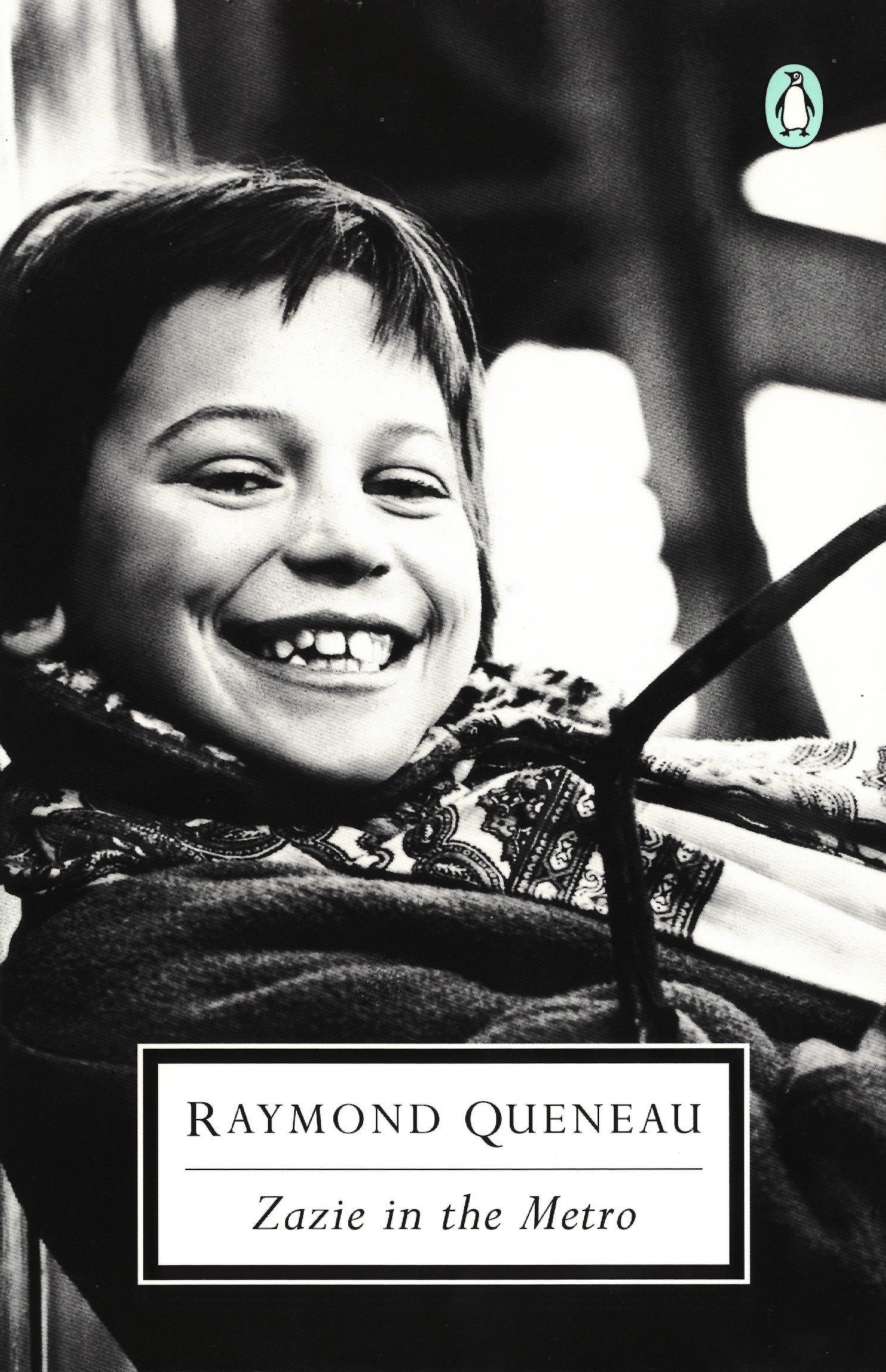
Zazie in the Metro by Raymond Queneau

'Being or nothingness, that is the question. Ascending, descending, coming, going, a man does so much that in the end he disappears. A taxi bears him off, a metro carries him away, the Tower doesn't care, nor the Pantheon. Paris is but a dream, Gabriel is but a reverie (a charming one), Zazie the dream of a reverie (or of a nightmare) and all this story the dream of a dream, the reverie of a reverie, scarcely more than the typewritten delirium of an idiotic novelist (oh! sorry). Over there, farther -- a little farther -- than the Place de Republique, the graves are overflowing with Parisians who were, who ascended and descended the stairs, came and went in the streets, and who did so much that in the end they disappeared. Forceps bore them, a hearse carries them away, and the Tower rusts and the Pantheon cracks a little more rapidly than the bones of the dead who are too much with us to dissolve into the humus of the town impregnated with cares. But I am alive, and there ends my knowledge...'

One fact that will tell you what Raymond Queneau's Zazie in the Metro is like is that Zazie, the foul-mouthed little girl from the French countryside who arrives to spend the weekend with her uncle Gabriel, never rides the Paris Metro. No doubt you will think about Waiting for Godot, another text where the promise of the title never happens; it's merely set over the page like a winking irony. Like Becket, Queneau's characters are all surface. It's hard to recognize any human depth in them, which makes their conversations hard to follow, composed as they are of verbal tics being spooled out again and again. The characters are composed of verbal tics, I mean. They are like the parrot Laverdure, who says only one thing: "Talk, talk, that's all you can do."

French people, the introduction informs me, find Zazie in the Metro enormously funny. There's a recognizably comic plot, that goes something like this: Zazie arrives to visit her uncle with only one desire, to ride the Metro, but there's a strike on. Her uncle tries to give her a tour of Paris, but she eludes his control, skipping off to pester and curse at strangers. Zazie is in turns chased after and spurned by Gabriel, as well as his gentle wife Marceline, his landlord Turandot, Turandot's parrot Laverdure, a disguised cop named Trouscaillon, and several other broad comic figures.

There's something ultramodern about Zazie, something that captures a postwar Paris emerging into a global culture. What Zazie jones for, other than to ride the Metro, is a nice pair of American blue jeans and a Coca-Cola. Her uncle Gabriel and his friend Charles, a taxi-driver, try to show Zazie the "real" Paris, but prove to know as little as she does: they bicker over whether a certain building is the Place de Republique, or the Gare de Lyon, or the Commercial Court. The only landmark they can really identify is the Eiffel Tower, but standing at the top of it with Zazie, they no longer have any faithful reference point at all.

All of which is underlined when Gabriel is "captured" by a group of tourists who, despite not thinking any French, believe him to be a tour guide; instead of taking Zazie to see the "real" Paris, Gabriel finds himself kidnapped by the group, leading them to sites neither he nor they can recognize. If you're still thinking of Waiting for Godot, you might read Zazie at the Metro as a romp through the postmodern emptiness of words, which fail time and time again to locate the characters in space or in meaning. The blue jeans are real but the Pantheon is just some building.

Zazie is a novel also about modern sex panic. It seems awfully prescient, for example, in the way that Zazie's solo adventures invoke anxieties about sex perverts, anxieties that Zazie herself is more than willing to weaponize when, for example, she wants to duck Trouscaillon. But it's Zazie herself that turns out to be sex-obsessed: an off-hand remark by Trouscaillon pushes her to ask her uncle, again and again over the course of the novel, whether or not he is a "hormosessual." He's not, he insists, but he does make his living by dancing at a nightly drag show. And neither does he consent to tell Zazie what a "hormosessual" is exactly--in another way failing as a guide to his young nice.

What this edition could have really used, I think, is a translator's note. Queneau was famously the linchpin of Oulipo, a group of French writers whose hallmark is wordplay. I'm sure the translations into English here are very clever when you know the original French, but I found myself wondering why I should really be interested in calling the blue jeans "blewgenes" or the Coca-cola "cacocalo." Some layer of meaning--like the blue jeans themselves, for Zazie--kept alluding me. The madcap energy of Zazie's weekend was never enough, for me, to make up that deficit.

Saturday, November 25, 2017

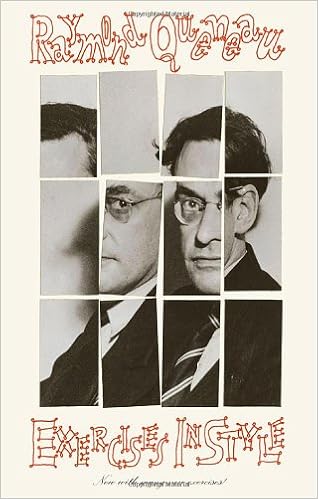
Exercises in Style by Raymond Queneau

In the S bus, in the rush hour.  A chap of about 26, felt hat with a cord instead of a ribbon, neck too long, as if someone's been having a tug-of-war with it.  People getting off.  The chap in question gets annoyed with one of the men standing next to him.  He accuses him of jostling him every time anyone goes past.  A snivelling tone which is meant to be aggressive.  When he sees a vacant seat he throws himself onto it.

Two hours later, I meet him in the Cour de Rome, in front of the gare Saint-Lazare.  He's with a friend who's saying: "You ought to get an extra button put on your overcoat."  He shows him where (at the lapels) and why.

Raymond Queneau's Exercises in Style tells a banal story, and tells it 99 times: a young man gets into an argument on a bus before taking an empty seat.  Later on, the narrator sees the same man having a conversation with another who suggests putting a new button on his overcoat.  It couldn't be anything but banal, really, because the plot, such as it is, isn't the point; it's the endless variation of style that Queneau wants to emphasize, the number of methods without limit of telling the same story.  The first version, above, is titled "Notation," but others tell the same tale with primarily auditory language, or use the metaphors of gastronomy, or in the fashion of a telegram or official letter, or in the voice of another kind of person, or without the letter E, or according to any number of mathematical word-games.

Some stand out, like "Philosophical," which begins, "Great cities alone can provide phenomenological spirituality with the essentialities of temporal and improbabilistic coincidences."  Or "Apostrophe," which begins, "O platinum-nibbled stylograph, let thy smooth and rapid course trace on this single-side calendered paper those alphabetic glyphs which shall transmit to men of sparkling spectacles the narcissistic tale of a double encounter of omnibulistic cause."  My plan is to use it in my Creative Writing classes to help students look past the particulars of what happens and to think about their own style and tone.  I think a few Queneau-style exercises could go a long way in getting them to reflect on that.

One of the biggest impressions this edition gives is just how difficult this book must have been to translate from Queneau's French.  Translator Barbara Wright has a loose hand--she'd have to--going so far as to change the voice-exercise "Vulgaire" to the English "Cockney," and changing an English-dialect impression chapter to one called " For ze Frrensh."  It also has a number of new homages from writers like Harry Mathews, Ben Marcus, and Jonathan Lethem; my favorite is a send-up of Beat novels by the writer Frederic Tuten:

Whee!  Whee!  The bus curled up to the curb with a mad tragic kind of speech and me and jenny Lou get on behind a guy sporting a baggy blue suit and a blue hat with a hemp band and I can see right away he's not hip but a square fidgeting every time someone jostles him and squirming when more people crowd into the bus but me and Jenny Lou dig being packed in with all the maids and busboys and car wash kids all the the holy ones who work in the dark obsidian laundries and then someone steps on this guy's foot and he lets out a howl like a naked coyote who's seen the invisible night and finally I say to him be cool man and dig the scene dig all the angels here dig the holy chicks and dig the whole ride because the ride is life...

Yeesh.