Showing posts with label French. Show all posts

Tuesday, March 2, 2021

A Coin in Nine Hands by Marguerite Yourcenar

Well before Giulio, men had appropriated the labor of bees to offer the results to the gods; century after century, they had surrounded their holy relics with an honor guard of tiny flames, as they projected on their gods their own instinctive fear of the dark. Giulio's ancestors had needed rest, health, money, love: these unknown people had offered candles to the Virgin Mary in the same way that their ancestors, buried even deeper in the accumulations of time, had offered honey cakes to Venus' hot mouth. These flickerings had been consumed infinitely faster than brief human lives: some wishes had been denied; others, on the contrary, granted: the unfortunate thing is that, because wishes sometimes come true, the agony of hoping is perpetuated. Then, without asking for it, these people had obtained the only salvation that's certain, the dark gift that obliterates all others.

A single ten-lira coin, on a single day, in Italy in 1933, passes through the hands of nine people: A lovesick divorcee pays a prostitute; the prostitute, recently diagnosed with cancer, gives it to a pharmacist; the aged and weary pharmacist to the candle-seller at the church; the candle-seller uses it to buy hot coals from a woman planning to assassinate Mussolini; the would-be assassin gives it to her fascist ex-husband; her ex-husband buys flowers from an old street vendor; the vendor gives it to a visiting painter she believes to be a beggar; the painter gives it to a radical Russian caught up in the assassination plot; he chucks it into a fountain where it's found, at last, by a drunk.

The coin, which you might expect to have some symbolic quality it never really possesses, is more or less a gimmick that allows Yourcenar to sketch these many characters, their private desires and woes. More ties the characters together, in fact, than the coin itself, which provides a structural pattern rather than a thematic one: when the doctor Alessandro Sarte engages in a tryst with a woman in a dark theater, he cannot know that this is Angiola, the former wife of the divorcee and the sister of the candle-seller Rosalia. (He doesn't even know that Angiola is the same woman appearing on the screen of the movie, thinking only with contempt that she's a woman trying, with desperate makeup, to look like Angiola the actress.) The nine possessors of the coin are intimately connected with each other, but again and again they fail to recognize that connection. Connection, like the passing of the coin, is ephemeral; isolation is eternal.

Among other things, A Coin in Nine Hands is an effective snapshot of life in fascist Italy. The center of the novel--literally and metaphorically--is Marcella, the woman who has vowed to shoot Mussolini. The novel sketches both radicals and reactionaries, and both are haunted by the absence of a reformer named Carlo Stevo who is said to be near death on the prison island of Lipari. Marcella, a kind of lover-admirer of Stevo, knows that her attempt on Mussolini's life will mean the end of her own no matter what happens; there's something poignant in the way that the absent Stevo seems to loom larger in everyone's lives than the real people to and from whom the coin passes. I thought the most compelling sketch, though, was that of Mother Dida, the ordinary flower-vendor, who illustrates the way fascism is perpetuated. Politics pass only glancingly through the thoughts of Dida, who mulls over her failed marriages and estranged children, but who has convictions, both vague and strong, about Mussolini's reclamation of national strength.

The ten-cent lira is used to buy lots of things: sex, candles, flowers, coals, booze. At its end the novel feels curiously meager, as if nothing has really been purchased or obtained for all the coin's movement. Surely this is by design; a book of sketches like these is, at the end, a book of sketches, and though the lives of these nine figures overlap tightly the many lines between them create an emptiness, a loneliness, in them like the hole in the middle of a cat's cradle.

Saturday, November 25, 2017

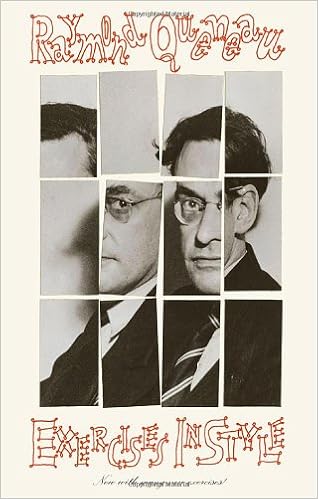
Exercises in Style by Raymond Queneau

In the S bus, in the rush hour.  A chap of about 26, felt hat with a cord instead of a ribbon, neck too long, as if someone's been having a tug-of-war with it.  People getting off.  The chap in question gets annoyed with one of the men standing next to him.  He accuses him of jostling him every time anyone goes past.  A snivelling tone which is meant to be aggressive.  When he sees a vacant seat he throws himself onto it.

Two hours later, I meet him in the Cour de Rome, in front of the gare Saint-Lazare.  He's with a friend who's saying: "You ought to get an extra button put on your overcoat."  He shows him where (at the lapels) and why.

Raymond Queneau's Exercises in Style tells a banal story, and tells it 99 times: a young man gets into an argument on a bus before taking an empty seat.  Later on, the narrator sees the same man having a conversation with another who suggests putting a new button on his overcoat.  It couldn't be anything but banal, really, because the plot, such as it is, isn't the point; it's the endless variation of style that Queneau wants to emphasize, the number of methods without limit of telling the same story.  The first version, above, is titled "Notation," but others tell the same tale with primarily auditory language, or use the metaphors of gastronomy, or in the fashion of a telegram or official letter, or in the voice of another kind of person, or without the letter E, or according to any number of mathematical word-games.

Some stand out, like "Philosophical," which begins, "Great cities alone can provide phenomenological spirituality with the essentialities of temporal and improbabilistic coincidences."  Or "Apostrophe," which begins, "O platinum-nibbled stylograph, let thy smooth and rapid course trace on this single-side calendered paper those alphabetic glyphs which shall transmit to men of sparkling spectacles the narcissistic tale of a double encounter of omnibulistic cause."  My plan is to use it in my Creative Writing classes to help students look past the particulars of what happens and to think about their own style and tone.  I think a few Queneau-style exercises could go a long way in getting them to reflect on that.

One of the biggest impressions this edition gives is just how difficult this book must have been to translate from Queneau's French.  Translator Barbara Wright has a loose hand--she'd have to--going so far as to change the voice-exercise "Vulgaire" to the English "Cockney," and changing an English-dialect impression chapter to one called " For ze Frrensh."  It also has a number of new homages from writers like Harry Mathews, Ben Marcus, and Jonathan Lethem; my favorite is a send-up of Beat novels by the writer Frederic Tuten:

Whee!  Whee!  The bus curled up to the curb with a mad tragic kind of speech and me and jenny Lou get on behind a guy sporting a baggy blue suit and a blue hat with a hemp band and I can see right away he's not hip but a square fidgeting every time someone jostles him and squirming when more people crowd into the bus but me and Jenny Lou dig being packed in with all the maids and busboys and car wash kids all the the holy ones who work in the dark obsidian laundries and then someone steps on this guy's foot and he lets out a howl like a naked coyote who's seen the invisible night and finally I say to him be cool man and dig the scene dig all the angels here dig the holy chicks and dig the whole ride because the ride is life...

Yeesh.