Friday, August 19, 2016

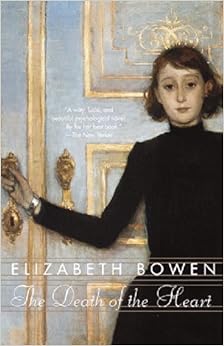
The Death of the Heart by Elizabeth Bowen

She had watched life, since she came to London, with a sort of despair--motivated and busy always, always progressing: even people pausing on bridges seem to pause with a purpose; no bird seemed to pursue a quite aimless flight.  The spring of the works seemed unfound only by her: she could not doubt people knew what they were doing--everywhere she met alert cognisant eyes.  She could not believe there was not a plan of the whole set-up in every head but her own.  Accordingly, so anxious was her research that every look, every movement, every object had a quite political seriousness for her: nothing was not weighed down by significance.

Portia, sixteen, comes from quite a checkered history: Her father impregnated her mother, with whom he was having an affair, and was summarily exiled from what he had considered a happy marriage.  In fact, he always taught Portia that the home which he had to leave was a kind of cozy family paradise.  After her father's death, Portia and her mother live in a series of French hotels for years, until her mother dies, and Portia finds herself returned to that mythic, paradisaical home, to live with her half-brother Thomas and his wife Anna.

This situation, of course, is a recipe for disappointment.  The title says as much: The Death of the Heart is a novel about the disillusionment of young idealism.  Portia takes up with Eddie, a young "bounder" (as the kids say, in 1938) who is tempestuous, selfish, and unreliable.  The adults in Portia's life know that Eddie is no good, but Bowen asks us to find something valuable in Portia's unwavering love for Eddie, which is strong and noble compared to the dissipated, conflicted love that Thomas and Anna have for each other, or their parents did.  The Death of the Heart is a novel about what the reality of the world does to young people; it starts, like an episode of Gossip Girl, when Anna illicitly reads Portia's diary.

A scrap of praise on the back of my copy insists that Bowen is "the link that connects Virginia Woolf with Iris Murdoch and Muriel Spark."  To my disappointment, there's very little of any of those three authors in The Death of the Heart.  It's much closer to those writers who came before Woolf and Modernism, like Henry James and Edith Wharton, whose subject was the human psyche as it appears when filtered through the strictures of social mores.  When Bowen has something profound or incisive to say, she launches into a kind of authorial lecturing:  "We really have no absent friends," she says.  "The friend becomes a traitor by breaking, however unwillingly or sadly, out of our own zone: a hard judgement is passed on him, for all the pleas of the heart."  An insightful thought, but sort of Victorian in its style and certitude.

The Death of the Heart appears on Time's 100 Books of the 20th Century List, which has been a great source of discoveries for me in the past.  Though I enjoyed it, I'm not sure this one quite deserved the honor.

Wednesday, August 17, 2016

The Girl You Left Behind by Jojo Moyes and The Nightingale by Kristin Hannah

Most days now his loss is a part of her, an awkward weight she carries around, invisible to everyone else, subtly altering the way she moves through the day.

Jojo Moyes is a total guilty pleasure (I devoured Me Before You and After You) and The Girl You Left Behind did not disappoint. It's the story of a painting that begins its life in the home of the subject, Sophie, a French woman whose husband (the artist) has gone off to fight in World War One and ends it on the walls of a widow, Liv, in modern day London--a wedding gift from a dead husband. The painting passes through many hands in between, most notably the Kommandant of the German unit stationed in Sophie's town, whom Sophie befriends in an attempt to reconnect with her husband.

The story weaves back and forth between France and London, and while Moyes is known for her steamy romances, it reads more like historical fiction than it does trashy romance novel. One of thing Moyes does well is building ethical dilemmas and guiding her reader through both sides. It's always a little bit more obvious than it needs to be (she doesn't seem to trust her readers to do much inferring on their own), but the issues are always engaging. This novel includes two: Sophie's decision to befriend the German Kommandant in an attempt to gather information on her husband who has disappeared and Liv's quest to keep the painting that was once Sophie's; a firm who specializes in returning art stolen by Nazis to their original families is working to take the painting, Liv's last connection to her dead husband, and return it to a French family who clearly intends to sell it. The debates are not particularly artfully written, but they're thought provoking, and Moyes does a nice job of pacing things out for you--even if she does do all the thinking for you along the way.

Liv's grief is painted well, as is Sophie's despair. The novel does include some romance, but both women have depth and purpose on their own (which I feel like is often missing in portraits of grieving or romancing women).

Overall, The Girl You Left Behind is everything I've come to expect from Jojo Moyes: thoughtful and easy to read, engaging, and a little less fluffy than the others.

How fragile life was, how fragile they were.
Love.It was the beginning and end of everything, the foundation and the ceiling and the air in between. It didn’t matter that she was broken and ugly and sick. He loved her and she loved him, All her life she had waited -longed for - people to love her, but now she saw what she really mattered. She had known love, been blessed by it.
Krsitin Hannah's The Nightingale is another story of love, loss, and war in France. It follows two sisters, Vianne and Isabelle as they take on the German invasion, each in their own way. Vianne is a mother and wife, and her war is a small, private one. She works to protect her daughter, even after her husband leaves for the front and a series of Nazis is billetted in her home. Isabelle, more hardheaded and rebellious is fighting her war on a broader scale. She joins the resistance and becomes "The Nightingale," escorting British and American pilots out of occupied France and to safety.

Hannah's imagining of two female perspectives of war is beautifully written and captures two sides of the feminine experience: one active, one passive. It's not sugar coated; the violence, sacrifice, and fear of both sides are palpable, and the value and challenge of both becomes clear. The historical conflict and the tension between characters (especially between the two sisters) keeps the story from being too saccharine. The relations hips feel real and broken and fraught in ways that make the characters that much more believable (if not more likeable). The only disappointment on that front is Vianne and Isabelle's father, an angry drunk who has a not particularly believable 180 late in the book. I was enjoying his irascible dislikeableness and annoyed that Hannah chose to redeem him.

I loved this book, partly because I'm a sucker for WWII fiction, but partly because it's a beautifully written piece of historical fiction. Also (a small spoiler alert), my cousin was a member of the Resistance in France and died in Ravensbruck, the camp where Vianne ends up, so I especially enjoyed Hannah's recreation of the Resistance structure: their meetings, networks, and systems.


The Ballad of Peckham Rye by Muriel Spark

'I know where you got all these disgusting ideas from.  You got them from Dougal Douglas.  Well, I'm glad he's gone and there won't be him at the wedding to worry about in case he starts showing off the lumps on his head or something.'

'I liked Dougal,' Humphrey said.

Here they were, kneeling at the altar.  The vicar was reading from the prayer book.  Dixie took a lacy handkerchief from her sleeve and gently patted her nose.  Humphrey noticed the whiff of scent which came from the handkerchief.

The vicar said to Humphrey, 'Wilt thou have this woman to be thy wedded wife?'

'No,' Humphrey said, 'to be quite frank I won't.'

They say there's only two stories: a fish out of water and a stranger comes to town.  Muriel Spark's The Ballad of Peckham Rye is a quintessential example of the second type.  It's all about what happens when the hermetic nature of a community is interrupted by an outsider, who, in this case is not only destabilizing, but outright destructive.

The stranger in this case is a Scotsman named Dougal Douglas, who is hired as an "Arts man" (whatever that means) at a textile manufacturer in the working-class London neighborhood of Peckham.  Dougal's task seems to be to improve the lives of the menial laborers at Meadows, Meade & Grimley, a job which he insists will require extensive research into the town, the factory, and its workers, but which consists mostly of not working.  When he does talk to his co-workers about work, it's usually to encourage them to take unasked-for days off.  Otherwise, he spends his time not showing up, befriending the locals, and working a subtle wedge into the many relationships which precede him in Peckham.  He gets a job at a rival company, and doesn't show up to that one, either.  Sometimes, he asks people to feel the lumps on his head, which he insists are the vestiges of two horns, sawed off his head at birth.

It's strange to think of Spark as subtle, but she's remarkably reticent when it comes to the deeper themes of her works.  Like Nabokov, half the time she seems to be playing games with the reader, baiting them into looking for deeper meanings that may not be there at all.  Unlike Nabokov, it's the sparseness of the novels and their bare-bones plots which can make such investigations futile; like looking for messages in spiderwebs.

But if there's something more profound going on in The Ballad of Peckham Rye than the mere joy of destruction, I think it's this: Dougal presents himself as a kind of Satan-figure, and his arrival in town really does end in disaster.  His friend Humphrey, who likes Dougal, answers "no" at the altar when he's about to marry Dixie, who doesn't.  His boss, Mr. Druce, commits a brutal murder out of jealousy toward Dougal.  But Dougal doesn't kill anyone; his worst sins, really, are skipping out on work, encouraging absenteeism, and ardent flirting.  In Dougal, Spark blurs the line between social and moral transgressions.  We laugh at the kind of banal corporate moralizing that we see in modern society all the time--I'm thinking of the boss in Office Space, droning on about cover sheets--but what if professionalism really were a bulwark between good and evil?  Or politeness?

The frightening thing about Dougal is that he seems to revel in the destruction he causes, then skips town.  He's not so different from Spark in that way, who clearly loves to be gruesome and doesn't care to linger on the repercussions.  I'd like to think that Spark, herself a Scottish transplant in London (and who, according to her biography, rather enjoyed stirring up trouble), saw the devilish Dougal as a representation of herself.

Sunday, August 14, 2016

A Severed Head by Iris Murdoch

I felt this: but felt it in the midst of a considerable and more immediate pain at seeing, in the circumstances of a sort of treachery, the well-loved room again.  To lose somebody is to lose not only their person but all those modes and manifestations into which their person has flowed outwards; so that in losing a beloved one may find so many things, pictures, poems, melodies, places lost too: Dante, Avignon, a song of Shakespeare's, the Cornish sea.  The room was Antonia.  It breathed the rich emphasis of her personality... It was a new and fierce pain to look on all this and see it as something mortal, indeed as something already perished, disintegrated, meaningless, and waiting to be taken away.

Martin Lynch-Gibbon has a good life: a wife, Antonia, he adores, and a mistress, Georgie... whom he also adores.  That is, until the day that his wife confesses that she is leaving him for her therapist, a mutual friend named Palmer Anderson.  She encourages Martin to be supportive: after all, they are all three of them friends, and they feel a duty to "look after" him and make sure that he is taken care of.  This development sends Martin into a psychological tailspin; not only robbed of his wife, but unable even to enjoy the cathartic release of anger or resentment.  At the margins of this story are Martin's aloof brother, Alexander, and Palmer's sister, a severe Jewish woman named Honor who encourages Martin to man up and demand that his wife return to him.

A Severed Head is a strange book.  Little happens beside conversation; it's very much in the mode of Edith Wharton or Henry James.  I'm beginning to think that some of the charm of Under the Net was that its protagonist was a middle-class writer, living not in an isolated manor house but a bustling, urban London; the well-to-do characters of this book and The Unicorn have less appeal. 

But it does, in a sense, have some of the wild energy that made Under the Net so good.  The plot really centers on a confusing domino-collapse of shifting allegiances: First, Martin falls in love with Honor, then walks in on Honor and Palmer (brother and sister!) in flagrante delicto.  Georgie accepts Alexander's proposal; Antonia leaves Palmer; Alexander dumps Georgia; Antonia declares that she's in love with Alexander--it's like a strange reality show, but with incest.  Presumably all this adds up to some interesting statement on the psyche, or on psychotherapy, or on human sexuality.  I'm not quite sure.  At the end, it seemed more silly to me than anything.

Saturday, August 13, 2016

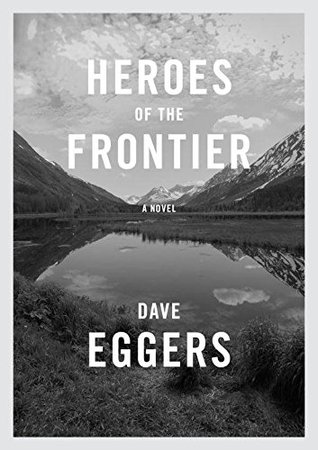
Heroes of the Frontier by Dave Eggers

But then again, this home, this property, was evidence of the glory of the land, this country.  There was so much.  There was so much space, so much land, so much to spare.  It invited the weary and the homeless like herself, her worthy children.  She had the blurry thought that all the world's searching and persecuted could find a home up here.  Alaska's climate was warming, was it not?  It would soon be a forgiving place, with milder winters and uncountable millions of unpopulated acres, and so many empty homes like this, waiting to take in the desperate travelers of the world.  It was a wonderful thought, a numbing notion.

Alaska likes to call itself The Last Frontier.  The idea is that, while every inch of the mainland United States has been domesticated, Alaska remains wild, mostly unpeopled, unseen by human eyes.  That's reflected in the lack of literature about Alaska--its more likely to attract someone like Christopher McCandless, the subject of Into the Wild, than a novelist like Dave Eggers.  It's a place for applied philosophy, not navel-gazing.

Which made it hard to find a book to bring with me on my trip to Alaska two weeks ago.  As I've said on this blog many times, I love reading books that are set in the places where I'm traveling.  But Alaska, though you might expect its distance and its mystery to be inviting subjects, has very few novels.  So when Dave Eggers released his newest novel, Heroes of the Frontier, about a woman from suburban Ohio who escapes to Alaska in an RV with her two children, I did something I never do.  I bought a hardcover book at full price.

The protagonist of Heroes of the Frontier is Josie, a dentist escaping personal and professional tragedy in Ohio.  Her practice has been sued to oblivion by a woman who developed oral cancer, and she has grown to hate the father of her children, an "invertebrate" named Carl.  And--making her decision to run unnecessarily overdetermined--she feels intense guilt over encouraging a young patient to join the military, where he died.

In response, she sets out with her young children, Paul and Ana, to Alaska, where they rent an RV.  They follow, strangely enough, the basic route that my friends and I did: beginning in Anchorage, down the Kenai Peninsula to Seward, then the town of Homer, and finally up, up through the interior toward parts unknown.  And yet I found these places, at least according to my own experience, difficult to recognize in Eggers' novel.  Eggers wants to sell us on the cleansing possibilities of the wilderness, and the idea of frontier, but he has no real feeling for the physical beauty of the Kenai Peninsula, or the staggering visual difference between the mountainous peninsula and the flat, plain-like interior.  Eggers' prose is too domestic, more Ohio than Alaska, too prosaic to match the environment.  Furthermore, he's infinitely more interested in the people Josie and her children come across, even as he claims that the emptiness of the landscape is somehow transformative.

Heroes of the Frontier is in many ways an antiquated kind of book.  It believes uncynically in the possibility of a frontier, and in the Thoreau-like ability of nature to improve us as people.  At the novel's climax, Josie and her children become stranded in a lightning storm on top of a mountain, and find their mettle to survive challenged.  She has an epiphany: instead of escaping to Alaska to find noble, courageous people, she must try to create them in her children.  And despite his attempts to equivocate--the last chapter reads simply, "But then there is tomorrow"--there's no doubt in the sincerity of the faith that Eggers places in the frontier as a place untroubled by commercialism, domestication, and modernity.  It's The Call of the Wild, but for people.

Thursday, August 11, 2016

Chronicle of a Death Foretold by Gabriel Garcia Marquez

They were sitting down to breakfast when they saw Santiago Nasar enter, soaked in blood and carrying the roots of his entrails in his hands.  Poncho Lanao told me: "What I'll never forget was the terrible smell of shit."  But Argenida Lanao, the oldest daughter, said that Santiago Nasar walked with his usual good bearing, measuring his steps well, and that his Saracen face with its dashing ringlets was handsomer than ever.

Gabriel Garcia Marquez' Chronicle of a Death Foretold is sort of like the antithesis of a murder mystery.  When the book opens, the murder hasn't yet happened, but it will, and the perpetrators are already known: Pablo and Pedro Vicario are going to murder Santiago Nasar because of his dalliance with their sister, whose lack of virginity has ruined her wedding night.  It moves forward, not backward, like a mystery, and yet the outcome is never in doubt.

Pablo and Pedro don't want to murder Santiago, in fact, they go about town the morning after the wedding announcing their attentions to anyone who will listen in hopes that someone will stop them.  But a funny thing happens: they say they are going to kill Santiago so much and so often that their insistence takes on the character of fate, and instead of moving to stop the twins, the people of the small Colombian town where they live begin to think of Santiago as already dead.  There's not much magical realism in Chronicle of a Death Foretold--we find out that the knife goes into Santiago several times, coming out clean--but the mechanics of fate here become a kind of magic, cobbled out of the common interactions of human beings.

Are the twins really fated to kill Santiago?  Where does their volition end and destiny take over?  How does the memory of the narrator, trying to piece together the story of Santiago's death many years in the future, act as a kind of fate imposed upon the narrative of history?  Is, perhaps, memory a kind of fate?  These are the questions that make Chronicle, though short, a rich novel.

This is my first Marquez novel.  I never really have felt interested in One Hundred Years of Solitude or Love in the Time of Cholera.  I think magical realism isn't really my thing.  But I did enjoy Chronicle, perhaps because the magical elements are muted, or perhaps because it is difficult to tell, in the brokenness of memory, what is magic and what is not.

Wednesday, July 27, 2016

The Golden Child by Penelope Fitzgerald

'The object of the museum is to acquire and preserve representative specimens, in the interests of the public,' he said.

'You say that,' returned Sir William, with another winning smile, 'and I say balls.  The object of the Museum is to acquire power, not only at the expense of other museums, but absolutely.  The art and treasures of the earth are gathered together so that the curators may crouch over them like the dynasts of old, showing now this, now that, as the fancy strikes them.  Who knows what wealth exists in our own reserves, hidden far more securely than in the tombs of the Garamantes?  There are acres of corridors in this Museum that no foot has ever trod, pigeons nesting in the cornices, wild cats, the descendants of the pets of Victorian curators, breeding unchecked in the basements, exhibits that are only looked at once a year, acquisitions of great value stacked away and forgotten.  The wills of kings and merchant princes, who bequeathed their collections on condition they should always be on show to the public, are disregarded in death, and those sufferers trudging like peasants to the temporary canteen, to be filled with coconut cakes and lift plastic containers to their lips--they pay for all, queue for all, are the excuse for all; I say, poor creatures!'

This is a sad moment for me.  I was blown away by Penelope Fitzgerald's The Blue Flower when I read it in 2012; it was one of those times when you say, "I know I'm going to read everything this person ever wrote."  And now, four years later, I have.  Nothing was ever quite as good as The Blue Flower, which is one of my favorite books ever, but I enjoyed them all immensely.  At least two others, to my mind, are unquestionably great: Innocence and At Freddie's.  I would go so far as to say that Fitzgerald is one of the most underappreciated writers of the 20th century.

The Golden Child is Fitzgerald's first novel.  She was sixty years old (!!!!) when she wrote it.  It bears the hallmarks of Muriel Spark more clearly, I think, than anything else Fitzgerald wrote.  It's a book where Fitzgerald is still finding her voice, but at moments, the Fitzgerald of The Blue Flower shines through quite clearly.

The story is a murder-mystery inspired by the exhibition of King Tut in the 1970's.  (Doesn't that sound awesome?)  A museum, clearly modeled after the British Museum, is exhibiting a set of golden treasures from the made-up civilization of Garamantia.  The heart of the exhibit is the tomb of the Golden Child, a Tut-like mummy in a golden casket who is said, like Tut, to carry a curse.  Waring Smith, a junior-level officer at the museum, is alone in the museum one night when a phantom figure tries to strangle him with the Golden Twine, a relic meant to guide the Golden Child back to the land of the living--but also one that should have crumbled when touched because of its advanced age.  Later, the archaeologist who discovered the treasures, Sir William, is discovered dead, caught between the sliding steel bookcases of the musem library.

The Golden Child fails to offer the kind of highly individuated, interesting characters that make Fitzgerald's other books standouts.  The irreverent Sir William, who openly disdains the exhibition he made possible, comes close, but Waring is archetypically hapless and henpecked.  He's the kind of guy that Martin Freeman would play in a movie, and not much more than that.

It stops short also of developing really interesting observations on the nature of a museum, whose internecine power squabbles mirror the historical clashes the museum seeks to document.  (Sir William's monologue on power above is as close as the novel comes.)  Nor does it really pause to consider the question of what it means to be real or authentic, which are questions of huge import to the exhibition.  But it does capture a kind of lyrical sadness in the image of the British public, waiting in four-hour long queues for an exhibit for reasons that are obscure even to them.  And the middle of the book, in which Waring is sent to Moscow to authenticate a piece of the treasure only to find out that the entire exhibit is a fake and the Russians have managed to gather the real thing, is funny and frenetic in a way that shows just what a gripping author Fitzgerald would become.

Wednesday, July 20, 2016

Nonfiction Animal Books: Soldier Bear, The Elephant Whisperer, The Soul of an Octopus

The Soul of an Octopus by Sy Montgomery

"A giant Pacific octopus - the largest of the world's 250 or so octopus species - can easily overpower a person. Just one of a big male's three-inch-diameter suckers can lift 30 pounds, and a giant Pacific octopus has 1,600 of them. An octopus bite can inject a neurotoxic venom as well as saliva that has the ability to dissolve flesh. Worst of all, an octopus can take the opportunity to escape..." 
The Japanese word for octopus is tako which means the first time I ate octopus I thought I had ordered a taco. Beware of homophones! I didn't know too much about octopuses (or octopods - never octopi) before I read this book. I knew they're really smart and can get into and out of crazy complicated spaces, I knew they have three hearts, I knew they're good at predicting World Cup winners. 300 pages of Montgomery's amazing non-fiction book (written for an adult audience but appropriate and appealing for young adults) and I am now much more knowledgeable and a little obsessed. To be clear, I spent an entire day researching how to have a pet octopus and was a little devastated to discover that the black telescope goldfish I named 'tako' in high school is the closest I will ever have to owning my own tako. 

This book is part non-fiction information about octopods, part philosophical wonderings about consciousness, part memoir about Montgomery's personal life. I find all three of these genre appealing, and I am now completely in love with octopuses, so this will surely be one of my favorite books of the year. 

Montgomery gains access to the behind-the-scenes area of the New England Aquarium, allowing her to meet and befriend the different octopods that call that space their home. I found the information fascinating, but someone who already loves octopuses might find it a bit remedial. She is even allowed to touch the octopuses, and these descriptions were some of my favorite in the book. 
"I stroked [the octopus's] head, her arms, her webbing, absorbed in her presence. She seemed equally attentive to me. Clearly, each of us wanted the other's company, just as human friends are excited to reunite with each other. With each touch and each taste, we seemed to reiterate, almost like a mantra: 'It's you! It's you! It's you!'"
Montgomery includes the other New England Aquarium volunteers and employees in her narrative, and I enjoyed the anecdotes about their personal lives and how they ended up with their arms stuck in a very cold tank letting an octopus use her suckers to taste them. The only part of the book I didn't love was Montgomery getting her SCUBA certification to join research expeditions to study octopuses in the wild. I had already read details about that research in the excellent picture book The Octopus Scientists (also by Montgomery), so that was a little redundant since I read both in the same week. 


Last week I found myself at the Aquarium of the Pacific and I spotted a gorgeous giant Pacific octopus in a tank in front of a line. 'Of course a person would want to wait in line to stare at this majestic creature,' I thought, and dutifully waited in line with all the 10 year olds. I stood off to the side of the tank so the littlies would be able to see and just sighed and marveled at this incredible being. She turned white and striped, changed her texture from smooth to spiky, and her color undulated between bright red and dark red. She moved around her tank, and I watched her for about 15 minutes until she tucked herself into a corner to hide. 

When I finally let my thoughts disentangle from her tentacles, I realized that the line was not for the octopus tank at all, but for a petting tank. The octopus was the opening act, the preshow. I felt miffed on behalf of the cephalopod - no sea star can compete with the soul of an octopus. 


_______________________________________________________________

The Elephant Whisperer by Lawrence Anthony with Graham Spence

"She got straight to the point...would I be interested in adopting a herd of elephants?...
'They must be a big problem. Nobody just gives away elephants.'
'As I said, the matriarch keeps breaking out. Not only does she snap electric wires, she's also learnt how to unlatch gates with her tusks and the owners aren't too keen about jumbos wandering into the guest camps. If you don't take them, they will be shot.'"


Lawrence Anthony, like Sy Montgomery, is not a scientist by trade. He does, however, run a game reserve in Zululand in South Africa (the kind of reserve where you take pictures as souvenirs - not heads). He is a wild animal lover who truly believes that animals should be wild in their natural habitat with as little human interference as possible. When presented with a free herd of 9 elephants that included babies, (well, free except for transportation, adding a giant electric fence around the whole reserve, chopping down all trees near the fence so they can't be used to take down the fence, creating a holding area that is elephant proof and also electrified, getting all these structures approved by the powers that be, and of course, feeding the elephants while they were in their elephant proof holding area which involved Anthony at one side of the area and another ranger at the other side as they alternated distracting the herd and pushing up to 2,000 pounds of alfalfa through the fence - other than that they were totally free!), Anthony couldn't resist saving them from certain deaths.

Incorporating a herd of elephants is very very complicated because elephants are giant and destructive and this particular group was pretty angry at the world. Their first night on the reserve, they break out of their elephant proof holding area, out of the electric reserve fence, and go on the run. Several days of helicopter chases later, they're back on the reserve but even more dangerous because now they know they can escape. Anthony wrestles terribly with how to keep the elephants and keep them safe (as soon as they're outside of the reserve, they're a danger to people and villages, and poachers can legally kill them).
"Then in a flash came the answer. I decided there and then that contrary to all advice, I would go and live with the herd. I knew the experts would throw up their hands in horror as we had been repeatedly instructed that to keep them feral, human contact...must be kept to the barest minimum. But this herd had already had too much human contact of the very worst kind, and their rehabilitation, if such a thing was even possible at all, called for uncommon measures...I would remain outside the [structure], of course, but I would stay with them, feed them, talk to them, but most importantly, be with them day and night."
Here begins the story of the elephant whisperer desperately trying to figure out how to balance saving the herd with keeping them wild. The story of the elephants is the main narrative that runs throughout this thick book, and it is certainly what readers will expect and want, but the subnarratives and anecdotes that don't involve the elephants are just as interesting and entertaining. Cowriter Graham Spence has done an excellent job interweaving stories about running the reserve, anecdotes about funny or dangerous animal encounters, and the politics between the white reserve owner Lawrence Anthony and the Zulu tribes and clans as they attempt to co-create an even larger game reserve that involves lands owned by many different people.

This is one of the few books I've read recently that is not young adult and not for any classes. When I picked it out at the airport, I felt like I was giving myself the gift of a good book, and luckily it lived up to that idea expectation perfectly. I also really really really want to go to the Thula Thula reserve where you can stay for 9 all-inclusive nights for under $2000 USD (airfare not included).

_______________________________________________________________

Soldier Bear by Bibi Dumon Tak illustrated by Philip Hopman

" 'You bad bear, what have you been up to now? And what on earth are all of those things doing on your head? What do you think you are? A clothesline?' The bear put his paws back over his eyes and started rocking slowly backward and forward. The unsuspecting bear had wandered into the women's quarters...'Hello,' [the woman] said to him, in a friendlier voice. 'Aren't you a funny bear!' 'Nice to meet you,' the second soldier said. 'I'm Stanislav, that's Peter, my best friend and the bear's master. And the bear? Well, he's Private Voytek - and it's about tie we started chaining him up.' "


This book tells the true story of Private Voytek, a bear and a member of the 2nd Polish Corps during WWII. A group of Polish soldiers find a boy carrying a baby bear in a sack in Iran. They trade a few things for the bear and find themselves in various hijinks which include the repeated scene of the group of soldiers going to a new place or being under a new command and having to explain, justify, beg, and plead to keep the bear. The soldier's menagerie grows until at one point they are begging an officer to let them take a Voytek, a monkey, a dalmation, a mutt, a parrot, and pigs on a ship as they get transported from the Middle East to Italy. While the story is interesting and provides a good introduction to WWII, the audience is hard to determine.

At one point the Germans invading Russia is described as a conversation:
'We thought you were our friends!' the Russians shouted at the Germans. 'Ha!' the Germans shouted back, 'We're only friends with ourselves.'  
At one point the Germans invading Russia is described as a conversation:
'We thought you were our friends!' the Russians shouted at the Germans. 'Ha!' the Germans shouted back, 'We're only friends with ourselves.'  
Less than a hundred pages later, the Polish soldiers share the traumatic horrible things they've witnessed:
"Do you know what it feels like to see two boys standing there and then getting blown to pieces the next second with bits of them hanging from the trees?" ... Then Peter said, "I saw a boot a while ago and it still had a chunk of someone's leg in it." ... "And do you know what I saw the other day?" Pavel said. "A dead soldier with a cigarette in his mouth. And it was still lit. He was lying on his side, like he was having a nap, but there was a fresh bullet in his head." 
Most of the book seems like it's written for grades 3-6, but that scene (which is definitely the most graphic in the novel) would make me a little uncomfortable sharing it with the younger crowd. Overall, the book was okay or a little less than okay. I know part of my disappointment is because I don't usually read books for this age range (I enjoy picture books and books for grade 6+ but I do not and have never wanted to work with elementary school kids), but I think another part is because I had just read two really great non-fiction books about animals that I was mentally comparing it to. There's no information about bears in general, bear life, or why this bear was so tame when pet bears are generally a really bad idea - we don't even find out what kind of bear it is until the very end. Private Voytek is an interesting anecdote that kept soldiers' morale up in horrific circumstances, but I would have been satisfied with a single podcast or a long news article about him.

Monday, July 18, 2016

Oranges Are Not the Only Fruit by Jeanette Winterson

People have never had a problem disposing of the past when it gets too difficult.  Flesh will burn, photos will burn, and memory, what is that?  The imperfect ramblings of fools who will not need to see the need to forget.  And if we can't dispose of it we can alter it.  The dead don't shout.  There is a certain seductiveness about what is dead.  It will retain all those admirable qualities of life with none of that tiresome messiness associated with live things.  Crap and complaints and the need for affection.  You can auction it, museum it, collect it.  It's much safer to be a collector of curious, because if you are curious, you have to sit and sit and see what happens.  You have to wait on the beach until it gets cold, and you have to invest in a glass-bottomed boat, which is more expensive than a fishing rod, and puts you in the path of the elements.  The curious are always in some danger.  If you are curious you might never come home, like all the men who now live with mermaids at the bottom of the sea.

I am giving up the 11th grade next year and going back to teaching the 10th.  That means goodbye, American Lit, goodbye Invisible Man and The Scarlet Letter and The Great Gatsby.  Our 10th grade curriculum is much more eclectic--I can't say I'm looking forward to re-reading The Odyssey, but it'll be nice to come back to The Metamorphosis again.  We're also probably the only school in the country that teaches Jeanette Winterson's coming-of-age gay novel, Oranges Are Not the Only Fruit.

When I read it last, I dreaded it because I really hated Winterson's novel Sexing the Cherry.  I was surprised to find that Oranges wasn't bad, and on this second reading (really more of a fourth, considering I read it along with two sections of the tenth grade in 2013) I was surprised to find that I genuinely liked it.  Without Sexing the Cherry darkening the corner of my vision, I was able to enjoy the humor that pervades the novel.  Most of it is mildly at the expense of Winterson's Charismatic Pentecostal upbringing:

I felt a bit awkward so I went to the Sunday School Room.  There was some Fuzzy Felt to make Bible scenes with, and I was just beginning to enjoy a rewrite of Daniel in the lions' den when Pastor Finch appeared.  I put my hands into my pockets and looked at the lino.

'Little girl,' he began, then he caught sight of the Fuzzy Felt.

'What's that?'

'Daniel,' I answered.

'But that's not right,' he said, aghast.  'Don't you know that Daniel escaped?  In your picture the lions are swallowing him.'

'I'm sorry,' I replied, putting on my best, blessed face.  'I wanted to do Jonah and the whale, but they don't do whales in Fuzzy Felt.  I'm pretending those lions are whales.'

'You said it was Daniel.'  He was suspicious.

He smiled.  'Let's put it right, shall we?'  And he carefully rearranged the lions in one corner, and in Daniel in the other.  'What about Nebuchadnezzar?  He started to root through the Fuzzy Felt, looking for a king.

'Hopeless,' I thought, Susan Green was sick on the tableau of the three Wise Man at Christmas, and you only get three kings to a box.

I left him to it.  When I came back into the hall somebody asked me if I'd seen Pastor Finch.

'He's in the Sunday School Room playing with the Fuzzy Felt,' I replied.

'Don't be fanciful, Jeanette,' said the voice.

That's funny.  On another level, you might read it as a statement on the restrictiveness of Jeanette's upbringing, and her mother's religion.  And you wouldn't be wrong.  But you might also read it as part of a kunstlerroman, a novel about the development of an artist, and consider the way that Jeanette plays loosely with the structures of Biblical narrative, but doesn't abandon them.

The problem I had teaching this novel, and the problem I anticipate having once again, is that students are happy to sit at the first few levels.  Representation of gay characters is important, and I'm glad we teach this book.  But to some extent, it can be calcifying--instead of encouraging our students to push the limits of their thinking, it can encourage them to confirm the things they already think and believe.  I don't particularly care what my students think about religion.  But I hope that I can get them to see how even the chapters are named after books of the Bible, and that Jeanette uses the religious stories and structures to help understand her life even long after she has been chased out of the church for being gay.  That's what makes Oranges Are Not the Only Fruit so powerfully tragic, but it's difficult to appreciate if you have never felt the need for a religious community in the first place.

Tell the Wolves I'm Home by Carol Rifka Brunt and The Wonder Spot by Melissa Bank


Both Melissa Bank's The Wonder Spot and Carol Rifka Brunt's Tell the Wolves I'm Home are coming of age novels that follow women as they find their place in the world. Bank's novel does so over a 25 year span while Brunt follows her protagonist over the course of a very tumultuous few months, but both women emerge, like all protagonists, as new, more complete humans.

By late August, I’m on my second sublet, and I’ve been working as a copywriter long enough to know I’m not good at it. I seem to be reliving the life I had when I was twenty-two, but I’m about to run twenty-eight, which feels like the opposite of twenty-two.

The Wonder Spot was a fun, quick read. Each chapter puts us inside Sophie Applebaum's head a different stage of her life, starting with a Bat Mitzvah ("When I pulled [my mother's] wrist over to look at her watch and made a face that signified, I'm dying, she posed her mouth in a smile. Then she held my hand as though we were in love") and ending at party in Brooklyn in Sophie's 40s ("I tell him that a party in Brooklyn is a commitment. It takes effort. It's like a wedding: You can't just drop by."). The chapters in between are full of Sophie's attempts to find a man and a job, and packed with a cast of characters befitting a quirky rom com set in New York City.

The book had more of an edge than your average beach read romance; Sophie is smarter, funnier, and more sarcastic than your everyday heroine. Her sense of frustration with the world around her and her observations on life, first as a teenager and later as an adult, are cutting and astute: "Like most adults, my mother seemed to believe that a nearby birth date was kids required for instant friendship. I told her I hoped she got to sit with the other forty-one- and forty-two-year-olds."

There aren't any groundbreaking thoughts or hugely moving moments in the book, but it was just what I needed at the end of the school year when my brain was totally fried. It was smart enough to not feel too much like a guilty pleasure, but easy enough not to take too much work.

It seemed like life was a sort of narrowing tunnel. Right when you were born, the tunnel was huge. You could be anything. Then, like, the absolute second after you were born, the tunnel narrowed down to about half that size. You were a boy, and already it was certain you wouldn't be a mother and it was likely you wouldn't become a manicurist or a kindergarten teacher. Then you started to grow up and everything you did closed the tunnel in some more. You broke your arm climbing a tree and you ruled out being a baseball pitcher. You failed every math test you ever took and you canceled any hope of being a scientist. Like that. On and on through the years until you were stuck. You'd become a baker or a librarian or a bartender. Or an accountant. And there you were. I figured that on the day you died, the tunnel would be so narrow, you'd have squeezed yourself in with so many choices, that you just got squashed.

I love the opening sentences of novels, and for some reason I especially love the first sentences of dark coming of age novels. The opening of Carson McCullers' Member of the Wedding is one of my all time favorites, but the start of Tell the Wolves I'm Home is pretty damn good too: "My sister, Greta, and I were having our portrait painted by our uncle Finn that afternoon because he knew he was dying." From there, Brunt takes us through six months in the life of June Elbus, a delightfully strange and impressively insightful 15 year old. We follow June as she wrestles with the death of her uncle (whom she loved so much she worries that she may have been in love with), her estrangement from her gorgeous, talented sister, and a new taboo friendship with her uncle's lover whom her family blames for her uncle's death. 

June is by far the best part of the novel. She is is sad and lonely and odd--she spends hours wandering through the woods behind her high school pretending to be in the middle ages--and just off enough to make you frustrated with her from time to time and keep things interesting. I usually don't have patience for characters who wallow, but Brunt manages to make June grow just enough through her grief that her process is both believable and heartening. The lessons June learns throughout are tinged with enough sadness that it never feels saccharine or trite.

Often books centered around grieving can stagnate, the primary movement is internal, so there isn't space for too much action elsewhere. Brunt, however, keeps things moving; June builds new relationships, solves mysteries, and works to fit her new sense of the world into her pre-existing sense of her family. The book, like June, is constantly moving forward (or trying and sometimes failing to). There isn't just one central problem of grief to be resolved, but many interconnected problems; you care enough about June and about everyone else to care how they work out. 

Maybe the most interesting relationship in the book is between June and her overachieving sister, Greta. Greta comes across as truly horrid at the start. In one opening scene, she threatens to make June kiss their uncle (who has AIDS and whom June secretly may have feelings for) by dangling mistletoe above them, and she continues to terrorize June about her feelings for their uncle, even after his death. Then, as the story progresses, we see flashes of humanity and weakness from her, and June is left to reconcile her childhood memories of their close, loving relationship with the mess they have now. Greta is a little bit of a caricature of the hyper successful older sister, but the interactions between them feel real and genuinely painful. It also doesn't come to a neat, perfect conclusion, which I appreciate. 

I couldn't put this one down. It's sad and riveting and full of characters that are satisfyingly imperfect. The realizations June comes to feel real and relatable, and they give you hope for yourself, no matter how screwed up you feel at the time.