Sunday, July 4, 2010

The Invisible Gorilla by Christopher Chabris and Daniel Simons

Warning: this book is NOT about tapping into superhero potential through the use of genetic engineering that has been used to successfully create invisible gorillas.


If you're disappointed, feel free to stop reading now. If that seemed elementary and you're shaking your head... You can still stop. Anyway, the title is actually a reference to the study that was rather cheekily entitled, "Gorillas in Our Midst." If you don't know what I'm referring to and would like to test yourself, check out a version of the experiment and see how you do.

Reading this book was interesting because less than a month ago I also read Malcolm Gladwell's book, Blink, which defends the opposing stance to Chabris and Simons. Since they write partly in response to him, they do actually refer to his works, but it was intriguing since I had no idea what I was getting into in the first place.

The authors are experimental psychologists who have built on the work of Ulric Neisser with regard to change blindness. They took the results of their studies to write, as the subtitle states, about ways that intuitions deceive people. This, in opposition to Gladwell's idea that often a gut reflex is more or equally trustworthy than protracted analysis. But they base their position on the fact that such reflexes rely heavily on certain beliefs about the way that our minds work which may not necessarily be true.

Chabris and Simons deal specifically with six illusions: attention, memory, confidence, potential, cause, and knowledge. They discuss ways that each illusion tricks us into believing ourselves more capable than we are, sometimes with serious consequences as in the case of an overconfident witness in a rape trial.

It's pretty interesting stuff, although I was a bit disheartened to think about all of the ways that I'm tricking myself. There were some pretty keen insights that tried to answer questions I've asked of myself but never quite been able to respond to, and hey, fortunately for me, I am brilliant so obviously none of those illusions apply to me anyway. (This example of the illusion of knowledge/confidence brought to you by the Optimists' Club of America)

Friday, July 2, 2010

Keesha's House / Return of the King / Stop Pretending

Keesha's House - Helen Frost
Written in poetic forms (sonnets and sestinas), Keesha's House takes the reader into the lives and thoughts of hurting teenagers and those around them. This book explores young adults dealing with issues such as teen pregnancy, homelessness, sexual abuse, and neglectful parents. It is the perfect read for any teenager, or adult who works directly with teens.

Return of the King - J. R. R. Tolkien
Last in the Lord of the Rings series, Return of the King ends the epic tale of Frodo Baggins' quest to destroy the Ring of Power. While not a thin book, Tolkien's word choice aids suspense to the tale making it an easier read. (Chris's Review, Jim's Review)

Stop Pretending - Sonya Sones
This autobiographical book conveys the feelings and thoughts of a young girl when her older sister suffers from a nervous breakdown and is placed in an asylum. Each chapter, written in poetic form, is configured as if it were a journal entry. While banned in many schools across the United States, this book is a great tool to help children and young adults learn about mental illness, and help them take a step closer to breaking down the walls of fear. (Brooke's Review)

Wednesday, June 30, 2010

Yeah I'm still alive

Sorry it's been so long since I've updated last. Moved back home at the end of May after finishing up my Peace Corps service so I've been pretty busy with all that. Problem is it's been so long that I've updated that I'm certain I've forgotten a few of the books I've read in the past 2 months or so. Oh well, serves me right.

We The Living by Ayn Rand
I never really set out to read all of Ayn Rand's books, it just sort of worked out that way. We The Living was the last major work by Rand that I hadn't read, which is somewhat ironic considering this was her first novel written in English. Rand is pretty polarizing, some absolutely despise her and some absolutely idolize her. I found both camps pretty annoying, frankly. She's hardly a perfect writer and her philosophy isn't as mindbogglingly brilliant (or mind-numbingly foolish) as so many seem to think. She falls somewhere in the middle. In my case, I like her books for the most part, but I don't love them. That said, We The Living is probably my second favorite Rand novel (after Atlas Shrugged) because I enjoyed the characters, the Soviet Russia setting, and found that Rand's philosophy came through much more clearly than I'd seen in her other efforts. I always understood that Rand thought Communism was wrong in practice, but could never grasp why she was against it in concept until We The Living.

Killing Pablo
by Mark Bowden
I've been on a non-fiction kick for the past few months and Killing Pablo was right in my wheelhouse. It's a well-written account of the hunt for one of history's most notorious outlaws, Pablo Escobar. Not much to say about this one, besides that I enjoyed it. My favorite sections were in the beginning discussing Pablo's exploits and eccentricities. Did you know Pablo Escobar had a gynecologist's chair in his mansion? Look out for the film adaptation coming out starring Christian Bale.

American Sphinx
by Joseph J. Ellis
Thomas Jefferson was one of history's most important Americans for a number of reasons. He penned the Declaration of Independence, served as a foreign ambassador during tumultuous times, was one of the architects of the United States Constitution, and expanded our national borders on a grand scale. However, he's a hard character to get a grasp on due to his remarkable ability to house two completely contradictory mindsets in that noble Virginia brow of his. Ellis (also author of The Founding Brothers which I loved) does an excellent job of tackling one of America's most enigmatic Presidents.

The Firm
by John Grisham
I had no idea that Grisham was popcorn literature. I suppose because he writes about the legal field and such that I expected his stuff to be a little more dense. I was happy to find out he writes the type of book you can read on the beach in an afternoon. I'm going to law school in the fall so I thought I'd give Grisham a try and I wasn't disappointed. He's a little formulaic from what I hear, but I enjoyed The Firm and would recommend it to anyone looking for a fun, quick read. Also: did anyone else who's read this find it hilarious that there was no retribution whatsoever for the whole adultery thing?

Can I Keep My Jersey?
by Paul Shirley
Paul Shirley became an NBA free agent after graduating from Iowa State. This began a short, journeyman career that saw Shirley playing in Los Angeles, Chicago, Spain, Russia, Atlanta, Kansas City, Japan and a few other places. Shirley is obviously a really funny, intelligent guy and it comes through in his writing. If you like sports, definitely check this out. It's sort of like a Ball Four for basketball.

Fool
by Christopher Moore
I've enjoyed a lot of Moore's books (Bloodsucking Fiends, Practical Demon Keeping, and Lamb specifically is one of my all-time favorite novels). Fool was not really up to snuff, as far as I'm concerned. Good, but not up to Moore's calibur. Long story short, Fool is Shakespeare's tragedy King Lear told from the perspective of the fool. It has some good moments and I enjoyed it. But I was a little disappointed because I had high hopes. If you're a Shakespeare fan (Chris) then check this out. You can read it in a couple of days.

Leviathan
by Paul Auster
Chris recommended The New York Trilogy to me a few years ago. I read it but didn't really get into it. For whatever reason I just wasn't really into it. When I came across Leviathan I recognized the author but it wasn't until after I finished it that I realized they were by the same author. I enjoyed Leviathan much more. It's a novel about a writer whose friend has just killed himself and is telling the story of how that came to pass. It's got interesting characters and is well-written overall. I definitely recommend Leviathan to anyone looking for a quick read.

Sunday, June 27, 2010

Dark Lord of Derkholm by Dianna Wynne Jones; Wild at Heart by John Eldredge; Every Young Woman's Battle by Shannon Ethridge

You know that you've picked a winner when you not only know and love a book, but so do your sisters and the owner of the bookshop where you managed to find it for $3. When people ask me for book recommendations, I try to personalize them as much as possible based on personality and expressed preference, but I'll also try surreptitiously to discover whether I can just overwhelm them with teen fantasy recommendations instead. Enter Diana Wynne Jones, whose writing has earned her a permanent "Fantasy Writer of the Month" parking space in my mind.

Dark Lord of Derkholm is the first of two books written about the odd but lovable family headed by the wizard Derk. His family includes a wife, Mara, two natural children, Shona and Blade, and five griffin children, Kit, Callette, Lydda, Don, and Elda. Plus about a million strange animals that he has bred using his ingenuity and wizarding skills. The family must bring all of its unique strengths together to defeat a formidable foe, Mr. Chesney, who is using their world as a sort of off-world tourist playground.

As ever, the story is delightful and filled with all sorts of interesting twists. If it has any flaw, it's that the climax drags on and the transition lines between rising action/climax are thereby blurred, but I enjoyed it enough that this was not a serious concern for me.

Wild at Heart was sitting on my parents' bookshelf, and I'd heard enough about it to be curious. Those opinions tended toward the "fairly solid, occasionally just a bit hokey," and on this side of reading it, I am inclined to agree.

The book is written for men, so I can't speak to the truth of most of it. Basically, Eldredge claims that men are seeking several things in life, but when they fail to act  on the desire to seek, they become either passive or violent. Additionally, their struggle is complicated by wounds that they receive from their relationships with their fathers, and until they dare to face those and resolve them in God, they will be helpless to live fully in the adventure.

It was an interesting read and an enlightening one. Again, I have to take it with a grain of salt, being female and unable to affirm its veracity, but I enjoyed it anyway. Plus, Eldredge talks about life in the context of story (not quite in those words), and I'm always keen on story. I'll probably not be recommending it to all of my male friends, but that's more because the ones who would care to read it have most likely already done so.

Ah, we're back in my territory. Sort of. The original book was written for men, but Every Young Woman's Battle isn't the original restructured a bit for women, so that's not a huge factor even if the authors do reference it occasionally.

In a very broad summary, it's a breakdown of all of the things that young women face personally and relationally, and the authors aim to give some insight into dealing with those life experiences/issues. Honestly, since the age range is probably 10-20 years old, most of it wasn't helpful to me. But I can understand why someone a bit younger might be edified by the book. And why parents might use it as a discussion tool or something along those lines.


And that, friends, is a week in books.

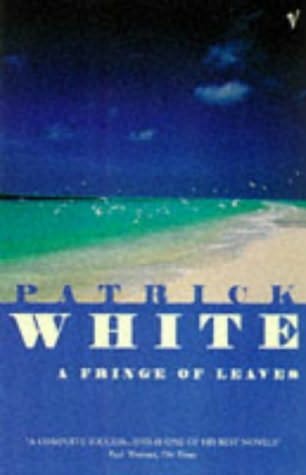
A Fringe of Leaves by Patrick White

Whether today or tomorrow's or yesterday's [march] it was all one by now, a continuous seamless tapestry, its details recurrent and interchangeable. Giant, wooden birds stalked the earth, or paused to consider the similar movements of the apparitions confronting them, or flumped towards safety if some more than usually grotesque gesture destroyed their sense of security.

There was an occasion when she fell down, scattering skywards a cloud of ashen parrots. She would have continued lying on the ground and perhaps become her true self: once the flesh melts, and the skeleton inside it is blessed with its final articulate white, amongst the stones, beneath the hard sky, in this country to which it can at last belong.

But he had got down, and was beating on her skull with his fists. 'Come on, fuck yez!' he was shouting. 'Wotcherthinkwereerefor? To die?'


I admit to picking up A Fringe of Leaves because it seemed similar to Voss, which I adored, and if I liked it less than the latter I blame White only partially, saving some fault for whoever wrote this atrocious dust-jacket synopsis for Penguin:

Returning home to England from Van Diemen's Land, the Bristol Rose is shipwrecked on the Queensland coast and Mrs Roxburgh is taken prisoner by a tribe of Aborigines, along with the rest of the passengers and crew. In the course of her escape, she is torn by conflicting loyalties--to her dead husband, to her rescuer, to her own adoptive class.


The myriad sins of which are, in descending order: 1.) The ship is not called the Bristol Rose, but the Bristol Maid. 2.) Mrs Roxburgh is not taken prisoner "along with the rest of the passengers and crew," because "the rest of the passengers are crew" are killed by the aborigines. 3.) Revealing that her husband dies is a pretty egregious spoiler for the back of the book. 4.) The events described here take place roughly two-thirds of the way through the book, and as such cannot really be considered what the book is about.

Let me try to do better. Yes, Ellen Roxburgh is shipwrecked and taken prisoner by a group of aborigines, but A Fringe of Leaves is one of those books that presents itself as being about one thing and then suddenly, in the middle of the narrative, rips the proverbial rug out from beneath the reader and becomes about something else. I think this particular custom, while rare, needs a name. The only other book I can think of that does this is J. M. Coetzee's Disgrace--Can anyone else think of one?

Rather, the book is about Ellen, who was plucked from the Cornish lower classes by a young, aristocratic lodger named Austin Roxburgh. Austin is in poor health, and they exhibit a kind of co-dependence--Austin has provided a way of escape from the poverty of Ellen's youth, and in return she takes care of him. Yet they seem to truly love each other. Their trip to Van Diemen's Land--what we now call Tasmania--is to visit Austin's brother Garnet Roxburgh, who is his brother's opposite: strong, adventurous, domineering. Ellen dislikes him but, perhaps responding to the restrictive nature of her marriage to Austin, lets Garnet bed her in a moment of weakness, thrown from her horse in the Tasmanian countryside.

The jacket is right, however, when it notes that the book is about "conflicting loyalties." Ellen exists in the overlap between opposite groups--the high class and the low, the "civilized" English and "uncivilized" aborigines. Because she belongs to everywhere she belongs nowhere. She is isolated, a stranger to the blacks and once again to the whites, who view her suspiciously after her escape:

Mrs Roxburgh again received the impression that they visualized her as the naked survivor, who doubtless t he moment before had finished defecating behind a clump of their father's bamboos.

So she smoothed her dress before appealing to them, 'You will breakfast with me, I hope, and give me courage to face the morning.'

It was too strange for them to contemplate for long.


Those described here are children, but as is so often the case, they represent the sentiments of their elders more boldly presented. So the push and pull exhibited on Ellen by the elements of English civilization and the elements of aboriginal civilization mirror the push and pull of Austin's class and her Cornwall origins, and the push and pull of Austin himself and his rakish brother.

It is also a book about responsibility and power--though Ellen is a position of service toward her husband, she, as his keeper, holds a great power over him. (So one might read her giving of herself to Garnet as an expression of her desire to forsake power.) This paradox--the power of the servant--is expressed again when the aborigines try to force her to breastfeed a child who has fallen sick. Again, when she is rescued by an escaped prisoner who has fallen in with the aborigines, she tries to promise a pardon for his help, an offer of life against death, even at her lowest point. That these efforts are fruitless--she is too dry to breastfeed; the frightened convict abandons her as soon as they come to the settlement--force Ellen to come to terms with powerlessness.

White's style is strangely schizophrenic: When among the English, his prose has the sort of intricate formality that the Victorians had, and he saves his most exotic writing for exotic places and situations, like the passage I've copied at the beginning of this post. My biggest complaint about Voss was that it seemed to develop with painful slowness, but that the sections situated in the Outback were well worth the wait. Because of the synopsis on the back, I was expecting the same from A Fringe of Leaves, and so perhaps I didn't give this book the patience that it required. Had I read the excellent assessment by the Complete Review, which begins, "It is misleading to describe this as the story of a shipwreck," I might have liked it quite a bit more.

The Problems of Jurisprudence

Richard Posner solves all our jurisprudential problems!

(Disclaimer = I'm no Posner scholar and it took me so long to read this book that by the time I finished it I had trouble remembering the beginning).

I will try to briefly review this book, given that (as far as I know) there's only one law student reading this blog, and so this book probably has only a passing interest for the other readers. Judge Posner sits on the Seventh Circuit, and is currently most famous for his affiliation with the law and economics movement. He has somewhat controversial views which come as a consequence of applying economic analysis to many legal questions. For those of us who have taken first year contracts his name was thrown around with the idea of an efficient breach of contract (although a breacher would still be liable, Posner believes that if damages are cheaper than performing a contract, we should allow a party to breach a contract and simply pay damages).

In this book Posner sets out to show how every philosophical foundation for law previously argued for is inadequate; in the absence of an adequate foundation, the only thing for a responsible judge to do is to make judgments pragmatically. This is the main thesis of the book (law and economics is brought up as a sub-thesis; but really only tangentially; this book is mostly about pragmatist jurisprudence). His basic method is to take a given explanation of what the law is (let's say originalism), and then point out how that explanation does not fully address the complexity of making legal determinations. For instance, with originalism, Posner points out that all textual analysis is open to indeterminacy. As a result, the idea of a "plain-meaning" of a text (or say, a constitutional clause) is non-existent for a vast array of legal questions.

This method of pragmatism leaves a great deal of discretion to a judge; and Posner is perfectly comfortable leaving open a legislative role for judges. He considers it constrained by the role judges have to play. For example, though Posner is comfortable allowing judge-made law, under his pragmatism a judge must take into account the damage done to the law-making system by judge-made law. Only in cases where judge-made law is less damaging than undermining the legislative branch, would it be okay for a judge to make such a decision. Of course, a judge determines the relative merits of these courses of actions.

Posner's pragmatism goes a long way towards explaining how judicial decision-making is actually made. That is, his work feels like a realist explanation of decision-making. Nonetheless, it feels somewhat vacuous in how little guidance it provides to a judge who is making a decision. I must make the decision which strikes me as most practical. It will seem most practical to me because it is most practical.

How is one to determine what is practical? Posner shies away from providing an answer; it will be up to the individual judge, and this lack of clarity is a necessary condition of the law. Posner does not say this, but it seems that he means this is a necessary condition of the idea of reason. For difficult cases, it is not easy to say what is reasonable and what not. With all things almost equal, there may not be anything to make a decision other than the judge's "gut" feeling about the case. This is not to say Judge Posner advocates haphazard decision-making. On the contrary, he implies that economic analysis is probably the most effective and most correct way to make a legal decision. His argument is that society can agree that economic efficiency is preferable to inefficiency; thus it is at least a reasonable basis for making decisions. He also points out that economically efficient decisions also provide the least incentive for appeals or re-argument or lobbying to change the law. If a decision is inefficient, there will be an incentive to change the decision (whether by legislation or appeal).

Thus, for Posner, there is always a basis to call into question a decision; but the basis will be as flexible as rationality is flexible; insofar as we cannot agree on what's reasonable, we will not agree on what's practical. We need judges to decide what's practical, not because they'll necessarily give the right/best answer; but because we need an answer.

Saturday, June 26, 2010

A Portrait of the Artist as a Young Man by James Joyce

His sins trickled from his lips, one by one, trickled in shameful drops from his soul festering and oozing like a sore, a squalid stream of vice. The last sins oozed forth, sluggish, filthy.

A month or so ago, Randy posted a scathing review of A Portrait of the Artist as a Young Man, and he and I (and Christopher) had a short discussion about it. You can read it in the comments for the post, but it boiled down, I think, to this: Randy felt like nothing that happened in the book was particularly interesting or significant. He felt like the events were interesting only to the extent the reader was invested in the character of Stephen Dedalus, the titular artist. I responded out of ignorance, not having read Portrait, but now, having finished it, I have to say, while I disagree with many of Randy’s conclusions, I do agree with one thing: Stephen is a difficult protagonist to really like.

The extent to which a character must be likable to be successful is variable; Ignatius Riley is an ignoble beast, but since A Confederacy of Dunces spends time pointing out his follies, he’s paradoxically easier to forgive. Stephen, on the other hand, seems to be presented as exactly the artist he believes himself to be. Reading Portrait, it’s difficult to determine the extent to which the reader is meant to like Stephen. On the one hand, it’s easy to cheer for his progression from mousy, guilt-ridden child to independent young artist; on the other, Stephen’s attitude changes from subservient and weak-kneed to almost unbearably arrogant and self-important.

Ok, so a quick summary for those who didn’t read the review linked above: Stephen Dedalus, a young man growing up in Dublin, Ireland around the turn of the 18th century, grows up in a factitious family, headed by a once great father who now lives mostly in a whiskey-clouded past and a mother whose only identifiable characteristic is her passive love for her son. He attends Catholic school, hears a lengthy sermon about Hell, turns devout, gets cold feet when approached with the idea of the priesthood, turns agnostic, seeks to find his purpose in art rather than Catholicism, and finds it. The end.

The novel is structured around two Joycean epiphanies, mentioned above: first, Stephen’s venture into devout Catholicism, and second, his change of direction into the world of art. Portrait seems to present the second of these as the more legitimate, ending with a blissful, purposeful Stephen out to face the world with his newfound philosophy. Is Stephen a successful character? Well, that depends. Had I only read Portrait, I think I would feel that the story was unfinished and that Stephen, as a character, was a bit simple. However, having read Ulysses last year, my feelings about Artist are significantly more positive. Spoilers for Ulysses follow, such as they are.

While Ulysses doesn’t spend most of its time on Stephen, he does appear as the most important secondary character in the novel, and what we see of him shows us where his path will eventually lead. Education and art, far from being the void-filling purpose Stephen believed them to be in Portrait, have proven just as stifling as his pursuit of religion, leaving him a depressed, empty intellectual who garners little respect and still lingers in the shadow of his father. This, to me, seems rather in keeping with Stephen’s character: every epiphany satisfies, but only for a little while. There is, in Joyce’s world, no one solution to the human problem, and so there is none for Stephen’s either. End Ulysses Spoilers.

If I may leave Portrait behind for a moment, I’d like to say that, brilliant as his novels are, Joyce’s books make me feel sad. It’s sad to imagine that such a brilliant man spent his entire life trying to create art that would satisfy him, and, though he went blind and died nearly friendless in the pursuit, he, like Stephen, never achieved it. It’s hard to read Stephen as anything but a surrogate for Joyce, the artist as an old man who ended up exactly like I imagine Stephen will.

So, to return to the point: Is Stephen, and by association, Portrait, successful on its own terms? Stephen, with all of his ambiguities, is successful in portraying the sort of man he is. If the novel seems a bit empty to me, it’s only because, ultimately, it is, but in the best possible—and I think, intentional—way.

Read Nathan's much more coherent review

Friday, June 25, 2010

Game Change: Obama and the Clinton's, McCain and Palin, and the Race of a Lifetime by John Heilemann


After reading this, I've learned something about myself...I love reading about other people's problems, especially famous, super rich people. I lap it up like a dog attached to a soup bone. I don't want to know what that says about me..

Some suspicions that were confirmed by this book:

- Bill Clinton is just as gross as I assumed he was. Smart, but ew. Ew. Eeewwww!

- Hillary swears like a f%$#^&king sailor. You rock,#^^$&#@*&, Hillary! And surprise, surprise, she may actually love her husband! Go figure!

- McCain had an affair in the 90's with someone my age.. oh.my. gosh. Can you imagine? Probably you shouldn't. That gag reflex is a hard one to control.

- Biden didn't get along too well during the campaign. Really?? By the way, where is Joe Biden? Sounds like a book name doesn't it. Has anyone seen Joe Biden on the news lately? What, he fall of the face of the Earth?

- My biggest surprise of the book?? I actually came off feeling slightly bad for Sarah Palin.. Yes, I know, I'm currently clutching my chest and breathing heavily at the thought of it.

Ah, you poor, poor multi-millionaires. Life would be rough without you for entertainment. As for me, I'd rather have my feet scraped than run for office...and I'll mail anyone a pretend dollar if anyone knows what movie that last line is from.
A must read for any political junkie..
4 stars.

Friday, June 18, 2010

The Winter's Tale by William Shakespeare

Exit, pursued by a bear.

While The Winter's Tale hardly does justice to the brilliance of Shakespeare, it still bears the distinction of its playwright. I confess, I am more a fan of the tragedies with their seemingly endless profundities than the comedies which, in their lightheartedness, struck me as being shallow. This particular play combines some of both worlds, with unfortunate events leading to joyful circumstances, all spiced with the usual madcap whirl of disguises, mix-ups, ravishing beauties, lovelorn (and rather silly) boys, whimsical songs, and sadly-the-wiser men.

(Begin spoiling here...)
The plot recalled to mind Sophocles' Oedipus the King, beginning as it does with the tragic blindness and (rather like Chesterton's purely rational madman) small-minded logic of King Leontes of Sicilia. He accuses his pregnant wife Hermione of adultery, the other party being his dear friend King Polixenes of Bohemia. In his rage, he cannot bear even to look at the child when it is born, and condemns it to the Oedipal fate of being cast out in the wilderness to whatever terrors or delights the gods might have for it. Baby Perdita ends up with shepherds (again...), King Leontes' heir dies, and Hermione basically turns into a statue. The oracle at Delphi says Leontes can't expect an heir unless he reclaims his daughter, who has been completely lost. There you have the tragedy.

Comedy turned out to be shades of The Tempest, with lots of disgustingly sweet love language exchanged between Polixenes' son, Florizel (whose name predisposes him to his speech; "flor-" is the Latin root for "flower"), and the shepherdess maiden, Perdita. Of course they're crossed in their love because that makes the plot more interesting, and from that, drama ensues, leading to happily ever after for practically everyone. Not Antigonus though. He got eaten by a bear. But that eventually freed dearest Paulina to marry Camillo, so all's well that ends well.

This play was an interesting stretch for me because I have only ever read one other Shakespeare play without the handy definitions page opposite, but the more I read, the more understandable his English becomes. That's neither here nor there, although I do recommend trying it at least once for the sake of the experience.

In terms of Shakespeare, it's not the first play I would recommend to anyone who hasn't read any of his work. In fact, it's rather far down the list. That being said, it is still miles ahead of the work of most playwrights, so in relative terms, it still ends up near the top. And there's always the satisfaction of knowing that you've read one of his more obscure works, so you can impress people that you meet at dinner parties. If you're the sort of person who goes to those sorts of events and wants to impress that sort of people, of course.

Wednesday, June 16, 2010

The Talented Mr. Ripley by Patricia Highsmith

"Marge, you must understand that I don't love you," Tom said into the mirror in Dickie's voice, with Dickie's higher pitch on the emphasized words, with the little growl in his throat at the end of the phrase that could be pleasant or unpleasant, intimate or cool, according to Dickie's mood. "Marge, stop it!" Tom turned suddenly and made a grab in the air as if he were seizing Marge's throat. He shook her, twisted her, while she sank lower and lower, until at last he left her, limp, on the floor. He was panting. He wiped his forehead the way Dickie did, reached for a handkerchief and, not finding any, got one from Dickie's top drawer, then resumed in front of the mirror. Even his parted lips looked like Dickie's lips when he was out of breath frm swimming, drawn down a little from his lower teeth. "You know why I had to do that " he said, still breathlessly, addressing Marge, though he watched himself in the mirror. "You were interfering between Tom and me--No, not that! But there is a bond between us!"

Warning: Spoilers within.

Tom Ripley's talents are unusual: They involve a little skill at mimicking, an ability to forge signatures, and a keen sense of observation. When The Talented Mr. Ripley opens, they are going to poor use: Tom is living in New York doing tax work, embarrassed by his apartment an his poverty, running a small scam in which he writes to artists charging them for nonexistent back taxes. When the father of a minor acquaintance, Dickie Greenleaf, mistakes him for one of Dickie's close friends and asks him to travel to Italy to beg Dickie to return home, Tom welcomes it as an opportunity to escape the mediocrity of his existence.

But when Tom arrives, he isn't particularly interested in retrieving Dickie. In fact, he becomes enamored of Dickie's lifestyle: his leisure, his jetsetting, his style. He desperately wants to be liked by Dickie, but Dickie is a class-A dick: Selfish, aloof, dismissive of Tom and of his own companion Marge, whose adoration he returns with diffidence. Eventually, Tom, in a moment of severe frustration, decides that he could be a much better Dickie than Dickie himself, and murders him.

This is Tom's M.O.: He despises himself and his own background. It isn't about money; he doesn't even cash the checks that he collects from his tax scheme. It's about stepping out of the cage that is Tom Ripley and entering into the freedom that is Dickie Greenleaf. So easily does Tom do this that he is interviewed twice by the same police officer, once as Dickie, and once as himself, and raises no eyebrows.

A friend of mine likened this book to Dexter, and I think that's especially apt. Not only in the sense that Tom is a murderer, and that we sympathize with him because his victims are especially noxious, but because the thrust of its plot is predicated on the elaborate tricks that Tom has to play to fool Marge, Dickie's father, and the Italian police. His ruse requires another murder and another cover-up, and soon Dickie's disappearance is plastered all over the Italian newspapers. Like the best episodes of Dexter, The Talented Mr. Ripley always asks the question, "How could he possibly get out of this one?"

One thing I especially liked about it is that Highsmith avoids the sort of identity crisis that characterizes a lot of Dexter. Tom feels no guilt about slipping into Dickie's identity, about absconding with his clothes and possessions and becoming him. He challenges us as a character because he is a completely amoral being--unlike Dexter, with his rigid ethical code--and yet we cheer for him, and hate Dickie. Fifty-five years after The Talented Mr. Ripley, in our celebrity obsessed culture, I think it's easy to see why--certainly there are some people out there whose wealth and lifestyle we think we could use a lot better.